“Where’d you steal this car from?”
The officer’s voice was loud, deliberate. He wanted everyone in the parking lot to hear.
“Don’t play dumb with me. Step out. Pop the trunk. I know you people are always hiding something.”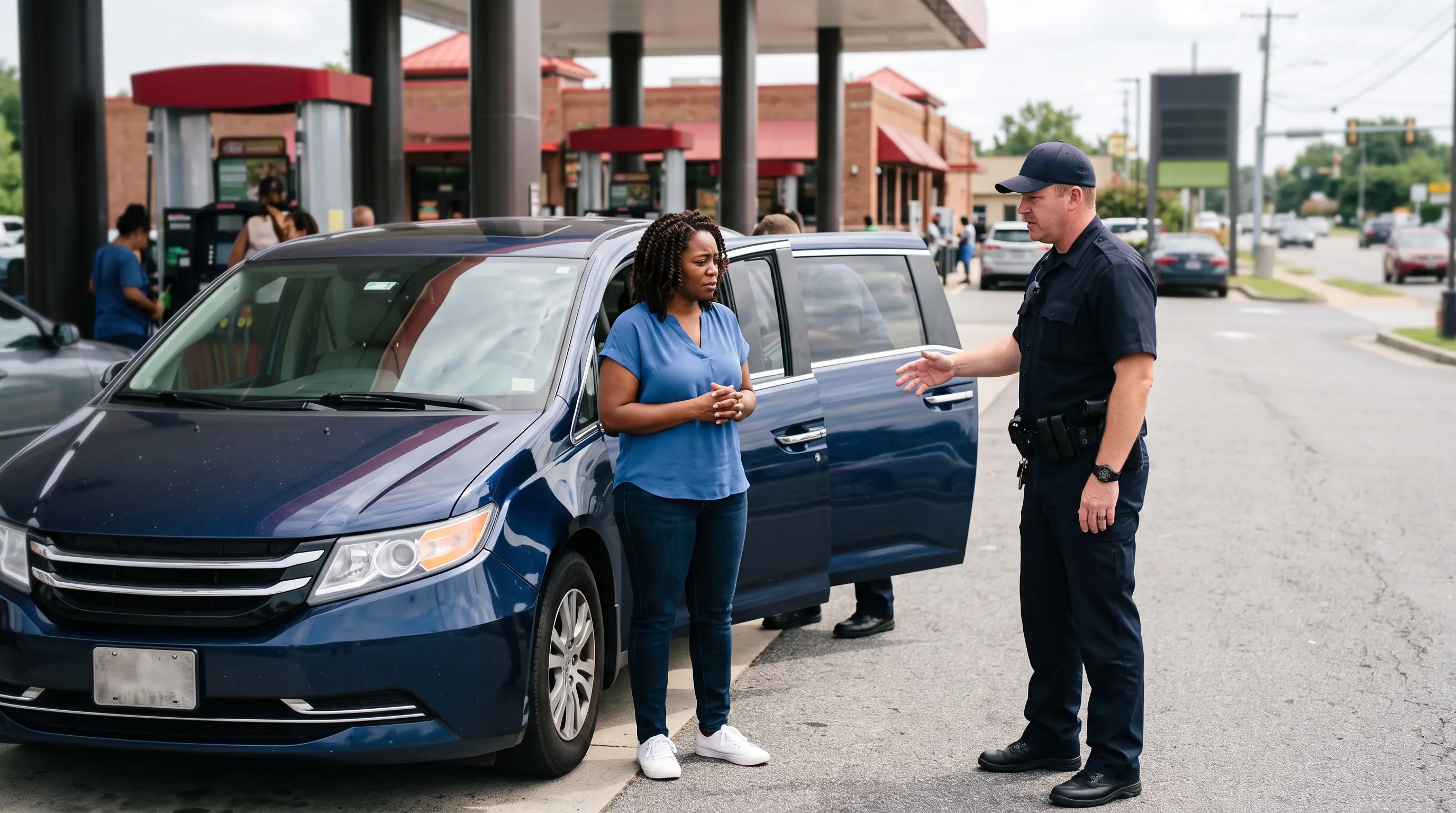
Gloria Sanders kept her hands visible on the steering wheel. Her voice stayed quiet and respectful.
“Officer, I haven’t done anything wrong. Can you please tell me what this is about?”
“I’ll tell you what’s wrong,” he snapped. “You’re in the wrong neighborhood driving the wrong car. Now get out before I drag you out and call CPS on that kid crying in the back.”
Saturday afternoon.
BP gas station.
Richmond, Virginia.
Gloria was buying snacks for her daughter’s soccer practice. The officer saw a Black woman in a clean minivan and decided she needed to be taught a lesson.
He did not know who was watching from the middle row.
By the time this stop ended, his badge would be gone.
Two hours earlier, Gloria Sanders was doing what she did every Saturday, juggling spreadsheets, soccer schedules, and a nine-year-old who could not find her shin guards.
She was an accountant at a midsize firm downtown. Numbers made sense to her. They did not lie. They did not change the rules halfway through.
Today, she was supposed to get Zoe to Riverside Park by 3:00 for soccer practice.
Simple.
Predictable.
Safe.
Her phone buzzed.
A text from Vincent, her husband.
The car won’t start. Can I catch a ride to the gym? I’ll figure out a tow later.
Gloria sighed.
Vincent worked nights. She worked days. They communicated through shared calendars and stolen moments at the breakfast table. This was marriage after fifteen years. Not always romantic, just functional.
She texted back.
Fine, but you’re sitting in the middle. The girls claimed the back.
Vincent Sanders did not look like a police chief right then.
When he climbed into the minivan twenty minutes later, he was wearing gym shorts and a faded college T-shirt. His hair was still damp from a shower after another sleepless night shift.
He had been chief for five months, still learning which fires to fight first, still figuring out who he could trust in a department that had not asked for reform.
He squeezed into the middle row.
The back seats were already occupied. Zoe and her two teammates, Marcus Brown and Lily Moore, were arguing about who played defense better.
“Dad, tell Marcus that girls can totally play defender,” Zoe said.
Vincent grinned.
“Marcus, girls can totally play defender.”
Marcus rolled his eyes.
“That’s not fair. You have to agree with her.”
“That’s called marriage, kid.”
The girls laughed.
Marcus groaned.
Gloria smiled despite herself.
For a moment, everything was normal. A dad going to the gym. A mom driving carpool. Kids arguing about soccer.
This was the life they had built.
Ordinary.
Unremarkable.
Precious.
Vincent’s phone buzzed.
He checked it.
His face changed.
The smile faded.
Gloria knew that look.
“Work?” she asked.
“Always something,” he said quietly.
She did not push.
She had learned early in his career not to ask for details. He told her what he could when he could. She respected the line between Vincent the husband and Vincent the chief.
But she saw the subject line before he closed the email.
Hughes. Complaint number 12.
She had heard that name before.
Officer Clayton Hughes.
Fifteen years on the force.
Vincent had been watching him for months. Quietly, carefully building something.
She did not know what.
She did not ask.
“We need to stop for snacks,” Zoe announced from the back. “Coach said to bring healthy options.”
Gloria glanced at the dashboard clock.
2:45.
They had time.
“BP station on Midlothian,” Vincent suggested.
“Yeah. Quick in and out.”
The minivan hummed down the road, windows cracked, spring air filtering in. Marcus was explaining a drill. Lily was checking her phone. Zoe was retying her cleats for the third time.
Vincent closed his email and tried to relax.
Gloria focused on the road.
She had installed a dash cam six months earlier after her friend Jennifer got pulled over and could not prove the officer was lying about her speed. Jennifer fought the ticket for four months and lost anyway.
Gloria learned the lesson.
Keep receipts.
Document everything.
The camera sat on her windshield now, a silent witness always recording.
She pulled into the BP station on Midlothian Turnpike. It was a busy intersection, historic neighborhood on one side, newer development on the other. The kind of place where old money and new ambition met and did not always shake hands.
She parked near the convenience store entrance.
The kids unbuckled, ready to pile out.
That was when she saw it.
The police cruiser was already there, idling near the air pump.
Officer Clayton Hughes stood beside it, arms crossed, watching her park.
Vincent saw him, too.
His jaw tightened.
He did not say anything.
Not yet.
Gloria turned off the engine. The dash cam kept recording. It always did for ninety seconds after ignition stopped.
The timestamp read 2:47 p.m., Saturday, May 18, 2024.
Hughes approached before she could open her door.
His boots crunched on the asphalt. Deliberate steps. Slow. He was not in a hurry. He wanted her to see him coming.
He tapped on her window hard three times.
Gloria rolled it down.
Her hands stayed visible.
Both on the steering wheel.
She had done this before. Not here. Not with this officer. But she knew the script.
Stay calm.
Stay compliant.
Do not give them a reason.
“Afternoon, ma’am.”
Hughes leaned down. Close. Too close. His breath smelled like coffee and something sour.
“License and registration, please.”
Gloria reached for her purse slowly.
“Officer, can I ask why I’m being stopped?”
“You can ask. Doesn’t mean I’ve got to answer yet.”
He watched her hand move toward the glove compartment.
“Slow. Real slow.”
She handed him both documents. Her license, her registration, her insurance card tucked behind it. Everything was current. Everything was legal.
Hughes studied the license longer than necessary.
His eyes flicked from the photo to her face, then back to the photo.
He was making a show of it.
“This your vehicle, Miss Sanders?”
“Yes, sir.”
“Registered to you?”
“Yes, sir.”
“Where are you headed?”
“Soccer practice. Riverside Park. My daughter and her teammates.”
Hughes glanced into the back seat.
Three kids stared back at him.
Zoe’s eyes were wide and scared. Marcus sat frozen. Lily’s hand gripped her phone.
“Soccer practice,” Hughes repeated flatly, like he did not believe her. “In this neighborhood?”
“The park is ten minutes from here.”
“Uh-huh.”
He walked around the minivan in a slow circle, checking the taillights, the tires, looking for something, anything.
He tapped the rear bumper with his knuckle.
“Registration sticker is about to expire.”
“It’s valid through June, sir.”
“I said it’s about to expire. That’s a warning.”
He came back to her window.
“Step out of the vehicle, please.”
Gloria’s stomach tightened.
“Officer, I don’t understand. Have I violated a traffic law?”
“I’ll determine that. Step out.”
In the middle row, Vincent did not move.
He was watching through the gap between the front seats. His phone was in his hand, recording. The angle captured Hughes’s face, the timestamp, everything.
Gloria opened her door slowly.
She stepped out onto the hot pavement. The sun beat down. Sweat formed at her hairline. She was wearing jeans and a plain blue shirt. Nothing flashy. Nothing threatening.
Just a mother in a parking lot.
“Hands where I can see them,” Hughes said.
She raised them slightly, palms open.
Across the parking lot, Jennifer Wilson was waiting for her daughter’s practice to start. She saw Gloria. Saw the officer. Saw Gloria’s hands raised.
Jennifer pulled out her phone and started recording.
She did not know why yet.
Just instinct.
Something felt wrong.
Tyrone Brown was two cars over, waiting for his son, Marcus. He saw it, too. His phone came out. He angled it toward Hughes and Gloria.
He did not say anything.
He just recorded.
Hughes walked around Gloria slowly, inspecting.
“Are you nervous, Miss Sanders?”
“No, sir.”
“You’re sweating.”
“It’s ninety degrees outside.”
“Uh-huh. Where were you before this?”
“Home. Then I picked up my husband. Then we came here.”
“Your husband?”
Hughes looked at the minivan. He saw a man in the middle row. Gym clothes. No uniform. Civilian.
“He’s in there?”
“Yes, sir.”
“Tell him to step out, too.”
Vincent did not move.
Not yet.
He was still recording, waiting for Hughes to violate procedure clearly enough that it could not be explained away.
Gloria’s voice stayed steady.
“Officer, can you please tell me what this is about?”
“Pop your trunk.”
“I’d like to know why.”
“I smell marijuana. Pop the trunk, or I’ll pop it myself.”
“There’s no marijuana.”
The minivan smelled like soccer gear and old French fries.
Hughes was manufacturing probable cause.
Gloria knew it.
Jennifer and Tyrone knew it.
Vincent knew it.
Zoe started crying in the back seat. Soft at first, then louder.
“Mommy.”
Hughes’s radio crackled. He pulled it to his mouth.
“Dispatch, this is Unit 12. I need backup at the BP on Midlothian. Uncooperative subject. Possible narcotics.”
Gloria’s hands started to shake now.
Not from fear.
From rage she had to swallow.
From humiliation in front of her daughter.
From knowing that eleven women before her had filed complaints about this exact officer, and nothing had happened.
She thought about those eleven women.
She made herself remember this moment. This timestamp. Every word.
2:49 p.m. The officer demands a trunk search. No probable cause. My daughter is crying. Witnesses recording.
Hughes stepped closer. His hand moved toward her arm.
Gloria took a breath.
“Officer, I do not consent to a search. I’d like to know what probable cause you have.”
“You don’t get to ask questions. I ask. You answer.”
Hughes grabbed her wrist.
Not hard enough to bruise.
Hard enough to control.
“Turn around. Hands behind your back.”
“Officer, please. My daughter is watching.”
“Should’ve thought about that before you drove around with drugs in your car.”
“There are no drugs in my car.”
Hughes yanked her arm and spun her toward the minivan.
Her shoulder hit the door frame.
Not violent enough to look like violence from a distance. Rough enough to make it clear who had power there.
Zoe screamed. Not words. Just sound.
Pure terror.
Marcus tried to hold her back. She was reaching for the door handle, trying to get to her mother.
Vincent’s hand was on his own door handle now.
He was counting seconds, waiting for the exact moment when intervention was justified.
Not yet.
Hughes had not crossed the final line yet.
Jennifer Wilson moved closer, phone raised.
“Officer, I’m recording this.”
Hughes did not look at her.
“Ma’am, step back, or I’ll cite you for interference.”
“I’m a citizen observing a public interaction.”
“I said step back.”
Tyrone Brown called out from his car.
“He hasn’t told her what she’s being charged with.”
Hughes ignored him.
He walked around to the back of Gloria’s minivan and tested the trunk.
Locked.
He returned to Gloria.
“Give me your keys.”
“I don’t consent to a search.”
“You got something to hide?”
“I have a constitutional right.”
“Don’t quote the Constitution at me, lady. You think you’re smart because you’ve got a fancy car and a job? You think that makes you special?”
His voice rose loud enough for everyone to hear.
“In this neighborhood, driving around like you own the place.”
Another car pulled into the parking lot.
Amanda Moore.
She was dropping her daughter Lily off for practice, but she saw Gloria against the minivan. Saw the officer’s posture.
Amanda was a lawyer. Family law, not criminal defense. But she knew wrong when she saw it.
She got out of her car and approached.
“Officer, I’m an attorney. Can you explain what violation occurred here?”
Hughes finally turned.
“And you are?”
“Amanda Moore. I’m asking what grounds you have for this stop.”
“This doesn’t concern you, ma’am.”
“It concerns me when I witness a potential Fourth Amendment violation in public.”
“Last warning. Back up now.”
Amanda did not back up.
She stood ten feet away, phone out, recording.
“For the record, I’m witnessing this interaction. The subject has stated she does not consent to a search.”
Hughes’s radio crackled.
“Unit 12, this is dispatch. Backup is en route. ETA three minutes.”
Gloria’s breathing came faster now.
Not panic.
Control.
She was counting in her head.
2:51 p.m. Officer requested backup. Officer grabbed my wrist. Officer demanded keys without a warrant. Daughter is crying. Three witnesses recording.
Backup arrived in two minutes, not three.
A second cruiser pulled in, lights flashing. Officer Travis Bennett stepped out. He was younger than Hughes, twenty-nine, six years on the force.
He looked uncomfortable.
Hughes waved him over.
“Need you to secure the vehicle while I search it.”
Bennett approached Gloria’s minivan.
He saw the kids in the back. Zoe crying. Marcus silent. Lily staring.
His face changed.
Something like guilt.
“Hughes? What’s the stop for?” Bennett asked quietly.
“Probable cause. Smell of marijuana.”
Bennett did not smell marijuana.
Neither did anyone else.
But he did not contradict his senior officer.
That was not how it worked.
That was not how you survived in a department where loyalty mattered more than truth.
Hughes returned to Gloria.
“Last chance. Keys. Or I call a tow truck, and we do this at the impound.”
“You have no legal right.”
“I have every right. You’re operating a vehicle in a suspicious manner in a high-crime area.”
“This isn’t a high-crime area,” Amanda called out. “I’ve lived here twelve years.”
Hughes spun toward her.
“You want to get arrested, too? Keep talking.”
The parking lot had become a theater.
Five adults watching. Three kids trapped inside a minivan. Two officers. One woman standing alone with her hands raised because putting them down might be interpreted as resistance.
Vincent watched Hughes’s hand move toward his belt, toward the handcuffs.
He was done waiting.
Gloria saw her daughter’s face through the window.
Zoe had stopped crying.
She had gone silent.
That was worse.
That was the moment when something breaks inside a child. When trust in authority dies. When the world stops feeling safe.
Gloria thought about the eleven women who had filed complaints. She wondered if their children had watched, too. If their daughters had learned the same lesson Zoe was learning right now.
That compliance did not guarantee safety.
That respectability did not earn respect.
That doing everything right still left you vulnerable to someone who decided you did not belong.
2:53 p.m. Officer preparing to handcuff subject. No charges stated. No explanation.
Hughes pulled the cuffs from his belt.
Metal glinted in the sunlight.
He reached for Gloria’s wrist again.
The back door of the minivan opened.
A man in gym clothes stepped out.
Hughes did not notice at first. He was focused on Gloria, on the cuffs in his hand, on asserting control.
Bennett noticed.
His eyes widened.
His posture changed.
He took a step back.
“Hughes,” Bennett said quietly, urgent. “Hughes.”
Hughes did not hear him.
He was reaching for Gloria’s arm.
The man in gym clothes walked forward.
Three deliberate steps.
His sneakers made no sound on the asphalt, but something about his movement made Jennifer Wilson lower her phone slightly. It made Tyrone Brown hold his breath.
Bennett tried again, louder.
“Hughes, stop.”
Hughes turned, annoyed.
“What?”
He saw the man.
Civilian clothes. No uniform. No threat.
Just some guy who, in Hughes’s mind, should have stayed in the vehicle.
“Sir, get back in the vehicle,” Hughes said.
The man did not respond.
He lifted the hem of his T-shirt just slightly.
Just enough.
A badge caught the sunlight.
Gold.
Unmistakable.
Hughes’s eyes focused on it.
The shape.
The seal.
Richmond Police Department, but not a regular badge.
Different design.
Higher rank.
His gaze moved from the badge to the man’s face.
Recognition spread like cold water through his veins.
Vincent Sanders.
The new chief.
Five months in office.
The reformer.
The one who had been asking questions about complaint procedures.
The one who had requested internal files on problematic officers.
The one Hughes had hoped would stay in his office and leave street cops alone.
Hughes’s face changed color from sun-flushed red to pale gray.
The transformation took three seconds.
His hand, still reaching for Gloria, dropped to his side.
“Chief Sanders.”
His voice cracked.
He cleared his throat and tried again.
“Chief, I didn’t…”
Vincent spoke.
His voice was quiet.
Calm.
Lethal.
“Officer Hughes, step away from my wife.”
Silence.
Complete.
Total.
Even Zoe stopped crying.
The world held its breath.
Hughes stepped back once, then twice. His hands rose slightly. It was an unconscious gesture. Surrender without words.
Bennett’s face had gone white.
He knew what this meant.
He knew he was a witness to his colleague’s career ending.
He took another step back, distancing himself.
Vincent continued walking forward and stopped beside Gloria.
He did not touch her. He did not comfort her.
That was the husband’s instinct, but he was choosing the badge right now.
He needed to be the chief.
“You requested backup for an uncooperative subject,” Vincent said.
Each word was measured and precise.
“What probable cause justified this stop?”
Hughes opened his mouth.
Nothing came out.
His throat had gone dry.
“I asked you a question, officer.”
“Sir, I… the vehicle matched a description.”
“What description?”
“There was a report of…”
“What report? What date and time? What case number?”
Hughes could not answer.
There was no report.
They both knew it.
Vincent’s voice dropped lower.
“You pulled over my wife in front of my daughter. You grabbed her wrist. You demanded a search without consent. You called for backup on a soccer mom buying snacks.”
He paused.
Let it sink in.
“And you did all of this while I sat in that vehicle watching, recording every word, every movement, every violation of procedure.”
Hughes’s hands were shaking now.
Visible tremors.
Jennifer Wilson zoomed in with her phone camera and captured it, the moment a bully realized he had been caught.
Vincent looked at Bennett.
“Officer Bennett, you’re dismissed. Return to your vehicle.”
Bennett did not argue.
He turned, walked, got in his cruiser, and sat there with his hands on the wheel. Not driving away. Not leaving. Just waiting to see how bad this would get.
Vincent turned back to Hughes.
“Monday morning. 8:00 a.m. My office. Bring your union representative. Bring a lawyer. You’ll need both.”
Hughes found his voice.
“Chief, I was just doing my job.”
“Your job?”
Vincent’s tone did not change.
Still quiet.
Still calm.
Somehow that made it worse.
“We’ll discuss what your job is and what it was on Monday at 8:00 a.m.”
He turned to Gloria.
His face softened just slightly.
“Get the kids to practice. I’ll handle this.”
Gloria did not show relief.
She did not cry.
She did not collapse.
She nodded once and got back in the minivan.
Her hands were steady on the wheel now.
Zoe’s voice came from the back, small and confused.
“Daddy, why was he mean to Mommy?”
Vincent did not answer.
He was still watching Hughes.
Monday morning.
8:00 a.m.
Richmond Police Department headquarters.
Officer Clayton Hughes arrived forty-seven minutes early.
He sat in his truck in the parking lot, engine off, hands on the wheel, staring at the building he had walked into for fifteen years.
Today, it looked different.
Hostile.
Like it had already decided he did not belong.
His union representative, Captain Derek Johnson, met him at the entrance.
Johnson was fifty-two, twenty-eight years on the force. He had seen officers survive worse than this. At least that was what he told Hughes.
“Keep your answers short. Don’t volunteer information. We’ve got you.”
Hughes nodded.
But his uniform shirt was already damp with sweat, and it was only sixty-five degrees outside.
They walked through the building.
Other officers saw him.
Some nodded.
Most looked away.
Word traveled fast in a department this size.
Everyone knew about Saturday.
Everyone knew the chief’s wife.
Everyone knew Hughes was finished.
The waiting area outside Vincent’s office had four chairs.
Hughes sat in one.
Johnson sat beside him.
They waited.
Twenty-three minutes.
No one offered coffee. No one made small talk. The secretary typed and did not look up.
At 8:31, the door opened.
“Chief Sanders will see you now.”
Vincent’s office was larger than Hughes expected. Clean desk. American flag in the corner. Framed commendations on the wall.
And one other person.
A woman Hughes did not recognize.
Late thirties. Black. Sharp suit. No smile.
Vincent gestured to two chairs across from his desk.
“Officer Hughes. Captain Johnson. Captain, this is Detective Emma Wright, Internal Affairs.”
Hughes felt his stomach drop.
This was not a conversation.
This was an investigation.
Wright sat beside Vincent. She had a file in front of her.
Thick.
Very thick.
She opened it slowly and deliberately, letting Hughes see the tabs, the pages, the documentation.
Vincent spoke first.
“Officer Hughes, you’re here regarding the incident on May 18 at approximately 1447 hours, BP gas station on Midlothian Turnpike. Do you recall that interaction?”
“Yes, sir.”
“Before we discuss Saturday, Detective Wright needs to provide some context.”
Wright turned pages, found one, and slid it across the desk.
“Officer Hughes, are you familiar with the Internal Affairs complaint process?”
“Yes, ma’am.”
“Are you aware of how many complaints have been filed against you during your tenure?”
Hughes hesitated.
“A few. Standard for street patrol.”
“Eleven,” Wright said.
Flat.
Factual.
“Eleven separate complaints spanning six years, from 2018 to 2024.”
She pulled out more pages, sliding them across one at a time like she was dealing cards.
Each one a separate life.
A separate incident.
“Complaint number one. February 2018. Sherice Williams, thirty-six-year-old high school teacher. You stopped her for a broken taillight, except her taillight wasn’t broken. She complained. Investigation found insufficient evidence. Case closed.”
Hughes said nothing.
“Complaint number three. August 2019. Tamara Johnson, dental hygienist. You detained her for forty-five minutes and called in a K-9 unit because you claimed to smell marijuana. The dog found nothing. She missed her son’s birthday dinner. She complained. Investigation found you followed proper procedure. Case closed.”
Wright’s voice did not change.
No emotion.
Just facts.
“Complaint number seven. March 2022. Angela Martinez, paralegal. You searched her vehicle without consent and found nothing. She complained. You stated she gave verbal consent. No recording. Your word against hers. Case closed.”
She kept going.
Eleven complaints.
Eleven women.
Eleven times the system said insufficient evidence.
Hughes shifted in his chair.
Johnson put a hand on his arm.
Stay quiet.
Wright closed that section of the file and opened another.
“These complaints showed a pattern, so I ran your traffic stop data. Would you like to know what I found?”
She did not wait for an answer.
“From September 2023 to April 2024, eight months, you conducted sixty-three traffic stops. Sixty-three. Do you know what percentage of those stops involved Black or Latina women?”
Silence.
“Eighty-nine percent. Fifty-six stops. Eighty-nine percent. And of those fifty-six stops, how many resulted in citations or arrests?”
More silence.
“Five. Five citations. Fifty-one stops where you detained someone, questioned them, sometimes searched their vehicle, and then let them go. No ticket. No arrest. No explanation.”
Wright pulled out a map and slid it across.
“Here’s where those stops occurred. See these three neighborhoods? Historically Black, working-class. East End, Southside, and the Midlothian corridor. Ninety-four percent of your stops happened in areas that comprise eight percent of your assigned patrol zone.”
Hughes’s jaw tightened.
Johnson leaned forward.
“Detective, correlation isn’t causation. These are high-crime areas.”
“They’re not high-crime areas,” Wright interrupted. “I pulled the data. Violent crime in these neighborhoods is actually below the city average. So why is Officer Hughes stopping nearly twice as many vehicles here compared to his wealthier, whiter patrol zones?”
No answer.
Vincent spoke now.
“Let’s talk about Saturday. Officer Hughes, I watched the interaction. I recorded it. So did three civilian witnesses. Would you like to see your own body cam footage?”
Hughes looked up.
“My body cam?”
“Yes. The one you’re required to activate during all civilian interactions. The one that uploads automatically to cloud storage. The one you can’t delete.”
Wright opened a laptop, turned it toward Hughes, and pressed play.
Audio filled the room.
Hughes’s voice, loud and aggressive.
“Where’d you steal this car from?”
Then Gloria’s response, calm and respectful.
Then Hughes again.
“You people are always hiding something.”
You people.
On camera.
With a timestamp.
Undeniable.
The video played for four minutes and thirty-three seconds.
Every demand.
Every escalation.
Every violation of procedure.
Hughes watched himself grab Gloria’s wrist. Watched himself call for backup with no justification. Watched himself reach for handcuffs.
The video stopped.
The room was quiet.
Vincent closed the laptop.
“Officer Hughes, you violated four separate departmental policies. You conducted a stop without reasonable suspicion. You demanded a search without probable cause. You used physical contact without necessity. And you requested backup under false pretenses.”
Hughes finally spoke.
“Chief, I followed my training.”
“Your training doesn’t include racial profiling.”
“I didn’t…”
“You people,” Vincent said quietly. “That’s what you said. You people. On camera. To my wife. In front of my daughter.”
Johnson tried to intervene.
“Chief Sanders, with respect, this is a single incident taken out of context.”
“Eleven complaints isn’t a single incident. Sixty-three stops isn’t context. This is a pattern.”
Wright opened another section of the file, the thickest one yet.
“Let’s talk about Metro Towing.”
Hughes’s face went gray again.
“In the past three years, you’ve called Metro Towing for forty-seven vehicle impounds. Forty-seven. Do you know who owns Metro Towing?”
Silence.
“Dale Richardson. Your brother-in-law. Married to your sister Diane. And do you know what Metro Towing charges for an impound? Three hundred eighty dollars base fee, plus ninety-five dollars per day storage.”
Wright pulled out bank statements with highlighted entries.
“These are your personal bank records, subpoenaed this morning. Deposits from DJR Consulting. That’s Dale Richardson’s side company. Eight thousand five hundred dollar deposits over three years, always within two weeks of you calling his tow truck. Total, fifty-two thousand dollars.”
The number hung in the air.
Hughes’s hands started shaking.
Visible tremors.
He gripped the armrests of his chair.
Johnson’s face had changed, too.
He had not known about the money.
The union might protect bad cops, but it did not protect criminal enterprise.
“Officer Hughes,” Vincent said, “you’re on administrative leave effective immediately. Turn in your badge, your service weapon, and your department vehicle keys. You’re not to enter any RPD facility without authorization. A formal investigation is underway. You’ll be notified of further proceedings.”
Hughes did not move.
“Your badge, officer.”
Hughes reached to his belt.
His fingers fumbled.
The badge fell and hit the desk.
He tried to pick it up, but dropped it again.
Wright picked it up for him and set it in front of Vincent.
Hughes stood.
His legs were not steady.
Johnson stood with him.
They walked to the door.
Vincent’s voice stopped them.
“Officer Hughes. Twelve complaints now. Twelve women who knew something was wrong. Eleven of them were told the system didn’t care. My wife was number twelve. The difference is this time someone was watching.”
Hughes left.
The door closed behind him.
He walked through the building past officers who did not meet his eyes. Past the duty desk where he used to joke with dispatchers. Past the parking lot where he used to feel safe.
His hands were still shaking when he got to his truck.
By Wednesday, the union would call a press conference.
By Thursday, Gloria’s phone would start ringing.
By Friday, everything would get worse before it got better.
But right then, in that moment, Clayton Hughes knew one thing with absolute certainty.
His career was over.
Wednesday, May 22.
The Richmond Police Benevolent Association held a press conference at 11:00 a.m. on the City Hall steps.
Six reporters showed up.
Captain Derek Johnson stood at the podium.
Union president.
Twenty-eight years on the force.
Dress uniform.
Medals gleaming.
“Officer Clayton Hughes is a decorated veteran with fifteen years of exemplary service,” Johnson began, voice steady and practiced. “He has received multiple commendations. He has served this community with distinction, and now his career is being destroyed because of one incident involving the chief’s family.”
The word family landed heavy.
Intentional.
“We support reform, but we cannot support a process where personal relationships compromise professional objectivity. When an officer’s career hinges on who he unknowingly interacted with, that’s not justice. That’s a dangerous precedent.”
Technically defensible.
Politically strategic.
It reframed everything.
Made it about Vincent’s marriage, not Hughes’s misconduct.
By afternoon, three outlets ran the same angle.
Chief’s wife traffic stop raises ethics questions.
Police union questions impartiality.
Personal or professional? Chief under fire.
Not one mentioned the eleven prior complaints.
Not one talked about the body cam footage.
Not one asked about the fifty-two thousand dollars.
Gloria saw the headlines during lunch, sitting in her car, reading articles that made her the problem.
Her supervisor had called her that morning. Gentle tone. Concerned face.
“Gloria, maybe take some personal time until this blows over. The firm doesn’t want to appear to be taking sides. Political situation.”
That was what they were calling it.
A political situation.
She said she would think about it.
She would not.
Her phone buzzed.
Unknown number.
Your husband set Hughes up. Race baiting won’t save his job.
Delete.
Block.
Another text.
Different number.
11 complaints. Maybe those women should drive better.
Delete.
Block.
You got your chief to railroad a good cop. Hope it was worth it.
She stopped checking.
That evening, Vincent stood in the driveway.
Someone had spray-painted his personal car.
One word.
Red.
Rat.
He filed a report.
He did not expect anything.
The responding officer was polite, professional. But Vincent saw the resentment.
The rank and file closing ranks.
Gloria found him there.
“We can repaint it.”
“It’s not about the paint.”
She knew.
It was the message.
You broke the code.
Vincent turned.
“I can drop this. Desk duty for Hughes. Quiet resolution. No hearing. No media. We could…”
“No.”
“Gloria.”
“No,” she said firmly. “Eleven women before me stayed quiet or got nowhere. If we stop now, what do I tell Zoe? That we only fight when it’s convenient?”
His phone rang.
Unknown number.
He ignored it.
It rang again.
Different number.
He turned it off.
Upstairs, Zoe had not slept through the night since Saturday.
Three nights straight, she woke crying.
Nightmares about the police, about her mother disappearing.
Gloria sat with her until she slept, then lay awake counting hours.
Thursday morning, Gloria’s inbox had forty-seven messages.
Half supportive.
Half vicious.
She stopped reading after ten.
But one email was different.
Subject: I was stopped, too.
Sender: Sherice Williams.
Gloria opened it.
Ms. Sanders,
I saw your name in the news. I filed a complaint against Officer Hughes in 2018. They said there was insufficient evidence.
I had my sixteen-year-old daughter in the car. He searched it anyway. Tore apart her backpack. Found nothing. She cried the whole way home.
I’m a teacher. I teach respect for authority. How do I do that when authority didn’t respect me?
If you’re fighting this, I want to help. I kept records. Photos. Receipts. He thought I’d forget. I didn’t.
Gloria read it three times.
She forwarded it to Detective Wright, then replied to Sherice.
Thank you. You’re not alone. Neither am I.
By Friday, twenty-two more emails arrived.
Different women.
Same story.
Hughes pulled them over. Questioned them. Searched them. Released them with no explanation.
Most never filed complaints.
They did not think anyone would listen.
Now someone might.
Friday evening, Richmond Times reporter Simone Clark published the story.
Suspended Officer’s History: 11 Complaints, All Dismissed.
Someone had leaked the Internal Affairs files.
Wright would not confirm.
She did not deny.
The story included stop data, the map, the percentages, quotes from three complainants, names, Metro Towing, traces of the money.
Suddenly, the narrative shifted.
It was no longer about the chief’s wife getting special treatment.
It was about a system protecting a problem officer for six years while dozens of women suffered silently.
Comments filled up.
More women sharing stories.
Not just Hughes.
Other officers.
Other stops.
Other humiliations.
A pattern emerging.
Gloria sat at her kitchen table that night, Vincent beside her.
Zoe had finally fallen asleep upstairs.
Twenty-three women’s emails were open on her laptop.
Twenty-three voices saying the same thing.
We thought we were alone.
We thought no one would believe us.
We thought complaining would make it worse.
Vincent looked at the screen.
“What do you want to do?”
Gloria thought about Zoe’s nightmare. About the spray paint. About her supervisor’s gentle suggestion to disappear.
Then she thought about Sherice Williams, about a sixteen-year-old girl crying in a car, about eleven complaints dismissed, about fifty-six women stopped for no reason.
“I want to fight,” she said.
Vincent nodded.
“Then we fight.”
But neither of them knew yet how dark it was about to get.
Saturday night, one week after the BP station, Zoe woke up screaming.
Gloria ran to her room and found her daughter sitting up in bed, eyes wide, breath coming in gasps.
“The police are taking you away,” Zoe sobbed. “They’re putting handcuffs on you, and I can’t stop them, and you’re gone.”
Gloria held her.
Rocked her.
“It’s okay. I’m here. I’m right here.”
“But what if they come back?”
What could Gloria say to that?
That it would not happen again?
She could not promise that.
Not honestly.
Not when the system that protected Hughes for six years was still intact.
“Daddy will keep us safe,” Zoe whispered.
Gloria felt something break inside her chest.
Her daughter should not have to rely on her father’s rank for safety.
That was not how it was supposed to work.
She stayed until Zoe fell back asleep, then went downstairs, sat at the kitchen table, and stared at nothing.
Vincent found her there at 2:00 a.m.
“You okay?”
“No.”
He sat.
They did not talk.
What was there to say?
Their daughter was traumatized. Their community was divided. His department resented him. Her job was threatening to push her out.
And they were doing this because it was right.
Because someone had to.
But right did not make it easier.
Monday morning, Zoe went back to school.
Third period lunch.
She sat with her usual friends.
Then Tyler Morrison walked by. His father was a police officer and worked with Hughes.
“My dad says your mom is a liar,” Tyler announced loud enough for three tables to hear. “She got Officer Hughes fired because she doesn’t like cops.”
Zoe’s face went red.
She did not respond.
She did not know how.
Tyler continued.
“My dad says your whole family hates the police. Even your dad. He’s a traitor.”
Zoe’s teacher intervened and sent Tyler to the principal, but the damage was done.
Zoe came home quiet.
Withdrawn.
She would not talk about her day.
That evening, she asked Gloria a question that cut deeper than any spray paint.
“Mommy, do you hate the police?”
Gloria’s throat tightened.
“No, baby. I love your father. I respect people who protect us.”
“Then why did you get Officer Hughes in trouble?”
“He did something wrong. He was mean to me for no reason. That’s different from hating all police.”
Zoe was nine.
Too young to process institutional bias. Too young to understand the difference between criticizing actions and condemning people.
She just knew her world felt dangerous now.
“I wish you didn’t say anything,” Zoe whispered. “Then everything would be normal.”
Gloria went to her bedroom, closed the door, sat on the edge of the bed, and cried.
Not quiet tears.
Full sobs, the kind that leave you empty.
She had brought this into their home.
She could have stayed silent.
Could have driven away from that gas station and absorbed the humiliation like eleven women before her.
Could have protected her daughter from nightmares and schoolyard cruelty.
Her phone rang.
Her mother.
“Baby, I saw the news. Maybe you should let this go. These people have power. They can make your life difficult.”
“They already are, Mama.”
“Then why keep fighting?”
Gloria did not have a good answer.
Just a memory.
Her father, ten years gone now, teaching her at age twelve.
When someone’s wrong, you speak up. Even if your voice shakes. Even if you’re scared. Because silence is consent.
She was scared now.
Her voice was shaking.
But she heard her father’s words.
Tuesday afternoon, Gloria sat in her parked car outside Zoe’s school, crying again, alone.
The lowest she had been since this started.
Her phone buzzed.
An email from Sherice Williams.
Then another from Tamara Johnson.
Then Kenya Anderson.
Then seventeen more women she had never met, sharing stories, offering support, saying the same thing.
Thank you for not staying quiet.
Gloria read every email, wiped her face, and took a breath.
Vincent texted.
You okay?
She replied.
No, but I’m not giving up.
Wednesday night, Gloria wrote an email to Simone Clark at the Richmond Times.
Subject: I want to tell my story.
She hit send before she could change her mind.
By Thursday, the tide began to turn.
Thursday, May 29.
The Richmond Times published Gloria’s interview.
Front page.
Above the fold.
I Was Stopped for Driving While Black. What Happened Next Changed Everything.
The article was long and detailed.
Gloria’s words were unfiltered.
She talked about Zoe’s nightmares, about the spray paint, about her supervisor suggesting she disappear.
But mostly, she talked about the eleven women who came before her.
“This isn’t about my husband’s job. This isn’t a personal vendetta. This is about a pattern. Eleven complaints filed. Eleven times the system said insufficient evidence. I’m complaint number twelve. The only difference? Someone with power was watching. That’s not justice. That’s luck.”
Within forty-eight hours, twenty-three women contacted the newspaper.
Same officer.
Similar stories.
Same outcome.
Dismissed.
Ignored.
Forgotten.
Sherice Williams, forty-two, high school English teacher, stopped in 2018. Her daughter was sixteen at the time. Hughes searched their car for thirty minutes and found nothing. Her daughter missed a college interview. Sherice filed a complaint and got a letter three months later.
Insufficient evidence to support allegations.
Tamara Johnson, thirty-eight, dental hygienist, stopped in 2019. Hughes called a K-9 unit, claimed he smelled marijuana. The dog found nothing. She sat on the curb for forty-five minutes while Hughes went through her trunk. She missed her son’s birthday dinner.
She filed a complaint.
Officer followed proper procedure.
Kenya Anderson, twenty-nine, graduate student pursuing a PhD in molecular biology, stopped in 2023 at 2:00 p.m. on a Tuesday. Stone sober. Hughes made her recite the alphabet backward. Made her walk a straight line. Made her touch her nose with her eyes closed.
Then he let her go.
No ticket.
No apology.
No explanation.
She did not file a complaint.
She thought it would not matter.
She was right.
Until now.
Friday afternoon, Jennifer Wilson created a Change.org petition.
Fire Officer Hughes. Reform stop protocols. Create independent oversight.
She shared it on the Riverside Park Soccer Parents Facebook group.
It spread to other groups.
Other networks.
By Sunday night, 3,200 signatures.
Local.
National.
International.
Monday, June 3.
Bethel A.M.E. Church on Broad Street.
Community meeting.
One hundred fifty people showed up.
Standing room only.
News cameras in the back.
Gloria spoke first.
Calm.
Factual.
The same quiet power she had shown at the gas station.
“I’m not special. I’m lucky. Lucky that my husband had power when I needed it. But justice shouldn’t require luck. It shouldn’t require knowing the right person. It should be automatic for everyone.”
Seventeen women stood up and shared stories publicly for the first time.
Not just about Hughes.
About other officers.
About stops that felt wrong.
About searches that violated rights.
About humiliation in front of children.
The media coverage shifted completely.
This was not the chief’s wife controversy anymore.
This was systemic.
Documented.
Undeniable.
Amanda Moore, the lawyer parent from the BP parking lot, stood.
“I’m offering pro bono legal representation for civil rights claims. Anyone who wants to file suit, I’ll help coordinate.”
Tyrone Brown, Marcus’s father, announced he was organizing a second meeting in a bigger venue.
“We’re done being quiet.”
Council member Lisa Taylor attended, sitting in the back, taking notes.
Tuesday morning, she filed a motion.
The city council would hold a public hearing on police accountability on June 12 at 7:00 p.m., with open testimony followed by a vote on Officer Hughes’s employment and departmental policy reforms.
The motion passed, seven to two.
Twenty-three women.
Three thousand signatures.
One hundred fifty voices in a church.
And finally, a hearing.
The system was being forced to look.
June 8.
Four days before the hearing, Detective Emma Wright received an email at 6:43 a.m.
Sender: Officer Travis Bennett.
Subject: You need to see this.
One attachment.
PDF.
Three pages.
Wright opened it and read the first line.
Her coffee went cold in her hand.
She forwarded it to Vincent immediately and called him thirty seconds later.
“Chief, we need to meet now. Not at the station.”
They met at a diner on the edge of town.
7:15 a.m.
Empty except for two truckers and a waitress who did not care who they were.
Wright slid her laptop across the table.
“Bennett sent this an hour ago. He’s been carrying it for fourteen months. Said he couldn’t sleep anymore.”
Vincent read.
Internal memo dated March 2023.
From Captain Derek Johnson, district supervisor at the time.
Now the union president.
Now the man defending Hughes on television.
To: Hughes, Martinez, Foster, Brooks, Williams, Patterson, Bennett.
Subject: Q2 performance metrics.
Gentlemen,
Our tow contracts are underperforming. Metro Towing needs 45 vehicles per month to justify their city contract. Current numbers are at 28.
We need to improve. Focus enforcement on Midlothian Corridor, Southside, and East End neighborhoods. High vehicle value, low legal pushback from residents. Remember, odor of marijuana remains sufficient probable cause under state law. Use your judgment.
Quota expectations: minimum six stops per week, minimum two tows per month. Failure to meet benchmarks will be reflected in performance reviews.
Vincent read it twice.
Then he looked at Wright.
“This isn’t a rogue officer. This is institutional design.”
“It gets worse,” Wright said.
She opened another file.
“We did forensic extraction on Hughes’s phone. Text messages. He kept everything.”
She scrolled to one.
Hughes to Officer Dale Martinez.
Johnson wants 12 stops this week. Midlothian is easy pickings. Soccer moms don’t lawyer up.
Another.
Hughes to an unknown number.
She complained. Don’t worry. Union will handle it.
The date matched one of the eleven complaints.
Another.
Hughes to Martinez.
New chief is a problem. Asking too many questions. Johnson says keep our heads down.
Another contained explicit biased language. Not subtle. Not deniable.
Wright closed the laptop.
“City controller Angela Davis finished the financial audit yesterday. Metro Towing paid six hundred eighty thousand dollars to the city over three years. Contract revenue. Hughes received fifty-two thousand dollars from Dale Richardson. Three other officers got a combined eighty-seven thousand.”
“And Johnson?” Vincent asked. “He’s clean?”
“His brother owns the storage lot Metro Towing uses. Guess how much rent?”
Vincent waited.
“One hundred twenty thousand over three years, paid by Metro Towing.”
The chain was complete.
Johnson created the pressure.
Officers made the stops.
The tow company got the vehicles.
Money flowed back through family connections.
Everyone profited except the women who got stopped for no reason.
Vincent sat back.
“We’re not firing one cop. We’re dismantling a conspiracy.”
“RICO is possible,” Wright said. “Federal civil rights violations are certain. I already contacted the FBI.”
By noon, the Washington Post had the story.
Virginia Police Department Accused of Quota-Based Towing Scheme Targeting Minority Neighborhoods.
By 3:00 p.m., the ACLU issued a statement calling it a systemic civil rights issue.
By 5:00 p.m., the Department of Justice announced a preliminary inquiry.
By 7:00 p.m., Captain Derek Johnson resigned as union president. He issued a statement through his attorney.
Administrative oversight.
No criminal intent.
Cooperating with the investigation.
No apology.
No acknowledgment.
Just lawyer language and retreat.
Hughes’s attorney called Wright that night.
“My client wishes to discuss cooperation in exchange for reduced charges.”
Translation: Hughes would testify against Johnson to save himself.
The hearing was in four days.
The evidence was overwhelming.
The system could not ignore this anymore.
Twenty-three women.
Three thousand signatures.
One leaked memo.
Justice does not always come fast, but sometimes it comes completely.
June 12.
7:00 p.m.
Richmond City Hall.
Council chambers packed.
Every seat filled. People standing along the walls. Six cameras in the back. All nine council members present.
Council member Lisa Taylor brought the gavel down.
“We’re here to address allegations against Officer Clayton Hughes and vote on departmental reforms. Chief Sanders.”
Vincent stood.
Uniform pressed.
Voice clinical.
He was the chief tonight, not the husband.
“On May 18, Officer Hughes conducted a stop without reasonable suspicion. He demanded a search without probable cause. He used physical contact without justification. He called backup under false pretenses. All documented on body cam, civilian recordings, and my witness testimony.”
A pause.
“This is not isolated. This is a six-year pattern.”
Detective Wright projected the data.
The audience heard her describe it.
Eleven complaints.
Sixty-three stops.
Eighty-nine percent Black or Latina women.
Fifty-two thousand dollars in kickbacks.
“And this memo establishes quotas targeting specific neighborhoods.”
She read it aloud.
Every word.
The chamber went silent.
“Ms. Gloria Sanders wishes to testify,” Taylor announced.
Gloria approached.
Hands steady.
Voice calm.
“I’m an accountant. I work with data. The data says I was stopped for my skin color. But data doesn’t show my daughter crying. Data doesn’t measure her nightmares.”
She looked at each council member.
“Eleven women before me complained. The system said, Not our problem. I’m number twelve. The difference? My husband has power. That’s not justice. That’s luck.”
Her voice hardened.
“Fire Hughes if you want, but if you don’t change the system that protected him, I’ll be back in two years with twenty-three other women.”
Applause erupted.
Taylor brought the gavel down.
“Sherice Williams.”
Sherice stepped forward next.
“I teach respect for authority. How? When authority didn’t respect me?”
Tamara Johnson followed.
“I missed my son’s birthday for a quota.”
Kenya Anderson stood after her.
“Master’s degree. PhD track. Asked to recite the alphabet backward at two in the afternoon while completely sober.”
Hughes’s attorney read his statement.
Hughes was absent.
“Officer Hughes regrets any perception of impropriety. He served fifteen years. He requests the council consider his full record.”
Taylor interrupted.
“His record includes eleven complaints, fifty-two thousand dollars in kickbacks, and texts calling minority women easy targets. What should we consider?”
No response.
Council member Miller tried.
“We can’t destroy a career over one incident.”
“Eleven incidents,” Taylor corrected. “Sixty-three stops. Twenty-three victims. When does pattern become policy?”
Miller went quiet.
Taylor called votes.
“Terminate Officer Hughes’s employment.”
Seven ayes.
Miller and one other dissented.
“Suspend Officers Martinez, Foster, and Williams pending federal investigation.”
Nine ayes.
Unanimous.
“Policy reforms. Mandatory body cams. Quota prohibition. Civilian review board.”
Eight ayes.
Miller voted no.
The gavel fell.
“Officer Clayton Hughes, your employment is terminated effective immediately. This council adopts Ordinance 2024-118.”
Gloria’s face showed no triumph.
Just exhaustion.
Relief.
Outside, Sherice hugged her.
Then Tamara.
Then Kenya.
Then fifteen others.
No celebration.
Just acknowledgment.
They had won.
But it should not have taken a police chief in the back seat for the system to listen.
Six months later, November.
Same BP gas station.
Same pump.
Gloria filled her tank.
Zoe sat in the passenger seat now, ten years old and growing up faster than Gloria wanted.
A patrol car pulled into the lot.
Different officer.
Young.
Professional.
He waved.
“Afternoon, ma’am.”
Then he kept driving.
Zoe watched him go.
“Mommy, was that okay?”
“Yeah, baby. That was just a police officer doing his job.”
Silence.
Then Zoe asked, “Is it safe now?”
Gloria paused.
She could lie.
Make it simple.
But Zoe deserved the truth.
“It’s safer. We made it safer. But we have to keep watching.”
The outcomes were mixed.
Hughes was fired. Criminal charges were pending. Plea deal negotiations dragged on.
Captain Johnson was under FBI investigation and had resigned. His pension was at risk.
Three officers were suspended. Two resigned. One was fighting termination.
Metro Towing lost its city contract. Dale Richardson faced civil suits from twenty-three women.
But the real change was Ordinance 2024-118.
Body cams were mandatory.
Footage had to be public within seventy-two hours.
Quotas were banned.
A civilian review board was established with subpoena power.
Annual bias training was required.
Not perfect.
But better.
Gloria finished pumping and got back in the minivan.
Zoe asked another question.
“Did it help? What you did?”
Gloria thought about the women who had thanked her. About mothers who could drive with less fear. About the officers who now knew someone was watching.
“Yeah,” she said. “It helped.”
She had thought it was just another Saturday.
She was wrong.
But because she refused to stay silent, the next Saturday might actually be just another Saturday for everyone.
The gas station was still there.
The police still patrolled.
But now, so did the cameras.
And the people behind them.