“You really think a fake federal plate makes you untouchable?”
Officer Nicholas Kirby smirked, tapping his heavy flashlight against the tinted glass of the unmarked SUV.
He assumed he was looking at a stolen luxury ride. He thought he was about to ruin a young man’s day and secure an easy arrest that would feed his ego.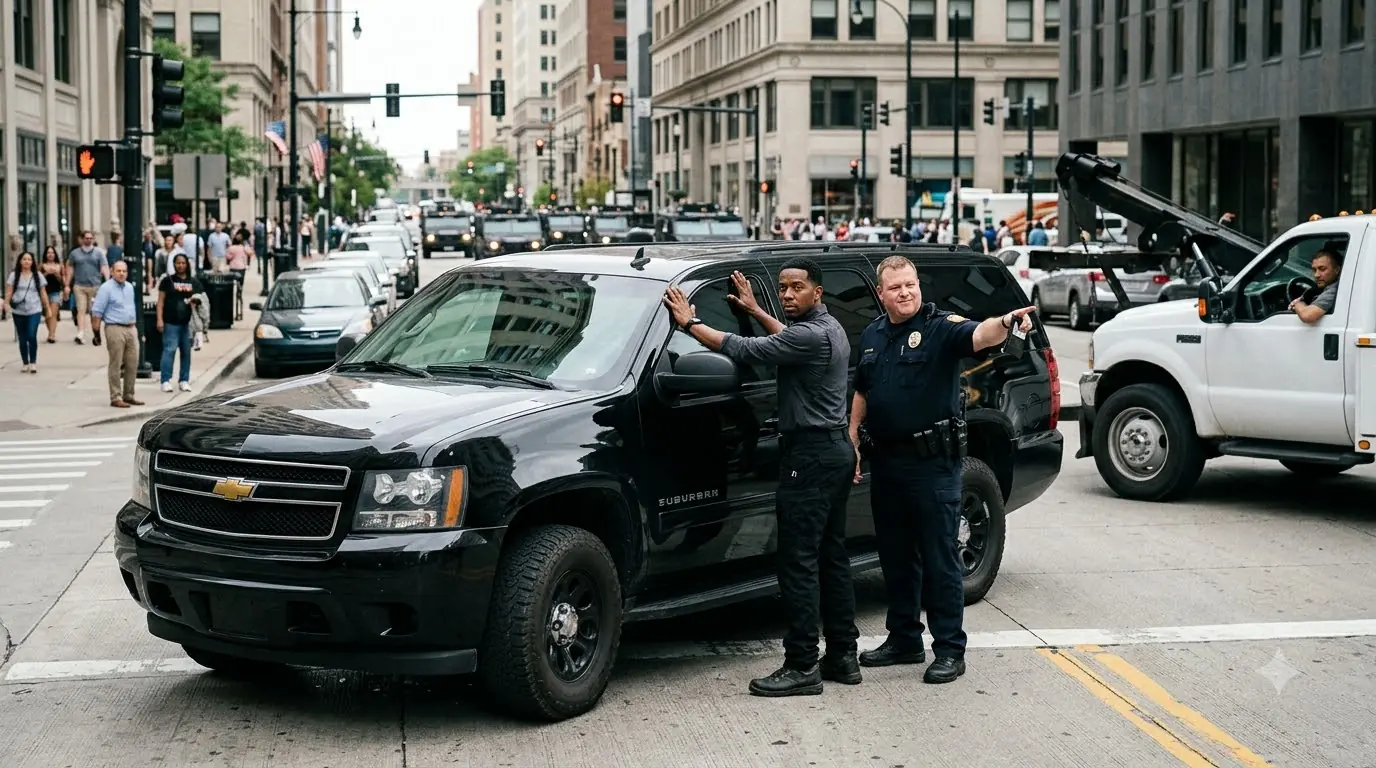
He was spectacularly wrong.
What Kirby did not know was that the vehicle he was kicking was not a normal SUV. It was a classified federal protection vehicle built to withstand threats most local officers would only ever read about in reports.
He did not know the calm man inside, Toby Martin, was an elite operative assigned to a presidential security team.
And he certainly did not know that attempting to tow that vehicle would instantly trigger one of the most serious federal protection alerts in the country and summon a Secret Service response team before Kirby could even understand what he had done.
This is the story of how one arrogant cop tried to impound a secure presidential vehicle and permanently destroyed his own life.
The city did not know it was being watched.
That was the point.
Toby Martin sat perfectly still in the driver’s seat of the unmarked Chevrolet Suburban, his dark eyes moving in slow, methodical sweeps across the intersection ahead.
To anyone passing by on the sidewalk, he looked like a bored driver waiting on someone who was running late. Maybe a private chauffeur. Maybe a ride-share driver killing time between fares.
Nothing worth a second glance.
That was also the point.
What those passing strangers could not see, what they had absolutely no way of knowing, was that the vehicle surrounding Toby was not a normal Suburban at all.
Not really.
The factory body panels had been replaced with classified protective armor. The windows, tinted nearly , were layers of specialized ballistic glass. Beneath the ordinary exterior was a secure communications platform, reinforced engine systems, emergency mobility features, and protective technology designed for the highest levels of federal security work.
The whole machine weighed far more than any civilian SUV and was built for one purpose only, to keep a critical asset moving when everything else went wrong.
It was, in every meaningful sense, a fortress on wheels.
And Toby Martin was its guardian.
He pressed two fingers lightly against the discreet earpiece nestled in his left ear and listened to the steady rhythm of encrypted radio traffic flowing through the secure channel.
Call signs. Time checks. Position confirmations. The language of men and women who operated in the spaces between what the public was ever allowed to know.
He understood every word, every pause, every subtle shift in tone that signaled a change in the operational picture.
“Overwatch Two, confirm your position.”
The voice in his ear was calm, clipped, professional.
“Overwatch Two is static at Checkpoint Delta,” Toby replied, his voice barely above a murmur. “Perimeter is clean. No anomalies.”
“Copy that. Hold your position.”
“Holding.”
He clicked off and returned to his sweep.
Toby had been doing this for six years.
Six years of advance work. Six years of arriving in cities days before anyone else. Six years of sitting in vehicles exactly like this one and watching the world move around him while he remained invisible.
He had held checkpoints in foreign capitals, in hostile territories, and in the middle of American cities that had no idea the most powerful man on the planet was about to pass through their streets.
He had done it in rain, in brutal summer heat, in the dead of winter, and in long, quiet hours when even breathing too loudly felt like a break in discipline.
He was exceptionally good at being invisible.
His background made him that way.
Raised in Baltimore by a single mother who worked double shifts at a hospital laundry, Toby had learned early that the world did not hand you anything. You earned it, or you went without.
He earned a full scholarship to Howard University. He earned his commission through ROTC. He earned his Ranger tab at Fort Benning. Then he earned the attention of a quiet recruiter who approached him after his third combat deployment with an offer most soldiers never received.
The work was classified.
The hours were brutal.
The pay was exceptional.
The mission was singular.
Protect the president of the United States.
He said yes without hesitation.
Now he sat at the corner of Meridian and Fifth, in a loading zone that had been quietly cleared through official channels by people who did not ask unnecessary questions.
The target route was two blocks east. The motorcade would pass nearby soon. His job was simple.
Hold the checkpoint.
Monitor communications.
Remain invisible until the package was clear.
Simple.
Clean.
Routine.
He reached for the stainless steel travel mug in the center console and took a slow sip of coffee, his eyes never leaving the street.
A delivery truck rumbled past. A woman pushed a stroller along the opposite sidewalk. Two teenagers on bikes cut through the intersection without stopping.
Nothing wrong.
Nothing out of place.
Toby set the mug back down and exhaled slowly through his nose.
He just had to hold the position a little longer, and the operation would proceed exactly as planned.
Clean.
Invisible.
Completely beneath the radar of everyone in the city.
He had no way of knowing that a -and-white cruiser had just turned onto Meridian Street.
Everything was about to go sideways.
Officer Nicholas Kirby was the kind of man who had never once questioned whether he deserved the power he carried.
The badge on his chest, the gun on his hip, the cruiser he steered through these streets like a landlord doing rounds on his property, all of it felt natural to him. Earned. Rightful.
He had been on the Meridian Police Department for eleven years, long enough to know every shortcut, every corner store owner who owed him a favor, and every face that, in his opinion, did not quite belong in certain parts of his city.
He had a gift for that last one.
He called it instinct.
He called it experience.
Most people who knew him called it something else entirely.
Kirby was forty-three years old, thick through the middle in the way of a man who had once been athletic and had since stopped trying. But his uniform was always pressed, his boots always shined, because appearances mattered to Kirby.
Appearances were authority.
He had been passed over for sergeant twice in the last four years, a fact that lived in him like a splinter he could not reach, festering quietly beneath everything he did.
His lieutenant did not respect him. His younger colleagues did not fear him the way they once had. The department was changing around him in ways he did not like and could not stop.
But out here on the streets, he was still the one with the badge.
He spotted the Suburban from half a block away.
It was parked in the loading zone on the east side of Meridian. Engine idling. Windows ed out so completely that you could not see so much as a shadow inside.
No commercial markings. No delivery company logo.
Just a big, dark, anonymous vehicle sitting exactly where it had no business sitting, as far as Kirby was concerned.
He slowed the cruiser and leaned forward against the steering wheel, squinting.
The plates caught his eye immediately.
They were not standard state issue. The format was different, federal exemption plates, the kind attached to government vehicles operating under official authority.
Kirby had seen them before. He knew what they were supposed to mean.
He just did not care.
Because what Kirby saw first, before the plates, before the vehicle, was the silhouette visible through the narrow gap where the window tint did not quite reach the mirror housing.
A man sitting in the driver’s seat.
And in the practiced, ugly shorthand that Kirby’s mind had been using for eleven years without ever being challenged on it, a series of assumptions fired in rapid succession.
Each one built on the last.
None of them based on a single fact.
He pulled the cruiser up behind the Suburban and sat for a moment, running the plates out of habit.
The system returned a federal exemption flag almost immediately.
That should have ended the entire encounter before it began.
Kirby stared at the return on his dashboard screen, his jaw tightening.
Federal exemption.
Right.
He had seen people run fake plates before. Stolen vehicles dressed up with fraudulent government markings to avoid scrutiny.
It happened.
And something about this, about the ed-out windows, about the loading zone, about the man sitting alone in a vehicle that Kirby had already decided did not add up, told him this was exactly that kind of situation.
It did not occur to him, not even briefly, that the federal flag had returned so quickly because it was completely legitimate.
It did not occur to him that the vehicle’s registration was protected inside secure federal infrastructure that his department system was barely cleared to acknowledge.
It did not occur to him that the calm, still figure in the driver’s seat carried more federal authority in one credential case than Kirby had accumulated in his entire career.
None of that occurred to him.
What occurred to him was opportunity.
He climbed out of the cruiser, settled his belt with a practiced roll of his hips, and put on the expression he reserved for moments like this.
Chin slightly raised.
Mouth set in a thin, satisfied line.
The look of a man who had already decided how the next ten minutes were going to go.
He unclipped his flashlight as he approached, more for effect than necessity. The afternoon light was still perfectly adequate.
He tapped it hard against the driver’s window.
Three sharp, aggressive knocks.
The kind designed to startle.
The kind that said, I own this moment before a single word had been spoken.
Inside the Suburban, Toby Martin did not flinch.
He simply closed his eyes for exactly one second, the way a man does when he recognizes a problem he was hoping to avoid, and then opened them again.
Here we go.
Toby lowered the window exactly two inches.
No more.
It was a deliberate choice. In his training, they called it controlled engagement. Give the minimum necessary to de-escalate without surrendering the operational posture of the vehicle.
Two inches meant he could communicate.
It did not mean he was inviting a conversation.
It did not mean he was complying with anything.
It was a professional courtesy extended to a man who had not yet earned it, because Toby Martin was disciplined enough to try the easy way first.
“License and registration.”
Kirby did not say good afternoon. He did not say excuse me.
He just planted himself at the window with his flashlight resting against his forearm and his chin tilted up at that particular angle that was meant to remind you who was in charge.
Toby looked at him for a moment without speaking.
Not with hostility.
Not with nerves.
With the flat, measuring patience of a man who had stared down considerably more dangerous things than a small-city cop with an attitude problem, and had learned that the first few seconds of any confrontation told you almost everything you needed to know about the person across from you.
What he saw in Kirby told him plenty.
“I’m going to reach into my left breast pocket,” Toby said, his voice low and even. “I’m going to show you a federal credential. I’d encourage you to look at it carefully.”
Kirby’s eyes narrowed slightly, but he said nothing.
Toby moved slowly and deliberately, the way his training had conditioned him to move in any situation where a nervous hand was hovering near a weapon.
He produced a slim hard-case credential wallet and held it up to the two-inch gap in the window.
The badge inside was not the kind you bought at a costume shop. It was not the kind carried by a city detective or a county sheriff’s deputy.
It was matte with a gold federal seal. Beneath the seal, in clean federal typeface, it identified Toby Martin as a special operations officer assigned to an executive protection division.
The kind of credential that, in the right circles, made rooms go quiet.
Kirby looked at it for approximately two seconds.
Then he made a sound that was almost a laugh, short, dismissive, pushed out through his nose like he was clearing it.
“That supposed to impress me?”
He leaned slightly closer to the window, squinting at the badge with the theatrical skepticism of a man performing confidence for an audience of one.
“I’ve seen better fakes at a Halloween store. You got an actual license and registration, or are we going to keep playing games?”
Toby held the credential steady for another three seconds, giving Kirby every opportunity to reconsider.
Then he lowered it slowly and looked straight ahead through the windshield.
“Officer,” he said.
His voice shifted almost imperceptibly, still calm, still controlled, but carrying something underneath it now, a quiet weight, like the first low pressure change before a serious storm.
“This vehicle is operating under federal authority in support of an active security operation. I am not able to provide you with standard registration documentation because this vehicle does not exist in any database your system has clearance to access.”
Kirby stared at him.
“What I can tell you,” Toby continued, “is that if you contact your department’s federal liaison and run the exemption code on those plates through the proper verification line, you will receive confirmation very quickly. I am asking you professionally to do that before this situation becomes something neither of us wants it to be.”
It was, by any reasonable measure, an extraordinarily generous warning.
Clear.
Specific.
Actionable.
Delivered without a single note of condescension.
Toby had given him the exact steps needed to walk away from this intersection with his dignity and his career fully intact.
Kirby stared at him for a long moment.
Then he straightened up, rolled his shoulders back, and tapped the flashlight twice against the roof of the Suburban with a sharp metallic clang that echoed down the quiet street.
“Step out of the vehicle.”
Toby did not move.
“I’m going to ask you one more time to contact your federal liaison.”
“And I’m going to ask you one more time,” Kirby said, his voice rising just enough to signal that the performance was escalating, “to step out of the vehicle. You’re parked illegally. Your plates don’t check out to my satisfaction, and right now, you’re obstructing a lawful order. So unless that magic badge of yours can fly, I suggest you open this door.”
In his earpiece, Toby heard the calm voice of his operations coordinator.
“Overwatch Two, status check.”
Toby pressed his fingers to the earpiece and said nothing.
He was running out of easy ways through this.
Toby made one final attempt.
He held up a single finger toward the window, a quiet, measured gesture asking for one moment, and keyed his secure channel with the deliberate calm of a man who understood that the next sixty seconds were going to determine the shape of the next several hours.
“Overwatch Two to command. I have a local law enforcement contact at Checkpoint Delta. Situation is escalating. Requesting authorization to disclose operational status to resolve.”
The response came back quickly.
“Negative, Overwatch Two. Disclosure not authorized at your level. Maintain cover. Handle and hold.”
Handle and hold.
In other words, figure it out without blowing the operation.
Do not reveal the president’s movement.
Do not escalate to federal intervention unless absolutely necessary.
Smile.
De-escalate.
Make the problem go away quietly.
Toby exhaled through his nose.
He looked at Kirby, still planted at the window with that flashlight and that expression, and understood with complete clarity that there was no version of this conversation that ended well.
Not because Toby could not handle it.
Because Kirby had already decided how this ended before he ever left his cruiser.
The man was not looking for an explanation. He was not looking for credentials or verification or any piece of information that might complicate the story he had already written in his head.
He was looking for a reason to feel powerful.
He had found one.
Now he was going to ride it all the way to the ground.
Toby opened the door.
He stepped out slowly, both hands visible, movements deliberate and unhurried, exactly the way his training had drilled into him for encounters like this.
He was six-foot-one, lean and composed, dressed in a dark tactical shirt and plain trousers. Nothing about him outwardly marked him as anything other than a man who had just been pulled out of a parked car by a cop with something to prove.
Kirby was on him immediately.
“Hands on the roof. Spread your feet.”
Toby complied without a word, placing both palms flat against the Suburban’s armored roof panel.
He felt Kirby’s hands begin moving across him with the rough, performative aggression of a man who wanted the pat-down to feel like a punishment.
It was not a search.
It was a statement.
Kirby’s hands moved hard across Toby’s shoulders, down his sides, across his lower back, each contact carrying just enough force to be humiliating without quite crossing the line into something that could be easily documented.
Toby stared at the roof panel beneath his hands and breathed.
Kirby found the sidearm immediately, a compact federal-issued weapon holstered at Toby’s hip, and yanked it free with a sharp pull that was entirely unnecessary given that Toby had not moved a muscle.
“Well, well,” Kirby said, holding the weapon up and turning it over like he had just found buried treasure. “Carrying without a visible permit. That’s a problem.”
“That weapon is federally registered and authorized under my operational credentials,” Toby said quietly. “Which you have already seen.”
“What I’ve seen,” Kirby said, “is a man with a fake badge and an unregistered firearm parked illegally in a loading zone.”
He was already reaching for his cuffs.
“You have the right to remain silent. I strongly suggest you use it.”
The cuffs went on tight.
Tighter than necessary.
Toby registered the pressure and filed it away without reacting, because reacting was what Kirby wanted, and Toby Martin had not survived six years of elite federal service by giving people what they wanted at the wrong moment.
He was walked to the back of the cruiser with a hand pressed firmly between his shoulder blades.
The door opened.
His head was guided down with a push that had just enough force behind it to make a point.
The door closed.
The lock engaged.
Toby sat in the cage of the back seat and looked through the scratched partition at the Suburban sitting twenty feet away.
Engine still idling.
Secure communications still running.
The entire operational nervous system of a presidential checkpoint now sitting unattended and exposed on a public street.
Through his earpiece, still active and still feeding, he heard the operations coordinator’s voice.
“Overwatch Two, you’ve missed your last two check-ins. Confirm status.”
He could not respond, not with Kirby three feet away outside the cruiser window, already on his radio, already calling it in to his dispatcher with the satisfied tone of a man who believed he had just made a significant arrest.
Outside, the Suburban sat silent and still.
The checkpoint was unmanned.
Kirby made the call with the casual confidence of a man cashing in a favor he had been saving.
“Hey, it’s Nick. Yeah, got an abandoned vehicle situation on Meridian at Fifth. Need a flatbed. Sooner the better.”
A pause.
A short laugh.
“Nah, nothing complicated. Just some guy who thought a fake federal plate was a get-out-of-jail-free card. Come on down.”
He hung up and leaned against the hood of his cruiser with his arms folded, the picture of a man entirely satisfied with himself.
He glanced back at Toby through the partition glass once, the way you glance at something you have already stopped thinking about, then turned his attention back to the street.
Inside the cruiser, Toby heard every word.
He closed his eyes for exactly two seconds.
Then he opened them and began working through the problem with the systematic calm that his training had built into him like load-bearing architecture.
Emotional response was a luxury he could not afford right now.
What he could afford was clarity.
The tow truck was coming.
The vehicle could not be towed.
Not practically.
Not legally.
And, as Kirby was about to discover, not physically.
But the attempt itself was the problem.
The moment anyone outside the authorized personnel list made forceful physical contact with that vehicle in a way its onboard systems classified as hostile interference, a cascade of automatic security responses would trigger that Toby had absolutely no ability to stop from the back of a police cruiser.
He needed to warn someone.
He shifted carefully against the cuffs, angling his body so that his left shoulder pressed against the seatback. He felt the faint pressure of the secondary communication unit still clipped to his collar, a backup transmitter Kirby had missed entirely during his rough and careless search.
Toby pressed his chin down against his chest, activating the transmit function, and spoke just above a whisper.
“Overwatch Two is compromised. I am in local law enforcement custody at Checkpoint Delta. Civilian tow is inbound to the vehicle. Protective protocols may engage on contact. Requesting immediate command notification.”
He did not know if it went through.
He had to assume it did.
Fourteen minutes later, the tow truck arrived.
It was a heavy-duty flatbed, the kind used for commercial vehicles and larger loads, driven by a heavyset man in a gray work shirt who climbed out chewing something and squinting at the Suburban with the professional assessment of someone who had moved a thousand vehicles and expected this to be no different.
Kirby met him at the front of the truck with a handshake and a nod, the easy body language of two men who had done this before.
“Big one,” the driver said, looking the Suburban over.
“Don’t let it intimidate you,” Kirby said.
The driver shrugged, walked back to his controls, and began positioning the flatbed equipment toward the Suburban’s front undercarriage.
Standard procedure.
Hook the frame.
Engage the lift.
Drag it onto the bed.
Ten minutes, start to finish, on a normal vehicle.
But this was not a normal vehicle.
The equipment made contact with the undercarriage.
What happened next took approximately four seconds.
The Suburban’s onboard threat response system registered unauthorized mechanical interference with the chassis and engaged its emergency immobilization protocol without hesitation.
Every system designed to keep the vehicle from being moved by unauthorized force responded at once.
The tow truck’s equipment seized mid-motion with a violent metallic crack that echoed off the surrounding buildings and made two pedestrians half a block away stop and turn.
Hydraulic fluid spilled across the asphalt. Electrical displays in the tow truck cab went dark. The engine coughed twice and died.
The driver stumbled back from his controls with his hands raised instinctively, staring at his truck with the expression of a man watching something impossible happen in real time.
Kirby came off the hood of his cruiser at the first crack.
He stood now in the middle of the street, looking from the disabled tow truck to the Suburban, which sat completely unmoved, completely undamaged, engine still idling with quiet indifference, as though nothing of any significance had just occurred.
The street was suddenly very quiet.
Kirby’s mouth opened, then closed.
Three blocks away, a secure line was already lighting up inside the federal protective command network.
The alert that entered the federal command center did not behave like a normal call.
It pulsed through secure systems in a way duty officers recognized immediately and responded to with the controlled urgency that came from years of training for exactly this moment.
The alert was severe.
Unauthorized physical interference with a presidential security asset.
Automatic trigger.
No human decision required to initiate it.
No long chain of approval to climb before the protective machinery began moving.
The vehicle’s onboard system had made the determination on its own, reported it directly through secure channels, and the machinery of the most powerful protective apparatus in the country had begun moving before the people on the street understood what had happened.
The watch officer’s voice was flat and precise.
“Confirm security asset interference. Checkpoint Delta. Overwatch Two compromised. Protective response authorized.”
The response from senior command reached the team in under two minutes.
Authorized.
What happened next was not chaos.
That was the thing people who had never seen a federal protection team operate always failed to understand. They imagined sirens and shouting and the frantic scramble of people reacting to a crisis.
What actually happened was the opposite.
It was the terrifying, absolute efficiency of a machine built, tested, and maintained for one singular purpose, now executing that purpose without friction, without hesitation, and without any margin for error.
The protective response team had been staged nearby as part of standard advance protocol for the evening’s presidential movement. They were already dressed, already armed, already in their vehicles, already running through final checks that preceded every deployment.
The alert reached their team leader.
Within moments, four unmarked Suburbans, identical in appearance to Toby’s vehicle, were moving through Meridian side streets in a coordinated pattern that cut off every exit from the intersection at Fifth without a single unit approaching from the same direction.
Kirby was still standing in the middle of the street, staring at the disabled tow truck, when he heard them.
He heard them before he saw them, which was itself a statement about how quickly they had arrived.
Not the long wail of standard police sirens, but something lower, sharper, more authoritative, federal emergency tones that cleared intersections and moved civilian traffic without the drawn-out announcement of a standard emergency response.
The sound came from multiple directions at once, disorienting in a way Kirby’s brain struggled to process, because his instincts were calibrated for threats that came from one direction at a time.
The first Suburban came around the north corner of Meridian and stopped in a precise diagonal block across the intersection in a single fluid motion.
The second came from the south and mirrored it.
The third and fourth appeared from the cross streets on either side, completing a perimeter around the entire block with geometric precision that spoke of rehearsed execution rather than improvised response.
The doors opened.
The men who came out of those vehicles were not dressed like the federal agents Kirby had seen in movies or television. No suits. No ties. No visible performances of authority.
They were in full tactical configuration, dark protective gear, helmets with mounted optics, gloved hands wrapped around compact rifles pointed at the ground for now, but carried with the relaxed readiness of people who raised them for a living.
They moved in pairs, spreading outward from the vehicles in overlapping arcs, establishing a hard perimeter around the intersection with the quiet, methodical efficiency of people who had done this in conditions considerably more hostile than a quiet city street on a Friday afternoon.
A civilian walking a dog on the far sidewalk stopped, looked at the scene unfolding in front of her, and very wisely turned around and walked the other direction without being asked.
The tow truck driver was already sitting on the curb with his hands visible, having made the entirely correct assessment that this was not a situation that required his continued participation.
Kirby stood in the center of it all, turning slowly, watching the perimeter close around him, and felt something he had not felt in eleven years of carrying a badge.
He felt small.
One of the tactical operators stopped six feet in front of him, rifle still down, visor up, and looked at him with an expression that contained no anger, no excitement, and no uncertainty whatsoever.
“Don’t move,” the operator said quietly.
It was not a request.
It took Kirby several seconds to recover from the initial shock, which was several seconds longer than it should have taken, and far less time than he needed to think clearly about what he was doing.
But thinking clearly had never really been Kirby’s strong suit under pressure.
He found his voice somewhere beneath the confusion and the creeping unease that had begun working its way up from his stomach.
Then he did what eleven years of unchallenged authority had conditioned him to do when he felt that authority slipping.
He got loud.
“Hey.”
He took a step toward the nearest operator, jabbing a finger in the man’s direction with the practiced aggression of someone who had used that gesture to end arguments for over a decade.
“Hey, I’m talking to you. Who authorized this response? This is my scene. I have a suspect in custody and an illegally parked vehicle under impound. You want to come onto my scene? You talk to me first. That’s how this works.”
The operator did not move.
He did not blink.
He did not adjust his grip on his rifle or shift his weight or give any physical indication that Kirby’s words had registered as anything requiring a response.
He simply watched Kirby with the patient, unreadable stillness of someone trained to treat elevated voices as background noise until they became something more actionable.
That stillness enraged Kirby more than any argument could have.
“I said this is my scene.”
He was louder now, turning to address the broader perimeter, playing to an audience that was not playing back.
“I don’t care who you people are. You don’t just roll up on an active law enforcement operation without coordinating with the officer on scene. That’s protocol. That’s basic protocol, and every single one of you knows it.”
One of the operators near the north Suburban said something quietly into his comm.
Another adjusted his position by three steps, closing a gap in the perimeter with the unhurried precision of someone executing a planned movement rather than reacting to anything Kirby was doing.
They were not listening to him.
They were not exactly ignoring him either.
They were categorizing him.
Filing him.
Monitoring him the way you monitor a variable in an environment you have already assessed and controlled.
Something to be managed rather than engaged.
It was the most professionally dismissive thing Kirby had ever experienced, and some part of him, buried beneath the bluster, understood exactly what it meant.
He chose not to listen to that part.
He took two more steps forward toward the operator who had told him not to move and dropped his hand toward his hip in the unconscious habitual gesture of a man reaching for the authority he kept holstered there.
The response was immediate and absolute.
Three rifles came up simultaneously.
Not frantically.
Not with the jerky adrenaline motion of someone startled into action.
With the smooth, practiced speed of people for whom raising a weapon was as natural and deliberate as standing up from a chair.
The muzzles found Kirby at center mass with geometric precision. The sighting systems settled on him in a tight cluster that did not waver.
Kirby froze.
The world went very quiet around him.
The ambient noise of the city, traffic from the next block, a distant siren, the low idle of four federal Suburbans, all of it seemed to recede to the edges of his awareness.
All that remained was the singular, overwhelming reality of three federal rifles pointed at his chest by three people calm enough to be terrifying.
“Remove your hand from your weapon,” the nearest operator said.
The voice was quiet, conversational, almost the tone of someone stating a fact rather than issuing a warning.
“Do it slowly. Do it now.”
Kirby’s hand came away from his hip as though the holster had burned him.
“Both hands where we can see them.”
His hands came up slowly, all the way to shoulder height, fingers spread, the universal language of a man who had just run out of moves and knew it.
The rifles stayed up.
The operators stayed locked in.
Nicholas Kirby stood in the middle of Meridian Street with his hands in the air and the full weight of what he had done beginning to settle over him like something cold and permanent.
It was the slow, nauseating recognition that the ground he had been standing on so confidently for the last hour had not been ground at all.
It had been a trapdoor.
And it had just opened beneath him.
The rear door of the cruiser opened from the outside.
Toby did not move immediately.
He sat for a moment, taking in the changed geometry of the street through the scratched partition window. The federal perimeter. The tactical operators. The ruined tow truck still leaking fluid across the asphalt. Kirby standing in the middle of it all with his hands at shoulder height.
And the particular expression of a man whose entire understanding of his own life had just been revised without his consent.
Then Toby swung his legs out and stood.
The agent who had opened the door was young, composed, and said nothing beyond a quiet, “Sir,” as he produced a cuff key and removed the restraints with practiced efficiency.
Toby rolled his wrists once, checked the pressure marks, and straightened his tactical shirt with two precise tugs.
He retrieved his federal credential wallet from the agent’s outstretched hand.
Then his sidearm, which he checked and reholstered in one smooth motion without looking down.
He looked at Kirby instead.
Kirby was looking back at him.
The chin that had been tilted up with such practiced authority an hour ago was level now. Behind his eyes was something Toby recognized, the frantic backward-running calculation of a man trying to locate the exact moment where everything went wrong and finding, to his mounting horror, that it was the very first decision he had made.
Toby held his gaze for exactly two seconds.
Then he turned away.
Kirby was not his problem anymore.
The detail leader was.
Special Agent in Charge Marcus Webb walked toward Kirby from the north Suburban with the unhurried stride of a man who had nowhere more important to be and nothing more pressing to do than stand in front of Nicholas Kirby and dismantle the last remaining architecture of his confidence.
Webb was fifty-one years old, silver at the temples, with the kind of face weathered by two decades of standing between the most powerful office on Earth and everything that threatened it.
He wore no tactical gear, just a dark suit, white shirt, and the discreet earpiece of his trade.
In the middle of all that tactical hardware, he looked like the most dangerous person on the street.
He stopped three feet from Kirby and looked at him the way a surgeon looks at a scan.
Clinically.
Completely.
“Officer Kirby.”
He had clearly already been briefed.
“My name is Special Agent in Charge Marcus Webb. I am the detail leader for the presidential security team currently operating in this city.”
He paused, letting that land.
“I need you to understand some things, and I need you to understand them clearly, so I’m going to speak slowly.”
Kirby’s hands were still partially raised.
Nobody had told him he could lower them.
“The vehicle you attempted to impound,” Webb continued, “is a classified federal asset designated as a secure communications and protection platform. It is one of several vehicles currently deployed in this city as part of an advance security operation for the movement of the president of the United States, who is scheduled to pass through this corridor shortly.”
The color that left Kirby’s face did not come back.
“The man you detained, handcuffed, and locked in the back of your cruiser is a special operations officer with high-level federal clearance. The credential he showed you was genuine. The federal exemption plates on that vehicle are genuine. Every warning he gave you was genuine, accurate, and given to you in good faith with considerable professional restraint.”
Webb tilted his head slightly.
“He showed you more patience than this situation required. Considerably more.”
Kirby’s mouth opened.
Nothing came out.
“When you instructed a civilian tow operator to make physical contact with that vehicle,” Webb continued, his voice never rising, never hardening, which was somehow worse than if it had, “you triggered a severe federal protective alert that reached national command channels within seconds. You pulled federal resources away from an active presidential protection operation. You detained a federal officer. You attempted to seize classified government property.”
He paused again.
“And you did all of this because you didn’t like where the car was parked.”
The silence that followed was the loudest thing Kirby had ever heard.
Webb studied him for one final moment, the way you look at something after you have finished explaining it, then clasped his hands in front of him.
“The president,” he said quietly, “knows your name, Officer Kirby.”
Kirby’s hands dropped to his sides.
His legs appeared to be considering the same option.
The police chief’s car arrived without sirens.
That was the first sign this was not a rescue.
Chief Raymond Holt pulled up to the outer edge of the federal perimeter in his personal vehicle, a detail that told its own story. He had come not in his official capacity as a responding commander, but as a man summoned to account for something one of his officers had done.
He was in his dress uniform, which meant someone had called him away from something formal. The expression he wore as he stepped out and badged his way through the perimeter line was the expression of a man who had been given just enough information on the drive over to understand the scale of what he was walking into and had spent that entire drive hoping he had misunderstood.
He had not misunderstood.
He stopped when he saw the ruined tow truck.
He took in the four federal Suburbans, the tactical perimeter, the operators still positioned at their intervals with the patient, permanent quality of people who were not leaving until they decided to leave.
His eyes moved to Toby Martin, standing near the armored Suburban with his credentials in hand and his expression composed.
Then to Webb.
Then finally to Kirby.
Kirby was standing exactly where Webb had left him, hands at his sides, the red gone from his face and something worse replacing it.
The gray, hollowed look of a man in the early stages of understanding that his life had just divided cleanly into before and after, and that everything in the after column was going to be defined by what he had done in the last ninety minutes.
Holt walked toward Webb with his hand extended and his jaw set.
“Chief Raymond Holt. I apologize for…”
“Special Agent in Charge Marcus Webb.”
The handshake was brief and professional.
“I appreciate you coming quickly, Chief. I’ll be direct with you because we’re short on time. Your officer detained a federal operative, attempted to seize a classified presidential security asset, and triggered a severe federal alert during an active presidential movement operation.”
Holt absorbed this without speaking.
His jaw worked once silently.
“The federal charges being prepared include interference with a protective function, unlawful detention of a federal officer, and attempted seizure of classified government property. Those charges are not negotiable, and they are not coming from me. They are coming from the United States Attorney’s Office, which has already been notified.”
Holt remained still.
“What I need from you right now,” Webb continued, “is your cooperation in the administrative component of what happens next. Your officer’s weapon and credentials need to be surrendered before he is taken into federal custody. I’m extending you the courtesy of allowing that to happen through your office rather than having my people do it unilaterally, because I think that matters to you, and because it’s the right way to handle it. But it is happening either way.”
Holt turned and looked at Kirby for a long moment.
Whatever Kirby was hoping to find in that look, solidarity, outrage on his behalf, some signal that his chief was going to step in and pull him back from the edge, it was not there.
What was there was something far worse.
Disappointment so complete it had moved past anger into exhausted finality.
The look of a man who had perhaps suspected something like this was possible and had hoped he was wrong.
He walked to Kirby slowly and stopped in front of him.
“Nick,” he said, voice low. Private, as private as anything could be on a street surrounded by federal agents. “Give me your weapon and your badge.”
Kirby stared at him.
“Chief, I was doing my job. The plates looked fake. The credentials looked fake. I had no way of knowing.”
“Your weapon and your badge,” Holt repeated quietly.
Finally.
The silence stretched for three seconds.
Then Kirby reached across his body with a hand that was not entirely steady, unholstered his service weapon, cleared it, and placed it in Holt’s outstretched hand.
The badge came off next.
The one he had polished that morning with the automatic pride of a man who had never imagined a day when he would hand it to someone else.
It sat in Holt’s palm, looking smaller than it ever had before.
Holt stepped back.
Two federal agents moved forward with the quiet efficiency that had characterized everything the protective team had done since arriving on this street.
Nicholas Kirby’s hands were drawn behind his back and secured in seconds.
He did not resist.
There was nothing left in him to resist with.
They walked him toward one of the Suburbans with a hand on each arm, and the door closed behind him with a sound that was almost gentle.
That was somehow the worst part.
The complete indifference of it.
The absence of drama.
As though what was happening to Nicholas Kirby was simply a routine administrative function being completed before more important work resumed.
Because that was exactly what it was.
Webb was already back on his comm. His attention returned entirely to the operation Kirby had nearly compromised.
The tactical operators began their controlled withdrawal from the perimeter, moving back to their vehicles in the same coordinated sequence in which they had arrived.
Toby Martin was back in the Suburban, door closed, engine idling, his voice low and steady in the secure channel as he reestablished contact with command and confirmed that Checkpoint Delta was operational.
Holt stood alone in the middle of Meridian Street, holding his officer’s badge and gun, watching the federal convoy begin to move.
He said nothing.
Minutes later, the presidential motorcade passed through the intersection at Fifth and Meridian without incident, without delay, and without any awareness on the part of the city around it that anything unusual had occurred.
The street looked exactly as it always had, except for the tow truck still sitting at the curb, its hydraulics destroyed and its engine dead, a monument to the spectacular and permanent consequences of mistaking arrogance for authority.
Nicholas Kirby did not see the motorcade pass.
He was already gone.
For Kirby, the collapse did not come with sirens and shouting. It came with paperwork, sealed charges, internal investigations, federal interviews, and a quiet procession of doors closing one by one.
The department suspended him before sunset.
The union refused to promise protection once the federal facts were presented.
The city attorney distanced the department from his actions within hours.
By the next morning, Kirby’s name was no longer being spoken as an officer involved in a misunderstanding. It was being spoken as a liability, a threat to a presidential security operation, and a man whose prejudice and ego had nearly disrupted one of the most sensitive federal movements in the country.
His career was not bruised.
It was over.
The badge he had used to intimidate people was gone.
The authority he had mistaken for personal ownership of the street was gone.
The cruiser, the uniform, the swagger, the polished boots, the habit of stepping into strangers’ lives and assuming he would be believed simply because he carried a badge, all of it vanished under the weight of federal consequence.
Toby Martin never spoke publicly about what happened.
He filed his report, completed his assignment, and returned to the kind of work that required him to disappear again before anyone could thank him.
Marcus Webb made sure the official record was precise, complete, and impossible to bury.
Chief Raymond Holt returned to his department carrying one badge, one weapon, and a humiliation that would become mandatory training material before the year was out.
And Nicholas Kirby learned, too late, that the badge on his chest had never made him powerful enough to ignore the truth.
It had only made the fall farther when the truth finally answered back.