You really think a fake federal plate makes you untouchable, boy? Officer Nicholas Kirby smirked, rapping his heavy flashlight against the tinted glass of the unmarked SUV.
He assumed he was looking at a stolen luxury ride. He thought he was about to ruin a young black man's day and secure an easy, ego-boosting arrest.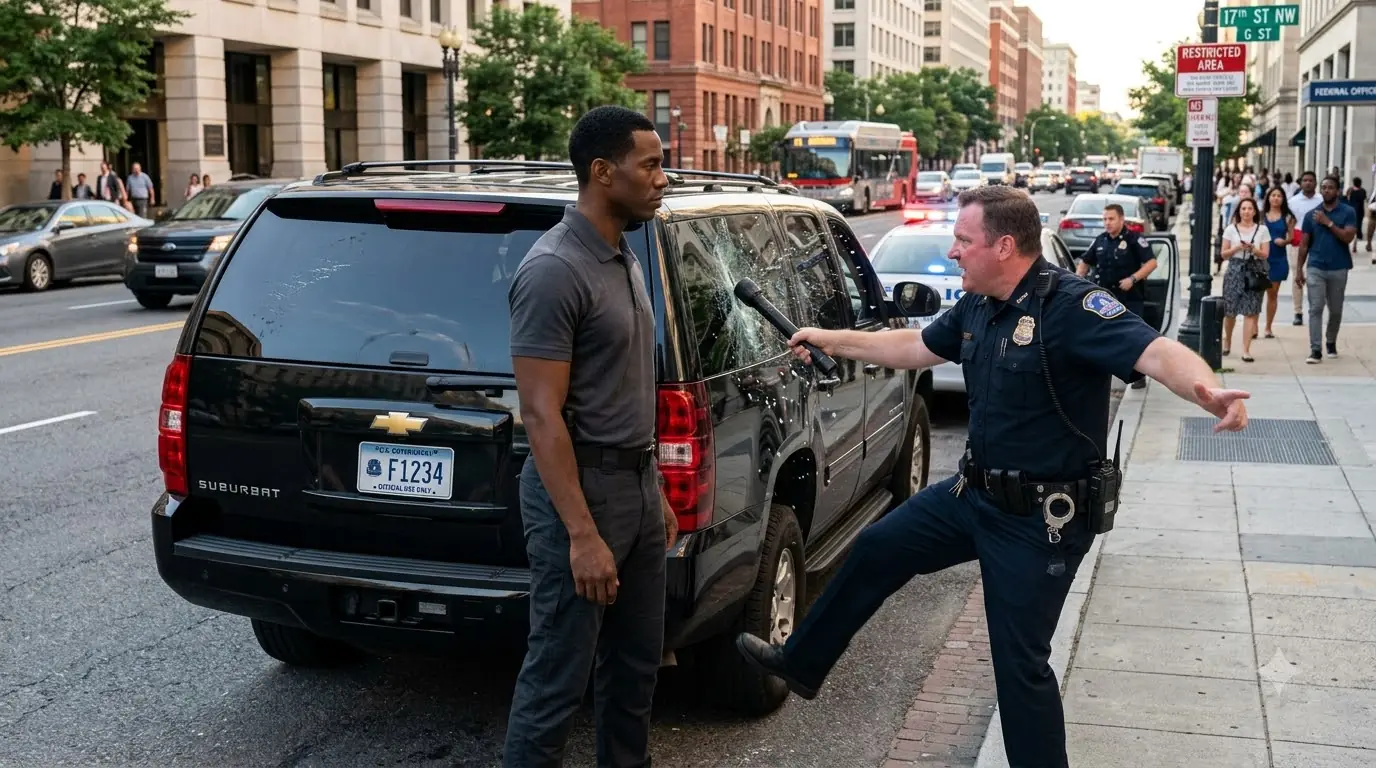
He was spectacularly wrong. What Kirby didn't know was that the SUV was a heavily protected federal security vehicle.
He didn't know the calm man inside, Toby Martin, served on a presidential protective team. And he certainly didn't know that attempting to tow the vehicle would trigger an immediate federal security response.
The city didn't know it was being watched. That was the point.
Toby Martin sat perfectly still in the driver's seat of the unmarked Chevrolet Suburban, his dark eyes moving in slow, methodical sweeps across the intersection ahead. To anyone passing by on the sidewalk, he looked like a bored driver waiting on someone who was running late.
Maybe a private chauffeur. Maybe a rideshare driver killing time between fares.
Nothing worth a second glance. That was also the point.
What those passing strangers couldn't see was that the vehicle surrounding Toby was far more than a standard Suburban. It was a heavily reinforced federal protective platform built to keep its occupants safe and remain mobile under severe attack.
Its exact specifications were classified, and Toby Martin was its guardian. He pressed two fingers lightly against the discrete earpiece nestled in his left ear and listened to the steady rhythm of encrypted radio traffic flowing through the secure channel.
Call signs, grid coordinates, time checks, the language of men and women who operated in the spaces between what the public was ever allowed to know. He understood every word, every pause, every subtle shift in tone that signaled a change in the operational picture.
"Overwatch 2, confirm your position." The voice in his ear was calm, clipped, professional.
"Overwatch 2 is static at Checkpoint Delta," Toby replied, his voice barely above a murmur.
"Perimeter is clean. No anomalies."
"Copy that. POTUS movement is T-minus 47 minutes."
"Hold your position."
"Holding." He clicked off and returned to his sweep.
Toby had been doing this for 6 years, arriving in cities days before anyone else. He sat in vehicles exactly like this one and watched the world move around him while he remained invisible.
He had held checkpoints in foreign capitals, in hostile territories, in the middle of American cities that had no idea the most powerful man on the planet was about to pass through their streets. He had done it in the rain, in brutal summer heat, in the dead of winter, with the heat off because running the engine too long drew attention.
He was exceptionally good at being invisible. His background made him that way.
Raised in Baltimore by a single mother who worked double shifts at a hospital laundry, Toby had learned early that the world didn't hand you anything. You earned it or you went without.
He'd earned a full scholarship to Howard University, earned his commission through ROTC, earned his Ranger tab at Fort Benning, and then earned the attention of a quiet recruiter who had approached him after his third combat deployment with an offer that most soldiers never received. The work was classified, the hours were brutal, the pay was exceptional, the mission was singular.
Protect the president of the United States. He had said yes without hesitation.
The motorcade would pass through in under an hour. His job was simple.
Hold the checkpoint, monitor the comms, flag anything that looked wrong, and remain invisible until the package was clear. Simple, clean, routine.
He reached for the stainless steel travel mug in the center console and took a slow sip of black coffee, his eyes never leaving the street. A delivery truck rumbled past.
A woman pushed a stroller along the opposite sidewalk. Two teenagers on bikes cut through the intersection without stopping.
Nothing wrong. Nothing out of place.
Toby set the mug back down and exhaled slowly through his nose. He just had to hold the position for 46 more minutes, and the operation would proceed exactly as planned, clean, invisible, and completely beneath the radar of everyone in this city.
He had no way of knowing that a black and white cruiser had just turned onto Meridian Street, and that everything was about to go sideways. Officer Nicholas Kirby was the kind of man who had never once questioned whether he deserved the power he carried.
The badge on his chest, the gun on his hip, the cruiser he steered through these streets like a landlord doing rounds on his property. All of it felt natural to him, earned, rightful.
He had been on the Meridian PD for 11 years, long enough to know every shortcut, every corner store owner who owed him a favor, and every face that he felt didn't quite belong in certain parts of his city. He had a gift for that last one.
He believed a gut instinct. He called it decades of experience reading the streets.
Most people who knew him called it something else entirely. He was 43 years old, thick through the middle in the way of a man who had once been athletic and had since stopped trying.
But his uniform was always pressed, his boots always shined, because appearances mattered to Kirby. Appearances were authority.
He had been passed over for Sergeant twice in the last four years, a fact that lived in him like a splinter he couldn't reach, festering quietly beneath everything he did. His lieutenant didn't respect him.
His younger colleagues didn't fear him the way they once had. The department was changing around him in ways he didn't like and couldn't stop.
But out here on these streets, he was still the one with the badge. He spotted the Suburban from half a block away.
It was parked in the loading zone on the east side of Meridian. Engine idling, windows blacked out so completely that you couldn't see so much as a shadow inside.
No commercial markings, no delivery company logo, just a big, dark, anonymous vehicle sitting exactly where it had no business sitting as far as Kirby was concerned. He slowed the cruiser and leaned forward against the steering wheel, squinting.
The plates caught his eye immediately. They weren't standard state issue.
The format was slightly different. Federal exemption plates, the kind attached to government vehicles operating under official capacity.
Kirby had seen them before. He knew what they were supposed to mean.
He just didn't care. Because what Kirby saw first before the plates, before the vehicle, was the silhouette visible through the narrow gap where the window tint didn't quite reach the mirror housing.
A man sitting in the driver's seat and in the practiced ugly shorthand that Kirby's brain had been running for 11 years without ever being challenged on it at a series of assumptions fired in rapid succession. Each one building on the last, none of them based on a single fact.
He pulled the cruiser up behind the Suburban and sat for a moment, running the plates out of habit. The system returned a federal exemption flag almost immediately, which should have ended the entire encounter before it began.
Kirby stared at the return on his dashboard screen, his jaw tightening. Federal exemption.
Right. He had seen people run fake plates before, stolen vehicles dressed up with fraudulent government markings to avoid scrutiny.
It happened. And something about this, about the blacked out windows, about the loading zone, about the man sitting alone in a vehicle that Kirby had already decided didn't add up.
Told him this was exactly that kind of situation. It did not occur to him, not even briefly, that the federal flag had returned in under 4 seconds because it was completely legitimate.
It did not occur to him that the vehicle's registration was buried so deep in classified federal infrastructure that his department system had barely been cleared to acknowledge its existence. It did not occur to him that the calm, still figure in the driver's seat had more federal authority in his left hand than Kirby had accumulated in his entire career.
None of that occurred to him. What occurred to him was opportunity.
He climbed out of the cruiser, settled his belt with a practiced roll of his hips, and put on the particular expression he reserved for moments like this, chin slightly raised, mouth set in a thin, satisfied line, the look of a man who had already decided how the next 10 minutes were going to go. He unclipped his flashlight as he approached, more for effect than necessity.
The afternoon light was still perfectly adequate. He rapped it hard against the driver's window.
Three sharp, aggressive knocks, the kind designed to startle, the kind that said, "I own this moment before a single word had been spoken." Inside the Suburban, Toby Martin didn't flinch.
He simply closed his eyes for exactly one second, the way a man does when he recognizes a problem he was hoping to avoid, and then opened them again. Here we go.
Toby lowered the window exactly 2 inches. No more.
It was a deliberate choice. In his training, they called it controlled engagement.
Give the minimum necessary to deescalate without surrendering the operational posture of the vehicle. Two inches meant he could communicate without inviting a longer encounter.
It did not mean he was complying with anything. It was a professional courtesy extended to a man who had not yet earned it because Toby Martin was disciplined enough to try the easy way first.
"License and registration." Kirby didn't say good afternoon, didn't say excuse me, just planted himself at the window with his flashlight resting against his forearm and his chin tilted up at that particular angle that was meant to remind you who was in charge.
Toby looked at him for a moment without speaking, not with hostility, not with nerves, with the flat, measuring patience of a man who had stared down considerably more dangerous things than a small city cop with an attitude problem, and had learned that the first few seconds of any confrontation told you almost everything you needed to know about the person across from you. What he saw in Kirby told him plenty.
"I'm going to reach into my left breast pocket," Toby said, his voice low and even.
"I'm going to show you a federal credential, and I'd encourage you to look at it carefully."
Kirby's eyes narrowed slightly, but he said nothing.
Toby moved slowly, deliberately, the way his training had conditioned him to move in any situation where a nervous hand was hovering near a weapon. He produced a slim hardcased credential wallet and held it up to the 2-in gap in the window.
The badge inside was not on the kind you bought at a costume shop. It was not the kind carried by a city detective or a county sheriff's deputy.
It was matte black with a gold seal, and beneath the seal in clean federal typeface, it identified Toby Martin as a special operations officer. POTUS security detail, executive protection division.
The kind of credential that in the right circles made rooms go quiet. Kirby looked at it for approximately 2 seconds.
Then he made a sound that was almost a laugh. Short, dismissive, pushed out through his nose like he was clearing it.
"That's supposed to impress me?" He leaned slightly closer to the window, squinting at the badge with the theatrical skepticism of a man performing confidence for an audience of one.
"I've seen better fakes at a Halloween store. You got an actual license and registration, or are we going to keep playing games?"
Toby held the credential steady for another 3 seconds, giving Kirby every opportunity to reconsider. Then he lowered it slowly and looked straight ahead through the windshield.
"Officer," he said, and his voice had shifted almost imperceptibly, still calm, still controlled, but carrying something underneath it now. A quiet weight, like the first low pressure change before a serious storm.
This vehicle is operating under federal authority in support of an active security operation. I am not able to provide you with standard registration documentation because this vehicle does not exist in any database your system has clearance to access.
What I can tell you is that if you contact your department's federal liaison and run the exemption code on those plates through the DHS verification line, you will receive confirmation within 60 seconds. I am asking you professionally to do that before this situation becomes something neither of us wants it to be.
It was by any reasonable measure an extraordinarily generous warning, clear, specific, actionable, and delivered without a single note of condescension. Toby had given him the exact steps needed to walk away from this intersection with his dignity and his career fully intact.
Kirby stared at him for a long moment. Then he straightened up, rolled his shoulders back, and tapped the flashlight twice against the roof of the Suburban with a sharp metallic clang that echoed down the quiet street.
"Step out of the vehicle," he said. Toby didn't move.
"I'm going to ask you one more time to contact your federal liaison."
"And I'm going to ask you one more time," Kirby said, his voice rising just enough to signal that the performance was escalating, "to step out of the vehicle. You're parked illegally."
Your plates don't check out to my satisfaction, and right now you're obstructing a lawful order. So unless that magic badge of yours can fly, I suggest you open this door.
In his earpiece, Toby heard the calm voice of his operations coordinator. Overwatch 2 status check.
T-minus 39 minutes. Toby pressed his fingers to the earpiece and said nothing.
He was running out of easy ways through this. Toby made one final attempt.
He held up a single finger toward the window. A quiet, measured gesture, asking for one moment, and keyed his secure channel with the deliberate calm of a man who understood that the next 60 seconds were going to determine the shape of the next several hours.
Overwatch 2 to command. I have a local law enforcement contact at Checkpoint Delta.
Situation is escalating. Requesting authorization to disclose operational status to resolve.
The response came back in under 10 seconds. Negative.
Overwatch 2. Disclosure not authorized at your level.
Maintain cover. Handle and hold.
Handle and hold. In other words, figure it out without blowing the operation.
Don't reveal the president's movement. Don't escalate to federal intervention unless absolutely necessary.
Smile. Deescalate.
And make the problem go away quietly. Toby exhaled through his nose.
He looked at Kirby, still planted at the window with that flashlight and that expression, and understood with complete clarity that there was no version of this conversation that ended well. Not because Toby couldn't handle it, but because Kirby had already decided how this ended before he ever left his cruiser.
The man wasn't looking for an explanation. He wasn't looking for credentials or verification or any piece of information that might complicate the story he had already written in his head.
He was looking for a reason to feel powerful. And he had found one.
And now he was going to ride it all the way to the ground. Toby opened the door.
He stepped out slowly, both hands visible, movements deliberate and unhurried at the way his training had drilled into him for exactly these kinds of encounters. He was 6'1, lean and composed, dressed in a dark tactical shirt and plain trousers.
Nothing about him outwardly marking him as anything other than a man who had just been pulled out of a parked car by a cop with something to prove. Kirby was on him immediately.
"Hands on the roof. Spread your feet."
Toby complied without a word, placing both palms flat against the Suburban's armored roof panel and felt Kirby's hands begin moving across him with the rough performative aggression of a man who wanted the pat down to feel like a punishment. It wasn't a search.
It was a statement. Kirby's hands moved hard across Toby's shoulders, down his sides, across his lower back, thus each contact carrying just enough force to be humiliating without quite crossing the line into something that could be formally documented.
Toby stared at the roof panel beneath his hands and breathed. He found the sidearm immediately.
A compact federal-issue weapon holstered at Toby's hip and yanked it free with a sharp pull that was entirely unnecessary given that Toby hadn't moved a muscle. "Well, well," Kirby said, holding the weapon up and turning it over like he'd just found buried treasure.
"Carrying without a visible permit, that's a problem." "That weapon is federally registered and authorized under my operational credentials," Toby said quietly, "which you have already seen."
"What I've seen," Kirby said, "is a man with a fake badge and an unregistered firearm parked illegally in a loading zone." He was already reaching for his cuffs.
"You have the right to remain silent. I strongly suggest you use it."
The cuffs went on tight, tighter than necessary. Toby registered the pressure and filed it away without reacting to it, because reacting was what Kirby wanted, and Toby Martin had not survived 6 years of elite federal service by giving people what they wanted at the wrong moment.
He was walked to the back of the cruiser with a hand pressed firmly between his shoulder blades. The door opened and his head guided down with a push that had just enough force behind it to make a point.
The door closed, the lock engaged. Toby sat in the cage of the back seat and looked through the scratched partition at the Suburban sitting 20 feet away.
Engine still idling, secure comms still running. The entire operational nervous system of a presidential checkpoint now sitting unattended and exposed on a public street.
Through his earpiece, still active, still feeding, he heard the operations coordinator's voice. Overwatch 2, you've missed your last two check-ins.
Confirm status. He couldn't respond.
Not with Kirby three feet away outside the cruiser window, already on his radio and calling this in with the satisfied tone of a man who believed he had just made a significant arrest. Outside, the Suburban sat silent and still with the checkpoint completely unmanned.
Kirby made the call with the casual confidence of a man cashing in a favor he'd been saving.
"Hey, it's Nick. I've got an abandoned vehicle situation at Meridian and Fifth, and I need a flatbed as soon as you can get here."
After a short pause, he laughed.
"Nothing complicated. Just some guy who thought a fake federal plate was a get-out-of-jail-free card, so come on down."
He hung up and leaned against the hood of his cruiser with his arms folded.
He looked like a man entirely satisfied with himself. He glanced back at Toby through the partition glass once.
It was the way you glance at something you have already stopped thinking about, and then he turned his attention back to the street. Inside the cruiser, Toby heard every word.
He closed his eyes for exactly two seconds. Then he opened them and began working through the problem with the systematic calm that his training had built into him like load-bearing architecture.
Emotional response was a luxury he could not afford right now. What he could afford was clarity.
The tow truck was coming. The vehicle could not be towed.
Not practically, not legally, and as Kirby was about to discover, not physically. But the attempt itself was the problem.
The moment anyone outside the authorized personnel list made physical contact with that vehicle in a manner the onboard systems classified as hostile interference, a cascade of automated responses would trigger that Toby had absolutely no ability to stop from the back of a police cruiser. He needed to warn someone.
Kirby had missed a secondary communications device during the careless search. Toby used it discreetly to notify command that he was in local custody, that a civilian tow truck was approaching the federal vehicle, and that the situation was about to escalate.
He didn't know if the warning went through, so he had to assume it did and keep moving. Fourteen minutes later, the tow truck arrived.
It was a heavy-duty flatbed, the kind used for commercial vehicles and larger loads, was driven by a heavy set man in a gray work shirt who climbed out chewing something and squinting at the Suburban with the professional assessment of someone who had moved a thousand vehicles and expected this to be no different. Kirby met him at the front of the truck with a handshake and a nod, the easy body language of two men who had done this before.
"Big one," the driver said, looking the Suburban over.
"Don't let it intimidate you," Kirby said. The driver shrugged, walked back to his controls, and began extending the flatbed's hydraulic lift arm toward the Suburban's front undercarriage.
The driver treated the job as routine. On a normal vehicle, he expected the impound to be quick and uneventful.
The arm made contact with the undercarriage at 5:22 inches the afternoon. What happened next took approximately 4 seconds.
The Suburban's onboard threat response system registered unauthorized mechanical contact with the chassis and executed its anchor mode protocol without hesitation and without mercy. Every wheel lock engaged simultaneously, driving hardened steel pins through the run flat tires and into the road surface below with a series of deep, resonant thunks that were felt more than heard.
The electromagnetic chassis lock activated, sending a precisely calibrated power surge back through any conductive contact point on the vehicle's exterior. The tow truck's hydraulic control system, which was very much a conductive contact point, received that surge directly.
The results were immediate and spectacular. The hydraulic arm seized midextension with a sound like a gunshot as a sharp metallic crack that echoed off the surrounding buildings and made two pedestrians half a block away stop and turn.
Fluid began pouring from the ruptured hydraulic lines in a dark, spreading stain across the asphalt. Every electrical display in the tow truck's cab went dark simultaneously.
The engine coughed twice and died. The driver stumbled back from his controls with his hands raised instinctively, staring at his truck with the expression of a man, watching something impossible happen in real time.
Kirby had come off the hood of his cruiser at the first crack. He stood now in the middle of the street, looking from the ruined tow truck to the Suburban, which sat completely unmoved, completely undamaged, engine still idling with quiet indifference, as though nothing of any significance had just occurred.
The street was suddenly very quiet. Kirby's mouth opened, then closed.
At the same moment, the interference triggered a high-priority federal security alert tied to the presidential protection operation. The warning moved immediately through protected channels, confirming that the checkpoint asset was compromised and that Toby was no longer in control of the vehicle.
Senior protective officials authorized an emergency response within minutes. What happened next was not chaos.What happened next was not chaos.
People unfamiliar with presidential protective operations might have imagined shouting and confusion. Instead, the response arrived with controlled efficiency.
Federal protective vehicles entered from different streets and quickly secured the intersection. Trained personnel established a perimeter, moved civilians away from the area, and isolated Kirby from the federal vehicle without unnecessary noise or spectacle.
The tow truck driver sat on the curb with his hands visible, having correctly decided that his part in the situation was over. Kirby stood in the center of it all, turning slowly, watching the perimeter close around him, and felt something he had not felt in 11 years of carrying a badge.
He felt small.Kirby stood in the center of it all, turning slowly, watching the perimeter close around him, and felt something he had not felt in 11 years of carrying a badge. He felt small.
One of the tactical operators stopped 6 feet in front of him, but rifle still down, visor up, and looked at him with an expression that contained no anger, no excitement, and no uncertainty whatsoever. "Don't move," the operator said quietly.
It was not a request. It took Kirby approximately 30 seconds to recover from the initial shock, which was 30 seconds longer than it should have taken, and about 30 seconds shorter than the time he needed to think clearly about what he was doing.
But thinking clearly had never really been Kirby's strong suit under pressure. He found his voice somewhere beneath the confusion and the creeping unease that had begun working its way up from his stomach.
And he did what 11 years of unchallenged authority had conditioned him to do when he felt that authority slipping. He got loud.
Hey. He took a step toward the nearest operator, jabbing a finger in the man's direction with the practiced aggression of someone who had used that gesture to end arguments for over a decade.
Hey, I'm talking to you. Who authorized this response?
This is my scene. I have a suspect in custody and an illegally parked vehicle under impound.
You want to come onto my scene? You talk to me first.
That's how this works. The operator he was addressing didn't move, didn't blink, didn't adjust his grip on his rifle or shift his weight or give any physical indication whatsoever that Kirby's words had registered as anything requiring a response.
He simply watched Kirby with the patient unreadable stillness of someone who had been trained to treat elevated voices as background noise until they became something more actionable. That stillness enraged Kirby more than any argument could have.
I said, "This is my scene." He was louder now, turning to address the broader perimeter, playing to an audience that was not playing back.
I don't care who you people are. You don't just roll up on an active law enforcement operation without coordinating with the officer on scene.
That's protocol. That's basic protocol.
And every single one of you knows it. One of the operators near the north Suburban said something quietly into his comm.
Another adjusted his position by three steps, closing a gap in the perimeter with the unhurried precision of someone executing a pre-planned movement rather than reacting to anything Kirby was doing. They were not listening to him.
They were not ignoring him either. Exactly.
They were categorizing him, filing him, monitoring him the way you monitor a variable in an environment you have already assessed and controlled, something to be managed rather than engaged. It was the most professionally dismissive thing Kirby had ever experienced, and some part of him he buried beneath the bluster, understood exactly what it meant.
He chose not to listen to that part. He took two more steps toward the operator and dropped his hand toward the sidearm on his belt.
The protective team reacted instantly, raising their weapons and ordering him to stop. Kirby froze.
The world seemed to narrow around him as he realized that the people surrounding him were disciplined federal professionals who had already taken control of the scene. "Remove your hand from your weapon," the nearest operator said quietly.
"Both hands where we can see them." Kirby obeyed, slowly raising his hands to shoulder height.
Nicholas Kirby stood in the middle of Meridian Street with the full weight of what he had done beginning to settle over him like something cold and permanent. The slow, nauseating recognition that the ground he had been standing on so confidently for the last hour had not been ground at all.The slow, nauseating recognition that the ground he had been standing on so confidently for the last hour had not been ground at all.
It had been a trap door and it had just opened beneath him. The rear door of the cruiser opened from the outside.
Toby didn't move immediately. He sat for a moment, taking in the changed geometry of the street through the scratched partition window, the federal perimeter, the tactical operators, the ruined tow truck still leaking fluid across the asphalt, and Kirby standing in the middle of it all with his hands at shoulder height, and the particular expression of a man whose entire understanding of his own life had just been revised without his consent.
Then Toby swung his legs out and stood. The agent who had opened the door was young, composed, and said nothing beyond a quiet sir, as he produced a small cuff key, and removed the restraints with practiced efficiency.
Toby rolled his wrists once, checked the pressure marks, and straightened his tactical shirt with two precise tugs. He retrieved his federal credential wallet from the agent's outstretched hand, then his sidearm, which he checked, cleared, and reholstered in one smooth motion without looking down.
He looked at Kirby instead. Kirby was looking back at him.
The chin that had been tilted up with such practiced authority an hour ago was level now, and there was something working behind his eyes that Toby recognized. The frantic backward-running calculation of a man trying to locate the exact moment where everything went wrong and finding to his mounting horror that it was the very first decision he had made.
Toby held his gaze for exactly two seconds, then turned away because Kirby wasn't his problem anymore. Toby had spent the entire encounter trying to preserve the operation while giving a local officer every possible chance to step back, and once federal command arrived, there was nothing more for him to prove.
His priority returned immediately to the checkpoint, the secure vehicle, and the presidential movement that still had to happen on schedule. Kirby, by contrast, was about to discover what happened when the authority he had treated as personal property was examined by people who answered to systems far larger than his own department.
The detail leader was Special Agent in Charge Marcus Webb, who walked toward Kirby from the north Suburban with the unhurried stride of a man who had nowhere more important to be and nothing more pressing to do than stand in front of Nicholas Kirby and dismantle the last remaining architecture of his confidence. Webb was 51 years old, silver at the temples, with the kind of face that had been weathered by two decades of standing between the most powerful office on earth and everything that threatened it.
He wore no tactical gear, dark suit, white shirt, the discrete earpiece of his trade. He looked in the middle of all that tactical hardware, like the most dangerous person on the street.
He stopped 3 feet from Kirby and looked at him the way a surgeon looks at a scan. Clinically, completely.
"Officer Kirby." He had clearly already been briefed.
"My name is Special Agent in Charge Marcus Webb. I am the detail leader for the presidential protective team currently operating in this city."
He paused, letting that land. "I need you to understand some things, and I need you to understand them clearly, so I'm going to speak slowly."
Kirby's hands were still partially raised. Nobody had told him he could lower them.
"The vehicle you attempted to impound," Webb continued, "is a classified federal protective asset supporting the movement of the President of the United States through this city. Your interference forced us to alter an active security operation."
The color that left Kirby's face did not come back. "The man you detained, handcuffed, and locked in the back of your cruiser is a federal protective officer operating under classified authority."
The credential he showed you was genuine. The federal exemption plates on that vehicle are genuine.
Every warning he gave you was genuine, accurate, and given to you in good faith at considerable professional restraint. Webb tilted his head slightly.
He showed you more patience than this situation required. Considerably more.
Kirby's mouth opened. Nothing came out.
"When you ordered a civilian tow operator to interfere with that vehicle," Webb continued, his voice never rising, "you triggered an emergency federal security response and pulled protective resources away from an active presidential operation." You detained a federal officer.
You attempted to seize classified government property. He paused again.
And you did all of this because you didn't like where the car was parked. The silence that followed was the loudest thing Kirby had ever heard.
Webb studied him for one final moment. It was the look of someone who had finished explaining the facts.
Then Webb clasped his hands in front of him. "The President," he said quietly, "knows your name, Officer Kirby."
Kirby's hands dropped to his sides. His legs appeared to be considering the same option.
The police chief's car arrived without sirens. That was the first sign that this was not a rescue.
Chief Raymond Holt pulled up to the outer edge of the federal perimeter in his personal vehicle, a detail that told its own story. He had come not in his official capacity as a responding commander, but as a man summoned to account for something one of his officers had done.
He was in his dress uniform, which meant someone had called him away from something formal. And the expression he wore as he stepped out and badged his way through the perimeter line was the expression of a man who had been given just enough information on the drive over to understand the scale of what he was walking into and had spent that entire drive hoping he had misunderstood.
He had not misunderstood. He stopped when he saw the ruined tow truck.
Took in the four federal Suburbans, the tactical perimeter, the operators still positioned at their intervals with the patient, permanent quality of people who were not leaving until they decided to leave. His eyes moved to Toby Martin, standing near the armored Suburban, with his credentials in hand and his expression composed, and then to Webb, and then finally to Kirby.
Kirby was standing exactly where Webb had left him, hands at his sides, the red gone from his face, and something worse replacing it. The gray hollowed look of a man in the early stages of understanding that his life had just divided cleanly into before and after, and that everything in the after column was going to be defined by what he had done in the last 90 minutes.
Holt walked toward Webb with his hand extended and his jaw set. Chief Raymond Holtt, I I apologize for Special Agent in charge Marcus Webb.
The handshake was brief and professional. "I appreciate you coming quickly, Chief," Webb said.
I'll be direct with you because we're short on time. Your officer detained a federal operative, attempted to seize a classified presidential security asset and triggered a high-priority security alert during an active POTUS movement operation.
The federal charges being prepared include interference with a protective function, unlawful detention of a federal officer, and attempted seizure of classified government property. Those charges are not negotiable and they are not coming from me.
They are coming from the United States Attorney's Office, which was notified 40 minutes ago. Holt absorbed this without speaking.
His jaw worked once silently. "What I need from you right now," Webb continued, "is your cooperation in the administrative component of what happens next."
"Your officer's weapon and credentials need to be surrendered before he is taken into federal custody. I'm extending you the courtesy of allowing that to happen through your office rather than having my people do it unilaterally because I think that matters to you and because it's the right way to handle it, but it is happening either way."
Holt turned and looked at Kirby for a long moment.
Whatever Kirby was hoping to find in that look, solidarity, outrage on his behalf, some signal that his chief was going to step in and pull him back from the edge. It wasn't there.
What was there was something far worse. Disappointment so complete it had moved past anger into a kind of exhausted finality.
The look of a man who had perhaps suspected something like this was possible and had hoped he was wrong. He walked to Kirby slowly stopped in front of him.
"Nick." His voice was low and private, as private as anything could be on a street surrounded by federal agents.
"Give me your weapon and your badge."
Kirby stared at him.
"Chief, I was doing my job. The plates looked fake, the credentials looked fake, and I had no way of knowing."
"Your weapon and your badge," Holt repeated. Quietly.
Finally. The silence stretched for three seconds.
Then Kirby reached across his body with a hand that wasn't entirely steady, unholstered his service weapon, and placed it in Holt's outstretched hand. The badge came off next, the one he had polished that morning with the automatic pride of a man who had never imagined a day when he would hand it to someone else, and it sat in Holt's palm, looking smaller than it ever had before.
Holt stepped back. Two federal agents moved forward with the quiet efficiency that had characterized everything the protective team had done since arriving on this street, and Nicholas Kirby's hands were drawn behind his back and secured with a zip tie in under 4 seconds.
He didn't resist. There was nothing left in him to resist with.
They walked him toward one of the black Suburbans with a hand on each arm, and the door closed behind him with a sound that was almost gentle, which was somehow the worst part, the complete indifference of it. The absence of drama, and as though what was happening to Nicholas Kirby was simply a routine administrative function being completed before more important work resumed.
Because that was exactly what it was. Webb was already back on his comm.
His attention returned entirely to the operation that Kirby had nearly compromised. The tactical operators were beginning their controlled withdrawal from the perimeter, moving back to their vehicles in the same coordinated sequence they had arrived in.
Toby Martin was back in the Suburban, door closed, engine idling, his voice low and steady in the secure channel as he reestablished contact with command and confirmed that checkpoint Delta was operational. Holt stood alone in the middle of Meridian Street, holding his officer's badge and gun, watching the federal convoy begin to move and said nothing.
Twelve minutes later, the presidential motorcade passed through the intersection at Fifth and Meridian without incident, without delay, and without any awareness on the part of the city around it that anything unusual had occurred. The street looked exactly as it always had, except for the tow truck, still sitting at the curb with its hydraulics destroyed and its engine dead, a monument to the spectacular and permanent consequences of mistaking arrogance for authority.
Nicholas Kirby didn't see the motorcade pass. He was already gone.