The first United States Army vehicle entered Veterans Memorial Plaza just as Officer Hank Barlow lifted his boot for the second time. Its dark government paint reflected the cold morning sky, and a small Army insignia was visible on the front door as it turned through the security entrance. A second vehicle followed closely behind, carrying uniformed soldiers and a senior commander whose visit had been scheduled weeks earlier. Hank did not hear them immediately because he was too busy shouting at the elderly Black man standing beside the memorial wall.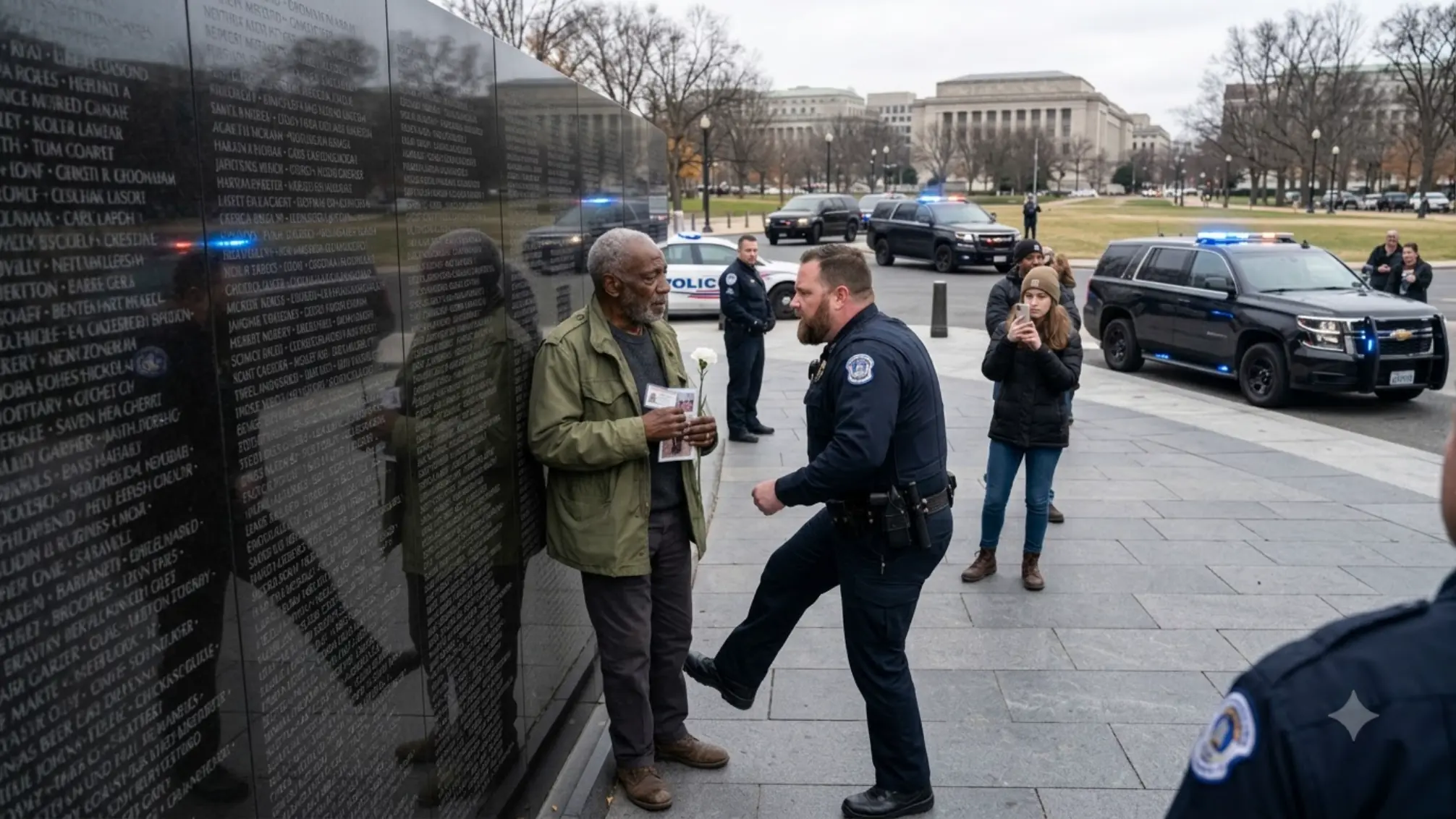
Elias Walker held a single white carnation in one hand and a faded photograph in the other. At sixty-eight, he was thinner than he had been during his years in the Army, and an old combat injury made his left leg stiff whenever the weather turned cold. His olive field jacket was faded at the shoulders, his brown boots were worn, and the silver beard along his jaw had been trimmed carefully that morning. Nothing about him looked threatening.
He had come to place the flower beneath the engraved name of Sergeant Daniel Mercer.
Forty-three years earlier, Daniel had pulled Elias from a burning transport vehicle during an overseas deployment. A second explosion struck before Daniel could escape, and Elias spent the rest of his life carrying the memory of the man who had traded his future for someone else’s. Every year, Elias visited the memorial on the anniversary of Daniel’s death.
That morning was different.
Daniel’s daughter, Major Rebecca Mercer, had invited Elias to attend a private Army remembrance ceremony scheduled for ten o’clock. Elias arrived early because he wanted a few quiet minutes alone at the wall before the officials, cameras, and military families gathered. He carried the original photograph of himself and Daniel standing beside an Army vehicle when they were both twenty-five.
Officer Hank Barlow saw only an elderly man in an old jacket.
Hank had been assigned to temporary perimeter duty after several demonstrations occurred near government property. He was forty-four, broad-shouldered, heavily built, and known among several officers for treating routine encounters like personal challenges. He believed control depended on establishing dominance before anyone questioned him.
At nine sixteen, Hank watched Elias step beyond a movable barrier that had been left partially open for invited guests.
“What are you doing here?” he shouted.
Elias turned slowly. “I’m attending the remembrance ceremony.”
“This area is closed.”
“I’m on the guest list.”
“Everyone says that.”
Elias reached toward the inside pocket of his jacket.
Hank’s hand immediately moved toward his holster.
“Keep your hands where I can see them.”
“My identification is inside my coat.”
“I didn’t ask for your life story.”
Elias lowered his hand. He had spent enough years around nervous young soldiers to recognize fear disguised as aggression. He did not want an argument, and he certainly did not want his visit to Daniel’s name turned into a spectacle.
“The ceremony coordinator can confirm who I am,” Elias said. “Her name is Major Rebecca Mercer.”
Hank glanced at the flower and photograph. “You expect me to believe an Army major invited you?”
“Yes.”
“To this ceremony?”
“Yes.”
Hank laughed without humor.
A young woman named Sofia Grant stood near the memorial entrance waiting for her father, a retired Navy corpsman. She heard the officer’s tone and lifted her phone, not yet recording but ready. The old man’s calmness contrasted sharply with the officer’s growing hostility.
Hank ordered Elias to leave.
Elias looked toward Daniel’s engraved name, visible only fifteen feet away. “Let me place the flower, and I’ll wait outside the barrier.”
“You don’t negotiate with me.”
“I’m not negotiating.”
“Then move.”
Elias took one careful step toward the wall.
Hank grabbed his shoulder and spun him around.
Pain shot through Elias’s injured leg. The photograph slipped from his fingers and landed faceup on the stone pavement. Daniel’s young face stared toward the gray sky.
Sofia pressed record.
“Officer, he didn’t do anything,” she called.
Hank pointed toward her. “Stay out of police business.”
Elias bent slowly to retrieve the photograph.
Hank interpreted the movement as defiance.
His boot struck the side of Elias’s damaged leg.
The veteran collapsed against the memorial wall.
The white flower fell beside him.
Sofia gasped, but she kept filming. Her phone captured Hank standing over Elias, ordering him to kneel properly and place both hands behind his head. It captured the old man’s face tightening with pain as he tried to protect the photograph against his chest.
Elias did not fight back.
He had survived explosions, surgeries, and nights when he woke believing he was still inside the burning vehicle. He knew how quickly fear and confusion could turn one bad decision into several. He refused to give Hank the excuse the officer seemed determined to manufacture.
“I’m a veteran,” Elias said.
“You’re trespassing.”
“My identification is in my pocket.”
“You should have thought about that before ignoring an order.”
Hank forced Elias onto both knees.
The movement drove the edge of an old surgical plate against the joint, and Elias nearly cried out. Instead, he stared at Daniel’s name and concentrated on breathing.
Sofia moved closer.
“His Veteran ID is visible,” she said. “It fell out when you kicked him.”
A small plastic card lay near Elias’s jacket. Hank looked at it but did not pick it up.
“Back away.”
“You assaulted him.”
“I said back away.”
“I’m recording everything.”
That sentence changed Hank’s expression.
He reached toward her phone, but another officer, Daniel Ruiz, approached from the patrol car near the entrance. Ruiz was younger, slimmer, and had been watching the encounter with growing concern.
“Hank,” he said quietly, “let’s slow this down.”
“Stay at your post.”
“He says he’s on the guest list.”
“He crossed a restricted barrier.”
“The barrier is open.”
Hank turned sharply. “You questioning me in front of civilians?”
Ruiz looked at Elias kneeling beside the wall.
“I’m asking whether we verified his identification.”
Hank grabbed the Veteran ID from the ground and barely glanced at it. The card identified Elias Walker as a disabled United States Army veteran. A Bronze Star and Purple Heart notation appeared beneath his service information.
Hank placed the card in his pocket instead of returning it.
“This could be fake.”
Elias looked up. “Call the number on the back.”
“I don’t take instructions from detainees.”
Sofia’s video captured that too.
At nine twenty-four, Hank radioed a report claiming he had detained an aggressive trespasser who had attempted to enter a restricted military ceremony. He stated that the man resisted instructions and made a threatening movement toward his clothing. He did not mention kicking Elias.
Ruiz heard the report and stared at him.
“That isn’t what happened.”
Hank lowered the radio. “Be careful, Ruiz.”
“I watched him reach for his identification.”
“You saw what I said you saw.”
“No.”
For the first time, uncertainty appeared behind Hank’s anger. He expected civilians to submit and junior officers to remain silent. He had not prepared for two witnesses refusing to support his version.
The first Army vehicle stopped thirty yards away.
Major Rebecca Mercer stepped from the rear passenger door wearing a dark service uniform beneath a long coat. She was forty-two, with Daniel Mercer’s gray eyes and the same determined expression Elias remembered from his friend. Colonel Thomas Avery exited the second vehicle with two military police officers and a representative from the Department of Defense’s memorial affairs office.
Rebecca saw Elias on his knees.
She stopped walking.
For a moment, she seemed unable to understand the image in front of her. Then she recognized the photograph pressed against his chest and began moving quickly across the plaza.
“Mr. Walker?”
Elias lifted his head.
Hank stepped between them. “Ma’am, stay back. This individual is being detained.”
Rebecca looked at his uniform, then at Elias’s injured leg.
“That individual is the honored guest at today’s ceremony.”
Hank’s face tightened. “He entered a restricted area without authorization.”
“I personally placed his name at the top of the guest list.”
“He failed to identify himself.”
“My Veteran ID is in his pocket,” Elias said.
Rebecca turned toward Hank. “You took his identification?”
“For verification.”
“Then verify it.”
Colonel Avery arrived beside her. He was a fifty-six-year-old Black American Army officer with a commanding presence that silenced conversations without requiring him to raise his voice. He looked at Elias, the fallen flower, the open barrier, and Sofia’s raised phone.
“What happened here?”
Hank straightened. “Sir, this man entered a restricted zone, refused orders, and became physically noncompliant.”
Ruiz shook his head.
Colonel Avery noticed.
“Officer, do you agree with that description?”
Hank answered before Ruiz could speak. “My partner is inexperienced.”
Avery did not look away from Ruiz. “I asked him.”
Ruiz swallowed. “No, sir. Mr. Walker said he was a veteran and an invited guest. He attempted to retrieve identification. Officer Barlow kicked his leg and forced him down.”
Silence settled across the plaza.
Hank turned toward him. “You better think carefully.”
“I already did.”
Sofia stepped forward with her phone still recording.
“I have the whole thing.”
Hank reached for the device.
A military police officer immediately stepped between them.
“Do not touch her phone.”
“This is a local police matter.”
“It became a federal security matter when you filed a false report during an official Army event,” Colonel Avery said.
Hank looked toward the patrol cars as though searching for someone who might restore his authority. Instead, another black government SUV entered the plaza. Two federal protective agents stepped out, followed by an investigator from the Department of Defense Inspector General’s office who had been assigned to observe the scheduled memorial ceremony.
The timing was accidental.
The consequences were not.
Agent Laura Bennett approached with a credential wallet held at shoulder height. She identified herself and asked everyone to remain in place while the conflicting reports were reviewed.
Hank immediately began speaking.
“He made a sudden movement. I believed he might be reaching for a weapon. I used the minimum force necessary.”
Sofia held up her phone. “He told him he was reaching for identification.”
“He advanced toward me.”
“He was walking toward the memorial.”
“He refused multiple lawful orders.”
“The officer kicked him after he bent down to pick up a photograph,” Ruiz said.
Agent Bennett looked toward Elias.
“Sir, are you injured?”
“My leg.”
“Did you threaten the officer?”
“No.”
“Did you attempt to strike him?”
“No.”
“Why were you here?”
Elias raised the faded photograph.
“To visit Daniel.”
Rebecca covered her mouth for a second before kneeling beside him. She picked up the crushed white carnation and carefully brushed dirt from its petals.
“My father carried this photograph in his wallet,” she said. “He told me Mr. Walker was the reason he volunteered for that final rescue.”
Elias shook his head.
“Daniel was the reason I came home.”
Colonel Avery turned toward Hank. “This man is here because the United States Army invited him.”
Hank’s defensive posture began to crack. “I couldn’t know that.”
“You were given a guest list this morning,” Rebecca said.
Hank looked at the folding table near the security entrance. A printed list rested beneath a clipboard. Elias Walker’s name appeared first in bold letters, followed by the designation HONORED SURVIVING VETERAN.
Officer Ruiz had seen the list during setup.
Hank had not bothered to read it.
Agent Bennett requested Hank’s body-camera footage.
He glanced down at the device mounted on his chest.
The indicator light was dark.
“My camera malfunctioned.”
Ruiz touched his own camera. “Mine was operating.”
Sofia raised her phone again. “So was mine.”
The federal investigator asked Hank to surrender Elias’s Veteran ID.
Hank hesitated before removing it from his pocket.
That hesitation was recorded by three separate cameras.
A medical team attached to the ceremony arrived and helped Elias stand. His injured leg would not fully support his weight, so they placed him in a wheelchair while checking for swelling or possible damage.
Rebecca stayed beside him.
“I’m sorry,” she whispered.
“You didn’t do this.”
“I invited you here.”
“You invited me to honor your father. That’s still what I’m going to do.”
The investigator separated the witnesses.
Ruiz gave a full statement. Sofia transferred a copy of her video without surrendering the original. The memorial security cameras confirmed that Elias entered through the partially open guest barrier and never threatened anyone.
Hank’s radio transmission became the most damaging piece of evidence against him.
In the call, he claimed Elias lunged and resisted.
Video showed the veteran standing still.
He claimed Elias refused to identify himself.
Video showed Elias repeatedly offering identification.
He claimed the barrier was closed and marked.
Photographs showed the opening through which invited guests had been instructed to enter.
Then investigators found an earlier camera angle from the parking area.
It showed Hank watching Elias approach for nearly a minute before confronting him. The officer had enough time to compare the elderly man with the guest-list photograph attached to the security packet.
He simply chose not to.
The local precinct commander arrived twenty minutes later. Captain Melissa Hart listened to the summary with a rigid expression, then ordered Hank to remove his badge and duty weapon pending investigation.
Hank stared at her.
“You’re taking his side?”
“I’m taking the side of the evidence.”
“He could have been dangerous.”
“He was carrying a flower.”
“You weren’t here.”
“Six cameras were.”
Hank looked around at the assembled military officers, federal agents, witnesses, and police personnel. His size no longer gave him control of the space. Every person there possessed either greater authority or better evidence.
Captain Hart reached toward him.
“Badge and weapon.”
Hank reluctantly surrendered both.
When another officer escorted him toward a patrol car, he passed Elias’s wheelchair. The veteran looked up at him without satisfaction or anger.
That seemed to bother Hank more than hatred would have.
“You ruined my career,” the officer muttered.
Elias held his gaze.
“No. You kicked an old man before reading his name.”
The memorial ceremony began forty-five minutes late.
Organizers offered to postpone it, but Elias refused. He asked only for another flower and enough help to reach Daniel’s place on the wall.
Two soldiers rolled his wheelchair across the plaza. Colonel Avery walked on one side, while Rebecca carried the replacement carnation on the other. The same officers who had arrived expecting a routine security assignment now stood at attention.
Sofia remained near the back with her father.
She had stopped recording.
This part did not belong to the internet.
At the memorial wall, Rebecca handed Elias the flower. He touched the engraved letters of Daniel’s name with trembling fingers and placed the carnation beneath them.
For several seconds, nobody spoke.
Then Elias lifted the photograph.
“This was taken three days before the attack,” he told the gathered soldiers. “Daniel had lost a card game and owed me twenty dollars. He said he would pay me when we got home.”
A few people smiled through tears.
“He never paid me,” Elias continued. “So I’ve spent forty-three years collecting interest by telling people what kind of man he was.”
Rebecca laughed softly while wiping her face.
Elias looked toward the young soldiers standing behind Colonel Avery.
“Courage is not being the strongest person in the room. Courage is having power and choosing to use it for someone who cannot protect himself.”
Several heads turned unconsciously toward the patrol car where Hank sat.
Elias continued.
“Daniel had every reason to leave me inside that burning vehicle. He went back anyway. Today, a young woman saw something wrong and kept recording. A police officer saw his partner cross a line and told the truth. Those choices matter more than uniforms.”
Ruiz stood near the outer edge of the ceremony.
Elias motioned for him to come forward.
The younger officer hesitated, then approached.
“You could have stayed silent,” Elias said.
“I almost did.”
“But you didn’t.”
Ruiz lowered his eyes. “I’m sorry I didn’t stop him sooner.”
“Learn from it.”
“Yes, sir.”
The investigation lasted four months.
Sofia’s video became central evidence. It showed the kick clearly enough that Hank’s claim of defensive force could not survive review. Ruiz’s body camera captured the officer threatening his partner and attempting to control the witness’s phone.
Security footage proved Elias never behaved aggressively.
The guest list proved he belonged at the ceremony.
The Veteran ID proved Hank knew exactly whom he had forced to the ground before filing his report.
Hank was charged with assault, falsifying an official report, evidence interference, and violating Elias’s civil rights under color of authority. He pleaded not guilty at first, insisting his actions were justified by security concerns.
The videos disagreed.
His department also reviewed earlier complaints. Three civilians had previously accused Hank of using unnecessary force, though each case had been closed after his written report contradicted their statements. Investigators reopened those files and discovered the same pattern: Hank described fear, sudden movement, and resistance whenever footage was missing.
This time, footage existed from every angle.
Captain Hart ordered new procedures for officers assigned to memorials and veteran facilities. Guest lists had to be reviewed before deployment, body cameras had to remain active during all contacts, and officers could not seize identification without documenting the reason.
Officer Ruiz remained on duty.
Some colleagues called him disloyal for contradicting Hank. Others privately thanked him for refusing to support a lie that could have damaged the entire department.
Elias defended him publicly.
“A badge does not require loyalty to misconduct,” he told reporters. “It requires loyalty to the truth.”
Sofia received a civic recognition award, though she initially tried declining it. She said pressing record did not feel brave; it felt like the only reasonable response when someone vulnerable was being mistreated.
Elias disagreed.
“Most courage feels ordinary to the person using it.”
The injury to his leg required surgery but caused no permanent new disability. Rebecca visited him throughout recovery and brought Daniel’s old letters, photographs, and medals. Together, they created a small archive documenting the friendship between the two soldiers.
One letter contained a line neither of them had seen before.
Daniel had written to his wife that if anything happened to him, Elias would understand what kind of man he had tried to be.
Elias read the sentence several times.
“He was wrong,” he finally said.
Rebecca looked worried. “About what?”
“I’ve spent my whole life trying to become worthy of what he did.”
“You already were.”
“No one feels worthy of being saved.”
Rebecca placed her father’s letter beside the faded photograph. “Maybe that’s why he chose you.”
A year after the confrontation, Elias returned to Veterans Memorial Plaza. He walked with a cane, accompanied by Rebecca, Colonel Avery, Sofia, and Officer Ruiz.
This time, the entrance stood open.
A new security officer checked the guest list and greeted Elias by name.
“Welcome back, Mr. Walker.”
Elias stopped.
The simple courtesy affected him more deeply than he expected.
At Daniel’s name, he placed another white carnation beneath the engraved letters. The stone reflected his older face beside the image of the young soldier in the photograph.
Behind him, a United States Army vehicle waited near the entrance.
Its presence reminded everyone of the morning authority arrived too late to prevent the first kick but early enough to expose the lie that followed. Yet Elias never described the story as one of military power defeating a police officer.
To him, the important people were Sofia and Ruiz.
One raised a phone when silence would have been easier.
The other contradicted his own partner when obedience would have protected him.
The federal agents, Army commander, guest list, and cameras confirmed the truth, but ordinary courage kept that truth from disappearing before they arrived.
Hank had asked Elias what he was doing at the memorial.
The answer was simple.
He had come to honor a man who once stepped into danger for someone else.
By the end of that cold morning, two more people had done the same.