The main hallway of the Fulton County Courthouse was already crowded when Officer Grant Mercer stepped in front of the elderly Black man approaching Courtroom 4B. Attorneys hurried between hearing rooms carrying thick files, clerks pushed carts stacked with sealed evidence boxes, and reporters gathered near the brass elevator doors for the most closely watched judicial hearing in Atlanta that year. Seventy-two-year-old Leonard Hayes moved through the noise in a tailored charcoal suit, polished black shoes, and a patterned gray tie, carrying a worn brown briefcase that had followed him through more than three decades of public service. He walked with quiet purpose until Mercer planted both boots directly in his path.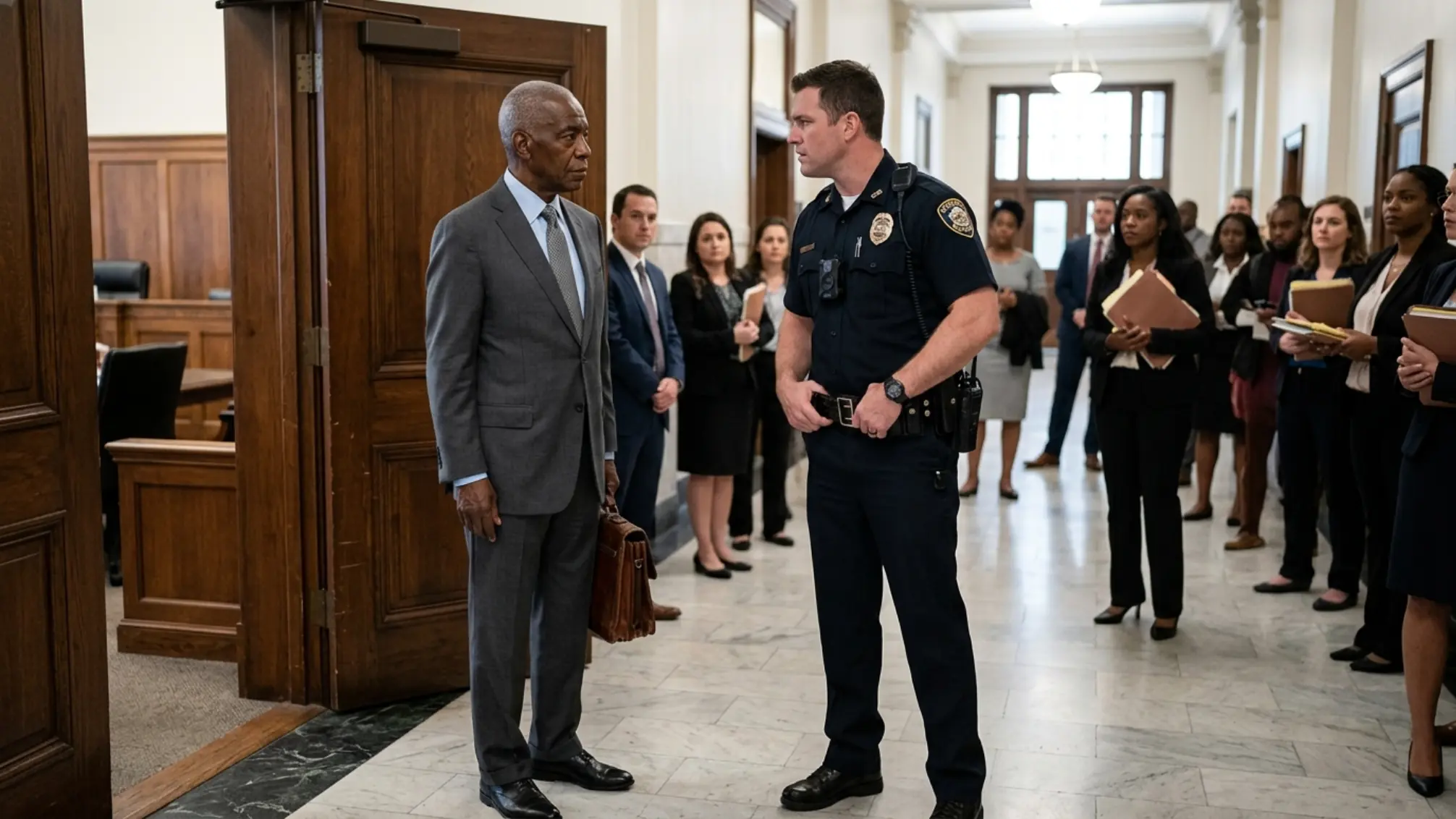
“This hearing is restricted,” the officer said, looking Leonard over. “Wait outside, old man.”
Leonard stopped without lowering his eyes. “You should verify a man’s name before deciding where he belongs.”
Mercer stepped closer, one hand settling against his duty belt. “Take another step, and I’ll remove you myself.”
Leonard tightened his grip on the briefcase. “Open those doors, Officer—then ask why every judge inside is waiting for me.”
Mercer gave a short laugh. He was thirty-eight, broad-shouldered, and newly assigned to courthouse security after twelve years in patrol. He wore his navy uniform as though it granted him ownership of every hallway he entered. The silver badge on his chest reflected the fluorescent lights while his expression remained cold and certain.
“You expect me to believe the judges are waiting for you?”
“I expect you to perform the simplest part of your duty,” Leonard replied. “Ask.”
Mercer did not ask. He had already decided what he saw: an elderly man carrying an old briefcase, arriving without an escort, standing near a restricted courtroom filled with state officials. Leonard’s expensive suit did not change the officer’s conclusion. In Mercer’s mind, the man was either confused, pretending to be important, or searching for a way into a room where he did not belong.
A young courthouse clerk named Emily Park slowed near the doorway. She looked at Leonard, then at Mercer, and her eyes widened with recognition. Before she could speak, Mercer raised one palm toward her.
“Keep moving, ma’am.”
Emily hesitated. “Officer, I think—”
“I said keep moving.”
Leonard glanced at her and gave a small shake of his head. He did not want the young clerk punished for challenging an officer in public. Emily continued down the hallway, but she immediately reached for her phone once she turned the corner.
Inside Courtroom 4B, eleven judges sat behind a long ceremonial bench. The hearing concerned allegations that courthouse security officers had selectively removed Black attorneys, elderly visitors, and low-income defendants from restricted areas while allowing other people to pass without verification. Complaints had accumulated for nearly three years, but most were dismissed as misunderstandings. The state judicial council finally ordered an independent review after security footage contradicted several official reports.
Leonard Hayes had been asked to lead that review.
For twenty years, he served as chief judge of the courthouse now standing before him. He had presided over murder trials, corruption cases, civil-rights disputes, and sentencing hearings that drew national attention. He was known for speaking softly, listening carefully, and making decisions that left little room for political interference. Even after retirement, younger judges regularly contacted him when difficult questions required experience rather than ambition.
His name remained engraved on a bronze plaque outside the ceremonial chamber on the third floor.
Mercer had passed that plaque every day for six months without reading it.
“Identification,” the officer demanded.
Leonard slowly reached inside his coat. Mercer’s posture changed immediately, and his hand moved closer to his holster.
“Keep your hands where I can see them.”
“You requested identification.”
“Tell me where it is first.”
“Inside my left breast pocket.”
Mercer stared at him for several seconds before allowing the movement. Leonard removed a leather wallet and opened it. Inside sat a retired judicial credential bearing his photograph, full name, and former title.
Mercer barely glanced at it.
“This expired four years ago.”
“It is a retired judicial credential, not a driver’s license.”
“It doesn’t grant access.”
“The sealed invitation beneath it does.”
Mercer took the envelope without permission and examined the raised state seal. He turned it over, studied Leonard again, then decided the document might be fraudulent.
“Anybody can print fancy paper.”
Leonard’s expression finally sharpened. “That statement would trouble the state archivist who prepared it.”
Mercer held the envelope out of reach. “Who told you to come here?”
“Chief Justice Rebecca Holloway.”
“Her office is upstairs.”
“She is inside that courtroom.”
“You know her personally?”
“I appointed her to her first judicial committee twenty-two years ago.”
Mercer smiled as if Leonard had confirmed a delusion. “Right. And I suppose you trained the governor too.”
“No,” Leonard said. “The governor was one of my law clerks.”
The answer drew quiet laughter from two uniformed officers standing near the metal detectors. Mercer looked toward them, pleased that the scene had become entertaining. Neither officer recognized Leonard, though one began recording discreetly on his personal phone.
Mercer returned the invitation by dropping it onto the floor.
The sealed envelope landed near Leonard’s polished shoe.
The hallway around them grew quieter.
Leonard stared at the invitation for a moment, then bent carefully and picked it up. His movements were slower than they had been a decade earlier, but his dignity remained intact. When he straightened, the patience in his face had changed into something Mercer failed to understand.
“Officer,” Leonard said, “what is your badge number?”
Mercer’s smile disappeared. “You don’t need it.”
“It is visible. I asked whether you would state it for the record.”
“What record?”
“The one your body camera is making.”
Mercer glanced toward the device on his chest. A red indicator light blinked near the lens. He had activated it when Leonard approached, expecting footage of a trespasser becoming argumentative. Now he understood the same recording preserved his refusal to verify official credentials and the moment he dropped a sealed judicial invitation onto the floor.
He reached toward the camera.
Leonard’s voice became firmer. “Do not disable it.”
“You don’t give me orders.”
“No. Department policy does.”
Mercer stepped closer until only inches separated them. “You think quoting policy makes you important?”
“I think following policy keeps officers from becoming defendants.”
The younger officer near the metal detector stopped smiling.
Mercer pointed toward the public seating area at the end of the hall. “Sit over there until I decide what happens next.”
“The hearing began four minutes ago.”
“Then you missed it.”
“They will not proceed without me.”
“You’re not going inside.”
Leonard looked at the closed wooden doors. “You have now refused my credentials, discarded an official summons, threatened physical removal, and delayed a state hearing concerning discriminatory courthouse security.”
Mercer’s jaw tightened. “Are you accusing me of something?”
“I am describing your choices.”
The distinction angered him more than an insult would have. Mercer preferred open confrontation because anger gave him justification to escalate. Leonard offered only precise language, measured breathing, and an unwavering stare. The older man’s calm made the officer feel as if every sentence were being entered into a court record.
A reporter named Melissa Grant noticed the confrontation from beside the elevators. She recognized Leonard immediately, having covered his final years on the bench. Her cameraman turned toward the hallway as she approached.
“Judge Hayes?”
Mercer moved between them. “Restricted security matter. Step back.”
Melissa looked around his shoulder. “Sir, the judicial council is waiting for you inside.”
“I am aware,” Leonard replied.
Mercer faced the reporter. “He has not been cleared.”
Melissa’s eyebrows rose. “That is retired Chief Judge Leonard Hayes.”
“I don’t care what he says he is.”
“He ran this courthouse for twenty years.”
Mercer looked toward Leonard again. Doubt appeared for the first time but lasted only a second. Admitting the mistake now would mean surrendering authority in front of officers, attorneys, cameras, and the man he had publicly insulted. Pride pushed him toward the worst possible decision.
“News cameras away,” Mercer ordered. “Or I’ll clear the hallway.”
Melissa folded her arms. “This is a public courthouse.”
“Not during a security event.”
“What security event?”
“This man attempted unauthorized entry.”
Leonard answered before Mercer could continue. “I presented a state-issued invitation and judicial identification.”
Melissa’s cameraman lowered the lens slightly, but the camera remained recording.
Emily Park returned with Court Administrator Thomas Bell. Bell was sixty-one and had worked beneath Leonard for most of his career. The administrator moved quickly until Mercer raised a hand and blocked him too.
“Officer, step aside,” Bell said.
“I’m handling an access violation.”
“You are preventing the chairman of the review panel from entering his own hearing.”
“He hasn’t been verified.”
“I am verifying him.”
Mercer did not move. “I need confirmation from my supervisor.”
“Then call your supervisor.”
“I already requested one.”
“When?”
Mercer said nothing.
Bell’s face hardened. “You have not called anyone, have you?”
The hallway had now become nearly silent. Attorneys stopped walking. Clerks gathered near office doors. Reporters lifted microphones. The two officers near the metal detectors exchanged worried glances.
Mercer reached for his radio. Before he could press the button, the courtroom doors opened.
Chief Justice Rebecca Holloway stepped into the hallway wearing her black judicial robe. She was followed by ten judges, the state attorney general, the mayor, and three members of the judicial oversight commission. Every conversation stopped as the group appeared.
Rebecca looked past Mercer and saw Leonard standing beside the wall with rainwater still darkening the shoulders of his suit.
“Judge Hayes,” she said. “We have been waiting.”
Mercer turned slowly.
Leonard offered a respectful nod. “I was delayed at the door.”
The chief justice’s gaze moved to the officer blocking him. “Why?”
Mercer straightened. “Ma’am, this individual failed to provide valid access credentials.”
Leonard held up the damp sealed invitation.
Rebecca stepped closer. “That invitation carries my signature.”
“He presented an expired badge.”
“It is a permanent retired judicial credential.”
“I was following security procedure.”
Thomas Bell spoke from behind them. “You refused to contact anyone who could verify him.”
Melissa added, “And dropped the invitation on the floor.”
Mercer looked toward the growing crowd. “This is being exaggerated.”
Leonard finally stepped forward. He did not raise his voice. “Your body camera will resolve that question.”
Mercer’s hand moved toward the device again.
Rebecca noticed. “Do not touch that camera.”
The order carried the authority of the highest-ranking judge in the building. Mercer lowered his hand.
Then something happened that ended any remaining doubt.
Rebecca turned toward Leonard and extended her hand. The other judges formed two quiet rows along the courtroom entrance. Attorneys and officials inside stood from their seats as Leonard crossed the threshold. Even retired federal judges in the gallery rose to greet the man many of them considered a mentor.
Mercer remained in the hallway, watching every judge inside the courtroom stand for the elderly Black man he had ordered to wait outside.
Leonard stopped before entering and looked back at him.
“This was the verification I suggested you request.”
Mercer’s face reddened. “Judge Hayes, I apologize for the misunderstanding.”
Leonard held his gaze. “Was my age the misunderstanding?”
“No, sir.”
“My race?”
“Absolutely not.”
“My lack of an escort?”
“I was following protocol.”
“Which protocol authorized you to call me ‘old man’?”
Mercer looked toward his supervisor, who had finally arrived at the far end of the hallway. Captain Samuel Price moved through the crowd with two Internal Affairs investigators behind him.
Leonard continued. “Which protocol allowed you to discard an official document? Which section required you to refuse verification after three courthouse employees identified me?”
Mercer’s mouth opened, but no answer came.
Captain Price removed the officer’s access card and radio. “Mercer, you are relieved from courthouse duty pending review.”
“Captain, this is political.”
“No,” Leonard said. “It became a matter of record the moment you activated your camera.”
Mercer looked toward the judges, reporters, and attorneys surrounding him. The same hallway where he had attempted to humiliate Leonard now held dozens of witnesses to his collapse. Yet Leonard did not smile or demand that the officer be dragged away.
“Preserve the footage,” he told Captain Price. “Do not edit, summarize, or release partial clips before the investigation.”
Price nodded. “Understood.”
Leonard entered Courtroom 4B.
Every person remained standing until he reached the central chair behind the review table. He placed the worn briefcase beside him and opened it. Inside were complaints, witness statements, body-camera analyses, and security reports gathered from three years of alleged discriminatory incidents.
The confrontation in the hallway had not distracted from the hearing.
It had become part of it.
Leonard looked across the packed room. “Please be seated.”
The benches lowered almost simultaneously. Cameras focused on him while the chief justice returned to her place nearby.
“This hearing was convened to determine whether courthouse security practices have treated people differently based on race, age, income, profession, or perceived status,” Leonard began. “Minutes ago, an officer prevented me from entering this room despite valid credentials and multiple opportunities for verification.”
He paused.
“I possess a title, witnesses, legal knowledge, and the attention of this institution. Most people who filed complaints possessed none of those protections.”
The courtroom remained completely still.
Leonard described a seventy-year-old grandmother removed from the second floor while waiting for her grandson’s hearing because an officer claimed she appeared lost. A Black public defender had been searched three times in one week despite displaying credentials. A Latino maintenance worker was detained after entering through an employee door he had used for nine years.
Each incident had been dismissed individually.
Together, they formed a pattern.
The first witness was attorney Marcus Greene, who described being ordered against a wall after reaching for his bar identification. Security officers later claimed he became aggressive, but surveillance footage showed Marcus speaking calmly with both hands visible.
“Why did you file a complaint?” Leonard asked.
“Because the next attorney might react differently,” Marcus replied. “And they would use that reaction to justify everything.”
Leonard nodded. The answer reflected what had nearly happened in the hallway. Mercer seemed to expect anger and moved closer each time Leonard refused to provide it.
The next witness was Eleanor Davis, the elderly grandmother. She said an officer addressed her as “auntie,” refused to tell her where the hearing room was, and escorted her outside despite heavy rain. She missed her grandson’s sentencing.
“I felt like furniture they wanted removed,” Eleanor said.
Leonard allowed silence to follow her words. Courts often filled quiet moments with procedure because truth made institutions uncomfortable. He refused to rescue anyone from that discomfort.
Captain Price testified after lunch. He admitted that complaints against security officers were usually reviewed by supervisors within the same unit. Investigators rarely interviewed civilian witnesses unless video contradicted the officer’s report.
“Why?” Leonard asked.
“Resource limitations.”
“Was Officer Mercer’s body-camera footage reviewed before he was assigned here?”
“No.”
“Were previous complaints considered?”
“There were two allegations of disrespectful conduct.”
“Only disrespect?”
Price hesitated. “One driver alleged Mercer threatened arrest after she questioned a search.”
“And the outcome?”
“Not sustained.”
“Who reviewed it?”
“Mercer’s former sergeant.”
“His training officer?”
“Yes.”
The structure protected familiarity rather than truth. Leonard did not accuse Price of creating the entire system, but he required the captain to describe it accurately. Responsibility became unavoidable once the language stopped hiding it.
During the afternoon recess, Emily found Leonard near the judge’s chambers. “I should have spoken sooner.”
“You tried.”
“I let him send me away.”
“You are a young clerk confronting an armed officer in a hallway. The institution should not depend on the least powerful person taking the greatest risk.”
Emily looked relieved but unconvinced. “What happens to him?”
“The evidence will decide.”
“After what he did, you still want a process?”
Leonard glanced through the window toward the courthouse steps. “Especially after what he did.”
He explained that fairness could not be something courts demanded only when the accused person was sympathetic. Mercer deserved notice, representation, and an opportunity to respond. Accountability without procedure became another form of unchecked power.
That evening, Internal Affairs reviewed the footage. It confirmed every major detail: Leonard provided identification, identified the chief justice who summoned him, requested verification repeatedly, and remained calm throughout. Mercer used demeaning language, discarded the sealed invitation, prevented employees from intervening, and falsely reported an attempted unauthorized entry.
Investigators also discovered that Mercer had attempted to mute his body camera after Melissa identified Leonard. The audio remained active and recorded him whispering to the younger officer, “Don’t let that clerk ruin the story.”
The words changed the case from poor judgment to deliberate misrepresentation.
A wider review uncovered eleven previous complaints. Seven involved Black citizens. Three involved elderly visitors. In four cases, Mercer claimed people became threatening after questioning his authority. Available footage showed no physical aggression.
Mercer was suspended without pay and charged administratively with dishonesty, discriminatory conduct, abuse of authority, interference with official proceedings, and attempted evidence manipulation. The department also referred the case to prosecutors because his false access report had delayed a state hearing.
He requested a private meeting with Leonard before the disciplinary board convened.
Leonard agreed.
They met inside an empty conference room two weeks later. Mercer wore a plain gray suit rather than a uniform. Without the badge, radio, and duty belt, he looked younger and far less certain.
“I want to apologize,” Mercer said.
Leonard waited.
“I should have checked your name.”
“You still believe the mistake was failing to recognize me.”
Mercer looked confused. “Wasn’t it?”
“No. You should not require a person to be a retired chief judge before treating him with dignity.”
“I didn’t know your position.”
“My position should have changed your access after verification. It should not have changed your basic respect.”
Mercer lowered his eyes.
Leonard opened a folder containing transcripts from the hallway. “When you believed I was ordinary, you called me ‘old man,’ dismissed my documents, and threatened physical removal. When the judges appeared, you called me ‘Judge Hayes’ and apologized.”
“I panicked.”
“You revealed the rule you were actually following.”
“What rule?”
“Respect power. Control everyone else.”
Mercer sat silently.
Leonard closed the folder. “Did you act this way with other people?”
The officer initially denied it. Then he admitted he had become increasingly suspicious after years on patrol. He learned to make decisions quickly based on clothing, location, age, and body language. Those assumptions had once helped him identify real threats, but eventually he stopped treating them as possibilities and began treating them as facts.
“That explains the habit,” Leonard said. “It does not excuse the choice.”
“I know.”
“Do you?”
Mercer’s voice weakened. “I thought the uniform meant people had to listen.”
“The uniform means you must listen before using its authority.”
The disciplinary board terminated Mercer one month later after determining that his dishonesty made continued police service impossible. Leonard did not celebrate the decision. A career had ended, but the system that shaped and protected the behavior still remained.
The judicial council adopted seventeen reforms based on Leonard’s review. Courthouse visitors could request immediate credential verification rather than relying on one officer’s discretion. Complaints involving discrimination would be reviewed by an external panel. Body-camera interference triggered automatic investigation, and all courthouse personnel received training focused on de-escalation, age discrimination, racial profiling, and professional respect.
Security officers were also required to learn the names and roles of the judges, clerks, public defenders, maintenance employees, and interpreters who worked inside the building. Leonard insisted that the goal was not preferential treatment for important people. It was preventing ignorance from becoming an excuse for humiliation.
Six months later, he returned to Courtroom 4B for a public report on the reforms. A newly assigned officer stood beside the entrance. She was twenty-nine, alert, and professional.
“Good morning, sir. May I verify your invitation?”
Leonard handed it to her.
She checked the name against a tablet, returned the document respectfully, and opened the door.
“Welcome back, Judge Hayes.”
He smiled. “Thank you, Officer.”
No crowd gathered. No cameras appeared. The exchange lasted less than thirty seconds.
That ordinary moment mattered more to Leonard than the dramatic scene in which every judge had risen. The system worked correctly without needing wealth, fame, or public embarrassment to force it into fairness.
Inside the courtroom, Leonard placed his old briefcase beside the same chair. The audience stood as he entered, but he raised one hand immediately.
“Please remain seated,” he said. “A title should never be required for a person to be treated as though he belongs.”
The officer who blocked him had believed authority meant deciding who was worthy of entering a room. Leonard Hayes had spent twenty years proving that real authority carried a different responsibility.
It did not stand at the door searching for people to exclude.
It opened the door—and made justice answerable to everyone who walked through it.