“I am going to need both of you to pack up and leave. Right now.”
“I am sorry. On what grounds, Officer?”
“Do not make this difficult. I told you to leave.”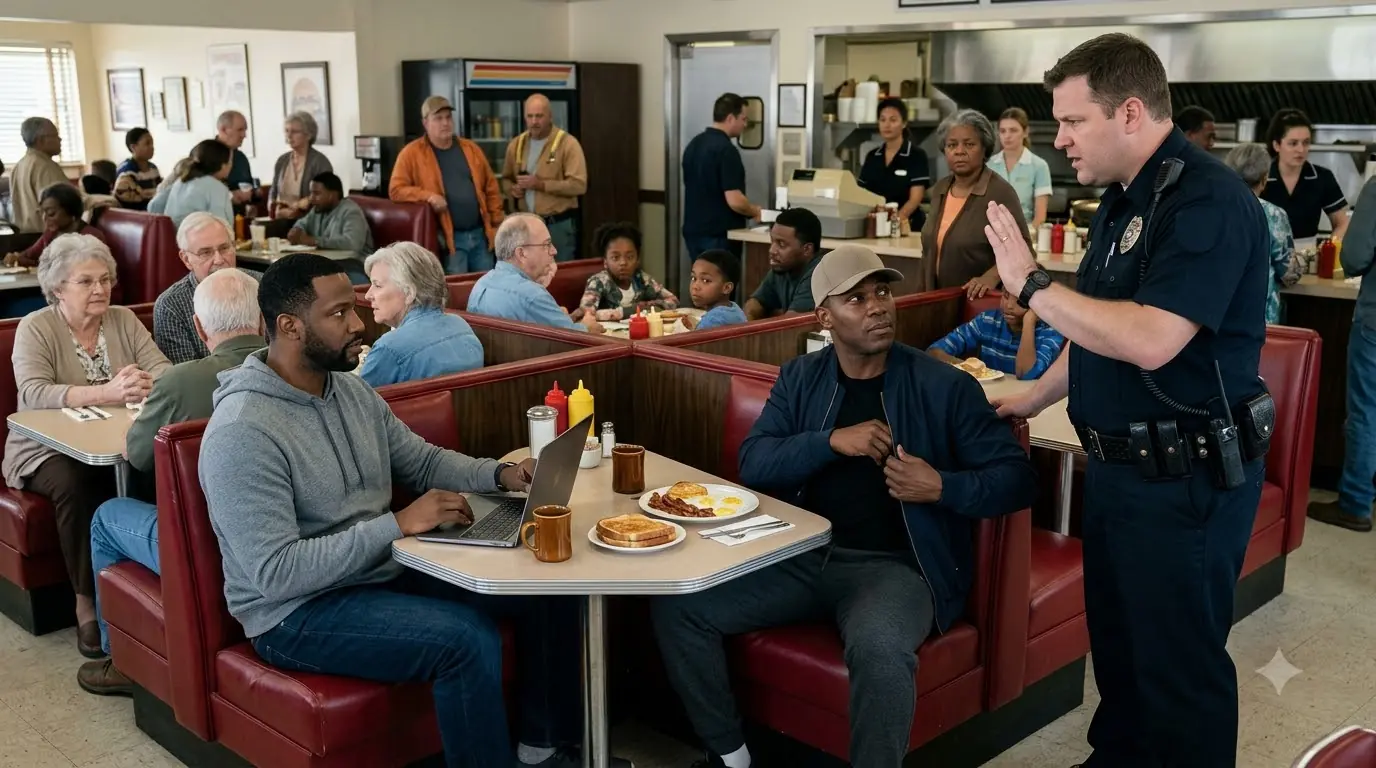
Detective Sergeant Marcus Webb watched the uniformed officer standing beside the booth.
“Are you certain you want to do this here, son?”
“Do not reach inside that jacket.”
The first badge struck the table with a sharp metallic sound.
“Detective Sergeant Darnell Carter, Major Crimes Division, badge number 5192.”
A second badge landed beside it.
“Detective Sergeant Marcus Webb, same division, badge number 4471.”
At exactly 7:42 on a quiet Tuesday morning in Harlow City, Georgia, a routine breakfast between two colleagues became one of the most discussed law-enforcement incidents in the state’s recent history.
It happened inside a corner booth at Rosie’s Classic Diner, located at the intersection of Fifth Street and Maple Avenue.
The diner’s overhead security system was recording.
The responding patrol officer’s body camera was attached to his chest and capturing every second.
In less than nine minutes, a fourteen-year veteran of the Harlow City Police Department made a decision that would destroy everything he had built during his career.
This was not a typical police-misconduct recording.
It was not a civilian being mistreated along a highway.
It was not someone being intimidated inside a parking lot.
It was a uniformed patrol officer, standing in full view of a crowded breakfast diner, attempting to remove two of his own department’s most decorated detectives from a public establishment for no reason other than the color of their skin.
What followed shook the Harlow City Police Department from its patrol divisions to its command staff.
It led to a federal review of the department’s internal culture.
It also proved something many people already understood.
Prejudice does not stop to examine credentials before revealing itself.
Marcus Webb was not an average forty-two-year-old man.
While many people his age thought about mortgages, family schedules, and weekend plans, Marcus was running active surveillance against one of the largest narcotics-distribution networks operating in the southeastern United States.
He joined the Harlow City Police Department at twenty-two, shortly after graduating from Georgia State University.
His degree was in criminal justice.
He also completed a minor in constitutional law.
Marcus had not limited himself to studying police procedures.
He studied the law itself.
He knew the amendments, the precedent-setting court decisions, and the protections granted to every citizen under the United States Constitution.
By the age of thirty, Marcus had been promoted to detective.
At thirty-five, he led investigations that dismantled two organized crime groups operating across three counties.
By forty, the department had awarded him the Medal of Valor twice.
Inside the department, he was known as a man who never raised his voice.
He did not lose control of his emotions.
He also never forgot a face.
His homicide-clearance rate was ninety-four percent, one of the highest in Georgia.
During twenty years of service, Marcus had filed no formal disciplinary complaint against another police officer.
That was not because he had never witnessed questionable behavior.
Until that Tuesday morning, nothing had been this open, direct, and impossible to dismiss.
Darnell Carter was Marcus’s partner, closest friend, and, in many ways, his opposite reflection.
Darnell was also forty-two and a graduate of Georgia State University.
His route into civilian law enforcement had been different.
He spent four years serving with the United States Army Military Police before joining the Harlow City Police Department at twenty-six.
Where Marcus was methodical and exact, Darnell relied more heavily on instinct and speed.
The two men had more than thirty-five years of combined law-enforcement experience.
They had worked undercover inside some of the most dangerous operations the department had ever approved.
They had shared tables with murderers, traffickers, and gang leaders who would have killed them without hesitation if their identities had been discovered.
Marcus and Darnell knew how to remain calm.
They knew how to examine a room without appearing to do so.
When Officer Brian Kowalski entered Rosie’s Diner and looked toward their booth, both detectives understood exactly what was coming.
On Tuesday, March 14, Marcus and Darnell had been awake since five in the morning.
They were entering the final week of a six-month undercover investigation targeting a narcotics-distribution organization operating from Harlow City’s Westside district.
Their clothing reflected their cover identities.
It was casual, inexpensive, and deliberately unremarkable.
Marcus wore dark jeans, a plain gray hoodie, and clean white sneakers.
Darnell wore dark athletic trousers, a navy jacket, and a baseball cap.
No badge was visible.
Neither man wore a department insignia.
Their service weapons were secured inside ankle holsters.
Their credentials remained inside their jacket pockets.
They chose Rosie’s because the diner was quiet during the early morning, located near the neighborhood where they needed to be by nine, and served what they both considered the best coffee in the county.
They needed the coffee.
At approximately 7:35, the detectives entered the corner booth.
They ordered eggs and coffee.
Then they opened a laptop between them and quietly reviewed surveillance notes collected during the previous night.
They were not loud.
They were not disruptive.
They were not arguing or disturbing another customer.
They occupied a booth they had every right to use.
They were two men eating breakfast while performing their jobs.
Everything about their presence was lawful.
The diner was approximately half full.
Several elderly couples sat near the windows.
A mother occupied the booth behind the detectives with her two young children.
A group of construction workers ate at the counter.
The smell of bacon, toast, and freshly brewed coffee filled the warm air.
It was, by every reasonable measure, an ordinary Tuesday morning.
Then the bell above the front door rang.
Marcus looked up from the laptop.
His eyes moved automatically toward the entrance, the way an experienced detective’s eyes always did.
The assessment took less than a second.
Officer Brian Kowalski entered in full patrol uniform.
Marcus watched him examine the room.
He watched Kowalski’s attention settle on the corner booth.
Then he saw the officer’s expression change.
Marcus did not comment immediately.
He lowered his eyes to the laptop, lifted his coffee, and spoke quietly enough that only Darnell could hear him.
“Here we go.”
He nodded once and took a slow drink.
Marcus’s pulse did not quicken from fear.
It moved with recognition.
Officer Brian Kowalski had served fourteen years with the Harlow City Police Department.
He was assigned to patrol duties in the Third Precinct.
At thirty-eight, he was broad-shouldered and wore a nearly permanent scowl that suggested much of the world personally irritated him.
Kowalski received three departmental commendations during his career.
All three involved traffic enforcement.
He also accumulated seven documented complaints from members of the public.
Six alleged racial bias.
Internal reviewers dismissed all seven without disciplinary action.
For Kowalski, entering Rosie’s Diner was simply part of another Tuesday patrol.
At least, that was what he believed.
Kowalski walked slowly along the diner’s center aisle.
Both thumbs rested inside his equipment belt.
He reached the corner booth and stopped without speaking.
For several seconds, he looked down at Marcus and Darnell as though examining a problem he had already decided how to solve.
“Morning,” he finally said.
The word carried no warmth.
Marcus raised his head.
“Good morning, Officer.”
“How long have you two been here?”
“Approximately ten minutes,” Darnell answered without looking away from the laptop.
Kowalski looked at the screen.
Then at the coffee cups.
Finally, he examined both men again.
“What are you boys doing in here?”
The word boys fell into the room like a stone striking still water.
Marcus placed the coffee cup carefully onto its saucer.
“We are eating breakfast, Officer.”
“Is that right?”
Kowalski removed a small field notebook from his pocket and clicked a pen.
“I need identification from both of you.”
Darnell finally looked up.
“For eating breakfast?”
“I will not ask a second time.”
That was where the encounter began moving in the wrong direction for Officer Kowalski.
The men in the booth did not become nervous.
They did not scramble for wallets, apologize, or begin explaining themselves from fear.
They watched him calmly and professionally.
It was the look experienced people gave someone who was making a serious mistake without realizing it.
Marcus leaned slightly against the back of the booth.
“Officer, what is the legal basis for requesting our identification?”
Kowalski’s pen stopped.
“We are seated inside a public establishment. We purchased food and have committed no offense.”
Marcus’s tone remained conversational.
“Under Georgia law, an officer requires reasonable, articulable suspicion of criminal conduct before compelling identification.”
The officer’s jaw tightened.
“So I will ask again. What is the legal basis for your request?”
“The manager called it in.”
“Called what in, specifically?”
“She reported two suspicious individuals inside the establishment.”
Darnell folded his hands together on the table.
He looked at Kowalski with the calm patience of a man who had heard many versions of the same excuse.
“Suspicious in what way?”
Kowalski did not answer.
“Officer,” Marcus continued, “I recommend that you think carefully about your next action.”
The officer’s expression hardened.
“You approached two men who are committing no crime and demanded identification without lawful justification.”
Marcus indicated the body camera.
“That potentially violates our rights under the Fourth Amendment. I want to be completely clear. We understand those rights.”
Kowalski leaned slightly toward the table.
“You know what? I have done this job for fourteen years. I do not need a legal lecture from…”
“From whom?” Darnell asked.
The diner had grown quieter.
The construction workers at the counter had stopped speaking.
The mother with two children watched over the top of the booth.
Several elderly customers near the windows had turned in their seats.
Rosie Tatum had stepped out from behind the service counter.
Rosie was a stout woman in her sixties who owned the diner for thirty years.
She stood beside the register and watched without interfering.
Kowalski straightened.
“I am going to need both of you to pack your things and leave. Right now.”
Marcus looked at him.
“I am sorry. On what grounds?”
“Do not make this difficult. I said leave.”
The body camera captured what happened next in perfect clarity.
Kowalski’s words and the manner in which he delivered them would later be examined in courtrooms, shown on television, and studied in police-ethics classes.
“This is a respectable establishment,” Kowalski said, lowering his voice.
He looked around the diner.
“I believe the people here would feel more comfortable if you took your business somewhere else.”
There it was.
There was no legal argument.
No safety concern.
No genuine procedure.
It was the clearest expression of what the encounter had always been about.
Marcus and Darnell looked at one another.
Twenty years of partnership passed between them through one glance.
Darnell slowly moved one hand toward the inside of his jacket.
“Do not reach inside there,” Kowalski snapped.
Darnell removed the badge.
It struck the table with a sharp, flat metallic sound.
The noise cut through the diner like an alarm.
“Detective Sergeant Darnell Carter, Major Crimes Division, Harlow City Police Department.”
Darnell kept his voice completely level.
“Badge number 5192. Sixteen years with this department.”
Kowalski became still.
Marcus’s badge landed beside Darnell’s.
“Detective Sergeant Marcus Webb, Major Crimes Division, badge number 4471.”
He looked directly at Kowalski.
“Twenty years with the Harlow City Police Department.”
Marcus paused.
“The man seated across from me holds the rank of Detective Sergeant First Class.”
The officer’s eyes moved toward Darnell.
“If you check the department’s organizational chart, you will discover that he is four pay grades above you.”
Color disappeared from Brian Kowalski’s face so completely that a woman at the nearest table later told investigators she believed he might faint.
Marcus picked up his coffee again.
He took a slow drink while looking at Kowalski over the rim of the cup.
“Now I am going to ask you one more question.”
Kowalski said nothing.
“You claimed the manager reported two suspicious individuals.”
Marcus glanced toward Rosie.
“Would you like to ask the manager to identify the people mentioned in that supposed report?”
The officer’s eyes moved briefly toward the owner.
“I would be interested in hearing that conversation.”
Kowalski remained silent.
His body camera was still recording.
Every word he spoke from that point forward would become part of an official record.
He knew it.
The expression on his face revealed that he now understood how much trouble he was in.
“We will finish our breakfast,” Darnell said. “Then we will complete our workday.”
He closed the laptop halfway.
“After that, Officer Kowalski, we will have a much longer conversation about what occurred here this morning.”
Darnell nodded toward the aisle.
“Have a good day.”
Kowalski turned around.
He walked out of the diner without speaking.
The room remained completely silent for three seconds.
Then Rosie began clapping slowly from behind the counter.
The construction workers joined her.
Within moments, nearly everyone in the diner was applauding.
Marcus looked at Darnell.
Darnell looked back.
Then he lifted his fork.
“Your eggs are getting cold.”
Marcus smiled for the first time that morning.
“They are.”
The eggs became cold anyway.
Neither detective finished them.
Within four minutes of Kowalski leaving the diner, Marcus opened a secure department application on his phone.
He began entering a detailed, time-stamped account of the encounter.
Darnell simultaneously created a second record on the laptop.
Neither man performed anger.
They remained exact and methodical.
They were constructing a case.
Both understood it.
“Did you record his badge number?” Darnell asked without looking away from the screen.
“I already had it.”
“The body camera remained active.”
“I saw the indicator light.”
“Good.”
Darnell closed the laptop.
Through the window, Kowalski’s patrol car remained at the curb.
“You know what bothers me most?” Darnell asked.
Marcus waited.
“We spent six months working undercover.”
Darnell looked toward the street.
“We sat in rooms with criminals who hurt people for a living. Some of them treated us with more basic human respect than that officer did.”
Marcus looked down at the coffee.
He considered the statement.
“That is the line I am using in the report.”
Darnell looked back.
“Use it.”
The detectives paid the bill, left Rosie a generous tip, and exited the diner at 8:09.
Twenty-seven minutes passed between Kowalski’s entrance and the detectives’ departure.
Those twenty-seven minutes ended one career.
They also triggered a federal review and changed Harlow City’s police department in ways that continued long after the incident.
Many people subjected to similar treatment might file an informal complaint.
Some would mention the event privately to a supervisor.
Others would decide the process was not worth the effort and allow the encounter to disappear into the enormous collection of incidents that never received proper attention.
Marcus Webb and Darnell Carter were not going to allow that.
By eleven o’clock that same morning, Marcus submitted a formal Internal Affairs complaint against Officer Brian Kowalski.
It was fourteen pages long.
The document was single-spaced.
It included section headings, subsections, and references to specific department policies.
Marcus cited relevant state and federal case law.
He created a timeline of the encounter, divided minute by minute.
He listed each civilian witness and identified where the person had been sitting inside the diner.
That allowed investigators to compare their positions with the overhead security footage.
He formally requested immediate preservation of all diner recordings, patrol vehicle data, radio traffic, and Kowalski’s body-camera footage.
Darnell submitted a separate complaint.
His was eleven pages.
It reached Internal Affairs twenty-three minutes after Marcus’s document.
The Harlow City Police Department’s Internal Affairs Division had operated for decades.
Sergeant Linda Okafor had supervised the unit for six years.
She later stated under oath that she received thousands of complaints during that period.
She had never received one from another police officer that was so thorough, precise, and legally complete.
“When I finished the first page of Detective Webb’s complaint, I understood this would not move through the ordinary process,” Okafor later said.
“I closed my office door, read the entire report without stopping, and called the chief.”
Internal Affairs received both formal complaints at 11:47.
By 2:15 that afternoon, fewer than three hours later, Brian Kowalski had been removed from patrol.
He was reassigned to administrative desk duty.
An emergency review panel was convened.
That speed was not normal.
Investigations involving tenured officers often required weeks merely to schedule the first formal review.
Everyone inside the department understood what the sudden movement meant.
The evidence could not be dismissed.
It could not be ignored.
The complaint was not going to disappear.
Sergeant Okafor obtained Kowalski’s complete personnel file that same afternoon.
What she found confirmed the detectives’ concerns.
There were seven previous complaints.
Each had been dismissed.
Six described racially biased behavior.
Two came from business owners in the same precinct.
Both owners alleged that Kowalski pressured them to call the police and report customers as suspicious.
The complaints were filed independently.
The business owners did not know each other.
The incidents occurred eight months apart.
Both cases were closed without meaningful investigation.
Okafor retrieved the body-camera footage from Rosie’s Diner.
She watched it once.
Then she called her deputy investigator, Marcus Hendrix, into the office and played it again.
After the second viewing, they contacted the department’s legal counsel, Patricia Sims.
All three watched the recording together.
When the video ended for the third time, Sims turned toward the investigators.
“This is no longer only an internal matter.”
She was correct.
The recording verified every important fact described in both complaints.
Kowalski never articulated a legal basis for demanding identification.
He addressed the detectives as boys.
He described Rosie’s as a respectable establishment and stated that other customers would be more comfortable if Marcus and Darnell left.
No manager ever approached Kowalski.
No employee directed him to speak with the detectives.
His claim about a manager’s report was either fabricated or deliberately misrepresented.
The body-camera recording contained another detail Marcus and Darnell did not include because they could not have seen it.
The technical unit enhanced the video and matched its time stamps with the patrol car’s location data.
Kowalski sat inside his cruiser outside Rosie’s Diner for eleven minutes before entering.
He was not answering a dispatch call.
No report came through his radio or computer.
He parked beside the street and looked through the diner windows.
He saw two men sitting inside a booth.
Then he decided to go inside.
Nobody called him.
Nobody reported Marcus or Darnell.
The officer created the entire encounter on his own.
Those eleven minutes changed the investigation.
What began as a misconduct complaint became something much more serious.
The formal investigation required nineteen days.
For a case involving a veteran officer, that was extraordinarily fast.
Many investigations needed at least sixty days to pass the preliminary stage.
This case did not contain meaningful ambiguity.
The evidence was detailed, preserved, and corroborated by independent recordings and witnesses.
The department’s review board received copies of the body-camera footage.
So did the city’s independent oversight committee and the Georgia Attorney General’s Office.
Each organization received the diner surveillance recordings, the two formal complaints, witness statements, and Kowalski’s complete disciplinary record.
Everything was documented.
Everything had been recorded.
There was little room for denial.
On April 2, the review board released its official findings.
The board concluded that Officer Brian Kowalski engaged in racially discriminatory conduct.
His actions violated department policy, municipal ordinance, and constitutional equal-protection principles.
The board determined that Kowalski made a materially false statement when he claimed Rosie’s manager had reported suspicious people.
No such report existed.
Investigators also concluded that Kowalski’s complaint history and the diner witnesses demonstrated a repeated pattern of racially selective enforcement.
The behavior was not isolated.
It was not accidental.
The board found that the seven previous complaints had been dismissed without adequate investigation.
That finding opened a separate inquiry into the supervisors who approved those dismissals.
The board recommended immediate termination.
Brian Kowalski resigned before the department could complete the formal process.
His resignation letter contained two sentences.
A fourteen-year career ended nineteen days after the morning he entered Rosie’s Diner and told two of the department’s most decorated detectives to leave because he believed they were unimportant men who did not belong there.
The department initially attempted to handle the matter entirely through internal procedures.
There was no press conference.
No public statement announced Kowalski’s resignation.
The review board’s report was filed inside the department’s records system.
For approximately one week, it appeared the story might quietly disappear.
Then Rosie Tatum made a decision nobody expected.
Rosie was sixty-four years old.
She had three children and five grandchildren.
She spent thirty years operating the diner and watching the neighborhood around it change.
At 9:30 on a Thursday evening, Rosie uploaded the security recording to her personal social-media page.
She added one caption.
“This happened inside my diner. These two men are heroes. The officer responsible is gone. People need to understand that this happens every day.”
By Friday morning, the post had been shared forty thousand times.
Three local television stations aired the video by Friday evening.
National news organizations obtained it by Saturday morning.
By Sunday, the footage had been watched more than eighteen million times across major platforms.
Legal commentators examined it frame by frame.
Retired police officers discussed the procedural violations.
Law professors showed the recording to students as a real-time example of Fourth Amendment rights and police accountability.
Civil-rights organizations issued statements.
The mayor responded publicly.
The governor’s office followed.
Many people praised Marcus and Darnell for maintaining control and addressing Kowalski with professionalism.
Others focused on a more disturbing question.
Would the department have acted as quickly if the victims had not been police officers?
Thousands of ordinary residents experienced similar treatment without badges to place on tables.
Some viewers described Kowalski as one bad officer.
Others argued that seven prior complaints, all dismissed, demonstrated a problem far more systemic than one person.
Some praised Harlow City’s leadership for reacting within hours.
Others noted that the department already had seven opportunities to act and refused each time.
One fact remained impossible to challenge.
Marcus Webb and Darnell Carter were correct.
Every material detail.
Every legal citation.
Every allegation.
Every minute of the account.
The Harlow City Police Department announced institutional changes during the weeks that followed.
Implicit-bias instruction became mandatory for patrol officers, supervisors, detectives, and command personnel.
The department redesigned the Internal Affairs review process.
Any complaint alleging racially discriminatory behavior would automatically receive a secondary examination by an independent reviewer.
The complaint could no longer be handled exclusively by supervisors inside the accused officer’s direct chain of command.
All seven previously dismissed complaints against Kowalski were reopened.
Three supervisors who approved those dismissals received formal disciplinary action.
One retired before the proceedings were complete.
The department also revised its policy concerning suspicious-person reports.
Any officer responding to such a report would be required to state, in writing and on body camera, the specific facts supporting reasonable suspicion before initiating enforcement action.
The new policy required officers to do exactly what Marcus asked Kowalski to do inside Rosie’s booth.
State the facts clearly.
Explain the lawful justification.
Place the reasoning on the record before taking action.
After the diner footage became public, four additional people described previous encounters with Kowalski.
One was a college student sitting inside his car near a public library.
Another was a small-business owner unloading inventory from a van outside his own store.
The third was a pastor walking home after an evening service.
The fourth was a retired teacher waiting at a bus stop.
Their stories contained the same pattern.
Kowalski approached without a legitimate complaint.
He treated ordinary behavior as suspicious.
He demanded identification and used authority to intimidate them.
None filed a formal complaint at the time.
Some believed nobody would take it seriously.
Others were afraid of retaliation.
After seeing the diner recording, all four contacted the Harlow City chapter of the NAACP during the same week.
Their accounts raised an unavoidable question.
How many similar encounters disappeared because the person being targeted had no badge to place on a table?
How many were never recorded, investigated, or corrected?
How many officers continued filing suspicious-person reports that no one had actually made?
How many people were forced to prove they belonged in places where they already had every legal right to stand, sit, work, or eat?
Marcus and Darnell returned to their undercover assignment.
Two weeks after the diner incident, they completed the six-month investigation.
The narcotics-distribution network was dismantled through a coordinated arrest operation.
Twenty-three people were arrested.
Investigators completed the largest narcotics seizure in Harlow City’s history.
Both detectives received departmental commendations for the operation.
Marcus was promoted to lieutenant later that year.
The promotion made him one of the highest-ranking officers inside the Major Crimes Division.
Darnell received an offer to become an instructor in the department’s redesigned officer-conduct and ethics program.
The program used the recording from Rosie’s Diner as its opening case study.
Neither man granted media interviews after the video became public.
They declined television appearances and individual profiles.
Their only public response was a joint written statement.
“We are grateful that the department treated this matter seriously.
“We hope this incident reminds officers and citizens that accountability is not the enemy of good policing.
“It is the foundation of good policing.”
Brian Kowalski did not return to law enforcement.
His certification through the Georgia Peace Officer Standards and Training Council, the credential required to work as a police officer in the state, was placed under formal review.
The final outcome of that certification process was not publicly released.
Rosie’s Classic Diner remained open.
The same customers continued arriving for breakfast.
Coffee was poured beneath the same warm lights.
Construction crews still occupied the counter during early mornings.
Families continued filling the booths.
A small framed photograph eventually appeared on the wall beside the corner booth.
It showed Marcus Webb and Darnell Carter dressed in suits with their badges visible.
The picture was taken on the day Marcus received his promotion.
Rosie selected the photograph and placed it there herself.
She said it would remain permanently.
The booth became more than the location of an ugly encounter.
It became a reminder of what happened when prejudice believed nobody important was watching.
Kowalski saw two men in casual clothes and believed that was enough information to decide who they were.
He sat outside for eleven minutes, creating suspicion from nothing.
Then he entered a public business, invented a report, demanded identification without lawful grounds, and attempted to remove them because their presence made him uncomfortable.
The badges did not create Marcus and Darnell’s dignity.
They only forced Kowalski to recognize authority he had already decided they could not possess.
The recording mattered because most people treated the same way could not end the encounter by placing police credentials on a table.
They had only their voices.
Their rights.
Their own account of what happened.
That was why the reopened complaints mattered.
It was why independent review mattered.
It was why the revised suspicious-person policy mattered.
Marcus and Darnell did not ask for special treatment.
They asked one officer to explain the law supporting his actions.
He could not.
Everything that followed began with that failure.
The officer wanted two men to justify their presence.
Instead, he was finally required to justify his authority.
Rosie’s security camera preserved the room.
Kowalski’s own body camera preserved his language.
The detectives preserved the timeline.
The witnesses preserved what they saw.
Together, those records prevented the encounter from becoming another unproven allegation buried inside a personnel file.
Marcus spent twenty years learning the law, developing patience, and documenting evidence.
Darnell spent years learning when instinct needed to be supported by facts.
Inside the diner, both men understood that anger would give Kowalski something to use against them.
Precision gave him nothing.
They did not shout.
They did not threaten.
They asked questions.
“What law have we violated?”
“What facts created suspicion?”
“Who called you?”
“Why are you asking for identification?”
Those questions exposed the absence of a lawful answer.
The badges were the final revelation, but they were not the reason the detectives were right.
Marcus and Darnell were right before Kowalski knew their names.
They were right while they sat in hoodies and casual clothes.
They were right when they appeared to be ordinary customers.
The Constitution did not begin protecting them after the badges touched the table.
It protected them from the moment they entered the diner.
Kowalski’s mistake was not simply failing to recognize two senior detectives.
His mistake was believing rights depended upon who a person turned out to be.
The department’s eventual response acknowledged that truth.
Accountability came quickly once the victims were known and respected officers.
The reopened cases asked why the same concern had not been given to earlier complainants.
The independent review requirement attempted to answer that failure.
The training program forced officers to watch one of their own create a crisis from an assumption.
Every class began with the same ordinary scene.
Two men drinking coffee.
A laptop open between them.
Breakfast cooling on the table.
A patrol officer deciding that their presence required investigation.
Then came the questions.
Then the false report.
Then the order to leave.
Then the badges.
For new recruits, the lesson was not to avoid harassing undercover detectives.
The lesson was to avoid harassing anyone.
One morning, several months after the investigation, Marcus returned to Rosie’s alone.
He was wearing a suit and had already been promoted.
The breakfast rush was beginning.
Rosie poured his coffee before he asked.
Marcus looked toward the photograph near the booth.
“You did not need to put that there.”
“I know.”
Rosie placed the coffee in front of him.
“I wanted to.”
Marcus studied the picture.
Darnell was smiling.
Marcus looked uncomfortable, as he normally did when a camera was pointed directly at him.
Rosie rested one hand on the table.
“I keep thinking about that morning.”
“So do I.”
“I should have said something before the badges came out.”
Marcus looked at her.
“You were watching a uniformed officer. Most people hesitate.”
“That does not make it right.”
“No.”
Rosie nodded.
“But you preserved the recording. You told the truth. You refused to let the department hide it.”
She looked toward the photograph.
“I suppose that counts for something.”
“It counts for a great deal.”
Rosie moved toward another customer.
Marcus remained in the booth and looked through the window.
The street outside appeared ordinary.
Patrol cars occasionally passed.
People walked into stores and waited for buses.
There was no sign of what happened months earlier.
That was another lesson of the case.
The places where rights were violated did not always look dangerous.
Sometimes they were warm diners filled with coffee and morning light.
Sometimes the person misusing authority appeared calm and professional.
Sometimes the violation began with a familiar word.
“Morning.”
Then came an assumption.
Then a request without legal grounds.
Then an order issued because the person wearing the uniform expected obedience.
Marcus and Darnell recognized the progression because they had spent their careers studying people who used power for unlawful purposes.
Kowalski believed he was different from those people because he wore a badge.
The investigation proved the badge did not change the nature of the conduct.
Authority without lawful justification was still abuse.
A false statement in a police report was still a false statement.
Targeting a person because of race remained discrimination, regardless of the language used to disguise it.
The department’s revised policies could not guarantee that another officer would never make the same choice.
Policies were only words until people enforced them.
The independent review system was designed to ensure complaints could not disappear as easily as Kowalski’s previous seven complaints.
The body-camera requirement created a record.
The new suspicious-person procedure required officers to identify facts rather than rely on vague feelings.
Those changes came because Marcus and Darnell refused to let the incident be reduced to an uncomfortable misunderstanding.
They named each violation.
They documented every minute.
They forced the institution to examine not only what Kowalski did, but what supervisors had allowed him to do for years.
Three supervisors faced disciplinary consequences because the investigation did not stop with the officer inside the diner.
It followed the paper trail.
It examined the people who signed dismissal forms.
It asked why separate complainants described the same conduct without receiving meaningful investigations.
It asked who benefited when those files were closed.
One supervisor retired early.
The other two remained in the department under formal corrective agreements.
They were required to complete management training and submit complaint decisions to independent review.
For the first time, their signatures carried consequences.
The four people who later came forward also changed the investigation’s meaning.
The college student described sitting inside his car while waiting for the library to open.
Kowalski accused him of planning a burglary.
The young man showed a university identification card and a library reservation email.
The officer still searched the vehicle.
No report was filed.
The business owner described unloading boxes through the rear entrance of his store.
Kowalski demanded proof that he owned the building.
The owner produced keys, invoices, and a business license.
Kowalski told him that people had to be careful in that neighborhood.
The pastor described walking home in formal clothing after a late service.
Kowalski stopped him and asked why he was wandering.
The pastor pointed toward the church less than two blocks away.
The officer kept him on the sidewalk for twenty minutes.
The retired teacher was waiting for a bus in daylight.
Kowalski repeatedly asked whether she lived in the area and why she was traveling alone.
She never filed a complaint because she assumed the department would believe its officer over her.
After Rosie shared the video, each person recognized the same tone.
The same questions.
The same presumption that ordinary activity became suspicious when performed by certain people.
Their statements did not result in additional criminal charges.
They did establish a broader pattern.
The Georgia Attorney General’s Office included their accounts in its cultural review of the department.
Federal reviewers examined traffic stops, pedestrian contacts, and suspicious-person reports filed during the previous five years.
The review found significant disparities across several precincts.
The Third Precinct, where Kowalski worked, produced the highest number of unsupported suspicious-person contacts.
Command staff could no longer describe the problem as one officer’s isolated behavior.
The department had allowed a culture where weak justifications were rarely questioned.
Some officers learned that vague language was enough.
“Did not appear to belong.”
“Acted nervous.”
“Looked out of place.”
“Concerned resident called.”
In many reports, no resident’s name or telephone number existed.
The new policy required officers to document those details.
Anonymous reports remained possible, but the officer still needed independent facts before detaining anyone.
A call alone was not automatically reasonable suspicion.
A feeling was not evidence.
A person’s race, clothing, or presence in a particular business could not become the justification.
These principles already existed in law.
The department had simply failed to enforce them consistently.
Marcus was later asked to assist with the policy review.
He accepted on one condition.
The committee had to include ordinary residents, not only attorneys and command officers.
Rosie agreed to participate.
So did the college student, the pastor, the business owner, and the retired teacher.
Darnell joined as a training representative.
During the first meeting, a command officer suggested that the diner encounter had been especially serious because Kowalski mistreated senior detectives.
Marcus corrected him immediately.
“The seriousness does not come from our rank.”
The room became quiet.
“It comes from the conduct.”
He looked around the table.
“If Darnell and I had been unemployed, visiting relatives, delivering food, or simply eating breakfast, the officer’s actions would have been equally unlawful.”
The command officer nodded.
Marcus continued.
“Our credentials made the department react. That fact should concern everyone in this room.”
The sentence became part of the committee’s final report.
It was quoted by local newspapers and later included in the department’s training manual.
Accountability could not depend on whether the victim carried credentials.
Good policing required lawful treatment before identity, status, or influence became known.
Darnell approached training differently.
He placed new officers inside simulated situations.
Actors sat in vehicles, waited near stores, or ate inside public businesses.
The trainees received vague dispatch information.
Some calls came from genuinely concerned residents.
Others came from biased or mistaken callers.
The officer had to separate a report from evidence.
Darnell stopped the exercise whenever a trainee relied on instinct without explaining facts.
“What exactly did you observe?”
The trainee would answer.
“He seems suspicious.”
“That is a conclusion. What fact led you there?”
“He looked around.”
“People look around. What crime does that indicate?”
“He was near a closed business.”
“Is the sidewalk public?”
“Yes.”
“Then what do you have?”
Often, the answer was nothing.
That was the point.
Darnell showed the Rosie’s video at the end of each course.
The footage stopped immediately before the badges appeared.
He asked the class whether Kowalski’s actions were lawful based only on the information available at that moment.
The correct answer could not depend on the later reveal.
The two men were protected by law before the class learned they were detectives.
When the video resumed and the badges struck the table, recruits felt the same shock Kowalski experienced.
Then Darnell asked a final question.
“Why did knowing their jobs change your emotional reaction?”
The room was often silent.
That discomfort was part of the training.
The department’s leadership wanted the video to become a lesson about professional embarrassment.
Marcus and Darnell insisted it become a lesson about equal rights.
Rosie’s Diner became locally famous after the recording spread.
Visitors asked to sit inside the corner booth.
Rosie refused to turn it into a spectacle.
She did not sell themed merchandise or rename breakfast items.
“It is still a diner,” she told reporters. “People come here to eat.”
The framed photograph was the only permanent marker.
Underneath it, Rosie later placed a small metal plaque.
ACCOUNTABILITY IS THE FOUNDATION OF GOOD POLICING.
Those were the detectives’ own words.
Customers occasionally asked Rosie what she remembered most.
It was not the badges.
It was the silence immediately before Darnell reached inside his jacket.
Rosie remembered Kowalski standing over the booth.
She remembered the children behind Marcus and Darnell watching an officer tell two men they did not belong.
She remembered wondering whether speaking would make the situation worse.
Then the badges appeared, and everyone suddenly felt safe enough to clap.
That realization stayed with her.
Why had the room waited until it learned the men possessed power?
Why had nobody applauded when Marcus calmly described the law?
Why did courage arrive only after the risk disappeared?
Rosie never found an answer that satisfied her.
She did decide that if something similar happened again, she would not wait.
Months later, she demonstrated that decision.
A private security guard confronted a Latino delivery driver near the diner’s rear entrance.
The driver wore a company uniform and held an invoice.
The guard still demanded that he leave.
Rosie walked outside before the exchange escalated.
“He is delivering my supplies.”
The guard attempted to explain.
Rosie interrupted.
“You did not ask me. You decided he did not belong.”
She directed the driver toward the kitchen and ordered the guard off the property.
No badges were required.
No video became national news.
The moment ended because someone spoke before the person being targeted had to prove his value.
Marcus heard about it later.
He sent Rosie a short message.
“That is how change is supposed to look.”
The narcotics case also continued shaping Marcus and Darnell’s careers.
The twenty-three arrests produced several convictions.
The organization’s financial records led investigators into two neighboring states.
Marcus’s promotion placed him in charge of teams conducting major felony investigations.
Darnell continued fieldwork while designing ethics instruction.
Their partnership changed but did not end.
They still met at Rosie’s when schedules allowed.
Darnell normally arrived first.
Marcus normally complained that the coffee was too strong while finishing two cups.
They avoided the famous booth when visitors were waiting for it.
Rosie reserved another corner table for them.
One morning, Darnell found Marcus reading Kowalski’s original body-camera transcript.
“You still look at that?”
“Occasionally.”
“Why?”
Marcus closed the file.
“To remember how ordinary it sounded at the beginning.”
Darnell sat across from him.
The first words were not a threat.
Kowalski said good morning.
He asked how long they had been there.
Only gradually did the purpose become clear.
“That is how these things often happen,” Marcus said. “Not all at once.”
A request becomes a demand.
A question becomes an accusation.
A person’s refusal to surrender a right becomes resistance.
By the time the misconduct is obvious, the report may already describe an entirely different event.
The cameras prevented that transformation.
Kowalski could not later claim Marcus and Darnell were aggressive.
He could not say they refused a lawful order because he never identified a lawful basis.
He could not claim Rosie asked him to remove them.
The footage showed he sat outside before entering without a call.
Technology alone did not create accountability.
Someone still had to preserve the footage.
Someone had to review it honestly.
Someone had to compare it with the written report.
For years, Kowalski’s body-camera recordings may have existed without supervisors asking the right questions.
The diner case was different because Marcus and Darnell knew exactly what to request.
They named the recordings before anyone could erase or overwrite them.
They identified the witnesses before memories faded.
They cited the law before the department could frame the event as a disagreement about manners.
Their experience allowed them to build a case ordinary citizens should never have been required to build alone.
That became another recommendation in the oversight report.
Complainants would receive assistance gathering available evidence.
The burden would not fall entirely on the person alleging misconduct.
Internal Affairs investigators would be required to request dispatch logs, location data, and body-camera footage immediately after receiving a credible complaint.
The department also extended the retention period for recordings connected to bias allegations.
Those reforms seemed technical.
For people who had watched complaints disappear, they mattered.
The retired teacher later received a written apology from the department.
So did the pastor and business owner.
The college student declined one.
He said an apology without consequences did not repair what happened.
The department respected his decision.
He later served as a community representative during recruit interviews.
He asked each applicant the same question.
“What would you do if your partner stopped someone without legal cause?”
Many candidates answered that they would speak to the partner privately afterward.
The student rejected that response.
“What would you do while the person’s rights were being violated?”
That distinction became another part of the hiring process.
Finnish the report later was not enough.
Apologize privately was not enough.
A good officer needed the courage to intervene while misconduct was occurring.
Brian Kowalski’s resignation did not automatically end the harm he caused.
The dismissed complaints remained.
The people stopped by him remembered the encounters.
The department had to decide whether it would protect its reputation or examine its failures.
The viral recording made silence impossible.
Public pressure forced action that should have occurred earlier.
Marcus understood that reality.
He did not confuse the department’s eventual speed with institutional courage.
The department acted quickly because the evidence was overwhelming and the victims held respected positions.
The test would come later, when the complainant had no badge, public audience, or legal education.
The revised process was intended for that person.
A teenager sitting in a car.
A pastor walking home.
A woman waiting for transportation.
A business owner opening his own store.
The real measure of reform would be whether those people received the same attention.
Sergeant Linda Okafor remained in charge of Internal Affairs.
She created a quarterly audit of bias complaints.
Independent reviewers selected closed cases at random and examined whether investigators interviewed witnesses, retrieved recordings, and analyzed the officer’s stated legal basis.
The first audit discovered two additional cases requiring reopening.
Neither involved Kowalski.
One supervisor attempted to resist the review.
Okafor placed Marcus’s fourteen-page complaint on the conference table.
“This is the standard.”
The message was understood.
Patricia Sims, the department attorney, began teaching supervisors how repeated small complaints could establish a larger pattern.
One report might be ambiguous.
Seven reports describing similar conduct required serious attention.
Dismissing each complaint individually could hide what became obvious when the files were placed side by side.
Kowalski’s history demonstrated that failure.
Every complainant had seen one piece.
The department possessed all seven and still refused to assemble them.
The oversight committee called that an institutional blind spot.
Community members called it protection.
The final report used both terms.
Three years after the diner incident, Harlow City published statistics showing a reduction in unsupported suspicious-person stops.
Complaints involving racial bias also decreased.
Officials initially celebrated the numbers.
Marcus remained cautious.
“A lower number may mean better behavior,” he said during a council presentation. “It may also mean people still do not trust the complaint process.”
The department began surveying residents who had contact with officers.
The results improved gradually.
Trust did not return because of one training course or policy change.
It returned through repeated experiences where officers acted lawfully when no camera audience was present.
Darnell’s students sometimes approached him years after completing the ethics program.
One officer described receiving a vague report about a teenager near parked cars.
The officer found the teenager retrieving sports equipment from his mother’s vehicle.
Instead of ordering him against the car, the officer asked a neutral question and verified the information.
The encounter lasted less than one minute.
Nothing dramatic happened.
“That is the point,” Darnell told him.
Success often looked like a story that never became a scandal.
Marcus and Darnell never described themselves as heroes for what happened at Rosie’s.
They considered their response part of the job.
Rosie disagreed.
The photograph stayed beside the booth.
The diner owner believed heroism did not always require danger.
Sometimes it required maintaining dignity while another person attempted to remove it.
Sometimes it meant writing fourteen pages when it would be easier to go home angry.
Sometimes it meant forcing an institution to confront a pattern it preferred not to see.
On the anniversary of the incident, Rosie invited the two detectives to breakfast.
No reporters attended.
There was no ceremony.
The construction workers at the counter recognized them and nodded.
The mother who had been there with her children returned.
Her children were older and still remembered the badges hitting the table.
One asked Marcus whether he had been afraid.
Marcus thought before answering.
“No.”
Then he corrected himself.
“I was concerned about what the officer might do if he felt embarrassed.”
The child looked confused.
“People with authority can become dangerous when they believe they are losing control,” Marcus explained. “That is why staying calm mattered.”
Darnell added another answer.
“We also knew cameras were recording.”
“What if they were not?”
Darnell looked toward Marcus.
“Then we would still tell the truth.”
The child nodded.
The response was simple.
The reality behind it was not.
Many people told the truth and were not believed.
That was why witnesses, records, and fair investigations mattered.
Rosie brought eggs and coffee.
She placed the plates in front of them.
“Try eating them before they become cold this time.”
Darnell smiled.
“No promises.”
The same bell rang above the door when another patrol officer entered.
For half a second, the room became quieter from memory.
The officer nodded politely toward the detectives and approached the counter.
Nothing happened.
Marcus lifted his fork.
Darnell looked at him.
“That is progress.”
Marcus glanced toward the photograph beside the booth.
“It is a beginning.”
Rosie’s Diner returned to its ordinary rhythm.
Coffee poured.
Plates moved between the kitchen and tables.
People entered, ate, paid, and left.
The corner booth remained available to anyone who arrived first.
That ordinariness was what Marcus and Darnell had been defending from the beginning.
The right to sit inside a public diner without being treated as a criminal.
The right to ask an officer for lawful justification.
The right to exist without proving status first.
Brian Kowalski thought the badges changed everything.
They changed only his understanding of the risk.
The law had not changed.
The detectives’ rights had not appeared suddenly.
The men inside the booth had not become more deserving of respect after identifying themselves.
They were the same people before and after the badges touched the table.
That was the lesson preserved inside the body-camera recording.
Prejudice looked at Marcus Webb and Darnell Carter and saw men it believed could be ordered out without consequence.
Accountability looked at the same recording and asked why any person should have been treated that way.
The department’s future depended upon which question its officers chose to remember.
The photograph beside Rosie’s corner booth remained.
Marcus in a suit.
Darnell beside him.
Both badges visible.
Rosie understood that the badges were not the most important part of the picture.
She placed it there because of what the men did after the officer left.
They documented.
They reported.
They followed the evidence into old personnel files and closed complaints.
They did not settle for one resignation.
They forced the system to examine how it had protected the same behavior before.
Officer Kowalski lost his career because of a decision made during an ordinary breakfast.
The department changed because two detectives refused to let that decision disappear.
The rest of the city learned because one diner owner pressed publish.
Accountability began inside a booth with two cups of coffee, cold eggs, and a simple question an officer could not answer.
“On what grounds?”