“Get off the bench, you filthy dog. People like you don’t belong outside this courthouse.”
Officer Raymond Keller tipped the white paper cup forward.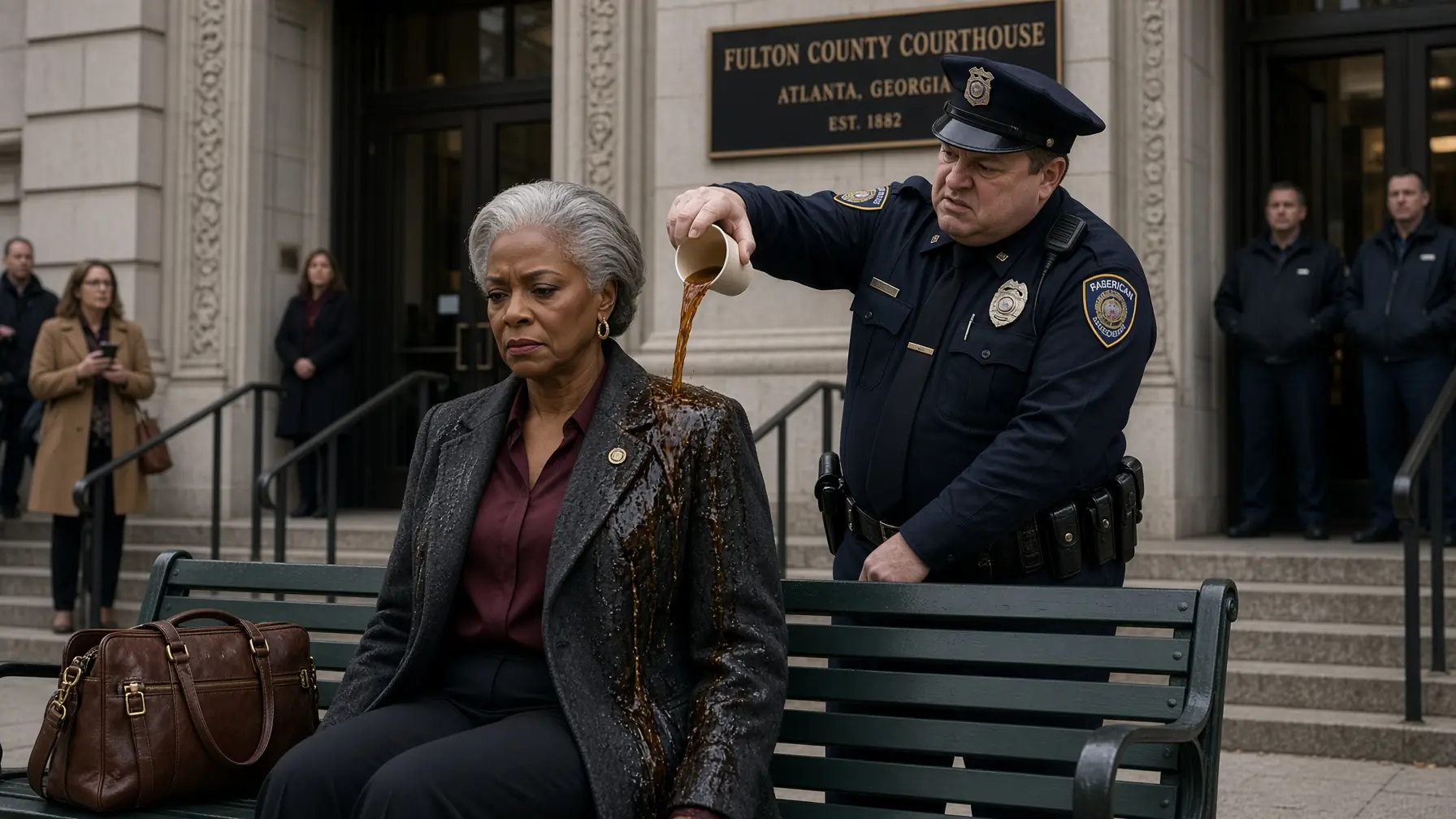
Hot coffee spilled across the left shoulder of the woman sitting quietly on the green metal bench outside the Fulton County Courthouse in Atlanta. It soaked into her charcoal wool coat, ran down the sleeve, and dripped onto the pavement beside her polished black shoes.
Several people on the courthouse steps saw it happen.
Nobody moved.
The woman lowered her eyes toward the dark stain spreading across her coat. Her name was Evelyn Carter. She was fifty-eight years old, elegant and composed, with deep-brown skin, intelligent dark eyes, and silver-gray hair swept neatly away from her face.
A brown leather legal bag rested beside her.
Keller did not notice it.
He was too busy enjoying the silence.
“You should remember every word you just said,” Evelyn replied.
Keller leaned over her shoulder.
“Or what? You think somebody inside gives a damn what happens to you?”
Evelyn slowly opened her leather bag.
She removed a black identification wallet and held it where he could see it.
“You’re about to find out,” she said. “I take the bench in ten minutes, and your name is first on my docket.”
Keller stared at the identification.
HON. EVELYN CARTER
SUPERIOR COURT JUDGE
For three seconds, the courthouse plaza seemed to stop breathing.
Keller’s expression changed first from irritation to confusion.
Then from confusion to disbelief.
Finally, fear.
Evelyn closed the wallet.
She stood.
Coffee still dripped from her sleeve.
Keller opened his mouth.
“Judge Carter, I—”
“Don’t.”
The word was quiet.
It stopped him faster than a shout could have.
Evelyn picked up her leather bag.
“You’ve already said enough.”
She walked toward the courthouse doors.
Keller remained beside the bench.
Behind him, two courthouse employees exchanged glances. A young attorney standing near the steps had already pulled out his phone, though Evelyn had not noticed.
Keller had.
And suddenly he understood that whatever happened next would not remain between two people on a sidewalk.
Evelyn Carter had been a judge for eleven years.
Before that, she had spent seventeen years as a prosecutor and six years in private practice.
She had presided over murder trials, financial fraud cases, complex civil disputes, police misconduct hearings, and cases that had filled the courthouse gallery with reporters.
She rarely raised her voice.
People who worked with her knew that the quieter Evelyn became, the more carefully everyone else should choose their next sentence.
That morning she had arrived early because her driver was unavailable and she wanted ten minutes alone before a difficult hearing.
Her robe was already in chambers.
She wore ordinary professional clothes beneath her coat.
No entourage.
No court officer beside her.
No visible symbol that would tell a stranger she had authority.
That had apparently been enough for Raymond Keller to decide she did not matter.
Inside the courthouse lobby, security officer Denise Hart looked up and immediately noticed Evelyn’s coat.
“Judge Carter?”
Evelyn continued toward the elevators.
Denise followed.
“What happened?”
“Coffee.”
“I can see that. How?”
Evelyn stopped.
She looked toward the glass doors.
Keller was now entering the courthouse.
His face was pale.
“He poured it on me.”
Denise stared at her.
“Who?”
Evelyn looked directly toward Keller.
“That officer.”
Denise’s expression hardened.
Keller saw both women looking at him and immediately changed direction.
“Judge, please.”
Evelyn pressed the elevator button.
“I said don’t.”
“Ma’am, I misunderstood what was happening.”
The elevator doors opened.
Evelyn stepped inside.
Denise joined her.
Keller moved forward.
Evelyn held up one hand.
“You are scheduled to appear in Courtroom 4B at ten o’clock.”
Keller stopped.
“I know.”
“Then be there.”
The doors closed.
Only then did Denise speak.
“He’s the officer in the Henson hearing.”
“Yes.”
Denise looked at the coffee stain again.
“You want me to call the chief?”
“No.”
“The sheriff?”
“Not yet.”
Denise hesitated.
“What do you want?”
Evelyn looked at the elevator numbers rising above the door.
“Preserve the exterior camera footage.”
Denise nodded immediately.
“All of it?”
“From the moment I arrived until Keller entered the building.”
“Done.”
“And find out whether anyone else recorded what happened.”
Denise studied her.
“You think he’s going to deny it?”
Evelyn’s expression did not change.
“I think evidence should exist before memory becomes convenient.”
In chambers, Evelyn removed the ruined coat.
Her judicial assistant, Marlene Price, stared when she saw it.
“What happened to you?”
“Coffee.”
“Coffee does not pour itself down one shoulder.”
Evelyn hung the coat carefully.
“Officer Keller decided I should leave the courthouse bench.”
Marlene froze.
“Raymond Keller?”
“Yes.”
“The officer testifying today?”
“Yes.”
Marlene slowly set down the files in her hands.
“You cannot be serious.”
Evelyn changed into her black judicial robe.
“Unfortunately, I am.”
Today’s hearing concerned twenty-six-year-old Marcus Henson, a delivery driver who had been arrested six months earlier after an encounter with Keller and another officer outside a convenience store.
Keller claimed Marcus had resisted a lawful detention.
Marcus claimed Keller became aggressive after Marcus questioned why officers were searching his vehicle.
The criminal charges against Marcus had already begun falling apart.
A convenience-store camera contradicted part of Keller’s written statement.
His body-camera recording began four minutes after he claimed the confrontation started.
That missing period had become important.
The prosecutor had requested a special evidentiary hearing because discrepancies now raised questions about Keller’s credibility.
Evelyn had been assigned the matter.
Keller was the principal witness.
And ten minutes before he was supposed to defend his professional conduct, he had poured coffee onto the judge presiding over the hearing because he assumed she was someone he could mistreat without consequence.
Marlene exhaled.
“You need to recuse yourself.”
Evelyn looked at her.
“I know.”
The answer surprised her assistant.
Evelyn continued.
“If I remain on this hearing after what happened outside, anything I rule against him can be attacked as personal retaliation.”
“Even with video?”
“Especially with video.”
Marlene nodded.
“So what now?”
“I put what happened on the record. I transfer the underlying hearing to another judge.”
“And Keller?”
Evelyn looked toward the door.
“What happened outside becomes its own matter.”
At exactly ten o’clock, the bailiff called the courtroom to order.
People rose.
Evelyn entered from chambers.
Marcus Henson sat beside his attorney.
Assistant District Attorney Laura Bennett sat at the opposite table.
Several police officers occupied the first gallery row.
Keller sat among them.
When Evelyn entered, he stood with everyone else.
His eyes locked on her.
Then on the bench.
The reality of what he had done seemed to hit him all over again.
Evelyn took her seat.
“Be seated.”
The courtroom settled.
She opened the case file but did not begin with Marcus.
“Before this court addresses the scheduled evidentiary hearing, there is a matter that must be placed on the record.”
Keller looked toward his attorney.
Evelyn continued.
“At approximately 9:42 this morning, outside the main courthouse entrance, I had an encounter with a witness scheduled to testify in this proceeding.”
Whispers moved through the gallery.
“I was seated on a public bench. Officer Raymond Keller approached me.”
Keller’s attorney stood.
“Your Honor—”
“Sit down, counsel. I am establishing the basis for recusal.”
The attorney slowly sat.
Evelyn continued.
“During that encounter, Officer Keller directed insulting language toward me and intentionally poured a cup of coffee onto my clothing.”
The courtroom went completely silent.
Marcus turned toward Keller.
Laura Bennett’s mouth tightened.
Several officers stared at the floor.
Evelyn continued.
“Officer Keller apparently did not know my identity at the time.”
Keller closed his eyes briefly.
“That fact,” Evelyn said, “does not improve the conduct.”
A quiet murmur passed through the gallery.
Evelyn looked toward both legal teams.
“Because Officer Keller is a material witness in today’s hearing, and because I am now a direct witness to separate conduct involving him, I will not preside over the evidentiary determination concerning Mr. Henson.”
Marcus’s attorney stood.
“Judge Carter, we understand.”
“The matter will be reassigned.”
Evelyn looked toward Marcus.
“Mr. Henson, this does not determine the merits of your case. Another judge will review the evidence independently.”
“Yes, Your Honor.”
Then she looked at Keller.
He swallowed.
“The courthouse security division has been instructed to preserve all exterior surveillance footage from this morning. Any civilian recordings that become available will also be preserved.”
Keller’s attorney rose again.
“Judge Carter, my client would like an opportunity to explain.”
Evelyn looked at him.
“Not in this proceeding.”
Keller suddenly spoke.
“I thought she was refusing to leave.”
Every head turned.
His attorney whispered sharply, “Raymond.”
Evelyn remained still.
“You were instructed not to address this incident here.”
Keller shook his head.
“I’m just saying this is being made into something it wasn’t.”
That sentence changed the atmosphere.
Evelyn leaned slightly forward.
“What was it, Officer?”
His attorney stood.
“Your Honor, I strongly advise—”
Keller interrupted him.
“She was sitting there looking like she had nowhere to go. I told her to move.”
Marcus’s attorney stared in disbelief.
Evelyn spoke carefully.
“And the coffee?”
Keller hesitated.
“It spilled.”
“You poured it.”
“I was trying to get her attention.”
The gallery reacted.
His attorney closed his eyes.
Evelyn’s voice became even quieter.
“Officer Keller, stop talking.”
This time he obeyed.
Evelyn turned toward the clerk.
“Forward the transcript of these statements to Internal Affairs and the county attorney.”
Keller finally seemed to understand that he had just created new evidence against himself in open court.
By lunchtime, the courthouse video had been secured.
It was worse than Keller’s explanation.
The recording showed Evelyn sitting alone.
Keller approached.
There was no confrontation before he reached her.
No emergency.
No disorder.
No request from courthouse staff to remove her.
He pointed at her repeatedly.
Then raised the cup deliberately above her shoulder.
Coffee poured for nearly two full seconds.
A young attorney named Calvin Ross had also recorded part of the incident on his phone.
His video contained audio.
Clear audio.
“Get off the bench, you filthy dog.”
Then Evelyn’s warning.
Then Keller saying nobody inside cared what happened to her.
The two recordings together eliminated any plausible claim that the coffee spilled accidentally.
Police Chief Martin Graves received copies that afternoon.
Within two hours, Keller was placed on administrative leave.
But Evelyn knew one incident did not explain a man’s behavior.
People rarely became that comfortable with cruelty for the first time on a courthouse bench.
She told Denise to send the footage through the proper channels.
Then she did something else.
She asked for Keller’s complaint history.
The answer arrived the next morning.
Twelve complaints in eight years.
Five alleged unnecessary verbal aggression.
Three involved questionable detentions.
Two alleged disrespectful treatment toward older Black citizens.
One involved a homeless veteran whom Keller allegedly ordered away from a downtown plaza despite having no lawful basis to remove him.
Most had been marked unsubstantiated.
Evelyn read every file.
One complaint bothered her most.
It came from a sixty-one-year-old Black school librarian named Gloria Fields.
Three years earlier, Keller had stopped Gloria outside a pharmacy.
She claimed he accused her of loitering after she sat on a public bench waiting for her grandson.
Her complaint said Keller told her, “People like you make this place look bad.”
No discipline followed.
Evelyn read the sentence twice.
People like you.
The wording was too familiar.
The Henson case was reassigned to Judge Samuel Bryant.
Bryant had no connection to Evelyn’s encounter.
His first action was to order production of Keller’s complete body-camera activation records.
That request uncovered something nobody expected.
Keller’s camera had repeatedly been activated late.
Not once.
Not twice.
Dozens of times.
A technical audit showed the equipment was functioning normally.
The problem was human.
Keller often turned the camera on only after interactions had escalated.
That meant the official record frequently began after the behavior witnesses complained about.
Marcus Henson’s case became the clearest example.
Convenience-store footage showed Keller approaching Marcus aggressively almost four minutes before his body camera began recording.
The store video had no perfect audio, but it showed Keller opening Marcus’s car door before the point described in his report.
A second camera showed Marcus with both hands visible.
Keller’s report claimed Marcus moved aggressively toward him.
The footage showed the opposite.
Judge Bryant dismissed the remaining charge against Marcus.
Then he referred Keller’s testimony for review.
The issue had moved beyond discourtesy.
Now credibility itself was in question.
Internal Affairs reopened Keller’s old complaints.
Investigators contacted witnesses.
A pattern emerged.
Keller often targeted people he assumed lacked influence.
Homeless residents.
Young drivers.
Older Black citizens.
People waiting outside businesses.
People sitting in public places.
People unlikely to have attorneys nearby.
The common thread was not that Keller knew who they were.
It was that he believed he knew who they were not.
Important.
Connected.
Powerful.
Worth listening to.
That assumption had protected him for years.
Until Evelyn.
Chief Graves called Evelyn a week later.
“We found six cases where Keller’s written account materially conflicts with independent video.”
Evelyn sat behind her desk.
“What happens now?”
“Independent review.”
“Good.”
Graves hesitated.
“I owe you an apology.”
“You didn’t pour the coffee.”
“No. But my department received complaints.”
Evelyn said nothing.
Graves continued.
“We treated each one separately.”
“That’s usually how patterns survive.”
He sighed.
“You’re right.”
Evelyn looked through her office window toward downtown Atlanta.
“What are you changing?”
“Body-camera compliance reviews. Automatic supervisor notification for repeated late activations. External review when three complaints allege substantially similar conduct.”
“That’s a beginning.”
“I know.”
Before hanging up, Graves said something Evelyn remembered.
“If he’d known you were a judge, this never would’ve happened.”
Evelyn looked at the stained coat hanging behind her office door.
“That is exactly the problem.”
Keller’s disciplinary hearing occurred two months later.
Evelyn attended only as a witness.
She did not sit on a bench.
She sat at a table like everyone else.
Keller’s attorney tried to frame the courthouse incident as a terrible lapse in judgment.
“A single bad morning,” he called it.
The investigator responded with eight years of records.
Gloria Fields testified.
So did Marcus Henson.
So did the homeless veteran from the plaza.
Two former officers testified that Keller routinely joked about knowing who could “make trouble” and who could not.
Then Calvin Ross’s phone recording played.
Keller’s own voice filled the room.
“People like you don’t belong outside this courthouse.”
No one moved.
The coffee followed.
Then came his second statement.
“You think somebody inside gives a damn what happens to you?”
The investigator stopped the recording.
He looked at Keller.
“That was not a question about courthouse security, was it?”
Keller stared at the table.
“No.”
“You did not know Judge Carter was a judge.”
“No.”
“You believed she had no influence over you.”
Keller’s attorney objected to the wording.
The investigator rephrased.
“Would you have poured coffee on her if you knew she was presiding over your hearing ten minutes later?”
Keller looked toward Evelyn.
“No.”
Evelyn felt no satisfaction.
That answer proved the entire case more clearly than any angry confession could have.
Keller understood restraint.
He simply applied it selectively.
Raymond Keller was terminated after the investigation concluded.
The department referred several matters to prosecutors for review because inconsistencies in his reports potentially affected previous arrests.
Some cases were reopened.
A number of convictions were examined.
Several citations were dismissed.
The county created a process for notifying defendants whose cases had materially relied upon Keller’s disputed testimony.
Chief Graves ordered the department to build a centralized complaint database capable of identifying repeated allegations against individual officers instead of allowing each file to disappear into separate folders.
Body-camera activation became part of performance reviews.
Repeated unexplained failures triggered automatic investigation.
None of those changes erased what happened.
But they made repetition harder.
Marcus Henson later received a formal dismissal and a written acknowledgment that the evidence did not support Keller’s original account.
Gloria Fields received something she had wanted for three years.
A letter stating that her complaint had been substantiated after reinvestigation.
She brought it to Evelyn’s chambers one afternoon.
“I kept the original rejection,” Gloria said.
She removed an old folded letter from her purse.
“They told me there wasn’t enough evidence.”
Evelyn looked at it.
Gloria placed the new letter beside it.
“This one says I told the truth.”
“You always knew you did.”
Gloria smiled sadly.
“Knowing and being believed aren’t always the same thing.”
Evelyn understood.
The charcoal coat was permanently stained.
Marlene suggested throwing it away.
Evelyn refused.
She had it cleaned as well as possible and hung it inside the small closet in chambers.
Months later, a new law clerk asked why she kept a damaged coat she never wore.
Evelyn told her.
The clerk listened quietly.
When the story ended, she said, “He must have felt stupid when he found out you were the judge.”
Evelyn shook her head.
“That isn’t the lesson.”
The clerk waited.
“He should not have needed to find out.”
The young woman nodded slowly.
Evelyn continued.
“If I had been unemployed, he would still have been wrong.”
She touched the stained sleeve.
“If I had been homeless, he would still have been wrong.”
Another pause.
“If I had never stepped inside that courthouse, he would still have been wrong.”
That was why Evelyn kept the coat.
Not as a trophy.
Not because she enjoyed remembering Keller’s face when she showed him her identification.
She kept it because the dramatic part of the story was also the least important.
Everyone liked telling the moment when the officer discovered the woman he had degraded was actually the judge presiding over his case.
It sounded satisfying.
A perfect reversal.
But Evelyn knew that framing carried a dangerous implication.
That Keller’s real mistake had been choosing the wrong woman.
It had not.
His mistake was believing there could ever be a right woman to treat that way.
The bench outside the courthouse remained where it had always been.
Every morning people sat there.
Lawyers.
Witnesses.
Defendants.
Families.
Courthouse employees.
People without homes.
People waiting for buses.
People simply tired enough to need a seat.
Evelyn sometimes passed it on her way inside.
She would remember the coffee running down her sleeve.
Then she would remember Keller’s words.
Nobody inside gives a damn what happens to you.
He had been wrong about that too.
Because eventually people inside did care.
The court cared.
Investigators cared.
Witnesses cared.
Citizens who had once believed their complaints had vanished discovered that records could be reopened.
And the system that had allowed one officer’s behavior to hide inside separate files was forced to look at the whole pattern.
Months after Keller’s termination, Evelyn presided over an unrelated case in Courtroom 4B.
She entered.
Everyone stood.
She took her seat beneath the state seal.
For a brief moment, her eyes moved toward the witness chair where Keller had been scheduled to sit that morning months earlier.
Then she opened the file before her.
“Be seated.”
The room settled.
Outside, the green bench remained under the courthouse columns.
No sign marked what had happened there.
No plaque identified Evelyn Carter.
That was how she preferred it.
Because nobody sitting on that bench should need a title displayed above their head to be treated like a human being.