“Get on your knees and pick up this mess. Now.”
The woman’s voice barely rose above a whisper.
“Officer, please. This is my home. I was just—”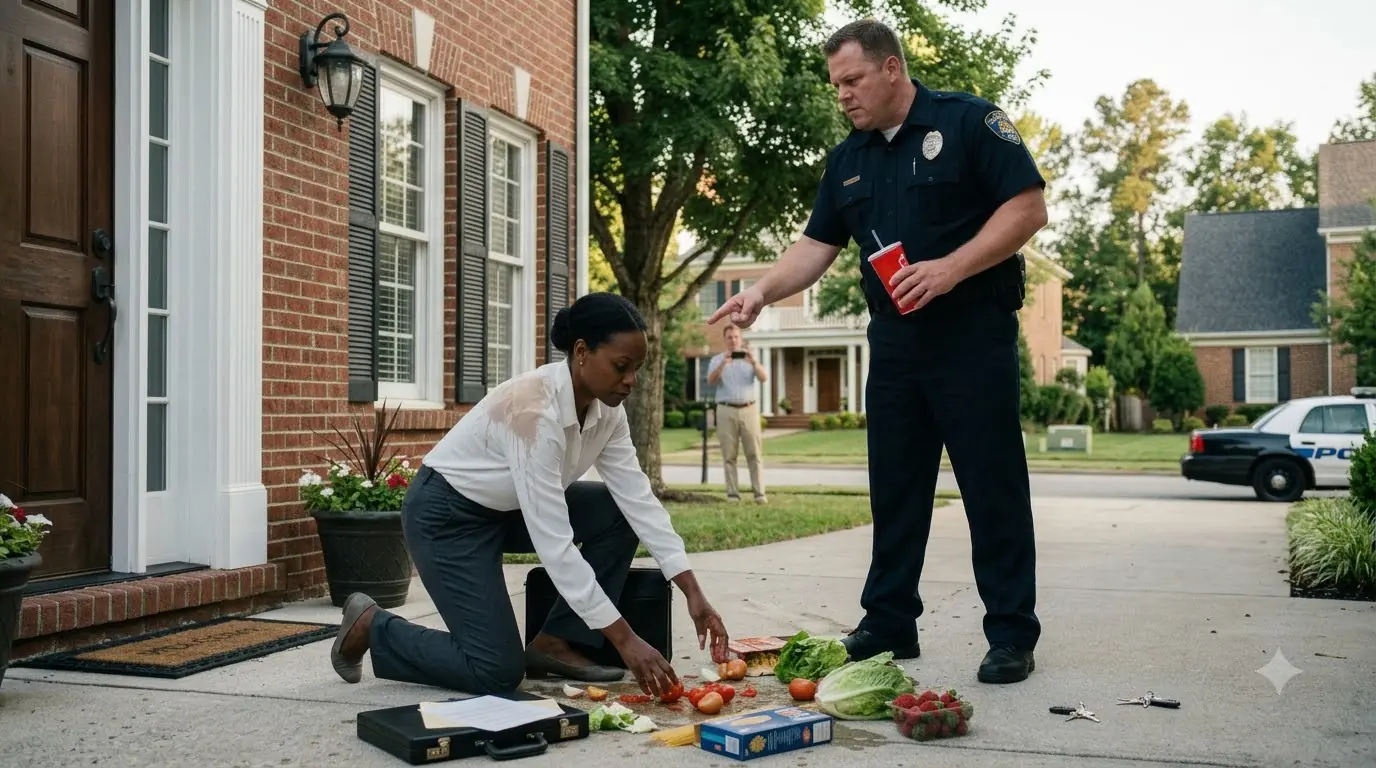
“I don’t care what you were doing.”
Officer Derek Hutchkins tilted the massive soda cup in his hand.
Cold liquid poured down Imani Clark Richardson’s back, soaking through her white blouse and dripping onto the concrete driveway beneath her.
“People like you need to learn some respect when a badge is talking.”
Imani knelt slowly.
Her hands moved through the mess scattered across her own driveway.
Broken eggs.
Crushed tomatoes.
Dry pasta.
Soaked papers.
Her house keys lay inches from her fingers.
“That’s better,” Hutchkins said.
“Stay down there where you belong.”
Across the street, a neighbor’s phone captured everything.
The red recording light blinked steadily.
Imani’s front door stood only eight feet away.
So close she could see the brass doorknob and the welcome mat she had purchased with her daughter the previous spring.
But she could not reach it.
Her expression did not change.
Calm.
Controlled.
And beneath that calm, something had become dangerously clear.
That morning had begun like any other.
At 6:30 a.m., the Richardson kitchen smelled of fresh coffee, toast, and eggs.
Imani stood at the counter wearing a soft gray robe, her natural hair pulled into a neat bun while she cracked eggs into a bowl.
“Mom, can I borrow the car tonight?”
Her sixteen-year-old son, Devon, barely looked up from his phone.
“You mean my car?”
Imani smiled.
“Ask your father for his.”
James Richardson walked into the kitchen adjusting his tie.
At forty-eight, James had the sort of presence that filled a room without demanding attention. Salt-and-pepper hair, calm eyes, controlled movements.
He kissed Imani on the forehead.
The gesture was automatic.
Familiar.
Fourteen years of marriage lived inside that small kiss.
“Big day,” he said.
Imani glanced at him.
“Police budget meeting at three?”
“And the misconduct complaint review.”
James poured coffee into a travel mug.
“Chief Donovan isn’t happy about it. Some officers have accumulated multiple complaints, but the system keeps moving them around instead of solving anything.”
He stopped himself.
Their fourteen-year-old daughter, Maya, bounded into the kitchen asking about soccer practice and whether someone had signed a school form.
The conversation shifted.
Homework.
Schedules.
Who was picking up whom.
This was their normal breakfast.
Children.
Jobs.
A family moving through an ordinary weekday.
They had moved to Riverside Heights fourteen months earlier after James won his second term as mayor.
The house was beautiful.
Colonial style.
Wide front porch.
Mature trees shading the sidewalk.
Everything James and Imani had worked for.
Everything some people seemed uncomfortable seeing them possess.
Riverside Heights was one of the wealthiest neighborhoods in the city.
Large homes.
Manicured lawns.
Joggers at sunrise.
Book clubs on Wednesdays.
Residents who recognized every unfamiliar vehicle within minutes.
It was the kind of neighborhood where people liked to believe they knew everything about everyone living around them.
But most of them barely knew the Richardsons.
Imani had noticed the small things almost immediately.
Two months after moving in, someone slipped an anonymous note under their front door asking whether “the maid” was staying overnight.
Imani was the person they meant.
Four months later, someone at an HOA meeting asked whether the Richardsons owned the house or were renting it.
Seven months after the move, police were called about a suspicious person near the mailboxes.
The suspicious person had been Imani.
She had walked outside around nine in the evening to collect her own mail.
She told James.
He made calls.
Asked why patrol officers seemed to circle Elmwood Drive so frequently.
The explanations were always vague.
Routine patrol.
Neighborhood security.
Preventive presence.
Nothing specific enough to challenge.
But Imani noticed something James could not see from City Hall.
The same patrol car appeared repeatedly.
Sometimes twice in a week.
Sometimes three times.
And the officer inside always watched her.
Not casually.
Not professionally.
His stare carried something heavier.
Contempt.
Once, Imani looked directly at him.
He did not wave.
Did not smile.
Did not look away.
He simply continued staring.
That officer was Derek Hutchkins.
Imani did not know his name yet.
“You sure you don’t want to come tonight?” James asked that morning.
He meant a donor dinner.
Another political event where Imani would stand beside him, smile for photographs, and spend two hours being introduced primarily as the mayor’s wife.
“I have three patient consultations tomorrow,” she said. “I need to prepare.”
That boundary mattered to her.
At work, she was Dr. Imani Clark Richardson.
Director of the Community Health Center.
A physician.
An administrator.
Someone who had built her own career through years of study, residency, public service, and leadership.
She was proud of James.
But she had no interest in becoming an accessory to his political life.
At the clinic, she used her professional name.
She attended only select political events.
James had his spotlight.
Imani had the work she actually cared about.
“The kids and I will hold down the fort,” she said.
James smiled.
“Deal.”
At 4:15 that afternoon, Imani left the health center.
Her assistant called after her.
“Don’t forget the board meeting Thursday.”
“I won’t.”
Imani stopped at Whole Foods on the way home.
Nothing unusual.
Vegetables.
Chicken breasts.
A box of pasta.
Eggs.
Tomatoes.
Strawberries.
Lettuce.
Two reusable grocery bags.
She paid, exchanged a few words with the cashier, and drove home.
At 4:48 p.m., she turned onto Elmwood Drive.
NPR played quietly on the radio.
The segment was about police reform initiatives taking shape in several cities.
The timing would later feel almost cruel.
Imani noticed a patrol car parked two houses down.
She did not give it much thought.
There had been so many patrol cars lately that she had almost trained herself not to notice.
She pulled into her driveway.
Turned off the engine.
Gathered her purse, briefcase, and both grocery bags.
The bags were heavy.
She balanced everything carefully.
Fifteen feet.
That was the distance between the car and her front door.
She had walked it hundreds of times.
Imani placed the bags on the doorstep.
Three concrete steps.
She opened her purse and searched for her keys.
The key ring carried a small photo charm.
James.
Devon.
Maya.
Imani.
All four smiling during a vacation two summers earlier.
“Excuse me, ma’am.”
The voice came from behind her.
Male.
Authoritative.
Close.
Imani turned.
Officer Derek Hutchkins stood at the bottom of the front steps.
His patrol car had moved.
It now blocked part of her driveway and prevented her vehicle from easily leaving.
Another officer stood near the patrol car.
Younger.
Nervous-looking.
Imani would later learn his name was Officer Brennan.
At 4:51 p.m., Imani stood at her own front door with her house keys in her hand.
“Can I help you, Officer?”
Hutchkins did not answer immediately.
His eyes traveled from her face to the grocery bags, then toward the house behind her.
Back to Imani.
“I need identification.”
Imani’s stomach tightened.
“Is something wrong?”
“Identification. Now.”
The word landed with finality.
Imani kept her voice controlled.
“I’m standing at my own home.”
“I’ll ask the questions.”
Hutchkins stepped onto the bottom stair.
“ID. Now.”
Imani could smell his cologne from several feet away.
Too strong.
Citrus mixed with something chemical.
“My license is in my purse. May I reach for it?”
Hutchkins stared.
“Slowly.”
Imani moved carefully.
She opened the purse.
Removed her wallet.
Pulled out her driver’s license.
Her fingers did not shake.
She handed it to him.
Hutchkins studied the card.
“Imani Clark Richardson.”
His eyes moved toward the printed address.
“This address?”
“Yes.”
“This is where you live?”
“This is my home.”
He looked at the license again.
Then at her.
Then at the house.
His expression suggested he had encountered numbers that did not fit the equation already formed in his head.
“Step away from the door.”
Imani blinked.
“I’m sorry?”
“Step down.”
“Officer, what is this about?”
His hand moved to his belt.
Not drawing his weapon.
Simply resting near it.
A reminder of what he carried.
“I won’t ask again.”
Imani descended the three steps.
She was now on the driveway.
Her grocery bags remained beside the front door.
Her keys were still clenched in her left hand.
“Officer, I’ve done nothing wrong. What is the reason for this stop?”
Hutchkins walked up the steps.
He stood where she had been standing moments earlier.
Between Imani and her own front door.
“How long have you lived here?”
“Fourteen months.”
“You own this house?”
“Yes.”
“Who with?”
“My husband.”
“What do you do for work?”
The questions came rapidly.
Not conversation.
Interrogation.
“I’m a physician and healthcare administrator.”
Hutchkins’s mouth twisted.
“Right.”
That single word carried disbelief.
Imani heard it immediately.
Hutchkins looked back at the house.
“This is an expensive neighborhood.”
Imani said nothing.
His eyes swept over her work clothes.
Her sensible shoes.
Her natural hair.
“You afford this place working at a clinic?”
Imani’s jaw tightened.
“My finances are none of your concern.”
“I’ve been watching this street.”
Hutchkins stepped closer.
“Seen you coming and going.”
Imani looked directly at him.
“Are you accusing me of something?”
“Who really owns this house?”
He emphasized really.
“I already answered you.”
“Boyfriend?”
“No.”
“Someone else paying for it?”
“I own this home with my husband.”
Imani’s voice hardened slightly.
“We purchased it legally.”
She turned toward the door.
“I’m going inside now.”
“I didn’t say you could leave.”
Imani stopped.
Turned slowly.
“Am I being detained?”
“You’re being questioned.”
“On what legal basis?”
Hutchkins descended another step.
Now he stood on the driveway with her.
Close enough that she could see a small coffee stain near the front of his uniform and a faint scar above his left eyebrow.
“I need to search your vehicle.”
“You don’t have my consent.”
“I smell marijuana.”
Imani stared at him.
“There is no marijuana in my vehicle.”
His expression hardened.
“So you’re calling me a liar?”
“I’m telling you there is no marijuana.”
“Open the car.”
“I do not consent to a search.”
“Then you’re hiding something.”
Hutchkins reached toward his handcuffs.
“Hands behind your back.”
Alarm shot through Imani’s chest.
“I’m not hiding anything. I want to call my attorney.”
“You can call from the station.”
He pointed toward the car.
“Turn around.”
Across the street, a front door opened.
Tom Carter stepped onto his porch with a phone already in his hand.
“Hey!”
Hutchkins looked toward him.
“What’s going on?”
“Police business. Stay back.”
Tom looked at Imani.
“That’s Mrs. Richardson. She lives there.”
Hutchkins ignored him.
He grabbed Imani’s arm.
Imani pulled instinctively.
“Don’t touch me.”
“You’re resisting.”
His grip tightened.
“I’m not resisting. I’m asking you to stop hurting me.”
Hutchkins turned her toward the vehicle.
Her shoulder struck the driver-side door.
She gasped.
“Hands on the hood.”
Imani placed both palms against the warm metal.
Her keys remained in one hand.
The teeth pressed painfully into her palm.
Hutchkins opened the driver’s door.
He began searching.
Imani repeated, “I do not consent to this search.”
He ignored her.
He pulled her briefcase from the passenger seat.
Instead of opening it normally, he turned it over.
The contents spilled onto the driveway.
Her tablet struck the concrete.
Medical journals opened as they landed.
Pens rolled beneath the car.
Patient-free administrative documents scattered in the breeze.
Her work ID landed face-up.
DR. IMANI CLARK RICHARDSON.
DIRECTOR, COMMUNITY HEALTH CENTER.
Hutchkins picked it up.
Looked at the photograph.
Then at her.
“This you?”
“Yes.”
He squinted at the title.
“Director.”
He laughed.
Short.
Sharp.
Mean.
“Could be fake.”
“It isn’t.”
“You can buy these online.”
He tossed the badge back onto the driveway.
Then opened her trunk.
Inside were reusable bags, an emergency kit, an umbrella, and several ordinary household items.
Nothing illegal.
Nothing suspicious.
Hutchkins slammed the trunk shut.
The sound echoed across Elmwood Drive.
By then, another neighbor had stepped outside.
Margaret Patterson, seventy-five, with carefully curled white hair.
She stood frozen on her porch.
Hutchkins walked toward Imani’s front steps.
He grabbed both grocery bags.
“What are you doing?”
He carried them down.
Then turned them upside down.
The contents hit the concrete.
Tomatoes rolled across the driveway.
Two burst.
Red pulp spread across the gray surface.
Eggs cracked open.
Yolk mixed with tomato juice.
The pasta box split.
Dry pieces scattered beneath the car.
Lettuce landed beside a puddle of egg.
A container of strawberries broke open.
Chicken wrapped in plastic slid across the wet mess.
Hutchkins tossed the empty bags aside.
“Clean it up.”
Imani stared.
“You did that.”
“I said clean it up.”
She looked at him.
His expression was hard.
Satisfied.
Then she looked past him.
Her front door.
Eight feet away.
Brass handle.
Welcome mat.
Small potted plant beside the steps.
Home.
She knelt.
The concrete remained warm from the afternoon sun.
She began collecting what could still be saved.
Her professional papers had already absorbed egg and tomato juice.
She lifted one journal.
The pages were ruined.
Hutchkins walked toward his patrol car.
Imani heard a door open.
Then close.
His footsteps returned behind her.
She was bent over trying to gather loose papers when something freezing struck her back.
Liquid soaked through her white blouse instantly.
She gasped.
The smell of cola filled the air.
It ran down her shoulders.
Across her arms.
Into her hair.
Onto the papers in her hands.
Onto the driveway.
“Maybe this will teach you some respect.”
Hutchkins stood above her holding the large cup.
“People like you need to learn your place when a badge is talking.”
He continued pouring until the cup was empty.
Then dropped it beside her.
It bounced once on the concrete.
Imani remained kneeling.
For three seconds, she did not move.
Cola dripped from her sleeves.
Her hair.
Her hands.
Then she stood.
Slowly.
Carefully.
Her blouse clung to her skin.
Dark stains spread across the white fabric.
The humiliation was physical now.
Cold.
Sticky.
Public.
She turned toward Hutchkins.
Her expression was completely calm.
No tears.
No shouting.
No pleading.
Only calculation.
Her house keys were still in her left hand.
The metal teeth had left red crescent marks in her palm.
Across the street, Tom Carter continued recording.
His hand shook.
The phone did not.
Margaret Patterson had already placed a call.
Her voice drifted across the street.
“Chief Donovan’s office, please. This is Margaret Patterson. One of your officers is assaulting a woman at her own home.”
“Put that phone down!” Hutchkins shouted.
Margaret turned away slightly but continued speaking.
“Her name is Imani Richardson. Yes. That Imani Richardson.”
Hutchkins looked back toward Imani.
For the first time, uncertainty moved across his face.
Only briefly.
“Clean up the rest of this and get out of my sight.”
Imani pulled her phone from her pocket.
The screen was wet.
Sticky.
Still working.
“I’m calling my attorney.”
Hutchkins moved quickly.
His hand struck the phone from hers.
The device flew across the driveway.
It hit the concrete.
The screen shattered.
The phone slid to a stop beside the spilled pasta.
“You’re not calling anybody.”
Tom’s voice came from across the street.
“I’m recording everything.”
Hutchkins turned.
His hand moved toward his belt again.
“Back off or you’re obstructing an officer.”
“You just assaulted her.”
“I said back off.”
Tom stayed on his own sidewalk.
His phone remained raised.
Officer Brennan shifted beside the patrol car.
“Derek…”
Hutchkins snapped toward him.
“Stay out of it, Brennan.”
The younger officer stopped.
But his discomfort was obvious.
His eyes moved from Imani to the ruined groceries.
Then toward the growing number of neighbors.
Margaret Patterson continued talking.
“She’s soaked. He poured something on her. I’m absolutely sure.”
She gave the address.
“847 Elmwood Drive.”
Hutchkins turned back toward Imani.
His face was red.
He was losing control of the situation.
More importantly, he was losing control of the witnesses.
“You’re under arrest.”
Imani’s stomach dropped.
Her voice stayed steady.
“For what?”
“Disorderly conduct.”
He paused.
“Resisting.”
“I have not resisted you.”
“Turn around.”
“On what legal grounds am I being arrested?”
“The grounds that I am a police officer and you are refusing a lawful order.”
“Requesting the legal justification for an arrest is not resistance.”
His jaw tightened.
He grabbed her wrist.
Twisted.
Pain ran up her arm.
“You’re hurting me.”
“Stop resisting.”
“I’m not resisting.”
He forced one arm behind her back.
Then the other.
Metal clicked around her wrists.
The cuffs tightened.
Too tight.
Imani winced.
“That’s better.”
Hutchkins leaned closer.
“You should have listened from the beginning.”
A car door slammed.
Another police cruiser had arrived.
Blue lights flashed silently against the houses.
Sergeant Linda Morrison stepped out.
A Black woman in her late forties with twenty years on the force, Morrison carried the kind of authority that came from experience rather than volume.
She took in the scene in seconds.
Woman in handcuffs.
Soaked clothing.
Groceries scattered across private property.
Broken phone.
Damaged work materials.
Neighbors recording.
Junior officer standing awkwardly beside a patrol vehicle.
Senior officer visibly angry.
This was bad.
Very bad.
“Hutchkins.”
Her voice cut across the driveway.
“What’s the situation?”
He straightened.
“Suspicious activity at this residence. Subject became belligerent during questioning.”
Morrison looked at Imani.
Then the house.
Then the keys still caught between two of her cuffed fingers.
“This woman was at the front door.”
“I had reasonable suspicion.”
“Of what?”
Hutchkins paused.
“Possible drug activity.”
Morrison’s eyebrow lifted.
“Based on what?”
“Marijuana smell from the vehicle.”
“I smelled nothing.”
Officer Brennan spoke quietly.
Everyone looked toward him.
He swallowed.
Then repeated it more firmly.
“I smelled nothing when we arrived.”
Hutchkins glared at him.
Morrison walked toward Imani.
“Ma’am, are you hurt?”
For the first time that afternoon, someone with authority had asked her that question.
Imani’s composure cracked slightly.
“No.”
She paused.
Then corrected herself.
“I’m not physically injured, but I am not okay.”
Morrison nodded.
“What happened?”
“I was unlocking my front door.”
Imani spoke carefully.
“Officer Hutchkins stopped me, ordered me away from my home, searched my vehicle after I refused consent, emptied my briefcase, scattered my groceries, made me kneel to collect them, then poured his drink over me.”
Morrison’s face remained professionally neutral.
Her eyes did not.
They hardened.
She looked at the enormous stain across Imani’s blouse.
Then the driveway.
Crushed tomatoes.
Broken eggs.
Scattered pages.
Cracked tablet.
Empty soda cup.
“This is your residence?”
“Yes.”
“How long?”
“Fourteen months.”
Morrison picked up Imani’s work ID.
She wiped egg from the plastic.
Read it.
“You’re a doctor?”
“Yes.”
“Community health director?”
“Yes.”
Morrison turned toward Hutchkins.
“Did you pour a drink on this woman?”
“She was being disrespectful.”
“That was not my question.”
Morrison stepped closer.
“Did you pour liquid on her?”
Silence.
“Officer Hutchkins.”
His jaw moved.
“She needed to learn—”
“Yes or no?”
“Yes.”
Morrison closed her eyes for half a second.
When she opened them, her voice had changed.
“Did she consent to the vehicle search?”
“I had probable cause.”
“Did she consent?”
Another pause.
“No.”
“Did you have a warrant?”
“I smelled—”
“Did you have a warrant? Yes or no.”
“No.”
Morrison turned toward Brennan.
“Officer Brennan. Tell me exactly what you observed.”
The younger officer straightened.
“We were driving through the neighborhood.”
He glanced briefly toward Hutchkins.
“Officer Hutchkins said he wanted to check this address.”
“Why?”
Brennan swallowed.
“He said someone there didn’t belong.”
The silence deepened.
“When we arrived, Mrs. Richardson was at the front door with groceries.”
“Any traffic violation?”
“No, ma’am.”
“Any suspicious activity you personally witnessed?”
“No.”
“Any marijuana smell?”
Brennan hesitated.
Hutchkins stared at him.
Brennan looked back at Morrison.
“No, ma’am.”
Hutchkins exploded.
“You’re serious right now?”
Brennan said nothing.
“You’re taking her side over another officer?”
Morrison’s voice sliced through him.
“There are no sides.”
Hutchkins turned.
“There is the truth and there is misconduct.”
Morrison stared directly at him.
“Which one are you defending?”
More neighbors had come outside.
An elderly couple.
A young family.
A jogger who had stopped.
Several people were recording.
Hutchkins saw them.
“Everyone put your phones away!”
Tom Carter shouted back.
“This is a public street.”
“I’ll arrest you for obstruction.”
“For standing on my own property?”
Morrison raised one hand.
“Officer Hutchkins, step back.”
“Linda, come on.”
“Step back.”
The command in her voice left no room for argument.
Hutchkins stepped away.
Morrison moved behind Imani.
“I’m removing these cuffs.”
The metal clicked.
Imani brought her hands forward.
Red marks circled both wrists.
She rubbed them gently.
“Thank you.”
Morrison looked at her.
“Do you need medical attention?”
“No.”
Imani breathed slowly.
“I want this documented.”
“It will be.”
“I want his badge number.”
“You’ll have it.”
“I want to file a formal complaint.”
Morrison nodded.
“You will.”
Hutchkins laughed bitterly.
“A complaint?”
He shook his head.
“You think that matters? The union will—”
“Your union cannot erase this.”
Morrison gestured toward the street.
“Multiple witnesses.”
Then toward the phones.
“Multiple videos.”
“It’s her word against mine.”
“No.”
Morrison pointed toward Brennan.
“It’s her statement, Officer Brennan’s statement, and several independent recordings against yours.”
“They don’t know what they saw.”
“They know exactly what they saw.”
A new voice entered the conversation.
Older.
Male.
Robert Patterson stepped from the neighboring property.
He had the straight posture of a retired service member and a crew cut that had barely changed in decades.
“Officer, I live at 843 Elmwood.”
He pointed toward his house.
“I watched this entire incident from my porch.”
Hutchkins stared.
“She was at her own front door when you stopped her.”
Margaret Patterson came beside her husband.
“I called Chief Donovan directly.”
That got Hutchkins’s attention.
“You called the chief?”
“Yes.”
Margaret held up her phone.
“I gave him the address.”
Hutchkins tried to recover.
“Fine.”
He shook his head.
“Let him come. I did nothing wrong.”
Morrison crossed her arms.
“You said she was suspicious.”
“She matched a description.”
Imani looked at him.
“What description?”
Hutchkins hesitated.
“There was a report.”
“Description of whom?” Morrison asked.
“A woman.”
“What description?”
Hutchkins searched for an answer.
“A Black woman in this neighborhood driving a Lexus.”
Morrison’s expression went still.
“That is not a description of criminal behavior.”
“It was suspicious.”
“Why?”
“Because—”
Morrison cut him off.
“Because she was Black and living in an affluent neighborhood?”
“No.”
“That is exactly what you have described.”
“That’s not what I meant.”
“Then explain what you meant.”
Hutchkins looked around.
Morrison.
Brennan.
Imani.
The neighbors.
Cameras.
His control over the situation had evaporated.
Instead of stopping, he became more reckless.
“This used to be a good neighborhood.”
Nobody spoke.
“A safe neighborhood.”
His voice rose.
“Then people started moving in who don’t fit.”
Morrison stared.
“People who don’t fit?”
Hutchkins nodded angrily.
“People buying houses they have no business affording. People changing what this place is.”
“Stop talking.”
But the restraint had broken.
“I’ve been a cop here fifteen years. I know this neighborhood. I know who belongs here.”
He pointed toward Imani.
“And something about her never added up.”
Tom’s phone remained fixed on him.
Margaret’s hand covered her mouth.
Brennan looked toward the ground.
Morrison’s jaw tightened.
Imani simply stared at Hutchkins.
He had finally said aloud what she had sensed for months.
He had watched her.
Tracked the house.
Waited.
Her broken phone suddenly rang from the driveway.
The damaged speaker produced a distorted sound, but the screen still illuminated.
Morrison bent down and picked it up.
The glass was shattered.
She looked at the caller ID.
Her expression changed.
“Oh my God.”
Hutchkins frowned.
“What?”
Morrison turned the screen toward Imani.
JAMES — CITY HALL.
She handed over the phone.
Their eyes met.
Something passed between them.
Imani tapped the answer button.
Then deliberately activated speakerphone.
“Hello?”
James’s voice came through.
Warm.
Familiar.
Concerned.
“Honey, I’m sorry. The police budget meeting ran late.”
Imani closed her eyes briefly.
“Chief Donovan is here with me,” James continued. “We’re finishing the misconduct protocol discussion.”
There was a pause.
“I should be home around five-thirty. Want me to pick up dinner?”
Imani looked down at the ruined groceries.
“James.”
His tone changed instantly.
“What happened?”
“I’m standing in our driveway.”
James went silent.
“I need you to come home immediately.”
“Are you hurt?”
“I was stopped by a police officer while unlocking our front door.”
Everyone on the street listened.
“He forced me away from the house. He searched my vehicle after I refused consent. He destroyed my groceries and work materials.”
She looked directly at Hutchkins.
“Then he poured his drink over me while I was kneeling to pick everything up.”
Silence came through the phone.
When James spoke again, the husband was gone.
The mayor had replaced him.
“Put the officer on the phone.”
Hutchkins stared.
“Who is this?”
James answered immediately.
“This is Mayor James Richardson.”
The color drained from Hutchkins’s face.
“Who am I speaking to?”
Hutchkins took the phone with a shaking hand.
“Officer Derek Hutchkins, sir.”
“Officer Hutchkins, did you pour a beverage on my wife?”
Hutchkins swallowed.
“Sir, I didn’t know—”
“That was not my question.”
James’s voice was cold.
“Did you pour a beverage on her?”
Silence.
“Answer me.”
“Yes, sir.”
“Badge number.”
“4739.”
“Officer Hutchkins, badge 4739.”
James paused.
“I want you to understand something.”
Hutchkins leaned against the patrol car.
“I am currently sitting with Police Chief Michael Donovan, City Attorney Sarah Carter, and members of the city council.”
Hutchkins’s breathing changed.
“We were discussing officer misconduct reform.”
Another pause.
“You just gave us a real example of why that conversation matters.”
Hutchkins stepped backward.
His shoe landed near one of the crushed tomatoes.
“Sergeant Morrison.”
She straightened.
“Yes, Mr. Mayor.”
“Document everything.”
“Yes, sir.”
“Photographs.”
“Yes.”
“Witness statements.”
“Yes.”
“Secure every available video.”
“Yes.”
“Officer Hutchkins is not to leave that location.”
Morrison looked at him.
“Understood.”
“I’m twelve minutes away.”
The call ended.
Hutchkins stared at Imani.
“Why didn’t you tell me?”
Her expression remained calm.
“Tell you what?”
“That you’re the mayor’s wife.”
Imani took the phone back.
“And why should that matter?”
“I would have—”
“What?”
She stepped toward him.
“Treated me like a human being?”
Hutchkins had no answer.
“I should not need to identify my husband before I’m allowed to enter my own home.”
Her voice was controlled.
“But you saw a Black woman in a neighborhood you decided she didn’t belong in.”
She gestured toward the driveway.
“You made your decision before asking a single meaningful question.”
“I made a mistake.”
“No.”
Imani looked toward the empty soda cup.
“You made a series of choices.”
Hutchkins shook his head.
“I can fix this.”
“Fix what?”
For the first time, sharp anger entered her voice.
“You poured a drink over me while I was kneeling.”
She pointed toward the groceries.
“You destroyed my food.”
The broken phone.
“My phone.”
The scattered papers.
“My work.”
She lifted her wrists.
“You put cuffs on me at my own home.”
Her eyes locked onto his.
“How exactly do you fix that?”
Tom called from across the street.
“Mrs. Richardson, I have eleven minutes of video.”
Margaret added, “My call to Chief Donovan is recorded and time-stamped.”
Another neighbor raised his hand.
“My doorbell camera captured the driveway.”
Hutchkins looked around.
Every direction offered another witness.
Another recording.
Another piece of evidence.
He turned toward Brennan.
“Tell them.”
Brennan said nothing.
“Tell them she was suspicious.”
Brennan finally met his eyes.
“No.”
Hutchkins stared.
“She wasn’t doing anything suspicious.”
“Back me up.”
“I’m supposed to tell the truth.”
Brennan’s voice became firmer.
“She was entering her house.”
Hutchkins turned toward Morrison.
“Linda.”
Her expression hardened.
“That’s Sergeant Morrison.”
“You know how these things are.”
“How what is?”
Hutchkins struggled.
“Working patrol. Making judgment calls.”
“Profiling residents?”
“No.”
“Searching vehicles without consent?”
“No.”
“Pouring drinks on civilians?”
His face crumpled.
“Please.”
The word came suddenly.
Weakly.
“I’ve got fifteen years on the force.”
No one answered.
“I have a family.”
He looked at Imani.
“A pension.”
Imani’s voice cut through him.
“You should have thought about all of that before.”
Tears appeared in Hutchkins’s eyes.
“I’m sorry.”
Imani stared.
“If I had known—”
She interrupted.
“If you had known I was connected to someone powerful, you would have treated me differently.”
Hutchkins stopped.
“That is not an apology.”
She shook her head.
“That is fear of consequences.”
Sirens sounded in the distance.
Getting closer.
Morrison began taking photographs.
Wet clothing.
Scattered groceries.
Broken electronics.
Empty cup.
Red wrist marks.
“Officer Hutchkins, stay where you are.”
He looked toward her.
“Do not speak to the witnesses.”
“Linda—”
“Sergeant Morrison.”
She pointed toward the patrol car.
“One more attempt to interfere with this scene and I will restrain you myself.”
Hutchkins went silent.
Imani stood beside her driveway.
Keys still in hand.
Her front door remained eight feet away.
But everything had changed.
At 5:14 p.m., a black SUV with city plates pulled into the driveway.
James Richardson stepped out before the vehicle had fully settled.
His suit jacket was gone.
Tie loosened.
Sleeves rolled up.
Behind him came Police Chief Michael Donovan, fifty-five, composed and grim.
City Attorney Sarah Carter followed carrying a tablet.
James went directly to Imani.
His hands found hers.
“Are you hurt?”
Imani shook her head.
But for the first time, her eyes filled.
“I’m angry.”
James looked at her wrists.
“I’m humiliated.”
Then the stained blouse.
“But I’m not seriously hurt.”
James looked around.
The crushed groceries.
Broken eggs.
The shattered phone.
The tablet on the concrete.
The empty soda cup.
Then the front door.
Eight feet.
She had been eight feet from home.
James turned toward Hutchkins.
“You stopped my wife at our front door.”
Hutchkins said nothing.
“She had her keys in her hand.”
“Sir, I didn’t realize—”
James stepped closer.
“You didn’t realize what?”
Hutchkins froze.
“That she was a person with rights?”
Chief Donovan approached.
He surveyed the scene once.
Then stopped in front of Hutchkins.
“Officer Hutchkins.”
His voice was flat.
“I’m placing you on immediate administrative suspension pending investigation.”
Hutchkins stared.
“Chief—”
“Badge.”
His hands began shaking.
He unpinned the badge.
Donovan took it.
“Duty weapon.”
Hutchkins carefully surrendered it.
Donovan handed it to Morrison.
“Radio.”
Hutchkins unclipped it.
Placed it in the chief’s hand.
“You have spent fifteen years on this force.”
Donovan stared at him.
“What happened today will be examined from the first second to the last.”
Hutchkins’s eyes filled.
“I have a family.”
Donovan’s expression did not soften.
“Then you should understand why every family on this street deserves to trust the people wearing our uniform.”
Sarah Carter stepped forward.
“I have documented the physical scene.”
She looked toward Tom.
“You recorded the encounter?”
“Yes.”
“Full recording?”
“About eleven minutes.”
“Preserve the original.”
“Already backed up.”
Sarah looked toward Margaret.
“You called Chief Donovan?”
“Yes.”
“Keep the original phone record.”
“I will.”
Then she turned toward Brennan.
“Your body camera?”
“Yes, ma’am.”
“Was it active?”
“My camera and the vehicle system captured portions of the encounter.”
Sarah looked toward Hutchkins.
“And yours?”
Silence.
Brennan hesitated.
Then spoke.
“His was not running.”
Donovan stared at Hutchkins.
“Why?”
Hutchkins said nothing.
Brennan continued.
“He told me earlier it had malfunctioned.”
Sarah made a note.
“That will be examined separately.”
Donovan looked at Hutchkins.
“You are suspended effective immediately pending internal and external review.”
Hutchkins nodded weakly.
“You are not to contact Mrs. Richardson, any witness, or anyone involved in reviewing this incident except through counsel or your authorized representative.”
Another nod.
“Do you understand?”
“Yes, sir.”
“Say it clearly.”
“Yes, sir. I understand.”
Donovan pointed toward the patrol vehicle.
“Officer Brennan will transport you away from the scene.”
Hutchkins walked unsteadily toward the car.
Brennan opened the rear door.
Hutchkins paused.
Then climbed inside.
The door closed.
Chief Donovan turned toward Imani.
His expression changed.
“Dr. Richardson.”
He took a breath.
“On behalf of the department, I am sorry.”
Imani looked at him.
“Your apology is noted.”
Donovan waited.
“But an apology cannot be the end of this.”
“No.”
“Systemic change has to follow.”
Donovan nodded.
“I understand.”
Sarah Carter approached.
“When you’re ready, we’ll need your full statement.”
“Tomorrow.”
“Of course.”
Imani looked down at her ruined groceries.
Her broken phone.
Wet paperwork.
Then her front door.
“I’d like to go inside now.”
James put his arm gently around her shoulder.
“Let’s go home.”
They walked up the driveway together.
James gathered the ruined grocery bags.
Imani climbed the three steps.
She placed the key in the lock.
Turned it.
The door opened.
She stepped inside.
Finally.
Her own home.
Behind them, Sergeant Morrison began securing evidence and gathering witness information.
Neighbors remained outside.
Some angry.
Some crying.
All of them understood that something had happened on Elmwood Drive that could no longer be dismissed as rumor or misunderstanding.
Tom Carter looked down at the video on his phone.
Eleven minutes.
He uploaded a copy to social media.
The video spread rapidly.
By evening, hundreds of thousands had seen it.
By night, the number had climbed into the millions.
The image that people could not forget was not Hutchkins shouting.
It was Imani kneeling.
House keys visible.
Her own front door behind her.
Soda pouring down her back.
Comments flooded the video.
She had the keys in her hand.
She was at her own home.
If this can happen to someone with influence, imagine what happens when nobody is watching.
By morning, national media organizations were covering the incident.
Civil rights lawyers discussed the footage.
Police reform advocates replayed the moment Hutchkins blocked Imani from reaching the door.
Commentators across political lines struggled to defend what appeared on screen.
There was too much evidence.
Too little ambiguity.
Within twenty-four hours, thousands gathered outside City Hall.
Signs filled the plaza.
SHE HAD HER KEYS.
A BADGE IS NOT IMMUNITY.
DIGNITY AT YOUR OWN DOOR.
The crowd included every age and background.
People were angry.
But more than angry, many were exhausted.
At two that afternoon, Dr. Imani Clark Richardson walked toward the microphones.
Navy suit.
Hair pulled back.
Eyes fierce.
She waited until the crowd quieted.
“My name is Dr. Imani Clark Richardson.”
The plaza became still.
“Two days ago, I came home carrying groceries.”
She paused.
“I walked toward my front door.”
Another pause.
“I took out my house keys.”
Imani looked across the crowd.
“I was about to enter my own home.”
The silence deepened.
“Instead, I was stopped.”
Her voice remained steady.
“Questioned.”
“Prevented from entering.”
“Searched.”
“Humiliated.”
“And physically restrained.”
She inhaled.
“Not because I had committed a crime.”
The crowd waited.
“Because an officer decided I did not look like someone who belonged there.”
Applause broke out.
Imani waited until it faded.
“I want to make something very clear.”
She leaned closer to the microphone.
“This is not important because I am the mayor’s wife.”
Her voice strengthened.
“It is important because I should not have needed to be the mayor’s wife for anyone to care.”
The crowd erupted.
Imani continued.
“I had witnesses.”
“Video.”
“Professional credentials.”
“Neighbors willing to speak.”
“A husband with access to power.”
She paused.
“If this could happen to me with all of those advantages, then we have to ask what happens every day to people who have none of them.”
The applause became thunderous.
“This is bigger than one driveway.”
Imani looked toward City Hall.
“Bigger than one officer.”
“And bigger than one family.”
She straightened.
“We need accountability.”
“We need oversight.”
“We need policies that identify patterns before someone accumulates years of complaints.”
“And we need every person to know they have the right to walk through their own front door without being treated as a threat simply because someone has decided they do not fit the neighborhood.”
The crowd answered with cheers.
Behind the scenes, investigators had already begun reviewing Hutchkins’s career.
The first discovery was devastating.
Twenty-one complaints.
A large majority from minority residents.
Many alleged unnecessary stops.
Aggressive questioning.
Unjustified searches.
Harassment.
Several had been dismissed for insufficient evidence.
Others ended after complainants gave up.
Names began appearing.
Marcus Thompson, an attorney who reported an improper search several years earlier.
Dr. Kenneth Wade, a surgeon stopped and questioned near his own vehicle.
Jasmine Rodriguez, a business owner detained during a disputed stop.
More former complainants came forward after seeing Imani’s video.
Within one week, investigators had identified multiple incidents that had never been examined together as a pattern.
Digital records made things worse.
Messages between Hutchkins and several associates showed repeated comments about families moving into Riverside Heights.
One message referenced the “new family on Elmwood” and said he was “keeping an eye on them.”
Other conversations contained biased jokes and derogatory remarks.
Location records showed Hutchkins had passed the Richardson residence dozens of times over several months, including occasions outside his normal patrol assignment.
The incident had not begun on the afternoon Imani carried groceries home.
The resentment had been growing for months.
Officer Brennan cooperated fully.
He admitted Hutchkins had repeatedly commented about the Richardson residence.
He provided investigators with information he had previously dismissed as complaining.
Sergeant Morrison submitted her report.
Tom Carter provided the original video file.
The Pattersons submitted their statements and call records.
Doorbell footage from other homes supplied additional angles.
The evidence accumulated rapidly.
Six days after the incident, the district attorney announced criminal charges based on the investigation.
The allegations included assault-related conduct, official misconduct, unlawful search and detention, civil rights violations, false reporting, and issues concerning evidence and departmental procedure.
The police union issued a cautious statement saying Hutchkins was entitled to representation while acknowledging the seriousness of the evidence.
Privately, everyone understood what the statement meant.
The union was not going to defend the conduct shown in the video.
The trial began eight weeks later.
Assistant District Attorney Maria Gonzalez prosecuted the case.
She was direct, disciplined, and almost impossible to distract from evidence.
The defense argued that Hutchkins had made a series of poor decisions during a stressful encounter.
The prosecution argued that the encounter had been created by Hutchkins himself.
On the second day, Imani testified.
She walked the jury through every moment.
Arriving home.
Carrying groceries.
Standing at the door.
The demand for identification.
Being ordered away from the entrance.
The search.
The destroyed property.
The cuffs.
The soda.
“I was eight feet from my front door.”
Imani held her hands together on the witness stand.
“My house keys were in my hand.”
She looked toward the jury.
“He stopped me from going home.”
During cross-examination, the defense asked why she had not immediately told Hutchkins she was married to Mayor Richardson.
Imani looked directly at the attorney.
“Because I should not have to establish political status before a police officer respects my rights.”
No one moved.
“That information should not have changed whether I was treated lawfully.”
The next day, Tom Carter’s video was played.
Eleven minutes.
Unedited.
Clear.
The jury watched Imani standing beside her own vehicle.
Watched groceries dumped onto the concrete.
Watched her kneel.
Watched soda pour over her.
Several jurors looked away.
Others stared at Hutchkins.
On another day, Officer Brennan testified.
“He said he wanted to check the address.”
Gonzalez asked why.
“He said someone there didn’t belong.”
“Did Mrs. Richardson commit a traffic violation?”
“No.”
“Did you personally observe suspected criminal activity?”
“No.”
“Did you smell marijuana?”
“No.”
“Did she attack Officer Hutchkins?”
“No.”
“Did she attempt to flee?”
“No.”
“Was she holding house keys?”
“Yes.”
Sergeant Linda Morrison testified after him.
“In twenty years of policing, I had rarely seen an encounter deteriorate so completely without a legitimate public-safety reason.”
She described the physical scene.
The lack of probable cause she could identify.
The statements Hutchkins made in front of witnesses.
“The situation was not made dangerous by Mrs. Richardson.”
Morrison looked toward the jury.
“It was made dangerous by the misuse of authority.”
Then came the recovered messages.
Comments about Riverside Heights.
Remarks about demographic change.
Disparaging jokes.
References to watching the Richardson home.
The defense could not reduce everything to one bad afternoon anymore.
A pattern had emerged.
Eventually Hutchkins testified.
“I believed something was suspicious.”
Gonzalez stood.
“What?”
“Her behavior.”
“What behavior?”
“She seemed out of place.”
“Doing what?”
Hutchkins hesitated.
“Entering the property.”
“Her property.”
Silence.
Gonzalez held up the empty soda cup preserved from the scene.
“You poured this over Dr. Richardson while she was kneeling.”
“It was a stressful situation.”
“For whom?”
Hutchkins looked at her.
“You were armed.”
Gonzalez continued.
“You wore a badge.”
She pointed toward Imani.
“She had groceries and house keys.”
No answer.
“You told her she did not belong.”
“I didn’t mean it the way it sounded.”
“How did you mean it?”
Hutchkins could not give an explanation that survived the evidence around him.
During closing arguments, the defense called the incident an extreme lapse in judgment.
The prosecution played several key moments from the video one final time.
Then Maria Gonzalez turned toward the jury.
“This case is not about one accidental word.”
She pointed toward the screen.
“Every stage required a decision.”
“To stop.”
“To escalate.”
“To search.”
“To humiliate.”
“To restrain.”
She paused.
“The question before you is whether a badge turns those choices into immunity.”
The jury deliberated for four hours.
The verdict came back guilty on the principal counts.
Hutchkins lowered his head at the defense table.
Sentencing took place two weeks later.
Judge Maria Torres presided.
She reviewed the history of complaints and the findings from the case before addressing Hutchkins.
“You stopped a resident standing at her own front door.”
Her voice was controlled.
“You had no evidence that she had committed the crime you eventually tried to attach to the encounter.”
She looked down at her notes.
“You forced her away from her home.”
“You searched her property.”
“You humiliated her.”
“You escalated an interaction that never needed to exist.”
The judge paused.
“Most troubling is the evidence that your assumptions about who belonged in that neighborhood influenced your decisions.”
Hutchkins stared at the table.
“You were entrusted with extraordinary authority.”
Judge Torres continued.
“That authority was supposed to protect the public.”
She imposed a custodial sentence along with probationary conditions, substantial financial penalties, permanent disqualification from future law-enforcement service, and mandatory counseling requirements.
Hutchkins began crying.
Judge Torres did not raise her voice.
“The public entrusted you with power.”
She closed the file.
“You used it against someone you had already decided was less entitled to respect.”
The gavel came down.
Imani sat beside James.
She did not smile.
There was accountability.
But satisfaction was harder.
Nothing returned the afternoon to her.
Nothing erased the feeling of kneeling eight feet from her own front door.
Civil proceedings moved quickly afterward.
The city reached a multimillion-dollar settlement resolving Imani’s claims and acknowledging major failures in supervision and complaint review.
Imani announced that the money would fund legal assistance for people challenging documented police misconduct.
“This money is not a prize.”
She stood beside representatives of several civil rights organizations.
“It should become access.”
She looked toward the cameras.
“Too many people experience violations and never get heard because they cannot afford attorneys, investigators, or time away from work.”
The settlement included structural reforms.
A civilian oversight board with meaningful investigative authority.
Revised body-camera requirements.
An early-warning system designed to identify repeated complaints.
Independent review of serious misconduct claims.
Recurring bias and constitutional-policing training.
Public reporting on complaint outcomes.
Chief Donovan announced his retirement during the reform process.
He acknowledged that the department had failed to connect years of warning signs.
Commander Patricia Hayes, a twenty-five-year veteran known for supporting accountability reforms, was selected to lead the department.
The culture did not transform overnight.
Some officers resisted.
Some union representatives objected.
Some residents complained that the city was overreacting.
But the old system could no longer pretend not to see what had been documented.
Six months later, City Hall auditorium was packed.
Five hundred people filled every seat.
Others stood along the walls.
A large banner behind the stage read:
POLICE REFORM PROGRESS REPORT.
Mayor James Richardson stood beside Imani.
She wore a deep green suit.
Her hair was styled in elegant twists.
She looked confident.
Strong.
Healed in ways.
Changed in others.
James spoke first.
Briefly.
He acknowledged reforms already completed and failures still unresolved.
Then he stepped aside.
Imani approached the microphone.
The room became quiet.
“Six months ago, I walked toward my own front door carrying groceries and my house keys.”
Her voice filled the auditorium.
“I did not make it inside.”
She paused.
“Not when I wanted to.”
The room remained still.
“A police officer decided that I did not belong in my neighborhood.”
Another pause.
“He was wrong.”
Imani looked across the audience.
“But here is the harder truth.”
She inhaled.
“I was one of the fortunate ones.”
Murmurs moved through the room.
“I had witnesses.”
“Video.”
“Resources.”
“A husband in public office.”
“Neighbors who refused to look away.”
Her voice softened.
“Most people who experience abuse of authority have far fewer advantages.”
She allowed that sentence to settle.
“So we changed things.”
Applause began.
Imani lifted one hand.
“Not slogans.”
The applause faded.
“Policy.”
She gestured toward Patricia Hayes.
“New leadership.”
Chief Hayes stood.
The auditorium applauded.
“A civilian oversight board with authority to investigate complaints independently.”
More applause.
“Body cameras required during enforcement interactions, with meaningful consequences for unjustified deactivation.”
Several officers in the audience nodded.
“An early-warning system.”
Imani continued.
“Repeated complaints now trigger escalating review rather than disappearing into separate files where nobody sees the pattern.”
She looked toward the department representatives.
“Independent investigators for major misconduct allegations.”
Applause.
“Recurring constitutional and bias training with actual evaluation, not simply attendance.”
More applause.
“A public accountability system where residents can see complaint data, investigations, and outcomes.”
Imani looked toward a screen beside the stage.
“Six months is not enough time to declare victory.”
She changed the slide.
“But we can measure direction.”
Complaints involving unnecessary escalation had fallen significantly.
Use-of-force incidents were down.
Community trust surveys showed measurable improvement.
Several officers had been removed after investigations revealed misconduct that earlier systems had failed to address.
And the new body-camera compliance rate was nearly complete.
Laughter moved through the room when Imani mentioned that unexplained camera failures had suddenly become extremely rare.
She smiled.
Then became serious again.
“But this is not fundamentally about statistics.”
She stepped away from the screen.
“It is about people.”
She looked around the auditorium.
“It is about trust.”
“It is about being able to call for help without wondering whether the person arriving has already decided what kind of person you are.”
Her voice softened.
“The Richardson family still lives on Elmwood Drive.”
Applause broke out.
“We are not moving.”
Imani smiled.
“Several more families have moved into our block.”
She glanced toward Margaret Patterson seated in the audience.
“Our neighborhood gatherings look a little different these days.”
Margaret laughed.
“Mrs. Patterson and I have tea almost every Thursday.”
Warm applause filled the auditorium.
Imani continued.
“Change is possible.”
Her expression became serious.
“But it requires more than being embarrassed by one viral video.”
“It requires systems strong enough to behave correctly when no camera is present.”
Her voice became quieter.
“My case had witnesses.”
“A verdict.”
“A settlement.”
“Reform.”
She paused.
“But I think constantly about the people who experience the same fear without any of those things.”
The room went silent.
“The people stopped where nobody is filming.”
“The people searched when nobody believes them.”
“The people whose complaints disappear because there is no headline attached.”
Imani looked directly into the audience.
“This victory cannot belong only to me.”
People began standing.
“It belongs to every person who has been profiled, harassed, dismissed, or treated as though dignity depends on where they live, what they look like, or who they know.”
The entire auditorium rose.
The standing ovation lasted almost a minute.
When the room finally quieted, Imani leaned toward the microphone once more.
“Real justice should not require privilege.”
She paused.
“It is a right.”
Her voice remained calm.
“And until that right applies to everyone, regardless of race, neighborhood, income, or last name, our work is not finished.”
The applause returned.
Later that evening, Imani sat in her living room.
The town hall recording was already circulating online.
Comments poured in.
This is what accountability looks like.
She turned one incident into structural change.
The question isn’t why it happened to the mayor’s wife. The question is how often it happens when nobody powerful is involved.
Her phone buzzed.
A message from Linda Morrison.
Now Captain Morrison.
Proud to serve under this system. Thank you for fighting when you had every reason to walk away from it.
Imani smiled.
She typed:
Thank you for standing up when you arrived that day.
Then she set down the phone.
She looked around the living room.
Family photographs.
Her medical degree.
James’s law-school diploma.
Devon and Maya’s school pictures.
Through the window, she could see the front doorstep.
The place where it happened.
Imani had walked through that door hundreds of times since.
At first, every crossing felt strange.
Then deliberate.
Eventually normal again.
But never meaningless.
Devon came through the door carrying his basketball bag.
“Hey, Mom.”
“Hey, baby.”
“Practice good?”
“Yeah.”
He started toward the stairs.
“Really good. I’m starving.”
“There’s food in the kitchen.”
“Love you.”
“Love you too.”
Normal.
Easy.
Safe.
That was what home was supposed to be.
Normal.
Easy.
Safe.
For everyone.
After Devon disappeared upstairs, Imani stood.
She walked to the front door.
Opened it.
Stepped onto the porch.
The evening air was cool.
Elmwood Drive was quiet.
Peaceful.
She walked down the three concrete steps.
Stopped on the driveway.
The stains were gone.
No tomatoes.
No broken eggs.
No cola.
No scattered papers.
Nothing physical remained from that afternoon.
But Imani remembered exactly where she had knelt.
Exactly where her phone shattered.
Exactly where Hutchkins had stood.
Memory did not disappear just because concrete had been washed.
Maybe that was all right.
Perhaps memory could become fuel.
Fuel for policy.
Fuel for vigilance.
Fuel for the next person whose story did not arrive with a famous last name attached.
Imani looked toward the front door.
Eight feet away.
The same distance.
Only now nothing stood between her and it.
She walked back up the steps.
Placed her hand on the doorknob.
Entered.
Then closed the door behind her.
Her house.
Her sanctuary.
Her right.
And the lesson she carried forward was painfully simple.
She should never have needed to be the mayor’s wife for any of it to matter.