“Get on your knees and pick up this mess. Now.”
The officer’s voice barely rose above a whisper.
“Officer, please. This is my home. I was only…”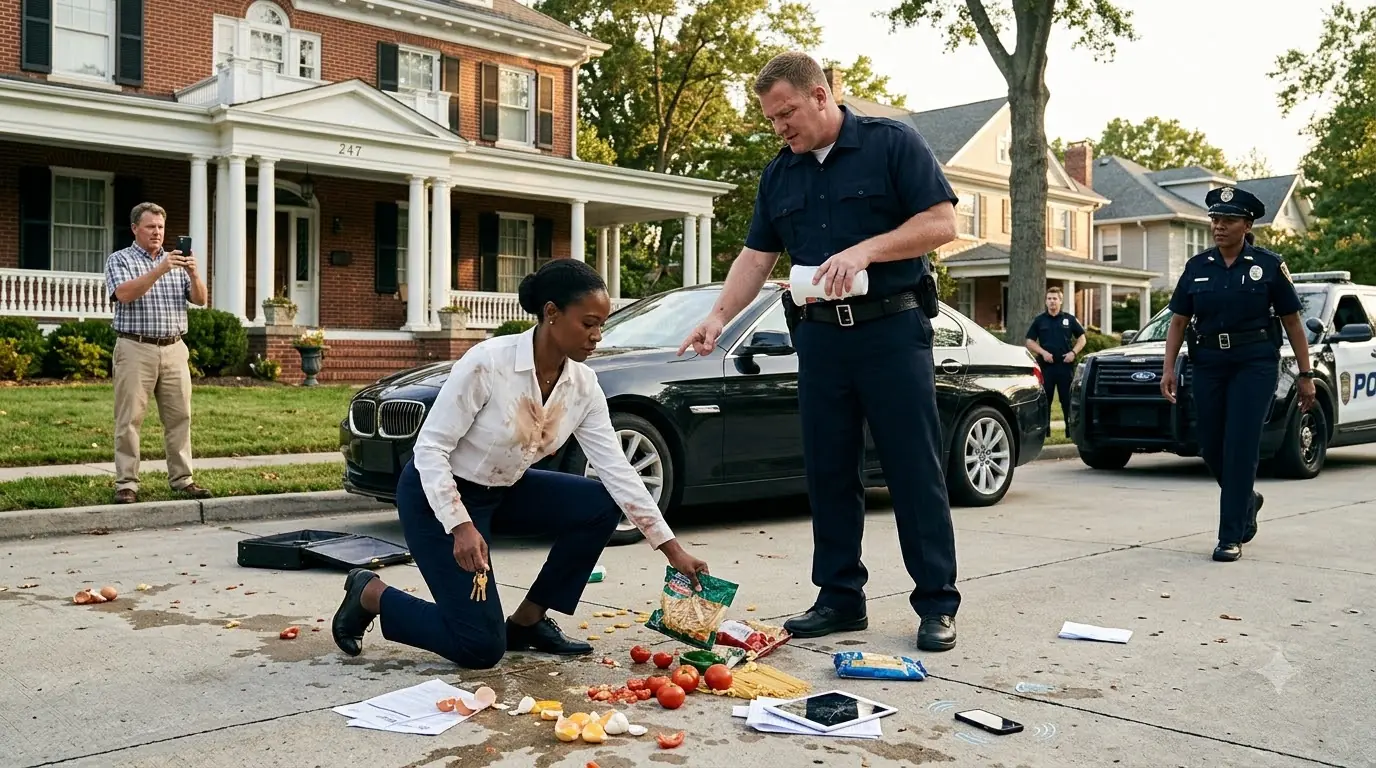
“I don’t care what you were doing.”
Officer Derek Hutchkins tilted his enormous soda cup. Cold liquid poured down the woman’s back, soaking her white blouse and dripping onto the concrete.
“People like you need to learn respect when someone wearing a badge is speaking.”
She knelt slowly. Her hands gathered scattered groceries, broken eggs, and crushed tomatoes. Her house keys lay inches from her fingers.
“That’s better. Stay down there where you belong.”
Across the street, a neighbor’s phone captured everything. The red recording light blinked steadily.
The woman’s front door stood only eight feet away. It was so close, but she could not reach it.
Her expression never changed.
It was calm, controlled, and dangerous.
Have you ever been humiliated at your own front door by someone wearing a badge?
That morning had begun like any other.
At 6:30 a.m., the Richardson kitchen smelled of fresh coffee and toasted bread.
Imani Clark Richardson stood at the counter with her natural hair pulled into a neat bun. She wore a soft gray robe, and her hands moved efficiently as she cracked eggs into a bowl.
“Mom, can I borrow the car tonight?”
Devon, sixteen, did not look up from his phone.
“You mean my car?” Imani asked with a smile. “Ask your father if you can use his.”
James Richardson entered the kitchen while adjusting his tie. At forty-eight, he had salt-and-pepper hair and the kind of presence that filled a room.
He kissed his wife’s forehead. The gesture was automatic and familiar, shaped by fourteen years of marriage.
“Big day,” he said. “The police budget meeting is at three.”
“The discussion about misconduct complaints?” Imani asked as she cracked another egg.
“Yeah. Chief Donovan isn’t happy about it.”
James poured coffee into a travel mug.
“Some of these officers have patterns. Multiple complaints. The union keeps protecting them.”
He did not finish the thought.
Their fourteen-year-old daughter, Maya, bounced into the kitchen. The conversation shifted to homework and soccer practice.
It was their normal breakfast, filled with children, work, and the rhythm of a family that looked different from most of its neighbors but lived exactly the same way.
The Richardsons had moved to Riverside Heights fourteen months earlier, after James won his second term as mayor.
The house was beautiful, a Colonial-style home with a wide front porch and mature trees lining the street. It represented everything they had worked to achieve.
It also represented everything some people believed they did not deserve.
Riverside Heights was eighty-nine percent white. The median home price was $1.2 million.
It was the kind of neighborhood where residents jogged at dawn and attended book clubs on Wednesday evenings. Everyone claimed to know everyone.
But they did not truly know the Richardsons.
Imani had noticed small things from the beginning.
During their second month in the house, someone tucked an anonymous note into their door.
“Is the maid staying overnight now?”
During the fourth month, a neighbor at an homeowners association meeting questioned whether the Richardsons truly owned the house or were merely renting it.
During the seventh month, someone called the police to report a suspicious person.
The suspicious person was Imani, checking her own mailbox at nine o’clock at night.
She had told James about the incidents. He made telephone calls and asked questions.
Why were officers patrolling their street so frequently?
The answers were always vague.
Routine patrols.
Keeping the neighborhood safe.
But Imani knew something was wrong.
She had seen the same patrol car multiple times. The officer inside always stared at her.
His expression was not neutral.
It was contemptuous.
Imani had made eye contact with him once. He did not look away or smile. He simply continued staring.
That officer was Derek Hutchkins, although she did not yet know his name.
“Are you sure you don’t want to come tonight?” James asked.
He meant the donor dinner, another fundraising event where Imani would stand beside him and smile.
“I have three patient consultations tomorrow at the clinic,” she said. “I need to prepare.”
It was her choice and her boundary.
She was Dr. Imani Clark Richardson, director of the community health center. She had built her career through her own work.
In her professional life, she was not merely the mayor’s wife. She was a physician, an administrator, and a leader who had earned respect through competence rather than political connections.
She used her maiden name professionally and rarely appeared at political events. She allowed James to occupy the spotlight while she focused on the work she actually cared about.
“The kids and I will hold down the fort,” she said.
At 4:15 p.m., Imani left the health center.
Her assistant called after her, “Don’t forget the board meeting on Thursday.”
Imani stopped at Whole Foods on the way home.
She did not purchase anything unusual, only ingredients for dinner. Organic vegetables, chicken breasts, a box of pasta, and two reusable shopping bags.
She paid, exchanged a few friendly words with the cashier, and drove home.
At 4:48 p.m., she turned onto Elmwood Drive.
National Public Radio played through the car speakers. The program was discussing police reform across the country.
The timing was painfully ironic.
Imani noticed a patrol car parked two houses away, but she did not think much about it. Police vehicles had become a familiar sight on their street.
She pulled into her driveway and turned off the engine.
Then she collected her purse, briefcase, and both grocery bags.
The bags were heavy, so she balanced them carefully.
Only fifteen feet separated her car from the front door.
She had walked that path a thousand times.
Imani placed the grocery bags on the doorstep at the top of three concrete steps. She searched inside her purse for her house keys.
The key ring carried a small photograph charm showing her family smiling together.
Her fingers closed around the keys.
“Excuse me, ma’am.”
The voice came from behind her.
Male.
Authoritative.
Close.
Imani turned.
Officer Derek Hutchkins stood at the bottom of her front steps.
His patrol vehicle now blocked her driveway and prevented her car from leaving.
Another officer, younger than Hutchkins, remained near the police vehicle. The younger man looked uncomfortable.
Hutchkins did not.
It was 4:51 p.m.
Imani stood at her front door with her keys in her hand. The metal felt warm against her palm.
“Can I help you, Officer?”
Hutchkins did not answer immediately.
His eyes moved from her face to the grocery bags on the doorstep, then to the house behind her.
Finally, they returned to her face.
“I need to see identification. Now.”
The word “now” landed like a period, final and nonnegotiable.
Imani’s stomach tightened, but her voice remained level.
“I’m standing at my own home. Is something wrong?”
“I’ll ask the questions.”
Hutchkins climbed onto the bottom step, moving closer.
“Identification. Now.”
Imani could smell his cologne. It was too strong, a mixture of citrus and something chemical.
“My driver’s license is inside my purse. May I reach for it?”
“Slowly.”
Imani moved with deliberate care.
She unzipped her purse, opened her wallet, and removed her driver’s license. Her fingers did not shake.
She handed it to him.
Hutchkins held the license up and studied it. His lips moved slightly as he read the information.
“Yes. This is my home. I live here.”
He examined the license again, then looked at her, then at the house.
His expression suggested he was attempting to solve an equation that did not make sense to him.
“Step away from the door.”
Imani blinked.
“I’m sorry. What?”
“Step down and move away from the door. Now.”
Her heartbeat accelerated, but her face remained neutral.
“Officer, I’m standing at my own front door. What is this about?”
His hand moved toward the weapon on his belt.
He did not draw it. He simply rested his hand there as a reminder.
“I won’t ask again. Step down.”
Imani descended the three steps.
Now she stood on the driveway, ten feet from her front door.
Her grocery bags remained on the doorstep. Her keys were still clutched in her left hand.
The metal teeth pressed painfully into her palm.
“Officer, I haven’t done anything wrong. What is the reason for this stop?”
Hutchkins climbed the steps.
He now stood where Imani had been standing, at her front door, on her property, physically positioned between her and her home.
“How long have you lived here?”
“Fourteen months.”
“You own this house?”
“Yes. My husband and I own it.”
“What do you do for work?”
The questions came quickly, clipped like an interrogation.
“I’m a physician and healthcare administrator.”
Hutchkins’s mouth twisted into an expression that was neither a smile nor a sneer.
“Right.”
That single word carried disbelief, mockery, and contempt.
“This is a million-dollar neighborhood,” he said.
His eyes traveled over her work clothes, sensible shoes, and natural hair.
“You afford this house on a healthcare salary?”
The insult was clear.
The assumption behind it was even clearer.
Imani’s jaw tightened.
“My finances are none of your concern.”
“I’ve been watching this street,” Hutchkins said as he descended a step. “I’ve seen you coming and going. Something doesn’t add up.”
“Are you accusing me of committing a crime?”
“Who really owns this house?”
He emphasized the word “really” as though it were a weapon.
“A boyfriend? A wealthy sponsor? Some guilty white liberal who wanted…”
“I own this home with my husband,” Imani interrupted. “We purchased it legally. I’m going inside now.”
She turned toward the door, the grocery bags, and her home.
“I didn’t say you could leave.”
She stopped and faced him again.
“Am I being detained?”
“You’re being questioned.”
“On what legal basis? I’m standing at my own home.”
Hutchkins descended the final step.
Now he stood on the driveway with her.
He was too close.
Imani could see a coffee stain on his uniform and a small scar above his left eyebrow.
He smelled of old coffee and overpowering cologne.
“I need to search your vehicle.”
“You don’t have probable cause, and I don’t consent to a search.”
“I smell marijuana.”
“There is no marijuana. That statement is false.”
His face hardened.
“So you’re calling me a liar?”
“I’m stating a fact.”
“Open your car. Now.”
“I do not consent to a search.”
“Then you’re hiding something.”
Hutchkins reached toward his handcuffs.
“Put your hands behind your back.”
Alarm surged through Imani’s chest.
“I’m not hiding anything. I want to call my attorney.”
“You can call your attorney from the station. Turn around.”
Across the street, a front door opened.
Tom Carter stepped onto his porch with his phone already in his hand.
“Hey,” Tom called. “What’s going on over there?”
Hutchkins’s head snapped toward him.
“Police business. Stay back.”
“That’s Mrs. Richardson,” Tom replied. “She lives there.”
Hutchkins ignored him.
He seized Imani’s arm.
She pulled back instinctively.
“Don’t touch me.”
“You’re resisting.”
His grip tightened painfully.
“I’m not resisting. I’m asserting my rights.”
Hutchkins spun her around and pushed her toward the car.
Her shoulder struck the driver’s door hard enough to make her gasp.
“Hands on the hood.”
Imani placed both palms against the warm metal.
The keys remained in her left hand, their teeth digging into her skin.
Hutchkins opened the driver’s door and began searching.
He removed her briefcase from the passenger seat.
Without opening it normally, he turned it upside down.
Its contents spilled across the driveway.
Documents scattered in the breeze.
Her tablet struck the concrete with a sharp crack.
Medical journals fell open, and pens rolled beneath the car.
Her work identification badge landed faceup.
The photograph showed her dressed professionally. Beneath it were the words:
Director, Community Health Center.
Hutchkins picked it up.
He looked at the photograph, then at Imani, then back at the photograph.
“This is you?”
“Yes.”
He narrowed his eyes at the title. His lips moved as he read the word “Director.”
Then he laughed.
It was a short, sharp, mean sound.
“Probably fake. You can buy these online.”
He tossed the badge onto the driveway.
Then he opened her trunk without permission.
He found nothing except a first aid kit and additional reusable shopping bags.
He slammed the trunk closed.
The sound echoed along the quiet street.
Another neighbor emerged.
Margaret Patterson was seventy-five years old, with white hair arranged in careful curls. She stood on her porch with one hand covering her mouth.
Hutchkins walked toward Imani’s doorstep.
He grabbed both grocery bags, carried them down to the driveway, and turned them upside down.
Tomatoes tumbled onto the concrete and burst. Red pulp spread across the gray surface.
Eggs shattered.
Yolk mixed with tomato juice.
The pasta box split open. Dry penne scattered across the driveway like confetti.
Organic lettuce fell beside a container of strawberries that cracked open.
The package of chicken breasts landed in a puddle of egg.
Hutchkins kicked the empty bags aside.
“Clean this up.”
Imani stared at the mess.
She looked at the groceries, the contents of her briefcase, and the work papers scattered across her own driveway.
“You created this mess.”
“I said clean it up. Now.”
The word carried the same finality as before.
Imani looked at him.
His face was hard, satisfied, and certain of his authority.
Then she looked beyond him toward her front door.
It was only eight feet away.
She could see the doorknob, welcome mat, and small potted plant beside the entrance.
So close.
Imani knelt.
Her knees touched the concrete, still warm from the afternoon sun.
She began gathering the ruined items.
Her papers were wet, egg soaking through the pages.
She picked up a tomato, but it fell apart in her hand.
Hutchkins walked toward his patrol car.
Imani heard the door open and close.
His footsteps returned, heavier than before.
She was bent over, attempting to save one of her medical journals. The pages were already ruined.
Cold liquid struck her back.
It soaked through her white blouse immediately.
The sensation was freezing and sticky.
The smell of cola filled her nose.
The liquid ran down her shoulders and arms, dripping onto the documents she held, onto the concrete, and across her hands.
“Maybe this will teach you some respect,” Hutchkins said from behind her.
“People like you need to learn your place when someone wearing a badge is speaking.”
The liquid continued pouring.
The cup held thirty-two ounces.
He emptied all of it down her back and into her hair.
Cola dripped from her elbows.
“People like you don’t belong in neighborhoods like this.”
When the cup was empty, he dropped it.
It clattered onto the driveway beside her.
Imani did not move.
For three seconds, she remained frozen, kneeling and soaked on her own driveway in front of her own home.
Then she slowly stood.
She turned with deliberate care.
Liquid dripped from her blouse and hair. Her white shirt had become transparent in places, with brown stains spreading across the fabric.
She could feel the cold, sticky material against her skin.
The humiliation was deliberate.
Imani looked at Hutchkins.
Her expression was completely calm.
There were no tears, no visible rage, and no fear.
There was only cold calculation.
Her house keys remained in her left hand.
The teeth had left small, red half-moon marks in her palm.
Across the street, Tom Carter continued recording.
His hand shook, but the red light on his phone remained steady.
Mrs. Patterson held her phone to her ear.
Her voice drifted across the street.
“Chief Donovan, this is Margaret Patterson. One of your officers is assaulting…”
“Put that phone down!” Hutchkins shouted.
Mrs. Patterson continued.
“He is assaulting Imani Richardson at her home. Yes, the Imani Richardson.”
Hutchkins looked back at Imani.
Something flickered across his face.
Uncertainty.
It disappeared quickly.
“Clean up this mess and get out of my sight.”
Imani removed her phone from her pocket.
The screen was wet and sticky, but the device still worked.
“I’m calling my attorney.”
Hutchkins moved quickly.
He struck the phone from her hand.
The device flew across the driveway and hit the concrete.
Its screen shattered with a sharp crack.
It skidded across the ground and stopped beside the scattered pasta.
“You’re not calling anybody.”
Tom Carter’s voice carried across the street.
“I’m recording this. I saw everything.”
Hutchkins spun toward him.
His hand moved toward his weapon, not drawing it, but touching the holster.
“Back away, or you’ll be arrested for obstructing an officer.”
“You assaulted her for no reason.”
“I said back away.”
Tom did not move.
He remained on the sidewalk with his phone held steady, recording everything.
The younger officer near the patrol vehicle shifted his weight.
“Derek, maybe we should…”
“Be quiet, Brennan. Stay in your lane.”
Officer Kyle Brennan closed his mouth, but his discomfort was obvious.
His gaze moved between Hutchkins and Imani, then toward the scattered groceries and the neighbors recording.
Mrs. Patterson continued speaking quietly but urgently into her phone.
“She’s soaking wet. He poured something on her. Yes, I’m absolutely certain. The address is 847 Elmwood Drive.”
Hutchkins turned toward Imani again.
His face was red, furious that his authority was being questioned and witnesses were gathering.
“You’re under arrest.”
Imani’s stomach dropped, but her voice remained steady.
“For what crime?”
“Disorderly conduct and resisting arrest.”
“I haven’t resisted anything. I complied with every request.”
“Turn around. Put your hands behind your back.”
She did not move.
“On what legal grounds am I being arrested?”
“The grounds are that I’m a police officer and you’re refusing a lawful order.”
“Asking for legal justification is not refusal.”
His jaw clenched.
He grabbed her wrist and twisted it.
Pain shot up her arm.
“You’re hurting me.”
“Then stop resisting.”
Hutchkins pulled her arm behind her back and seized the other one.
Imani did not fight him, but her body remained rigid and tense.
“Stop resisting.”
“I’m not resisting. I’m refusing an illegal arrest.”
Metal clicked behind her.
The handcuffs were cold against her wet skin.
Hutchkins tightened them excessively.
The metal pressed into her wrists, making her wince.
“That’s better,” he said close to her ear. His breath was hot. “I should have done this from the beginning.”
A car door slammed nearby.
Another patrol vehicle arrived with blue lights flashing but no siren.
Sergeant Linda Morrison stepped out.
She was a Black woman in her late forties with twenty years on the force. Her uniform was crisp and carefully pressed.
She moved with authority.
Her eyes swept across the scene immediately.
A woman stood in handcuffs, soaking wet.
Groceries and documents were scattered across the driveway.
Multiple neighbors were recording.
The situation was bad.
Very bad.
“Hutchkins, what’s the situation?”
He straightened and released Imani’s arms, but left the handcuffs in place.
“Suspicious activity at this residence. The suspect became belligerent when questioned.”
Morrison looked at Imani, the house, and the grocery bags on the doorstep.
Then she looked back at Hutchkins.
“This woman was standing at her own front door.”
“I had reasonable suspicion.”
“Of what crime?”
Hutchkins hesitated.
“Possible drug activity.”
Morrison raised one eyebrow.
“Based on what?”
“I smelled marijuana coming from the vehicle.”
“I smelled nothing,” Officer Brennan said quietly.
Then he spoke more loudly.
“I smelled nothing when we arrived.”
Hutchkins glared at him with pure hostility.
Morrison approached Imani.
“Ma’am, are you all right?”
Finally, someone had asked if she was all right.
“No,” Imani answered.
Her voice cracked slightly, the first break in her composure.
“I’m not. I was assaulted at my own home.”
“What happened?”
“I was unlocking my front door. This officer stopped me, forced me away from the entrance, searched my vehicle without permission, destroyed my property, and poured his drink over me while I was picking up the groceries he scattered.”
Morrison’s expression remained professionally neutral, but her eyes hardened.
She examined the large brown stain covering the back of Imani’s white blouse.
She looked at the driveway.
Crushed tomatoes.
Broken eggs.
Scattered papers.
A damaged tablet.
She noticed the empty soda cup on the ground.
“This is your residence?”
“Yes. I live here with my husband and our two children.”
“How long have you lived here?”
“Fourteen months.”
Morrison picked up Imani’s work identification badge and wiped egg from the plastic.
She read the title.
“You’re a doctor?”
“Yes. I’m also a healthcare administrator.”
Morrison turned toward Hutchkins.
Her expression was carefully controlled.
“Did you pour liquid on this woman?”
“She was being disrespectful.”
“That isn’t an answer. Did you pour your drink on her?”
Silence.
“Officer Hutchkins, did you pour your beverage on this civilian?”
His jaw tightened.
“She needed to learn…”
“Yes or no?”
“Yes.”
Morrison closed her eyes briefly.
When she opened them, her voice was harder.
“Did she consent to the search of her vehicle?”
“I had probable cause.”
“Did she consent?”
Another pause.
“No.”
“Did you have a warrant?”
“I smelled…”
“Did you have a warrant? Yes or no?”
“No.”
Morrison turned toward Brennan.
“Officer Brennan, what did you observe?”
The younger officer straightened.
“We were driving through the neighborhood. Officer Hutchkins said he wanted to check this address. He said someone here didn’t belong.”
Morrison’s expression sharpened.
“When you arrived, what was the resident doing?”
“She was standing at her front door with grocery bags. He stopped her before she could enter.”
“Did you witness a traffic violation?”
“No, ma’am.”
“Any suspicious activity?”
“No, ma’am.”
“Did you smell marijuana?”
Brennan hesitated.
He looked at Hutchkins, then back at Morrison.
“No, ma’am. I did not.”
Hutchkins exploded.
“Are you serious? You’re taking her side against another officer?”
Morrison’s voice cut through the air like glass.
“There are no sides. There is the truth, and there is misconduct. Which one are you defending?”
More neighbors had emerged.
An elderly white couple stood nearby. A young family with a toddler watched from their porch. A jogger had stopped on the sidewalk.
Several people held up phones and recorded.
Hutchkins noticed them.
His face turned even redder.
“This is ridiculous. Everyone put those phones away. This is official police business.”
“This is a public street,” Tom Carter replied. “We have every right to record.”
“I’ll arrest you for obstruction.”
“For what? Standing on my own property?”
Morrison raised one hand.
“Officer Hutchkins, step back. Now.”
“Linda, come on. You know how this is. She…”
“Step back.”
Something in Morrison’s tone carried absolute command.
Hutchkins stepped away.
Morrison reached for Imani’s handcuffs.
“I’m removing these. You are not under arrest.”
The cuffs clicked open.
Imani brought her hands forward.
Her wrists were red and marked.
She rubbed them gently.
“Thank you,” she said quietly.
“Ma’am, do you need medical attention?”
“No. I want this documented. I want his badge number, and I want to file a formal complaint.”
“You’ll receive all of that,” Morrison said. “I promise.”
Hutchkins laughed.
It was a short, bitter sound.
“A complaint? You think that matters? My union will…”
“Your union won’t save you from this,” Morrison replied.
She gestured toward the scene, witnesses, and cameras.
“This is recorded from multiple angles, and there are several witnesses.”
“So what? It’s her word against mine.”
“It’s her word, Officer Brennan’s statement, and approximately six civilian recordings against yours.”
“They don’t understand what they saw.”
“They understand exactly what they saw.”
A new voice joined the conversation.
It belonged to an older white man with a straight back and military-style crew cut.
“Officer, I’m Robert Patterson. I live at 843 Elmwood Drive. I watched the entire incident from my porch, and I had a clear view.”
He pointed toward the Richardson home.
“That woman was at her own front door when you stopped her.”
Margaret Patterson joined her husband.
“I called Chief Donovan directly. He knows what happened.”
The color faded slightly from Hutchkins’s face.
“You called the chief?”
“Yes. He requested the address. I gave it to him. He said he recognized this residence and is on his way.”
Something changed in Hutchkins’s expression.
He remained defiant, but cracks had begun appearing.
“Fine. Let him come. I didn’t do anything wrong. She was suspicious. She matched a description.”
“What description?” Morrison asked.
“There was a report about someone…”
He was scrambling now, inventing details badly.
“What description, Officer Hutchkins?”
“A Black woman in this neighborhood driving a Lexus.”
Morrison’s voice became icy.
“That is racial profiling.”
“No, it isn’t.”
“You stopped her because she is Black and lives in an affluent neighborhood. That is the definition of racial profiling.”
“That isn’t what I meant.”
“Then what did you mean?”
Hutchkins looked around.
Morrison.
Brennan.
The neighbors.
Imani, standing there soaked in cola, surrounded by ruined groceries and a broken phone.
He was cornered.
Cornered people sometimes became vicious.
“You know what? Fine. I’ll say it.”
He gestured toward the surrounding houses.
“This used to be a good neighborhood. A safe neighborhood. Then people like her started moving in.”
The words hung in the air.
They were toxic and undeniable.
“People like her?” Morrison repeated.
“Yes. People who don’t belong. People who buy houses they can’t afford and lower property values. People who…”
“Officer Hutchkins, stop speaking.”
But he could not stop.
The restraint he had maintained for fourteen months had broken.
“I’ve been a police officer here for fifteen years. I know this neighborhood. I know who fits and who doesn’t.”
He turned toward Imani and pointed at her.
“How did you really afford this place? Drug money? Welfare fraud? Or did you marry some wealthy white man who wanted to prove how progressive he was?”
The silence that followed was absolute.
Even the birds seemed to stop singing.
Tom Carter’s voice shook with anger.
“I recorded all of that. Every word.”
Mrs. Patterson covered her mouth as tears filled her eyes.
Officer Brennan looked toward the ground, ashamed.
Sergeant Morrison’s jaw was clenched tightly.
Imani simply stared at Hutchkins.
Her expression remained calm and controlled.
But something burned behind her eyes.
It was patient.
It could wait.
Her broken phone suddenly began ringing on the ground.
The sound came through the cracked speaker, muffled but audible.
Morrison picked it up.
The screen was shattered but still illuminated.
She saw the caller identification.
Her expression changed.
The color drained from her face.
“Oh my God.”
Hutchkins frowned.
“What?”
Morrison held the phone up so Imani could see the screen.
It read:
James, City Hall.
Morrison handed the phone to her.
Their eyes met, and understanding passed between them.
Imani tapped the answer button and deliberately activated the speaker.
“Hello.”
The voice coming through the damaged phone was warm, familiar, and concerned.
“Honey, I’m sorry. The police budget meeting ran late. We’re just finishing now.”
It was a mature male voice, its natural authority softened by affection.
“Chief Donovan is here with me. We’ve been discussing officer misconduct protocols. I should be home by 5:30. Do you want me to bring dinner?”
Hutchkins frowned, confused.
Imani’s voice remained calm.
“James, I’m standing in our driveway. I need you to come home immediately.”
The tone on the other end changed at once.
“What’s wrong? Are you hurt?”
“I was stopped by a police officer while unlocking our front door. He forced me away from the house, conducted an illegal search, destroyed our groceries, and poured his drink on me.”
Silence followed.
It was heavy and absolute.
When James spoke again, his voice was completely different.
He was no longer speaking only as a husband.
He was speaking as the mayor.
“Put the officer on the phone.”
Hutchkins reached toward it.
His hand shook.
“Who is this?”
The voice coming through the speaker was cold and commanding.
“This is Mayor James Richardson. Who am I speaking to?”
The blood drained from Hutchkins’s face.
His complexion changed from red to white within seconds.
“This is Officer Derek Hutchkins, sir.”
Morrison stood very still, her eyes wide.
“Officer Hutchkins, did you assault my wife?”
“Sir, I didn’t know…”
“Did you or did you not pour a beverage on her?”
Silence.
“Answer me.”
“Yes, sir.”
The response was barely audible.
“Badge number.”
“4739.”
“Say it clearly.”
“Officer Derek Hutchkins, badge 4739, sir.”
“I want you to understand that I’m currently sitting with Police Chief Michael Donovan, City Attorney Sarah Carter, and three members of the city council.”
Hutchkins stumbled backward.
His foot landed on a crushed tomato.
“We were discussing police misconduct reform. You just became our case study.”
His legs weakened.
He leaned against the patrol vehicle.
“Sergeant Morrison, are you at the scene?”
Morrison straightened.
“Yes, Mr. Mayor.”
“Document everything. Photographs, witness statements, and video evidence. Officer Hutchkins is not to leave that location.”
“Yes, sir.”
“I’m twelve minutes away.”
The call ended.
Hutchkins stared at Imani.
“Why didn’t you say something?”
Her expression did not change.
“Say what?”
“That you’re the mayor’s wife.”
“And why should that matter?”
“I…”
“If I had told you I possessed political influence, you would have treated me differently.”
Hutchkins opened his mouth but could not answer.
“What should I have said, Officer? That I’m human? That I deserve respect? That I have the right to enter my own home?”
Imani stepped closer.
She was still dripping with soda and covered in stains, but the balance of power had shifted completely.
“I shouldn’t need to be the mayor’s wife to be treated with dignity at my own front door.”
Hutchkins stood speechless.
“You saw a Black woman in a wealthy neighborhood,” Imani continued. “You decided I didn’t belong. Then you decided I needed to be taught a lesson.”
“I made a mistake. I’ll fix it.”
“Fix it?”
Her voice became sharp.
“You poured your drink over me while I was kneeling. You humiliated me in front of my neighbors. You violated my rights.”
She gestured toward the driveway.
Eggs.
Tomatoes.
Broken pasta.
Ruined papers.
“How exactly do you intend to fix that?”
Tom Carter called from across the street.
“Mrs. Richardson, I have eleven minutes of video beginning from the moment he stopped you.”
Mrs. Patterson added, “I recorded my telephone call to Chief Donovan. It is timestamped.”
Another neighbor spoke.
“My doorbell camera captured the entire incident. It’s automatically backed up online.”
Hutchkins looked around at the witnesses, cameras, and evidence.
He turned toward Brennan.
“Kyle, tell them. Tell them she looked suspicious.”
Brennan met his eyes.
“No.”
“What?”
“She wasn’t suspicious. She was entering her own home. You stopped her for no reason.”
“You’re supposed to support me.”
“I’m supposed to tell the truth. You violated department policy, conducted an illegal search, and assaulted a civilian.”
Hutchkins turned toward Morrison.
“Linda, come on. You know how it is.”
“How it is?” Morrison repeated.
Her voice was ice.
“You mean profiling people because of their skin color and abusing your authority?”
“I was doing my job.”
“No. You were doing the opposite.”
His face crumpled as reality began to settle over him.
“Please. I’ve been on the force for fifteen years. I have a family and a pension. I’ll lose everything.”
Imani’s voice cut through his plea.
“You should have considered that before you acted.”
He turned toward her.
Tears formed in his eyes.
“Please. I’m sorry. If I had known…”
“If you had known that I possessed power, you would have treated me differently. That is not an apology. That is fear of consequences.”
“I didn’t mean…”
“You meant every word.”
Imani’s voice remained controlled.
“You said I didn’t belong. You said people like me lower property values. You suggested I married a white man for money.”
Each sentence struck with precision.
“You aren’t sorry you did it. You’re sorry you chose the wrong victim.”
Sirens sounded in the distance.
They were drawing closer.
Hutchkins’s face was wet with tears and sweat as he recognized the destruction of his career.
Morrison removed her phone and began photographing the stains on Imani’s blouse, the scattered groceries, broken eggs, damaged property, and empty soda cup.
“Officer Hutchkins, remain here. Do not speak to anyone. Do not make any telephone calls. Wait for Chief Donovan and the mayor.”
“Linda…”
“That is Sergeant Morrison. If you say one more word, I will place you in handcuffs myself.”
The sirens were close now.
Hutchkins stood defeated.
Imani remained in front of her home with her keys still in her hand.
The door remained eight feet away.
But now she had witnesses and evidence.
Justice was twelve minutes away.
At 5:14 p.m., a black sport utility vehicle carrying city plates turned sharply into the driveway.
There were no lights or siren, but the urgency was unmistakable.
Mayor James Richardson stepped out before the vehicle had completely stopped.
His suit jacket was gone, his tie loosened, and his sleeves rolled up.
Behind him came Police Chief Michael Donovan, a fifty-five-year-old white man with a military bearing and a grim expression.
City Attorney Sarah Carter emerged third. She was forty, with sharp eyes and a tablet already in her hand.
James went directly to Imani.
His hands found hers.
“Are you hurt?”
She shook her head, but her composure cracked slightly. Her eyes became wet.
“I’m angry. I’m humiliated, but I’m not physically hurt.”
James saw the stains covering her blouse.
He looked at the scattered groceries, broken eggs, damaged phone, and ruined documents.
Then he looked toward their front door.
His wife had been eight feet from safety.
James turned toward Hutchkins.
“You stopped my wife at our front door.”
Hutchkins could not speak.
“She had her keys in her hand, and you stopped her.”
“Sir, I didn’t realize…”
“You didn’t realize what? That she is a person? That she possesses constitutional rights?”
James stepped closer.
Hutchkins flinched.
“You saw a Black woman and decided she could not possibly belong here.”
Chief Donovan approached.
He surveyed the scene, and his expression darkened.
Then he stopped in front of Hutchkins.
“Officer Hutchkins, I am placing you under immediate suspension. Surrender your badge, weapon, and radio. Now.”
Hutchkins’s hands shook.
He unpinned his badge.
The metal glinted in the afternoon light.
Chief Donovan took it from him.
“Weapon.”
Hutchkins slowly removed his service pistol from its holster.
His hand trembled as he surrendered it.
The chief gave the weapon to Morrison.
“Radio.”
Hutchkins unclipped the radio and handed it over.
“You served on this force for fifteen years,” Donovan said. “You just ended all fifteen of them.”
“I have a family. I have a pension.”
“You should have considered them before abusing a civilian.”
Hutchkins began crying again.
“You violated your oath, abused your authority, targeted a resident because of her race, conducted an illegal search, and assaulted a civilian.”
Every charge landed like another nail.
“You may face criminal charges for assault, official misconduct, civil rights violations, unlawful search, false reporting, and evidence tampering.”
Sarah Carter stepped forward.
“I have sixteen photographs documenting the wet clothing, destroyed groceries, damaged property, broken telephone, and empty cup.”
She turned toward Tom Carter.
“Sir, did you record the incident?”
Tom nodded.
“Eleven minutes in full high definition. I already sent a copy to your email.”
Sarah looked toward Margaret Patterson.
“You called the chief?”
“I did. I recorded the call.”
Sarah turned to Brennan.
“Was your body camera operating?”
“Yes, ma’am. The footage is secure. The patrol vehicle’s camera recorded the scene too.”
She looked at Hutchkins.
“What about your body camera?”
Silence.
Brennan spoke quietly.
“He didn’t activate it. He told me it had malfunctioned, but I saw him turn it off.”
Sarah entered a note on her tablet.
“Add possible evidence tampering.”
Chief Donovan’s voice became hard as stone.
“Derek Hutchkins, you are suspended without pay, effective immediately. You are prohibited from contacting Mrs. Richardson, any witnesses, or department personnel.”
The chief continued.
“Internal Affairs will collect the remainder of your uniform and equipment tomorrow at eight o’clock in the morning. Do you understand?”
Hutchkins nodded.
“Verbal confirmation.”
“Yes, sir.”
His voice sounded broken.
“Get into the patrol vehicle. Officer Brennan will drive you directly home. There will be no stops, no press statements, and no social media activity.”
Donovan fixed him with a final stare.
“Speak only with your union representative and attorney.”
Hutchkins stumbled toward the vehicle.
His legs barely supported him.
Brennan opened the rear door, the section normally used for detained civilians.
Hutchkins climbed inside.
The door closed.
The sound was final.
Chief Donovan turned toward Imani.
His expression softened.
“Mrs. Richardson, on behalf of the department, I apologize.”
Imani’s voice remained steady.
“Your apology is noted, Chief. But apologies won’t repair this. Systemic change will.”
“You’ll get it,” Donovan replied. “I promise.”
Sarah Carter approached.
“Mrs. Richardson, when you’re ready, we’ll need a complete statement.”
“Tomorrow will be fine.”
Imani looked at the ruined groceries, shattered phone, and scattered papers.
Then she looked at her front door.
“I’d like to go inside now.”
James squeezed her shoulder.
“Let’s go home.”
They walked together across the driveway and climbed the three steps.
James picked up the empty grocery bags.
Imani inserted her key into the lock and turned it.
The door opened.
She stepped into her own home at last.
The door closed behind them.
Outside, Sergeant Morrison began securing the scene.
Photographs.
Evidence markers.
Witness statements.
Neighbors continued watching.
Some were crying, and others were angry.
All of them understood that they had witnessed something that would change their neighborhood forever.
Tom Carter looked down at the eleven-minute recording on his phone.
He opened social media.
His finger hovered above the upload button.
Then he pressed it.
The video began uploading.
Tom Carter’s recording went viral within ninety minutes.
By seven o’clock that evening, it had been viewed three hundred thousand times.
By nine o’clock, two million people had watched it.
By midnight, eight million people had seen a Black woman soaked with soda at the entrance to her own home.
The comments multiplied rapidly.
“She had her keys in her hand at her own front door.”
“This is the mayor’s wife. Imagine what happens to people without power.”
By morning, national media organizations had obtained the recording.
One network presented it as breaking news.
“Mayor’s Wife Assaulted at Home by Police Officer.”
Civil rights attorneys appeared on television panels to discuss the footage.
Even outlets usually sympathetic toward law enforcement described the officer’s conduct as indefensible. The recording was too clear to explain away.
Hashtags began trending.
Justice for Imani.
Doorstep Incident.
Black at Home.
Within twenty-four hours, five thousand people filled the plaza outside City Hall.
Signs appeared throughout the crowd.
She Had Her Keys.
Black While Home.
A Badge Does Not Mean Immunity.
The gathering was diverse, including people of every age and race.
They were not only angry.
They were heartbroken.
At two o’clock in the afternoon, Imani stepped toward the microphones.
She wore a navy suit, and her hair was pulled back.
Her eyes were fierce.
“My name is Dr. Imani Clark Richardson. Two days ago, I came home carrying groceries. I walked to my front door, took out my keys, and prepared to go inside.”
She paused.
“Then I was stopped, questioned, illegally searched, humiliated, and assaulted.”
Her eyes moved across the crowd.
“Not because I had broken a law. Because I am Black.”
The plaza became completely silent.
“If this can happen to me, with my resources, platform, and witnesses, imagine what happens every day to people without those advantages.”
Her voice grew stronger.
“This is not about me being the mayor’s wife. It is about me being a Black woman presumed to be a criminal at her own front door.”
Thunderous applause erupted.
“We demand accountability. We demand reform. We demand that every person have the right to enter their own home without being stopped, searched, or violated.”
The crowd answered with a unified chant.
“Justice now! Justice now!”
Behind the scenes, Internal Affairs opened Hutchkins’s personnel file.
It contained twenty-one complaints.
Eighteen had been filed by people of color.
Marcus Thompson, a Black attorney, reported an unlawful search in 2019.
The complaint was dismissed.
Dr. Kenneth Wade, a Black surgeon, reported harassment in 2021.
Investigators concluded that there was insufficient evidence.
Jasmine Rodriguez, a Hispanic business owner, had been detained for two hours in 2022.
The police union intervened.
Investigators identified nine additional victims during the first week.
Digital forensic specialists recovered deleted text messages.
In one message to another officer, Hutchkins wrote:
“New Black family on Elmwood. Keeping an eye on them.”
In a message to a friend, he wrote:
“The mayor’s wife thinks she’s special. She won’t last.”
Investigators also recovered a group conversation involving four officers.
It contained racist images, profiling jokes, and slurs.
Global positioning records revealed that Hutchkins had driven past the Richardson house forty-seven times during the previous six months.
Each trip took him away from his assigned patrol route.
The incident had not been a simple mistake.
It was part of a pattern of deliberate harassment.
The district attorney filed charges six days later.
Hutchkins faced three felony counts and four misdemeanor charges, including assault, official misconduct, civil rights violations, unlawful search, attempted false arrest, filing false reports, and evidence tampering.
The police union issued a weak public statement.
Its careful language made one thing clear.
The organization was abandoning him.
The trial began eight weeks later.
Assistant District Attorney Maria Gonzalez led the prosecution.
She was sharp, focused, and direct.
The defense attorney looked exhausted from the first day.
On the second day, Imani testified.
She guided the jury through every moment.
Standing at her front door.
Being ordered away.
The unlawful search.
The destruction of her groceries.
Being forced to kneel.
The drink pouring over her back.
“I was eight feet from my front door,” she told the jury. “I had my house keys in my hand, and he stopped me from going home.”
Her voice never wavered.
The defense attorney could not shake her during cross-examination.
“Why didn’t you identify yourself as the mayor’s wife?” he asked.
“Because I shouldn’t have to prove my importance before being allowed to enter my own home.”
The jury remained completely focused on her.
On the third day, Tom Carter’s recording was played in court.
Eleven minutes of clear footage appeared on the large screen.
Two jurors wiped their eyes when Hutchkins poured the soda.
Three looked away when he said people like Imani did not belong in the neighborhood.
On the fourth day, Officer Brennan testified.
“He told me that morning that he wanted to check that address,” Brennan said. “He said someone living there didn’t belong.”
The defense could not discredit him.
He appeared honest and sincere.
On the fifth day, Sergeant Morrison testified.
“In twenty years, I have never witnessed such a clear abuse of police authority. He had no legal justification for his actions. He targeted Dr. Richardson because of her race.”
On the sixth day, prosecutors displayed the recovered text messages.
Racist images.
Group conversations.
Complaints about diversity.
Several jurors looked at Hutchkins with open disgust.
On the seventh day, Hutchkins testified.
It was disastrous.
“I believed she looked suspicious.”
“Why?” Gonzalez asked.
“Something felt wrong.”
“What felt wrong?”
“My instincts.”
“Your instincts told you that a woman unlocking her own front door was suspicious?”
Hutchkins did not answer.
The prosecutor held up the empty soda cup.
“You poured this over Dr. Richardson while she was kneeling. Can you explain that?”
“It was a stressful situation.”
“Stressful for whom? You had the badge and the weapon. She had groceries and house keys.”
Hutchkins remained silent.
“You told her that people like her did not belong. What did you mean?”
“I didn’t mean it the way it sounded.”
“How else could those words possibly be understood?”
Again, he had no answer.
The closing arguments began on the eighth day.
The defense described the incident as a mistake committed by an overzealous officer.
The prosecution played the recording one final time.
“This was not a mistake,” Gonzalez told the jury. “Every action you witnessed was a choice.”
She looked toward the jurors.
“Now you also have a choice. Justice or impunity.”
The jury deliberated for four hours.
They found Derek Hutchkins guilty on every count.
He collapsed against the defense table.
Sentencing occurred two weeks later.
Judge Maria Torres presided.
She was a fifty-two-year-old Latina and former prosecutor known for imposing firm sentences.
“You stopped a woman at her own front door while she held her keys,” Judge Torres said.
“You forced her away from her home. You violated her rights, humiliated her, and assaulted her.”
The judge’s voice became steel.
“Why? Because you decided she did not belong.”
She looked directly at Hutchkins.
“You weaponized your badge, betrayed the public trust, and terrorized a resident because of her skin color.”
The courtroom was silent.
Judge Torres sentenced him to two and a half years in county jail, followed by four years of probation.
He was ordered to pay $100,000 in fines and restitution.
He received a permanent ban from working in law enforcement and was ordered to complete therapy and racial-bias counseling.
Hutchkins wept.
“The public trusted you with authority,” Judge Torres continued. “You used that authority to oppress. This court finds your conduct reprehensible.”
The gavel came down.
Imani sat in the gallery with James beside her.
She did not smile.
It was justice, but it felt hollow.
The civil proceedings moved more quickly.
Imani filed a lawsuit against the city, police department, and Hutchkins.
The city agreed to a $4.5 million settlement within sixty days.
Imani donated every cent to a legal defense fund for victims of police misconduct.
“This money is not mine,” she said. “It belongs to every person who has been profiled and did not possess the resources to fight back.”
The settlement required mandatory reforms.
A civilian oversight board was established, and Imani was appointed chair.
The city adopted a new body camera policy.
It created an early warning system for complaints.
Independent investigators were assigned to misconduct cases.
Quarterly bias training became mandatory.
A public accountability dashboard was created.
Police Chief Donovan retired.
He was replaced by Commander Patricia Hayes, a Black woman and twenty-five-year veteran known for supporting reform.
The department’s culture began to change.
Six months later, five hundred people crowded into the City Hall auditorium.
There was standing room only.
A banner hung above the stage.
Police Reform Progress Report.
Mayor James Richardson and Imani stood together at the podium.
She wore a deep green suit, and her natural hair was arranged in elegant twists.
She looked powerful, confident, and healed.
But she was not unchanged.
James spoke first.
His remarks were brief. He acknowledged the work already completed and the work still ahead.
Then he stepped aside.
Imani approached the microphone.
The auditorium became quiet.
“Six months ago, I walked toward my front door carrying groceries and house keys.”
Her voice was calm and strong.
It filled the room.
“I never made it inside. Not when I intended to.”
She paused.
“A police officer decided I didn’t belong in my own neighborhood, at my own house, on my own doorstep.”
She allowed the truth to settle over the audience.
“He was wrong.”
Imani looked across the room.
“But here is the difficult truth. I am one of the fortunate ones.”
She paused again.
“I had witnesses. I had video evidence. I had resources. I had a husband with power.”
Her voice softened.
“Most people who experience what happened to me possess none of those advantages. For them, justice usually never arrives.”
Murmurs of agreement moved through the crowd.
“So we made changes. Real changes. Not promises and not committees without authority. Action.”
She gestured toward Commander Patricia Hayes, who sat in the front row.
“Our department has new leadership. Commander Hayes brings twenty-five years of experience and a commitment to reform.”
Patricia stood.
Applause filled the auditorium.
She nodded and returned to her seat.
“We now have a civilian oversight board with real authority to investigate and discipline. It does not merely recommend action. It can take action.”
More applause followed.
“Body cameras are mandatory and must remain active throughout public interactions. There will be no more convenient malfunctions. Officers who intentionally deactivate them face immediate suspension.”
Imani continued.
“The early warning system now triggers an automatic review after three complaints. Five complaints result in removal from street duty.”
She looked toward the audience.
“Repeat misconduct will no longer disappear behind institutional protection.”
She moved to the next reform.
“Independent investigators now handle all allegations of misconduct. Police officers will no longer be solely responsible for investigating their own colleagues.”
“Quarterly bias training includes real testing. Officers who fail must retrain. Those who fail twice are reassigned. Anyone who fails three times is terminated.”
She pointed toward the screen behind her.
“The public accountability dashboard lists every complaint, investigation, and outcome. Anyone can review it online.”
People throughout the room nodded.
“Here are the results so far.”
A chart appeared.
“Complaints are down thirty-four percent, not because we are hiding them, but because officers understand that genuine accountability exists.”
She continued.
“Use-of-force incidents are down forty-one percent. Community trust scores have increased by twenty-eight percent.”
Imani paused.
“Six officers were terminated for misconduct that would previously have been concealed or excused.”
She allowed the figures to speak for themselves.
“And there have been zero body camera malfunctions since the new policy took effect.”
Knowing laughter moved through the auditorium.
“But this is not about numbers,” Imani continued. “It is about people. It is about trust.”
She looked toward the front rows.
“It is about the fundamental right to feel safe in your own neighborhood and at your own front door.”
Her voice softened.
“The Richardson family still lives on Elmwood Drive in the same house. We are not leaving.”
Warm applause began.
“Seven more families of color have moved into the neighborhood. Our block parties now include everyone.”
She smiled slightly.
“Mrs. Patterson and I drink tea together every Thursday.”
The applause grew warmer.
“Change is possible, but it requires commitment. It requires courage. It requires refusing to accept injustice as normal.”
Imani stepped slightly away from the podium.
Her tone became more personal.
“My case received a resolution. There was a verdict, sentence, and reform.”
She looked directly at the audience.
“But I think about the others. The people who experience discrimination without cameras, witnesses, or influence.”
Her eyes moved across the room.
“This victory is not only mine. It belongs to every person who has been profiled, harassed, or dismissed because of how they look.”
The audience rose to its feet.
The standing ovation lasted nearly a minute.
When the auditorium became quiet again, Imani leaned toward the microphone one final time.
“Real justice does not require privilege. It is a right.”
Her voice carried through the room.
“Until everyone possesses it, regardless of skin color, neighborhood, or last name, none of us are truly free.”
The applause was thunderous.
Later that evening, Imani sat in her living room and reviewed reactions to the town hall speech.
The video had been posted online.
Comments appeared rapidly.
“This is what accountability looks like.”
“She transformed her trauma into systemic change.”
“If this can happen to the mayor’s wife, imagine what happens to ordinary people.”
Her phone vibrated.
It was a message from Linda Morrison, who had recently been promoted to captain.
“Proud to serve under this new system. Thank you for fighting.”
Imani smiled and typed a reply.
“Thank you for standing up that day.”
She placed the phone beside her and looked around the living room.
Family photographs covered the wall.
Her medical degree hung beside James’s law degree.
The children’s school pictures stood in frames.
Through the window, she could see the front door and the doorstep where everything had happened.
She had crossed that threshold a thousand times since the incident.
Every crossing was a small victory.
A reclamation.
Devon walked through the door after basketball practice.
“Hey, Mom.”
“Hey, baby. Was practice good?”
“Yeah. Really good. I’m going upstairs.”
The exchange was normal, easy, and safe.
That was how it should have been.
Normal.
Easy.
Safe.
For everyone.
Imani stood and walked toward the front door.
She opened it and stepped outside.
The evening air was cool, quiet, and peaceful.
She looked down at the concrete where she had knelt, where the groceries had scattered, and where the soda had dripped.
No stains remained.
But the memory was permanent.
Perhaps that was all right.
Perhaps the memory could become fuel.
Fuel for change.
Fuel for justice.
Fuel for the work still ahead.
Imani went back inside.
She closed and locked the door.
It was her home.
Her sanctuary.
Her right.
One question remained, a question that should trouble every person who witnessed what happened.
If the mayor’s wife could be stopped at her own front door while holding her house keys, who was truly safe?
How many other people had experienced the same injustice that very day without a single witness?