The judge’s gavel slammed down inside courtroom 302, the sound echoing through the stifling air like a final warning.
Officer Bradley Jenkins stood completely frozen at the defense table. His trademark arrogant smirk had vanished, replaced by a sick, chalky pallor.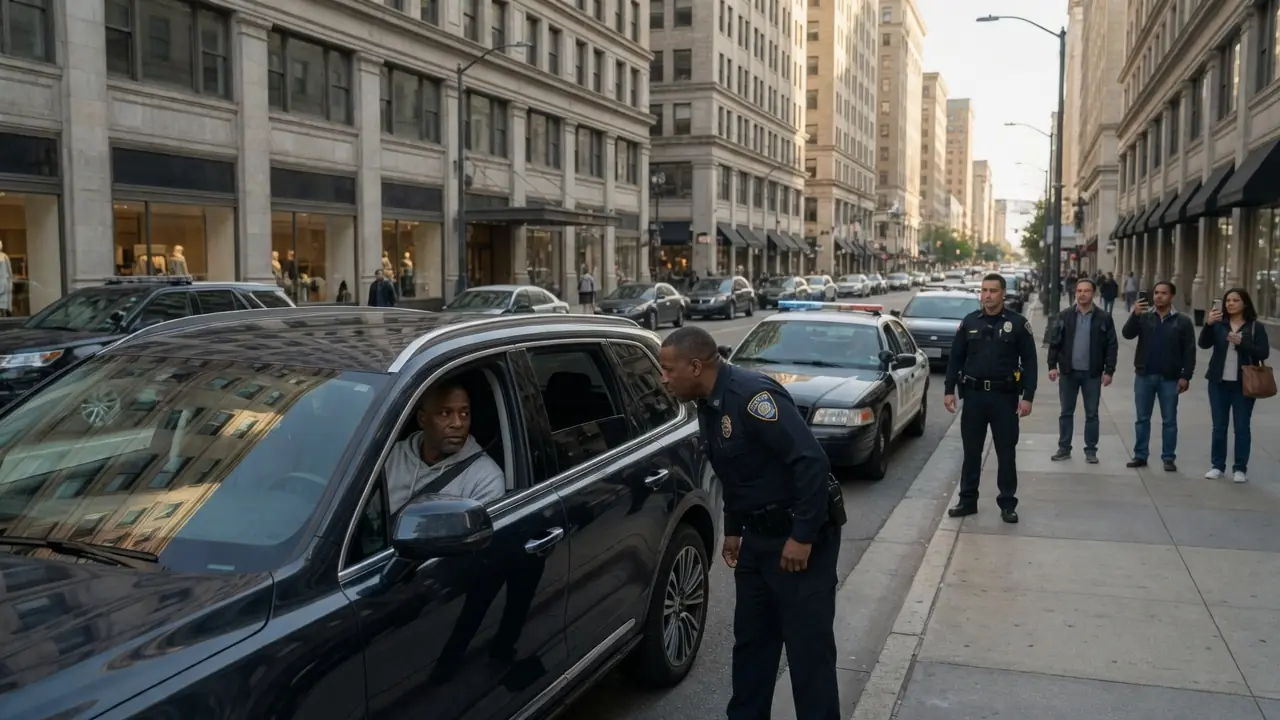
Pulling over a man in a luxury SUV late on a rainy Tuesday night was supposed to be an easy intimidation tactic. He thought he was bullying just another helpless citizen in the dark.
He had absolutely no idea the man calmly sitting behind the wheel was Captain Farah Fidelia, his district’s new commanding officer.
That single racially biased stop did not just end a corrupt career.
It systematically dismantled an entire crooked regime, bringing devastating, inescapable consequences down on a man who truly believed he was untouchable.
The night was unforgiving.
A torrential downpour turned the asphalt of Route 114 into a slick mirror. Inside squad car 4A, the heater blew a weak stream of lukewarm air, barely cutting through the damp chill.
At the wheel sat Officer Bradley Jenkins, an eight-year veteran of the Oakridge Police Department whose personnel file was as thick as a phone book. It was littered with excessive force complaints and racial profiling accusations that had all mysteriously vanished under the protective wing of the local police union.
Beside him sat rookie Officer Timothy Fowler, barely three months out of the academy, clutching his thermal coffee mug like a lifeline.
Jenkins was a man who thrived on authority. He had pale, watery eyes that constantly scanned the road not for danger, but for victims. He drummed his fingers on the steering wheel, irritated by the slow night.
“Nothing out here but wet dogs and ghosts, Fowler,” Jenkins muttered, his voice a low, gravelly rasp. “We need some action to keep the blood pumping.”
Ahead of them, the taillights of a sleek midnight-blue Range Rover cut through the sheets of rain. The vehicle was maintaining a perfect fifty-five miles per hour, dead center in the right lane.
It was not speeding.
It was not swerving.
It was, by every visible measure, a model of lawful driving.
But Jenkins narrowed his eyes, leaning forward slightly as his headlights washed over the SUV. Through the heavily tinted rear window, he could barely make out the silhouette of the driver.
“Look at this guy,” Jenkins sneered, a familiar dark tone creeping into his voice. “Out here at two in the morning in a hundred-thousand-dollar rig. Probably running something up from the city.”
Timothy frowned, peering through the rhythmic sweep of the windshield wipers.
“He’s going exactly the speed limit, Brad. Registration tags look up-to-date from here.”
“That’s exactly how they drive when they’re hiding something, rookie,” Jenkins shot back, his hand hovering over the siren switch. “They drive too perfect. It’s a dead giveaway.”
Before Timothy could push back, Jenkins flicked the switch.
The squad car erupted into a frenzy of flashing red and blue strobe lights, piercing the darkness and painting the surrounding pine trees in frantic colors. The siren gave a short, aggressive yelp.
Inside the Range Rover, Captain Farah Fidelia glanced in his rearview mirror.
He was fifty-two years old, a decorated veteran of the state police who had just been transferred to Oakridge to clean up a precinct infamous for corruption and civil rights violations.
He was off duty, dressed comfortably in a gray hooded sweatshirt and dark jeans, exhausted after a grueling fourteen-hour day of internal audits.
He sighed and checked his speedometer.
He knew he had not committed a single infraction.
Fidelia engaged his right turn signal and smoothly pulled the heavy SUV onto the gravel shoulder of the highway, bringing it to a gentle stop beneath the dim glow of a flickering streetlamp.
He placed the vehicle in park, rolled down his driver’s-side window completely to ensure full visibility, and placed both hands firmly at ten and two on the steering wheel.
He did not reach for his glove box.
He did not dig into his pockets.
He waited.
His demeanor was utterly tranquil.
His mind was sharp.
In the squad car, Jenkins threw it into park and unclipped his radio.
“Dispatch, 4A. Initiating a traffic stop on Route 114 northbound, just past mile marker twelve. Midnight-blue Range Rover.”
“Copy, 4A,” the dispatcher crackled back. “Reason for stop?”
Jenkins did not miss a beat.
“Failure to maintain lane. Erratically crossing the yellow line.”
Timothy looked at Jenkins, his stomach twisting.
“Brad, he didn’t cross the line.”
“Watch and learn, Fowler,” Jenkins said, stepping out into the pouring rain and ignoring the rookie’s protest.
He did not bother putting on a rain jacket. He wanted to look imposing. He rested his right hand heavily on the butt of his holstered service weapon, a blatant intimidation tactic, and began his slow, aggressive walk toward the SUV.
He intentionally shone his heavy-duty flashlight directly into the driver’s-side mirror to blind the occupant.
As Jenkins approached the window, he shifted the blinding beam directly into Fidelia’s face.
Fidelia did not flinch.
He merely blinked against the harsh light, his expression unreadable.
“License, registration, and proof of insurance,” Jenkins barked over the sound of the rain, leaning down so his face was inches from the open window.
He offered no greeting.
He stated no reason for the stop.
“I ask the questions, buddy,” Jenkins snapped, his jaw tightening.
He hated being questioned.
He hated it even more when the person questioning him did not sound afraid.
“I said license and registration. Now, or we can do this the hard way.”
Fidelia maintained eye contact, his composure unyielding.
“My wallet is in my back right trouser pocket. My registration is in the glove compartment. I will reach for them slowly.”
“Just get it,” Jenkins commanded, shining the flashlight down into the cab, scanning the interior for anything he could use as probable cause.
Fidelia moved with deliberate slowness. He reached behind him and retrieved a plain brown leather wallet.
He extracted his civilian driver’s license, deliberately leaving his gold captain’s badge hidden in a separate credential case in the center console.
He wanted to see exactly how this officer operated when he thought nobody of consequence was watching.
He handed the license and registration out the window.
Jenkins snatched the documents and held them under his flashlight.
He read the name.
Farah Fidelia.
He looked back at Fidelia, a sneer curling his lip.
“Whose car is this, Farah? You borrow this from your boss?”
“It is my vehicle,” Fidelia replied evenly.
“Right,” Jenkins scoffed. “A guy like you driving a car like this. Step out of the vehicle.”
Timothy, who had walked up to the passenger side of the vehicle, felt his heart hammer against his ribs. He tapped the roof of the car gently, trying to get Jenkins’ attention.
“Brad, everything looks clear here. The tags match the license.”
“I said step out of the car, Farah,” Jenkins shouted, ignoring his partner, his hand gripping his gun harder. “You’re acting suspicious. I’m ordering you out of the vehicle for my safety.”
The rain battered the roof of the Range Rover, sounding like a thousand tiny drums.
The tension in the damp air was thick enough to choke on.
Fidelia looked at the young officer on the passenger side, noting the pale, frightened look on the kid’s face.
Then he looked back at Jenkins, whose eyes were wide with manufactured, adrenaline-fueled rage.
“Officer,” Fidelia said, his tone still perfectly measured, though now carrying a distinct note of authority that Jenkins was too arrogant to recognize. “I am perfectly willing to comply with a lawful order. However, I must inform you that I am carrying a licensed firearm. It is secured in a lockbox under my seat.”
Jenkins’ reaction was instantaneous and violently disproportionate.
He yanked his service weapon from its holster, pointing it directly at Fidelia’s chest.
“Gun! He’s got a gun! Hands on the wheel!”
Timothy gasped, stumbling back from the passenger window, his hand instinctively flying to his own weapon, though he did not draw it.
“Brad, wait. He just told you about it.”
“Shut up, Fowler!” Jenkins screamed, his finger resting dangerously close to the trigger. “Farah, with your left hand, open the door from the outside. Move slow, or I will stop you right here. Do you understand me?”
Fidelia felt a cold, righteous anger blooming in his chest, but he locked it away.
This was exactly why he had been sent to Oakridge.
The department was a festering wound of constitutional violations, and Officer Bradley Jenkins was the infection made flesh.
“I am complying,” Fidelia said smoothly.
He used his left hand to reach out the window and pull the exterior door handle. The heavy door swung open, the rain immediately blowing into the warm cabin.
“Out. Face the car. Hands on the roof,” Jenkins ordered, stepping back to maintain his firing angle.
Fidelia stepped out into the storm.
He was a tall, powerfully built man, standing six-foot-three. His presence alone commanded a natural respect.
He calmly turned around and placed his hands flat on the wet roof of his SUV.
Jenkins holstered his weapon, stepped forward, and aggressively grabbed Fidelia’s wrists, twisting them behind his back with unnecessary force.
He slapped a pair of cold steel handcuffs onto Fidelia’s wrists, ratcheting them down so tightly the metal bit into the bone.
“You’re making a massive mistake, Officer,” Fidelia stated quietly.
“The only mistake here is you thinking you could ride through my town,” Jenkins whispered maliciously into Fidelia’s ear, patting him down roughly.
Finding nothing else, Jenkins shoved Fidelia against the side of the vehicle.
“Fowler, go search the car. Find the lockbox.”
Timothy hesitated, wiping rain from his eyes.
“Brad, we don’t have probable cause to search the vehicle. He hasn’t committed a crime. The firearm is secured.”
Jenkins spun around, his face purple with fury.
“Are you deaf, rookie? I have probable cause. He was swerving. He’s acting agitated, and he has a weapon. Search the car before I write you up for insubordination.”
Timothy swallowed hard.
His conscience was screaming at him, but his fear of his training officer overpowered it.
He moved to the driver’s side, pulling out his flashlight. He leaned into the vehicle.
It was immaculately clean.
He looked under the seat and saw a heavy steel lockbox bolted to the floorboards.
“I see the box, Brad. It’s locked. We need a warrant for this.”
Jenkins marched over, shoving Timothy out of the way.
“We don’t need a warrant if we find something else in plain sight.”
Jenkins began rummaging aggressively through the center console, tossing pristine maps and mints onto the passenger seat. He popped open the glove compartment, scattering registration papers.
“Stop.”
Fidelia’s voice sliced through the sound of the rain like a razor.
It was the first time his tone had changed.
It was no longer the voice of a cooperative citizen.
It was the voice of command.
“Officer Fowler.”
Timothy looked at the man in handcuffs.
“Sir?”
“In the center console, beneath the cup holder tray, there is a red leather credential case. I suggest you open it before your partner commits a federal civil rights violation.”
Jenkins laughed, a harsh, grating sound.
“What is it, Farah? Your fake badge you bought online? Let’s see it.”
Jenkins reached into the console, ripped the tray up, and grabbed the red leather case.
He flipped it open under the glare of his flashlight.
The heavy gold shield gleamed even in the dim light, intricate and authoritative. Next to it was a laminated identification card bearing the seal of the state police and the Oakridge Police Department.
Captain Farah Fidelia.
Division Commander.
Internal Affairs.
Jenkins froze.
The air seemed to rush out of his lungs.
He stared at the badge, then looked at the ID card, then looked at the towering handcuffed man standing in the rain.
For a brief, agonizing second, the reality of the situation crashed down on him.
The man he had just illegally stopped, unlawfully detained, physically assaulted, and whose car he was currently searching without legal grounds was not just a police officer.
He was the highest-ranking officer in Jenkins’ direct chain of command.
A man sent by the state specifically to root out bad cops.
Timothy, leaning over Jenkins’ shoulder, read the ID.
He staggered back a step, his face draining of all color.
“Oh my God. Captain.”
Panic, pure and unfiltered, seized Jenkins’ mind.
In a rational world, he would have instantly unlocked the cuffs, apologized, and begged for his job.
But Bradley Jenkins’ ego was a fragile, toxic thing.
When backed into a corner, he doubled down.
His twisted logic kicked in.
If I admit who he is, I’m fired and going to jail. If I claim it’s a fake badge, I can book him, get the union involved, and muddy the waters before the brass finds out.
“Fake,” Jenkins choked out, his voice pitching an octave higher than normal. “It’s a fake badge. Impersonating a police officer is a felony, Farah.”
Timothy stared at his partner in sheer horror.
“Brad, are you insane? Look at the seal. Look at the watermark on the ID. That is real.”
“Shut up, Fowler,” Jenkins roared, slamming the credential case into his pocket.
He grabbed Fidelia by the arm and shoved him violently toward the squad car.
“You have the right to remain silent. Anything you say can and will be used against you in a court of law.”
Fidelia did not fight back.
He allowed himself to be pushed into the cramped plastic back seat of the cruiser.
As the door slammed shut, locking him in the cage, Fidelia looked out the window at Jenkins.
He was not scared.
He was calculating.
He knew every policy Jenkins had violated.
Every law he had broken.
Jenkins climbed into the driver’s seat, his hands shaking so violently he could barely put the car in gear.
Timothy got into the passenger seat, staring straight ahead, paralyzed by the career-ending train wreck he was strapped into.
“You’re a witness, Fowler,” Jenkins hissed, throwing the car into drive. “He crossed the yellow line. He was aggressive. He reached for a weapon, and he had a counterfeit badge. That is the story. You deviate from that, and the union will make sure you never wear a badge in any state in this country. Do you hear me?”
From the back seat, in the darkness, Fidelia spoke quietly.
“Officer Fowler, you have a choice to make by the time we reach the precinct. I advise you to make the right one.”
The drive back to the 8th Precinct was conducted in suffocating, terrifying silence.
The wipers slapped rhythmically against the windshield, keeping time with the pounding pulse in Jenkins’ temples.
He was sweating profusely despite the chill of the cruiser.
Every time he glanced in the rearview mirror, he saw Fidelia sitting there, perfectly composed, watching him with eyes that felt like they were recording his very soul.
They pulled into the sally port of the precinct.
The harsh fluorescent lights flickered to life, illuminating the stark concrete walls.
Jenkins threw the car into park and marched around to the back, hauling the door open.
He grabbed Fidelia by the bicep, hauling him out roughly.
“Let’s go, tough guy,” Jenkins grunted, trying desperately to maintain the facade of control.
They walked through the heavy steel doors into the booking area.
The room smelled of bleach, stale sweat, and old coffee.
At the high booking desk sat Desk Sergeant Michael O’Connor, a twenty-year veteran with a graying mustache who was counting down the days to his pension.
A few other officers were milling about, filling out paperwork or chatting by the coffee machine.
“Got a live one, Sarge,” Jenkins announced loudly, trying to project confidence. “Impersonating an officer, resisting arrest, carrying a concealed weapon.”
Sergeant O’Connor looked up from his ledger, pushing his reading glasses down his nose.
His eyes drifted from Jenkins down to the tall, handcuffed man in the gray hoodie.
O’Connor squinted.
He leaned forward over the desk.
The blood slowly drained from O’Connor’s face until he looked like he had seen a ghost.
O’Connor had been at the morning briefing earlier that week. He had seen the photographs. He had read the memos.
“Jenkins,” O’Connor whispered, his voice trembling. “What have you done?”
“What?”
“What have you done?”
“I caught him on 114,” Jenkins said, his voice loud, trying to perform for the room. “Driving a high-end Rover, swerving, tried to flash a fake gold shield at me to get out of it.”
The room went dead silent.
The officers by the coffee machine stopped mid-sentence.
Every eye in the booking area locked onto Fidelia.
“Take the cuffs off him, Bradley,” O’Connor said, his voice suddenly sharp, carrying an edge of sheer panic. “Take them off right now.”
“Sarge, he’s a felony suspect.”
“I said take the cuffs off him!” O’Connor roared, slamming his heavy fist onto the wooden desk so hard the coffee mugs rattled. “Do you have any idea who you are holding?”
Fidelia stepped forward, turning his back to Jenkins.
“Do as the sergeant says, Officer Jenkins.”
Jenkins’ hands were trembling uncontrollably now.
He fumbled with the keys, his bravado finally shattering under the weight of the room’s horrified silence.
The cuffs clicked open.
Fidelia rubbed his raw, red wrists and brought his hands to his front.
He reached into his pocket, a movement that made Jenkins instinctively flinch, and pulled out his cell phone.
He dialed a number and held the phone to his ear.
“Yes, Deputy Chief,” Fidelia said, his voice echoing clearly in the silent room. “This is Captain Fidelia. I need you down at the 8th Precinct booking area immediately. Bring Internal Affairs Detectives Ramirez and Hayes.”
He paused.
“Yes. We have an officer involved in a multi-level felony civil rights violation. I have his badge number. It’s Officer Bradley Jenkins.”
Jenkins physically stumbled backward, hitting the cinder block wall.
“You… you can’t.”
Fidelia hung up the phone and turned to face Jenkins.
The commanding aura radiating from him was palpable.
“Officer Jenkins, as of this exact second, you are stripped of your police powers. You are suspended without pay pending a full investigation. Surrender your weapon and your badge to Sergeant O’Connor.”
Jenkins looked frantically at the other officers in the room, searching for an ally.
Searching for the blue wall of silence he had relied on for eight years to cover his abuses.
But the officers all looked away.
Even the most hardened among them knew Jenkins had crossed a line he could never uncross.
He had gone after the wrong man.
And he had missed.
Slowly, with shaking hands, Jenkins unbuckled his gun belt and laid it on the booking desk.
He unpinned his silver star and set it next to the weapon.
“Officer Fowler,” Fidelia said, turning to the rookie who was standing near the door looking like he was going to be sick.
“Yes, sir,” Fowler said, snapping to attention.
“Go to the interview room,” Fidelia commanded gently but firmly. “Write down every single detail of what occurred tonight. Do not omit a single word. If you write the truth, your career survives tonight. If you lie to protect him, you will share his consequences. Do you understand?”
“Yes, sir. Absolutely, sir,” Fowler said, practically sprinting toward the hallway.
Four months passed.
The union tried everything.
They tried to claim Jenkins was suffering from extreme stress. They tried to claim the lighting on the highway made it impossible to see the badge clearly. They tried to quietly sweep it under the rug with a resignation and a transfer to a county sheriff’s department two towns over.
But Farah Fidelia was not interested in sweeping anything under the rug.
He had meticulously compiled the evidence.
He had Fowler’s sworn testimony, the dashcam footage from the cruiser that contradicted Jenkins’ claim of swerving, and the audio recording of Jenkins explicitly ignoring protocol and escalating the situation through clear bias.
Jenkins did not just get fired.
He was indicted by a federal grand jury.
The scene shifted to the imposing architecture of the federal district courthouse.
Courtroom 302 was packed.
The mahogany pews were filled with local reporters, civil rights advocates, and dozens of off-duty police officers. Some were there to support Jenkins out of a misplaced sense of loyalty, but many more were there to witness the end of an era.
Jenkins sat at the defense table wearing a cheap, ill-fitting suit that seemed to swallow his suddenly diminished frame.
His high-priced defense attorney, Frank Hodges, looked stressed, constantly shuffling papers and wiping his brow.
Jenkins had spent the last four months living in a state of arrogant denial, convinced the system that had protected him for so long would save him again.
But as the heavy oak doors at the back of the courtroom swung open, that delusion finally shattered.
Captain Farah Fidelia walked down the center aisle.
He was dressed in his full Class A dress uniform. The brass buttons gleamed. The rows of commendation ribbons rested proudly on his chest. The gold eagles of his rank were pinned crisply to his collar.
He did not look angry.
He looked like an instrument of absolute, uncompromising justice.
As Fidelia took his seat in the front row directly behind the prosecution table, Jenkins felt a cold knot of pure terror tighten in his stomach.
The gavel slammed down, echoing through the stifling air.
The judge’s voice boomed through the room.
“All rise. The United States of America versus Bradley Thomas Jenkins.”
The trap had sprung.
The hammer was about to fall.
And Jenkins was about to learn that accountability does not just arrive.
It devours.
The air in federal courtroom 302 was thick with anticipation, the kind of heavy silence that precedes a violent storm.
Judge Thomas Albright, a no-nonsense jurist with a reputation for mercilessly striking down legal theatrics, peered over his wire-rimmed glasses at the defense table.
Bradley Jenkins sat rigid, his knuckles white as he gripped the edge of the mahogany table. The arrogance that had defined his eight years on the Oakridge Police Force was gone, replaced by the cornered panic of a man realizing his usual lifelines had been cut.
Lead federal prosecutor Sarah Mitchell stood at the podium.
She was methodical, brilliant, and possessed a courtroom presence that made even veteran defense attorneys sweat.
“Ladies and gentlemen of the jury,” Mitchell began, her voice carrying clearly across the silent room. “This is not a case about a split-second decision made in the heat of a dangerous moment. This is a case about a man who used a taxpayer-funded badge as a license to hunt.”
She turned slightly toward Jenkins.
“Officer Bradley Jenkins did not pull over Captain Farah Fidelia because of a traffic violation. He pulled him over because of the color of his skin, the car he was driving, and the absolute certainty that, as a police officer in Oakridge, he would face zero consequences for his actions.”
Frank Hodges, Jenkins’ high-priced union lawyer, immediately launched into a frantic defense during his opening statement.
He painted Jenkins as a proactive, dedicated public servant suffering from undiagnosed stress.
“Officer Jenkins was working a dark, dangerous highway,” Hodges argued, pacing in front of the jury box. “He saw a vehicle acting suspiciously. When he approached, the driver, who, yes, turned out to be a captain, was uncooperative and stated he had a weapon. Officer Jenkins reacted as he was trained to do. He secured the scene to ensure he went home to his family that night.”
But the prosecution’s first witness blew that narrative entirely out of the water.
When Timothy Fowler’s name was called, a murmur rippled through the gallery where dozens of off-duty Oakridge cops sat.
The blue wall of silence, the unwritten rule that cops never testified against cops, was the foundation of Jenkins’ entire worldview.
Seeing his former rookie partner walk through the swinging wooden gates and take the oath was the first real hammer blow to Jenkins’ fragile psyche.
Fowler looked pale, but his voice was steady.
Under Mitchell’s questioning, he systematically dismantled every lie on Jenkins’ official arrest report.
“Officer Fowler, did the vehicle ever cross the yellow line?” Mitchell asked.
“No, ma’am,” Fowler replied, refusing to look at Jenkins. “The vehicle was maintaining the lane perfectly. We had no probable cause for the stop.”
“And when Captain Fidelia informed Officer Jenkins about his legally secured firearm, was he aggressive?”
“No. He was completely calm. He kept his hands visible. Brad— Officer Jenkins drew his weapon immediately and began screaming.”
Hodges practically leaped out of his chair for cross-examination.
His strategy was to paint Fowler as a terrified rookie who had been pressured by Internal Affairs into testifying against his mentor to save his own job.
“Officer Fowler,” Hodges sneered, “isn’t it true you were intimidated by Captain Fidelia? Isn’t it true you’re only sitting here today changing your story because Internal Affairs threatened to ruin your life if you didn’t give them a scapegoat?”
“Objection,” Mitchell called out calmly. “Badgering.”
“Sustained,” Judge Albright said. “Mr. Hodges, dial it back.”
Fowler leaned forward, finally locking eyes with Jenkins across the room.
“Nobody threatened me, sir. I’m sitting here because I watched my training officer violate a man’s constitutional rights, assault him, and then order me to lie about it on a federal document.”
He paused.
“I became a cop to stop criminals, Mr. Hodges. Not to ride shotgun with one.”
The gallery gasped.
Jenkins’ face drained of blood.
Hodges swallowed hard, his face flushing red, and quickly dismissed the witness.
But the prosecution was not done.
The real twist was still to come.
Hodges had filed a pretrial motion to suppress the dashcam footage from squad car 4A, claiming the hard drive in the vehicle had mysteriously corrupted due to water damage from the rain that night.
It was a classic Oakridge PD cover-up tactic.
But Mitchell smiled as she called her next witness, the precinct’s IT director.
“Mr. Hodges claims the footage is gone,” Mitchell said to the jury. “What Officer Jenkins didn’t know is that two weeks before this incident, Captain Fidelia ordered a precinct-wide software update. Every dashcam in Oakridge now automatically mirrors its data to a secure, off-site cloud server the moment the sirens are activated.”
She looked directly at Jenkins.
“The local hard drive might have been accidentally wiped, but the cloud remembers everything.”
The courtroom lights dimmed.
The large screens flickered to life.
The jury watched in high definition as the midnight-blue Range Rover drove perfectly straight.
They heard Jenkins’ voice, clear as day, on the interior microphone.
“Look at this guy. Out here at two in the morning in a hundred-thousand-dollar rig. Probably running something.”
Then came the next line.
“That’s exactly how they drive when they’re hiding something, rookie.”
They watched Jenkins draw his weapon on a perfectly compliant man.
They heard the bias in his voice.
The visual evidence was devastating.
There was no split-second fear for his life.
There was only malice.
The atmosphere in the courthouse reached a boiling point on the third day of the trial.
The prosecution called its star witness.
“The state calls Captain Farah Fidelia.”
Fidelia walked to the witness stand with the same measured, unshakable composure he had displayed on the rain-slicked highway.
He wore a sharply tailored charcoal suit.
As he swore to tell the truth, his eyes briefly met Jenkins’.
There was no triumph in Fidelia’s gaze.
There was only the cold, mechanical precision of an auditor inspecting a condemned building.
Mitchell walked Fidelia through the events of the night.
Fidelia recounted the stop flawlessly, his memory exact. He explained police protocol, the use-of-force continuum, and probable cause, completely dismantling Jenkins’ claim that standard procedure had been followed.
“Captain Fidelia,” Mitchell asked, pacing near the jury box, “why did you wait to reveal your badge until after you were handcuffed and your vehicle was being illegally searched?”
“Because,” Fidelia replied, his deep voice commanding the absolute attention of everyone in the room, “if I had shown my shield immediately, Officer Jenkins would have let me go with a forced smile and a ‘have a good night, Captain.’ And the very next night, he would have done the exact same thing to a civilian who didn’t have a gold badge to protect them.”
He paused.
“I needed to see exactly how the citizens of Oakridge were being treated in the dark.”
When it was Hodges’ turn to cross-examine, the defense attorney looked like a man walking to his own execution.
He had nothing to work with.
He tried his only remaining tactic: baiting the witness.
He wanted to make Fidelia look angry, aggressive, or vindictive, hoping to play on the jury’s subconscious biases.
“Captain Fidelia, you clearly have an agenda against my client,” Hodges said, leaning on the podium. “You came to Oakridge to make a name for yourself, didn’t you? You set a trap for Officer Jenkins. You deliberately acted suspiciously to provoke a confrontation so you could ruin his career.”
Fidelia did not raise his voice.
He did not shift in his seat.
“Mr. Hodges, driving the speed limit and maintaining my lane is not acting suspiciously. Complying with commands is not provoking a confrontation.”
He looked toward Jenkins.
“Your client ruined his own career the moment he decided the law did not apply to him.”
“But this was an isolated incident,” Hodges insisted, his voice rising in desperation. “A single bad night, and you’re trying to send a man with a family to federal prison for a mistake.”
Mitchell stood.
“Objection, Your Honor. Counsel is opening the door to character and prior conduct.”
Judge Albright looked at Hodges with raised eyebrows.
“Are you sure you want to go down this road, counselor? You’ve just claimed this was an isolated incident. The prosecution is now entitled to rebut that.”
Hodges, realizing his fatal error too late, opened his mouth to withdraw the statement.
But the damage was done.
“I’ll allow it,” Albright ruled. “The prosecution may proceed on redirect.”
Mitchell approached the witness stand, a stack of thick manila folders in her arms.
This was the moment accountability hit back with the force of a freight train.
“Captain Fidelia,” Mitchell said, handing the folders to the bailiff to enter into evidence, “during the four months Officer Jenkins was suspended awaiting trial, what did you do?”
“As head of Internal Affairs, I initiated a comprehensive audit of Officer Jenkins’ arrest record over the past five years,” Fidelia answered.
“And what did you find?”
Fidelia adjusted his posture, looking directly at the jury.
“I found a distinct, calculated pattern and practice of civil rights violations. Officer Jenkins specialized in late-night traffic stops targeting minority drivers in affluent neighborhoods. We found fourteen highly questionable stops.”
Mitchell turned to the gallery.
“Your Honor, the state calls Arthur Pendleton.”
An older, dignified man in a tweed jacket stepped through the courtroom doors.
Jenkins slumped in his chair, his hands covering his face.
“Mr. Pendleton is the principal of Oakridge North High School,” Mitchell explained to the court. “Two years ago, he was pulled over by Officer Jenkins. He was dragged from his car, accused without evidence, and held in a cell for forty-eight hours before the charges were mysteriously dropped. His car was impounded, and he nearly lost his pension.”
Mitchell pointed to the gallery doors again.
“The state also calls Michael Thompson, an emergency room nurse, and Farah Lewis, a local business owner, both subjected to the exact same treatment by the defendant.”
The courtroom erupted into whispers.
The judge had to bang his gavel three times to restore order.
Fidelia had not just caught Jenkins breaking the law.
He had systematically dismantled the corrupt machinery that allowed Jenkins to operate.
By auditing the past, Fidelia had brought Jenkins’ buried victims into the light.
The defense’s narrative of a stressed cop making a one-time mistake evaporated into thin air.
Jenkins was not a victim of a high-stress job.
He was a serial abuser who had finally pulled over the wrong man.
The closing arguments in federal courtroom 302 felt less like a legal proceeding and more like an autopsy of a corrupted soul.
Prosecutor Sarah Mitchell stood before the jury box, her gaze sweeping across the twelve men and women who held Bradley Jenkins’ fate in their hands.
The air conditioning hummed, a low drone beneath the heavy weight of the evidence that had been meticulously laid out over the past two weeks.
“Frank Hodges wants you to believe that Bradley Jenkins was a victim of a high-stress environment,” Mitchell began, her voice ringing with clear, cold precision. “He wants you to believe that the badge he wore was a heavy burden that occasionally caused him to stumble. But you have seen the dashcam footage. You have heard the cloud-recovered audio. You have listened to the heartbreaking testimonies of Arthur Pendleton, Michael Thompson, and Farah Lewis, men who were humiliated, terrorized, and nearly ruined by the defendant simply because they drove nice cars in neighborhoods where he decided they did not belong.”
Mitchell turned and pointed directly at Jenkins, who shrank visibly in his chair.
“That badge was not a burden to Bradley Jenkins. It was a weapon. And on the night of October 12, he aimed that weapon at Captain Farah Fidelia. He thought he was hunting a powerless man in the dark. He had no idea he had cornered a lion.”
She faced the jury again.
“We ask you to return a verdict of guilty on all counts: deprivation of civil rights under color of law, aggravated assault, and obstruction of justice.”
When Hodges delivered his closing, it was a hollow, defeated echo.
He begged for leniency, relying on worn-out clichés about the thin blue line.
But the jury’s faces were stone.
They had seen behind the curtain.
The rot was undeniable.
Judge Thomas Albright formally instructed the jury, and they filed out to deliberate.
But while the jury debated Jenkins’ fate, Captain Fidelia was already detonating the next explosive charge in his master plan.
The twist Bradley Jenkins never saw coming was that his trial was merely the opening act.
As Jenkins sat in a holding cell nervously awaiting the verdict, a fleet of SUVs bearing the gold seal of the FBI pulled up to the Oakridge Police Union headquarters and the former deputy chief’s private residence.
When Fidelia had ordered the precinct-wide cloud backup of the dashcams, he had not just secured video files.
He, alongside Internal Affairs Detectives Ramirez and Hayes, had quietly preserved the precinct’s internal email server and the union’s grievance database.
They found the digital paper trail.
Emails from Union President Richard Cobb to the former precinct captain detailing how to alter use-of-force reports to protect officers like Jenkins.
They found the fix-it spreadsheets where civilian complaints of racial profiling were deliberately misclassified as clerical errors and buried in the archives.
While the jury deliberated Jenkins’ guilt, the federal government indicted six more individuals, effectively decapitating the corrupt leadership that had enabled Jenkins for nearly a decade.
The blue wall of silence had not just cracked.
Fidelia had rigged it with dynamite and blown it to ash.
Four hours later, the buzzer in courtroom 302 sounded.
The jury had reached a verdict.
Jenkins was led back to the defense table. His hands shook so violently he had to clasp them together in his lap.
The jury foreperson, a middle-aged schoolteacher, stood up, holding the slip of paper.
“On the charge of deprivation of rights under color of law, we find the defendant, Bradley Thomas Jenkins, guilty.”
Jenkins squeezed his eyes shut.
“On the charge of aggravated assault, guilty. On the charge of obstruction of justice and official oppression, guilty.”
The gavel cracked like a gunshot.
Jenkins collapsed forward, sobbing openly into his hands, the arrogant predator entirely broken.
He looked back at the gallery, searching for his police buddies, searching for Richard Cobb, searching for anyone from the union to offer a lifeline.
But the seats designated for his supporters were empty.
They were all busy calling their own defense attorneys.
Judge Albright did not even grant bail pending sentencing.
“Mr. Jenkins,” the judge said coldly, “you are a disgrace to the uniform and a danger to the public trust. You are remanded immediately to federal custody.”
Two U.S. Marshals stepped forward.
They hauled Jenkins to his feet.
As they pulled his arms behind his back, the sharp click of the heavy steel handcuffs echoed through the room.
It was the exact same sound Jenkins had subjected so many innocent men to in the dark.
Only this time, the cuffs were not coming off.
The final chapter of Bradley Jenkins’ story would not be written in the fleeting adrenaline of a highway traffic stop, but in the cold, indelible ink of federal law.
Sentencing day arrived in the bitter, unforgiving depths of late January.
The sky outside the towering federal district courthouse was a bleak, monolithic slab of slate gray, threatening freezing rain that mirrored the frigid atmosphere inside courtroom 302.
Over the past three months, the landscape of the Oakridge Police Department had been entirely and aggressively transformed.
Under Captain Farah Fidelia’s unwavering, surgical command, the department had been fundamentally purged of its toxic elements.
The officers who had previously stood by, arms folded in silent complicity while men like Jenkins terrorized the public, found themselves facing a stark ultimatum.
Resign quietly with whatever dignity they had left, or face the relentless, microscopic scrutiny of Fidelia’s newly empowered Internal Affairs Division.
Most chose the former.
The collateral damage to the corrupt establishment was absolute.
The digital paper trail Fidelia had secured from the precinct’s cloud servers had detonated through the local political landscape.
Richard Cobb, the arrogant police union president who had built a career shielding abusive cops from accountability, was now facing his own federal indictment for racketeering and conspiracy to obstruct justice.
The blue wall of silence had not merely cracked.
It had been reduced to ash.
When the heavy oak doors of courtroom 302 swung open, a collective hush fell over the packed gallery.
Bradley Jenkins was escorted down the center aisle by two towering United States Marshals.
There was no tailored suit today to project false authority.
There was no silver star pinned to his chest.
He wore a shapeless, glaringly bright orange federal prison jumpsuit. His wrists were secured in heavy steel handcuffs attached to a thick belly chain, and his ankles were bound by iron shackles that clinked harshly against the polished mahogany floor with every shuffling, defeated step.
Jenkins was a ghost of the man who had prowled Route 114.
He had visibly aged a decade in a matter of months. His previously slicked-back hair was thinning and unkempt. His complexion possessed a sickly, sallow pallor, and his shoulders were permanently slumped under the crushing psychological weight of his new reality.
The man who had once thrived on inducing fear was now entirely consumed by it.
The grim reality of a fifteen-year federal sentence had thoroughly shattered his fragile ego.
He was led to the defense table and sank into the wooden chair like a puppet with its strings severed.
He dared not look back at the gallery.
If he had, he would have realized the true extent of his isolation.
The seats usually reserved for the fraternity of off-duty police officers, the men he thought were his brothers, were entirely empty.
They had abandoned him the moment the federal indictments began raining down.
Instead, the pews were filled to capacity with the citizens of Oakridge.
Judge Thomas Albright, his expression carved from granite, adjusted his wire-rimmed glasses and surveyed the courtroom.
“This court is now in session for the formal sentencing of Bradley Thomas Jenkins. The court will now hear victim impact statements.”
The first to walk through the wooden gates was Arthur Pendleton, the sixty-year-old high school principal.
He stood tall, adjusting his tweed jacket, projecting a quiet, dignified strength that Jenkins had once tried to strip away in the mud of a highway shoulder.
“Your Honor,” Pendleton began, his voice echoing clearly in the cavernous room. “Two years ago, this man pulled me over for a broken taillight that wasn’t broken. He dragged me from my vehicle, threw me to the asphalt, and laughed while he told me my career was over. He locked me in a cage for forty-eight hours based on fabricated charges that were quietly dropped only when I threatened to drain my life savings on a lawyer.”
Pendleton turned his body, forcing Jenkins to look at him.
Jenkins kept his eyes glued to the defense table, his jaw trembling.
“You took my dignity, Mr. Jenkins,” Pendleton continued, his voice rising with righteous conviction. “You made me fear the very people I pay taxes to employ. You made my teenage son terrified of the flashing lights of a police cruiser.”
He paused.
“But today, standing here looking at you in those chains, I don’t feel fear. I don’t even feel anger anymore. I just feel profound pity. You traded your humanity for a fleeting, pathetic sense of power, and now you are left with absolutely nothing.”
Next to the podium came Michael Thompson, an emergency room nurse.
He detailed how Jenkins had profiled him outside the hospital after a grueling twelve-hour shift, violently searched his vehicle, and threatened additional escalation simply because Thompson had questioned the legality of the stop.
“You told me that night that I had no rights you had to respect,” Thompson said, his voice thick with emotion. “You told me you were the law. You were wrong. The law is the man sitting in the front row who finally stopped you. You were just a thug with a taxpayer-funded gun.”
Farah Lewis, a local business owner who had nearly lost his commercial license due to Jenkins’ falsified reports, spoke last, delivering a scathing indictment of the financial and emotional ruin Jenkins had inflicted on his family.
By the time the civilian victims were finished, the atmosphere in the courtroom was incredibly heavy, thick with the undeniable truth of Jenkins’ serial abuses.
Then Judge Albright nodded toward the prosecution table.
“The court recognizes Captain Farah Fidelia.”
Fidelia stood and walked to the podium.
He was dressed immaculately in his Class A dress uniform. The brass buttons caught the dull winter light filtering through the high windows, and the gold eagles on his collar gleamed with uncompromising authority.
He did not look at Jenkins with hatred.
He looked at him with the cold, clinical detachment of a surgeon who had successfully removed something poisonous from a patient.
“Your Honor,” Fidelia began, his deep, resonant voice filling the room and commanding the absolute attention of every soul present. “The badge of a police officer is not a shield behind which a coward can hide his prejudices. It is not a weapon forged to enforce a personal, twisted hierarchy. It is a sacred contract with the public.”
He paused.
“It represents a promise that the most vulnerable among us will be protected, and that the laws of this nation apply equally to everyone, regardless of their zip code, their bank account, or the color of their skin.”
Fidelia turned his head slightly to look directly at the man in the orange jumpsuit.
Jenkins finally looked up, his pale eyes filled with tears, unable to escape the piercing gaze of the captain who had orchestrated his downfall.
“Bradley Jenkins did not just assault me on that highway,” Fidelia continued, his tone methodical and unyielding. “He assaulted the foundational trust of a democratic society. He believed that the dark of the night and the silence of his peers would hide his actions forever. He believed consequences were for other people.”
The courtroom remained silent.
“But consequences are not a myth, Your Honor. They are the inevitable result of arrogance colliding with the truth. We ask this court to impose the maximum sentence. Not out of vengeance, because a man this broken requires no further vengeance, but as a permanent, undeniable warning to anyone in law enforcement who mistakes a badge for a crown.”
Fidelia stepped back from the podium and returned to his seat, his posture perfectly straight.
The silence in the room was deafening.
Judge Albright leaned forward, steepling his fingers on the high mahogany bench.
He looked down at Jenkins, and the sheer disgust on the judge’s face made the former officer flinch.
“Bradley Jenkins, stand up.”
The defense attorney, Frank Hodges, gently nudged his client.
Jenkins practically had to be hauled to his feet, his chains rattling loudly, his knees visibly shaking.
“In my twenty-five years on the federal bench,” Judge Albright began, his voice a low, terrifying rumble, “I have sentenced cartel leaders, corrupt politicians, and violent felons. But there is a special, profound category of contempt reserved for a man like you.”
The judge’s eyes narrowed.
“You took an oath to uphold the Constitution of the United States, and instead, you treated it like discarded paper. You hunted the citizens of Oakridge. You operated a localized reign of terror under the cowardly protection of a uniform you were entirely unworthy to wear.”
Albright picked up his pen, signing the official sentencing document with a sharp, aggressive flourish.
“The jury has found you guilty of deprivation of rights under color of law, aggravated assault, and obstruction of justice. I am denying the defense’s request for downward departure.”
He paused.
“Mr. Jenkins, I sentence you to one hundred eighty months, fifteen full years, in the custody of the Federal Bureau of Prisons. There will be no parole in the federal system.”
Jenkins let out a choked, wet gasp, his head dropping toward his chest.
But the judge was not finished.
The consequences had not yet completed their sweep.
“Furthermore,” Albright continued, raising his voice over the murmurs of the gallery, “under the provisions of federal forfeiture laws and the civil rights statutes, you are hereby permanently decertified from acting as a law enforcement officer.”
Jenkins began shaking.
“In addition, to satisfy the financial restitution owed to Mr. Pendleton, Mr. Thompson, Mr. Lewis, and the numerous other victims identified in the state’s audit, I am ordering the complete and total forfeiture of your municipal police pension. Every cent you thought you had secured for your retirement will be distributed to the men and women whose lives you attempted to destroy.”
Jenkins’ legs finally gave out.
He collapsed backward into his chair, sobbing openly.
A pathetic, broken shell of a man.
The realization that he had lost everything, his freedom, his career, his identity, and his entire financial future, crashed over him like a tidal wave of concrete.
The accountability was absolute.
Thorough.
Merciless.
“This court is adjourned,” Albright declared, bringing the heavy wooden gavel down with a sharp, definitive crack.
“Let’s go,” one of the Marshals grunted, hauling Jenkins by his armpits.
They turned him around, and as they marched him toward the side door leading to the holding cells, Jenkins dragged his feet, his shackles scraping against the floor in a miserable rhythm.
He disappeared behind the heavy steel door, effectively erased from the life of power he once abused, destined to spend the next fifteen years living with the consequences of his own choices.
Captain Farah Fidelia stood up, smoothing his uniform jacket.
He turned and walked down the center aisle of the courtroom.
As he reached the heavy wooden double doors at the back, the citizens in the gallery, Arthur Pendleton, Michael Thompson, Farah Lewis, and dozens of others, stood up.
They did not cheer.
They did not applaud.
They simply offered him a quiet, profound nod of respect.
It was the deepest form of gratitude a community could give.
Fidelia pushed open the doors and stepped out of the courthouse into the crisp, biting winter air.
The threatening rain had finally broken, and a few rays of pale sunlight were beginning to pierce through the heavy gray clouds, illuminating the wet pavement of the city streets.
He looked out over the city of Oakridge.
The storm was over.
The rot had been exposed.
For the first time in a decade, the citizens of this city could look at a -and-white police cruiser and see a shield meant to protect them, rather than a predator waiting in the dark.
The spectacular downfall of Bradley Jenkins serves as a stark modern reminder that systemic arrogance eventually engineers its own destruction.
Power unchecked breeds a dangerous delusion of invincibility.
But accountability, especially when wielded by those with the integrity to document the truth, is an uncompromising force.
Captain Farah Fidelia did not just survive a racially biased traffic stop.
He used it as a master class in accountability, turning one officer’s own tactics into the very evidence that dismantled a corrupt regime.
Real justice rarely happens by accident.
It requires the courage to stand in the dark, the patience to gather the facts, and the unshakable resolve to bring hidden rot into the blinding light of a courtroom.
In the end, Jenkins learned the hardest lesson of all.
A badge can grant authority.
But it cannot shield you from the absolute consequences of your own malice.