Michael Trent had been standing outside the closed Bellamy & Cross boutique for less than fifteen minutes when Officer Greg Mason decided he looked suspicious. The downtown Virginia street was almost empty, its luxury storefronts dark except for decorative window lights reflecting across polished sidewalks. Michael wore a fitted navy suit, crisp white shirt, black shoes, and an understated watch, looking exactly like a man who had just finished an evening business meeting. Mason apparently saw something else.
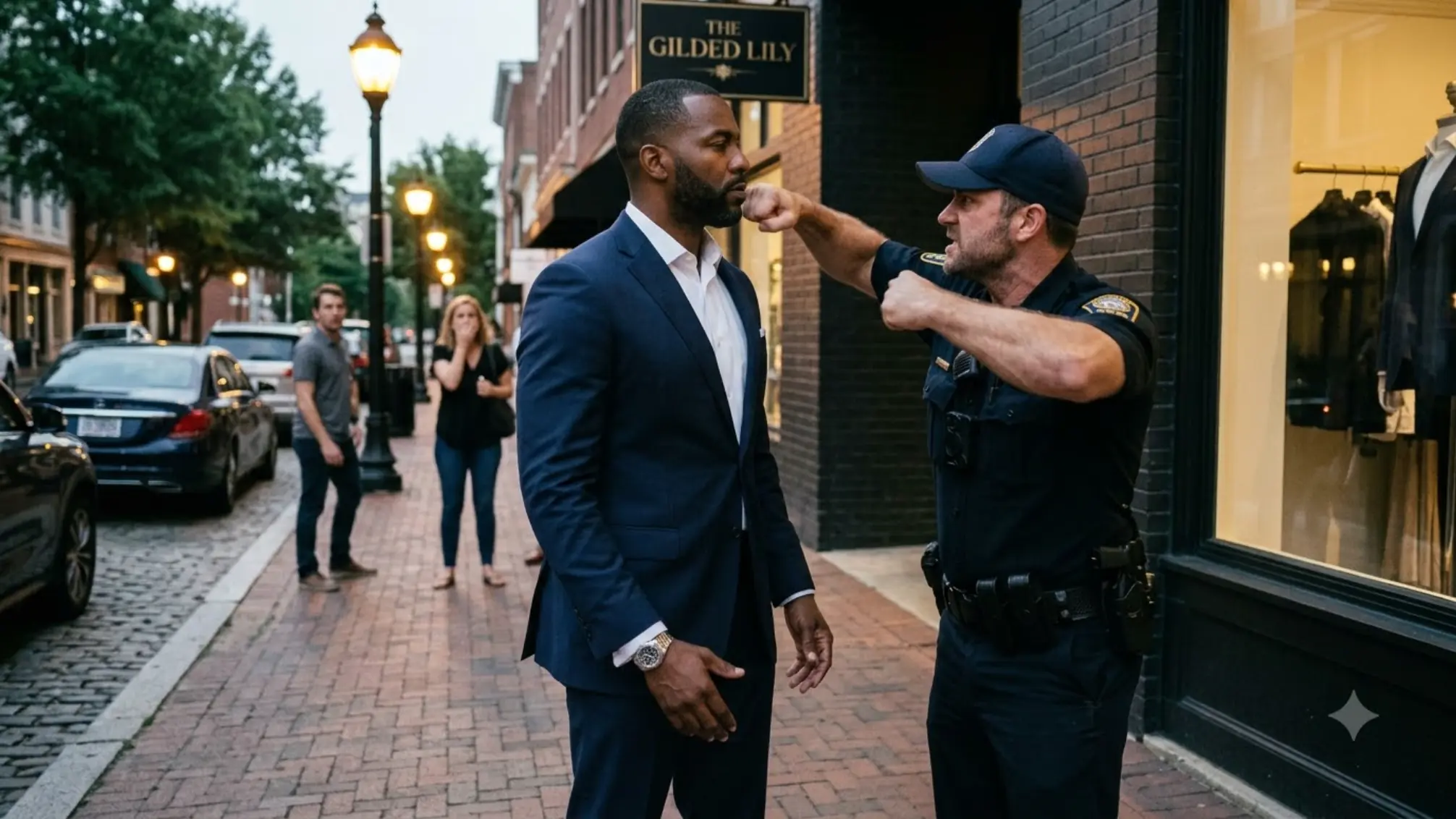
Michael checked his phone again and read the message from his assistant, Joshua Reed. Traffic had backed up two streets away after a late construction closure, and Joshua estimated another ten minutes before he could reach the boutique. Michael slipped the phone into his jacket pocket and leaned lightly against the storefront while watching for the familiar black sedan. Heavy footsteps approached from behind him.
“Hey.”
Michael turned.
Officer Mason was walking toward him with one hand resting against his duty belt. He was thirty-nine, broad-shouldered, cleanly uniformed, and wore the suspicious expression of someone who had already formed an opinion before asking a question. His body camera sat centered on his chest, its indicator light visible beneath the streetlamp. Michael noticed that detail immediately.
“What are you doing here?” Mason asked.
“I’m waiting for someone.”
Mason looked toward the dark boutique.
“Store’s closed.”
“I know.”
“So why are you standing outside it?”
Michael gave him a measured look. “Because that’s where my ride is meeting me.”
Mason stepped closer and studied Michael’s suit. “Your ride?”
“My assistant.”
Something resembling amusement crossed the officer’s face. “Assistant.”
Michael understood the tone. “Yes.”
Mason walked toward the boutique window and glanced inside as though expecting broken glass or missing merchandise. Everything remained perfectly intact. He returned his attention to Michael and said, “Interesting place to hang around this late.”
“I’m not hanging around.”
“Looks like it from here.”
Michael took a slow breath. He had spent years working with police leadership, neighborhood organizations, business associations, and residents across the city, so he knew the difference between an officer asking reasonable questions and one looking for an excuse to continue an encounter. Mason’s posture belonged to the second category. Michael decided not to identify himself yet.
“Officer, is there some problem?”
Mason’s expression hardened at the question. “I’m trying to figure that out.”
“I’ve explained why I’m here.”
“You got identification?”
Michael paused.
“Am I suspected of committing a crime?”
Mason took another step forward. “When an officer asks for ID, you give him ID.”
“That wasn’t my question.”
The street seemed suddenly quieter. A couple leaving a restaurant farther down the block slowed as they noticed the confrontation. Michael kept his hands visible and his voice level, but Mason interpreted calm resistance as disrespect.
“You getting smart with me?”
“No.”
“Sounds like it.”
“I asked whether I’m suspected of an offense.”
Mason looked toward the boutique again. “Maybe loitering.”
Michael almost smiled. “Standing on a public sidewalk waiting for transportation isn’t automatically loitering.”
Mason’s jaw tightened. “You a lawyer now?”
“No.”
“Then maybe stop telling me how my job works.”
Michael studied him. “I know enough to ask why I’m being detained.”
Mason’s eyes narrowed.
“You aren’t detained yet.”
“Good.”
Michael stepped slightly away from the storefront.
“I’ll continue waiting for my ride.”
Mason immediately moved into his path.
“I didn’t say you could leave.”
Michael stopped.
“You just said I’m not detained.”
Mason’s expression changed.
There it was, the contradiction.
Michael did not celebrate it. He simply stood still and waited for Mason to decide whether he wanted to correct himself. Instead, the officer leaned closer until only inches separated them.
“Something about you doesn’t sit right with me.”
Michael’s eyes hardened.
“What exactly?”
Mason looked at the expensive storefront, then back at Michael.
“You don’t exactly blend in around here.”
The words hung between them.
Michael’s voice became colder.
“Say what you mean.”
“You know what I mean.”
“No.”
Michael looked directly at the body camera.
“I’d like you to explain it.”
Mason noticed where his eyes had moved. His hand shifted toward the center of his chest, but he stopped before touching the camera. “Watch your tone.”
“My tone isn’t illegal.”
“You’re real close to finding out what happens when somebody keeps challenging me.”
Michael felt his pulse increase, but his face remained composed. He had dealt with hostility throughout his career, though rarely this openly. The problem was no longer whether Mason misunderstood his presence outside the boutique. The problem was that every reasonable answer seemed to make the officer angrier.
“I’m standing on a sidewalk,” Michael said. “You approached me.”
“Because you looked suspicious.”
“Doing what?”
Mason pointed toward the store. “Standing outside a closed business.”
“So would anyone waiting for transportation at this location.”
“Not everyone.”
Michael stared at him.
“People like me?”
Mason gave a short, ugly smile.
“If the shoe fits.”
The couple down the street had stopped completely now. The woman raised her phone. Mason spotted the movement and pointed toward them.
“Keep moving.”
The man answered, “We’re on the sidewalk.”
Mason turned his anger toward them for half a second before returning to Michael.
Michael said, “They’re allowed to record.”
“I didn’t ask you.”
“No.”
Michael glanced at the body camera again.
“But yours is already doing it.”
That sentence snapped something inside Mason.
He grabbed the front of Michael’s suit jacket.
Michael did not strike him.
He did not shove him.
He simply looked down at the officer’s fist gripping the expensive fabric and then back into Mason’s eyes.
“Take your hand off me.”
Mason pulled him closer.
“You don’t give me orders.”
“Release me.”
“People like you think putting on a suit makes you important.”
Michael’s expression became almost emotionless.
“You have no idea who I am.”
Mason laughed.
“That’s the problem with guys like you. You always think somebody should care.”
Michael looked toward the camera.
“Put your hands on me again and make sure your bodycam catches every second.”
Mason’s face flushed.
Then his fist moved.
The punch struck Michael along the jaw before he had time to turn completely. Pain exploded across the left side of his face, and his shoulder slammed against the boutique window. The glass rattled violently behind him.
The couple down the block shouted.
Michael lifted one hand instinctively toward his face.
Mason grabbed his other arm.
“Stop resisting!”
“I’m not resisting!”
Mason pushed Michael against the glass again.
The absurdity of the command almost overwhelmed him. Michael’s arms were open, his hands visible, and he had made no aggressive movement. Yet Mason repeated the phrase louder, perhaps for the camera, perhaps for the witnesses, perhaps because saying it made the story easier to write later.
“I said stop resisting!”
“You punched me.”
“You stepped toward me.”
“You grabbed me first.”
Mason pulled Michael’s arms behind his back and snapped one cuff around his wrist.
The cold steel tightened.
Michael closed his eyes for half a second.
Not from fear.
From concentration.
Everything after this mattered.
Words.
Sequence.
Witnesses.
Camera.
Commands.
He opened his eyes.
“Officer Mason.”
The use of his name caught the officer’s attention.
Michael had read it from the uniform plate.
“You are making a serious mistake.”
Mason tightened the second cuff.
“You should’ve thought about that before getting mouthy.”
Michael turned his head slightly.
“Before you put me in that car, check my ID.”
Mason laughed.
“Now you want to cooperate?”
“You’re going to want to know who you just cuffed.”
“You threatening me?”
“No.”
Michael’s voice was almost quiet now.
“I’m giving you one last opportunity to understand the situation you created.”
Mason pulled Michael away from the storefront and marched him toward the patrol vehicle.
The witnesses continued recording.
Michael stopped beside the rear door.
“Wallet. Inside jacket pocket.”
Mason stared at him.
“You carrying something?”
“A wallet.”
“Anything dangerous?”
“No.”
Mason reached cautiously into the jacket and removed it.
Michael watched his expression.
The officer opened the leather wallet and pulled out the driver’s license first.
His eyes moved across the name.
Michael Trent.
The color began leaving Mason’s face before he even reached the second credential.
He looked at Michael.
Then back at the card.
Another identification sat beside the license.
Official city seal.
Photograph.
Full title.
Mayor Michael Trent.
For several seconds, Mason did nothing.
The city around them seemed to disappear.
Michael watched recognition arrive piece by piece.
The name.
The face.
The title.
The man whose photograph had appeared on local news broadcasts, city announcements, infrastructure projects, school openings, and election materials.
The mayor.
Mason looked up.
“You’re…”
Michael held his stare.
“Yes.”
Mason’s fingers began trembling.
“The mayor?”
“Yes.”
The officer looked toward the body camera.
Then toward the witnesses.
Then at Michael’s swollen jaw.
His confidence collapsed.
“Sir, I didn’t know.”
Michael’s eyes sharpened.
“That’s exactly the problem.”
Mason grabbed for the handcuff key.
“Let me get these off.”
Michael stood still while the cuffs opened.
Mason removed them quickly.
Red marks circled Michael’s wrists.
“I’m sorry, sir.”
Michael rubbed one wrist.
“Would you be sorry if I weren’t the mayor?”
Mason froze.
“Sir, I…”
“Answer the question.”
“I made a mistake.”
“No.”
Michael stepped closer.
“You made assumptions.”
Mason looked away.
“You decided I was suspicious before I said a word. You decided I didn’t belong near that store. You ignored every explanation I gave you, grabbed me, struck me, and cuffed me.”
“I thought you were…”
Michael cut him off.
“You thought I was what?”
Mason could not finish.
Michael nodded slowly.
“That is what needs to be investigated.”
A black sedan turned onto the street.
Joshua Reed jumped from the passenger side before the vehicle had completely stopped. He saw Michael’s face, the patrol car, and the officer standing several feet away. His expression changed instantly.
“Michael?”
“I’m okay.”
“What happened?”
Mason started speaking.
“There was a misunderstanding.”
Michael turned toward him.
“Stop.”
The officer fell silent.
Joshua walked closer.
“Did he hit you?”
Michael looked at Mason.
“Yes.”
Joshua stared at the officer with disbelief.
“You hit the mayor?”
Michael shook his head.
“No.”
Joshua looked confused.
Michael continued.
“He hit a man standing on a sidewalk.”
That distinction became the foundation of everything that followed.
Michael refused to let Mason’s misconduct become outrageous merely because the victim happened to hold political office. If what happened was wrong, then it was wrong before the wallet opened. The mayoral title simply gave Michael access to people who could force the incident into daylight.
He asked Mason for his badge number.
The officer gave it immediately.
Michael photographed his wrists.
Joshua photographed his jaw.
The witnesses provided their contact information and agreed to preserve their videos.
Then Michael left.
He did not demand Mason’s immediate arrest.
He did not threaten him.
He went to City Hall.
Joshua followed.
Inside Michael’s office, the mayor removed his jacket and placed it carefully across a chair. The fabric was wrinkled where Mason had grabbed him. His jaw had begun swelling.
Joshua paced.
“This is unbelievable.”
“No.”
Michael sat behind his desk.
“That’s the worst part.”
Joshua stopped.
Michael continued.
“It’s believable.”
He opened his laptop.
For months his office had received community complaints about aggressive pedestrian stops, racial profiling, vague “suspicious person” reports, and officers escalating encounters after citizens questioned them. Michael had pushed Police Chief Thomas Harland for stronger de-escalation training and outside complaint review. Harland repeatedly responded that existing procedures were adequate.
Tonight made the word adequate impossible to accept.
Michael called the chief.
Harland arrived at City Hall forty minutes later.
The moment he saw Michael’s face, he stopped.
“What happened?”
“Officer Greg Mason.”
Harland’s expression shifted.
Michael explained the entire encounter in chronological order.
No exaggeration.
No dramatic adjectives.
Harland listened.
When Michael finished, the chief asked, “Was his body camera active?”
“Yes.”
“Witnesses?”
“Two that I know of.”
Joshua added, “Both recorded.”
Harland sat back.
Michael looked directly at him.
“I want the footage preserved tonight.”
“It will be.”
“I want the dispatch records preserved.”
“They will be.”
“I want Mason removed from street duty pending review.”
Harland hesitated.
Michael noticed.
“Why are you hesitating?”
“I need to follow procedure.”
“So follow it.”
Michael leaned forward.
“But do not confuse procedure with delay.”
Harland nodded.
“I’ll place him on administrative suspension tonight.”
The investigation began the next morning.
Body-camera footage confirmed nearly everything Michael had described. Mason initiated the contact without receiving a call for service, had no report of attempted burglary, and possessed no specific information connecting Michael with criminal activity. The recording captured Mason saying Michael did not “blend in,” grabbing his jacket, and escalating after Michael questioned the legal basis for the encounter.
Most damaging was the punch.
Mason’s report initially described Michael as making a “sudden forward movement.”
Video showed otherwise.
Michael had remained almost stationary.
The report said Mason feared an assault.
The footage captured Michael’s hands clearly.
That discrepancy expanded the investigation.
Then prior complaints surfaced.
Seven in five years.
One from a Black attorney stopped outside his own condominium building.
Another from a delivery driver questioned for nearly thirty minutes after completing a legitimate drop-off.
A third from a college student Mason accused of casing parked cars while waiting for friends outside a restaurant.
None had resulted in serious discipline.
Michael read the summaries in silence.
He looked toward Chief Harland.
“You knew about these?”
“Not all personally.”
“But the department did.”
Harland did not answer.
Michael closed the folder.
“That’s the real problem.”
Three days later, Michael held a press conference outside City Hall.
The bruise along his jaw remained visible.
Reporters packed the plaza.
Michael stepped toward the podium.
“Last week, I was stopped while standing outside a downtown business waiting for transportation.”
Cameras clicked.
“I was questioned, physically restrained, struck, and handcuffed despite having committed no crime.”
The crowd murmured.
Michael continued.
“The officer changed his behavior only after discovering my identity.”
He paused.
“That is not the part of this story that should concern you most.”
Reporters went silent.
“The concern is what would have happened if I had been someone without this office.”
That sentence traveled across the city within minutes.
Michael announced three actions.
An independent review of Mason’s conduct.
An audit of prior misconduct complaints involving similar allegations.
And legislation establishing civilian oversight of serious complaints.
The police union objected immediately.
Its president accused Michael of exploiting a personal encounter for political reform.
Michael answered publicly only once.
“I would prefer the encounter had never happened.”
Then he returned to work.
The audit uncovered a pattern larger than Mason.
Complaints were frequently reviewed individually without supervisors comparing repeated allegations against the same officers. Body-camera footage was sometimes checked only when complainants specifically challenged written reports. Citizens rarely knew how their complaints ended.
Michael insisted the reform package address systems rather than simply one officer.
Complaint-pattern tracking.
Mandatory body-camera review in serious allegations.
Independent civilian oversight.
Clear de-escalation standards.
Public reporting of disciplinary outcomes where legally permitted.
The debate became fierce.
Some officers supported the changes.
Others felt accused collectively.
Michael repeatedly said the same thing.
“Accountability protects good officers too.”
Two months after the sidewalk encounter, Mason appeared before a disciplinary board.
The body-camera video played.
Nobody spoke during the punch.
Mason sat with his attorney and watched himself grab Michael’s jacket.
Watched himself ignore the explanations.
Watched himself say Michael did not belong.
Then watched himself strike him.
When testimony ended, Mason finally spoke.
“I didn’t know he was the mayor.”
One board member looked directly at him.
“Why should that matter?”
Mason opened his mouth.
Nothing came.
The board member continued.
“If Mayor Trent had been Michael Trent, accountant, teacher, mechanic, waiter, or unemployed resident, would the force have been justified?”
“No.”
Mason lowered his head.
That became the moment the entire case turned from scandal into lesson.
Mason was terminated for excessive force, improper detention, inaccurate reporting, and conduct inconsistent with department standards. The decision was not based on punching a mayor. It was based on punching a citizen without lawful justification.
Chief Harland announced the termination publicly.
Then he announced something else.
He would support the independent oversight reforms.
Michael had not expected that.
They met privately afterward.
“What changed?”
Harland looked tired.
“I watched Mason’s footage.”
“You saw it before.”
“No.”
The chief shook his head.
“I watched the previous complaints too.”
Michael waited.
Harland continued.
“Different people. Same tone. Same assumptions.”
He looked toward the window.
“We kept looking for one incident bad enough to prove he was a problem.”
Michael nodded.
“And?”
“We should’ve been looking at the pattern.”
That admission mattered more to Michael than Harland’s apology.
Systems rarely improved when leaders insisted nothing had failed.
The city council passed the reform package four months later.
It was not unanimous.
It was not perfect.
Several provisions were revised after legal review, and the union successfully challenged language it believed interfered with collective bargaining agreements.
Michael accepted legitimate changes.
Reform that could survive scrutiny mattered more than symbolic language destined to collapse.
The final package created independent review for serious use-of-force complaints, automated pattern notifications, expanded body-camera auditing, and clearer public reporting.
A year later, Michael returned to Bellamy & Cross.
The boutique owner had invited him to a downtown business association event.
He arrived early.
Again.
Joshua texted him.
Traffic. Five minutes.
Michael laughed.
He stood outside the same window.
This time, another patrol officer walked past.
The officer recognized him.
“Good evening, Mayor.”
Michael nodded.
“Evening.”
The officer continued down the street.
Nothing happened.
Michael remained standing there.
No questions.
No accusations.
No hands on his jacket.
No punch.
For most people, such an ordinary moment would have meant nothing.
For Michael, it meant everything.
Joshua arrived.
“You okay?”
Michael looked toward the street.
“Yeah.”
“You’re staring.”
“I’m appreciating something boring.”
Joshua smiled.
“Government does make people weird.”
Michael laughed.
Then he looked once more at the spot where Greg Mason had cuffed him.
The encounter had changed the city.
But Michael knew better than to pretend one policy package eliminated prejudice, arrogance, or misuse of authority.
Institutions required maintenance.
Complaints required attention.
Leadership required the willingness to discover uncomfortable patterns before a crisis made ignoring them impossible.
That became the lesson Michael repeated whenever people asked about the night the officer discovered he had punched the mayor.
He never began with the ID.
He never began with Mason’s terrified face.
He began with the sidewalk.
A man waiting for a ride.
An officer making an assumption.
A question answered with suspicion.
Suspicion becoming control.
Control becoming force.
Only then did Michael mention the wallet.
Because the badge inside the wallet had not made him worthy of dignity.
The title had not created his rights.
Being mayor had simply ensured people listened quickly when those rights were violated.
Michael eventually framed neither his damaged suit nor the photograph of his bruised face.
Instead, he kept one page from the reform bill inside his office.
It contained a simple requirement:
Serious complaints involving similar allegations against the same officer must be reviewed collectively for patterns of conduct.
Years later, that paragraph helped supervisors identify another problem officer after three separate complaints that once would have been evaluated in isolation.
The intervention happened before anyone was seriously harmed.
When Michael learned about it, he read the report quietly.
Joshua asked whether he felt vindicated.
Michael shook his head.
“No.”
“Then what?”
Michael closed the folder.
“Relieved.”
Because real change was not the dramatic moment when an arrogant officer opened a wallet and realized he had assaulted the wrong man.
Real change was what happened later.
When the next person did not need to be the mayor for somebody to listen.