Sheriff’s Officer Tommy Brooks lifted his hand before anyone in Courtroom 3 understood what he intended to do. The palm cracked against Evelyn Carter’s cheek so sharply that conversation died instantly, leaving only the hum of fluorescent lights and the stunned inhale of fifty people packed into the wooden benches. Evelyn’s head turned with the impact, but her feet never moved, and when she slowly faced him again, her expression carried none of the fear Brooks expected. “You just showed this entire courtroom your place,” she said.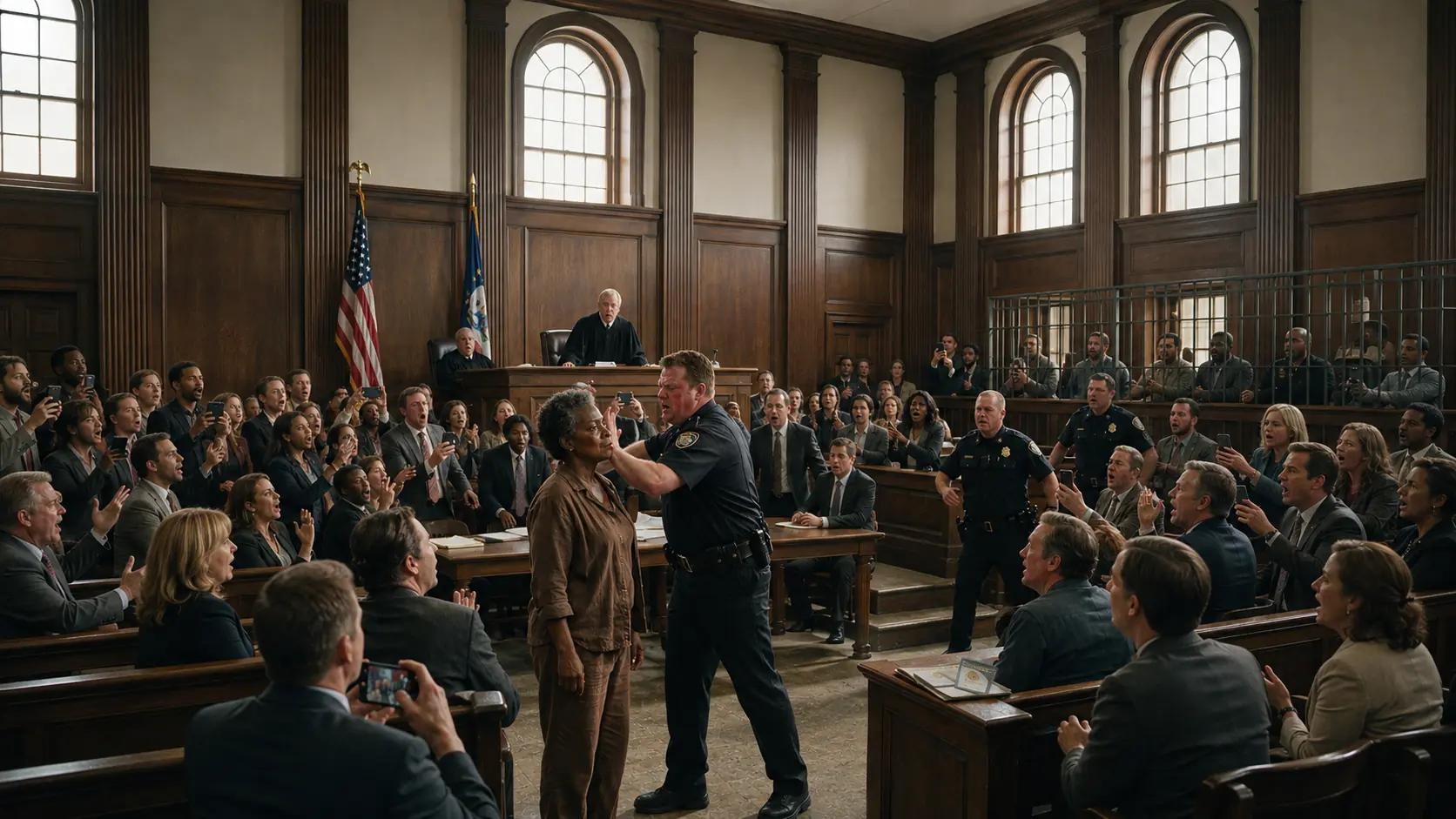
Brooks was forty-seven, heavyset, red-faced, and accustomed to people lowering their eyes whenever his voice rose. He stood inches from Evelyn wearing a dark county police uniform, one hand still half raised, while spectators stared and several phones quietly appeared above the benches. Evelyn was a 56-year-old Black American woman with short gray-black curls, deep brown skin, and calm intelligent eyes, dressed in a slightly wrinkled navy blazer, patterned blouse, gray trousers, and inexpensive black shoes. Nothing about her appearance suggested the amount of authority she had deliberately chosen not to display that morning.
“Who the hell are you?” Brooks demanded. Evelyn touched the corner of her mouth, looked at the faint smear of blood on her fingertip, and reached slowly inside her blazer. Brooks tensed as though expecting resistance, but she simply withdrew a slim leather credential case and placed it on the prosecution table. “The Chief Judge reviewing your badge,” she said, turning toward the bailiff, “lock those doors.”
Judge Malcolm Morrison rose behind the bench so quickly his chair struck the wall. His face had drained of color as he stared at Evelyn’s credentials, then at Brooks, then back at the woman standing in the center aisle. Two court officers immediately moved toward the exits, closed the heavy wooden doors, and positioned themselves there while the entire gallery fell into absolute silence. Brooks laughed once, but the sound died when nobody joined him.
“This is some kind of stunt,” Brooks said. Evelyn ignored him and looked directly at Morrison. “Judge Morrison, please step away from the bench until I determine whether this proceeding has been compromised.” Morrison did not argue; he gathered his papers, stepped down, and stood beside the clerk as Evelyn walked toward the raised platform. Every movement was slow enough to feel deliberate.
The moment Evelyn climbed the three steps to the bench, people in the gallery began whispering. Brooks remained in the aisle, staring upward with the expression of a man watching the floor disappear beneath him. Evelyn sat down, placed both hands on the desk, and looked across the courtroom. “Clerk, bring me the docket for every vagrancy and public-disturbance case processed through this courtroom during the last twelve months.”
The clerk hesitated. “Your Honor, all of them?” Evelyn nodded. “All of them.” Then she looked toward Brooks. “And nobody removes Officer Brooks from this room until his body camera, courtroom security footage, transport logs, booking sheets, and arrest reports are preserved.”
Brooks stepped forward. “You can’t hold me here.” Evelyn looked down at him. “I can preserve evidence inside a courthouse under my administrative authority, and if you leave after being instructed not to destroy or remove evidence, you will explain that decision to investigators.” Brooks opened his mouth, then closed it.
The courtroom had not been chosen randomly. Evelyn had arrived three hours earlier without a driver, assistant, judicial robe, security detail, or visible credential because seven complaints had reached her chambers concerning Courtroom 3. Each complaint described defendants being pushed into guilty pleas before anyone meaningfully reviewed whether their arrests had been lawful. Three mentioned Officer Tommy Brooks by name.
One complaint came from an unemployed veteran sleeping inside his truck after losing his apartment. Another came from a 68-year-old Black American woman arrested after arguing with a parking-enforcement officer outside a grocery store. A third involved a young father sitting on a public bench after midnight while waiting for a rideshare. Each had been charged under vague public-disturbance or vagrancy-related ordinances, and all three claimed Brooks had told them the judge “always backs the badge.”
That phrase bothered Evelyn more than anything else. Courts did not exist to back badges, punish poverty, or reward police confidence. They existed to examine evidence. If Brooks had genuinely begun treating Courtroom 3 as an extension of his authority, Evelyn wanted to see how he behaved when he believed nobody important was watching.
So she dressed ordinarily. She left her judicial credential inside her blazer. She asked investigators not to announce her arrival. Then she sat on a hallway bench and watched.
Within forty minutes, Brooks insulted two defendants. He called one man “garbage,” told another woman to stop wasting the court’s time, and threatened to add another charge when a homeless man asked to speak to a public defender before entering a plea. None of the behavior reached the level Evelyn expected from the complaints, but the pattern was ugly.
Then Brooks noticed her. She had been sitting alone for nearly two hours, taking notes discreetly on a folded sheet of paper, when he demanded to know why she was “loitering” inside the courthouse. Evelyn answered that she was waiting for a case to be called. Brooks asked for identification.
She declined.
Not because she lacked it, but because courthouse spectators were not required to identify themselves simply for sitting quietly in a public hallway. Brooks immediately interpreted refusal as defiance. Within minutes, he had decided she belonged on the misdemeanor docket.
“Public disturbance,” he told the clerk. Evelyn almost laughed. She had not raised her voice once.
Now she sat in the judge’s chair while Brooks finally understood why she had allowed the charge to proceed. He had created the evidence himself. Every insulting remark, unsupported command, and aggressive escalation had occurred beneath courthouse cameras.
“Your Honor,” Brooks said, forcing his voice lower, “I made a judgment call.” Evelyn leaned forward. “You struck a woman in open court.” Brooks glanced toward the phones in the gallery. “She challenged me.”
Evelyn’s eyes hardened. “That is not an offense.” Brooks shifted. “She was being disruptive.” Evelyn turned toward the clerk. “Was I disruptive before Officer Brooks touched me?”
The clerk looked terrified. “Your Honor…” Evelyn softened her voice. “You are not being asked to protect me. You are being asked for the truth.” The clerk swallowed and answered, “No.”
Brooks looked at her sharply. Evelyn noticed. “Officer, do not intimidate a court employee from the floor of my courtroom.” Brooks scoffed. “Your courtroom? Morrison’s name is on the door.”
Judge Morrison flinched. Evelyn looked toward him. “Not anymore, pending review.”
That sentence created another wave through the gallery. Morrison stepped forward. “Chief Judge Carter, I want to be clear, I never authorized physical force against defendants.”
“I did not say you did.”
“Then why remove me?”
“Because seven complaints allege defendants were pressured inside this courtroom, and three claim Officer Brooks told them you would automatically accept his version of events.”
Morrison looked toward Brooks.
Brooks stared at the floor.
Evelyn continued. “If those statements are false, evidence will clear you. If they are true, I need to know whether you encouraged that belief, tolerated it, or simply failed to notice what was happening directly in front of you.”
Morrison said nothing.
The clerk returned carrying two thick binders and a rolling cart stacked with case files. Evelyn stared at the number of folders. “How many?”
“Eighty-three cases involving Officer Brooks and either public disturbance, loitering, obstruction, or vagrancy-related charges.”
The gallery erupted in murmurs.
Evelyn raised one hand. Silence returned.
“Eighty-three in twelve months?”
“Yes, Your Honor.”
She looked at Brooks.
“How many resulted in convictions?”
The clerk checked the summary sheet. “Sixty-two guilty pleas.”
“Trials?”
“Four.”
“Dismissals?”
“Eleven.”
“And the rest?”
“Pending.”
Evelyn leaned back.
Sixty-two guilty pleas was not proof of wrongdoing. People pleaded guilty for many reasons, including because charges were legitimate. But the numbers were significant enough to demand review.
“Public defenders assigned?”
The clerk checked again.
“Only seventeen.”
Evelyn’s expression changed.
“Why?”
Morrison answered this time. “Most defendants waived counsel.”
“Before or after speaking with Brooks?”
Nobody answered.
That silence became the first serious crack.
Evelyn turned toward the courtroom security monitor. “Pull today’s hallway footage.” A technician seated near the clerk began accessing the system while Brooks demanded that his attorney be contacted.
“You may call counsel,” Evelyn said. “You are not under criminal arrest at this moment.” Brooks frowned. “Then unlock the doors.”
“No.”
“Why?”
“Because evidence preservation is underway, and I have reasonable concern that courthouse personnel may communicate before interviews are separated.”
Brooks laughed. “You think everybody here is corrupt?”
Evelyn shook her head. “I think assumptions are exactly what created this situation.”
Security footage appeared on the courtroom monitor. The first clip showed Brooks confronting Evelyn in the hallway. No audio was available from that camera, but his body language was unmistakable: pointing, stepping into her space, blocking her path.
Then body-camera audio was synchronized.
Brooks’s voice filled the room.
Of course that’s your case. Judge Morrison’s got better things to do than waste time on your kind.
Morrison’s eyes closed.
The gallery remained silent.
Another clip played.
You people come in here thinking rules don’t apply.
Evelyn watched without expression.
Then another.
Keep talking and I’ll make sure Morrison buries you before lunch.
The judge turned toward Brooks.
“What did you say?”
Brooks stepped backward. “That’s not what I meant.”
Morrison’s face reddened. “You used my name?”
“It was just language.”
“You told defendants I would bury them?”
“I was trying to control the hallway.”
Evelyn interrupted. “By telling people the judge had already decided their guilt?”
Brooks looked trapped.
“I was talking tough.”
“Inside a courthouse.”
Silence.
“While wearing a badge.”
Brooks clenched his jaw.
The technician loaded additional footage from previous dates. Evelyn had not expected to review months of material immediately, but someone in court administration had already begun matching complaint dates to stored recordings. The first case involved the unemployed veteran.
Video showed Brooks pushing the man against a wall after he asked whether sleeping in a legally parked truck constituted a crime. No violent resistance appeared.
The second involved the elderly woman.
Brooks repeatedly called her “grandma,” even after she asked him to use her name. When she demanded a supervisor, he arrested her for obstruction.
The third clip was worse.
A young Black American father named Malcolm Hayes sat handcuffed on a courthouse bench. Brooks stood above him and said, Take the plea. Morrison always takes my word over yours.
Judge Morrison stared at the screen.
“Stop.”
The technician paused.
Morrison’s voice shook. “Play it again.”
The clip replayed.
Nobody looked at Brooks.
Morrison turned toward Evelyn. “I never told him that.”
“I believe you.”
“Then how many people pleaded guilty because they believed him?”
Evelyn looked toward the eighty-three files.
“That is what we are about to determine.”
Brooks finally understood the danger. This was no longer about a slap. The physical assault had simply forced everyone to freeze long enough for Evelyn to pull on a thread already woven through dozens of cases.
“I want my lawyer,” he said.
Evelyn nodded. “Call one.”
Brooks pointed at her. “You planned this.”
“I planned an inspection.”
“You set me up.”
“You chose every action.”
“You came dressed like that on purpose.”
Evelyn looked down at her ordinary blazer.
“Yes.”
“Why?”
“To see whether justice changed when nobody recognized me.”
The sentence silenced even Brooks.
Evelyn looked across the courtroom. “It did.”
Court administrators arrived twenty minutes later. So did county internal affairs, two independent investigators from the state judicial conduct office, and the chief public defender.
Brooks’s service weapon was secured pending investigation. His body camera was uploaded immediately. His access to police databases and courthouse systems was temporarily suspended.
He was furious.
“You’re destroying my career over one bad moment.”
Evelyn looked at the eighty-three files.
“No.”
Then she pointed toward them.
“I’m finding out whether your career destroyed eighty-three moments belonging to other people.”
Brooks had no answer.
Interviews began that afternoon.
Court clerks were separated.
Bailiffs were questioned.
Public defenders were asked whether defendants had ever described pressure before pleas.
The answers were uncomfortable.
One attorney admitted hearing complaints but assumed defendants exaggerated.
Another said Brooks routinely brought people into court already convinced they were guilty.
A clerk remembered him warning defendants not to “waste Morrison’s time” if they wanted leniency.
Judge Morrison had never personally ordered that behavior.
But investigators found something else.
He rarely questioned Brooks’s arrest narratives.
In thirty-six cases where defense attorneys challenged probable cause, Morrison sided with Brooks thirty-two times.
Again, numbers alone did not prove bias.
But several rulings used language copied almost word-for-word from Brooks’s reports.
Evelyn confronted Morrison privately.
“Did you read these files?”
“Yes.”
“All of them?”
He hesitated.
Her eyes hardened.
“All of them?”
“No.”
“How many?”
“I relied heavily on summaries.”
“Whose summaries?”
Silence.
Evelyn already knew.
Brooks.
Morrison sat down.
“I trusted him.”
“That was your mistake.”
“I had no reason not to.”
“You had defendants telling you.”
He looked away.
“They always complain.”
Evelyn leaned forward.
“That sentence is why we are here.”
Morrison closed his eyes.
He had not accepted money.
He had not ordered illegal arrests.
He had not conspired with Brooks.
But he had allowed efficiency to replace skepticism.
He had treated repetition as credibility.
Brooks appeared constantly.
Defendants came and went.
Over time, the familiar officer became easier to believe than the unfamiliar citizen standing before him.
Evelyn temporarily reassigned Morrison while the review continued.
He did not fight the decision.
Brooks did.
His lawyer argued that Evelyn’s slap incident had prejudiced the entire administrative process. He claimed she could no longer objectively oversee anything related to his cases.
Evelyn agreed with part of that argument.
She recused herself from Brooks’s disciplinary outcome.
A three-person independent panel took control.
Brooks seemed relieved.
That relief disappeared when the panel received the complete video archive.
Twenty-two cases showed potential conduct problems.
Nine displayed clear contradictions between Brooks’s written reports and available footage.
Five contained statements suggesting defendants should plead guilty because challenging him was pointless.
And two showed unnecessary physical force.
Evelyn’s case became the third.
Brooks was placed on administrative leave.
The prosecutor’s office began reviewing whether charges had been filed using inaccurate reports.
Public defenders contacted former defendants.
Several had already served short jail sentences.
One had lost a job.
Another lost an apartment after spending eight days incarcerated before pleading guilty simply to go home.
The young father from the video, Malcolm Hayes, returned to court six months after his original conviction.
This time Evelyn sat in the gallery.
A different judge reviewed the body-camera recording.
Brooks’s report claimed Malcolm threatened him.
Video showed Malcolm repeatedly asking why he was being detained.
The conviction was vacated.
Malcolm stood quietly after the ruling.
Outside court, reporters surrounded him.
One asked how victory felt.
Malcolm shook his head.
“Victory would’ve been somebody watching that video before I spent eight days in jail.”
Evelyn heard the quote that evening.
It stayed with her.
Justice delivered late could still matter.
But pretending delay caused no damage was another kind of dishonesty.
More cases were reopened.
Not all were overturned.
Some arrests were lawful.
Some defendants had genuinely committed offenses.
Evelyn insisted on separating legitimate cases from tainted ones because accountability meant precision, not revenge.
Twenty-three convictions were eventually vacated or amended.
Eleven defendants received restitution or compensation through separate civil processes.
County policy changed.
No officer could directly pressure defendants concerning pleas.
Every misdemeanor defendant received clear written notice of the right to counsel before waiver.
Courtroom security staff underwent retraining focused on physical restraint, disability awareness, and professional conduct.
More importantly, body-camera footage connected to contested arrests had to be reviewed before plea acceptance whenever feasible.
Brooks’s disciplinary hearing lasted four days.
He admitted slapping Evelyn.
He called it an emotional reaction.
He denied systematically intimidating defendants.
Video contradicted him repeatedly.
The panel ultimately terminated his employment for excessive force, dishonesty, intimidation, and conduct undermining judicial proceedings.
A prosecutor later charged him with misdemeanor assault related to striking Evelyn.
He pleaded no contest.
The judge imposed probation, community service, and mandatory counseling.
Evelyn did not attend sentencing.
She had already seen enough of Tommy Brooks.
Judge Morrison faced a different consequence.
The judicial conduct commission found no evidence of criminal corruption but concluded he had failed to exercise adequate independent review and allowed courtroom efficiency to erode procedural fairness.
He received a formal censure and stepped away from criminal misdemeanor assignments.
Months later, he asked Evelyn to meet.
She agreed.
They sat inside an empty courtroom.
Morrison looked older.
“I keep thinking about Malcolm Hayes.”
“So do I.”
“I thought I was protecting the docket.”
“You protected the docket.”
He looked at her.
“That’s the problem, isn’t it?”
“Yes.”
“The docket isn’t the person.”
Evelyn nodded.
Morrison stared at the empty defense table.
“I became efficient.”
“Efficiency can be useful.”
“Until it becomes automatic.”
“Yes.”
He sighed.
“I trusted the badge.”
Evelyn looked toward the judge’s chair.
“You were supposed to test it.”
He nodded slowly.
“I know.”
That was the last serious conversation they ever had.
One year after the slap, Evelyn returned to Courtroom 3.
No undercover clothes.
No secret inspection.
She wore her black judicial robe.
The courtroom had changed.
New signage explained defendants’ rights clearly.
Public defenders were present during the morning docket.
Body-camera review terminals sat beside the clerk.
A new judge presided.
Evelyn watched from the rear.
A police officer testified in a disorderly-conduct case.
The defendant disagreed.
Instead of automatically choosing one account, the judge asked for video.
The footage played.
It supported part of the officer’s story.
It supported part of the defendant’s.
The judge dismissed one charge and allowed another to proceed.
Nobody cheered.
Nothing spectacular happened.
That pleased Evelyn.
Courts were not supposed to produce viral moments.
They were supposed to produce careful decisions.
After the docket, a young clerk recognized her.
“Chief Judge Carter?”
“Yes?”
“Can I ask you something?”
“Sure.”
“Is it true Officer Brooks slapped you before you revealed who you were?”
Evelyn smiled faintly.
“Yes.”
The clerk shook her head.
“He must’ve been terrified when he found out.”
“That isn’t what bothered me.”
“What did?”
Evelyn looked toward the benches.
“That he wasn’t terrified before.”
The clerk frowned.
Evelyn continued.
“He believed I was nobody.”
Then she looked at the bench where Malcolm Hayes had once sat handcuffed.
“He thought nobody meant consequences didn’t matter.”
The clerk became quiet.
That was the part headlines often misunderstood.
Brooks’s great mistake was not striking the Chief Judge.
It was striking a woman he believed had no power.
His shock after seeing Evelyn’s credential did not prove respect.
It proved calculation.
He had behaved differently the instant status became visible.
Evelyn wanted a courthouse where status changed nothing.
Where a homeless defendant mattered.
Where a frightened teenager mattered.
Where an elderly woman mattered.
Where an ordinary spectator sitting on a hallway bench mattered.
Years later, a framed photograph of Courtroom 3 hung inside the judicial training center.
It did not show Evelyn taking the bench.
It did not show Brooks striking her.
Instead, it showed the empty courtroom after everyone had left.
Judge’s chair.
Defense table.
Prosecution table.
Witness stand.
Rows of wooden seats.
Beneath the photograph was one sentence from Evelyn’s training address:
“The person with the least power in the room is the reason the room exists.”
New judges read it every year.
Some knew the story behind it.
Others did not.
That did not matter.
Evelyn never wanted the lesson to depend on her name.
Because before Brooks discovered who she was, she was still entitled to dignity.
Before Morrison learned defendants had been pressured, they were still entitled to fair hearings.
Before cameras exposed contradictions, facts were still facts.
Authority did not create those truths.
It merely decided whether institutions honored them.
Tommy Brooks learned that distinction too late.
He had slapped a Black woman because he believed she was powerless.
Seconds later, she revealed herself as the Chief Judge.
But the real reversal came after she sat behind the bench.
She did not use her power to destroy him.
She used evidence to uncover what his power had already done.