“Who pays for a house like this?”
The officer’s voice carried across the quiet front lawn.
Dr. Simone Laurent stood beside her rose garden, one hand still holding the green garden hose. Water dripped softly from the nozzle onto the grass. 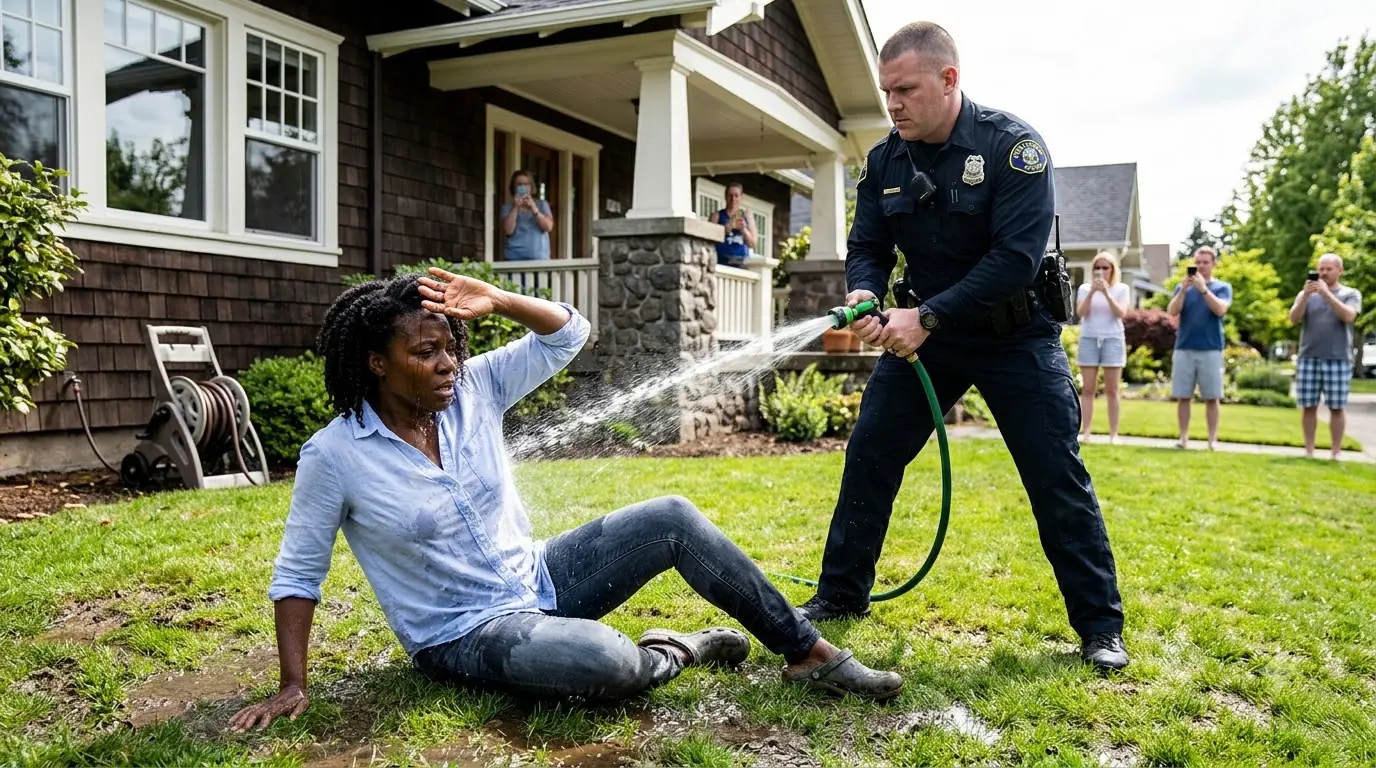
She stared at the officer, trying to understand how a peaceful Wednesday morning had turned into an interrogation on her own property.
“You think I’m stupid?” he continued, moving closer. “Someone like you in a neighborhood like this? You’re either working here or you’re somewhere you don’t belong.”
“Officer,” Simone said carefully, “I own this home.”
He laughed.
It was cold and dismissive.
“Own it?”
His disbelief was the point.
Less than an hour later, water would be pouring from Simone’s clothes as neighbors stood around her with phones raised. The officer who had treated her like a criminal would be staring at the identification in her hand, his face drained of color.
What she pulled from her pocket would not merely reveal who she was.
It would expose who he was.
Wednesday morning, June 12, Portland, Oregon.
The sun rose over Laurelhurst, washing one of the city’s most desirable neighborhoods in pale morning light. Tree-lined streets curved past old Craftsman homes, wraparound porches, stone walkways, and lawns maintained with almost obsessive care.
At 2847 Maple Ridge Drive, the morning had begun peacefully.
The two-story house was pale yellow with white trim. A rose garden ran along the front walk. Red geraniums filled terracotta pots beside the porch steps, and ivy climbed one side of the wooden fence.
Inside the kitchen, Dr. Simone Laurent poured herself a second cup of coffee.
The room smelled of French roast and lavender dish soap.
Vivaldi played quietly from a speaker on the counter.
Simone was forty-two years old. Her natural curls were pulled back beneath a cloth headband, and she wore faded jeans with a simple cotton blouse because she planned to spend twenty minutes in the garden before getting ready for work.
Her briefcase sat beside the front door.
Inside were case files and notes for oral arguments scheduled that afternoon at the federal courthouse.
Simone served on a federal appellate court. Years of legal work had trained her to examine language carefully, to remain composed under pressure, and to separate emotion from evidence.
But for the next few minutes, she did not want to think about courts.
She wanted to water her roses.
On the refrigerator was a photograph of Simone and her husband, Dr. James Laurent, taken on their anniversary.
James was a cardiothoracic surgeon. He had left for the hospital shortly after six that morning because Wednesdays were usually filled with early procedures.
Simone looked at the photograph for a moment, smiled, then opened the front door.
Cool morning air touched her face.
This was her favorite part of the day.
Before courtrooms.
Before legal briefs.
Before people expected answers from her.
Just Simone and the garden.
She uncoiled the green hose beside the porch, opened the spigot, and adjusted the nozzle to a gentle spray.
The roses darkened as water sank into the soil.
She moved slowly from one plant to the next.
“Good morning, Simone.”
Eleanor Henderson waved from the neighboring property.
Eleanor was seventy-eight, with white hair pinned neatly above a floral house dress. She stood beside her own flower bed holding a hose.
“Morning, Eleanor.”
“Your roses look beautiful.”
“Yours are doing pretty well, too.”
Eleanor laughed.
“That fertilizer I told you about works miracles.”
“You were right.”
It was an ordinary exchange between women who had lived beside one another for five years.
They shared tea most Sundays.
When packages arrived while Simone and James were away, Eleanor collected them.
The previous month, while the Laurents were in Hawaii, Eleanor had checked the house each afternoon.
There was nothing unusual about Simone standing in that yard.
Nothing suspicious.
Nothing requiring police attention.
Simone moved toward the geraniums.
She hummed quietly along with the music still drifting through the open front door.
Her thoughts had already begun shifting toward the civil-rights case waiting on her desk.
She never heard the patrol car slow down across the street.
Inside the vehicle, Officer Derek Whitmore watched her through the windshield.
Whitmore was thirty-eight and had spent fifteen years with the Portland Police Bureau. He wore his hair in a close buzz cut and carried himself with the rigid confidence of someone accustomed to people responding to his uniform before he ever said a word.
His partner, Officer Ryan Mills, sat beside him looking at his phone.
Mills was twenty-four.
Eight months earlier, he had graduated from the academy.
Whitmore nodded toward Simone.
“You see that?”
Mills looked up.
“See what?”
Whitmore watched Simone watering the flowers.
“She doesn’t fit.”
Mills frowned.
“Derek, she’s watering a garden.”
“In Laurelhurst.”
“So?”
Whitmore’s jaw tightened.
“Something feels off.”
Mills looked toward the house.
There was no damaged window.
No alarm.
No person calling for help.
No suspicious vehicle.
Just a woman standing beside roses.
“Captain Reynolds has been telling us to be careful about unnecessary contacts,” Mills said. “Especially after the community liaison review.”
Whitmore shifted the car into park.
“I’ve been doing this fifteen years.”
“Derek.”
“I know suspicious when I see it.”
He opened the door.
Mills watched him cross the street.
Something in his stomach tightened.
He considered following.
Then he remained in the car.
Whitmore was senior.
Mills was still probationary.
That decision would haunt him later.
Whitmore crossed the sidewalk and approached Simone’s property.
His boots struck the pavement with deliberate weight.
One hand rested near his duty belt.
Simone noticed him only when his shadow crossed the roses.
She released the hose trigger and straightened.
“Good morning, Officer. Can I help you?”
Her voice was professional.
Calm.
Her pulse increased anyway.
Whitmore stopped at the decorative fence.
Instead of waiting at the gate, he stepped across the low boundary and onto the lawn.
“What are you doing here?”
Simone blinked.
“I’m watering my garden.”
“This is your garden?”
“Yes.”
Whitmore looked at the house.
Then at Simone.
“This is your house?”
The emphasis made her uneasy.
“Yes. I live here.”
He stepped closer.
“I need identification.”
Simone’s legal instincts immediately engaged.
“Why?”
“To verify you belong here.”
“I’m standing on my own property.”
“Then showing identification shouldn’t be a problem.”
Simone kept her tone even.
“Officer, I’m asking what legal basis you have for demanding identification from someone gardening at her own residence.”
Whitmore’s expression hardened.
“Don’t make this difficult.”
“I’m not.”
“We’ve had reports of suspicious activity.”
“Here?”
“In this area.”
“What activity?”
Whitmore hesitated.
Simone waited.
Finally he said, “People being places they shouldn’t be.”
She understood.
Not from what he said.
From how he looked at her while saying it.
“Officer, are you telling me I look like someone who shouldn’t be in this neighborhood?”
Whitmore took another step.
“Are you the homeowner, or are you working for the homeowner?”
Eleanor’s voice came from next door.
“Officer, Simone lives there.”
Whitmore turned sharply.
“She and her husband have lived there for years.”
“Ma’am, stay out of this.”
“I’m her neighbor.”
“This is police business.”
“She’s watering flowers.”
Whitmore raised his voice.
“Do not interfere.”
Eleanor stared at him.
Then she reached into the pocket of her house dress and pulled out her phone.
Simone noticed.
She was grateful.
Whitmore noticed, too.
His irritation increased.
“Officer,” Simone said, “I am willing to answer reasonable questions. But so far, you’ve given me no reason for this contact.”
He laughed.
“You giving me legal advice now?”
“I’m explaining my rights.”
“Your rights?”
Whitmore moved until he was only a few feet away.
“You have the right to cooperate.”
Simone’s jaw tightened.
“That isn’t how constitutional rights work.”
Behind Whitmore, Mills finally got out of the patrol car.
“Derek.”
Whitmore did not turn.
“Go back to the car.”
“Maybe we should clear this.”
“I said I’ve got it.”
Mills stopped near the fence.
Simone looked at him.
For one second, their eyes met.
His expression told her he knew something was wrong.
But he still said nothing.
Across the street, a young couple on their morning walk stopped.
The woman pulled out her phone.
Two houses away, Mr. Carter stepped onto his porch.
He folded his arms.
Whitmore saw the growing audience.
Instead of calming down, he seemed to become more determined to win.
“All right,” he said. “You’re going to prove you live here.”
“How?”
“Deed. Mortgage paperwork. Utility bill. Something.”
“Those documents are inside.”
“Then we’ll go inside.”
Simone stared at him.
“You want to enter my home?”
“To verify your story.”
“Do you have a warrant?”
“I don’t need one if you let me in.”
“I’m not letting you in.”
Whitmore nodded slowly.
“Then you’ll stay here while I figure out whether you’re trespassing.”
“On my own property?”
“That’s what I’m trying to determine.”
For several seconds, Simone considered simply walking inside and retrieving her federal credentials.
It would end the argument.
Probably instantly.
But another thought stopped her.
Why should it require federal credentials to convince an officer she had the right to water flowers outside her own home?
If she had been a teacher, accountant, waitress, secretary, nurse, or unemployed, would Whitmore have gained more authority over her?
No.
She remained where she was.
“I want your name and badge number.”
Whitmore touched his nameplate.
“Derek Whitmore. Badge 4782.”
“I’ll remember it.”
He gave a sarcastic smile.
“That a threat?”
“No. Documentation.”
The teenager on the bicycle had stopped now.
He was about sixteen.
His name was Marcus Henderson, though Simone did not know that yet.
Marcus raised his phone.
“I’m recording.”
Whitmore spun around.
“Put that away.”
Marcus stayed where he was.
“I’m on the sidewalk.”
“Get moving.”
“It’s legal to record police activity from here.”
Whitmore took one step toward him.
“Do not interfere with me.”
Marcus continued filming.
The live stream started small.
Forty-seven viewers.
Then sixty-eight.
Then more than one hundred.
Simone turned her attention back to Whitmore.
He looked angrier than before.
“Last chance. Identification.”
“You still haven’t given me a lawful reason.”
“Failure to identify. Obstruction. Resisting.”
“I haven’t resisted anything.”
“You’ve resisted every instruction I’ve given.”
“An unlawful instruction doesn’t become lawful because you repeat it.”
Whitmore shook his head.
“There you go again. Playing lawyer.”
“I work in the justice system.”
He laughed.
“What are you? A filing clerk?”
Simone remained silent.
“Court assistant?”
Nothing.
Whitmore looked toward her house.
“Maybe maintenance?”
Eleanor gasped.
Mr. Carter shook his head.
Marcus’s audience climbed.
Two hundred.
Then three hundred.
“Officer Whitmore,” Simone said, “you are making a serious mistake.”
“The mistake is thinking I’m going to let you stand here and tell me how to do my job.”
He gestured toward the house.
“A place like this costs what? Half a million?”
“Approximately.”
“You expect me to believe that?”
“Why wouldn’t you?”
His expression answered before he did.
Simone stepped closer verbally, not physically.
“Say it.”
“Say what?”
“Whatever you’re thinking.”
Whitmore’s face darkened.
“Don’t push me.”
“I’m standing in my own yard.”
The hose remained loosely in Simone’s hand.
Water dripped from the nozzle.
Whitmore noticed it.
“Put that down.”
Simone looked at the hose.
“It’s a garden hose.”
“Put it down.”
She placed it carefully on the grass.
“Step away from it.”
“This is absurd.”
“Step away.”
Simone moved back.
Whitmore keyed his radio.
“Unit 712 to dispatch. Requesting backup at 2847 Maple Ridge Drive.”
Static answered.
“Nature of call?”
“Possible trespassing. Subject refusing identification.”
Mills finally spoke more firmly.
“Derek, stop.”
More neighbors emerged.
A woman in exercise clothes.
A man walking a dog.
Another teenager.
Several phones were raised now.
Simone looked at the people around her.
Eleanor was recording with trembling hands.
Mr. Carter gave Simone a small nod.
Stay calm.
She looked at Whitmore.
“I am going to reach slowly into my back pocket for identification.”
Whitmore’s hand moved closer to his belt.
“Keep your hands where I can see them.”
“My identification is in my back pocket.”
“Slow.”
Simone moved carefully.
Her heel caught the hose.
She stumbled half a step.
The hose shifted.
A small splash of water struck Whitmore’s trouser leg.
Barely enough to darken the fabric.
He looked down.
Then up.
His face changed.
“Did you just spray me?”
“It was an accident.”
“You assaulted me.”
“No.”
“I saw you do it.”
“I tripped over the hose.”
Mills moved quickly toward them.
“Derek, stop.”
Whitmore reached down and seized the hose.
“Officer Whitmore,” Simone said. “Put that down.”
He turned the nozzle.
The gentle spray became a concentrated stream.
Simone saw what he intended a fraction of a second before it happened.
“Don’t.”
The water struck her upper body.
The force shocked her.
She raised her arms and turned away.
Whitmore continued.
“Think you can disrespect an officer?”
“Stop!”
Water hit her shoulders and face.
Simone stepped backward, caught her heel near the edge of the flower bed, and fell onto the wet lawn.
Whitmore continued spraying.
Mills stood frozen for one terrible moment.
Then he shouted.
“Derek! Enough!”
Eleanor screamed from next door.
“Stop! She can’t breathe!”
The crowd erupted.
People shouted.
Phones remained raised.
Marcus’s live stream climbed into the thousands.
Simone covered her face and turned her head away from the water.
She struggled to catch her breath.
The humiliation was almost as overwhelming as the physical shock.
She was on the ground in front of her own home.
In front of neighbors who had known her for years.
Because one man had looked at her and decided she could not possibly belong.
Finally, Whitmore released the nozzle.
Silence followed.
Simone gasped for air.
Water ran from her hair and soaked clothing.
Her gardening blouse clung uncomfortably to her skin. Makeup that she had applied lightly before breakfast had streaked down her face.
Near the driveway, her briefcase had been knocked open during the commotion.
Several case papers had slid into the water.
Whitmore tossed the hose down.
“Maybe now you’ll learn some respect.”
The crowd exploded.
“You went too far!”
“What is wrong with you?”
“We have everything on video!”
Mills stood several yards away from his partner.
His face was pale.
Simone remained seated for several seconds.
Then she placed one hand on the grass and pushed herself upright.
Water dripped from her sleeves.
Her knees shook.
Her voice did not.
“Officer Whitmore.”
He looked at her.
“You have just made the worst decision of your career.”
He laughed nervously.
“Another threat?”
“No.”
Simone reached into her back pocket.
“This is documentation.”
The wet denim resisted.
She pulled out a leather credential case.
Whitmore watched.
Simone opened it.
The gold federal seal caught the morning sun.
Her official photograph sat beneath it.
The yard went quiet.
“My name is Dr. Simone Laurent.”
Whitmore’s expression changed.
“I serve as a federal appellate judge.”
The color drained from his face.
For several seconds, he stared at the credentials as though refusing to understand them could make them disappear.
Simone’s voice remained controlled.
“You just assaulted a federal judge on her own property in front of dozens of witnesses.”
Whitmore swallowed.
“That could be fake.”
Mills pulled out his phone.
His fingers moved rapidly.
“Derek.”
Whitmore ignored him.
Mills stared at the screen.
Then his shoulders dropped.
“Oh, God.”
He walked closer and held the phone where Whitmore could see it.
On the screen was Simone’s official judicial biography and portrait.
Same woman.
Same face.
Black judicial robe.
United States flag in the background.
Appointed years earlier.
Confirmed.
A sitting federal judge.
Mills scrolled.
His face grew even paler.
“She’s presided over civil-rights cases involving police departments.”
Whitmore snatched the phone.
He read.
His breathing became shallow.
“I didn’t know.”
Eleanor shouted from her porch.
“I told you she lived there!”
Marcus kept filming.
His live audience crossed four thousand viewers.
Comments moved too quickly to read.
Mr. Carter left his property and approached the fence.
“I’m a retired attorney,” he said. “Civil-rights litigation. I witnessed the entire encounter.”
Whitmore stared at him.
Mr. Carter continued.
“There are multiple recordings. Whatever happens next will not depend on anyone’s memory.”
More neighbors gathered.
A nurse returning from an overnight shift.
An older couple.
A man still holding his morning coffee.
People who normally passed one another with polite nods were suddenly united by what they had witnessed.
Simone turned toward Mills.
“Officer Mills.”
He straightened.
“Yes, Your Honor?”
“Badge number?”
“2847.”
“You witnessed the contact from the beginning?”
His eyes dropped.
“Yes.”
“You attempted to stop your partner?”
“I tried.”
Whitmore snapped toward him.
“Shut up, Mills.”
Mills stepped farther away.
“No.”
Whitmore stared.
Mills shook his head.
“No, Derek. I’m not covering this.”
Simone retrieved her phone.
The screen still worked despite the water.
“I’m calling Chief Amanda Winters.”
Whitmore’s knees seemed to weaken.
“Your Honor.”
Simone looked at him.
“Please.”
His voice was different now.
The arrogance was gone.
“I didn’t know who you were.”
Simone paused.
“If you had known I was a judge, you wouldn’t have treated me this way?”
Whitmore opened his mouth.
She continued before he could answer.
“So if I had been the courthouse employee you assumed I was, this would have been acceptable?”
“No. That’s not what I—”
“Choose your words carefully.”
The call connected.
“Chief Winters.”
“Chief, this is Judge Simone Laurent.”
There was an immediate change in the chief’s voice.
“Judge Laurent. Is everything all right?”
“No. I need you at 2847 Maple Ridge Drive immediately.”
A pause.
“What happened?”
“One of your officers confronted me while I was gardening at my home, accused me of being somewhere I did not belong, refused to accept witness confirmation that I lived here, and then used my garden hose against me after an accidental splash.”
Silence.
“What officer?”
“Derek Whitmore. Badge 4782.”
The pause on the other end was longer.
“Is he still there?”
“Yes.”
“Keep the scene intact. I’m coming with Internal Affairs.”
“Thank you.”
Before Simone ended the call, Chief Winters asked to speak with Whitmore.
Simone held out the phone.
His hand shook when he accepted it.
“Chief.”
Even without speakerphone, her voice was loud enough for several people nearby to hear.
“What happened?”
“There was a misunderstanding.”
“A misunderstanding involving a federal judge being sprayed to the ground in her own yard?”
“I didn’t know she was a judge.”
The silence from the phone was almost worse than shouting.
Whitmore looked down.
Chief Winters finally said, “Remove yourself from any enforcement role immediately. Mills will secure the scene. You are suspended pending investigation. Do not leave.”
“Chief, please. I’ve got kids. A mortgage. Fifteen years—”
“You should have considered your career before this morning.”
Whitmore’s face collapsed.
He handed the phone back.
Simone spoke briefly with the chief, ended the call, then addressed her neighbors.
“Please preserve your recordings. Investigators will need copies.”
Several people answered at once.
“We will.”
“Absolutely.”
“We have everything.”
The young couple approached.
“We recorded from three angles.”
“Thank you,” Simone said. “Save the original files.”
Marcus stepped forward carefully.
“My stream is still running.”
Simone looked at him.
Thousands of people were watching.
He seemed suddenly unsure of himself.
“Should I stop?”
Simone considered.
“Preserve it. Don’t edit anything.”
He nodded.
That answer would later become important.
Truth needed more than outrage.
It needed an unaltered record.
Mills keyed his radio.
“Request supervisor and Internal Affairs to Maple Ridge Drive. Officer-involved misconduct incident. Multiple civilian witnesses.”
Dispatch asked him to repeat.
Mills swallowed.
“Federal judge involved. Situation serious.”
Whitmore lowered himself onto the wet grass.
Not because anyone ordered him to.
Because his legs no longer seemed able to support him.
“Your Honor.”
Simone turned.
“I’m sorry.”
Tears ran down his face.
“I made a terrible mistake.”
“You made a series of choices.”
“I lost control.”
“For nearly an hour, you chose not to listen.”
“I didn’t mean—”
“You meant each question when you asked it.”
Her voice was not loud.
That made every word carry farther.
“You meant it when you suggested I didn’t belong. You meant it when my neighbor told you I lived here and you threatened her instead of listening. You meant it when your partner asked you to stop.”
Whitmore bowed his head.
Simone continued.
“And when I reached for identification, you were already convinced that whatever I showed you would not matter.”
He had no answer.
A local news van arrived.
A reporter named Laura Carter stepped out, followed by a camera operator.
She took in the scene in seconds.
The soaked homeowner.
The uniformed officer seated on the lawn.
Neighbors filming.
Police vehicle.
Garden hose lying near a damaged flower bed.
“Judge Laurent?”
Simone turned.
“I’m Laura Carter with Channel 6 News. Can you tell us what happened?”
Simone hesitated.
She was cold.
Her hands had started shaking.
Part of her wanted to walk inside, close the door, and disappear.
But cameras were already everywhere.
If she said nothing, others would fill the silence.
“Yes,” she said.
Laura raised the microphone.
The camera went live.
“My name is Dr. Simone Laurent. I serve on the federal bench. This morning I came outside to water the flowers at my own home.”
Behind her, Whitmore stared at the grass.
“Officer Whitmore approached me and demanded that I prove I belonged in this neighborhood.”
Laura’s expression changed.
“He refused to accept my explanation that I lived here. He questioned whether I could afford this home. He made assumptions about my occupation and status based on who he believed someone like me could be.”
The camera kept rolling.
“When a small amount of water accidentally splashed his uniform after I tripped over the hose, he took the hose and used it against me while I was on the ground.”
Laura looked toward Whitmore.
“How long?”
“I don’t know exactly.”
Marcus called from behind the camera line.
“Almost a minute. My stream has the timestamp.”
Simone nodded once.
“This happened because Officer Whitmore decided what kind of person I was before speaking to me.”
She looked into the camera.
“And that matters beyond what happened to me.”
A dark government vehicle pulled up.
Special Agent Sarah Kim stepped out.
She approached Simone, displayed credentials, and introduced herself as part of a federal civil-rights investigative team.
“Judge Laurent, I need to speak with you when you’re ready.”
“Of course.”
Simone turned back toward Laura Carter’s camera.
“I am a judge. I have access to attorneys, institutions, records, and people who will listen when I call. Many citizens do not.”
She paused.
“That is the part everyone should remember.”
Eleanor crossed the grass carrying a towel.
“Simone.”
She wrapped it around Simone’s shoulders.
“You’re freezing.”
Simone held it closed.
“Thank you.”
Eleanor’s eyes filled.
“I should have done more.”
“You spoke up.”
“I was terrified.”
“And you spoke anyway.”
Sergeant Vincent Thompson arrived next.
He had spent twenty-five years with the department and carried himself with none of Whitmore’s performance.
He approached Simone.
“Judge Laurent, I’m Sergeant Thompson. I’m deeply sorry.”
“I need the scene preserved.”
“It will be.”
He turned toward officers arriving behind him.
“Photograph everything. Hose, property boundary, damaged plants, documents, positions. Do not disturb anything until investigators clear it.”
For Simone, the simple professionalism was almost painful.
This was what should have happened from the beginning.
Her phone rang.
James.
She answered.
“Simone?”
His voice was frantic.
“I saw the news. Are you hurt?”
“I’m okay.”
“I’m leaving the hospital.”
“Drive carefully.”
“Ten minutes.”
He hung up.
Simone stared toward the yellow house.
The place had been a sanctuary that morning.
Now strangers moved around it photographing her lawn as evidence.
Chief Amanda Winters arrived shortly afterward.
She stepped from her vehicle, saw Simone, and walked directly to her.
“Judge Laurent, I cannot express how horrified I am.”
Simone met her eyes.
“Apologies are easy, Chief.”
Winters nodded.
“You’re right.”
“I want action.”
“You will have it.”
Chief Winters turned.
“Officer Whitmore. Stand.”
Whitmore struggled upright.
“Turn over all department property.”
Mills stepped forward.
Whitmore slowly removed his badge.
Then the required equipment from his belt.
Mills accepted each item and passed it to the chief.
Winters placed them into an evidence bag.
Fifteen years of authority reduced to numbered property.
Whitmore looked at Simone.
“Your Honor.”
She remained wrapped in Eleanor’s towel.
He swallowed.
“I know it doesn’t mean anything, but I’m sorry.”
“You’re right.”
His eyes lifted.
“I don’t believe you yet.”
The words hit him harder than shouting would have.
“You’re sorry now that you know who I am. You’re sorry because there are cameras. You’re sorry because consequences arrived.”
“That’s not fair.”
Simone looked toward the garden.
“What happened this morning wasn’t fair.”
Sergeant Thompson guided Whitmore toward the patrol car.
There were no theatrics.
No crowd confrontation.
Just procedure.
Whitmore stopped once and looked back.
A few neighbors stared at him in silence.
Others kept recording.
The patrol car door closed.
It drove away.
Simone watched until it turned the corner.
Then the strength left her.
James’s car arrived moments later.
He was out before the vehicle had fully settled.
“Simone.”
She walked toward him.
For the first time since the confrontation began, she stopped being Judge Laurent.
She became a shaken woman in her husband’s arms.
James held her.
“I’ve got you.”
Her body trembled.
“I couldn’t breathe.”
“I know.”
“I kept telling him.”
“I know.”
James looked past her toward the departing police vehicles.
Anger flashed through his face.
Simone felt his muscles tighten.
“James.”
He looked down.
“Let the law handle it.”
He breathed slowly.
Then nodded.
“All right.”
The investigation began before Simone finished changing clothes.
Agents photographed the lawn.
The garden hose was collected.
The damaged roses were documented.
Wet case papers were photographed before anyone moved them.
Neighbors gave preliminary accounts.
Mills gave his first statement.
By early afternoon, Simone’s quiet Wednesday had become a national story.
At Portland Police Bureau headquarters, Chief Winters entered the command center to find nearly every phone line active.
Media.
City officials.
Federal investigators.
Community organizations.
Her assistant approached.
“The mayor is waiting. Federal civil-rights investigators want access to personnel records. Multiple national networks want statements.”
“Give investigators everything they lawfully request.”
“What about media?”
“Press conference at four.”
Internal Affairs Detective Maria Ramirez entered holding a thick personnel file.
“Chief.”
Winters saw her expression.
“What?”
“Whitmore’s record.”
Ramirez placed the folder on the desk.
“Twelve prior excessive-force complaints.”
Winters looked up.
“All closed?”
“Most marked unfounded.”
“Who signed the findings?”
Ramirez opened the file.
“Captain Richard Reynolds on eight.”
Winters’s face tightened.
“Where’s Reynolds?”
“Called in sick this morning.”
“Before or after the incident?”
“Before.”
“Find him.”
Ramirez hesitated.
“There’s more.”
She placed settlement summaries beside the file.
“Three civil claims connected to Whitmore resulted in city payouts. Combined amount is significant.”
Winters stared at the papers.
“And he remained on patrol.”
“Yes.”
District Attorney Marcus Williams arrived shortly afterward.
He went straight to the command room.
“Tell me the videos are as clear as everyone says.”
Winters opened a laptop.
“You should see them yourself.”
Williams watched.
One camera showed the beginning.
Another captured Whitmore stepping across the property boundary.
Marcus Henderson’s live stream showed the prolonged argument.
Eleanor’s phone captured the hose incident from the side.
The young couple had a nearly unobstructed angle.
Williams stopped the playback.
“How many recordings?”
“Eleven usable angles so far.”
“Witnesses?”
“More than forty.”
“Partner?”
“Mills is cooperating.”
Williams leaned back.
“We’ll evaluate assault, official misconduct, coercive conduct, and any bias-related enhancement supported by evidence.”
Winters nodded.
“Federal team is examining civil-rights violations.”
Williams returned his attention to the screen.
“Who was supposed to supervise Whitmore?”
“Captain Reynolds.”
“That’s where I’d start next.”
Back at Maple Ridge Drive, Simone sat at her kitchen table in dry clothes.
A soft sweater replaced the wet blouse.
Her hair was wrapped in a towel.
James placed tea beside her.
The first cup he had made an hour earlier remained untouched.
“You need to eat.”
“I’m not hungry.”
“You need something.”
“I can still feel the water.”
James sat across from her.
Simone stared at the tabletop.
“Every time I close my eyes, I see his face.”
James took her hand.
“You did nothing wrong.”
“I know that.”
Her voice cracked.
“I know it here.”
She touched her temple.
“But knowing and feeling aren’t the same.”
Her phone buzzed again.
Chief Judge Morrison had sent a message.
You are off next week’s calendar. Non-negotiable.
Another message came from a national legal organization offering support.
Then another.
And another.
Simone put the phone face down.
“Millions of people are going to see me on that lawn.”
James said nothing.
“Soaked. On the ground. Unable to stop him.”
“They’re also going to see you stand up.”
“That doesn’t erase the part before it.”
“No.”
James moved his chair closer.
“It doesn’t.”
He lifted her chin gently.
“But being hurt isn’t the same as being broken.”
A knock came at the door.
Agent Kim.
Simone took a breath.
For a moment, she wanted James to tell the agent to return tomorrow.
Instead, Simone stood.
“Let’s do it.”
Her formal statement lasted nearly ninety minutes.
She described the approach.
The questions.
The property boundary.
Eleanor’s warning.
Mills’s hesitation.
The hose.
The fall.
The credential reveal.
She repeated Whitmore’s language as accurately as she could remember it.
Agent Kim asked careful follow-up questions.
“Did he make comments about your race or background?”
“Yes.”
“Before or after you identified yourself as a judge?”
“Before.”
“Did his behavior change after he learned your occupation?”
“Completely.”
Agent Kim made another note.
“That distinction matters.”
At the precinct, Whitmore sat in an interview room.
No badge.
No equipment.
No authority.
His union attorney, Jack Morrison, sat beside him.
“Do not answer substantive questions without me.”
Whitmore rubbed his face.
“What happens now?”
“State investigation. Federal investigation. Internal discipline.”
“Prison?”
“Possibly.”
Whitmore stared at him.
“My children will grow up seeing that video.”
Morrison did not answer.
“You’ve defended officers before.”
“I have.”
“Then defend me.”
“I will defend your legal rights.”
Whitmore looked at him.
“That’s not the same thing.”
“No.”
The interview-room door opened.
Chief Winters entered carrying termination documents.
“Derek Whitmore, effective immediately, you are terminated from the Portland Police Bureau.”
Whitmore stared at her.
“I’m suspended.”
“You were.”
“The investigation isn’t finished.”
“The administrative review of the video and conduct established grounds for termination independent of the criminal cases.”
He looked at Morrison.
“You can appeal through the applicable process,” the attorney said.
Whitmore’s hands began shaking.
“Fifteen years.”
Winters’s expression did not change.
“You ended those fifteen years.”
She left.
Whitmore stared at the termination page for a long time.
Then he signed acknowledgment of receipt.
Outside headquarters, news vans lined the street.
Laura Carter reported live.
“Officer Derek Whitmore has been terminated less than forty-eight hours after the incident at the home of federal Judge Simone Laurent. State and federal investigations remain active.”
Behind her, demonstrators gathered.
Some carried signs demanding accountability.
Others called for review of Whitmore’s previous cases.
The story was no longer about one garden hose.
Week one changed everything.
Agent Sarah Kim led a broader federal review.
Investigators subpoenaed employment records, communications, prior complaint files, and selected digital accounts under proper legal process.
What they found raised deeper concerns.
Whitmore belonged to a private online group where officers sometimes shared hostile jokes, complaints about neighborhood demographics, and comments about people they believed did not “belong” in particular areas.
Several posts were attributed to him.
One photograph included a caption making light of a previous stop.
Another message sent before the incident with Simone referred to patrolling Laurelhurst and “seeing what doesn’t belong.”
Investigators also found repeated gaps in camera activation during past stops.
The pattern was not proof by itself.
But it demanded review.
A veteran reporter named David Washington began investigating Whitmore’s history for The Oregonian.
His series ran across five days.
Day one examined Whitmore’s fifteen-year record.
Day two gave voice to people who had encountered him.
Jamal Henderson described being stopped as a nineteen-year-old while walking home.
Charges from that encounter had eventually been dropped, but the arrest followed him for years.
Maria Gonzalez described a traffic stop based on an alleged equipment problem that she later learned did not exist.
Her car had been searched.
Nothing was found.
David Carter described being stopped while jogging and detained long enough to miss his daughter’s birthday dinner.
None of these cases alone proved what happened in another.
Together, however, they created questions the department could no longer dismiss.
Day three examined the internal complaint process.
Documents showed Captain Richard Reynolds had personally signed several determinations closing complaints against Whitmore.
In multiple files, witness interviews appeared incomplete or missing.
Some complaints had been marked unfounded with remarkably little documentation.
Day four followed the money.
The city had paid substantial settlements tied to police-misconduct claims over the years.
Those settlements were funded by taxpayers.
Some included confidentiality provisions that had kept the details from becoming widely known.
Day five focused on reform.
Civilian oversight.
Early-warning systems.
Body-camera policy.
Independent investigations.
Duty-to-intervene rules.
Public pressure intensified.
Chief Winters held another press conference.
“We are not waiting for criminal cases to finish before examining institutional failures.”
A reporter shouted, “How did Officer Whitmore remain employed after repeated complaints?”
Winters paused.
“That is one of the questions this department must answer honestly.”
Another reporter asked about Reynolds.
“He has been placed on administrative leave pending investigation.”
“Did he cover for Whitmore?”
“That is under review.”
By the third week, a grand jury considered the state case.
Jurors watched video from multiple angles.
They heard from neighbors.
They heard from Mills.
They heard expert testimony about police procedure and discriminatory conduct.
A police-practices expert explained that Whitmore had several opportunities to disengage.
“He was told by a known neighbor that Judge Laurent lived at the property. His partner expressed concern. The subject was engaged in ordinary residential activity. Yet the encounter escalated instead of de-escalating.”
A psychologist specializing in bias described the importance of language used during the encounter.
“When someone repeatedly connects race, wealth, occupation, and belonging, those words provide evidence of how the person was being perceived.”
Officer Mills entered the room looking older than he had three weeks earlier.
“What did you see?” a prosecutor asked.
“I saw my partner decide she was suspicious before we ever left the car.”
“Did you agree?”
“No.”
“Did you tell him?”
“I tried.”
“Did you stop him?”
Mills looked down.
“No.”
“Why not?”
“He was senior. I was probationary. I was scared of what would happen to my career.”
“Do you regret that?”
“Every day.”
The grand jury returned indictments on state charges supported by the evidence.
Federal investigators soon filed separate civil-rights charges.
Captain Reynolds also came under criminal scrutiny for alleged interference with complaints and records.
The institutional walls around Whitmore began collapsing.
Simone, meanwhile, made a different decision.
She filed a civil-rights lawsuit.
Her attorney was Gloria Martinez, a nationally respected lawyer with three decades of experience handling police-misconduct litigation.
At the press conference announcing the suit, Martinez stood beside Simone.
“We are seeking compensation for the harm Judge Laurent suffered,” she said. “But that is not the primary objective.”
Reporters leaned forward.
“The lawsuit seeks enforceable reforms.”
Simone stepped to the microphone.
She looked stronger than she had on the lawn.
That did not mean she was healed.
It meant she had chosen where to place the pain.
“I could settle privately,” she said. “I could return to work and try to forget this.”
She paused.
“But the people who encountered Officer Whitmore before me did not have my platform.”
Cameras clicked.
“I will not use my position only to protect myself.”
The suit alleged civil-rights violations against Whitmore and institutional failures by the city and supervisory personnel.
Martinez demanded extensive discovery.
Emails.
Complaint files.
Training records.
Settlement records.
Supervisor communications.
The documents made the city’s position increasingly difficult.
Several officials privately urged settlement.
Others argued that fighting the case would deepen public distrust.
Eventually the parties reached an agreement.
Simone accepted a personal compensation component.
A much larger portion was directed toward a police-reform fund and implementation of oversight measures.
The city agreed to reforms that included stricter body-camera requirements, strengthened civilian review, recurring bias and de-escalation training, and an improved early-warning system for officers with repeated complaints.
When reporters asked Simone whether she was satisfied with the money, she corrected the premise.
“The money is not the victory.”
“What is?”
“Change that outlives the headline.”
Several months after the incident, the criminal trial began.
The courthouse was surrounded by reporters.
Judge Robert Carter presided.
Jury selection lasted weeks because nearly everyone in the region had heard some version of the story.
The final panel was diverse in age, background, and race.
District Attorney Marcus Williams gave the opening statement.
“Derek Whitmore wore a badge, carried public authority, and swore an oath. The evidence will show that on June 12, he used that authority not to protect, but to intimidate and punish a citizen who had committed no crime.”
Defense attorney Harold Brennan stood.
“Officer Whitmore made serious errors. But the jury must separate poor judgment from criminal intent. The question is not whether his conduct was ugly. The question is whether the state has proven every element of the charged offenses.”
Then the witnesses began.
Simone took the stand during the first week.
She wore a navy suit.
No judicial robe.
No symbols of office.
Just a witness answering questions.
Williams led her through the morning minute by minute.
“What were you doing when Officer Whitmore approached?”
“Watering roses.”
“Had anyone called police about you?”
“Not that I am aware of.”
“Did Officer Whitmore explain a specific crime?”
“No.”
“Did another resident tell him you lived at the property?”
“Yes. Eleanor Henderson.”
“What did he do?”
“He told her not to interfere.”
Williams paused.
“What happened when you attempted to retrieve identification?”
“I caught my foot on the hose. A small amount of water struck his uniform.”
“Intentional?”
“No.”
“What happened next?”
Simone took a slow breath.
“He picked up the hose and turned it on me.”
The courtroom was silent.
“How long?”
“Video indicates approximately fifty seconds.”
“How did it feel?”
Simone looked toward the jury.
“Longer.”
During cross-examination, Brennan approached carefully.
“Judge Laurent, you challenged Officer Whitmore repeatedly, correct?”
“I questioned his legal basis.”
“You refused instructions.”
“I declined demands that were not supported by an identified legal basis.”
“You told him he was making a mistake.”
“Yes.”
“Could that be understood as threatening?”
“No.”
“You splashed him first.”
“Accidentally.”
Brennan shifted.
“As a federal judge, you have resources most citizens don’t.”
Simone paused.
“Yes.”
“Influence?”
“Yes.”
“Power?”
“In certain contexts.”
“Then this case is unusual.”
Simone looked toward the jury.
“That morning, none of my professional authority protected me until Officer Whitmore knew I possessed it.”
Brennan stopped.
Simone continued.
“And that is precisely why this case matters. Respect should not depend on discovering that the person you are mistreating has influence.”
Two jurors looked down.
Officer Mills testified next.
He did not try to save himself.
“He made comments in the patrol car suggesting she did not belong in the neighborhood.”
“What did you do?”
“I told him it looked like she was simply gardening.”
“What happened after he approached her?”
“I watched the situation get worse.”
“Could you have intervened earlier?”
“Yes.”
“Why didn’t you?”
“Fear.”
“Of Judge Laurent?”
“No. Of Officer Whitmore.”
Mills’s voice cracked.
“I was worried about my job.”
He looked toward Simone.
“I should have been more worried about doing the right thing.”
Eleanor Henderson testified.
“So you knew Judge Laurent?”
“Five years.”
“How?”
“She lived next door.”
“What did you tell Officer Whitmore?”
“That Simone lived there.”
“Did he listen?”
“No.”
“What did he do?”
“Threatened me with interference.”
Eleanor shook her head.
“I had trusted police officers my entire life. That morning I learned authority still has to be questioned when it is wrong.”
Marcus Henderson testified, too.
He was seventeen by then.
The prosecutor asked why he had started recording.
“Because I thought nobody would believe her later.”
“Why?”
Marcus hesitated.
“Because people always say things happened differently once the cameras are gone.”
His original live stream was admitted into evidence.
Unedited.
Timestamped.
Long enough to show the progression rather than just the most shocking moment.
Mr. Carter testified about the property boundary and his observations as a retired civil-rights attorney.
The young couple described Whitmore’s language.
Neighbors described Simone’s calm behavior before the escalation.
Then the videos were played.
The courtroom watched nearly the entire sequence.
Whitmore approaching.
Simone answering.
Eleanor speaking.
Mills hesitating.
Whitmore escalating.
The splash.
The hose.
Simone falling.
The reveal.
No narration.
No social-media captions.
No dramatic music.
Only reality.
The defense struggled after that.
Against his attorney’s advice, Whitmore eventually chose to testify.
“I regret what happened.”
Williams approached for cross-examination.
“You regret it?”
“Yes.”
“When did you begin regretting it?”
Whitmore hesitated.
“Immediately.”
Williams picked up a printed message.
“Read this.”
Whitmore looked.
His face changed.
“Read it aloud.”
He swallowed.
“Patrolling Laurelhurst today. Let’s see what doesn’t belong.”
Williams waited.
“What did you mean?”
“It was a joke.”
“What didn’t belong?”
“Things that were suspicious.”
“People?”
Whitmore looked toward the jury.
Williams repeated.
“People?”
“Yes.”
“What people?”
Silence.
“Mr. Whitmore.”
His voice dropped.
“Minorities.”
A murmur moved through the courtroom.
Judge Carter raised a hand.
“Quiet.”
Williams placed the page down.
“No further questions.”
The defense called character witnesses.
Whitmore’s father testified.
His voice was tired.
“Derek was raised better than this.”
“Do you believe what he did was acceptable?”
“No.”
“Do you believe he should face consequences?”
The older man looked toward his son.
“Yes.”
No fellow officers volunteered to defend Whitmore’s conduct.
Jennifer Whitmore, his wife, did not testify for the defense.
She had separated from him after the incident.
The jury deliberated for six hours.
When they returned, everyone stood.
The foreperson read the verdicts.
Guilty on assault.
Guilty on official misconduct.
Guilty on coercive conduct.
The jury also found the bias-related enhancement supported.
Whitmore lowered his head into his hands.
Simone sat in the gallery beside James.
She did not smile.
There was relief.
But no celebration.
At sentencing two weeks later, Simone gave a victim-impact statement.
“Your Honor, Derek Whitmore did more than humiliate me.”
The courtroom listened.
“He abused public authority in a way that communicated a dangerous message: that some citizens must prove they belong before they are entitled to ordinary dignity.”
She looked toward Whitmore.
“I do not ask for revenge.”
Whitmore raised his eyes.
“I ask for a sentence that makes clear that a badge is a responsibility, not permission.”
Judge Carter imposed a substantial state prison sentence.
Federal sentencing followed later on the civil-rights conviction.
Combined, Whitmore faced thirteen years of incarceration, followed by supervision and a permanent prohibition against returning to law enforcement.
Captain Reynolds was convicted separately on charges connected to obstruction and misconduct in the complaint process.
He received a federal prison sentence and lost his position.
For many people in Portland, those convictions mattered.
But Simone kept saying the same thing.
Punishing two men was not reform.
Six months after sentencing, the city’s policing system looked different.
A federal oversight agreement required years of monitoring.
Body-camera rules were strengthened.
Automatic uploads reduced opportunities for unexplained gaps.
Officers who repeatedly received serious complaints were flagged for independent review.
Civilian oversight gained stronger investigative authority.
Training expanded beyond annual presentations to recurring sessions focused on bias, constitutional policing, de-escalation, and intervention when colleagues crossed boundaries.
Officer Ryan Mills became one of the most unexpected voices in that process.
He spoke openly about his failure on Maple Ridge Drive.
“I knew it was wrong before it got bad.”
A training room full of officers listened.
“I told myself I was junior. I told myself he outranked me. I told myself stepping in could hurt my career.”
Mills paused.
“All of those thoughts were about me.”
He looked around.
“My job was supposed to be about the person who needed help.”
Mills eventually became an instructor in ethical intervention.
Later, he was promoted.
When reporters tried to describe him as the officer who stopped Whitmore, he corrected them.
“I didn’t stop him soon enough.”
That honesty became part of his teaching.
Chief Winters also changed.
At a press conference months later, she stood before a new civilian oversight board.
“The department failed long before June 12.”
A reporter asked, “Did Judge Laurent force these reforms?”
Winters considered.
“She forced us to stop pretending improvement was optional.”
Complaints declined.
Use-of-force incidents also fell.
The statistics mattered.
But Simone cared more about whether ordinary citizens felt safe asking questions.
Her own next step became the Laurent Initiative.
The organization began with part of the civil settlement and grew through donations.
Its mission was simple: give ordinary people access to tools that Simone already had because of her career.
Legal assistance.
Rights education.
Support for people documenting public misconduct safely.
Scholarships.
Community advocacy.
Connections to experienced attorneys.
The initiative’s first year exceeded every expectation.
More than one hundred cases received some level of legal support.
Several ended in settlements.
Others resulted in disciplinary reviews.
A handful led to criminal investigations.
Workshops taught citizens how to preserve recordings, document incidents accurately, and distinguish observation from rumor.
Simone insisted on that distinction.
“Evidence must remain evidence,” she told trainees. “The goal is accountability, not internet punishment.”
Marcus Henderson became one of the initiative’s first youth scholars.
His original video had been viewed millions of times.
He had received offers from media companies, activist groups, and influencers.
Instead, he accepted a scholarship and planned to study criminal justice and digital media.
At a Laurent Initiative event, he stood beside Simone.
“You know what I remember most?” he asked.
“The hose?” she said.
“No.”
He smiled.
“I remember Mrs. Henderson shaking while she recorded.”
Eleanor sat in the first row.
Marcus continued.
“She was terrified, but she kept holding the phone.”
Eleanor wiped her eyes.
“That taught me more than the video going viral.”
Eleanor herself became a regular presence at city council meetings.
At seventy-eight, she joked that she had accidentally become an activist.
“I spent most of my life believing good people stayed out of trouble,” she told one audience.
“Now I think good people sometimes have to step directly into it.”
Mr. Carter volunteered to teach community rights workshops.
Jamal Henderson joined local neighborhood outreach work.
Maria Gonzalez became an advocate for people navigating the consequences of questionable arrests and searches.
Former complainants who had believed nobody would ever hear them began meeting one another.
Their stories stopped existing in isolated files.
They became a pattern people could see.
David Washington’s newspaper series won journalism awards.
He accepted them reluctantly.
“The prize isn’t the point,” he said. “The point is that records sitting in filing cabinets became human stories.”
Laura Carter continued covering the reforms.
Her original broadcast from Maple Ridge Drive remained one of the station’s most viewed reports.
When asked what she remembered, she always mentioned the roses.
“Everyone focuses on the badge reveal.”
She shook her head.
“I remember seeing crushed flowers underneath evidence tape. She had been doing something completely ordinary.”
That ordinary act became the symbol.
A woman watering roses.
Officer Derek Whitmore served his sentence in Oregon before transfer and federal custody arrangements were finalized.
He worked in a prison library.
He attended counseling.
He eventually began writing letters to Simone.
She never read them personally.
Her staff logged them for legal purposes and parole records.
One contained an apology.
Another attempted an explanation.
A third admitted that the first apology had still been centered on what he lost rather than what he had done.
Simone chose not to respond.
Forgiveness, she believed, was personal.
Accountability was public.
The two did not require one another.
Jennifer Whitmore rebuilt her life separately.
She never excused what happened.
When her children were old enough to ask, she told them the truth in age-appropriate terms.
“Your father hurt someone,” she explained. “He had authority, and he used it wrongly. Loving someone doesn’t mean pretending they didn’t do harm.”
Whitmore’s father continued visiting his son.
He brought family photographs.
He talked about responsibility.
“Remember what you lost,” he told him once.
“Then remember what she lost that morning before you start feeling sorry for yourself.”
Captain Reynolds’s appeals failed.
The investigation into his supervision became training material for departments outside Portland.
It demonstrated how repeated complaints become meaningless when supervisors treat closure rates as success.
The reforms extended beyond the city.
Oregon lawmakers passed new statewide requirements strengthening body-camera policy, oversight, and pattern tracking.
Other states introduced similar measures.
A federal proposal drew bipartisan discussion, though national legislation moved more slowly.
Law schools began teaching Laurent’s civil case in classes on constitutional litigation, police accountability, and institutional liability.
The case was cited in later lawsuits involving failure to intervene and supervisory negligence.
Documentary producers contacted Simone.
At first she refused.
She did not want the worst morning of her life turned into entertainment.
Eventually, she agreed to participate in a serious documentary on one condition.
“The story cannot end with my badge.”
The producers asked what she meant.
“If the lesson is that Whitmore made a mistake because he attacked a federal judge, then everyone has missed the point.”
She looked directly at them.
“The lesson is that he should not have treated anyone that way.”
The documentary focused on the years before June 12.
The complaints.
The silence.
The settlements.
The officers who knew pieces of the truth.
The supervisors who looked away.
The citizens who lacked the authority Simone carried in her pocket.
The garden confrontation became the opening.
Not the whole story.
Simone returned to the bench after several weeks.
Her first morning back, she sat alone in chambers for ten minutes before court.
The robe felt heavier than before.
Her clerk knocked gently.
“You ready?”
Simone looked toward the window.
“Yes.”
She entered the courtroom.
“All rise.”
The familiar words sounded different.
Power sounded different now.
She became more vocal in speeches about institutional accountability.
At a National Bar Association keynote, she said, “Justice cannot depend on the victim being important enough to inconvenience the system.”
The line traveled widely.
But Simone’s favorite change happened at home.
Three months passed before she could garden again.
The first time she picked up the hose, her hands began shaking.
She turned it off.
James saw her from the porch.
He did not rush over.
Did not tell her she was safe.
Did not tell her the fear was irrational.
He simply sat down on the porch step.
Simone looked at him.
“I hate this.”
“I know.”
“It’s a hose.”
“I know.”
She stared at the green coil.
“I used to love mornings out here.”
“You will again.”
“What if I don’t?”
James shrugged gently.
“Then we’ll find another way to water roses.”
The next day, he installed sprinklers.
Not because Simone could never touch a hose again.
Because healing did not need deadlines.
Weeks later, she picked it up herself.
She watered one rose bush.
Then two.
Then the geraniums.
Eleanor saw her from next door.
She did not mention June 12.
She simply lifted her mug.
“Tea Sunday?”
Simone smiled.
“Of course.”
Life gradually returned to the neighborhood.
Not the old life.
Something new.
Marcus stopped by occasionally.
Mr. Carter still walked every morning.
Eleanor continued gardening.
James continued leaving too early on Wednesdays.
Simone continued drinking French roast and listening to Vivaldi.
The roses grew back.
The damaged plants produced new stems.
One evening, Simone and James sat together on the porch while the sun slipped behind the houses.
James looked toward the garden.
“You changed a lot of things.”
Simone shook her head.
“I wanted to water flowers.”
“And?”
“The world changed because enough people refused to pretend what happened was normal.”
She leaned back.
“Eleanor spoke. Marcus recorded. Mills eventually told the truth. Investigators followed evidence. Reporters opened old files. Jurors listened. Citizens demanded reform.”
James smiled.
“You left yourself out.”
“I stood up.”
“That counts.”
Simone looked at the roses.
For months, people had asked whether it had been worth it.
She never liked the question.
Worth implied choice.
She had not chosen to be profiled.
Had not chosen humiliation.
Had not chosen to become a symbol.
What happened had been wrong regardless of what followed.
The better question was what to do after something wrong had already happened.
That answer she understood.
Document it.
Tell the truth.
Refuse to let status become the moral of the story.
Use whatever influence you have to make it harder for the next person to be treated the same way.
Whitmore saw a Black woman standing beside an expensive home and made assumptions before he knew a single fact about her.
He was wrong about Simone.
But the deepest wrong was not failing to recognize a judge.
It was believing anyone deserved less dignity because of what he imagined them to be.
Simone had resources.
A title.
A husband with professional standing.
Neighbors willing to speak.
A phone number that connected directly to people in authority.
She knew millions of others did not.
That became the permanent lesson of Maple Ridge Drive.
Justice was not Derek Whitmore losing his badge.
Justice was Marcus knowing his video mattered.
It was Eleanor understanding that fear and courage could exist together.
It was Mills teaching younger officers that loyalty to a partner ended where duty to the public began.
It was old complaint files being reopened.
It was supervisors learning that ignoring warning signs could have consequences.
It was communities gaining ways to ask questions before another ordinary morning became a crisis.
Years later, visitors sometimes drove slowly past Simone’s house.
Some recognized it from old footage.
Others knew only that something important had happened there.
The roses gave no indication.
They grew along the walkway.
The geraniums returned every spring.
The house remained pale yellow with white trim.
On Wednesday mornings, classical music still drifted from the kitchen.
And sometimes, just after sunrise, Judge Simone Laurent stood in faded jeans with her hair pulled back, holding a garden hose.
No cameras.
No crowd.
No badge in her hand.
Just water touching soil.
The most ordinary thing in the world.
Exactly as it should have been all along.