“What is this? You’re making the entire neighborhood smell with this pile of garbage.”
The police officer grabbed a bag of oranges and threw it forcefully onto the street.
“People like you do not belong here.”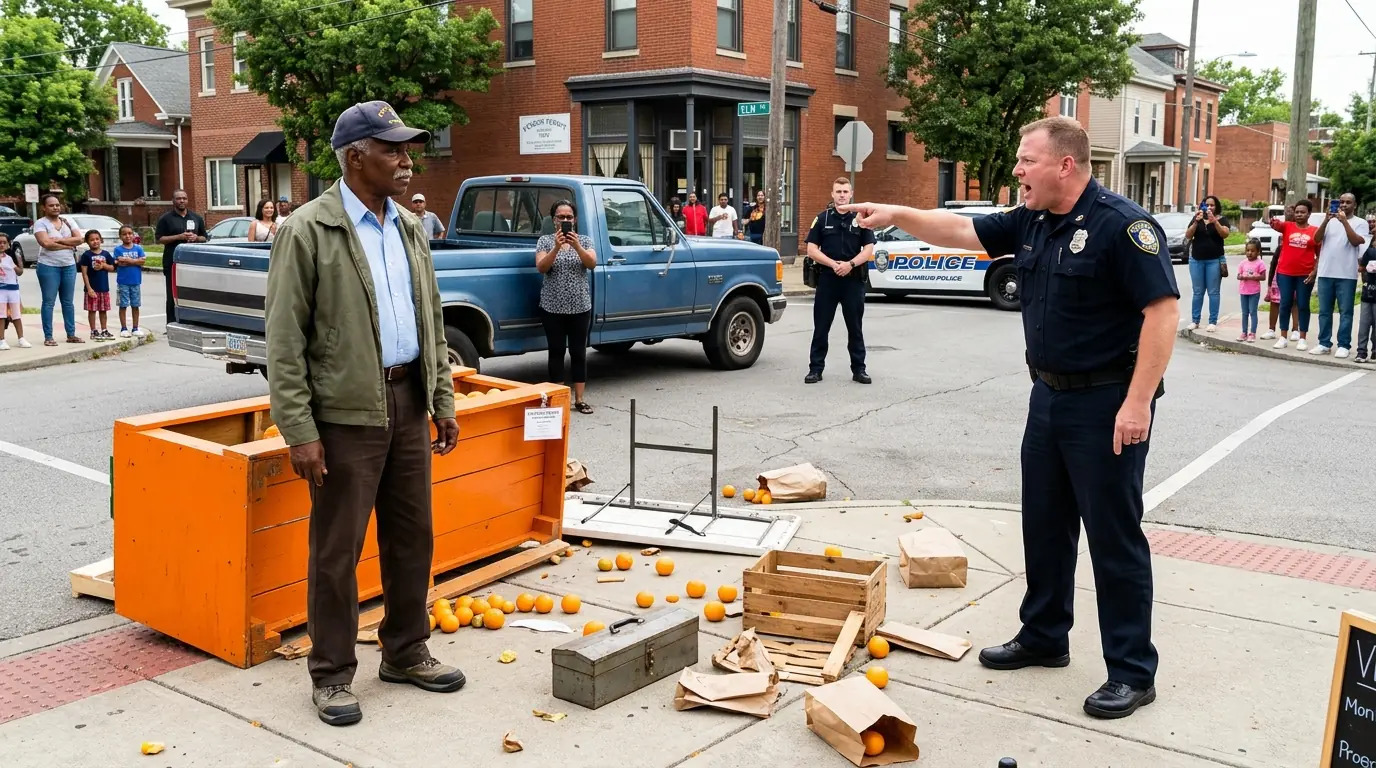
The elderly Black man remained still. His hands did not move, and his voice stayed low and even.
“Sir, every one of those oranges has been paid for.”
“Paid for?”
The officer laughed.
“With what? Public assistance?”
He pressed one of the oranges beneath his boot. Juice splashed across the pavement and onto the old man’s shoes.
“Now get out of this neighborhood before I remove you myself.”
The old man said nothing.
He simply looked at the officer, calm and unshaken.
The officer had no idea that he had just threatened a man whose name could permanently alter the course of his career.
Three hours before the oranges struck the pavement, Oliver Davis was already awake.
It was 5:15 in the morning.
He did not need an alarm.
His body had awakened at that hour for forty-one years. Some habits remain long after retirement.
Oliver sat on the edge of the bed for a moment.
The house was quiet.
Morning light entered through the curtains and stretched across the wooden floor. Birds moved outside, a dog barked somewhere along the street, and the refrigerator produced a low, steady hum from the kitchen.
Oliver stood, put on his slippers, and walked downstairs.
The house was modest.
Three bedrooms.
A small yard.
A vegetable garden behind the house.
Nothing about it was extravagant.
A careful observer, however, would have noticed certain things.
A shadow box hung in the hallway near the staircase. Behind its glass rested a row of medals and ribbons in bronze, silver, deep red, and blue.
They were the kind of decorations most people saw only inside museums or military displays.
Oliver passed them every morning without looking.
To him, they had become part of the wall.
A framed photograph rested on the living-room bookshelf. It showed a younger Oliver shaking hands with a man in a dark suit.
A reflection across the glass partly concealed the other man’s face.
Thick books surrounded the photograph.
Military history.
Strategy.
Leadership.
That morning, none of those things mattered.
Oliver Davis was simply a man making coffee.
He filled the machine with water and dark grounds. The machine sputtered, and the kitchen slowly filled with the bitter, comforting smell of fresh coffee.
Oliver poured one cup, added a single spoonful of sugar, and stood beside the window.
The sky above the rooftops was beginning to turn gold.
Dorothy came downstairs in her bathrobe.
After forty-two years of marriage, she still kissed Oliver on the cheek every morning.
“You’re loading the truck again?” she asked.
“It’s Saturday.”
He said it as though that explained everything.
Dorothy shook her head and smiled.
“Try not to give all of them away for free again, Olly. You always return with an empty truck and an empty wallet.”
Oliver chuckled.
“No promises.”
By 6:30, Oliver’s old pickup truck was loaded.
There were twelve crates of oranges purchased from a local farm outside the city.
He added a folding table and a hand-painted sign he had made three years earlier.
The paint had begun fading along the edges.
“Fresh Oranges, $3 Per Bag or Free for Kids.”
Oliver drove ten minutes to the corner of Elm Street and Fifth Avenue.
It was the same corner he had used every Saturday for three years.
The neighborhood knew him.
The neighborhood loved him.
It was a changing part of the city.
Historically, the area had been home to Black working families who lived inside old brick houses passed from one generation to another. A barber shop had operated on the block since the 1970s, and the nearby church had a cracked parking lot and a gospel choir that rehearsed with the windows open.
New businesses were beginning to appear.
A modern coffee shop had opened one block away.
A condominium development was rising two streets over.
There were new faces.
There were also new complaints.
Someone had recently contacted the city about unlicensed street vendors creating an unattractive appearance.
Another person filed a noise complaint against the church choir.
Nobody said directly what was happening.
Most of the longtime residents understood.
Oliver unfolded his table.
He arranged the oranges in neat rows and attached his laminated vendor permit to the front leg with a large binder clip.
By eight o’clock, the block was active.
Mrs. Coleman arrived first.
She was eighty years old and walked with a cane.
Oliver handed her a full bag before she could reach inside her purse.
“You keep your money,” he said.
Mrs. Coleman patted his hand and called him a saint.
A group of children circled the table on bicycles.
Oliver tossed an orange to each one.
They caught the fruit like baseballs and rode away laughing.
A young mother stopped beside the table with a stroller.
Two neighbors debated football across the street.
The church bells rang at nine.
It was a peaceful morning.
Warm.
Familiar.
The kind of morning that allowed people to forget the world still had sharp edges.
Then a patrol vehicle turned the corner.
It traveled slowly.
Too slowly.
The windows were open, and the officer behind the wheel examined the block as though searching for something specific.
An older resident sitting on his porch noticed immediately.
“There goes Lawson again,” he muttered to his wife.
A teenage girl across the street looked up from her telephone.
She saw the cruiser and instinctively opened the camera application.
She had witnessed enough interactions on that block to understand when recording might become important.
The patrol vehicle circled once.
Finally, it stopped near Oliver’s table.
The driver’s door opened hard.
The hinges groaned.
Sergeant Craig Lawson stepped onto the pavement as though the entire neighborhood belonged to him.
His boots struck the ground heavily and deliberately.
He wore dark sunglasses and a rigid expression. One hand rested near the equipment on his duty belt while the other adjusted his vest as though he were entering a dangerous scene rather than approaching an elderly man selling fruit.
Lawson did not look directly at the people on the sidewalk.
He looked through them.
Past them.
As though they were pieces of street furniture.
His partner, Officer Pete Sullivan, climbed from the passenger side.
Sullivan was in his early thirties, with sandy hair and a softer face.
He remained beside the hood of the cruiser with his arms folded and his eyes directed toward the pavement.
Sullivan was the kind of officer who rarely initiated cruelty.
He was also the kind who rarely stopped it.
A spectator with a badge.
Lawson walked directly toward Oliver’s table.
There was no greeting.
No nod.
No good morning.
Only a straight, aggressive path across the sidewalk.
His shadow covered the oranges before he spoke.
Oliver saw him approaching from twenty feet away.
He placed down the orange he had been handing to a customer and straightened his back.
His posture changed.
Not aggressively.
Not defensively.
He simply became alert.
It was the way a man stands when he senses a storm approaching but refuses to retreat from it.
Lawson stopped less than two feet from the table.
He tilted his head and examined the oranges.
Then he looked at the hand-painted sign.
Finally, he looked Oliver up and down slowly, as though examining something unpleasant.
He allowed a deliberate pause to settle between them.
It was designed to make Oliver feel small.
“You have a permit for this setup?”
Oliver nodded once.
“Yes, sir. I have operated here for three years. The permit is attached to the side of the table.”
He gestured toward the laminated card.
The city seal was clearly visible at the top.
It displayed the issue date, expiration date, and approved vendor category.
Everything was current.
Everything was in order.
Lawson did not look at it.
He did not turn his head or move his eyes toward the permit.
“I do not see a permit. That means you are operating illegally on city property.”
“Sir, it is directly beside you.”
Oliver pointed again.
“You are welcome to inspect it.”
Lawson drew a sharp breath through his nose.
“It could be false. It could be expired. I do not know where you obtained it, and I am not accepting it.”
“It was issued by the city clerk’s office downtown.”
Oliver’s voice remained controlled and measured, like the voice of someone accustomed to speaking in rooms where every statement was recorded.
“You may telephone the office and verify it. I will wait.”
“I am not making calls for you.”
Lawson did not raise his voice.
Instead, it became lower and heavier.
That quiet hostility felt louder than shouting.
“I am telling you to pack this entire setup immediately. Do not make me repeat myself.”
Oliver slowly exhaled.
His hands remained at his sides.
Open.
Visible.
Still.
“Officer, I would like your name and badge number. I would also like to speak with your supervisor.”
The request was polite and respectful.
Something about it affected Lawson as though Oliver had thrown a match into gasoline.
Color moved up Lawson’s neck.
His nostrils widened.
He closed the remaining distance until Oliver could smell stale coffee on his breath and hear the leather on his duty belt creak each time he inhaled.
“You do not make demands here.”
Lawson stared into Oliver’s face.
“Not today. Not ever. Do you understand me?”
Before Oliver could answer, Lawson reached over the table with both hands.
He grabbed a full wooden crate containing approximately fifteen pounds of oranges and forced it from the edge.
The crash split the peaceful morning open.
Wood struck concrete and broke.
Oranges scattered in every direction.
They bounced into the gutter, rolled across the asphalt, and disappeared beneath parked vehicles.
Juice sprayed across the sidewalk in bright, sticky lines.
Pulp and pieces of rind covered the pavement.
The smell reached everyone immediately.
Sharp citrus mixed with warm concrete and dust.
The entire block stopped.
A woman near the crosswalk covered her mouth.
A young boy pulling a red wagon froze and pointed.
The man on the porch stood so quickly that his chair scraped loudly across the wooden boards.
Oliver watched the oranges roll through the gutter.
Three years of Saturday mornings.
Three years of waking before dawn, loading his truck, arranging the table, and repainting the sign whenever the letters faded.
Lawson reduced part of it to broken wood and crushed fruit within seconds.
Oliver’s jaw tightened slightly.
Only someone watching closely would have noticed.
He did not step backward.
He did not lift his hands.
He did not raise his voice.
“Officer.”
The word sounded carved from stone.
“That property belongs to me. You have no legal authority to destroy it.”
Lawson stared at him and laughed.
“What property? This junk?”
He kicked an orange from the curb.
It struck a fire hydrant and split open.
“You should be thanking me for cleaning this up. This neighborhood does not need outsiders turning the sidewalk into a flea market.”
“I have sold oranges here for three years. There have been no violations or complaints.”
“I am the complaint.”
Lawson pointed a thick finger close to Oliver’s face.
“People like you believe you can set up anywhere you want. You make the area look neglected, and decent residents are tired of it.”
People like you.
The phrase remained in the air like a stain.
Oliver did not respond.
It was not because he had nothing to say.
Decades of experience had taught him that no carefully chosen words would reach a man who had already decided not to listen.
Two blocks away, Dorothy Davis was walking toward the corner.
She carried a paper bag containing a turkey sandwich and a bottle of water.
It was their Saturday routine.
She saw the patrol car first.
Then she noticed the oranges scattered across the ground.
Finally, she saw her husband.
Oliver was sixty-eight years old, standing perfectly still while a white officer stood so close that Dorothy could see the veins in the man’s neck from across the street.
Her steps slowed.
Her breathing caught.
One hand pressed against her chest as though she were holding her heart in place.
Her expression changed.
First confusion.
Then disbelief.
Finally, something colder and more deliberate.
Dorothy reached into her jacket pocket and removed her telephone.
She opened the camera and pressed record.
Her hands trembled.
The frame remained steady.
Across the street, the teenage girl was already broadcasting live.
She held the telephone low near her hip and angled it upward.
The red recording indicator remained visible.
The audience increased rapidly.
Fifty viewers.
One hundred.
Three hundred.
Five hundred.
Comments appeared faster than anyone could read.
More neighbors gathered.
The barber stepped outside while a customer remained inside with styling foil still wrapped around his hair.
Two joggers stopped across the street.
A mail carrier paused along his route and watched with his delivery bag hanging open.
Everyone observed.
Many recorded.
Lawson noticed the telephones.
He looked around and counted them.
Six.
Seven.
Possibly more.
A reaction moved across his face.
Doubt.
Calculation.
Perhaps a brief instinct for self-preservation.
It disappeared almost immediately.
Lawson chose to escalate.
“Put those telephones away.”
He turned toward the crowd.
“This is an active police matter. You are interfering with an officer, and that can be charged.”
Nobody moved.
Not one person lowered a telephone.
Lawson faced Oliver again.
His movements were slower now.
Heavier.
“Final warning, old man.”
“I have done nothing unlawful, Officer.”
Lawson removed the radio from his shoulder.
Static cracked through the quiet street.
He pressed the transmission button without taking his eyes from Oliver.
“Dispatch, Unit 44. I have an unlicensed street vendor at Elm and Fifth refusing a lawful order. Requesting another unit.”
The radio responded with a flat voice.
“Copy, Unit 44. Assistance is on the way.”
Oliver did not blink.
His feet remained shoulder-width apart.
His hands stayed at his sides, open and clearly visible.
His chin was level.
His breathing was steady.
It was the posture of a man who had stood before generals, senators, and presidents.
A man who had issued commands affecting military forces across continents.
Lawson saw none of that.
He saw only an elderly Black man who refused to obey an improper demand.
Sullivan shifted near the cruiser.
His arms remained crossed, but his face had become pale.
He transferred his weight from one foot to the other and stared at a crack in the pavement.
“Sarge,” he said quietly. “Maybe we should let this go.”
“I told you to stay out of it, Pete.”
Sullivan pressed his lips together.
He looked away.
The sun continued rising.
Heat collected on the pavement.
The church bell rang ten times farther down the street.
Juice from the damaged oranges was already drying into dark, sticky stains.
The situation was only beginning.
Lawson demanded Oliver’s driver’s license.
He held it between two fingers as though it were dirty.
He tilted it toward the sunlight, examined the front, turned it over, and examined it again.
Then he walked to the cruiser and leaned through the open window.
Lawson entered Oliver’s information into the system.
He took his time.
A long time.
It was not the amount of time necessary to verify identification.
It was the kind of delay used to make a person stand beneath the sun, uncertain whether they would be arrested.
Oliver remained exactly where Lawson left him.
His hands stayed beside his body.
His feet did not move.
Sunlight pressed against the back of his neck.
Sweat formed near his temples.
He did not wipe it away.
Three minutes passed.
Then five.
Then seven.
The neighbors watched.
Dorothy continued recording.
The other telephones remained raised.
Lawson eventually returned.
He moved more slowly than before.
His jaw shifted from side to side.
Oliver’s record had come back completely clear.
No arrest.
No warning.
Not even a parking citation.
The result appeared to make Lawson angrier.
He tossed Oliver’s license toward the ground.
It spun across the concrete and landed face down in a puddle of orange juice.
“Pick it up.”
Oliver looked at the license.
Then he looked at Lawson.
He bent slowly, the way a sixty-eight-year-old body bends, and retrieved it.
Oliver wiped the card against his shirt.
He did not speak.
Lawson watched with a small smile forming at one corner of his mouth.
Then he inhaled sharply and exaggerated the motion.
“What is that smell?”
Oliver remained silent.
“Something does not smell right around your truck.”
Lawson turned toward the old pickup parked beside the curb.
“I need to search it.”
“There is nothing inside the truck except oranges, a folding table, water, and tools.”
“That is for me to determine.”
Lawson began walking toward the vehicle.
“I have probable cause.”
“No, sir, you do not.”
Oliver’s voice became firmer but remained flat.
There was no anger.
No panic.
Only fact.
“The Constitution protects citizens from unreasonable searches. You need a warrant or specific legal grounds. You have neither.”
Lawson spun around.
His mouth twisted.
“You are a lawyer now? Are you selling legal degrees with the oranges?”
He turned back and pulled the tailgate open.
The metal groaned loudly against its old hinges.
Lawson leaned into the bed of the truck and began throwing its contents onto the street.
A toolbox struck the pavement.
The lid opened, and wrenches and screwdrivers spilled across the asphalt.
A folded blanket landed inside the gutter.
A cooler containing water bottles fell and cracked open.
Water gathered around Oliver’s shoes.
Lawson reached for the remaining crates of oranges.
He pushed both from the truck bed one after another.
They struck the ground and broke apart.
Fruit covered the sidewalk.
Some oranges remained whole.
Others split on impact.
Juice ran toward the storm drain in a narrow orange-colored stream.
Lawson climbed down and wiped his hands against his pants.
“Nothing illegal.”
He said it as though the absence of contraband were Oliver’s fault.
“You have a considerable mess to clean.”
Oliver looked at the destruction.
The morning’s work had become pulp, broken crates, and scattered tools.
The toolbox his father gave him thirty years earlier lay open in the road.
The blanket Dorothy kept inside the truck for cold mornings was soaking in gutter water.
Oliver did not speak.
His silence said enough.
That calm, absolute restraint seemed to break the last thread of Lawson’s composure.
Lawson stepped directly into Oliver’s personal space.
“You think you are intelligent?”
The words came through clenched teeth.
“You think quoting constitutional rights makes you better than me?”
Oliver did not retreat.
He did not lean away.
He did not blink.
“I know my rights, Officer. Nothing more.”
“Your rights.”
Lawson repeated the word quietly, as though it tasted unpleasant.
“I will tell you about your rights.”
He grabbed Oliver by the upper arm.
The grip was severe enough to leave marks on elderly skin.
Lawson turned him and pressed him chest-first against the side of the pickup.
The metal had been heating beneath the sun.
“Hands on the vehicle. Separate your feet.”
“On what charge?”
“Refusing a lawful order. Obstruction. Whatever else is appropriate.”
Lawson forced Oliver’s feet farther apart and began searching him.
The search was aggressive.
His hands moved as though trying to find something Lawson already knew was not there.
The crowd reacted.
“Leave him alone!” a woman shouted.
“He has not done anything!”
The man from the porch stepped into the street.
“This is wrong. Someone call a supervisor.”
Voices overlapped.
The teenage girl’s live broadcast had reached four thousand viewers.
The comments appeared continuously.
Sullivan remained beside the cruiser.
His face had changed from pale to gray.
His hands shook.
Twice, he opened his mouth.
Twice, he closed it again.
He looked like a man watching a building burn while holding an empty bucket.
Dorothy was now only ten feet away.
Tears moved down her face.
Her lips were pressed tightly together.
Her telephone remained steady.
The camera never moved.
She recorded as though their future depended upon it.
Perhaps it did.
Lawson removed a pair of handcuffs.
The metal produced a cold, final sound.
He took Oliver’s right wrist and fastened the first cuff.
Then he secured the second.
The locks clicked across the silent block.
Oliver Davis, a man who had once commanded more than one hundred thousand soldiers, stood handcuffed against his own truck.
He was surrounded by crushed oranges on the street where he had served neighbors every Saturday for three years.
Lawson stepped backward and examined the result.
Then he did something that caused everyone on the sidewalk to stop breathing.
He walked toward the few oranges still intact.
One by one, he crushed them beneath his boots.
Slowly.
Deliberately.
He pressed each orange flat and twisted his heel.
The wet sound of breaking fruit became the only noise on the block.
Lawson maintained eye contact with Oliver.
A smile appeared on his face.
“Looks like your little business is closed today.”
He crushed another orange.
A six-year-old girl stood behind her mother’s leg.
She held a small bag Oliver had given her earlier.
The child was crying quietly.
She did not understand the legal conflict or the history of the neighborhood.
She only understood that the kind man who gave her oranges was wearing handcuffs while the police officer smiled and destroyed his fruit.
Oliver closed his eyes.
Not in defeat.
Not in surrender.
In restraint.
This was a man who had participated in decisions affecting national security.
He had sent soldiers into dangerous situations and worked to bring them home.
He had sat across tables from national leaders and never lost control.
Now he was deliberately holding his power in reserve.
Oliver knew something Lawson did not.
He understood exactly how the situation would eventually end.
A second patrol vehicle turned onto Elm Street.
It was not the backup Lawson expected.
The vehicle stopped, and the driver’s door opened.
Captain Elaine Howard stepped out.
She was a tall Black woman in full uniform, with captain’s bars on her collar and sharp, observant eyes.
Every crease in her uniform appeared pressed to a precise line.
Howard had been monitoring dispatch when Lawson requested assistance.
That was not the only reason she came.
A member of the department’s public-affairs office had seen the teenage girl’s live broadcast and sent Howard a direct message.
“You need to see what is happening on Elm Street.”
Howard stopped at the edge of the scene.
Her eyes moved once across everything.
An elderly Black man in handcuffs.
Crushed oranges covering the pavement.
A pickup truck emptied onto the street.
Angry witnesses.
Numerous telephones recording.
One officer appearing satisfied.
Another looking terrified.
Howard walked forward.
Her boots moved quietly over the pavement.
Every step was measured.
“Sergeant Lawson.”
Her voice cut through the crowd.
“What is happening here?”
Lawson straightened.
His body shifted into the practiced posture used when reporting to a superior.
“Captain, I have an unlicensed vendor who refused to follow a lawful order.”
Howard pointed toward the overturned table.
“I can see the vendor permit from here, Sergeant.”
The laminated document remained attached to the table leg.
“It is directly in front of you.”
Lawson opened his mouth.
Nothing came out.
Howard turned toward Oliver.
She looked at his face.
Then her eyes moved toward the faded veteran’s cap he had been wearing.
A military insignia was stitched above the brim.
Howard studied it.
Her expression changed.
Recognition appeared first.
Then realization.
Finally, controlled anger.
She moved closer to Oliver.
“Sir.”
Her voice became quieter and almost private.
“Are you General Davis?”
She examined his face again.
“General Oliver Davis?”
The block became silent.
Even the birds appeared to stop.
Oliver, still restrained, turned his head toward her.
He nodded once.
“Yes, ma’am. I am.”
Howard closed her eyes for half a second.
When she opened them, the anger inside them was unmistakable.
She faced Lawson.
Her voice did not rise.
It carried the authority of rank, discipline, and years of earned respect.
“Sergeant Lawson, remove those handcuffs immediately.”
Lawson gave a short, nervous laugh.
“Captain, with respect, I do not care whether he claims to be…”
“This man is retired General Oliver Davis.”
Howard stepped closer with each sentence.
“He served this country for forty-one years. He received multiple distinguished-service decorations and held senior command responsibilities within the United States Army.”
She stopped in front of Lawson.
“He has commanded more soldiers than you will meet during your lifetime.”
Howard’s gaze hardened.
“Remove the handcuffs. Now.”
The silence became so heavy it felt physical.
Every telephone remained directed toward them.
The live audience passed twelve thousand viewers.
Lawson’s face changed rapidly.
Red.
Then white.
Then gray.
His mouth remained open.
He reached for the handcuff key.
His fingers shook so badly that the keys struck one another.
Lawson missed the lock on the first attempt.
Then the second.
On the third try, the cuffs opened.
Oliver slowly brought his hands forward.
Dark red marks circled his wrists.
They were already beginning to bruise.
He rubbed each wrist without hurrying.
There was no visible relief on his face.
Only patience.
The patience of a man who had waited through much worse.
Oliver looked at Lawson.
There was no anger in his expression.
No triumph.
That made the gaze more devastating.
It carried the weight of four decades of command.
It was the kind of look that made experienced officers stand straighter and powerful men reconsider their next sentence.
Lawson could not hold it.
He lowered his eyes.
Oliver spoke.
Each word landed with the precision of an official order.
“Captain Howard, I want this officer’s full name and badge number. I want the name of his direct supervisor and the case number for this interaction.”
He allowed a pause.
“I want every recording from both officers preserved in its original form, including all body-camera footage and dispatch communications.”
Oliver continued calmly.
“I will file formal complaints with internal affairs, the city council, the mayor’s office, and the appropriate federal civil-rights authorities.”
He looked toward Lawson.
“I will also contact legal counsel.”
There was no shouting.
No exaggerated threat.
Oliver sounded like a man issuing instructions he expected to be followed.
Everyone on the block understood the difference.
Lawson attempted to speak.
“Sir, I was only doing my job. I did not know you were…”
“You did not know what?”
Oliver interrupted without raising his voice.
“That I was a general?”
He took one step toward Lawson.
“That should not matter.”
His tone remained completely controlled.
“You should treat every citizen on this sidewalk with basic dignity.”
Oliver gestured toward the damaged stand.
“Every person. Whether they have stars on a uniform or four oranges on a table.”
He studied Lawson.
“The fact that you do not, and that you chose not to today, tells me everything necessary about your conduct.”
Lawson had no answer.
His mouth moved.
No words emerged.
His arms hung uselessly beside his body.
The sunglasses he had worn like armor were crooked.
He did not adjust them.
Lawson looked like a man watching his career collapse while he stood inside it.
That was exactly what was happening.
Sullivan remained near the cruiser.
He held his head between both hands.
His shoulders moved.
He could not look up.
Then the neighborhood came alive.
One person began clapping.
A second joined.
The entire sidewalk followed.
It was not disorder.
It was vindication.
Relief.
The sound of people releasing a breath they had held for years.
There were cheers and tears.
A man raised one fist into the air.
The woman from the barber shop pressed both hands against her heart.
Dorothy moved through the crowd and reached Oliver.
She wrapped her arms tightly around him.
Oliver held her with one arm.
His other hand rested gently against the back of her head.
Dorothy still held the telephone.
The camera continued recording.
The teenage girl’s broadcast passed one hundred thousand viewers.
Comments moved so quickly that they appeared as a continuous blur of light.
Captain Howard faced both officers.
Her voice became steel.
“Return to the precinct immediately. Place your department weapons on the hood.”
Lawson removed his sidearm with shaking hands.
He placed it on the cruiser.
Sullivan did the same before Howard repeated the instruction.
They entered the vehicle.
Lawson sat in the passenger seat.
Howard drove.
Nobody spoke.
The neighborhood watched the patrol car leave.
A slow round of applause followed it down the block.
Oliver stood in the center of the scattered fruit with Dorothy beside him.
Then he did something nobody expected.
He smiled.
By the time Lawson entered the precinct, Police Chief Ronald Greer was already standing behind his desk.
Both of Greer’s fists pressed against the wood.
His computer displayed a replay of the live broadcast.
His telephone had been ringing for twenty minutes.
The mayor’s office had called.
Two members of the city council had called.
A national reporter requested comment.
Someone from the governor’s communications office had also contacted the department.
Greer had spent thirty years in law enforcement.
He was a large man with a thick neck who expected discipline and hated surprises.
This was the worst surprise of his career.
Captain Howard escorted Lawson into the office.
Lawson walked like someone uncertain whether the floor beneath him remained solid.
“Sit down,” Greer said.
He did not offer coffee.
He left the office door open.
“Chief, I can explain. The vendor did not display his permit properly. I followed standard procedure.”
“Standard procedure?”
Greer repeated the words as though they were poisonous.
He turned the computer monitor toward Lawson.
The recording showed Lawson throwing the crate.
Destroying the fruit.
Searching the truck.
Pressing Oliver against the vehicle.
Handcuffing him.
“That looks standard to you, Sergeant?”
Lawson said nothing.
Greer opened the body-camera footage.
Lawson’s own equipment had captured everything.
Every word.
Every movement.
Every insult.
The audio clearly preserved the sound of oranges breaking beneath his boots.
It also captured the little girl crying.
“You harassed a retired senior military commander.”
Greer’s voice shook with anger.
“You destroyed private property. You searched a vehicle without valid cause and placed an elderly citizen under arrest without a lawful basis.”
He pointed toward the screen.
“You did all of it on camera, before dozens of witnesses, during a live broadcast that now has millions of views.”
Lawson opened and closed his mouth.
“I did not know who he was.”
“That is the problem.”
Greer struck the desk with his palm.
The coffee mug jumped.
“You should not need to know who someone is before treating that person like a human being.”
Down the hallway, Sullivan sat inside another interview room.
Two internal-affairs investigators faced him.
A recorder rested on the table.
Sullivan’s leg moved continuously beneath his chair.
His eyes were red.
His voice repeatedly broke.
He told them everything.
Sullivan said Lawson focused on Oliver the moment he saw an elderly Black man operating the vendor table.
He described what Lawson said while they were still inside the cruiser.
“Watch me make this man’s day miserable.”
Sullivan admitted there was no suspicious smell.
No legitimate probable cause.
No reason to search the truck.
Then he said the most damaging thing.
This was not the first time.
“He does this,” Sullivan said while staring at the table. “He selects people he believes will not be able to fight back.”
His voice became quieter.
“It is usually the same kind of resident.”
Sullivan pressed his hands together.
“I never reported it. I stood there.”
His statement eventually filled fourteen pages.
Within four hours, the consequences began.
Lawson was placed on immediate unpaid suspension while internal affairs conducted a full investigation.
His badge was collected.
His service weapon remained on Captain Howard’s desk.
His access to every departmental system was revoked before he left the building.
Sullivan was placed on paid administrative leave as a cooperating witness.
He would face a separate investigation for failing to intervene.
Investigators told him his cooperation would be considered.
At four o’clock that afternoon, Chief Greer held a press conference outside the precinct.
The sun remained high.
Television cameras filled the sidewalk in several rows.
Microphones surrounded the podium.
Greer described the incident as deeply disturbing and completely inconsistent with the values the department claimed to uphold.
He promised a transparent investigation.
He promised accountability.
Reporters shouted questions.
Greer answered three.
Then he returned inside.
Oliver Davis did not hold a press conference that day.
He went home.
Oliver sat with Dorothy on the front porch.
She brought him lemonade with more sugar than most people would consider reasonable.
It was how he preferred it.
He leaned back and watched the evening shadows stretch across the yard.
His telephone vibrated on the table beside him.
Reporters.
Television producers.
Former military colleagues.
He allowed it to continue.
Dorothy reached across the space between their chairs and held his hand.
“Are you all right, Olly?”
Oliver drank some lemonade and looked toward the sky.
“I will be.”
By midnight, Dorothy’s recording and the teenager’s live broadcast had been viewed more than twelve million times.
Every major national network carried the footage.
The story appeared everywhere.
It was still only Saturday.
By Monday morning, the event had acquired a name.
The internet called it the Orange Stand Incident.
It trended across every major platform.
News channels replayed the footage continuously.
The crate falling.
The fruit breaking.
The handcuffs closing around the wrists of a man who had committed no offense.
Commentators debated the incident.
Others became emotional while discussing it.
The image of Lawson crushing oranges while smiling became a symbol overnight.
The deeper story was only beginning to emerge.
A journalist named James Whitfield opened it.
He worked for CityBeat, the region’s largest newspaper.
Whitfield was thorough, relentless, and patient.
Within two hours of the video becoming widely known, he submitted public-records requests.
The documents he received changed everything.
Sergeant Craig Lawson had fourteen previous excessive-force and misconduct complaints in his personnel history.
Fourteen.
Every complaint had been filed by a Black or Latino resident.
Every one was dismissed during internal review.
There was not one sustained finding.
No formal disciplinary action.
Not even a written warning inside his personnel file.
Fourteen complaints.
No consequences.
Whitfield published the investigation on Tuesday.
The article struck the city with enormous force.
By Wednesday, three additional victims had come forward publicly.
Gloria Sims spoke first.
Two years earlier, she operated a flower cart on the same block.
According to Gloria, Lawson emptied her buckets, damaged her arrangements, and told her to take the little garden project somewhere else.
She filed a complaint with the department.
Nobody called her.
Nobody requested further information.
Nothing happened.
Curtis Hall described a separate incident.
Lawson had ordered his food truck impounded because of an allegedly missing permit.
The valid permit had been visible on the dashboard.
Curtis required four months and approximately two thousand dollars in fees to recover the vehicle.
His business nearly failed.
The department classified his complaint as unfounded.
The third case involved Andre Price.
Andre said Lawson stopped him while he was riding his bicycle three times in one month.
Each time, Lawson claimed he matched a description.
Andre did not match any known description.
He was fifteen, wearing his school uniform, and riding home after class.
His mother filed a complaint after every stop.
Each complaint was dismissed within a week.
The pattern became impossible to deny.
Oliver’s experience was not one terrible morning.
It was part of years of selective, discriminatory enforcement directed at residents of color.
The system had protected the behavior by dismissing every complaint.
Whitfield’s headline read:
“Fourteen Complaints, Zero Consequences: How One Sergeant Operated Without Accountability for Years.”
The article was shared more than two million times within forty-eight hours.
On Thursday, the Civil Rights Division of the Department of Justice announced a formal investigation.
The inquiry was not limited to Lawson.
It covered the entire police department.
Federal investigators examined hiring practices, complaint-handling procedures, use-of-force policies, and potential patterns of discriminatory policing.
They arrived within a week.
They brought records requests.
They brought subpoenas.
They intended to remain as long as necessary.
Oliver agreed to one interview.
Only one.
He sat in the living room across from a national news anchor.
Dorothy sat beside him with one hand resting on his arm.
Oliver spoke as he always did.
Measured.
Precise.
No unnecessary words.
He described the encounter plainly.
He did not exaggerate.
He did not dramatize.
The simplicity of the account made Lawson’s conduct feel even worse.
Then Oliver said something that stopped the country.
“I survived that encounter because of who I am.”
He looked directly into the camera.
“I have a military record, professional connections, and attorneys who answer my telephone calls.”
Oliver paused.
“What happens to the person who does not have those things?”
He continued.
“What happens to Gloria and her flowers? What happens to Curtis and his food truck? What happens to a fifteen-year-old child riding a bicycle?”
His voice did not crack.
It did not waver.
“The most important question is not what happened to me.”
Oliver leaned slightly forward.
“The question is what happens to them every day when nobody is recording.”
The forty-three-second clip was viewed more than thirty million times.
It was played during debate on the floor of the United States Senate.
Newspapers in several countries quoted it in editorials.
Six weeks later, Sergeant Craig Lawson entered federal court.
The charges included deprivation of civil rights under color of law, destruction of property, false arrest, and filing a false report.
Judge Helen Bradford presided.
She was known for fairness and for having no tolerance for abuses of public authority.
The prosecution’s evidence was extensive.
Jurors watched the complete body-camera recording.
They saw Dorothy’s video.
They watched the teenager’s live broadcast.
Sullivan testified for three hours.
He described not only the Saturday encounter, but months of Lawson’s behavior that he witnessed and failed to report.
The government called the people connected to the fourteen earlier complaints.
They spoke one by one.
Gloria Sims described the flower cart.
Curtis Hall described losing access to his food truck.
Andre Price’s mother testified because Andre remained too anxious to face the courtroom.
Each incident differed in its details.
The pattern remained the same.
Expert witnesses discussed discriminatory profiling and the improbability of fourteen similar complaints involving only minority residents being mere coincidence.
Lawson’s defense argued that he had followed established departmental procedures.
Judge Bradford was not persuaded.
The jury deliberated for less than four hours.
Guilty on every count.
The court sentenced Lawson to thirty-six months in federal prison.
He lost his pension benefits and received a lifetime prohibition against employment in law enforcement at the local, state, or federal level.
His name was entered into the national decertification system.
Lawson remained motionless while the sentence was read.
His attorney placed a hand on his shoulder.
Lawson appeared not to feel it.
Sullivan received two years of probation, two hundred hours of community service, and mandatory retraining.
The court considered his cooperation.
His career in policing was still effectively over.
The consequences extended beyond the courtroom.
Police Chief Ronald Greer resigned three weeks after federal investigators published their preliminary findings.
The report described a systemic culture of suppressing complaints, insufficient supervision, and racially disparate outcomes.
Greer’s resignation letter consisted of one paragraph.
He admitted no wrongdoing.
He was still gone.
The city council moved quickly.
Within two months, it passed a package of reforms.
An independent civilian-review board was created with authority to obtain documents and compel testimony.
Body cameras became mandatory during all public interactions.
Officers could no longer manually disable recording without a documented emergency reason.
The department adopted a formal duty-to-intervene policy.
Any officer witnessing misconduct was required to act immediately or face serious discipline, including termination.
Oliver received an invitation to the signing ceremony at city hall.
He stood near the back of the room.
He did not want the podium.
He brought someone with him.
The six-year-old girl who had stood behind her mother’s leg while holding a bag of oranges.
Her name was Amara.
She wore a yellow dress and carried one orange in both hands.
After the mayor signed the final page, Amara walked forward.
She handed him the orange.
The room became silent.
Then applause filled it.
An Associated Press photographer captured the moment.
A retired four-star general stood behind a six-year-old girl in a yellow dress as she presented an orange to the city’s mayor.
The photograph appeared on the front pages of eleven newspapers the following morning.
It became the image that defined the entire story.
The next Saturday, Oliver Davis drove his pickup to the corner of Elm and Fifth.
Same corner.
Same time.
Same folding table.
Same hand-painted sign.
He had repainted the faded letters in fresh blue paint the previous evening.
That Saturday was different.
A line stretched around the block.
People came from every part of the city.
Some drove forty minutes.
Others traveled by bus.
They did not all come to buy oranges.
They came to shake Oliver’s hand.
They came to thank him.
They wanted to stand on the sidewalk where an elderly man had refused to surrender his dignity.
Oliver greeted each person.
He shook hands and embraced strangers.
He allowed a little boy to wear his veteran’s cap.
When the child saluted, Oliver returned the salute.
Oliver did not charge anyone that day.
Every orange was free.
Dorothy remained beside him throughout the morning.
She wore a yellow sundress, almost the same shade as Amara’s.
Dorothy smiled until her cheeks hurt.
A reporter asked what Oliver had been like before the world learned his name.
“He has always been this way,” Dorothy said. “The world simply had an opportunity to see it.”
By the afternoon, the table was empty.
Every crate had been cleared.
Oliver folded the table and placed it into the pickup.
He stood for a moment and looked at the corner.
The pavement was clean.
There was no damaged fruit.
No broken wood.
Only sunlight across an ordinary sidewalk.
The neighborhood began changing after the incident.
Not through displacement.
Through conversation.
Longtime residents and recent arrivals created a community board together.
They held monthly meetings inside the church while the gospel choir practiced nearby.
Oliver was named honorary chair.
He attended every meeting.
Most of the time, he listened.
Publishers offered book contracts.
Organizations offered speaking tours and consulting work.
Oliver accepted several opportunities and donated every dollar to a legal-defense fund for victims of police misconduct.
He did not name the organization after himself.
He named it for Gloria Sims, Curtis Hall, and Andre Price.
They were the people whose experiences remained unknown until Oliver’s case forced the city to listen.
The fund’s first case involved a young father in a neighboring community.
He had been falsely arrested inside a grocery store while his daughter watched.
Oliver’s attorneys accepted the case without charge.
That Saturday with the oranges, the handcuffs, and the smiling officer began as the worst morning of Oliver’s year.
It became the beginning of something much larger.
The story began with one man, one folding table, and several crates of oranges.
It began with an officer who saw skin color and social status before seeing another human being.
It began the way abuses of power often begin.
One person decided another person’s dignity did not matter.
It did not end there.
It ended in a courtroom with a guilty verdict.
It led to a resignation.
It produced new oversight rules.
It created a moment in which a small girl wearing yellow handed an orange to the mayor.
It returned Oliver to the same street corner the following Saturday, where he distributed free fruit to a line reaching around the block.
It created change.
The deepest lesson was not that Oliver happened to be powerful.
It was that the system moved quickly only after discovering whom Lawson had harmed.
Oliver possessed a famous record, professional connections, and access to influential institutions.
Gloria, Curtis, and Andre had filed complaints before him.
The system barely moved.
That was the part Oliver refused to allow the public to forget.
Justice should not require a powerful name before it awakens.
The person with the fewest resources should receive the same legal protection as the person with the most.
That is not an impossible ideal.
It is supposed to be the promise.
The promise had been broken repeatedly.
Oliver’s restraint also carried a lesson.
Winning did not require becoming as cruel as the person abusing authority.
Sometimes the strongest response was remaining calm enough to preserve the truth.
Oliver refused to give Lawson an angry reaction that could be used against him.
He remained himself.
Measured.
Controlled.
Unbroken.
The truth did not appear instantly.
It took witnesses, recordings, journalists, investigators, and months of legal work.
It still emerged.
The orange stand remained a reminder that dignity does not depend on rank.
Respect does not require a résumé.
Justice should not change according to a person’s title, uniform, wealth, or connections.
Justice that protects only the powerful is not justice.
It is privilege.
Oliver Davis understood the difference.
After everything ended, he continued waking before dawn on Saturdays.
He continued loading oranges into his old pickup.
He continued driving to Elm and Fifth.
His medals remained behind glass inside the hallway.
The photograph remained on the bookshelf.
The books remained arranged around it.
Most Saturdays, Oliver was not General Davis to the people passing the corner.
He was simply Mr. Oliver.
The man who sold three-dollar bags of oranges.
The man who gave fruit to children for free.
The man who remembered Mrs. Coleman before she reached for her purse.
The man who stood calmly when someone tried to strip away his dignity.
The neighborhood remembered what happened.
More importantly, it remembered what followed.
People began watching more carefully.
Officers were required to intervene when colleagues crossed the line.
Citizens understood the importance of documenting public encounters.
Complaints were no longer treated as pieces of paper that could disappear quietly into filing cabinets.
Gloria’s flowers mattered.
Curtis’s food truck mattered.
Andre’s bicycle ride home mattered.
Oliver’s oranges mattered.
Not because of the famous identity hidden beneath his old clothes.
They mattered because every person standing on that street deserved to be treated as human before anyone learned a name.
That was the standard Oliver had fought for during his military career.
It was the standard he demanded on Elm Street.
It became the standard the city could no longer pretend not to understand.