Power creates a dangerous illusion, and Sheriff Cole Tagert was its ultimate believer.
For years, he turned the highways of Georgia into his personal hunting ground, using his badge to intimidate and exploit anyone he considered vulnerable.
He believed his latest target, a Black woman traveling alone in a luxury sport utility vehicle, would be another easy person to rob, frighten, and ruin.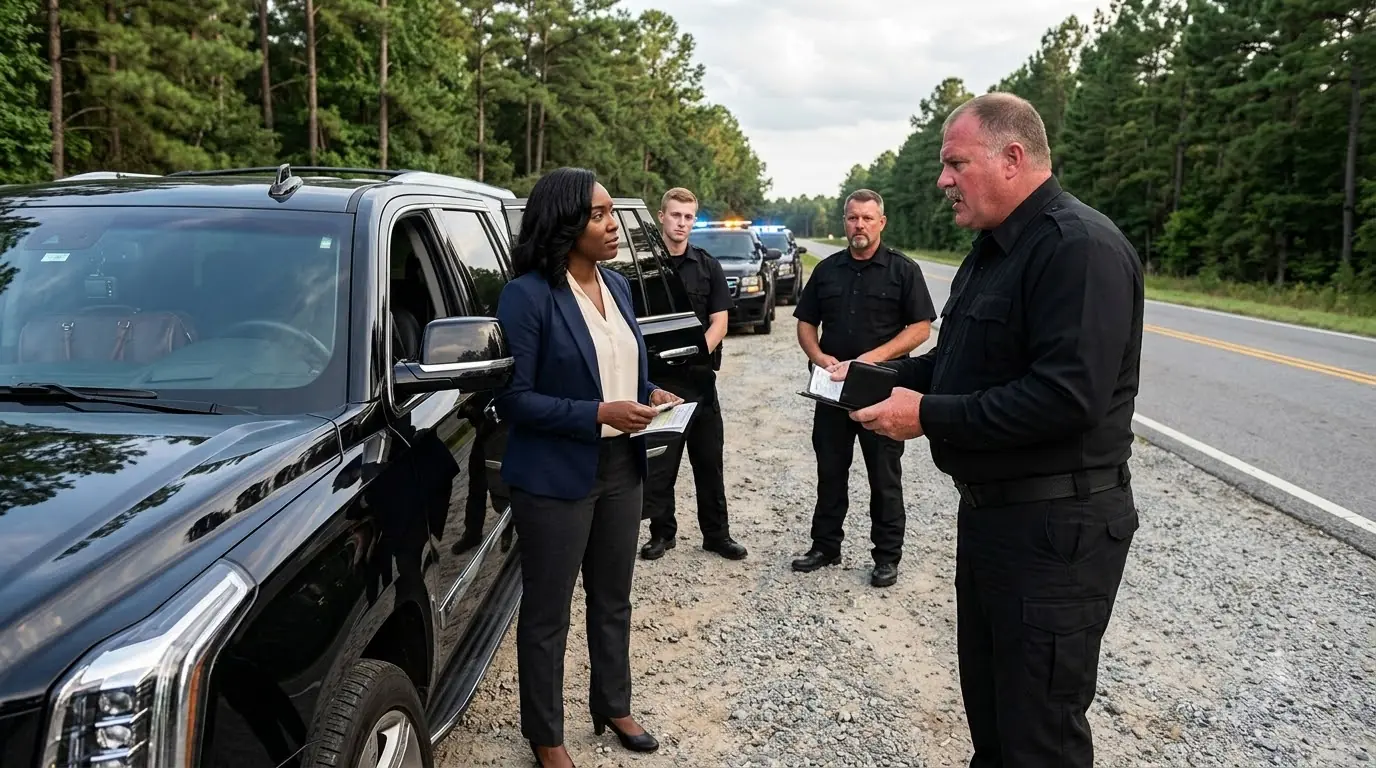
He was wrong.
She was not an ordinary civilian.
She was the nightmare he had never prepared to face.
This was the story of how an arrogant predator unknowingly walked into his own cage.
Ridgeville County sat like a forgotten bruise near the edge of the state line. It was a stretch of highway surrounded by dense pine woods, where the speed limit dropped from sixty-five miles per hour to thirty-five without sufficient warning.
For local residents, it was simply home.
For outsiders, especially drivers targeted because of their appearance, it had become a trap.
At the center of that trap was Sheriff Cole Tagert.
Tagert seemed to belong to another century, a relic from a time when men like him believed a badge granted absolute and unquestioned authority. He was thick-necked and heavily built, with a uniform that always appeared one deep breath away from splitting at the seams.
He wore mirrored aviator sunglasses even when the sun was disappearing beyond the horizon. An unlit cigar usually rested between his teeth, leaving them permanently stained.
During his fifteen years as sheriff, Ridgeville County developed a notorious reputation.
Civil rights attorneys from Atlanta had attempted to investigate him for years. Their complaints described repeated racial profiling, unlawful traffic stops, and abusive use of civil asset forfeiture laws.
Tagert had a predictable method.
He stopped minority drivers who owned expensive vehicles, claimed to smell marijuana, and confiscated their cars, cash, watches, or other possessions under the excuse of suspected drug trafficking.
The victims were usually too frightened or financially vulnerable to challenge the county through a prolonged legal process.
Thomas Reed, a software engineer, lost the ten-thousand-dollar cash deposit he had saved for a house.
The Miller family had its minivan seized while traveling on Thanksgiving.
Tagert faced few consequences because District Attorney Robert Hughes and Judge Arthur Pendleton protected him. Complaints disappeared into a bureaucratic graveyard, and challenges were delayed until victims no longer possessed the money or emotional strength to continue.
Tagert believed the system surrounding him was permanent.
His arrogance had finally grown larger than the immunity his local allies could provide.
He simply did not know it yet.
It was a sweltering Tuesday evening in late August.
Heat rose from the asphalt in shimmering waves, bending the headlights of the sparse oncoming traffic.
Tagert had parked his Ford Explorer Interceptor inside his usual hiding place, a gravel turnout concealed behind a billboard advertising a motel that had closed years earlier.
He was bored.
He drummed his thick fingers against the steering wheel, waiting for something to interrupt the monotony.
Then a 2024 Cadillac Escalade passed him.
It was midnight black, with tinted windows and an engine so quiet that it seemed to glide through the dusk.
Tagert’s eyes narrowed.
He accelerated from the turnout, sending pale dust into the air, and followed the Escalade at an aggressive distance.
Through the rear window, he could see the outline of the driver.
A woman.
When the Escalade passed beneath the amber light of a rare streetlamp, his headlights briefly illuminated her face.
A Black woman.
Traveling alone.
Driving a vehicle worth more than one hundred thousand dollars.
The vehicle also carried out-of-state plates.
Inside Tagert’s prejudiced mind, those details always produced the same conclusion.
The car was either stolen or purchased with illegal money.
He did not run the license plate first.
He did not believe he needed to.
Tagert activated the emergency lights on his center console. Red and blue strobes filled the highway, followed by an aggressive burst from the siren.
Inside the Escalade, Special Agent Ella Meline released a slow, controlled breath.
Ella was thirty-six years old and a veteran investigator with the FBI’s Civil Rights Division in Washington, D.C. She had built her career by dismantling corrupt institutions piece by piece.
The encrypted laptop on the passenger seat contained files documenting the exact type of traffic stop now occurring behind her.
Ella had been sent to Georgia to lead a covert preliminary investigation into Tagert’s department.
She had not expected to become his target on her second day in the county.
She looked into the rearview mirror and watched the sheriff’s vehicle move aggressively behind her.
Ella removed her foot from the accelerator, tapped the brake pedal to acknowledge the emergency lights, and guided the Escalade onto the gravel shoulder.
She placed the transmission in park.
Then she lowered all four windows, a standard precaution intended to reassure an approaching officer.
Ella positioned both hands visibly on the steering wheel.
Then she waited.
Through the side mirror, she watched Tagert leave his cruiser.
He did not approach immediately.
First, he released the retaining strap over his holster, turning the movement into a deliberate physical threat.
With one hand resting near his weapon, he walked toward the Escalade with a heavy, swaggering gait.
He directed a powerful flashlight into Ella’s side mirror, blinding her unnecessarily despite the remaining daylight.
“Turn off the engine and throw the keys out of the window,” Tagert shouted from behind the rear quarter panel.
Ella remained calm.
“Good evening, Sheriff. Is there a problem?”
“I said turn off the engine and throw the keys out.”
His voice rose with irritation.
He reached the driver’s window and leaned toward the interior.
Tagert wrinkled his nose as though attempting to detect a scent.
“Whose car is this, girl?”
Ella’s jaw tightened almost imperceptibly at the final word.
She slowly reached toward the dashboard and switched off the keyless ignition.
“The vehicle belongs to my employer, Sheriff.”
Tagert shone the flashlight directly into her eyes and held it there longer than necessary.
“Who might that be? A cartel boss from Miami? A stolen-car operation out of Atlanta?”
He extended one hand.
“License and registration. Now.”
“I can assure you the vehicle is legally registered,” Ella replied.
Her voice remained professional and absent of the fear Tagert was accustomed to producing.
She began moving one hand toward the center console.
“Keep your hands where I can see them,” Tagert snapped.
His hand tightened near his holster.
“My registration is in the glove compartment,” Ella said evenly. “My driver’s license is inside my wallet, which is in my purse on the passenger seat.”
She held his gaze.
“I am going to retrieve both items very slowly. Do you understand?”
Tagert bristled.
He was not accustomed to drivers, particularly Black drivers, speaking to him with calm authority.
It angered him.
“Get the papers and don’t make any sudden movements unless you want to regret it.”
Ella retrieved a civilian driver’s license issued under her real name but without any visible connection to the federal government.
She also collected the vehicle registration and passed both items through the window.
Tagert snatched them from her hand.
The registration identified the owner as Apex Logistics LLC, a shell corporation the FBI used to register vehicles assigned to sensitive operations.
“Apex Logistics,” Tagert muttered.
A smirk formed across his face.
“I’ve heard that kind of story before. Sounds like a shell company.”
He looked at the license.
“Why are you driving a hundred-thousand-dollar truck registered to a phantom corporation through my county, Ella?”
“I was not aware that driving on a public highway was a crime, Sheriff Tagert.”
His eyes hardened.
“Why exactly did you pull me over?”
“You crossed the yellow line,” Tagert lied without hesitation. “Twice.”
He leaned closer.
“Your windows are also too dark, and I smell a strong odor of marijuana coming from inside this vehicle.”
Ella almost smiled.
There it was.
The predictable phrase corrupt officers used as a pretext to bypass constitutional protections.
“There is no marijuana inside this vehicle,” Ella said. “I do not use it, and this is a company vehicle.”
“Step out.”
Tagert took one step backward and partially withdrew his weapon.
“We’re going to conduct a search.”
“Sheriff,” Ella said, lowering her voice into a register that carried a warning he was too arrogant to recognize, “I strongly recommend that you return to your cruiser and run the plate and registration properly.”
She continued.
“Call the telephone number listed in the restricted record. Doing so will save both of us a considerable amount of paperwork.”
“Are you refusing my order?”
Tagert’s voice became a low growl.
He reached for the radio microphone on his shoulder.
“Dispatch, this is Tagert. I have a noncompliant suspect on Route 9 near mile marker forty-two. Send Collins and Harrison.”
“Copy that, Sheriff,” the dispatcher replied. “Units are on the way.”
“I am not refusing,” Ella said, keeping both hands visible. “I am informing you that you are making a serious miscalculation.”
She looked directly at him.
“You have no probable cause for a search, and your claim about smelling marijuana is a fabricated pretext.”
Tagert laughed.
It was a harsh and unpleasant sound.
“You think you’re a lawyer?”
He moved closer to the window.
“Listen carefully. Out here, I am the law. I am the judge and jury until you reach the courthouse.”
His hand moved toward the door.
“Now get out before I remove you myself.”
Ella understood that he had moved beyond reason.
He was operating entirely through ego and prejudice.
She had two options.
She could display her federal credentials and end the encounter immediately.
Or she could allow Tagert to complete the unlawful actions that would strengthen the Department of Justice case being built against him.
Ella chose the second option.
“All right,” she said.
The click of her seat belt sounded unusually loud.
She opened the door and stepped into the humid Georgia evening.
“Turn around and place your hands on the roof,” Tagert ordered.
Ella complied.
Tagert approached from behind and forced her feet farther apart than necessary.
He conducted the search roughly and without professionalism, using the contact to assert control rather than to ensure safety.
When he found no weapon, he seized Ella’s wrists and pulled them behind her back.
Tagert locked a pair of steel handcuffs around them, tightening the restraints enough to press painfully against her skin.
“You are making a mistake, Tagert,” Ella said while staring at the polished black surface of the Escalade.
“The only mistake made tonight was driving a stolen truck through my county.”
Tagert grabbed her upper arm and forced her toward his cruiser.
He positioned her against the hood.
“Stay there.”
Tagert returned to the driver’s side of his vehicle and lifted the radio.
“Dispatch, run the Virginia plate. Ocean, Victor, Niner, Two, Two, Delta.”
A minute passed.
Cicadas hummed inside the dense pine forest bordering the highway.
Ella waited against the cruiser.
The metal remained warm from the heat.
She recorded every detail in her memory.
Ella knew what the dispatcher would see once the government plate entered the system.
“Sheriff?”
The dispatcher, Marge, returned to the radio.
Her voice contained confusion and a growing trace of panic.
“That plate is producing a restricted warning.”
Tagert leaned inside his vehicle.
“What kind of warning?”
“It says, ‘Do not stop. Contact federal authorities immediately.’ There is a red flag across the entire record.”
Marge paused.
“The vehicle is listed as restricted government property.”
Tagert looked through the windshield toward Ella.
Years of unchecked authority and bias prevented him from accepting the obvious explanation.
Instead, his mind created a conspiracy.
“It’s a cloned plate,” he said into the radio. “Criminal organizations have been copying federal tags.”
“Sheriff, are you certain?”
“Send a tow truck. We’re impounding the vehicle.”
“The system says to contact the listed number.”
“I don’t care what the system says, Marge. Do your job.”
Tagert dropped the radio and returned to Ella.
A triumphant smile spread across his face.
“You almost fooled me. Federal plates?”
He shook his head.
“Using cloned government tags is a serious federal offense. You’re going away for a long time.”
“You were instructed not to stop this vehicle,” Ella said.
Her eyes remained fixed on him.
“You were given a telephone number. Why have you not called it?”
“Because I don’t negotiate with criminal couriers.”
The sound of approaching sirens interrupted the conversation.
Two Ridgeville County Sheriff’s Department cruisers came rapidly down the highway.
They stopped behind Tagert’s Explorer, covering the scene in rotating red and blue light.
Deputy Jimmy Collins stepped out of the first vehicle.
He was a young rookie with a short haircut and an obvious desire to please his superior.
Deputy Wade Harrison exited the second cruiser.
He was an older, hardened officer with a permanent scowl.
“What do we have, boss?” Harrison asked.
His hand rested casually on his duty belt.
He looked at Ella in handcuffs and smiled.
“Looks like a significant arrest.”
“Criminal courier,” Tagert said confidently. “Driving a vehicle with cloned federal plates.”
He pointed at the Escalade.
“She claims there are no drugs inside, but I can smell them.”
Tagert gave his orders.
“Wade, search the rear compartment. Jimmy, take the cabin. If you find removable panels, check behind them. I want every hiding place examined.”
Ella raised her voice.
“You do not have a warrant.”
Her words cut through the humid air.
“You do not possess probable cause. Dispatch gave you an explicit warning to contact federal authorities.”
She continued.
“If either deputy touches that vehicle, he will be participating in an unlawful search and a potential violation of federal civil rights law.”
Collins stopped with one hand near the Escalade’s door.
He looked back at Tagert.
“Sheriff, did dispatch mention federal authorities?”
“She’s trying to manipulate you,” Tagert shouted. “The plate is fraudulent. Search the vehicle.”
“I am formally warning all three of you,” Ella said.
Her voice carried over the running engines.
“Every action you take from this moment forward may become evidence in a federal prosecution. Step away from the vehicle.”
Harrison laughed and shook his head.
“She has a lot to say, Cole.”
He opened the passenger door and began searching the interior.
Collins hesitated.
Then, intimidated by Tagert, he opened one of the rear doors and began pulling at the seats.
Ella watched.
The trap had not caught only one corrupt officer.
It was capturing the people who willingly followed him.
For the next ten minutes, the deputies nearly dismantled the Cadillac’s interior.
They emptied Ella’s overnight bag onto the pavement, scattering clothing across the shoulder.
They removed sections of the trunk lining and inspected the floor for hidden compartments.
“Nothing in the back,” Collins called.
Sweat ran from his forehead.
He appeared increasingly anxious.
“No marijuana, no cash, nothing.”
“Keep searching,” Tagert ordered.
He approached the front passenger side and pushed Harrison away.
“You don’t know how to search properly.”
Tagert grabbed Ella’s black leather tote bag from the floor.
He emptied it across the passenger seat.
Cosmetics.
A wallet.
Sunglasses.
A heavy rectangular credential case made of black leather.
Tagert picked it up.
It felt solid in his hand.
He opened it.
Time seemed to stop.
The flashing lights reflected from the gold shield embedded in the leather.
Above it was a federal identification card.
Department of Justice.
Federal Bureau of Investigation.
Ella Meline.
Special Agent.
Top Secret security clearance.
Tagert froze.
Even the nighttime insects seemed to become silent.
The oppressive Georgia heat suddenly felt cold against his skin.
He stared at the credentials and desperately searched for a reason they could be false.
A criminal prop.
A convincing imitation.
Anything except what they clearly were.
Tagert had worked in law enforcement for twenty years.
He recognized an authentic federal shield.
The holograms.
The watermark.
The raised lettering.
It was genuine.
He slowly looked through the windshield.
Ella remained beside his cruiser with her hands restrained behind her.
She watched him.
She did not appear afraid or angry.
She observed him with the detached focus of a scientist examining a specimen beneath glass.
“Did you find anything?” Harrison asked as he leaned toward the door.
Then he saw the credentials.
The color disappeared from his face.
“Oh, Lord,” he whispered.
“What is it?” Collins asked.
He walked around the vehicle and looked inside.
His eyes widened.
He took several steps backward and placed a hand against his forehead.
“Sheriff, you told us she was a courier.”
Tagert swallowed.
His mouth had gone completely dry.
He carried the credential case toward Ella with trembling hands.
“You’re with the FBI?”
His voice had lost every trace of its earlier authority.
“Remove the handcuffs, Cole,” Ella said quietly.
Tagert reached for the key.
His hands shook so severely that he dropped it onto the pavement.
He cursed under his breath, retrieved it, and unlocked the restraints.
Ella brought her arms forward and calmly moved her wrists.
She did not behave like a helpless victim.
She moved like a fighter preparing for the next round.
“Agent Meline,” Tagert began, forcing a nervous laugh. “There has been a serious misunderstanding.”
He struggled to find an explanation.
“The plate looked unusual, and with criminal activity in the region…”
“Be quiet, Tagert.”
Ella did not raise her voice.
She did not need to.
Her words cut through him.
She crossed to the Escalade, stepped over the clothing scattered across the road, and took her credentials from his hand.
Ella clipped the badge to her belt.
Then she reached toward the windshield and removed a small digital camera integrated into the federal vehicle.
Tagert stared at it.
His stomach seemed to drop.
“This FBI-issued recording system has captured high-definition video and audio since you began following me,” Ella explained.
She walked toward the three officers.
“It recorded you lying about my driving.”
She counted each violation calmly.
“It recorded the fabricated claim about marijuana. It recorded you ignoring dispatch’s warning. It recorded you ordering an unlawful search and damaging federal property.”
“Agent, please,” Harrison said, stepping backward. “We can discuss this. I was following the sheriff’s instructions.”
“Save your explanation for the grand jury.”
Ella turned toward Tagert.
She stepped close enough to force the larger man to retreat.
“You believed I was another Black woman passing through your county, didn’t you?”
Her voice remained controlled.
“You thought I was someone you could intimidate, someone whose vehicle you could seize and whose money you could take.”
Tagert was sweating heavily.
The unlit cigar nearly slipped from between his lips.
“No, ma’am. That was never my intention. I was doing my job.”
“Your job was to protect the public,” Ella interrupted.
“Instead, you turned this county into a source of personal revenue built from the lives of minority drivers.”
She held his gaze.
“We have been investigating you for six months.”
Tagert’s face changed.
“The Civil Rights Division does not usually conduct covert operations against a local sheriff,” Ella continued. “Your conduct required an exception.”
She listed the evidence.
“We traced the money. We interviewed Thomas Reed. We spoke with the Miller family. We know about the private fund you operate with Judge Pendleton.”
At the mention of the victims and the judge, Tagert stumbled.
He reached toward his cruiser for support.
He finally understood that this was not merely an unfortunate traffic stop.
The investigation had already been underway.
He was finished.
“You were the bait,” Collins whispered.
Horror spread across his young face.
“No,” Ella corrected. “I was the trap.”
She looked at Tagert.
“He took the bait when he activated his lights.”
Ella removed a telephone from her pocket and dialed a number.
She placed the call on speaker.
“Command, this is Vanguard.”
“Go ahead, Vanguard,” a clear voice replied.
“The primary subject has committed multiple offenses, including deprivation of rights under color of law, unlawful detention, and an illegal search.”
Ella looked toward the officers.
“The operation is fully activated. Send the teams.”
“Copy. Estimated arrival, two minutes.”
Tagert looked down the dark highway.
A line of headlights appeared near the county boundary.
They did not belong to ordinary police cruisers.
Large black federal vehicles moved rapidly toward them.
They were coming for him.
“Sheriff,” Ella said, folding her arms, “remove your duty belt and place it on the hood of your cruiser.”
The sound of the approaching engines grew louder.
“Your shift is over.”
A convoy of eight black federal vehicles appeared over the hill.
Their concealed emergency lights illuminated the pine trees in alternating red and blue.
The vehicles entered the turnout with coordinated precision, surrounding Tagert’s Explorer and the two county cruisers.
Doors opened before the convoy had fully stopped.
Federal agents wearing protective equipment and clearly marked FBI vests moved into position around the scene.
“Federal agents. Keep your hands visible.”
“Step away from the vehicles.”
The commands were coordinated and left no opportunity for negotiation.
Jimmy Collins immediately dropped to his knees.
He placed his hands behind his head and began crying.
His career had barely begun, but his obedience to a corrupt superior had brought it to the worst possible conclusion.
Wade Harrison remained motionless.
His face was pale as he slowly lifted both hands.
Cole Tagert stared at the duty belt he had placed on the hood.
The reality of the situation crashed through his arrogance.
Special Agent in Charge Owen Corkran stepped from the lead vehicle.
He was a tall, silver-haired man with cold, focused eyes.
A dark tactical windbreaker covered the suit beneath it.
He walked directly toward Ella.
“Agent Meline. Status?”
“The subject fully committed,” Ella answered.
She disconnected the camera’s data unit from the Escalade.
“Unlawful detention, fabricated probable cause, illegal search, and attempted seizure. The complete recording is here.”
Corkran nodded.
Then he turned toward Tagert.
“Sheriff Cole Tagert, you are under arrest for deprivation of rights under color of law.”
He continued.
“You are also being charged under federal racketeering statutes.”
“Racketeering?” Tagert said.
His knees nearly failed beneath him.
“You’re charging a county sheriff like an organized criminal?”
“When you operate your department like a criminal enterprise, we investigate it as one,” Corkran replied.
He looked at Ella.
“Agent Meline, would you like to proceed?”
Ella approached Tagert.
For the second time that evening, a pair of handcuffs appeared.
The balance of power had completely changed.
Tagert had spent fifteen years using restraints as instruments of fear and humiliation.
Now he flinched as Ella took hold of his wrists.
She did not force him against the vehicle.
She did not handle him roughly.
Ella secured the handcuffs with exact professional procedure.
Her calmness wounded his pride more deeply than violence could have.
“You have the right to remain silent,” Ella said, looking directly into his frightened eyes.
“I strongly suggest that you finally use it.”
Federal agents placed Tagert in the rear of one of the black vehicles.
At the same time, another coordinated operation unfolded twenty miles away in Ridgeville.
At exactly 9:45 that evening, a second FBI team entered the Ridgeville County Sheriff’s Department.
The night-shift deputies were disarmed and temporarily detained while federal agents secured the building.
Auditors and cybercrime investigators entered the administrative offices.
They collected computer systems, financial records, physical ledgers, and materials from the department’s evidence storage areas.
When agents opened Tagert’s private seizure vault in the basement, the scale of the criminal operation became visible.
The vault did not contain only evidence from legitimate investigations.
It was filled with property taken from civilians.
Envelopes contained thousands of dollars removed from minority drivers traveling along nearby interstate routes.
Agents found expensive watches, laptops, jewelry, and records connected to more than forty seized vehicles.
Many of those vehicles had been sold through shell companies linked to the sheriff’s associates.
The FBI widened its operation across the county.
District Attorney Robert Hughes was eating a ribeye steak at the exclusive Pine Valley Country Club when federal agents entered the dining room.
The clinking of silverware stopped.
Agents approached his table, informed him of the charges, and escorted him through the restaurant in handcuffs while his associates watched.
Judge Arthur Pendleton was arrested at his home inside a gated community.
He attempted to invoke judicial immunity and shouted about jurisdiction.
An agent presented him with a federal indictment signed by a United States district judge in Atlanta.
By midnight, Ridgeville County’s sheriff, district attorney, and most influential judge sat inside separate interview rooms at the FBI’s Atlanta field office.
The predator had become the prisoner.
The trap had closed.
The interrogation room was deliberately cold.
It smelled faintly of bleach and stale coffee.
Cole Tagert sat at a stainless-steel table wearing a paper detention uniform.
His mirrored aviator glasses were gone.
His sheriff’s uniform had been sealed inside an evidence bag.
Without the badge, sunglasses, weapon, and carefully cultivated image, Tagert looked like an old, tired, frightened man.
The steel door opened.
Ella entered with Owen Corkran.
They did not shout or throw files onto the table.
They sat down methodically.
Corkran placed one thin manila folder in front of them.
Tagert looked at Ella.
The arrogance that had directed his adult life was gone.
In its place was desperation.
“Agent Meline, listen,” he began. “We both work in law enforcement. We understand what happens on the road.”
His voice cracked.
“The job is stressful. Decisions must be made quickly. I made a mistake tonight, and I admit that.”
Tagert leaned forward.
“Allow me to resign. I will surrender the badge, take my pension, and disappear. There is no reason to destroy my entire life over a traffic stop that went wrong.”
Ella stared at him.
The silence lasted thirty seconds.
“A traffic stop that went wrong?” she finally repeated.
She opened the folder and slid a photograph across the table.
Thomas Reed.
Beside it, she placed a photograph of the Miller family.
Then she added more photographs.
Black and Hispanic drivers.
Workers.
Parents.
Ordinary people whose lives Tagert’s department had damaged.
“You did not make a mistake, Cole.”
Ella touched the photographs.
“You created a business model. A profitable model built around racial bias.”
She continued.
“During the last seven years, your department seized more than four million dollars in money and property from drivers with out-of-state plates.”
Tagert looked away.
“You claimed each seizure involved suspected criminal funds. Yet no criminal charges were filed in ninety-two percent of those cases.”
“Civil asset forfeiture is legal under state law,” Tagert argued. “It isn’t a crime.”
“It becomes a crime when the money does not remain with the department,” Corkran said.
He placed a financial ledger over the photographs.
“We traced the funds.”
Corkran leaned toward him.
“The cash did not purchase patrol vehicles or protective equipment. It entered a county improvement fund controlled by District Attorney Hughes.”
He turned another page.
“From there, the money was invested in commercial real estate through a private company.”
Corkran looked directly at Tagert.
“That company was secretly owned by you, Hughes, and Judge Pendleton.”
Tagert’s breathing changed.
“You were not policing,” Corkran said. “You were operating a highway robbery organization.”
Tagert closed his eyes.
His chest rose and fell rapidly.
He had believed he was too intelligent and too protected to be discovered.
Pendleton repeatedly assured him that the corporate structures were impossible to penetrate.
“Judge Pendleton will not cooperate,” Tagert whispered. “Hughes knows that if one of us talks, all of us fall.”
Ella gave a short, cold laugh.
Tagert flinched.
“You still do not understand what happens on this side of the interview table.”
She removed two signed documents from the folder.
“These cooperation agreements were signed three hours ago.”
Tagert stared at the signatures.
They did not belong to Hughes or Pendleton.
They belonged to Jimmy Collins and Wade Harrison.
“Your deputies immediately began cooperating,” Ella said.
She watched the devastation spread across his face.
“Collins broke down during transport. He explained the traffic quotas you established, the coded radio language, and the instructions for targeting minority drivers.”
She tapped the second document.
“Harrison resisted slightly longer. When he learned that the racketeering charge could carry a lengthy sentence, he gave us the key to your basement vault and described the payments delivered to District Attorney Hughes.”
Tagert fell back against the chair.
The betrayal felt physical.
He had ruled his subordinates through fear.
When confronted by a more powerful authority, that fear turned against him.
“They’re lying to save themselves,” he said weakly.
“It no longer matters,” Corkran replied as he stood.
“District Attorney Hughes is also blaming you. He claims you coerced him.”
He closed the folder.
“Judge Pendleton says he did not know the source of the real estate investment money.”
Corkran looked down at him.
“Your entire organization collapsed within six hours. Every person you considered loyal is now identifying you as the leader.”
The full weight of Tagert’s isolation finally reached him.
“What do you want?” he asked.
His voice was barely more than a rasp.
“What is the deal?”
“There is no deal,” Ella answered.
She stood and adjusted her jacket.
“We do not require your cooperation.”
Ella listed the evidence.
“We have recorded communications, financial records, the vehicle footage, and testimony from your deputies.”
She moved toward the door.
“You will be indicted on thirty-four federal counts.”
Tagert stared at her.
“Your pension will be revoked. Your financial assets, including your home and commercial properties, have been frozen.”
She continued.
“They will be sold to provide restitution to the people you robbed.”
Tagert began trembling.
“My wife, Brenda. What happens to her?”
“Brenda understood what was coming,” Corkran said. “When agents served the warrant at your home this morning, she was packing a moving truck.”
He paused.
“She is filing for divorce.”
Tagert lowered his head.
“You have nothing left, Cole.”
Ella placed one hand on the steel door handle.
Then she looked back.
“For fifteen years, you used your badge to make people feel powerless.”
Her voice became quieter.
“You looked at people who resembled me and saw targets. You believed you were the law.”
Ella opened the door.
“But the law is outside this room, and it is preparing to place you inside a very small cell for a very long time.”
She stepped into the hallway.
“Enjoy processing, inmate Tagert.”
The door closed.
Its echo sounded like the final strike of a judge’s gavel.
Cole Tagert lowered his face into his hands beneath the harsh fluorescent light.
The consequences he had escaped for more than a decade had finally reached him.
The predator was inside the cage.
He was left with the knowledge that he had built the case against himself, and a Black federal agent had simply allowed him to complete it.
The sun rose over Ridgeville County the following morning.
The oppressive atmosphere that had controlled the area for years felt different.
By seven o’clock, the highway where Tagert once operated his predatory traffic stops was lined with satellite news vehicles.
National and regional journalists arrived throughout the morning.
The headline spread rapidly.
“Georgia Sheriff Arrested in FBI Operation After Profiling Undercover Federal Agent.”
The Ridgeville County Sheriff’s Department, once protected by local relationships and silence, had been taken under Department of Justice control.
Federal agents guarded the entrance.
Deputies who had not been arrested were placed on administrative leave while their conduct was reviewed.
Their badges and weapons were temporarily surrendered.
The Georgia State Patrol assumed the county’s law enforcement responsibilities under federal oversight.
For the victims of Tagert’s organization, the news felt almost impossible.
For years, they had submitted complaints that disappeared beneath Robert Hughes and Arthur Pendleton.
Now those complaints returned with the full authority of a federal investigation.
Ella stood inside a temporary command center established at the community hall.
She drank black coffee while evidence boards filled the walls.
During the following forty-eight hours, agents documented the scale of the corruption.
Robert Hughes requested a plea agreement almost immediately after entering federal custody.
He offered to cooperate against members of the town council and local government.
Federal prosecutor William Caldwell had traveled from Washington to supervise the case.
He rejected the offer.
“We do not need your assistance, Robert,” Caldwell told him across the interview table. “We already located the hidden accounts.”
He closed the file.
“You are going to federal prison, and you will never practice law again.”
Hughes lost his license before the weekend ended.
His assets, including the large estate beside the golf course, were seized under the same forfeiture laws he had helped weaponize against innocent drivers.
Judge Pendleton’s collapse was equally severe.
From federal custody, he attempted to use political connections in Atlanta to stop the indictment.
He discovered that no public official wanted to associate with a judge recorded participating in a racially discriminatory racketeering operation.
The state legislature began emergency removal proceedings.
Pendleton lost his judicial authority and faced a twenty-count federal indictment involving money laundering, wire fraud, and conspiracy.
Criminal convictions were only part of the process.
Ella believed justice required repairing as much of the victims’ damage as possible.
The Department of Justice released the ledger recovered from Tagert’s basement.
It listed every vehicle, amount of cash, watch, computer, and other valuable item taken during the previous seven years.
To manage the enormous number of restitution claims, federal officials coordinated with civil rights organizations and private legal advocates.
The Equal Justice Initiative, founded by civil rights attorney Bryan Stevenson, offered representation to many victims without charge.
Its attorneys joined other legal teams in filing coordinated civil rights claims against Ridgeville County, the accused officials, and the corporations used to hide the money.
The consequences were direct.
Tagert’s real estate investments, purchased with money taken from motorists, were sold through federal proceedings.
The proceeds were distributed to the people his department victimized.
Thomas Reed received repayment of the ten-thousand-dollar house deposit taken from him.
His civil settlement also included one hundred fifty thousand dollars in additional damages.
The Miller family received compensation for the minivan seized while they traveled on Thanksgiving.
They used the remaining settlement to help both children complete college without debt.
As weeks became months, Ridgeville County’s corrupt political and financial network was dismantled.
The institutions that had protected Tagert were replaced, audited, and rebuilt under outside supervision.
At the center of the collapse sat Cole Tagert.
He waited inside a concrete cell for his final day in court.
Eighteen difficult months passed after the operation on Route 9.
The federal justice system slowly removed everything that remained of Tagert’s former life.
His freedom.
His money.
His allies.
His reputation.
Now came the final consequence.
The Richard B. Russell Federal Building in downtown Atlanta rose above the city in glass and concrete.
Its scale made nearly everyone who entered feel small.
On that Thursday morning, Courtroom 23B was filled beyond normal capacity.
The atmosphere held a quiet, electric anticipation.
The first four rows of heavy wooden benches were reserved for Tagert’s victims.
Black and Hispanic families had traveled from across the eastern United States to witness the final chapter of the case.
At the prosecution table, Ella wore a sharply tailored navy suit.
William Caldwell sat beside her, arranging files that represented thousands of hours of investigative work.
Ella did not turn toward the gallery.
She could still feel the presence of the families behind her.
A side door opened.
The gallery reacted with a collective gasp.
Cole Tagert entered between two United States marshals.
He looked nothing like the arrogant sheriff who once walked along Georgia highways in mirrored aviator glasses.
Tagert had lost more than sixty pounds while awaiting trial.
His formerly flushed complexion had faded into an unhealthy gray.
His face had become thin, and his hair was almost completely white.
Federal transport restraints circled his waist, wrists, and ankles.
Every slow step produced the metallic sound of chains against the polished floor.
Tagert wore a loose orange detention uniform.
The word “INMATE” appeared across the back in large black letters.
It had replaced the sheriff’s uniform he once used as a shield.
He did not look up.
His bloodshot eyes remained fixed on the floor.
His shoulders were bent in complete defeat.
“All rise,” the bailiff announced.
Federal Judge Martha Gable entered from her chambers.
She was a direct and disciplined judge known for serious sentences in civil rights and public corruption cases.
Judge Gable took her place behind the mahogany bench.
She adjusted her glasses and looked down at Tagert.
The courtroom became silent.
Before sentencing, federal procedure allowed the victims to speak.
William Caldwell stood.
He called Thomas Reed first.
Thomas approached the wooden podium and adjusted his glasses.
His hands gripped the edges tightly enough to whiten his knuckles.
For several seconds, he stared at Tagert’s lowered head.
“For years, you convinced yourself that people like me were beneath you,” Thomas began.
His voice trembled briefly before becoming stronger.
“You stopped me on a dark highway because of the color of my skin.”
He looked directly at Tagert.
“You took the ten thousand dollars I saved for my first home. You left me beside the road and laughed when I asked for a receipt.”
Thomas paused.
“You threatened to invent evidence if I challenged you.”
His voice carried to the back of the gallery.
“You believed you had taken my dignity that night. You believed you broke me.”
Thomas straightened.
“But you exposed your own cowardice. You needed a gun and a badge to feel powerful.”
He looked at the restraints around Tagert’s body.
“Your money is gone. Your authority is gone. You are exactly where you belong.”
Tagert closed his eyes.
A tear moved down his hollow cheek.
He still refused to look up.
Owen Miller approached the podium next.
His family’s minivan had been taken on Thanksgiving.
“You left my wife and two children crying beside the interstate,” Owen said.
Emotion thickened his voice.
“My seven-year-old daughter asked me whether the police were the bad people.”
He looked toward the judge and then back at Tagert.
“Because of you, I did not know how to answer her.”
Owen drew a slow breath.
“Today, when I return home, I can tell her that people who abuse their power can be caught.”
When the final statement ended, a heavy silence filled the courtroom.
Judge Gable leaned forward and folded her hands.
“Cole Tagert, stand.”
The marshals helped him rise.
His legs were unsteady.
The chains sounded loudly in the quiet room.
“Law enforcement officers are entrusted with one of the most serious responsibilities in a democratic society,” Judge Gable began.
“They possess the power to deprive citizens of liberty.”
Her voice carried clearly through the courtroom.
“You accepted that sacred responsibility and transformed it into an instrument of prejudice and greed.”
Tagert remained motionless.
“You did not serve as a peace officer. You operated as the leader of a criminal organization.”
Judge Gable’s gaze sharpened.
“You selected minority drivers because you believed they lacked the money, education, or influence to resist you.”
She paused.
“You were wrong.”
No one moved.
“The United States Constitution is not a suggestion. Its protections do not disappear when a motorist crosses the Ridgeville County line.”
Judge Gable continued.
“You weaponized the law. The law will now respond.”
She reviewed the seriousness of the charges.
The systematic deprivation of civil rights.
The racketeering conspiracy.
The theft and laundering of public assets.
The abuse of elected office.
“For your leadership of this criminal enterprise, it is the judgment of this court that you be committed to the custody of the Federal Bureau of Prisons for a term of three hundred months.”
A gasp moved through the gallery.
Twenty-five years.
“The sentence will be served consecutively as required by the judgment, without the possibility of parole under the federal system.”
Judge Gable raised her voice above the growing reaction.
“Given the nature of these crimes and your former law enforcement position, this court will recommend placement in a secure federal institution capable of managing your custody.”
Tagert looked up for the first time in nearly two hours.
Fear entered his eyes.
His mouth opened, but no words emerged.
“Court is adjourned,” Judge Gable announced.
She struck the gavel.
The sound moved through the room with finality.
The gallery erupted.
People cried, embraced, applauded, and spoke prayers of gratitude.
The bailiff did not immediately silence them.
He stepped back and allowed years of suppressed emotion to move through the courtroom.
The marshals turned Tagert toward the side door.
As he walked away, his eyes moved across the prosecution table and found Ella.
She did not smile or celebrate his fear.
Ella stood and buttoned her suit jacket.
She held his gaze with an expression of calm, immovable justice.
It was the same look she gave him on the highway when he placed the handcuffs around her wrists.
It was the expression of someone who understood the ending before he recognized that the story had begun.
Tagert lowered his head.
His shoulders shook as the heavy door closed behind him.
He had lost the free world he once believed he controlled.
Two hours later, the courthouse was nearly empty.
Ella walked through the glass doors and entered the warm Atlanta afternoon.
The sky above the city was clear and blue.
She unlocked a new black government-issued sport utility vehicle.
Ella placed her briefcase on the passenger seat and sat behind the wheel.
The clean scent of new leather contrasted sharply with the stale coffee and bleach of the interview rooms where she had spent much of the previous year and a half.
She started the engine and entered the interstate.
Traffic moved quickly around her.
Large green highway signs pointed south toward Ridgeville.
Ella did not look into the rearview mirror.
There was no reason to.
The trap was empty.
The predator was caged.
The roads were finally safer.
Unchecked authority had allowed Cole Tagert to imagine himself untouchable.
He built an empire through prejudice, intimidation, and theft from people he believed had no voice.
He forgot one fundamental rule.
Justice may be delayed, but it is not always denied.
When Tagert handcuffed Special Agent Ella Meline, he did not merely detain a woman.
He attached himself to a federal investigation that destroyed his criminal organization, wealth, reputation, and freedom.
Power had blinded the predator.
In the end, he stopped the wrong person and completed the case against himself.