Officer Dana Holloway looked at my federal badge for less than three seconds before throwing it into a trash can.
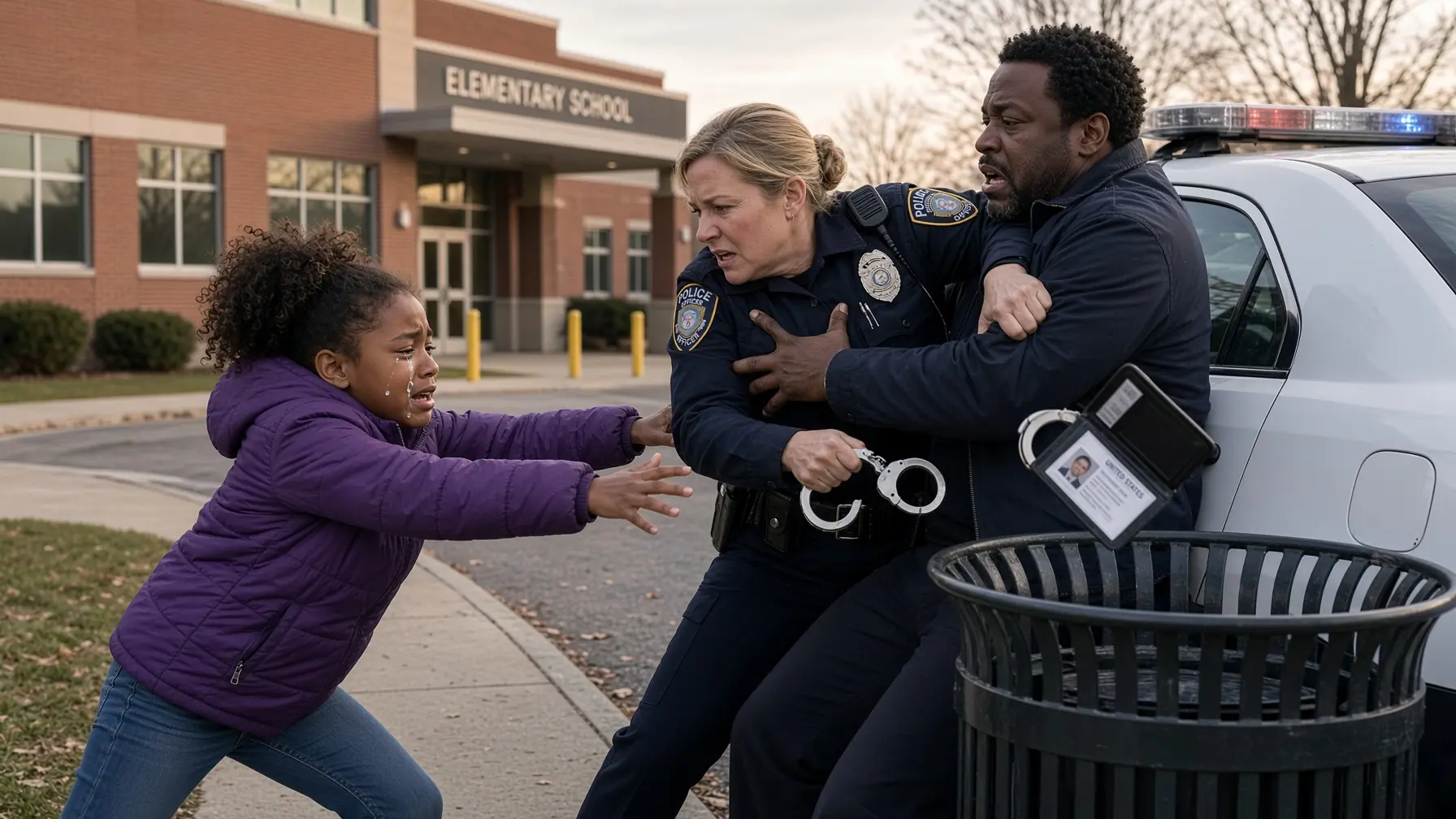
Not setting it down.
Not handing it back.
Throwing it.
The leather credential wallet hit the metal rim, flipped once, and landed on top of a half-empty coffee cup and somebody’s fast-food bag.
My ten-year-old son, Caleb, stared at it.
Then at her.
Then at me.
“Dad…”
I kept my eyes on Officer Holloway.
She was white, early thirties, blonde hair pulled into a tight bun beneath her patrol cap, one hand resting near her holster.
Her partner, Officer Luis Mendoza, stood several feet behind her looking increasingly uncomfortable.
Holloway folded her arms.
“You’re not going to flash some fake badge at me and expect this to go away.”
“It’s not fake.”
She smirked.
“Sure.”
Caleb tugged my sleeve.
“Dad, she threw your badge away.”
“I saw.”
Holloway pointed toward the curb.
“Both of you stay right there.”
I looked past her.
Across the street sat a black government Suburban.
Two more were turning onto the block.
Holloway had not noticed them yet.
I checked my watch.
Five minutes.
Maybe less.
Then I looked back at her.
“Officer.”
“What?”
“You should probably pick that badge back up.”
She laughed.
“Why?”
“Because in about five minutes, you're going to have to explain why you threw a federal credential in the trash.”
Her smile disappeared slightly.
“Federal credential?”
“You heard me.”
Then the first Suburban door opened.
And six armed federal agents stepped out.
My name is Marcus Reed.
Forty-three years old.
Black.
Single father.
And at the time, I was a supervisory special agent with the U.S. Marshals Service, assigned to a violent-fugitive task force working across three counties.
That title sounds more exciting than most of the job actually was.
A lot of paperwork.
A lot of waiting.
A lot of coordinating with local departments.
And, occasionally, moments where everything went wrong very quickly.
That Saturday should have been simple.
I was off duty.
Caleb and I had just left a youth basketball tournament at Franklin Recreation Center.
His team lost by six.
He scored eight points and spent the entire drive complaining about one missed layup.
“You scored eight.”
“I should’ve scored ten.”
“You had four assists.”
“Still.”
“You defended their best player.”
“He scored twelve.”
“Caleb.”
“What?”
“You are ten.”
He crossed his arms.
“That doesn’t mean I can’t be disappointed.”
I looked at him.
His mother used to say things exactly like that.
That still hit me sometimes.
Three years earlier, my wife, Natalie, died after a sudden brain aneurysm.
No warning.
No long goodbye.
One morning we were arguing about whether Caleb needed a new winter coat.
Two days later I was sitting in a hospital room holding her hand while machines did work her body could no longer do.
After that, everything became mine.
School forms.
Lunches.
Homework.
Basketball practices.
Haircuts.
Doctor appointments.
The conversations about grief I was never trained for.
I could coordinate twenty officers during a high-risk fugitive arrest without raising my voice.
But figuring out how to tell a seven-year-old his mother was not coming home nearly destroyed me.
Three years later, Caleb and I had found a rhythm.
Not perfect.
Real.
And that Saturday, all I wanted was to buy him lunch and get home before the football game.
Then I saw the man in the gray hoodie.
We were walking toward my truck when I noticed him across the parking lot.
Male.
White.
Mid-thirties.
Gray hoodie.
Baseball cap low.
He looked at me.
Then immediately turned away.
That by itself meant nothing.
Then he looked again.
Longer.
My instincts sharpened.
I knew the face.
Not personally.
From a briefing photo.
Derrick Sloan.
Federal fugitive.
Armed robbery.
Weapons trafficking.
Wanted on an outstanding warrant.
Our task force had spent three weeks trying to locate him.
And there he was standing fifty yards from a youth basketball gym.