The argument started beside the squat racks at 6:42 in the evening, just as Iron Gym reached its busiest hour. Officer Darren Cole stood inches from a massive Black man wearing a backward cap and a charcoal tank top, jabbing one finger toward his chest while half the gym pretended not to watch. The man, forty-two-year-old Marcus Reed, said almost nothing at first. He simply stood there with both fists resting at his sides, his shoulders broad, his tattooed arms still, and his eyes locked calmly on the officer shouting in his face.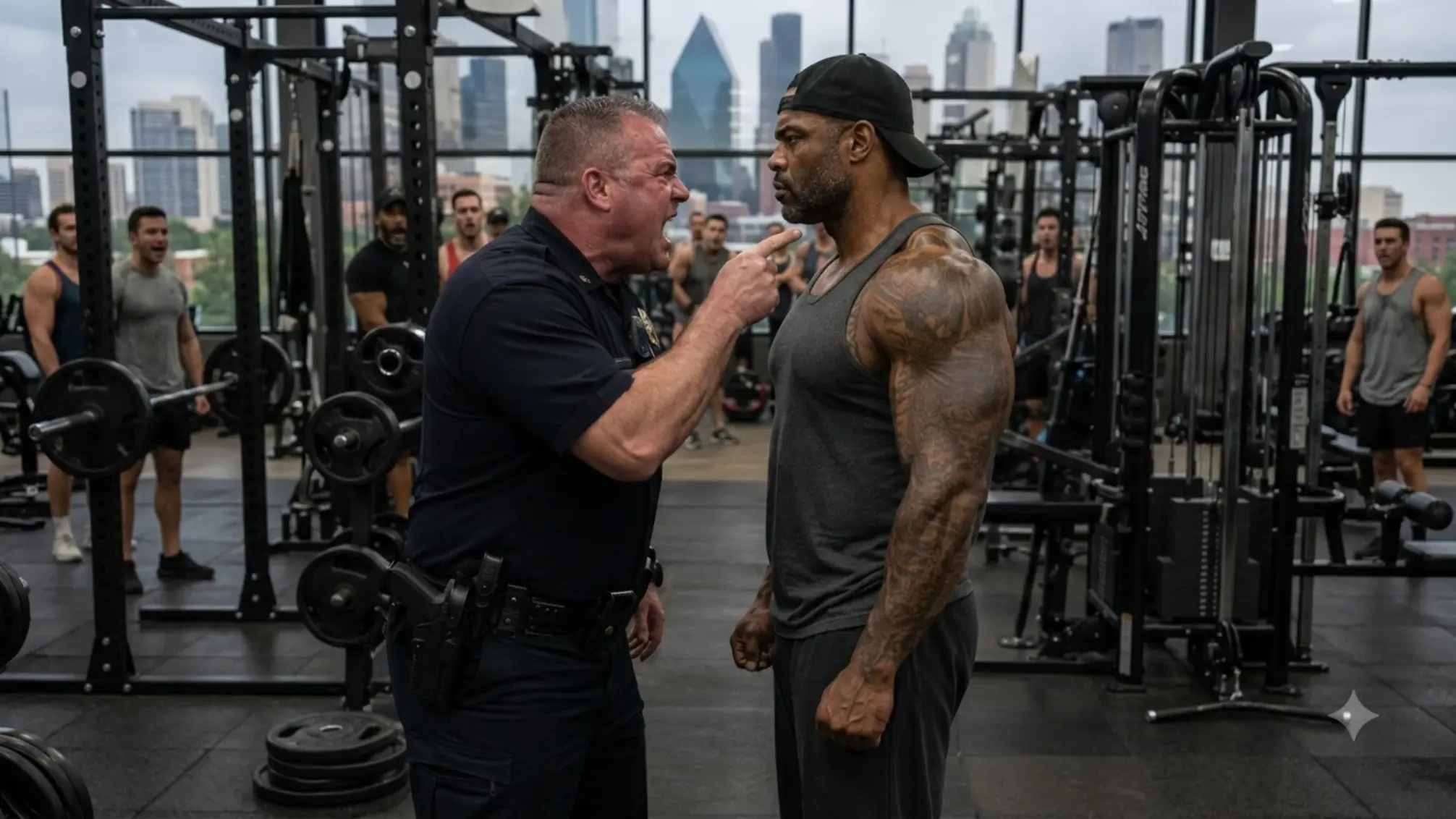
“You don’t belong in here, janitor,” Cole snapped. “Drop the attitude before I drag you out myself.” Marcus did not raise his voice. “Take one more step and you’ll blow an operation bigger than your whole career.” Cole laughed so loudly that several people near the free-weight area turned completely around.
Iron Gym occupied the top floor of a converted warehouse in downtown Dallas, with exposed steel beams, rows of black squat racks, heavy dumbbells, and tall windows overlooking the city. Marcus had been inside for nearly three hours, lifting, stretching, and quietly watching the same people move through the building. To anyone else, he looked like a heavily built cleaner or maintenance worker who happened to train during his break. That assumption was exactly what the FBI had spent weeks creating.
Marcus was not there to clean anything. He was a senior undercover agent assigned to a federal counterterrorism task force that had been tracking a domestic cell believed to be preparing a large coordinated attack somewhere in Texas. Investigators did not yet know the exact target, and they were deliberately keeping operational details compartmentalized, but they knew one suspected courier used Iron Gym as a regular meeting point. Marcus’s job was simple: observe, identify contacts, and stay invisible until the rest of the team had enough evidence to move.
For seventeen years, Marcus had survived undercover work by understanding one rule better than almost anything else: the moment people become interested in you, the operation becomes more dangerous. That was why he had arrived in worn training clothes, carried cleaning gloves in his gym bag, and spent the first hour wiping down equipment whenever the suspected courier entered. Nobody asked questions about a man they thought belonged to the building but did not matter. Until Darren Cole walked through the front door.
Cole was forty-eight, stocky, broad through the chest, with short graying hair and the permanently flushed face of a man who seemed to live one argument away from losing his temper. He had entered the gym while responding to a complaint about a parked motorcycle blocking part of the rear loading lane. The motorcycle belonged to another member, the complaint was resolved in less than five minutes, and Cole should have left. Instead, he noticed Marcus near the squat racks and decided he had found a different problem.
Cole approached the front desk manager and pointed across the room. “Who’s that?” The manager looked toward Marcus and shrugged. “He helps around sometimes.” That answer was technically true because the owner had agreed to support the undercover cover story. Cole heard something else.
“Helps around?” he repeated. “He work here?” The manager hesitated. “Sort of.” Cole’s eyes narrowed. “Then why is he using member equipment?”
The manager explained that Marcus had permission. Cole did not care. By the time he crossed the gym floor, he had already transformed a vague question into suspicion. Marcus saw him coming and felt the operation shift before the officer said a word.
“You work here?” Cole demanded. Marcus looked at him. “Sometimes.” Cole glanced at Marcus’s tattoos, backward cap, and heavy build. “Then why are you training instead of working?” Marcus answered, “Because I’m allowed to.”
Cole stared at him for several seconds, clearly expecting more submission than he received. “Got ID?” Marcus felt the first real spark of concern. His undercover identification would survive a routine local check, but every unnecessary contact created risk. “Why do you need it?”
Cole’s face hardened. “Because I asked.” Marcus looked around the gym without turning his head too obviously. Near the cardio section, the suspected courier was still walking on a treadmill. Two men associated with him stood beside a cable machine talking quietly. A confrontation here could destroy six weeks of work.
Marcus lowered his voice. “Officer, I’m asking you politely to leave this alone.” Cole stepped closer. “That sounds like somebody with something to hide.” Marcus’s expression did not change. “It sounds like somebody trying to keep you from making a serious mistake.”
That sentence sealed it. Cole interpreted calmness as arrogance. He reached toward Marcus’s upper arm and said, “You’re coming outside.”
Marcus shifted just enough to prevent the grip without looking aggressive. “Do not touch me.” Cole stared at him. “You threatening me?”
“No.” Marcus looked directly into his eyes. “I’m warning you.”
From a parked surveillance vehicle half a block away, Special Agent Lena Ortiz heard every word through Marcus’s concealed transmitter. She immediately removed her headset with one hand and looked toward the team leader sitting beside her. “Local officer is interfering.”
Supervisory Agent Daniel Hsu leaned toward the monitor. “How bad?” Lena turned up the audio. Cole’s voice filled the van.
“I don’t care who you pretend to be,” he shouted. “You look like trouble, and I’m done asking.” Marcus answered, “Touch me, Officer, and when FBI command storms this gym, you’ll be the first man in cuffs.”
Daniel’s eyes closed briefly. “Marcus just burned the cover.” Lena shook her head. “He had no choice.”
Inside the gym, Cole laughed again. “FBI?” He looked around theatrically. “You hear that? Janitor thinks he’s federal.” Several gym members backed away.
Marcus felt the suspected courier slow on the treadmill. That mattered. The man was listening now. Marcus could not allow Cole to keep escalating.
He lowered his voice. “Officer Cole, listen carefully. Walk away from me. Do not use your radio. Do not ask anyone here more questions. Just walk away.”
Cole’s expression changed. “How do you know my name?” Marcus glanced toward the badge on his chest. “It’s printed right there.”
Cole suddenly grabbed Marcus’s wrist. Marcus did not strike him. He rotated his hand, broke the grip with a small controlled movement, and immediately stepped backward with both hands open.
The gym went silent.
Cole reached for his handcuffs. “That’s resisting.” Marcus answered, “You never detained me lawfully.” Cole pulled the cuffs free. “Turn around.”
Marcus’s jaw tightened. Across the gym, the suspected courier stepped off the treadmill.
Lena saw it on the surveillance feed. “Target is moving.” Daniel grabbed the radio. “All teams hold. Do not rush the building unless Marcus calls it.”
The courier picked up his backpack and headed toward the rear exit. One of his associates followed.
Marcus saw them leave. Six weeks of surveillance was walking out the door.
He looked at Cole.
“You just cost the FBI a live surveillance target.”
Cole smirked. “Sure I did.”
Marcus slowly reached into his training bag.
Cole immediately drew his hand toward his holster. “Hands where I can see them.”
Marcus stopped.
“I’m reaching for credentials.”
“Don’t.”
Marcus froze. His voice became harder. “Then you reach into the side pocket yourself.”
Cole hesitated.
The gym manager stepped closer. “Officer, maybe you should listen to him.”
“Back up.”
The manager did.
Cole finally reached into the open side pocket of Marcus’s bag and pulled out a black leather credential wallet. He opened it.
The color left his face.
Marcus said nothing.
Cole stared at the gold federal badge, then at the identification card bearing Marcus Reed’s photograph and title.
“You’re actually FBI.”
Marcus’s voice stayed cold. “Now you understand why I told you to stop.”
Cole looked around the gym as though searching for a way to rewind the last five minutes. “Why are you here?”
Marcus stepped forward and took the credential case from his hand. “That question is exactly why you should have walked away.”
Cole’s radio suddenly crackled. Dispatch asked whether he needed assistance. He reached for it.
Marcus grabbed his wrist.
Not violently.
Firmly.
“Do not answer that.”
Cole’s face flushed again. “Take your hand off me.”
“If you broadcast what’s happening here, you may put people in danger.”
The gym manager stared.
Cole swallowed. For the first time, fear replaced arrogance.
“What kind of operation?”
Marcus released him. “One you are not cleared to know.”
The front doors opened.
Lena Ortiz entered first wearing plain clothes and holding her credentials visibly at chest height. Daniel Hsu followed with three other agents. They did not run, shout, or draw weapons.
They moved quickly but deliberately.
Cole looked toward them.
Lena walked straight past him and stopped beside Marcus. “Target exited through the rear.”
Marcus nodded once.
Daniel asked, “Secondary team still on him?”
“Tracking vehicle only,” Lena answered. “No contact.”
Cole heard the exchange. His expression tightened.
Daniel finally looked at him. “Officer?”
Cole straightened reflexively. “Darren Cole, Dallas Police.”
Daniel held out his credential. “Supervisory Special Agent Daniel Hsu. Do not discuss anything you heard in this gym with anyone outside your chain of command until federal investigators brief your department.”
Cole nodded slowly.
Then he made another mistake.
“I was just doing my job.”
Marcus looked at him.
Daniel turned.
Cole continued. “He wouldn’t identify himself.”
Marcus laughed once, without humor. “You never had a reason to demand identification.”
“I received a complaint.”
“About a motorcycle.”
Cole’s mouth closed.
Marcus continued. “Then you saw me and created another investigation because you thought I didn’t belong here.”
“That’s not what happened.”
“Good.”
Marcus gestured toward the ceiling.
“Then the cameras will prove you right.”
Cole looked upward.
Iron Gym had sixteen security cameras.
He had noticed none of them.
Daniel spoke quietly. “Officer Cole, this is no longer only about interference with a federal operation. Your conduct may need to be reviewed separately.”
Cole’s face turned red. “You people are going to blame me because your surveillance subject walked away?”
Marcus stepped closer.
“No.”
His voice was calm.
“I’m blaming you because I warned you repeatedly and you cared more about winning an argument than understanding what was happening.”
Nobody spoke.
Cole looked toward the members watching from a distance.
Humiliation hit him harder than the federal credentials had.
He left ten minutes later with instructions to report directly to his supervisor.
The operation did not end.
That surprised Marcus.
The suspected courier had left early, but the secondary surveillance team remained on his vehicle. Rather than disappearing, the man drove to a warehouse district south of downtown and met with another previously unidentified individual.
The accidental movement created a new lead.
Daniel told Marcus not to celebrate.
“We got lucky.”
Marcus nodded. “I know.”
By midnight, agents had connected the warehouse visitor to a rental property under federal surveillance. The task force obtained additional legal authority to expand monitoring, and analysts spent the entire night comparing phone records, vehicle movements, financial transfers, and travel patterns.
No one inside the gym learned the details.
That was intentional.
The FBI did not need a crowd understanding how close the investigation might be to its target.
Three days later, the task force moved.
Federal agents and local partners executed coordinated arrests across several locations. The suspected cell was taken into custody without a public confrontation, and investigators recovered enough evidence to support charges tied to an attempted large-scale attack plot.
The exact operational methods remained restricted.
The public learned only that authorities had disrupted a serious planned act before anyone was hurt.
Marcus watched the press conference from a conference room at the field office.
Nobody mentioned Iron Gym.
Nobody mentioned Darren Cole.
Nobody mentioned the five minutes when one angry officer nearly collapsed the operation.
Marcus preferred it that way.
Then Internal Affairs called.
Cole’s confrontation had triggered a departmental review because the gym footage raised questions unrelated to the FBI case. Investigators asked Marcus to provide a statement once the counterterrorism matter was secure.
He agreed.
Not because he wanted revenge.
Because the video bothered him.
The footage showed something he had missed in the moment.
Cole had passed six other large men in the gym before approaching Marcus.
Two were louder.
One had no visible membership tag.
Another was training shirtless despite gym rules.
Cole ignored all of them.
He walked directly toward Marcus.
Internal Affairs reviewed Cole’s previous complaints.
There were nine.
Most were minor.
Three involved accusations that he demanded identification from Black men in businesses where no crime had been reported.
One involved a Latino delivery driver forced to sit on a curb for twenty minutes after Cole claimed the van “looked wrong.”
Another involved a teenager questioned outside his own apartment building because Cole said he did not appear to live there.
None had led to serious discipline.
Each complaint had been handled separately.
The gym video gave investigators context.
Cole was interviewed two weeks later.
He insisted race had nothing to do with the encounter.
“I thought he was suspicious.”
The investigator asked, “Why?”
“He didn’t look like gym staff.”
“What does gym staff look like?”
Cole paused.
“He was dressed like a member.”
“So were dozens of other people.”
“He was acting evasive.”
“How?”
“He wouldn’t answer my questions.”
“Before you approached him, what suspicious behavior did you observe?”
Cole had no answer.
The investigator waited.
Cole finally said, “It was instinct.”
That word became central to the report.
Instinct could be valuable.
It could also disguise assumption.
Internal Affairs found no evidence Cole knowingly tried to sabotage the federal operation. They did find repeated problems with unsupported stops, escalating language, and failure to articulate lawful reasons for demands.
Cole was removed from street duty pending retraining and disciplinary review.
Marcus learned about it months later.
By then, the terror case had moved into federal court.
Marcus had returned to ordinary investigative work.
Iron Gym remained open.
The owner offered him a lifetime membership.
Marcus declined at first.
Then changed his mind.
He returned on a Saturday morning wearing the same backward cap and charcoal tank top.
The manager recognized him immediately.
“So you’re actually here to work out this time?”
Marcus smiled.
“That depends.”
“On what?”
“Anybody planning to interrogate the janitor?”
The manager laughed.
“No cops today.”
Marcus walked toward the squat rack.
Several regular members recognized him from the confrontation but knew almost nothing else. The FBI had never publicly identified him as part of the disrupted attack investigation.
That was also intentional.
One younger member approached while Marcus loaded plates onto the bar.
“Were you really undercover?”
Marcus looked at him.
“Who told you that?”
“Everybody.”
Marcus smiled.
“Then everybody knows too much.”
The young man laughed nervously.
“Was the cop really going to ruin the whole thing?”
Marcus paused.
That question stayed with him.
“No.”
The young man looked surprised.
Marcus adjusted the weight.
“He could’ve hurt the operation.”
“But he didn’t?”
“No.”
“Why not?”
“Because good operations aren’t built around one person.”
Marcus looked toward the city through the gym windows.
“Other agents adjusted.”
The young man nodded.
Then asked, “Were you mad?”
Marcus thought about Cole’s finger inches from his face.
The handcuffs.
The courier walking toward the exit.
The fear that six weeks of work had disappeared because one stranger needed to prove authority.
“Yes.”
“What stopped you from hitting him?”
Marcus looked back.
“My job.”
The young man laughed.
“I thought you were gonna say training.”
“That too.”
Marcus began his set.
Months later, he testified in the federal case connected to the disrupted plot. The courtroom was closed for part of his testimony because several investigative details remained sensitive.
He described surveillance.
Evidence.
Contacts.
Timelines.
He never exaggerated.
When defense counsel asked whether the operation had experienced any major compromise, Marcus thought about Iron Gym.
He answered carefully.
“There was one unexpected law-enforcement interaction.”
The attorney leaned forward.
“Did it threaten the investigation?”
“Temporarily.”
“How?”
“I’m not discussing operational specifics beyond what the court authorized.”
The judge sustained the boundary.
After testimony, Marcus sat outside the courtroom with Lena Ortiz.
She handed him coffee.
“You know what I still think about?”
“What?”
“That cop’s face when he opened your badge.”
Marcus smiled.
“You enjoyed that too much.”
“A little.”
“He thought I was a cleaner.”
“You technically cleaned six machines.”
“That was cover.”
Lena laughed.
Then she became serious.
“You ever think about what would have happened if you weren’t FBI?”
Marcus looked at her.
That was the question he had been asking himself for months.
If he were simply Marcus Reed, gym member.
No badge.
No surveillance van.
No federal team.
No protected operation important enough to make everyone suddenly cautious.
Would Cole have backed away?
Marcus knew the answer.
Probably not.
He took a drink.
“That’s why the review mattered.”
Lena nodded.
The FBI case eventually ended with convictions tied to the planned attack. No bombs went off. No crowded venue became a crime scene. No families woke up to the kind of headlines investigators had spent months trying to prevent.
Marcus considered that the only victory worth remembering.
Iron Gym became just a gym again.
People lifted weights.
Music played too loudly.
Members complained about broken machines.
Nobody knew that one of the most important nights in the building’s history had involved almost nothing visible at all.
A man pretending to be unimportant.
A cop who assumed that meant powerless.
A surveillance target walking through a back door.
And a federal team quietly adjusting before everything collapsed.
One evening nearly a year later, Marcus finished training and headed toward the exit.
A cleaner was wiping down the front desk.
He was an older Black man, probably sixty, wearing a gray work shirt with a name patch that read LEON.
A young member dropped a towel near him.
“Hey, man,” the member said, “pick that up.”
Leon looked at the towel.
Then at the young man.
Marcus stopped walking.
Before he could say anything, the gym manager stepped out from behind the counter.
“You dropped it,” he told the member. “You pick it up.”
The young man rolled his eyes but bent down.
Leon continued cleaning.
Marcus smiled slightly.
The manager noticed.
“What?”
“Nothing.”
Marcus pushed open the front door.
Outside, downtown Dallas glowed beneath a clear evening sky.
His phone vibrated with a message from Daniel.
New briefing tomorrow. 0700.
Marcus typed back.
I’ll be there.
He slipped the phone into his pocket and headed toward his truck.
People later told the Iron Gym story as if the important moment came when Darren Cole discovered Marcus was FBI.
Marcus disagreed.
The badge made Cole stop.
But it should never have been necessary.
The real mistake happened earlier.
The moment Cole looked at a quiet Black man in work clothes and decided he could not possibly belong in the room unless he explained himself.
Everything after that—the shouting, the handcuffs, the nearly compromised operation—grew from that first assumption.
Marcus had spent his career hunting dangerous people who planned extraordinary harm.
That night reminded him that smaller abuses of authority could begin far more quietly.
One look.
One assumption.
One officer deciding he already knew the truth.
And sometimes the person being dismissed as insignificant is the one carrying the responsibility for something far bigger than anyone in the room can see.