Handcuffs bit painfully into his wrists as he was forced against the rain-soaked hood of a patrol car.
Officers Thomas Riker and Mitchell Hayes laughed as though they had just caught another dangerous suspect wandering through territory they considered their own. They were confident, aggressive, and completely unaware of the truth.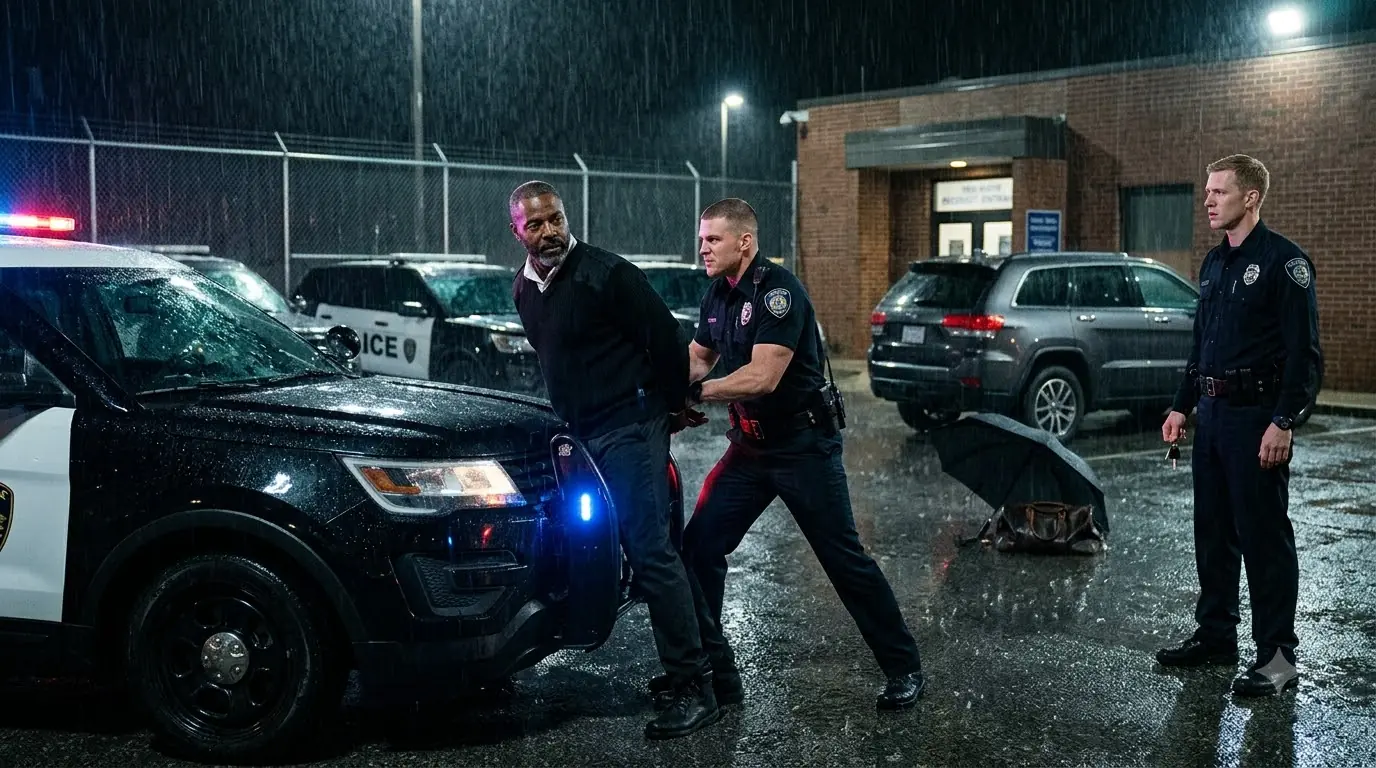
The man standing in front of them was not a random trespasser.
His name was Marcus Vance.
And by eight o’clock the following morning, he would become their new chief of police.
Rain fell over Oakridge in relentless sheets, drumming against the roof of Marcus’s understated charcoal SUV. The digital clock on the dashboard glowed faint blue.
11:42 p.m.
Sunday night.
In exactly eight hours and eighteen minutes, Marcus was scheduled to stand inside the atrium of the Oakridge Municipal Building, raise his right hand, and swear an oath to protect a city whose police department had recently become a national symbol of institutional failure.
Oakridge was a sprawling Rust Belt suburb with a population of roughly ninety thousand.
For years, the Oakridge Police Department had functioned almost like a closed institution inside the city government. Complaints rarely resulted in meaningful consequences. Supervisors protected officers they had worked beside for decades. Reports disappeared into administrative systems that seemed designed to exhaust anyone persistent enough to challenge them.
The previous chief, Arthur Sterling, had been pushed into early retirement after a federal investigation uncovered evidence of civil-rights violations, manipulated records, excessive-force complaints, and repeated failures to address discriminatory policing.
The scandal had nearly destroyed public trust.
Mayor Elias Thorne had spent six months searching for someone willing to walk into the department from the outside.
He needed someone who was not connected to the local hierarchy.
Someone willing to confront both the officers and the political structure that had protected them.
He found Marcus Vance.
Marcus was forty-seven years old and a twenty-two-year veteran of law enforcement, much of it spent with the Chicago Police Department’s Internal Affairs Division. His reputation was simple: if Marcus opened an investigation, nobody cared what badge, rank, union connection, or political friendship stood behind the subject.
Facts were facts.
Records were records.
And misconduct was misconduct.
That philosophy had earned Marcus commendations.
It had also earned him enemies.
He was broad-shouldered and lean, with the build of a former middleweight boxer. His hair was closely cropped, his eyes sharp and observant, and his neatly trimmed beard carried enough gray to show the years without making him look old.
Marcus had spent his career studying people.
Tonight, he was dressed nothing like a police chief.
His new ceremonial uniform hung inside a garment bag on the rear seat of the SUV.
Instead, Marcus wore dark navy tactical trousers, polished black boots, a crisp white button-down shirt, and a heavy black sweater without any department markings.
No visible badge.
No gold stars.
No rank insignia.
He looked like someone connected to law enforcement.
But he could just as easily have been private security, a federal contractor, or an ordinary citizen who preferred practical clothing.
Marcus had driven several hundred miles that afternoon, leaving his wife Sarah in Chicago to supervise the final stages of their move.
Before he left, Sarah stood in the kitchen doorway holding coffee.
“You’re walking into a hornet’s nest, Mark.”
Marcus smiled.
“They don’t want you there.”
“I know.”
“The union already hates you.”
“I know.”
“You haven’t even started.”
Marcus kissed her forehead.
“That’s exactly why I’m going.”
Now he turned off Oakridge’s main arterial road and drove toward the rear of the Fourth Precinct.
He had not told anyone he was coming.
That was intentional.
The rear lot was surrounded by a high chain-link security fence. According to the audits Marcus had spent weeks reviewing, the motorized gate had been malfunctioning for months.
He found it stuck partially open.
Wide enough for a vehicle to pass through.
Marcus frowned immediately.
His first unofficial inspection had revealed a security failure before he even got out of the vehicle.
He drove through.
A dozen marked cruisers sat under the rain.
Personal vehicles filled the outer spaces.
Near the reinforced rear entrance was a clearly marked parking space.
CHIEF OF POLICE.
RESERVED 24/7.
It was empty.
Marcus pulled into it.
He shifted into park and turned off the engine.
For several seconds, he sat silently.
He had no intention of making a grand entrance.
He wanted to see the precinct when nobody had prepared for him.
Sunday graveyard shift.
Supervisors tired.
Senior administrators at home.
No press officers.
No politicians.
No department-wide email warning everyone that the new chief was coming.
This was when an institution showed its real personality.
Marcus wanted to enter quietly, get a cup of the notoriously bad coffee mentioned in several internal reports, observe the desk sergeant, and see how officers behaved when they believed nobody important was watching.
He reached across the passenger seat.
A heavy leather duffel bag rested there.
Inside were administrative documents, credentials, his new Oakridge badge, and secured duty equipment connected to his move.
He slung the bag over his shoulder.
Then grabbed a plain black umbrella.
The moment he stepped outside, the cold November rain hit him.
Marcus opened the umbrella.
He had walked only twenty yards toward the station entrance when a powerful spotlight struck him directly in the face.
“Hey!”
The voice came through a patrol cruiser’s exterior speaker.
“Freeze right there. Keep your hands where I can see them.”
Marcus stopped.
He did not panic.
Two decades in Chicago had trained that reaction out of him years ago.
A patrol cruiser had entered behind him and stopped at an angle.
Its spotlight washed out his vision.
Marcus lowered the umbrella enough to see while keeping his right hand clearly visible around the handle.
His other hand held only the duffel strap.
Two cruiser doors slammed.
Footsteps splashed through puddles.
“I said drop the bag and put your hands up!”
Marcus could make out two officers moving toward him.
One approached from the left.
The other shifted wider.
One hand rested close to a holstered firearm.
The other officer had already drawn a less-lethal device.
Every department had officers like these.
People who approached uncertainty as a challenge to their authority instead of a situation to assess.
“Good evening, officers,” Marcus said.
His voice remained level.
“It’s raining pretty hard. Let’s not escalate this. I’m heading inside the precinct.”
“Shut your mouth.”
The officer on the left stepped closer.
His nameplate caught the light.
RIKER.
Thomas Riker appeared to be in his late twenties. Short, muscular, close buzz cut, shoulders squared aggressively.
“You don’t tell us what to do.”
Riker pointed.
“Drop the umbrella. Drop the bag. Kick them away.”
The second officer was taller and thinner.
HAYES.
Mitchell Hayes.
Younger-looking.
More nervous.
Eager to follow his partner’s lead.
“You heard him,” Hayes said.
“Do it.”
Marcus evaluated the scene.
He could end everything immediately.
All he had to say was:
My name is Marcus Vance. I become your chief in eight hours.
The spotlight would probably disappear.
Riker would lower his weapon.
Hayes would suddenly remember manners.
Apologies would follow.
But Marcus looked at Riker’s posture.
The speed of escalation.
The assumptions already being made.
A thought entered his mind.
If they behave this way toward me, what happens to an eighteen-year-old kid from the south side during a midnight stop?
What happens to a frightened motorist?
What happens when there is no incoming police chief standing beneath the sweater?
Marcus decided not to reveal himself.
Not yet.
He lowered the umbrella.
Placed it on the pavement.
Then removed the duffel from his shoulder and set it beside the umbrella.
Both hands rose slowly to shoulder height.
“My hands are visible.”
Marcus looked toward Riker.
“I am not armed in a threatening manner. I am here to conduct business inside the precinct.”
Riker scoffed.
“Business at midnight in a restricted lot?”
He glanced toward Marcus’s SUV.
Then his expression sharpened.
“And you parked in the chief’s space.”
Marcus followed his gaze.
“Yes.”
“You got some nerve.”
Riker moved closer.
“What are you doing back here? Checking the cruisers? Looking for something to steal?”
“No.”
Marcus spoke evenly.
“I parked there because the space was empty, and I have legitimate business inside.”
“Turn around.”
Marcus did not move immediately.
Riker raised the less-lethal weapon toward him.
“Face away from me.”
“There is no need to point that at me, Officer Riker.”
Marcus deliberately used his name.
“I am complying with your instructions.”
Riker’s expression changed.
“How do you know my name?”
“Your nameplate.”
“You think you’re smart?”
Marcus said nothing.
“Turn around.”
Marcus slowly turned.
Rain soaked through his hair and ran down his neck.
“Hands behind your head,” Hayes ordered. “Interlace your fingers.”
Marcus complied.
Before his hands fully settled, Riker grabbed the back of his sweater and shoved him forward.
Marcus struck the hood of the patrol cruiser harder than necessary.
Pain flared through his ribs.
He remained silent.
“Spread your feet.”
Riker kicked one ankle outward.
“Officer,” Marcus said, his voice dropping slightly, “this amount of force is unnecessary. I am fully compliant.”
Riker laughed.
“Listen to this guy.”
Hayes began patting Marcus down.
“We got ourselves a lawyer.”
Marcus stared at the wet hood beneath him.
“You are violating basic procedure.”
Riker leaned his forearm against Marcus’s upper back.
“Thinks he knows procedure too.”
Hayes checked Marcus’s waist and pockets.
“Nothing on his belt.”
He reached into one cargo pocket.
“Keys.”
Riker immediately created a theory.
“Probably tools in the bag.”
Marcus turned his head slightly.
“I have identification in my right rear pocket.”
Riker ignored him.
“Could be planning to get into one of the cruisers.”
Marcus spoke more clearly.
“Officer Riker, check my identification.”
Riker grabbed his left wrist.
“Bring your arms down.”
“My identification will explain why I am here.”
“I’ll check your ID when we get inside.”
Riker forced one arm behind Marcus.
Marcus deliberately relaxed his muscles.
“I am not resisting.”
Riker took the other wrist.
Metal closed around both.
Click.
Click.
The cuffs tightened painfully.
Marcus inhaled.
He knew exactly what was being done.
The restraints were tighter than necessary.
He felt pressure around the bones of both wrists and numbness beginning in his fingers.
“Tight enough?” Riker muttered near his ear.
Marcus closed his eyes for one second.
Rain.
Motor oil.
Wet asphalt.
The smell of the officer’s uniform.
Mayor Thorne had warned him the department was damaged.
Marcus had just learned how deep the damage went.
“They are adequately secured,” Marcus said.
His refusal to react seemed to irritate Riker even more.
Riker pulled him away from the cruiser.
“Let’s go.”
He nodded toward Hayes.
“Grab the bag.”
Hayes picked up Marcus’s duffel.
The transition from freezing rain to the fluorescent interior of the Fourth Precinct was abrupt.
The hallway smelled of bleach, burnt coffee, damp uniforms, and old paperwork.
Marcus knew the smell well.
Almost every police building in America seemed to carry some version of it.
Riker kept one hand tightly around Marcus’s upper arm as they moved down the corridor.
“Keep walking.”
Another unnecessary shove.
Marcus said nothing.
They passed the holding area.
Then entered the main bullpen.
The first thing Marcus noticed was disorder.
Desks buried beneath unfinished paperwork.
Takeout containers.
Old computer monitors.
Coffee cups.
Officers sitting casually while dispatch traffic echoed from speakers nearby.
Nobody appeared particularly concerned about the radio.
Several officers looked up when Riker marched Marcus through the room in handcuffs.
“What’d you catch, Tommy?”
A heavyset officer leaned back in his chair with his boots on a desk.
Marcus recognized him immediately from personnel files.
Officer Kowalski.
Three excessive-force complaints in two years.
All closed under the previous administration.
“Found him lurking around the back lot.”
Riker spoke loudly enough for the whole room.
“Parked in the chief’s space. Tactical gear. Wouldn’t identify himself.”
Marcus registered the lie immediately.
Wouldn’t identify himself.
Marcus had told them where his identification was.
More than once.
Riker was already rewriting the encounter for witnesses.
Another officer approached.
Jenkins.
Marcus recognized him too.
Currently under quiet review for questionable overtime reporting.
Jenkins looked Marcus up and down.
“Little late for Halloween, isn’t it?”
A few officers laughed.
Marcus remained silent.
He scanned every face.
Every desk.
Every reaction.
He had memorized much of this shift roster.
That preparation was paying off.
“Sergeant Miller!”
Riker shouted toward a raised workstation.
A balding man in his late fifties slowly looked up from a crossword puzzle.
Sergeant Miller.
Shift commander.
In Marcus’s files, Miller appeared repeatedly in complaints involving poor supervision.
Never directly accused of brutality.
Almost always accused of looking the other way.
“What is it?”
Miller adjusted his glasses.
“Got a trespasser.”
Riker pushed Marcus forward.
“Uncooperative. Need room two to process him. We’re inventorying the bag.”
Miller barely looked at Marcus.
He did not ask what crime had occurred.
He did not ask whether Marcus had been identified.
He did not ask about the condition of the cuffs.
He did not ask why a trespassing suspect was being brought into an interrogation room rather than simply cited or removed.
“Room two is open.”
Miller waved.
“Don’t make a mess.”
Then he returned to his crossword puzzle.
Marcus felt more disappointed by Miller than by Riker.
An aggressive young officer was a problem.
A supervisor who normalized him was a system.
Riker pulled Marcus toward the hallway.
“Let’s go.”
Interrogation room two was small.
Pale green walls.
Paint peeling around the corners.
A metal table bolted to the floor.
Three plastic chairs.
Two-way glass on one wall.
According to the audit Marcus had reviewed, the room’s recording equipment had been out of service for months.
No one had prioritized fixing it.
Riker forced Marcus into a chair.
The cuffs behind his back made the position awkward.
His shoulders ached.
Hayes placed the leather duffel on the table.
“Want me to open it?”
Riker leaned against the doorway.
“Yeah.”
He looked at Marcus.
“Let’s see what our mystery guest brought into the station.”
Marcus spoke calmly.
“I am advising you again to check my identification. It is in my right rear pocket.”
Neither moved.
“And I do not consent to a search of that bag.”
Riker laughed.
“There he goes again.”
He leaned close.
“In here, you don’t make the rules.”
Marcus met his eyes.
“I understand exactly how you believe this department operates.”
Something about the sentence made Riker pause.
Only for a fraction of a second.
Then ego took control again.
“Open it.”
Hayes unzipped the bag.
The first item he removed was a secured equipment case.
He set it on the table.
Riker’s eyes brightened.
“What’s in there?”
Marcus said nothing.
Hayes found the appropriate key among those already taken from Marcus.
He opened the case.
His expression changed.
Riker noticed immediately.
“What?”
Hayes stared downward.
“What is it?”
“A Glock.”
Riker smiled.
Then Hayes continued.
“But…”
Riker stepped closer.
Inside the case was a department-issued sidearm connected to Marcus’s former Chicago service.
The labeling and accompanying documentation clearly identified it as official equipment associated with Marcus Vance, formerly of the Chicago Police Department’s Internal Affairs command structure.
Riker stared.
The smile disappeared.
“He stole a cop’s weapon.”
The explanation came too quickly.
Too desperately.
Marcus looked toward Hayes.
“Side pocket of the bag.”
Hayes did not wait for Riker.
He unzipped it.
Reached inside.
Then pulled out a black leather credential case.
Hayes opened it.
A gold Oakridge shield sat on one side.
CHIEF OF POLICE.
On the other side was Marcus’s official identification.
Marcus Vance.
Chief of Police.
Effective Monday.
Hayes stopped breathing for a second.
The credential case slipped from his fingers and landed open on the table.
Marcus’s photograph stared upward between them.
Hayes slowly lifted his head.
Then looked at Riker.
“Tommy.”
Riker said nothing.
“Tommy…”
Hayes’s voice cracked.
“Oh my God.”
Marcus shifted slightly in the chair.
The handcuffs rattled behind him.
Neither officer moved.
Marcus looked from one to the other.
“Now.”
His voice was quiet.
“Are you going to remove these handcuffs yourselves, or should we call Mayor Thorne and ask him to come down here?”
The silence became absolute.
Riker’s face changed slowly.
The arrogance drained away.
His skin turned pale.
His breathing became shallow.
“I…”
Marcus waited.
“The keys,” Marcus said.
He looked toward Hayes.
“Remove the restraints.”
Hayes moved forward with shaking hands.
It took him several attempts to line up the key correctly.
Finally one cuff released.
Then the other.
Marcus brought his arms forward.
Red marks circled both wrists.
He did not rub them immediately.
Instead, he stood.
Straightened his sweater.
Rolled his shoulders back.
Riker looked smaller now.
“Chief Vance…”
Marcus looked at him.
“Chief, listen.”
Riker lifted both hands.
“You have to understand what we saw. Tactical clothing. Restricted lot. Midnight. We’ve had problems back there.”
Marcus’s expression remained clinical.
“Standard procedure?”
“Yes.”
Riker seized the phrase.
“Exactly. Standard procedure.”
Marcus took one step closer.
“Then let us review your standard procedure.”
Riker’s mouth closed.
“You initiated contact with a compliant individual without first establishing that a crime had occurred.”
Marcus continued.
“You escalated immediately.”
He gestured toward the door.
“You aimed a less-lethal weapon while your partner maintained a hand near his firearm.”
Riker started to interrupt.
Marcus raised one hand.
“You demanded compliance. I complied.”
His voice became firmer.
“You asked for identification only after deciding what you thought I was.”
“You never told us—”
“If I had told you I was your new chief, would your behavior have changed?”
Riker stared.
Marcus waited.
“Yes or no?”
Neither officer answered.
Marcus continued.
“If I were an ordinary resident who took a wrong turn into an unsecured lot, would your actions suddenly become acceptable?”
Hayes lowered his head.
“If I were a delivery driver looking for the rear entrance, would forcing me against a cruiser have been necessary?”
Riker looked toward the table.
“You assumed criminal intent.”
Marcus pointed toward the credentials.
“Then refused to examine the information that would have challenged your assumption.”
He took another breath.
“And within minutes, you were already telling the bullpen that I had refused to identify myself.”
Riker looked up.
“You heard that?”
“I hear everything.”
Marcus picked up his badge.
He clipped it onto his belt.
“I am not officially sworn in until eight tomorrow morning.”
Riker’s face showed a faint flicker of hope.
Marcus extinguished it immediately.
“But right now I am still a citizen.”
He looked at the marks around his wrists.
“A citizen who was detained, handled unnecessarily, restrained too tightly, misrepresented in front of witnesses, and searched despite repeatedly telling you where my identification was.”
Hayes’s eyes filled.
“Chief, please.”
Marcus looked toward him.
“My wife is pregnant.”
Hayes swallowed.
“I didn’t start this. I was following Riker.”
Marcus remained silent.
“I didn’t shove you.”
“No.”
Marcus nodded.
“But you watched.”
Hayes’s face collapsed.
“You participated.”
“I…”
“You had multiple opportunities to slow this encounter down.”
Marcus continued.
“You chose instead to validate your partner.”
Hayes looked toward the floor.
Marcus closed the equipment case.
Then returned it to his bag.
“Both of you stay in this room.”
Riker looked up.
“What?”
Marcus’s tone hardened.
“You are relieved from patrol duty pending immediate review.”
“Chief—”
“Do not leave.”
Marcus pointed toward the wall.
“Do not touch evidence.”
He looked at Hayes.
“Do not make phone calls until a supervisor arrives to secure your equipment and document the incident.”
Riker opened his mouth.
Marcus stopped him.
“You have spent the last twenty minutes telling me how much authority this building gives you.”
He picked up the duffel.
“Now you are going to learn what accountability looks like inside it.”
Marcus opened the door.
Then stepped into the hallway.
The bullpen looked almost exactly as he had left it.
Kowalski was still sitting with his feet near the desk.
Jenkins was tossing a tennis ball against a wall.
Sergeant Miller had returned to his crossword.
Marcus walked to the center of the room.
Then dropped the duffel onto an empty desk.
The heavy sound made everyone look up.
Kowalski’s feet hit the floor.
Jenkins missed the tennis ball.
Miller froze.
Every officer looked at Marcus.
Then at the gold badge now clipped visibly to his belt.
Then at his wrists.
Miller’s face changed first.
“Where’s Riker?”
“Interrogation room two.”
Marcus’s voice carried across the room.
“Officer Hayes is with him.”
Nobody moved.
“Both have been removed from patrol duties pending an immediate investigation.”
Kowalski stood.
“Wait a minute. Who the hell are you?”
Marcus turned toward him.
“Sit down, Officer Kowalski.”
Kowalski blinked.
Marcus continued.
“Or this becomes a much more difficult evening for you.”
“How do you know my name?”
“I know every name on this shift.”
Marcus stared at him.
“I also know about the excessive-force complaints currently in your personnel history.”
Kowalski’s jaw dropped.
He slowly sat.
Marcus walked toward Miller’s raised desk.
The sergeant tried to hide the crossword beneath an incident report.
Marcus noticed.
“Sergeant Miller.”
“Yes, sir.”
The words came automatically.
“You are the shift commander.”
Miller swallowed.
“Yes.”
“You allowed two patrol officers to bring a handcuffed citizen through your station without asking them to establish the basis for detention.”
Miller looked toward the hallway.
“Riker said it was routine.”
Marcus cut him off.
“Your job is not to repeat what Riker says.”
Miller went silent.
“Your job is supervision.”
Marcus pointed toward the bullpen.
“You are responsible for the culture of this shift.”
Miller looked sick.
“I thought—”
“That is exactly the problem.”
Marcus’s voice became quieter.
“You did not think.”
He turned away from the desk.
Twelve officers were now watching him.
Nobody touched a phone.
Nobody laughed.
“My name is Marcus Vance.”
He let the silence settle.
“At eight o’clock this morning, I am scheduled to be sworn in as your new chief of police.”
Several faces changed instantly.
Someone near the rear whispered something.
Marcus continued.
“I arrived tonight without notice because I wanted to see this precinct as it actually functions.”
He looked toward Miller.
“I saw it.”
Then toward Kowalski.
“All of it.”
Marcus walked slowly between the desks.
“I saw an unsecured gate that has been listed as defective for months.”
“A shift commander doing a crossword while dispatch traffic went unanswered.”
“Officers treating a handcuffed citizen like entertainment.”
“And two patrolmen escalating a routine encounter into an unnecessary detention without once stopping to determine who they were dealing with or whether a crime had even occurred.”
Nobody moved.
“I am preserving this shift for administrative review.”
Miller looked up.
“What does that mean?”
“It means nobody alters reports.”
Marcus’s gaze moved across the room.
“Nobody deletes messages.”
“Nobody changes body-camera files.”
“Nobody calls another officer to coordinate stories.”
He pointed toward the workstations.
“All digital and written records from this shift are to be preserved immediately.”
A murmur spread through the room.
Jenkins raised a hand slightly.
“Sir, union representation—”
“You will have whatever representation departmental policy and law provide.”
Marcus interrupted.
“But evidence preservation begins now.”
He looked toward Miller.
“Notify dispatch that another unit will cover priority calls temporarily while this shift is reviewed and relieved in an orderly manner.”
Miller nodded.
“Yes, sir.”
Marcus continued.
“I am not presuming every officer in this room is corrupt.”
Several people exhaled slightly.
“But I am presuming nothing else either.”
The relief disappeared.
“For years, this department appears to have operated under the belief that a badge protects the person wearing it from scrutiny.”
Marcus shook his head.
“A badge creates more scrutiny.”
He walked past Kowalski.
“You have powers ordinary citizens do not possess.”
“Authority to detain.”
“To search under lawful circumstances.”
“To use force when genuinely necessary.”
“To enter homes under narrowly defined conditions.”
“To deprive someone of freedom.”
Marcus stopped.
“That means you should be held to a higher standard than the public.”
His eyes moved around the room.
“Not a lower one.”
He returned to the center.
“Mayor Thorne did not hire me to take photographs, attend fundraisers, and give speeches about reform while everyone goes back to business as usual.”
Marcus unclipped the badge.
He held it in one hand.
“I came here to rebuild this department.”
Several officers stared at him.
“Those of you who respect the Constitution, who do the work correctly, who treat frightened citizens like human beings and not inconveniences…”
Marcus nodded.
“You have nothing to fear from me.”
Then his expression hardened.
“Those of you who falsify reports, use unnecessary force, ignore misconduct, or protect people who do…”
He lowered the badge.
“You should understand that tonight was the last night you could reasonably expect nobody to look.”
Marcus turned toward Miller.
“Have a supervisor secure the badges and duty equipment of Officers Riker and Hayes.”
“Yes, sir.”
“Then call Mayor Thorne.”
Miller hesitated.
“What should I tell him?”
Marcus picked up his duffel.
“Tell him his new chief started early.”
At 2:14 a.m., the rear doors of the Fourth Precinct opened again.
Mayor Elias Thorne entered wearing a heavy wool coat over striped pajama trousers.
His hair was uncombed.
Behind him walked Jack Callahan, president of the Oakridge Police Union.
Callahan looked nothing like a man interrupted during sleep.
He looked ready for war.
The bullpen had changed completely.
Nobody lounged.
Nobody joked.
Reports were being preserved.
Supervisors documented the incident.
The officers from the shift sat quietly while administrative staff began separating potential witnesses.
Marcus stood near the shift commander’s platform.
“Marcus!”
Mayor Thorne shook rain from his coat.
“What happened?”
He looked around.
“I got a call saying the Fourth Precinct had gone into emergency administrative status. Then Callahan tells me two officers are being held.”
Jack Callahan pushed past him.
“You listen to me, Vance.”
Marcus looked at him.
“I don’t care whether you become chief in six hours or six minutes.”
Callahan pointed toward the hallway.
“You do not get to violate union protections because two officers didn’t recognize you.”
Marcus remained still.
“Where are Riker and Hayes?”
“Separated and awaiting formal review.”
“I want to see them.”
“You will see them through the proper process.”
Callahan laughed.
“This is ridiculous.”
He looked toward the officers in the bullpen.
“I talked to Miller.”
Sergeant Miller looked down immediately.
“They found an unidentified man wandering around a restricted police lot dressed in tactical gear.”
Callahan looked back at Marcus.
“They detained you.”
His voice turned mocking.
“They didn’t know you were the incoming chief.”
Marcus said nothing.
“You got embarrassed.”
Callahan shrugged.
“That’s unfortunate.”
Mayor Thorne looked uncomfortable.
“But it isn’t a civil-rights crisis.”
Marcus stared at Callahan.
“Is that your position?”
“My position is that you release my officers.”
Callahan stepped closer.
“You issue a clarification that they were doing their jobs.”
Marcus’s face remained unreadable.
“And then maybe this city avoids starting your administration with a massive labor war.”
Mayor Thorne looked between them.
“Marcus, I need to understand what happened.”
Callahan continued.
“The lot cameras don’t even work properly.”
He smiled faintly.
“So unless you’ve got something beyond your word, I suggest we stop pretending this is anything more than a misunderstanding.”
Marcus reached into his pocket.
Callahan watched carefully.
Marcus removed his phone.
“You are correct about the precinct cameras.”
He looked toward Thorne.
“They are inadequate.”
The mayor exhaled.
Marcus continued.
“That is another problem we will address.”
Then he turned back toward Callahan.
“My vehicle has an independent security system.”
Callahan’s expression changed slightly.
“It recorded the area around the SUV when the officers approached.”
The room became quiet.
Marcus tapped the screen.
Audio began playing.
Riker’s voice filled the bullpen.
“Drop the bag and get your hands up now.”
Then Marcus.
“Good evening, officers. It’s raining pretty hard. Let’s not escalate this.”
Riker again.
“Shut your mouth. You don’t tell us what to do.”
The recording continued.
Commands.
Marcus complying.
Marcus offering identification.
The sound of his body striking the vehicle.
Riker accusing him of resistance.
Marcus clearly stating that he was not resisting.
The handcuffs tightening.
Riker’s taunting voice.
Callahan stopped moving.
Mayor Thorne’s eyes closed.
The recording ended.
Marcus lowered the phone.
“That is the encounter.”
Callahan stared at the floor.
Marcus continued.
“It has been preserved.”
He put the phone away.
“And copies are being provided to the appropriate outside investigators.”
Callahan took one step backward.
His posture had changed completely.
“I…”
Marcus waited.
Callahan looked toward the hallway.
“Riker shouldn’t have—”
“No.”
Marcus interrupted.
“He should not have.”
Callahan tried again.
“Hayes is young.”
“He had a duty to intervene.”
Callahan said nothing.
Marcus turned toward the mayor.
“Elias.”
Thorne looked exhausted.
“Go home.”
The mayor blinked.
“What?”
“Get two hours of sleep.”
Marcus checked the clock.
“Put on a suit.”
Then looked around the bullpen.
“We still have a swearing-in ceremony at eight.”
Thorne stared at him.
“You’re still doing it?”
Marcus almost smiled.
“Especially now.”
The mayor let out a long breath.
Marcus added, “Bring your communications team.”
Thorne frowned.
“Why?”
“You’re going to need them.”
Just before eight o’clock, the storm broke.
Morning sunlight pushed through thinning clouds and flooded the glass atrium of the Oakridge Municipal Building.
The room was packed.
Local television cameras.
Newspaper reporters.
City council members.
Community leaders.
Police personnel.
Rumors had spread since dawn.
Something happened at the Fourth Precinct.
Officers removed from duty.
The incoming chief involved.
No one had the complete story.
Sarah Vance stood near the front.
She had driven through the night from Chicago after receiving Marcus’s message.
When she saw him near the podium, her expression held equal parts pride and concern.
Marcus wore his new uniform.
Midnight blue.
Perfectly tailored.
Gold insignia at the collar.
Oakridge badge above his heart.
Nothing about him looked like the man who had been standing beneath a spotlight in a rain-soaked parking lot hours earlier.
Except his wrists.
Beneath the cuffs of his uniform shirt were dark red marks.
Mayor Elias Thorne approached the microphone.
He looked as though he had aged several years overnight.
“Today marks a new chapter for Oakridge.”
Cameras recorded every word.
Thorne spoke about transparency.
Rebuilding trust.
Institutional responsibility.
Partnership between law enforcement and the community.
The usual language of political transition.
“And now…”
Thorne turned.
“I present the new chief of the Oakridge Police Department.”
“Marcus Vance.”
Polite applause filled the atrium.
Marcus stepped forward.
A local judge administered the oath.
Marcus raised his right hand.
Promised to uphold the Constitution.
To serve the people of Oakridge.
To faithfully perform the duties entrusted to him.
When the oath ended, the judge shook his hand.
Marcus moved toward the podium.
A prepared speech waited there.
Pages written by the mayor’s staff.
Marcus looked at them.
Then folded them once.
Set them aside.
The reporters immediately noticed.
The room quieted.
“Good morning.”
Marcus did not smile.
“Mayor Thorne spoke about transparency.”
He looked across the atrium.
“Transparency is a useful word.”
Then paused.
“But without truth, it is nothing more than decoration.”
Several reporters shifted forward.
“The truth is that this city’s police department is deeply damaged.”
A collective murmur moved through the room.
Thorne closed his eyes for a moment.
Marcus continued.
“Approximately eight hours ago, I arrived at the Fourth Precinct.”
Cameras zoomed in.
“I was not wearing this uniform.”
He touched the front of his jacket.
“I carried no visible badge.”
“I arrived without announcement because I wanted to see the department I was about to lead when no one knew leadership was watching.”
The room became completely still.
“I learned more than I expected.”
Sarah’s eyes stayed fixed on him.
“In the rear parking lot, two officers stopped me.”
Marcus paused.
“I complied with their instructions.”
“My hands were visible.”
“I repeatedly offered identification.”
He lifted one wrist slightly.
“They escalated anyway.”
Reporters began looking toward one another.
“I was forced against a patrol vehicle.”
“Handcuffed.”
“Taken inside.”
“My identification was ignored until officers opened my personal bag and discovered the credentials telling them who I was.”
The atrium erupted.
Questions flew toward him.
“Chief Vance!”
“Which officers?”
“Were you injured?”
“Were they arrested?”
Marcus raised one hand.
The noise gradually faded.
“The important part of this story is not that they detained the incoming chief.”
He leaned slightly toward the microphone.
“The important part is that they changed their behavior only after learning I was the incoming chief.”
Silence.
Marcus looked directly toward the main television camera.
“Before they knew my title, I was simply a Black man standing in a police parking lot.”
He allowed the sentence to settle.
“And based on what I experienced, I now understand more personally why so many residents of Oakridge have spent years telling this city that they feel judged before they are heard.”
Mayor Thorne looked toward the floor.
Marcus continued.
“If my credentials had been checked first, the incident would have ended immediately.”
“But an ordinary resident should not need the credentials of a police chief to receive professional treatment.”
Several people in the audience began applauding.
Marcus waited.
“Officers Thomas Riker and Mitchell Hayes have been removed from duty pending comprehensive investigation.”
The room reacted again.
“Outside agencies have been notified.”
He continued.
“Evidence from the encounter has been preserved.”
“Supervisory failures from that shift are also under administrative review.”
A reporter shouted, “Are more officers being suspended?”
Marcus looked toward the press.
“Yes, if the evidence supports it.”
Another shouted, “Are you conducting a department-wide investigation?”
Marcus answered immediately.
“Yes.”
More questions.
He raised his hand again.
“To the people of Oakridge…”
The room quieted.
“I am not going to stand here and ask you to trust this department today.”
Several community leaders looked surprised.
Marcus continued.
“We have not earned that.”
He placed both hands on the podium.
“Trust is not created by a new chief.”
“It is not created by a press conference.”
“It is not created by a new logo, a new slogan, or a speech.”
His eyes moved across the room.
“It is created when a frightened teenager is stopped at night and treated professionally.”
“When an officer writes the truth even when the truth makes another officer look bad.”
“When a supervisor asks questions instead of protecting reputations.”
“When complaints are investigated instead of buried.”
“And when the badge means service rather than immunity.”
Applause began slowly.
Marcus turned his attention toward the officers standing at the rear of the atrium.
“To the men and women of the Oakridge Police Department who serve lawfully and with integrity…”
His tone softened slightly.
“I will stand beside you.”
“I will defend you when you do your jobs correctly.”
“I will make sure you have the training, staffing, equipment, and leadership you deserve.”
Some officers nodded.
“But if you falsify reports…”
Marcus’s voice hardened.
“If you abuse people who cannot fight back…”
“If you ignore misconduct because another officer is your friend…”
“If you use the authority of this city to intimidate the citizens who pay you to protect them…”
The room was silent again.
“Turn in your badge before I find the evidence myself.”
Several reporters stopped typing.
Marcus continued.
“Because under this administration, misconduct will not be hidden to protect the reputation of the department.”
He shook his head.
“The reputation of the department will be rebuilt by confronting misconduct.”
Mayor Thorne watched him carefully.
Marcus looked into the cameras.
“We are police officers.”
“That means we answer to the law.”
“Not to one another.”
“Not to old friendships.”
“Not to politics.”
“And not to fear.”
He stepped away from the podium.
For one second, the atrium remained frozen.
Then it erupted.
Questions.
Applause.
Camera flashes.
Reporters shouting.
Marcus did not answer them immediately.
He walked down the short steps.
Sarah met him.
She looked toward his wrists.
“You okay?”
Marcus exhaled.
“Ask me in a year.”
She gave him a tired smile.
“You always did pick the easy jobs.”
Marcus almost laughed.
He took her hand.
Together, they walked toward the doors.
Outside, the rain had stopped.
Oakridge looked washed clean beneath the morning light.
Marcus knew better than to mistake appearance for reality.
Two officers would not explain an entire department.
One overnight audit would not rebuild decades of distrust.
One speech would not reform a culture.
Riker and Hayes were only the first visible symptom.
Marcus had already seen the deeper problems.
The supervisor who never asked questions.
The officers who laughed as a handcuffed stranger passed.
The broken security gate nobody bothered repairing.
The interrogation-room equipment left unusable.
The complaints quietly buried.
The instinct to protect the department’s image instead of protecting the law.
Those things would take years to change.
Some officers would resist.
Some would resign.
Some would accuse Marcus of destroying morale when what he was actually destroying was impunity.
The union would fight him.
Politicians would lose courage when reform became expensive.
Citizens would demand results faster than any institution could realistically deliver them.
Marcus understood all of that.
He had accepted the job anyway.
Because eight hours before his swearing-in ceremony, Oakridge had accidentally shown him exactly what he had been hired to confront.
Two officers believed the man in front of them had no power.
That belief revealed how they used their own.
And for Marcus Vance, that was where the rebuilding would begin.