“Sorry, but the woman upstairs has only a few minutes left.” Dr. Nathaniel Carter kept his voice controlled even as Officer Daniel Price pulled one of his wrists behind his back beside the rain-soaked sedan. Nathaniel’s blue surgical scrubs were visible beneath his open black overcoat, and his hospital identification badge still hung from his chest beneath the flashing red-and-blue lights. Price barely glanced at any of it before tightening the handcuff and saying, “Save the doctor act—you parked like the rules don’t apply to you.”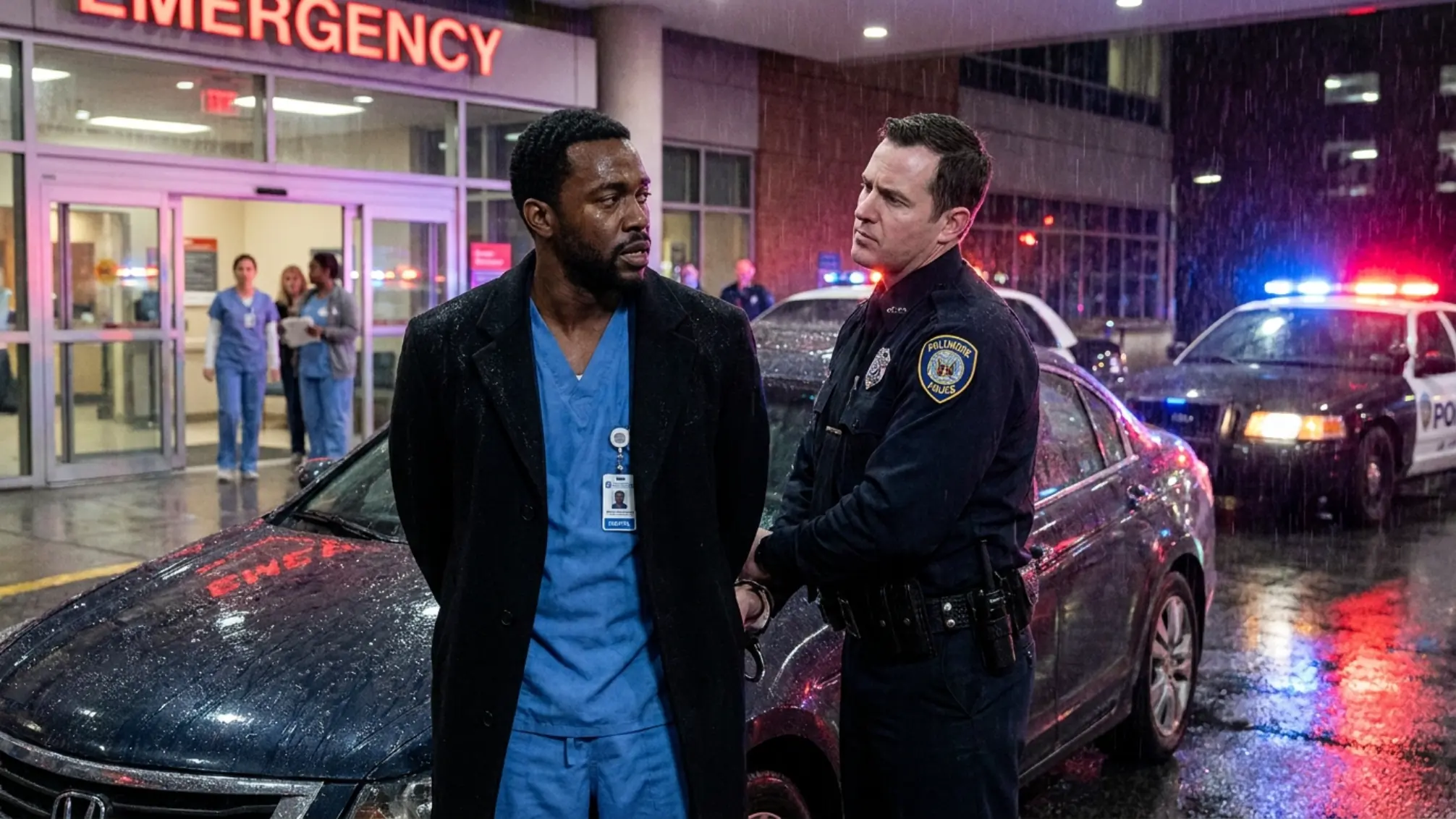
Nathaniel turned his head just enough to look directly at him. “Keep wasting time and you won’t be explaining this to me—you’ll be explaining why your chief’s wife never reached surgery.” Price’s hand stopped for half a second, but pride quickly hardened his face again. “What did you just say?”
Nathaniel had been called back to Maryland Central Medical Center seventeen minutes earlier while driving home after a fourteen-hour shift. A 52-year-old woman had arrived in the emergency department after suddenly collapsing at a restaurant, and imaging revealed a rapidly expanding intracranial hemorrhage pressing dangerously against the brainstem. The neurosurgeon already inside the hospital was trapped in another emergency procedure, leaving Nathaniel, one of the region’s most experienced trauma and vascular surgeons, as the closest specialist credentialed to perform the intervention. The emergency department had called him three times while he raced through the rain.
He knew only the patient’s name when the call came: Rebecca Lawson. Nobody mentioned that her husband was Baltimore Police Chief Michael Lawson because that information had absolutely nothing to do with how Nathaniel treated patients. Rebecca was simply a critically ill woman whose condition could become irreversible if surgeons failed to relieve the pressure quickly enough. Nathaniel had driven toward the hospital calculating minutes rather than miles.
The emergency entrance was clogged when he arrived. An ambulance occupied the usual physician-access lane, another vehicle was blocking the drop-off loop, and an accident victim had just been brought inside surrounded by paramedics. Nathaniel pulled his sedan partly across the curb beside the restricted medical entrance, activated his hazard lights, displayed his hospital placard on the dashboard, and immediately called the surgical coordinator to say he had arrived. He expected security to understand why emergency physicians occasionally parked badly during emergencies.
Officer Daniel Price saw only the car. Price had been completing paperwork inside his cruiser outside the hospital after transporting an assault victim when Nathaniel’s black sedan stopped abruptly near the curb. He watched the driver step out wearing an expensive-looking coat and polished shoes and immediately decided the man was another arrogant professional who believed hospital credentials allowed him to ignore traffic rules. Instead of checking the dashboard placard, Price opened his cruiser door and shouted for Nathaniel to stop.
Nathaniel heard him but kept moving toward the hospital entrance. “Doctor!” a nurse called from behind the automatic doors, recognizing him through the glass. Nathaniel raised one hand to acknowledge her and shouted that he was coming. Before he reached the entrance, Price caught his arm.
“I told you to stop.”
Nathaniel turned. “Officer, I have an emergency surgery upstairs.”
“Then you should’ve parked legally.”
“I’ll move the car after the patient is stabilized.”
“No. You’ll move it now.”
Nathaniel looked toward the hospital doors. “I don’t have time.”
Price’s expression sharpened. “You have time when a police officer tells you that you have time.” Nathaniel stared at him for a moment, trying to understand whether the man truly comprehended what he was saying. “There is a patient upstairs with increasing intracranial pressure. Every minute matters.”
Price folded his arms. “Everybody has an excuse.”
Nathaniel pulled his hospital badge forward. “Dr. Nathaniel Carter. Trauma surgery. Call the hospital if you need confirmation.” Price glanced at the badge but did not take it. “I’ve seen fake IDs before.”
Nathaniel’s phone rang again.
He looked at the screen.
OPERATING ROOM 4.
He tried answering.
Price grabbed the phone from his hand.
Nathaniel’s expression changed instantly. “Give me the phone.”
“You can make calls after we straighten this out.”
“That call is from my operating room.”
“You’re making this worse.”
“No, Officer. You are.”
Price stepped closer. “Watch your tone.”
Nathaniel almost laughed from disbelief. Somewhere above them, a woman’s life was being measured in minutes, yet the officer was discussing tone. Nathaniel looked through the glass entrance and saw two nurses standing inside, clearly alarmed.
One nurse pushed through the door.
“Dr. Carter!”
Price immediately raised one hand. “Stay back.”
The nurse froze.
“He’s needed upstairs right now.”
“I’m handling something.”
“He’s the surgeon.”
Price looked toward Nathaniel, then back toward the nurse. “He says that.”
The nurse stared at him. “I work here. I’m telling you.”
Nathaniel’s phone rang again in Price’s hand.
The officer silenced it.
That was the moment Nathaniel realized reason alone might not end the encounter.
“Officer, listen carefully.” Nathaniel lowered his voice instead of raising it. “You have my hospital identification. You have a nurse confirming my identity. You have a hospital emergency entrance behind you. If you need to issue a parking citation, issue it. If you need my registration, take it. But if you physically prevent me from reaching that patient, your decisions from this moment forward are going to be documented.”
Price’s face reddened.
“You threatening me?”
“No.”
“Sounded like one.”
“It’s a warning about consequences.”
Price reached toward Nathaniel’s arm again. “Turn around.”
The nurse gasped.
Nathaniel did not move.
“Am I under arrest?”
“You’re being detained.”
“For parking?”
“For refusing lawful commands.”
Nathaniel finally looked angry. “Your command is preventing emergency medical care.”
Price grabbed his wrist.
Nathaniel let him.
Resistance would only make everything worse.
The first handcuff clicked closed.
Rain ran down Nathaniel’s face while Price pulled his other arm backward. That was when Nathaniel said the sentence that finally introduced Rebecca Lawson into the encounter. “Sorry, but the woman upstairs has only a few minutes left.”
Price answered with contempt.
“Save the doctor act—you parked like the rules don’t apply to you.”
Nathaniel looked directly at him.
“Keep wasting time and you won’t be explaining this to me—you’ll be explaining why your chief’s wife never reached surgery.”
Price froze.
“What did you just say?”
“Rebecca Lawson.”
The officer’s face changed slightly.
Nathaniel continued.
“Fifty-two. Intracranial hemorrhage. Emergency OR Four.”
Price stared.
“That name supposed to scare me?”
“No.”
“Then why mention the chief?”
“Because you seem incapable of understanding that a patient matters unless she is connected to somebody you respect.”
That sentence hit harder than Nathaniel intended.
Price’s jaw tightened.
“You’re going in.”
“For what?”
“Obstruction.”
The nurse behind them shouted, “This is insane!”
Price pointed toward her. “Go inside.”
She did not.
Instead, she reached for her phone.
Nathaniel saw her begin recording.
A second officer arrived moments later. Officer Rachel Moore stepped from her cruiser and immediately noticed the unusual scene: a physician in scrubs handcuffed outside the emergency entrance while hospital employees gathered behind glass. “What happened?”
Price answered quickly. “Guy abandoned his vehicle in a restricted zone and refused instructions.”
Moore looked at Nathaniel’s badge. “He works here?”
“He claims he does.”
The nurse shouted, “He does!”
Moore turned toward Price.
“Did you verify?”
Price looked irritated. “I’m doing that.”
Nathaniel’s phone began ringing again.
Moore looked toward the device in Price’s hand.
“Whose phone is that?”
“His.”
“Why do you have it?”
Price did not answer.
Moore took the phone and looked at the screen.
OR 4 — EMERGENCY.
She immediately handed it toward Nathaniel before realizing his hands were cuffed.
Nathaniel said, “Answer it.”
Moore did.
“This is Officer Moore.”
A woman’s voice exploded through the speaker loudly enough that everyone nearby could hear.
“Where is Dr. Carter?”
Moore looked at Price.
“He’s outside.”
“Outside where?”
“The emergency entrance.”
“Get him upstairs now. Her pressure is rising.”
Moore’s expression changed.
“Who is this?”
“Dr. Elena Hayes, surgical director. Whoever is keeping Nathaniel outside is interfering with an active emergency procedure.”
Price stepped forward. “Give me the phone.”
Moore pulled it away.
“No.”
He stared at her.
“What?”
She looked at Nathaniel’s cuffs.
“Take those off.”
Price’s face hardened. “This is my detention.”
Moore stepped closer. “And it’s wrong.”
For several seconds, neither officer moved.
Then the hospital doors opened violently.
A tall white man in a soaked dress shirt rushed through them with two hospital administrators behind him. He looked fifty-five, his face pale and terrified, and his movements had none of the controlled confidence normally associated with senior command.
Michael Lawson did not look like the police chief.
He looked like a husband whose wife might die.
“Where is Dr. Carter?”
Everyone stopped.
Nathaniel raised his cuffed hands slightly.
Lawson looked at him.
Then at Price.
Then back at Nathaniel.
“What the hell is happening?”
Price’s face lost color.
“Chief?”
Lawson walked closer. “Why is the surgeon who is supposed to be operating on Rebecca standing outside in handcuffs?”
Price began explaining. “Sir, he illegally parked and became noncompliant.”
Lawson stared as though he had spoken another language.
“Noncompliant?”
Nathaniel interrupted.
“Chief, we can discuss this later. Your wife needs surgery.”
Lawson looked at Price.
“Take them off.”
Price hesitated.
“Sir—”
“Now.”
The cuffs opened.
Nathaniel rubbed one wrist once, then immediately turned toward the hospital.
Lawson followed him.
Nathaniel stopped at the doors and looked back toward Moore. “My phone.”
She tossed it carefully.
He caught it.
Then he disappeared inside.
No speech.
No victory.
No demand for apology.
Rebecca mattered more.
Nathaniel changed into sterile operating clothes while running through imaging with Dr. Hayes. The hemorrhage had expanded since the original scan, creating dangerous pressure around structures controlling breathing and cardiovascular function. Her pupils were beginning to respond asymmetrically. The surgical team understood that the delay had cost time they did not have.
Nathaniel entered OR Four.
Rebecca Lawson was already anesthetized.
He positioned himself beneath the lights.
“Let’s go.”
For the next three hours, nothing outside the operating room mattered.
Not Officer Price.
Not the handcuffs.
Not the rain.
Not the police chief.
Nathaniel focused entirely on bleeding vessels, pressure, damaged tissue, and the narrow difference between intervention and catastrophe.
Outside, Michael Lawson sat beside his adult daughter Emily.
He had spent thirty years in policing and had stood beside families waiting for terrible news more times than he could count. None of that experience prepared him for waiting behind operating-room doors while his own wife’s life depended on the man one of his officers had just arrested. Every minute felt like punishment.
Price remained outside the hospital.
He had been ordered back to headquarters.
Moore stayed long enough to provide a preliminary statement.
Lawson did not personally order Price suspended.
He knew he was too emotionally connected to the incident.
Instead, he called Deputy Chief Evelyn Grant.
“I need you to take control of this.”
Grant understood immediately.
“You’re recusing?”
“Yes.”
“Completely?”
“Completely.”
Lawson looked toward the operating-room doors.
“My wife is in there because of this. I shouldn’t decide anything involving that officer.”
Grant promised an independent internal investigation would begin before sunrise.
Four hours after Nathaniel entered surgery, the operating-room doors opened.
Lawson stood so quickly his chair scraped backward.
Nathaniel walked toward him still wearing surgical scrubs.
There was dried exhaustion around his eyes.
Lawson could barely speak.
“My wife?”
Nathaniel removed his cap.
“She’s alive.”
Emily covered her mouth.
Lawson closed his eyes.
Nathaniel continued.
“We controlled the bleeding and relieved the pressure. There was significant compression, but she responded well once pressure came down.”
“Brain damage?”
“Too early to know.”
Lawson nodded.
Nathaniel looked at him directly.
“The next twenty-four hours matter.”
Lawson extended his hand.
Nathaniel shook it.
“Thank you.”
“You don’t owe me thanks for doing my job.”
Lawson’s expression changed.
“I owe you something.”
Nathaniel knew exactly what he meant.
“Not tonight.”
“But—”
“Tonight you go sit beside your wife.”
Lawson lowered his eyes.
Nathaniel walked away.
He had been awake nearly twenty-two hours.
Before leaving the hospital, he photographed the redness around his wrists.
Then he wrote down everything he remembered.
Price’s first command.
The confiscated phone.
The nurse’s confirmation.
The handcuffs.
The time.
Every sentence.
Nathaniel had worked too many trauma cases involving conflicting recollections to trust memory alone.
The internal investigation began with video.
Hospital cameras covered nearly the entire emergency entrance.
Price’s body camera captured everything else.
Investigators watched Nathaniel display his hospital badge.
They heard the nurse confirm he was the surgeon.
They watched Price take his phone.
They heard the OR call repeatedly.
Then they watched Price handcuff him anyway.
Deputy Chief Grant stopped the recording.
“Play the nurse part again.”
The investigator replayed it.
He’s the surgeon.
Price answered:
He says that.
Grant watched twice.
Then came the radio logs.
Price had never requested credential verification before applying handcuffs.
His written report claimed Nathaniel attempted to walk away after being ordered to stop.
Video showed Nathaniel repeatedly explaining the emergency and offering identification.
His report said Nathaniel became aggressive.
No recording supported that description.
The review expanded.
Price had eight previous complaints involving unnecessary escalation.
Most had been closed.
One involved a Black attorney detained outside his own office after Price questioned whether he belonged there.
Another involved an Asian pharmacist accused of using a fraudulent professional badge that was later confirmed legitimate.
A third involved a Latino business owner stopped while unlocking his own restaurant after midnight.
Each incident alone had been described as a judgment error.
Together, they looked different.
Grant requested every supervisory review.
She discovered the same phrases repeated.
Officer acted within reasonable discretion.
Communication issue.
No evidence of intentional misconduct.
Training recommended.
The training had happened.
The behavior had not changed.
Chief Lawson learned only limited information.
He refused detailed briefings.
Rebecca remained hospitalized.
She regained consciousness the following afternoon.
Lawson sat beside her when her eyes opened.
“You look terrible,” she whispered.
He laughed and cried at the same time.
“So do you.”
She tried smiling.
Then she asked the first question Lawson expected.
“What happened?”
He held her hand.
“You got sick.”
“I know that.”
Her speech remained weak.
“How bad?”
“Bad.”
She looked toward the door.
“Doctor?”
“Carter saved you.”
Rebecca closed her eyes.
Lawson waited.
Then she whispered, “Thank him.”
“I did.”
She squeezed his hand.
“Again.”
Lawson smiled.
“I will.”
Nathaniel visited two days later.
Rebecca was sitting upright with assistance.
She remembered nothing after collapsing.
Lawson stood near the window while Nathaniel explained the surgery and recovery plan.
Rebecca listened carefully.
When he finished, she looked toward his wrists.
The redness had faded but remained visible.
“What happened to you?”
The room became quiet.
Lawson answered.
“One of my officers arrested him outside.”
Rebecca stared at her husband.
“What?”
Nathaniel immediately redirected.
“That’s being handled separately.”
Rebecca looked furious.
“He arrested the surgeon coming to save me?”
Nathaniel nodded once.
Rebecca turned toward Lawson.
“Michael.”
“I recused myself.”
“Good.”
She looked back toward Nathaniel.
“I’m sorry.”
Nathaniel shook his head.
“You weren’t responsible.”
“No.”
Rebecca’s voice remained weak but firm.
“But somebody wearing my husband’s badge was.”
That sentence stayed with Lawson.
Three weeks later, Price faced an internal interview.
His attorney accompanied him.
Price argued that he could not simply accept anyone claiming to be a physician during a police encounter.
Grant agreed.
Then she asked the obvious question.
“What evidence would have satisfied you?”
Price hesitated.
“A verified hospital credential.”
“He displayed one.”
“It could’ve been fake.”
“A hospital employee identified him.”
“She could’ve been mistaken.”
“His phone showed repeated calls from the operating room.”
“That didn’t prove anything.”
Grant leaned forward.
“The police chief arrived and identified the patient.”
Price looked away.
“That happened later.”
Grant nodded.
“So again: what would have satisfied you before the arrest?”
Price had no answer.
That was the central failure.
Nothing Nathaniel produced had been allowed to correct Price’s initial assumption.
Evidence did not guide the suspicion.
Suspicion filtered the evidence.
Grant’s report sustained allegations of improper detention, unnecessary arrest, seizure of property without justification, interference with emergency medical activity, inaccurate reporting, and failure to properly evaluate readily available exculpatory information.
Price was suspended pending final disciplinary proceedings.
The investigation into supervisors produced its own consequences.
Two sergeants were disciplined for previously approving incomplete complaint reviews.
A lieutenant was removed from direct supervisory duty.
The department created an automatic pattern review for officers accumulating repeated complaints involving professional credentials or questionable detention escalation.
Nathaniel filed a civil claim.
He did not seek millions.
His attorney asked why.
Nathaniel answered simply.
“I want policy change more than headlines.”
The eventual settlement covered damages, legal expenses, mandatory training changes, and an independent review of the department’s detention practices around hospitals and emergency personnel.
Price ultimately lost his position.
Not because Rebecca Lawson happened to be the police chief’s wife.
Chief Lawson insisted on making that distinction publicly.
At a press conference months later, a reporter asked whether the result would have been different if the patient had been an ordinary citizen.
Lawson paused.
Then he answered.
“If it would have been different, we have a bigger problem.”
The room became quiet.
“The officer did not make his worst mistake because he delayed care for my wife.”
Lawson looked toward the cameras.
“He made his worst mistake when he decided a Black physician’s identification, hospital badge, emergency call, and colleague’s verification were all less trustworthy than his own first impression.”
That sentence appeared in newspapers the next morning.
Rebecca eventually recovered enough to return home.
She had mild weakness in one hand and underwent months of therapy, but neurologists expected substantial recovery.
Nathaniel saw her several times during follow-up appointments.
On her final scheduled visit, she handed him a small envelope.
He opened it after she left.
Inside was a handwritten note.
You saved my life before you knew my name mattered to anyone. That is the part I will never forget.
Nathaniel kept the note.
Not because Rebecca was the chief’s wife.
Because she understood.
Months later, Nathaniel walked through the same emergency entrance on another rainy night.
A police cruiser was parked outside.
For one brief moment, his body tightened.
Then Officer Rachel Moore stepped from the vehicle.
They recognized each other.
She walked over.
“Doctor.”
“Officer.”
Moore looked uncomfortable.
“I should’ve challenged him sooner.”
Nathaniel nodded.
“Yes.”
No reassurance.
No easy absolution.
Moore accepted it.
“I do now.”
Nathaniel looked at her.
“What?”
“Challenge things sooner.”
He smiled slightly.
“Good.”
A trauma pager sounded from his pocket.
Nathaniel checked it.
“Duty calls.”
Moore stepped aside immediately.
“Go.”
Nathaniel walked through the doors.
That single word represented everything Price had failed to understand.
Go.
A doctor says there is a patient dying upstairs.
Verify quickly if necessary.
Then let him go.
A hospital badge should not need a famous patient behind it.
A surgeon should not need the police chief’s wife on the table before urgency becomes believable.
Nathaniel Carter had been telling the truth before Michael Lawson appeared.
The emergency existed before Price knew the patient’s identity.
Rebecca’s life mattered before anyone said who her husband was.
That was the lesson Lawson ultimately carried back into his department.
The twist was never that Officer Price arrested the doctor who was supposed to save the police chief’s wife.
The real failure was that he believed Nathaniel required somebody important behind those hospital doors before his words deserved to be trusted.
Rebecca happened to be important to the police chief.
But every patient was important to somebody.
And on that rainy night outside Maryland Central Medical Center, one officer came dangerously close to learning that lesson only after it was too late.