“Save the attitude—you’re caught, and I’m done listening to excuses.”
Officer Brent Lawson’s finger stopped inches from Simone Carter’s face.
Around them, the bright central atrium of Atlanta’s Lenox Crown Mall had transformed into an audience. Shoppers stood near polished railings with phones raised, store employees crowded beside the luxury boutiques, and people on the second floor leaned over the glass balcony to watch two uniformed officers detain a beautiful Black woman in gray joggers and a burgundy crop top.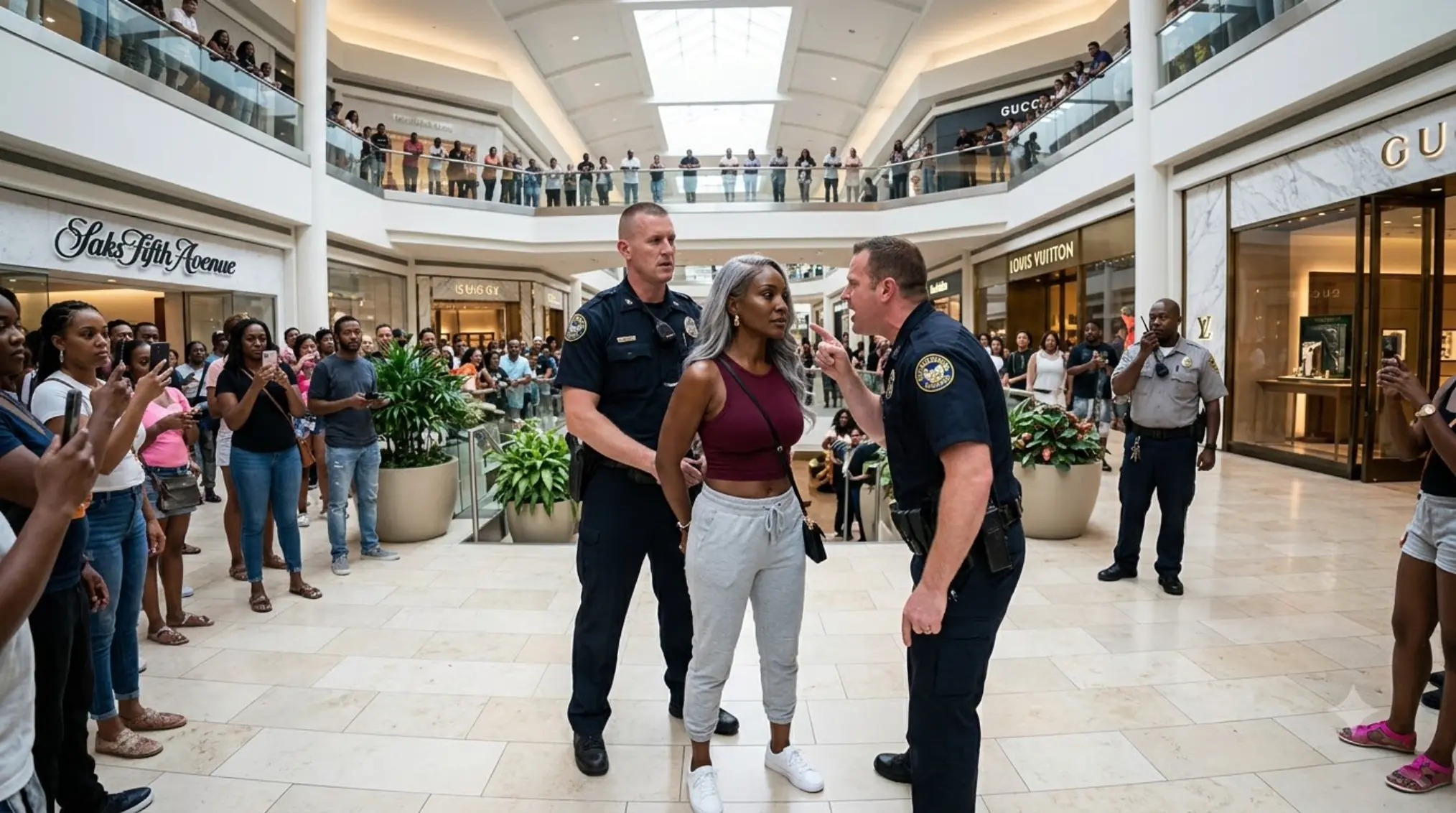
Simone stood perfectly still.
Her long silver-gray hair fell in loose waves over her shoulders, and the thin black strap of her crossbody bag rested diagonally across her chest. Her wrists were already pulled behind her back, where Officer Caleb Warren held them while Lawson continued speaking as though volume could replace evidence.
Simone looked directly into Lawson’s eyes.
“Then check the receipt and security footage before you embarrass yourself any further.”
Lawson’s face hardened.
“You don’t tell cops how to investigate. Keep talking and I’ll add resisting.”
Simone almost smiled.
Almost.
Instead, she said quietly, “Go ahead—then open my wallet and explain why you just handcuffed your own captain in front of half the mall.”
The words did not immediately register.
Lawson blinked.
Behind Simone, Warren’s grip changed.
“What?”
Simone did not repeat herself.
For thirty-eight seconds, nobody moved.
Then Warren said, “Captain?”
Simone turned her head slightly.
“You heard me.”
Lawson looked at Warren.
Then back at Simone.
“No.”
She raised an eyebrow.
“No?”
“You’re not a police captain.”
There was something almost fascinating about his certainty.
Simone had spent twenty-one years inside law enforcement, twelve of them supervising officers, and five as captain of the department’s Professional Standards and Community Response Division. She had watched people make terrible decisions under stress, fear, pride, and confusion.
But certainty without evidence was the one she feared most.
It allowed people to stop checking themselves.
“Open my wallet,” she said.
Lawson stared.
“It’s in the crossbody bag.”
“You’re saying your badge is in there?”
“Yes.”
“Department?”
“Atlanta Metropolitan.”
Lawson’s expression shifted.
Only slightly.
The department patch on his shoulder carried the same name.
Warren released one of Simone’s wrists, slowly reached toward her bag, then stopped.
“Captain, may I?”
“Yes.”
That word mattered.
Simone noticed that Warren finally asked.
He opened the zipper.
Inside were a phone, keys, lipstick, a folded receipt from Beaumont & Vale Jewelers, and a black leather credential wallet.
Warren removed it.
Opened it.
The gold command badge caught the mall lighting.
CAPTAIN SIMONE CARTER.
Below it sat her department identification.
Warren went pale.
Lawson did not.
For a second, his face seemed incapable of deciding what emotion to choose.
Surprise.
Fear.
Embarrassment.
Then pride won.
He pointed toward the badge.
“That doesn’t change what happened.”
Simone’s eyes sharpened.
“Good.”
Lawson clearly had not expected that answer.
She continued.
“It shouldn’t.”
The crowd remained silent.
Simone turned slightly toward Warren.
“Put my credential back.”
He did.
“Now,” she said, “either arrest me based on evidence or release me based on evidence.”
Lawson’s jaw tightened.
“You were identified by store security.”
“Then investigate.”
“We are.”
“No.”
Her voice remained quiet.
“You accused me first.”
That distinction seemed to embarrass him more than her rank.
Ten minutes earlier, Simone had not expected her Saturday afternoon to become an internal-affairs case.
She had come to the mall for one reason.
Her mother’s birthday.
Dr. Elaine Carter would turn seventy in three days, and despite Simone’s repeated requests, her mother refused to name anything she wanted.
“I have everything,” Elaine always said.
Simone considered that answer unacceptable.
So she went shopping.
She wore clothes chosen specifically because she was off duty.
Gray joggers.
White sneakers.
Burgundy sleeveless top.
Gold hoops.
No command uniform.
No department vehicle.
No assistant.
No radio.
For six hours, she wanted to be Simone Carter rather than Captain Carter.
She entered Beaumont & Vale just after two.
The boutique sold watches, jewelry, handbags, and accessories priced high enough that sales associates spoke about them in voices usually reserved for fragile objects.
A watch caught her attention.
Rose gold.
Simple face.
Leather strap.
Elegant without being flashy.
Her mother would hate the price.
Which made Simone like it more.
A sales associate named Kelsey helped her.
Simone tried on the watch.
Bought it.
The total came to $4,860 after tax.
She nearly changed her mind.
Then she remembered her mother paying Simone’s college application fees from money saved by skipping new clothes for two years.
She handed over her card.
Receipt.
Box.
Bag.
Done.
Simone left Beaumont & Vale and walked approximately forty yards before someone shouted:
“Ma’am!”
She turned.
A security employee hurried toward her.
Behind him came two mall security guards.
The first man pointed at the shopping bag.
“I need you to come back.”
Simone frowned.
“Why?”
“There’s an issue with merchandise.”
“What issue?”
“A watch is missing.”
Simone looked toward her bag.
“I purchased a watch.”
“We need to verify that.”
“Then verify it.”
The security employee, Miles Grant, held out his hand.
“Give me the bag.”
“No.”
His eyebrows rose.
“No?”
“You can inspect the receipt. You are not taking possession of my property until you explain what you’re alleging.”
That was when Miles made his first mistake.
He glanced toward the crowd forming nearby and said:
“We can do this quietly if you cooperate.”
Simone heard the implication immediately.
Quietly.
As though she had something to hide.
“Was I seen stealing?”
Miles hesitated.
“A staff member saw suspicious behavior.”
“What behavior?”
“You were handling merchandise.”
“In a jewelry store.”
“You were observed near an unsecured display.”
“Which display?”
Miles did not answer.
Simone asked again.
“Which display?”
Instead, he told one mall guard to call police.
Simone could have displayed her credentials then.
It would have ended everything quickly.
That was exactly why she did not.
Her department had received repeated community complaints about how officers handled shoplifting calls at large retail centers.
Most complaints involved one central issue.
Officers arrived.
Accepted store-security statements as facts.
Then treated the customer as a suspect before reviewing objective evidence.
Simone had spent months telling patrol supervisors that the department had to stop outsourcing probable cause to private security employees.
Now she was standing inside the exact situation they had discussed.
And nobody knew her rank.
She decided to observe.
Officer Caleb Warren arrived first.
Thirty-one.
Seven years on the department.
Generally solid evaluations.
Simone recognized the name but not the face.
Lawson arrived two minutes later.
Forty-two.
Eleven years of service.
Three citizen complaints during the previous eighteen months.
None sustained.
Simone recognized his personnel history immediately because one complaint had crossed her division.
Lawson approached Miles first.
Not Simone.
That bothered her.
They spoke for approximately one minute.
Then Lawson walked toward Simone and said:
“Give me the stolen merchandise.”
Not:
Can you tell me what happened?
Not:
May I see your receipt?
Not:
The store reported an issue.
Give me the stolen merchandise.
Simone answered:
“I don’t have stolen merchandise.”
Lawson looked toward her shopping bag.
“Security says you do.”
“Security is wrong.”
“Everybody says that.”
Warren stood slightly behind him.
Simone removed the paper receipt from her bag.
“Here.”
Lawson barely looked at it.
Instead, he asked:
“Where’s the watch?”
“In the box.”
“Open it.”
She opened the shopping bag.
Removed the box.
Opened it.
Rose-gold watch.
Lawson looked toward Miles.
“That it?”
Miles said:
“The missing watch is rose gold.”
Simone looked between them.
“You haven’t even checked the model number?”
Lawson ignored her.
He took the receipt.
The printed item code was visible.
So was the purchase time.
2:11 p.m.
Simone checked the mall clock.
2:24.
Thirteen minutes.
She said:
“Compare the receipt code with the watch.”
Lawson looked irritated.
“Stop directing the investigation.”