Sergeant Rick Dobson thought he was merely forcing a stubborn old man and his dog out of a roadside diner. He ignored the warnings, laughed at the medals on the German Shepherd's collar, and pulled out his handcuffs to arrest the elderly veteran.
What he did not know was that the quiet man before him was Vice Admiral William "Bill" Thornton, call sign Hawkeye, a special warfare legend. 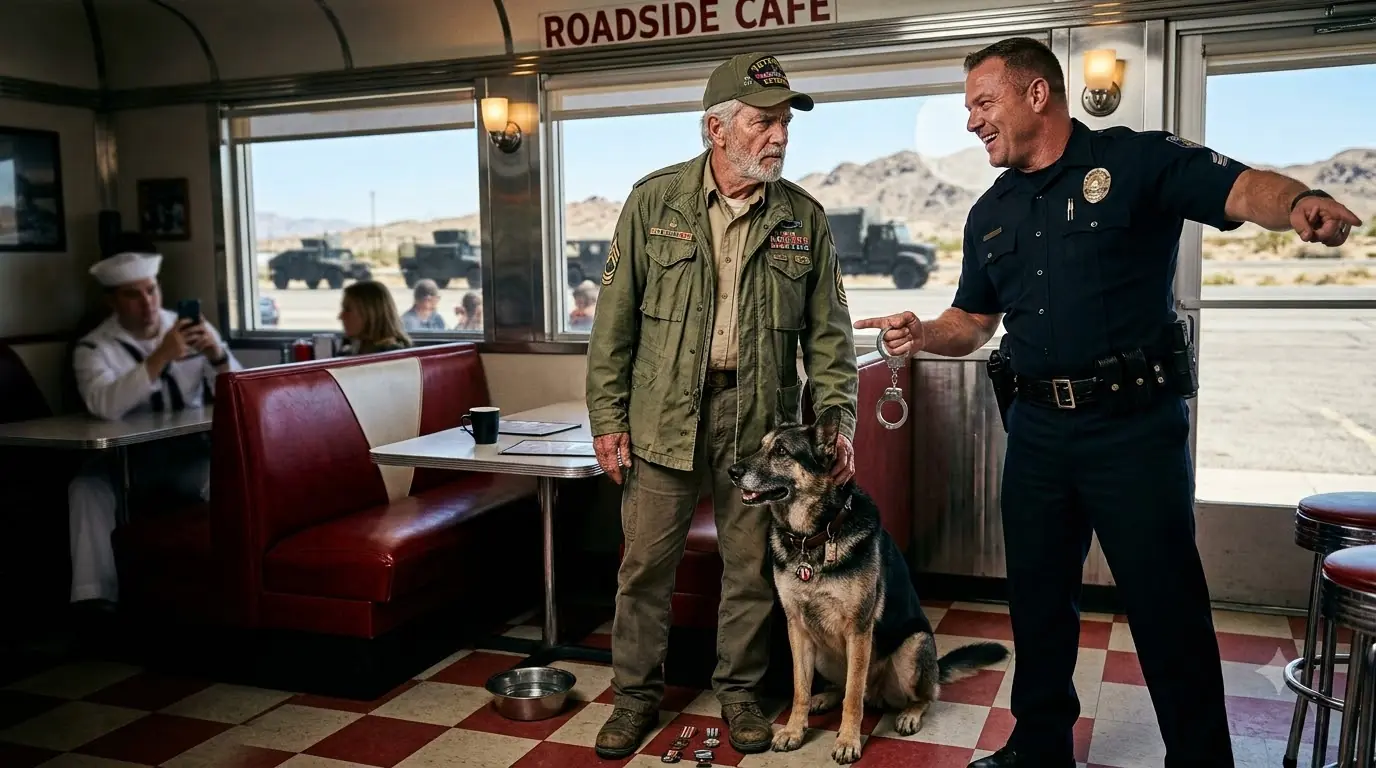
By the time Dobson understood his mistake, military vehicles had surrounded the diner and fifty sailors were standing in formation outside.
The Route 66 Diner sat beside a stretch of California highway that time had mostly forgotten. Chrome gleamed beneath fluorescent lights, and the scent of coffee and bacon grease seemed permanently embedded in the walls.
Bill Thornton pulled his aging Ford pickup into the gravel lot, and the truck's engine ticked as it cooled beneath the desert sun. Beside him in the passenger seat, Rex lifted his head, ears forward and dark eyes alert.
"Easy, boy," Bill said quietly, his voice roughened by age and years of shouting orders over helicopter rotors and gunfire. "We're just getting some lunch."
Rex was an eleven-year-old German Shepherd whose muzzle had begun to gray, though his posture remained proud. He wore a collar with a metal plate reading, "Military Working Dog, U.S. Navy, Retired."
Mixed among Rex's identification tags were Bill's own dog tags from four decades earlier, the metal worn smooth by time. They had served together in Afghanistan and saved one another more times than Bill cared to count.
Bill moved with the careful economy of someone carrying old injuries that had never healed properly. Rex matched his pace exactly, just as he had since Bill adopted him after retirement eight years earlier.
The dog never pulled ahead and never lagged behind. They crossed the parking lot together and entered when the bell above the door chimed.
It was midafternoon, well past the lunch rush, and only a handful of customers occupied the red vinyl booths. A waitress in a retro uniform looked up and smiled.
A young man in civilian clothes sat in a corner booth nursing coffee, though his regulation haircut immediately caught Bill's attention. At the counter, two police officers in dark blue uniforms turned to study the newcomers.
Bill chose a booth near the window and slid onto the vinyl seat. Rex settled at his feet, placed his head on his paws, and became perfectly still. The waitress approached with a menu and a glass of water. Her name tag read Linda.
"Welcome to the Route 66 Diner," she said warmly. "Can I get you something to drink?"
Linda glanced at Rex, noticed the collar, and smiled more broadly. "Of course. Thank you for your service, both of you."
Bill nodded, as uncomfortable with gratitude as he had always been. "We were just doing our jobs, ma'am."
Linda returned with coffee and a bowl of water, setting it carefully on the floor. Rex did not move until Bill gave a subtle hand signal. Then he raised his head and drank with dignified restraint. Bill opened the menu while the highway shimmered through the window beneath the afternoon heat.
He was three days into a drive from Virginia to San Diego, taking his time and stopping whenever he felt like it. At his age, there was no reason to rush.
He had nowhere he was required to be except wherever he happened to be. That freedom still felt unfamiliar after a lifetime spent measuring every hour against a mission.
Bill heard the footsteps before he saw the man approaching. Leather creaked, equipment jingled, and heavy shoes struck the linoleum with deliberate force.
He did not look up immediately because he had spent enough time around armed men to recognize the sound. When the footsteps stopped beside the booth, a flat voice addressed him.
"Excuse me, sir. We don't allow dogs in here."
Bill looked up. The officer was in his mid-forties, thick around the middle, with a uniform pulled tight across his stomach. His name tag read Dobson, and the stripes identified him as a sergeant. Behind him stood a younger officer named Kyle, watching with the weary expression of someone who had witnessed this routine before.
"He's a service animal and a retired military working dog," Bill said evenly. "He's permitted to be here."
Dobson's eyes moved briefly toward Rex before returning to Bill. "Federal law doesn't mean much in my town, old man. We have local ordinances. No animals in food service establishments, so take the dog outside or leave."
Something tightened in Bill's chest, but his voice remained controlled. "I've been traveling for three days. We only want lunch, and then we'll be on our way. Rex won't cause any trouble."
Kyle tried to sound reasonable, though his tone landed closer to condescension. "Look, we understand that you're attached to the dog. Maybe you bought him one of those service tags online, but we can't let everyone with a pet claim it's a service animal. Health regulations are serious."
Bill's jaw hardened. "He is not a pet. He completed eight years of active service and has more decorations than many service members."
Dobson gave a short, dismissive laugh. "Sure he does, and I'm the chief of police."
He leaned closer, resting one hand near the handcuffs on his belt. "Here's what's going to happen. You're going to take your dog, get in your truck, and leave my town. If you refuse, I'll cite you for disorderly conduct, and if you give me any more trouble, I'll arrest you for resisting."
The diner had become quiet. The remaining customers watched with visible discomfort, but none stepped forward. The young man in the corner booth lowered his coffee and began moving his thumb across his phone. B
ill studied Dobson for a long moment, measuring him with the same calm attention he once gave a dangerous battlefield.
He had met men like Dobson before. They wore authority like a weapon and needed others to feel small so they could feel powerful. They had never served anything larger than their own ego. Bill had no interest in humiliating the man, but he would not surrender Rex to satisfy that hunger for control.
"I'm not looking for trouble, Sergeant," Bill said quietly. "I came in for lunch."
"Too late for that."
Dobson reached down and grabbed Rex's collar, yanking upward. Rex's lips pulled back as a low warning growl rolled from his chest. Dobson jerked his hand away, his face flushing with anger.
"Now the dog's aggressive," he snapped. "That's grounds for seizure. Kyle, call animal control."
Bill placed his hand gently on Rex's head, and the dog immediately became silent, though his gaze never left Dobson. "Easy," Bill murmured. "Stand down."
Dobson's hand shifted toward his service weapon. "Sir, stand up. You and the animal are both being detained."
Bill remained seated. "Sergeant, you're making a serious mistake."
"The only mistake here is yours."
Dobson pulled out his handcuffs, and the metal clicked together in his hand. "Last chance. Stand up and place your hands behind your back, or this gets much worse for you."
The sound of the cuffs dragged Bill backward through time. The checkered linoleum blurred into a dusty Afghan road, and the fluorescent lights became the harsh glare of a foreign sun. Coffee and bacon disappeared beneath the remembered scent of diesel, dirt, and explosives. Bill was younger again, wearing combat gear with the weight of command on his shoulders.
The year was 2011, and his team was moving through Helmand Province. Rex was four years old, powerful and alert, serving as a dual-purpose patrol and explosives detection dog. He had been assigned to Bill's unit after his previous handler was killed by an improvised explosive device. Rex had stood over that man's body until the extraction team arrived.
Some operators believed the dog had become too damaged, too aggressive, and too unpredictable to continue. Bill saw something else in him. He saw intelligence, discipline, and a loyalty so complete that Rex would die before allowing the same failure to happen again. Bill had begun working with him personally, and trust grew between them one mission at a time.
"Hawkeye, this is Overwatch," a voice crackled in Bill's earpiece. "We're tracking multiple heat signatures inside the compound ahead. Recommend holding position for air support."
Bill keyed his radio. "Negative, Overwatch. We have a civilian hostage inside that compound, an American contractor captured seventy-two hours ago. If we wait, he may not survive."
"Sir, the rules of engagement require authorization."
"I know the rules," Bill answered. "I also know that man has a family waiting in Ohio. We're not leaving him while paperwork decides whether we can do our jobs."
Bill signaled his six-man SEAL team forward. They moved in a tactical column with Rex slightly ahead, his nose working the air and his ears processing sounds beyond human range. They were fifty meters from the compound when Rex froze so suddenly that the entire formation stopped with him. His body went rigid, his nose pointed toward the ground, and one paw lifted in a classic alert.
Bill raised a closed fist and dropped beside him. "Possible IED. Rex has contact."
He followed the dog's focus toward a patch of disturbed earth that appeared no different from the ground around it. Trusting Rex more than his own eyes, Bill worked a probe carefully into the soil until it touched metal several inches below the surface. An explosives technician moved forward and spent twenty tense minutes neutralizing a pressure-plate device packed with enough explosive material to devastate the patrol.
When the device was safe, the technician looked at Rex with open astonishment. "That dog just saved every one of us."
Bill scratched behind Rex's ears and felt him lean into the touch. "He does it every day. Most decorated member of the unit, and he doesn't even know what a medal is."
The team approached the compound from another direction. The hostage rescue was fast, violent, and efficient. They extracted the American contractor and three Afghan nationals who had been assisting coalition forces. During the exfiltration, enemy fighters opened fire from a tree line and forced the team toward cover.
A round struck Bill in the side, penetrating his protective gear and knocking him down. He rolled behind a wall, struggling to breathe through the pain as blood spread across his uniform. Rex reached him immediately and placed his own body between Bill and the incoming fire. Teeth bared, the dog stood like a living shield, ready to absorb whatever came next.
The team returned fire while a corpsman pulled Bill behind the mud wall and treated the wound. "You're going to be fine, sir," the corpsman said. "The round passed through and missed anything vital."
Bill barely heard him. His eyes remained on Rex, who had followed and resumed his protective position. "Good boy," Bill managed through the pain. "Good boy, Rex."
Later, after the medevac, surgery, and awards ceremony, Bill sat beside Rex in a recovery tent. Rex had received another commendation for valor, and Bill had received another Purple Heart. Bill rested one hand on the dog's head while Rex watched him without blinking.
"You saved my life again today," Bill said. "I don't know how many times that makes, but I'm keeping count. When your service is over, and they decide you're too old or too damaged to continue, I'm going to be there. I'm adopting you, and we're going home together. That's a promise."
Rex's tail struck the ground once. Nine years collapsed into that single sound, and the Afghan dust dissolved into the cool air of the diner. Gunfire became the clink of silverware, and Bill found himself staring at Sergeant Dobson's handcuffs. The officer was still standing over him, red-faced and impatient.
"Sir, for the last time, stand up."
Bill looked at him, and something in his eyes made Dobson take an involuntary step backward. Before either man could move again, the young customer in the corner booth stood with his phone still in his hand. His posture and haircut made his identity unmistakable even before he spoke.
"Officer, do you know who you're arresting?"
Dobson turned toward him. "This doesn't concern you, son. Sit down."
The young man remained standing. "I'm Petty Officer Second Class Marcus Webb, United States Navy, stationed at Naval Base San Diego. The man you're about to handcuff is Vice Admiral William Thornton, retired, call sign Hawkeye. He commanded Naval Special Warfare Command for six years, and that dog saved more American lives than you've probably met in your entire career."
Confusion moved across Dobson's face, followed by doubt and then defensive anger. "I don't care if he's the president. He's violating local ordinances."
Webb raised his phone. "I sent a message to my commanding officer. It's already moving up the chain. You should reconsider what you're doing because this situation is about to become very complicated."
Dobson's hand shifted toward his weapon. "Are you threatening me, sailor?"
"I'm advising you. There's a difference."
Bill rose slowly with both hands visible. "Sergeant Dobson, I'm asking one more time. Let Rex and me finish our lunch, and we'll leave. No one needs to escalate this."
Dobson's expression hardened. "I think we're past that."
He seized Bill's arm and tried to spin him toward the wall. "Hands behind your back. Now."
Rex surged to his feet, and a single bark exploded through the diner. It was not the frantic sound of an uncontrolled pet. It was the sharp command of a dog trained for combat. Dobson jumped back with one hand reaching for his gun.
"Rex, heel," Bill ordered.
The dog immediately returned to Bill's side and sat at attention. His body was controlled, but his eyes remained fixed on Dobson. Even Kyle looked shaken by the speed of the response.
"That's it," Dobson said as he grabbed his radio. "Kyle, call for backup and get animal control here. I want this dog seized and this man placed in a cell."
Kyle lifted his own radio. "Dispatch, this is Unit Twelve. We need..."
A distant rumble interrupted him. The sound grew rapidly, heavy engines approaching in formation. Everyone in the diner turned toward the windows as a military convoy appeared on the highway.
Six Navy vans moved in formation behind two military police vehicles with their lights flashing. At the front was a black sedan carrying small admiral's flags on the hood. The vehicles entered the diner parking lot with precise coordination and stopped in a disciplined line. Doors opened almost simultaneously.
Fifty sailors stepped out and formed ranks in the gravel. Their faces were serious and their bearing immaculate. From the black sedan emerged a woman in Navy service khakis whose authority made Dobson's swagger look childish. Four silver stars gleamed on her collar.
Admiral Patricia Hayes, commander of Naval Base San Diego, crossed the parking lot while every sailor snapped to attention. She entered when the bell above the diner door chimed, and the room seemed to become colder. Her gaze swept over Bill, Rex, Dobson's handcuffs, and the uneasy witnesses.
Her expression softened briefly when she saw Bill. "Vice Admiral Thornton, sir. I apologize for the circumstances of this reunion."
Bill lowered his hands. "Admiral Hayes, I wasn't expecting to see you today."
"One of my sailors reported that local law enforcement was detaining you," she replied, gesturing toward Webb. "Given your service record and current status, I believed it warranted my personal attention."
She turned toward Dobson. "I'm Admiral Patricia Hayes. Who are you, and why are you detaining this man?"
Dobson had gone pale, but he tried to maintain his authority. "Sergeant Rick Dobson, ma'am. This man violated local ordinances by bringing an animal into a food service establishment. When I attempted to enforce the law, he became belligerent."
"Belligerent," Admiral Hayes repeated flatly. "Vice Admiral Thornton holds the Navy Cross, three Silver Stars, and five Purple Hearts. He commanded Naval Special Warfare forces and led more than two hundred combat operations. You are claiming he became belligerent because you ordered him to remove his retired military working dog from a diner."
"The dog isn't properly identified as..."
Admiral Hayes raised one hand and silenced him. She approached Rex, knelt beside him, and read the tags on his collar. Rex remained at attention, though his tail moved once in recognition.
"This is Rex," she said, looking toward Bill. "The military working dog credited with detecting forty-seven improvised explosive devices during eight years of service, and the dog who protected you during a hostage rescue in Helmand Province."
"That's him," Bill answered quietly.
Admiral Hayes stood and faced Dobson again. "Sergeant, this dog has more decorations than you have years in uniform. He is a veteran of the United States Navy, and the man you were about to arrest trained many of the officers now serving in naval special warfare."
She stepped closer, lowering her voice. "You will apologize to Vice Admiral Thornton. You will apologize for grabbing Rex. Then you will leave this diner and consider very carefully how you want the rest of your career to unfold. If you push this further, every abuse of authority and every questionable arrest connected to you will be referred for investigation. Do I make myself clear?"
Dobson's face had changed from red to white. His hand trembled as he lowered the cuffs. "I was only doing my job."
"No," Admiral Hayes replied. "You were abusing your authority. There is a difference."
She turned toward the customers. "Vice Admiral William Thornton, call sign Hawkeye, served this nation for forty years. He led personnel in combat from Vietnam through Desert Storm and the global war on terror. He earned his call sign because he could read a battlefield, identify threats before they emerged, and save lives through tactical judgment."
Her gaze returned to Dobson. "He never asked for recognition and never sought the spotlight. He performed his duty with honor and integrity, which is more than can be said for everyone wearing a badge in this town."
Admiral Hayes then looked back at Bill. "Sir, on behalf of the United States Navy and every sailor who served under your command, thank you. I also apologize that your retirement was disturbed by people who failed to understand what honor looks like."
Bill answered quietly. "Thank you, Admiral, but I didn't come here for recognition. I only wanted lunch."
A small smile appeared on her face. "Then you will have lunch. It is on me, and every sailor outside would be honored to stand watch while you eat."
"That isn't necessary."
"With respect, sir, it is today."
She signaled through the window, and the sailors shifted into an honor guard flanking the diner entrance. Dobson watched them with a stunned expression. His arrogance had vanished, leaving only embarrassment and fear.
"I didn't know," he said. "Nobody told me."
"You never asked," Admiral Hayes replied. "You saw an old man with a dog and decided he was nobody. You never considered that quiet dignity and worn clothing might conceal a lifetime of service. You judged him by his appearance instead of his character. That failure belongs to you, not him."
Admiral Hayes handed a card to Linda. "Put whatever Vice Admiral Thornton and Rex want on my account, and add twenty percent for yourself because you had to witness this."
Linda accepted the card with shaking hands. "Thank you, Admiral. And sir, I'm sorry. We're honored to have you here."
Bill sat again, and Rex settled immediately at his feet. Gradually, the diner resumed its ordinary rhythm, though every customer kept looking toward the windows where fifty sailors stood at parade rest. They had become an honor guard for a man who had never requested honor but had earned it through service and sacrifice.
Admiral Hayes joined Bill in the booth despite his protest. "Give me five minutes, sir. I haven't seen you since you retired, and I owe you a conversation."
They spoke over coffee about the Navy, the changes in her command, and the sailors who still mentioned Bill's name with reverence. Rex lay beneath the table, his head resting on his paws. For the first time since Dobson approached, Bill's shoulders began to loosen.
"He may have two good years left," Bill said quietly. "Maybe less. I promised him we'd finish this journey together, so that's what we're doing. We're driving across the country, taking our time, and saying goodbye to the places that mattered."
Admiral Hayes's eyes brightened. "He's a good dog."
"They are all good dogs," Bill said. "Rex was simply special."
They sat in silence for a moment before Admiral Hayes leaned forward. "Sir, would you allow me to pursue legislation protecting retired military working dogs and their handlers from this kind of harassment? We could call it the Rex Protocol and establish penalties for deliberate interference with retired working dogs and their partners."
Bill considered the idea. "If it helps even one veteran and one dog avoid what happened today, then yes. Do it."
"Consider it done."
Six months later, Bill received a letter on official Navy stationery inviting him to a signing ceremony at the California State Capitol. The Rex Protocol had passed with bipartisan support, creating protections for retired military working dogs and their handlers. It also established consequences for officials who knowingly harassed veterans or interfered with their service animals.
Bill and Rex drove to Sacramento and stood together on the Capitol steps while the governor signed the measure. When the ceremony ended, a young Marine approached and knelt before Rex. He looked into the old dog's eyes with the reverence of someone who understood exactly what Rex represented.
"Thank you," the Marine said. "My partner saved my life in Iraq. He's retiring next year, and I'm adopting him. Because of you and this law, I know people will respect what he gave."
Bill rested one hand on Rex's head. "That is all we ever wanted. Respect for those who served and cannot speak for themselves."
One year after the confrontation, Bill and Rex returned to the Route 66 Diner. The building looked much the same from the highway, but a plaque now hung near the entrance. It honored Vice Admiral William Thornton, call sign Hawkeye, United States Navy, Retired, and military working dog Rex, who reminded the community that heroes did not always wear uniforms and service did not end when war did.
Beneath the inscription was a new diner policy: all military veterans and their service animals ate free. Linda was still working there, and her smile was genuine when they entered. "Welcome back, Admiral. Your usual booth?"
"That would be perfect," Bill said.
They sat by the window, and Bill ordered coffee and a burger. Linda brought Rex a bowl of water and a small plate of plain chicken, insisting it was on the house. Rex ate slowly and then placed his head on his paws beneath the table.
Bill was seventy-nine now, and Rex was twelve. Both were nearing the ends of their respective roads, but they were together, respected, and aware that their experience had changed something beyond themselves. Bill watched the highway through the window and listened to the quiet sounds of the diner.
Rex suddenly lifted his head, and his tail struck the floor. Bill followed the dog's gaze toward a young couple entering with a golden retriever wearing a service vest. The man carried a military bearing and haunted eyes, the posture of someone carrying weight no one else could see.
The couple hesitated near the door. Bill recognized the uncertainty in their faces, the familiar question of whether the dog would be welcomed or challenged. Linda approached them warmly and pointed toward the plaque.
She explained that they were welcome, their dog was welcome, and their service mattered. Relief spread across the young veteran's face, and his shoulders relaxed. He led the retriever toward a booth, where the dog settled beside him without incident.
"That's why we did it," Bill said softly to Rex. "So that man and his dog don't have to fight the battle we did."
Rex's tail moved once in agreement.
Bill finished his coffee, left a generous tip despite the meal being free, and stood to leave. As he and Rex crossed the diner, the young veteran looked up. Recognition passed between the two men, the unspoken understanding of people who had seen combat, returned changed, and found steadiness in the loyalty of a dog.
The veteran nodded. Bill nodded back. No words were necessary.
Outside, the California sun was warm and the highway stretched empty in both directions. Bill helped Rex into the truck, climbed behind the wheel, and started the engine. They still had miles to travel, places to visit, and memories to make in whatever time remained.
As the diner disappeared in the rearview mirror, Bill felt something he had not experienced in a long time. It was peace, not because the whole world had changed, but because he and Rex had changed one small corner of it. They had made that corner kinder, more just, and more respectful of those who had served.
For Bill Thornton, that was enough. For Rex, resting beside him as the truck followed the old highway, it was more than enough. They continued west together, just as Bill had promised years earlier in a recovery tent far from home.