Ariana Cole had run the same three-mile loop through Piedmont Park every Saturday morning for nearly two years. At thirty-four, she moved with the easy confidence of someone who valued those quiet hours more than almost anything else in her schedule, her sleek black ponytail swinging behind a fitted black athletic shirt and running shorts as Atlanta woke around her. She had no purse, no suit, no visible badge, and nothing about her appearance suggested she had spent the previous eleven years investigating some of the most sensitive civil-rights cases in the Southeast. That was exactly why Sergeant Derek Miller believed he could decide who she was before learning her name.
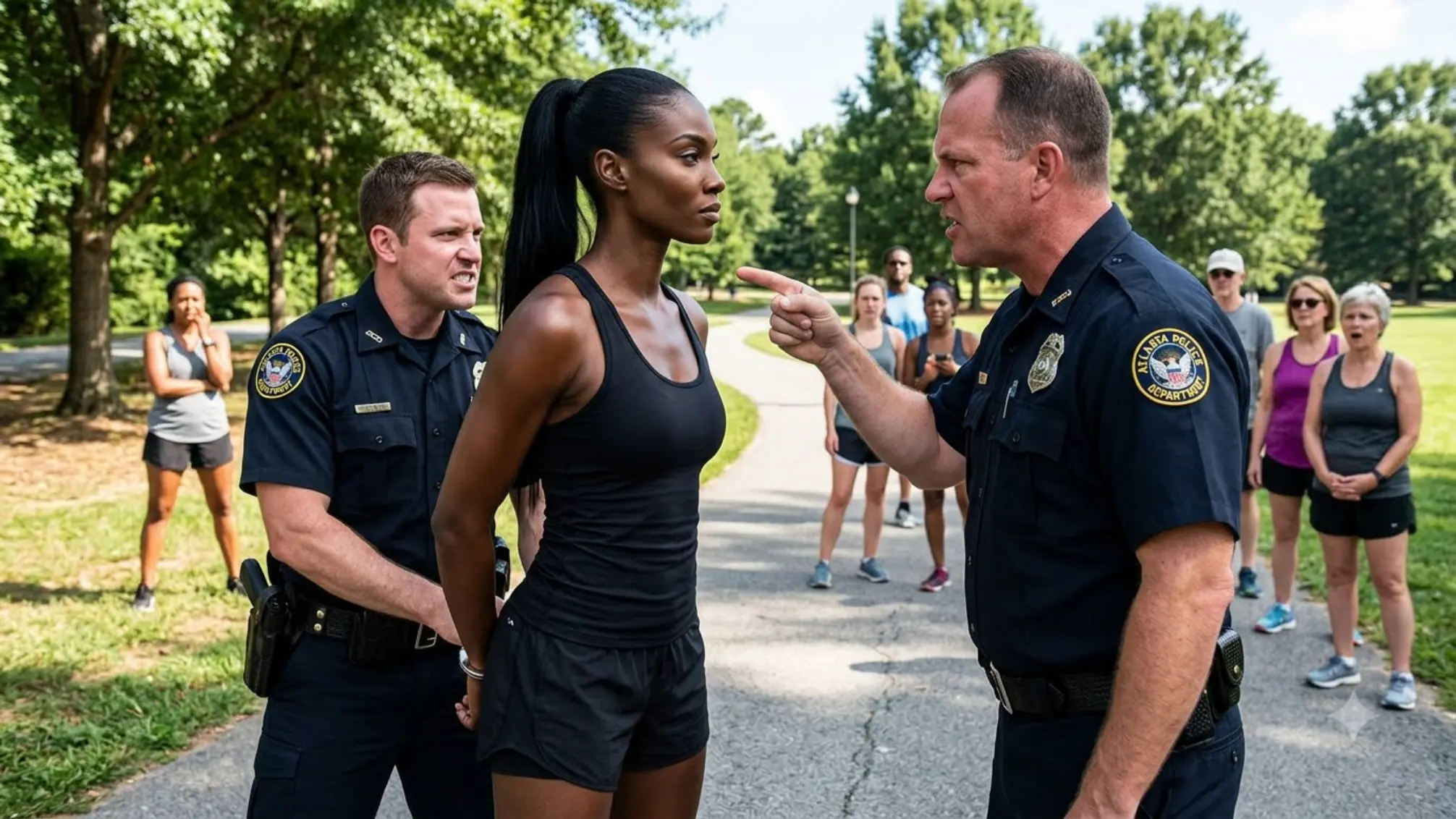
The first patrol car rolled across the service lane behind Ariana as she passed the northern lawn. She heard the engine accelerate, then the sharp chirp of a siren meant less as a warning than a command for attention. Ariana slowed to a walk and removed one wireless earbud. Miller stepped from the vehicle while Officer Thomas Johnson climbed out from the passenger side.
“You,” Miller called. “Stop right there.”
Ariana turned. “Is there a problem, Officer?” Miller looked her over slowly, from her running shoes to her face, then glanced toward several expensive homes visible beyond the park. “We’ve had complaints about somebody hanging around where they shouldn’t be.”
Ariana looked behind herself. “I’m jogging.” Johnson approached from the side, wearing the faint grin of someone who already expected the encounter to become entertaining. Miller asked for identification, and Ariana explained that she carried only her phone and a small running pouch containing a key, emergency cash, and one credential case she had no intention of revealing unless necessary.
“What crime do you suspect me of committing?” Ariana asked.
Miller’s expression changed immediately. “Nobody said anything about a crime.” Ariana kept her voice calm. “Then why are you demanding identification?” Johnson laughed quietly.
Miller stepped closer. “Because when a police officer asks who you are, you answer.” Ariana looked toward the body camera centered on his uniform. The recording indicator was active. “Your camera is on, Sergeant, so maybe you should explain why a woman jogging in a public park has suddenly become suspicious.”
That sentence irritated him more than Ariana expected. Miller’s jaw tightened, and he pointed toward her face. “People like you always think knowing a few legal words lets you dictate the encounter.” Ariana stopped looking at his finger and focused directly on his eyes.
“People like me?”
“You heard me.”
“No. I want you to explain it.”
Johnson moved closer behind Ariana. “Maybe lose the attitude.” Ariana glanced toward him. “I’m standing still, answering questions, and asking for the reason I’m being detained.”
Miller laughed without humor. “You aren’t detained yet.” Ariana nodded once. “Then I’m free to continue my run.” She turned slightly.
Miller grabbed her upper arm.
Ariana stopped instantly. “Remove your hand.” Miller tightened his grip. “Now you’re detained.”
“For what?”
“Suspicious behavior.”
“What behavior?”
“Arguing with officers.”
Several joggers had slowed nearby. A young couple stopped completely, and one woman raised her phone. Ariana noticed them without turning her head.
Miller noticed too.
“Keep moving!” he shouted.
The woman kept recording.
Ariana spoke quietly. “She has the right to film from there.” Miller’s attention snapped back toward her. “I didn’t ask for your legal opinion.”
“You keep creating reasons to need one.”
Johnson reached for Ariana’s other wrist. She moved her arm forward just enough to keep him from grabbing it unexpectedly, but she did not strike, shove, or step toward either officer. Miller immediately raised his voice.
“Stop resisting!”
Ariana stared at him. “I am not resisting.”
Johnson caught her wrist. “Hands behind your back.”
“For what arrest?”
“Do it.”
Ariana recognized the moment when arguing further could give them the physical reaction they appeared to want. She slowly placed both hands behind her back. Johnson snapped one cuff around her left wrist and pulled the second tighter than necessary.
Miller moved inches from her face. “You were told to stop because people like you don’t just run through this side of the park acting like you own it.” Ariana’s eyes hardened. “Take your hand out of my face and tell me what law you think I broke.”
Johnson tightened the cuffs. “Keep talking and we’ll make this a lot worse for you right here in front of everybody.” Ariana turned her head slightly toward Miller’s body camera. She knew exactly how useful that sentence might become later.
Then Miller said something even worse.
“Maybe public embarrassment is what you need.”
The nearby crowd went silent.
Ariana looked at him with a calmness that made Johnson uncomfortable. “Enjoy your last little bit of power, Sergeant.” Miller smiled. “That a threat?”
“No.”
She held his stare.
“It’s a prediction.”
Miller grabbed the front of her athletic shirt near the shoulder and yanked her forward. The seam tore several inches beneath his hand, exposing the edge of the sports layer underneath. Gasps erupted from the witnesses.
Ariana did not scream.
She looked down at the torn fabric.
Then back at Miller.
“You just damaged my clothing while I’m restrained.”
Miller shrugged. “Should’ve cooperated.”
A jogger shouted, “She was cooperating!”
Johnson looked toward the crowd.
“Everybody back up.”
Phones rose higher.
Ariana’s anger sharpened into something colder. She had investigated officers who later claimed people were aggressive, combative, irrational, or threatening, only for video to show something very different. Miller was creating exactly that kind of evidence in real time.
She had not come to Piedmont Park as an investigator.
That morning she was simply Ariana Cole, a woman finishing a run before breakfast.
But professionally, she was Special Counsel Ariana Cole of the U.S. Department of Justice Civil Rights Division, temporarily assigned to Atlanta as part of a federal review involving repeated allegations of discriminatory stops and excessive enforcement practices.
Miller had no idea.
And Ariana had not planned to tell him.
Not yet.
“Search her,” Miller ordered.
Ariana looked toward him. “You do not have my consent.”
Johnson reached toward the small running pouch secured at her waist.
“I said I do not consent.”
Miller stepped closer. “You lost the right to make decisions when you started giving us trouble.”
Ariana almost responded.
Instead, she looked toward his camera again.
Every sentence mattered.
Johnson unzipped the pouch.
Car key.
Twenty dollars.
Emergency contact card.
Then his fingers touched the black leather credential case.
He pulled it out.
“What’s this?”
Ariana said nothing.
Miller grabbed it from him and flipped it open.
For several seconds, his face did not move.
Then every trace of arrogance disappeared.
Johnson leaned closer.
The federal seal caught the afternoon sun.
Miller read the identification twice.
Ariana Cole. Special Counsel. Civil Rights Division. United States Department of Justice.
Johnson whispered, “Oh, damn.”
Ariana kept her hands cuffed behind her.
Miller looked from the credential to her face as though hoping either one would change.
“You work for Justice?”
Ariana answered evenly. “The credential says what it says.”
Miller immediately lowered his voice. “Why didn’t you tell us?”
Ariana stared at him.
“Would you have treated me differently?”
He opened his mouth.
Nothing came out.
“That’s exactly why.”
Johnson reached for the handcuff key. “Ma’am, we’ll get these off.”
Ariana stepped away from him as much as the restraints allowed. “No.”
Both officers looked confused.
“You wanted an arrest,” she said. “Finish explaining the legal basis.”
Miller’s face reddened.
“This got out of hand.”
“No.”
Ariana looked toward the witnesses.
“You put hands on me, restrained me, threatened me, searched me after I refused consent, and tore my clothing.”
She turned back toward him.
“That didn’t ‘get out of hand.’ Those were decisions.”
Miller glanced around desperately. The crowd was larger now, and at least seven people were recording. A bicycle officer had arrived farther down the path and was speaking urgently into his radio.
Ariana continued.
“Now tell your body camera why I’m under arrest.”
Miller looked toward the ground.
“You’re not.”
Ariana’s voice sharpened. “Then remove the cuffs.”
Johnson unlocked them.
Ariana brought her hands forward slowly. Red marks circled both wrists, and the torn shoulder of her shirt hung unevenly. She did not fix it.
She wanted photographs exactly as it was.
Miller handed back the credential case. “Ms. Cole, I apologize.”
Ariana did not take it immediately.
“For what?”
He looked confused.
She repeated the question.
“What exactly are you apologizing for?”
“The misunderstanding.”
Ariana’s expression became colder.
“No.”
Miller swallowed.
“For the way the encounter escalated.”
“No.”
Johnson looked toward his partner.
Ariana finally took the credentials.
“You’re apologizing because you discovered I have federal authority.”
Miller shook his head quickly. “That’s not true.”
“Then tell me what changed between the moment you tore my shirt and the moment you opened that case.”
He had no answer.
A supervisor arrived seven minutes later.
Lieutenant Rachel Monroe approached quickly, took one look at Ariana’s wrists and damaged shirt, and asked Miller what happened.
“Suspicious-person investigation,” he said.
Monroe looked around the jogging trail.
“What suspicious person?”
Miller pointed toward Ariana.
Monroe stared at him.
“She was running.”
“We received complaints.”
“From who?”
Miller hesitated.
Johnson finally answered.
“There wasn’t a specific call.”
Ariana watched Monroe’s face change.
“What?”
Johnson looked uncomfortable. “Sergeant Miller saw her from the patrol car.”
Monroe turned slowly toward Miller.
“You initiated this without a call for service?”
“She looked suspicious.”
“Doing what?”
Miller became defensive. “She was lingering near residences.”
Ariana spoke. “I was running continuously until your vehicle stopped me.”
Several witnesses immediately confirmed it.
Monroe asked for body-camera preservation before anyone could say more. Miller stiffened. “Lieutenant, we can handle this internally.”
Ariana finally smiled.
Very slightly.
“No, Sergeant.”
She raised her credential case.
“You had your chance to handle things internally.”
The incident reached federal supervisors before Ariana left the park.
She called Deputy Assistant Attorney General Marcus Hale, explained that she had unexpectedly become a principal witness in a matter overlapping with an existing federal review, and immediately requested removal from investigative decision-making involving Miller or Johnson.
Marcus agreed.
“You’re a witness now.”
“Exactly.”
“You okay?”
“My wrists hurt.”
“And?”
Ariana looked at the torn shirt.
“Angry.”
“That I believe.”
She spent the afternoon documenting everything.
Photographs of both wrists.
Photographs of the torn seam.
Names of witnesses.
Original phone videos.
Body-camera preservation requests.
Dispatch logs.
GPS location of Miller’s patrol car.
The most important fact emerged before sunset.
There had been no complaint.
Miller and Johnson had entered Piedmont Park after seeing Ariana jogging near an affluent residential boundary. Their dispatch system showed no burglary report, suspicious-person call, trespassing complaint, or matching suspect description.
Nothing.
The encounter had begun with Miller’s assumption.
That made his first written report especially important.
He claimed Ariana was “repeatedly looking toward private homes and changing direction after observing the patrol vehicle.”
Three independent videos contradicted him.
Ariana had been running straight along the marked path.
One jogger’s fitness camera captured nearly two minutes before police approached.
She never changed direction.
Never approached a residence.
Never stopped.
The federal review expanded.
Not because Ariana demanded it.
Because Miller’s name already existed in records.
Six complaints over four years.
One involved a Black college professor stopped while photographing architecture.
Another involved a Latino teenager questioned near a wealthy neighborhood after leaving a landscaping job.
A third involved two Black women detained after sitting on a park bench near closing time, though the park was still legally open.
Every case had been individually closed.
Insufficient evidence.
Officer discretion.
Reasonable suspicion articulated.
Ariana’s case created something previous complainants lacked.
Multiple independent videos.
Two active body cameras.
And one officer whose report contradicted nearly every outside recording.
Investigators compared the previous complaints.
Patterns appeared immediately.
Miller repeatedly used location as part of suspicion.
Affluent neighborhood.
Luxury shopping district.
Upscale park.
Expensive apartment complex.
His reports frequently contained phrases such as appeared out of place, did not seem familiar with the area, and behavior inconsistent with typical residents.
Those phrases concerned federal reviewers.
What exactly did a “typical resident” look like?
Miller faced that question during an administrative interview.
He struggled.
“It’s instinct.”
The investigator asked, “Based on what?”
“Experience.”
“What experience?”
“Years of police work.”
“That doesn’t answer the question.”
Miller became irritated.
“You can’t explain everything officers notice.”
The investigator opened Ariana’s file.
“She was wearing athletic clothing on a running trail.”
“Yes.”
“She was running.”
“Yes.”
“What about her was inconsistent with a person using the park?”
Miller remained silent.
The investigator played the bodycam.
People like you don’t just run through this side of the park acting like you own it.
Miller looked away.
“What did you mean by ‘people like you’?”
“I meant argumentative people.”
“She had asked what law she broke.”
“She was confrontational.”
The video played again.
Ariana’s voice was measured.
Her hands remained visible.
No shouting.
No threats.
Then came Johnson’s sentence.
Keep talking and we’ll make this a lot worse for you right here in front of everybody.
Then Miller tore her shirt.
The interview room became silent.
Miller finally said, “I lost my temper.”
That admission mattered.
But it did not explain everything.
Johnson cooperated earlier.
He admitted he knew the encounter lacked a clear legal foundation before he applied the cuffs.
“Then why did you do it?” investigators asked.
“Because Miller was my sergeant.”
“Did rank make the arrest lawful?”
“No.”
“Did you believe Ariana posed a threat?”
“No.”
“Did you believe she committed a crime?”
Johnson stared at the table.
“No.”
That became another critical finding.
The problem was not one man losing his temper.
The problem was a second officer recognizing something was wrong and still helping because hierarchy felt safer than judgment.
Six weeks later, Atlanta police leadership placed Miller on administrative suspension pending a formal disciplinary hearing. Johnson was reassigned and subjected to separate review.
Ariana said almost nothing publicly.
When reporters found her name, she issued one statement.
“My professional title should not determine whether an officer respects my constitutional rights.”
That sentence became the headline.
People wanted more.
She refused.
The case was not valuable because police happened to detain a federal lawyer.
It was valuable because the officers behaved differently only after discovering she was one.
At Miller’s disciplinary hearing, footage from the park played on a large screen.
Ariana sat near the back.
She watched herself standing in cuffs.
Watched Miller point into her face.
Watched Johnson hold her wrists.
Watched the fabric tear.
Then the credential case opened.
Miller’s entire demeanor changed instantly.
One panel member paused the recording.
“That moment bothers me.”
Miller’s attorney looked up.
“Which moment?”
“The officer suddenly becomes capable of de-escalation.”
Silence.
The panel member continued.
“Nothing about Ms. Cole’s behavior changes.”
He pointed toward the frozen image.
“The only new information is that she has institutional power.”
Ariana felt her jaw tighten.
That was exactly the issue.
Miller apologized during his final statement.
“I made terrible decisions that day.”
Ariana listened.
“I allowed frustration to affect my judgment, and I treated Ms. Cole in a way I regret.”
Then he said something she did not expect.
“I’ve spent weeks thinking about why seeing that federal badge changed me so quickly.”
The room became quieter.
“The truth is I became afraid of consequences.”
Ariana looked up.
Miller continued.
“And I should have been afraid of doing the wrong thing before I knew who she worked for.”
That was the first thing he said Ariana believed completely.
The panel terminated Miller for unlawful detention, unnecessary force, unprofessional conduct, inaccurate reporting, and violations of search procedures.
Johnson received a lengthy suspension, retraining, and demotion for participating in the detention despite recognizing its weak legal basis.
But consequences extended beyond two officers.
The department reopened previous complaints involving similar conduct.
Supervisors were required to review patterns instead of isolated incidents.
“Out of place” language in reports now required specific factual explanation.
Officers received additional training emphasizing that location, wealth, clothing, and perceived social belonging could not replace articulable evidence.
The department also strengthened expectations for subordinate officers.
Following an unlawful command was not automatically protected simply because a supervisor gave it.
That provision interested Ariana most.
Three months after the disciplinary hearing, Johnson requested a meeting.
Ariana almost declined.
Then she agreed.
They met inside a federal office conference room.
Johnson looked exhausted.
“I’m sorry.”
Ariana waited.
He continued.
“I knew he was wrong.”
“Yes.”
“That’s what I keep thinking about.”
Ariana folded her hands.
“He was my sergeant.”
“You said that in the investigation.”
“I know.”
He looked directly at her.
“It sounded pathetic when I heard myself say it.”
Ariana did not soften the point.
“Because rank explains pressure. It doesn’t erase responsibility.”
Johnson nodded.
“What should I have done?”
“You know.”
He looked down.
“Stopped him.”
“Yes.”
“Even if it cost me.”
Ariana leaned forward slightly.
“Especially if the alternative was making an innocent person pay the cost for you.”
Johnson absorbed that.
Months passed.
Ariana returned to Piedmont Park.
Not immediately.
For weeks she ran elsewhere because she hated admitting that one encounter had changed something she previously considered effortless.
Then one Saturday she drove back.
Same trail.
Same black running clothes.
Different shirt.
She stood beside the path for several seconds before starting.
The first mile felt strange.
Every police vehicle made her attention sharpen.
Every officer made her wrists remember the cuffs.
But gradually the rhythm returned.
Footsteps.
Breathing.
Trees.
Atlanta skyline beyond the park.
On her second lap, Ariana passed a patrol officer speaking politely with a cyclist.
Nothing happened.
She kept running.
That ordinary moment felt more powerful than Miller losing his badge.
Later, Marcus Hale asked what part of the case bothered her most.
“The shirt?”
“No.”
“The cuffs?”
“No.”
“The racial language?”
Ariana paused.
“That mattered.”
“But?”
She looked through her office window.
“The moment the credential opened.”
Marcus understood.
“Because he changed?”
“Immediately.”
Ariana nodded.
“He suddenly knew how to speak calmly.”
She looked at him.
“That means he was capable of control the entire time.”
The insight shaped her future work.
Abuse of authority was not always a person losing control.
Sometimes it was someone choosing where control was worth using.
Choosing who deserved patience.
Choosing who deserved explanation.
Choosing who deserved dignity.
Ariana began including the park encounter in training sessions without identifying Miller personally.
She showed the footage only up to the moment before the credential appeared.
Then she stopped it.
“What should happen next?” she asked recruits.
Someone usually answered, “Verify whether a crime occurred.”
Another: “Release her if there’s no basis.”
Another: “Supervisor intervention.”
Correct.
Then Ariana played the credential reveal.
The room always noticed the transformation.
Miller’s shoulders lowered.
His voice softened.
His hands stopped threatening.
Ariana paused again.
“Nothing about the citizen changed.”
That became the lesson.
Years later, people online still told exaggerated versions of the story.
Some claimed Ariana was FBI.
She was not.
Others said dozens of federal agents stormed the park.
They did not.
Some claimed Miller was arrested instantly.
That never happened.
The truth required no embellishment.
A beautiful Black woman went jogging.
Two officers decided she looked suspicious.
One turned questions into disrespect.
They restrained her.
Threatened her.
Damaged her clothing.
Then they discovered she possessed enough institutional authority to make consequences unavoidable.
The badge did not create her rights.
It exposed how differently those rights had been treated.
That distinction stayed with Ariana.
On the second anniversary of the incident, she completed the same three-mile route without thinking about Miller once.
Only afterward did she realize it.
She sat on a park bench, breathing hard and smiling at the absurd significance of forgetting.
A young Black woman ran past wearing headphones.
Two teenagers kicked a soccer ball nearby.
An elderly couple walked a dog.
The park belonged to all of them.
Not because anyone carried credentials.
Not because anyone could frighten an officer with a job title.
Because public space was public.
Ariana stood and stretched.
Her phone vibrated.
Marcus had sent a message about another civil-rights investigation beginning Monday.
She read it.
Then put the phone away.
Work could wait another twenty minutes.
Ariana started running again.
No badge visible.
No federal title.
No explanation ready.
Just a woman moving confidently through a park where she belonged.
And that was exactly how the story should have begun.