“Hand over the cash now,” Officer Raymond Pike barked, slamming his palm onto the hood of the copper-colored classic car. “Or I tow this thing and leave you stranded like the broke thug you look like.”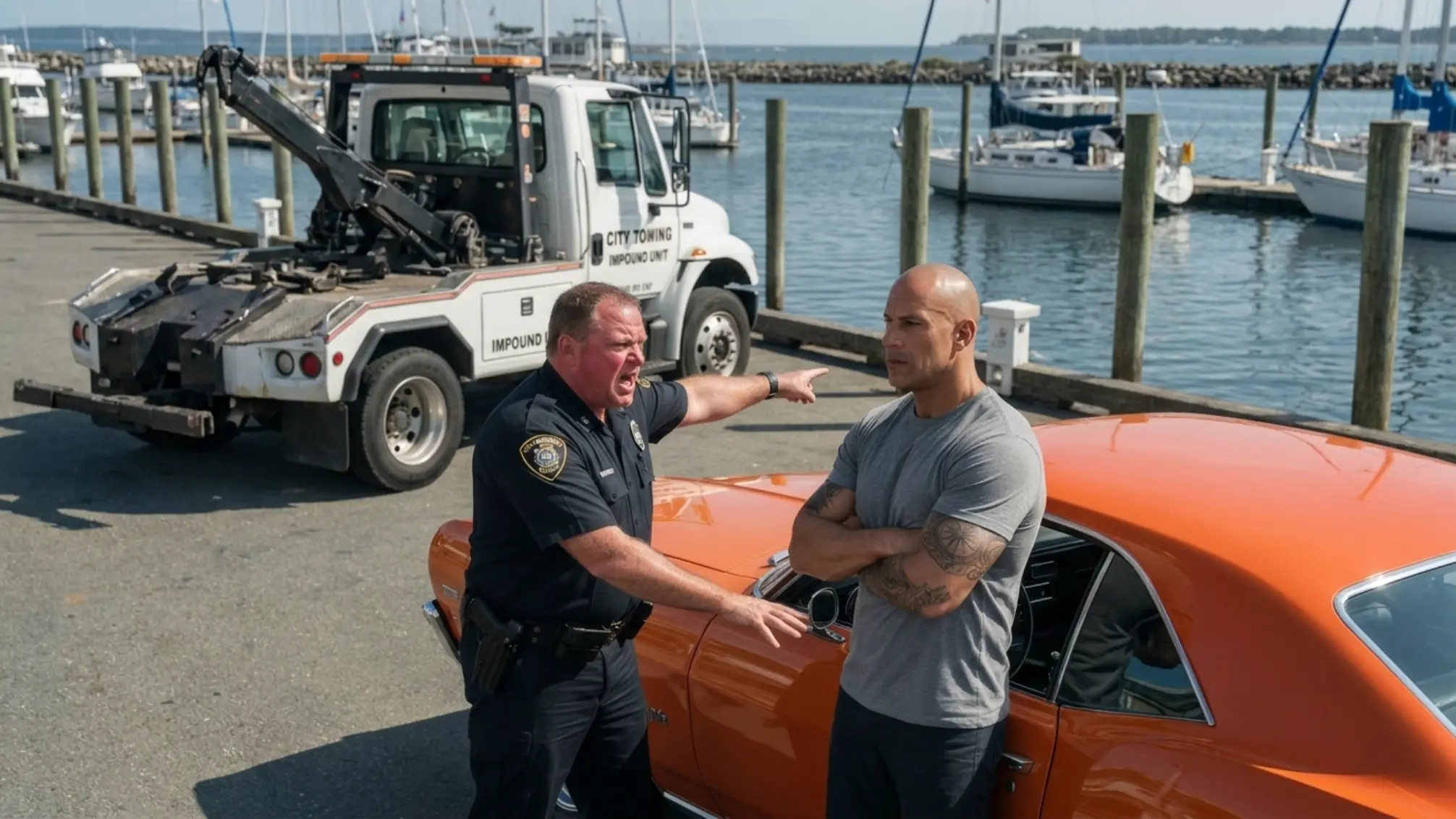
Marcus Hale stood beside the driver’s door with his powerful tattooed arms folded across his fitted gray T-shirt. At forty-two, he was tall, broad-shouldered, and built like a man who had spent half his life lifting steel rather than talking about it. His bald head reflected the hard afternoon sunlight, but his expression remained cold and unreadable. “You talk big for a man stealing in broad daylight.”
Raymond’s flushed face tightened. He pointed toward the black tow truck idling near the marina gate. “Open your mouth again, and I’ll tow the car, crush your pride, and bill you for every damn minute.”
Marcus reached through the open window and pressed the trunk release. “Good. Now watch that trunk open—and pray you understand what a gold badge means.”
The trunk lid rose slowly.
Inside sat a black evidence case, two compact cameras, a sealed envelope containing marked cash, and a gold badge mounted beside an identification card issued by the Maryland Office of the Attorney General. Beneath the badge were the words SPECIAL INVESTIGATIONS DIVISION.
Raymond stopped pointing.
The tow-truck driver behind him shut off his engine.
Marcus unfolded his arms and looked toward the badge. “You were saying something about cash.”
Raymond swallowed. “This isn’t what it looks like.”
“It looks like you demanded an unrecorded payment to prevent an illegal tow.”
“I was explaining the marina’s policy.”
“You called me a thug.”
“That was—”
“Your body camera off again?”
Raymond glanced at the center of his uniform shirt. The small black camera mounted there displayed no active recording light.
Marcus nodded once. “That’s what I thought.”
Harbor Point Marina sat on the edge of Chesapeake Bay, twelve miles outside Annapolis. During summer weekends, its parking lots filled with fishing trucks, boat trailers, expensive convertibles, and tourists carrying coolers toward rental slips. The property looked private, but the main access lane and thirty-two waterfront parking spaces had been transferred to county control years earlier in exchange for public-development grants.
That distinction mattered.
The marina manager could enforce time limits and trailer restrictions. County officers could issue citations when violations occurred. A contracted towing company could remove vehicles only after documented authorization, photographic evidence, and a waiting period clearly stated on posted signs.
None of those rules permitted roadside cash payments.
Yet for nearly three years, visitors had complained that Officer Raymond Pike and Shoreline Recovery demanded money directly. Drivers were told their cars violated unclear regulations, blocked emergency access, or displayed invalid permits. Those who paid cash were allowed to leave. Those who objected were threatened with immediate towing, storage fees, and additional citations.
Most people paid.
The amounts were carefully chosen—usually between one hundred fifty and three hundred dollars. Large enough to hurt, but small enough that tourists rarely hired attorneys or returned to fight. Some were embarrassed. Others believed an officer would not openly demand money unless the demand was legal.
The complaints looked unrelated until one woman refused to disappear quietly.
Her name was Evelyn Brooks, a sixty-nine-year-old retired school principal from Baltimore. She had driven to Harbor Point Marina with her granddaughter for a memorial boat ride honoring Evelyn’s late husband. Her parking permit was valid, displayed correctly, and visible through the windshield.
Raymond told her it had expired.
When she challenged him, he ordered Shoreline Recovery to lift the rear of her car. Then he offered to “settle the matter” for two hundred dollars in cash.
Evelyn paid because her granddaughter was crying.
The following morning, she filed complaints with the marina, county police, state consumer-protection office, and attorney general. She included photographs, her bank withdrawal receipt, the tow truck’s plate number, and the exact words Raymond used.
The marina denied wrongdoing.
The county police department reported no record of Raymond issuing a citation or requesting a tow at that time. Shoreline Recovery claimed the driver had responded to a lawful private-property removal but released the car before completing service.
No one explained where Evelyn’s money went.
Marcus Hale received the file six weeks later.
Before joining the attorney general’s Special Investigations Division, Marcus had spent eight years in the United States Marine Corps and another ten investigating organized theft, procurement fraud, and public corruption. His size made people expect aggression. His real strength was patience.
He read Evelyn’s statement twice.
Then he requested every complaint involving Harbor Point Marina, Shoreline Recovery, and Raymond Pike. Seventeen reports appeared over thirty months. Most contained similar language: cash demanded, towing threatened, no receipt provided, no citation located afterward.
Marcus created a timeline.
The incidents occurred mainly on Fridays, Saturdays, and holiday afternoons when the marina was crowded. Raymond was always working. Shoreline Recovery was nearly always nearby, sometimes arriving before anyone officially called for a tow.
The pattern suggested coordination.
Marcus visited the marina in ordinary clothes. He photographed the parking signs, measured the public access lane, and watched Raymond interact with drivers. Raymond appeared courteous when families complied quickly. When someone questioned him, his posture changed. He stepped closer, raised his voice, and pointed toward the tow truck.
Fear did the collecting for him.
Marcus also noticed something else. Raymond’s body camera frequently remained inactive during vehicle disputes. County policy required continuous recording during enforcement contacts unless a documented technical failure occurred.
Raymond had reported fourteen camera failures in one year.
No other officer in his unit reported more than two.
Marcus requested bank records, towing dispatch logs, personnel schedules, and records from the marina’s private security office. The early evidence was suspicious but incomplete. Cash created no automatic trail, and the victims rarely knew whether Raymond kept the money or shared it.
They needed a controlled encounter.
The copper-colored car belonged to Marcus’s late father.
It was a restored 1972 Chevrolet Monte Carlo with a long hood, black interior, and enough chrome to attract attention. Marcus rarely drove it during investigations, but Harbor Point’s complaints consistently involved vehicles that appeared valuable enough to justify a high towing fee.
The car would make believable bait.
Investigators installed two concealed cameras. One faced through the windshield. Another recorded the driver’s side from inside the cabin. A separate audio device sat beneath the dashboard, and the marked bills were placed inside Marcus’s wallet.
The trunk held his agency identification, emergency equipment, and a recording receiver monitored by two investigators parked near the marina office.
Marcus entered Harbor Point shortly after two o’clock on a Saturday afternoon.
He purchased a public parking permit from the automated machine and placed it on the dashboard exactly as instructed. He photographed its location, checked the timestamp, and walked toward the waterfront.
Then he waited.
Raymond approached the car eleven minutes later.
The tow truck followed before Raymond had touched his radio.
Marcus watched from beside a bait shop as Raymond examined the permit, looked toward the tow truck, and placed a yellow sticker on the driver’s window. The sticker claimed the vehicle was parked in a restricted commercial-loading space.
It was not.
Marcus returned to the car.
Raymond blocked him from entering. “This vehicle is being impounded.”
“For what?”
“Restricted zone.”
Marcus pointed toward the painted public-parking number beneath the car. “That space is public.”
Raymond did not look down. “The marina changed the designation.”
“Where’s the sign?”
“You want to argue, argue at the impound lot.”
The tow-truck driver began lowering the wheel lift.
Marcus asked whether a citation had been issued.
Raymond said the citation would be processed after removal.
That violated county procedure.
Marcus requested Raymond’s supervisor. Raymond refused. Then he leaned closer and lowered his voice.
“There’s another way to handle it.”
“How?”
“Two hundred fifty cash, and the truck leaves.”
“Receipt?”
“No receipt. Consider it an administrative release.”
Marcus asked whether the payment went to the county.
Raymond’s patience vanished.
That was when he slammed the hood, insulted Marcus, and ordered him to produce the money.
The trunk opened moments later.
Raymond now stood between the copper car and the silent tow truck, staring at the gold badge. Sweat gathered along his hairline despite the breeze coming off the bay.
Marcus removed his identification from the trunk.
“Special Investigator Marcus Hale,” he said. “Maryland Office of the Attorney General.”
Raymond forced a laugh. “You’re running some kind of test?”
“We call it an investigation.”
“I never accepted any money.”
“You demanded it.”
“It was hypothetical.”
“You named the amount.”
“I was explaining potential costs.”
“Cash only?”
Raymond’s eyes shifted toward the tow-truck driver.
The driver opened his door as though considering escape.
Two unmarked state vehicles entered from opposite ends of the marina lane. Investigator Lena Ortiz stepped from the first, followed by three agents wearing visible badges and body armor. The second vehicle stopped behind the tow truck, preventing it from leaving.
Lena approached Raymond. “Hands where we can see them.”
His face reddened again. “You can’t arrest me for a conversation.”
“No one said you were under arrest yet.”
She removed his department-issued radio and secured his duty weapon according to protocol. Another investigator instructed the tow-truck driver to step away from his vehicle.
Marcus looked toward Raymond’s inactive body camera. “Activate it.”
Raymond hesitated.
“Now.”
The camera light turned on.
Marcus spoke clearly for the official record. “Your camera became operational immediately when instructed. We’ll compare that with the fourteen technical failures you reported.”
Raymond stared at the pavement.
The investigation did not end at the marina.
Agents obtained a warrant for Shoreline Recovery’s office after the tow-truck driver admitted he had received cash from several motorists and passed part of it to Raymond. Inside a locked desk, investigators found handwritten logs that did not match the company’s official dispatch records.
The private notebook listed dates, vehicle descriptions, payment amounts, and initials.
The initials RP appeared repeatedly.
So did DC, belonging to Daniel Crowe, Harbor Point’s operations manager.
Investigators recovered more than nineteen thousand dollars in cash from a wall safe. Some bills matched withdrawal dates reported by victims. Others were bundled in envelopes labeled with marina weekends and holiday events.
Shoreline Recovery’s official books described these transactions as cancellation fees.
County law permitted a limited cancellation fee only after a properly authorized tow had begun. The company had charged people before legal authorization existed, concealed the payments, and divided the proceeds.
The scheme went deeper.
Daniel Crowe had given Raymond a list of vehicles likely to produce easy cash: out-of-county plates, tourists, older drivers, luxury cars, and anyone parked far from groups of witnesses. Raymond created the appearance of official enforcement. Shoreline Recovery supplied the tow truck and intimidation.
Drivers who paid were released.
Drivers who refused were sometimes towed illegally.
Storage fees accumulated immediately, reaching hundreds of dollars within a day. People who challenged the charges were warned that additional administrative penalties could be added.
Raymond received thirty percent of cash collections.
Daniel received twenty percent.
The towing company kept the remainder.
The official records were manipulated to make the incidents appear lawful. Photographs were cropped to hide valid permits. Dispatch times were altered. Some citations were created after vehicles arrived at the impound yard.
Several body-camera files had been deleted.
Raymond claimed the deletions resulted from equipment malfunction. Digital-forensics specialists recovered fragments showing him accepting folded cash from drivers.
One recording showed Evelyn Brooks.
Her granddaughter stood behind her, crying and clutching the sleeve of Evelyn’s coat. Raymond took the two hundred dollars, counted it, and told the tow-truck driver to lower the car.
The footage lasted forty-three seconds.
When Marcus showed it to Evelyn, she remained silent for a long time.
“I thought maybe I remembered something incorrectly,” she finally said.
“You remembered correctly.”
“He looked at me like I was foolish.”
“He depended on you feeling that way.”
Evelyn straightened in her chair. “Will I have to testify?”
“Possibly.”
“Then I will.”
The attorney general’s office identified forty-eight confirmed victims. Investigators suspected the real number exceeded one hundred, but many cash transactions could not be traced, and some tourists never filed complaints.
Refund notices were issued through local news reports and marina records.
People called from five states.
A father from Pennsylvania said his family had missed a prepaid fishing trip after their minivan was towed. A nurse from Virginia reported paying three hundred dollars because she needed to return home for a night shift. A disabled veteran described being threatened with arrest when he tried to photograph Raymond’s badge number.
The pattern was no longer merely financial.
It was an abuse of authority built around humiliation.
Raymond’s attorney argued that he had misunderstood the marina’s complicated towing agreement. The evidence showed otherwise. Messages recovered from his phone contained jokes about “weekend donations” and discussions of which drivers looked least likely to complain.
One message from Daniel Crowe read:
Older couple in the blue Lexus. Easy release fee. No locals nearby.
Raymond replied:
Send the truck before I walk over.
Another exchange discussed Marcus’s copper Monte Carlo.
Daniel wrote:
Expensive classic near slip entrance. Solo male. Hit him for 250.
Raymond responded:
Already on it.
Neither man knew the solo driver was recording them.
Raymond Pike was charged with bribery, extortion under color of official authority, theft, misconduct in office, evidence tampering, and conspiracy. Daniel Crowe faced similar charges, along with falsifying business records. Shoreline Recovery’s owner was charged with organized fraud and illegal towing violations.
The tow-truck driver cooperated.
His testimony explained the roadside routine, the cash division, and the signals Raymond used. A hand against the hood meant the driver should lower the wheel lift. Two taps meant the motorist appeared ready to pay. A raised finger meant increase pressure.
The same finger Raymond had pointed at Marcus appeared in photographs from six earlier complaints.
Harbor Point Marina attempted to distance itself from Daniel. Its owners claimed he acted without authorization. Investigators found emails showing senior management had received repeated complaints and chose not to examine them closely because aggressive towing kept public spaces available for higher-paying marina customers.
The state terminated the marina’s operating agreement for the public parking area.
County officials suspended the towing contract and opened an independent review of every company authorized to remove vehicles from public access zones. New rules required electronic dispatch numbers, timestamped photographs, active body-camera recording, and cashless payment systems.
No officer could personally collect a release fee.
The reforms arrived too late for many victims, but Evelyn attended the public hearing where they were approved. She sat in the front row with her granddaughter.
Marcus stood near the rear wall.
After the meeting, Evelyn approached him. “You opened the trunk because you knew he’d demand money?”
“I believed he would.”
“Were you angry when he insulted you?”
“Yes.”
“You didn’t look angry.”
“That was part of the job.”
She smiled. “I was a school principal for thirty-four years. Looking calm while angry was part of mine too.”
Marcus laughed.
The criminal case lasted eleven months.
Raymond eventually pleaded guilty after prosecutors presented the recovered recordings, marked-money operation, cash ledger, and phone messages. He received a prison sentence, lost his law-enforcement certification, and was ordered to pay restitution.
Daniel Crowe also pleaded guilty.
Shoreline Recovery lost its license and entered liquidation. Its remaining trucks were sold, and part of the proceeds went into a compensation fund for motorists who had been illegally charged.
During Raymond’s sentencing, the judge asked whether he wished to speak.
He stood in a dark suit that fit poorly across his heavy shoulders. Without his uniform, badge, weapon, and duty belt, he appeared smaller than he had beside Marcus’s car.
“I made bad decisions,” he said. “But I never forced anyone to give me money.”
Evelyn looked toward the prosecutor.
Marcus remained still.
The judge answered before anyone else could.
“You wore a public uniform, arranged for a tow truck to seize their property, and threatened escalating costs if they refused. The uniform was the force.”
Raymond lowered his head.
The sentence followed.
Marcus drove the Monte Carlo back to Harbor Point the next summer.
The marina had changed. New signs clearly identified public spaces. Payment information appeared in several languages, and a posted number allowed visitors to challenge towing decisions immediately.
A different management company operated the property.
Marcus parked in the same numbered space and placed a valid permit on the dashboard. For several minutes, he remained beside the car, looking toward the place where Raymond had slammed his hand against the hood.
Then a harbor employee approached.
Marcus expected a question about the vehicle.
Instead, the young man smiled. “Beautiful Monte Carlo.”
“My father’s.”
“What year?”
“Seventy-two.”
The employee walked around it carefully without touching the paint. “He restore it?”
“Started it. I finished after he died.”
“You drive it often?”
“Not enough.”
The employee nodded toward the trunk. “Big trunk on these.”
Marcus almost smiled. “Big enough.”
He spent the afternoon walking along the marina. Families moved between boats, fishermen loaded coolers, and elderly couples sat beside the water without worrying that someone would turn their confusion into profit.
Evelyn’s complaint had started everything.
Marcus’s gold badge had ended the roadside encounter, but the badge alone had not proved the case. Evidence did that: permits, recordings, marked bills, dispatch logs, deleted files, victim statements, and one private notebook filled with numbers criminals believed no one else would ever read.
The badge had changed Raymond’s expression.
The evidence changed the system.
Before leaving, Marcus opened the trunk.
The black investigation case was gone. Only a folded chair, basic tools, and a framed photograph of his father remained inside. In the picture, his father stood beside the Monte Carlo shortly after buying it, smiling with one hand resting on the roof.
Marcus closed the trunk gently.
People later told the story as the shocking moment an angry officer demanded cash from the wrong man and watched a gold badge rise into view. They remembered Raymond’s frozen face, the waiting tow truck, and the agents arriving from both directions.
But Marcus remembered the people who had paid before him.
They had not possessed badges.
They had possessed valid permits, lawful rights, and the reasonable expectation that a uniformed officer would not use fear to steal from them. That should have been enough.
The gold badge did not make Marcus more deserving of dignity than Evelyn Brooks or any other motorist.
It merely gave Raymond one final opportunity to reveal exactly who he had always been.
He demanded the cash.
Marcus opened the trunk.
And this time, the person Raymond tried to intimidate had arrived carrying everything needed to bring him down.