James Wilson had been riding for nearly three hours when the old gas station outside Lakeside appeared beyond the heat rising from the California highway. His polished blue Harley rolled beneath the faded canopy, and he killed the engine beside pump four before removing his black helmet. At fifty-five, James carried himself with the quiet discipline of a man accustomed to responsibility, but the black leather jacket, dark jeans, and motorcycle gave strangers no reason to know anything about the three decades of service hidden behind his calm face. On that afternoon, he wanted nothing more complicated than fuel, a bottle of water, and another hundred miles of open road.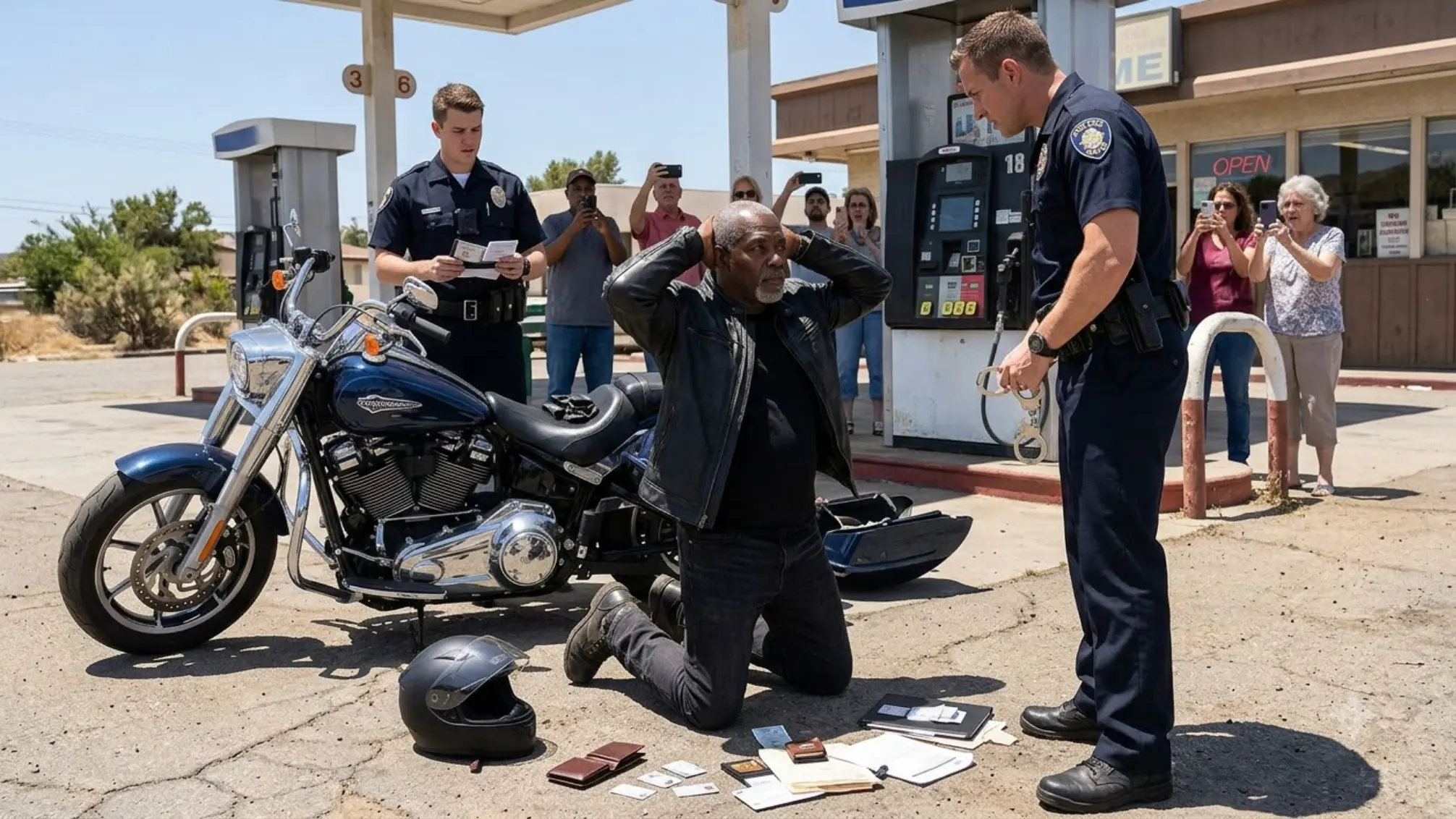
Inside the station, Mrs. Evelyn Powell watched him approach the counter with a bottle of water and a protein bar. When James opened his wallet, an official identification card became visible beside his driver’s license, and the elderly store owner recognized enough to understand that the quiet biker had spent much of his adult life in public service. “Thank you for what you’ve done,” she said. James gave her a restrained smile and answered, “Just doing my job, ma’am.”
Across the road, Officers Michael Tanner and Ryan Briggs sat inside a patrol cruiser watching the Harley. Tanner was thirty-eight and had spent seventeen years on the Lakeside Police Department, long enough to believe experience justified instinct even when instinct had no evidence behind it. He studied James through the windshield and made a comment about how expensive the motorcycle looked. Briggs, only twenty-four and still treating Tanner as the model for how experienced officers behaved, glanced at the bike and quietly agreed that it was a custom machine.
Tanner started the patrol car before James had even left the station parking lot. “Let’s see what he’s running,” he said. Briggs did not ask what traffic violation had occurred because none had. James pulled onto the highway, used his signal properly, remained within the speed limit, and drove less than half a mile before blue lights appeared behind him.
James checked his mirrors once. There was no confusion in his expression, only recognition. He slowed carefully, signaled, moved onto the shoulder, turned off the motorcycle, placed the kickstand down, and kept both hands visible on the handlebars. Years of experience had taught him that perfect compliance did not always prevent escalation, but it removed excuses.
Tanner approached with one hand resting near his holster. “License and registration.” James turned his head slightly but kept his hands visible. “May I reach for my wallet, Officer?”
“Slowly.”
James retrieved the documents and passed them over. Tanner studied the official identification first, looked at the name James Wilson, then at the rank printed beneath it. A smirk appeared almost immediately. “Colonel?”
James remained calm. “Thirty years of service.”
Tanner glanced toward Briggs. “In what army?” James answered evenly, but Tanner was already moving to the next accusation. “Where are you coming from?”
“A charity motorcycle event.”
“Where are you going?”
“North toward Sacramento.”
Tanner looked at the Harley again. “Step off the bike.” James held his gaze. “May I ask why?”
“Because I told you to.”
The volume in Tanner’s voice increased enough that Briggs shifted uneasily. James slowly swung one leg over the seat and stood beside the motorcycle with both hands visible. He understood exactly what Tanner wanted: irritation, resistance, a movement that could later be described differently in a written report.
James gave him none of it.
Tanner walked around the Harley. He studied the saddlebags, chrome, custom seat, and expensive components with an expression that made the motorcycle seem less like property and more like evidence. “Pretty fancy bike.”
“I purchased it legally.”
“Mind if we look through the bags?”
James answered carefully. “With respect, Officer, I don’t consent to a search without legal cause.” Tanner immediately stepped closer.
“Refusing a search?”
“I’m stating my rights.”
“What are you hiding?”
“Nothing.”
Tanner turned toward Briggs and nodded at the saddlebags. Briggs hesitated. “Sergeant, maybe we should verify the identification first.”
Tanner’s face hardened. “Search the bags.”
James noticed the body camera mounted on Tanner’s uniform was not active. Briggs’s camera, however, showed a small illuminated indicator. James looked at his watch, memorizing the time.
“Officer Tanner, I’m requesting your supervisor.”
Tanner laughed. “You think you’re getting special treatment because you printed yourself some fancy identification?”
James said nothing.
Briggs opened the first saddlebag.
Inside were neatly arranged documents, personal items, a secure communications device, a small metal case, and paperwork associated with James’s work. Briggs lifted one envelope and stared at the official markings. “Tanner, this looks legitimate.”
Tanner grabbed it.
James’s voice changed.
“Do not open that envelope.”
The authority in his tone was unmistakable.
Tanner tore it open anyway.
Several pages slid into his hand. He skimmed the first page, understood almost none of it, and deliberately let the documents fall onto the dusty shoulder.
Wind caught one.
Then another.
James watched without moving.
“That material needs to be secured.”
Tanner kicked one page away from his boot. “Sure it does.”
A silver sedan slowed as it passed. The driver lifted a phone and began recording. Tanner shouted at her to keep moving.
Across the road, Mrs. Powell had stepped outside the gas station.
More customers followed.
Phones began appearing.
Briggs found the metal case and opened it. Inside were service coins, commendation pieces, and photographs. One picture showed James in formal uniform standing among senior national officials.
Briggs stared at it.
“Tanner.”
“What?”
“Look at this.”
Tanner barely glanced at the photograph. “Anybody can fake a picture.”
James watched him step over it.
Something inside Briggs changed.
Until that moment he had been uncertain whether James’s story was true. Now uncertainty had shifted toward fear that Tanner was deliberately refusing to accept evidence because accepting it would require admitting the stop itself had been unjustified.
Tanner reached for James’s wallet and emptied it onto the pavement.
Credit cards.
Receipts.
Identification.
Personal photographs.
James watched everything without raising his voice.
Tanner pointed toward the motorcycle. “Where’d you steal this?”
James’s expression finally sharpened.
“The registration is in your hand.”
“Answer the question.”
“I just did.”
Tanner unclipped his handcuffs.
“On your knees.”
Briggs looked toward him. “Sergeant—”
“On your knees!”
James slowly lowered himself onto the scorching pavement.
Heat immediately penetrated his riding pants. He placed his hands behind his head exactly as ordered.
Across the street, someone shouted that officers were being recorded.
Tanner ignored them.
He grabbed James’s helmet from the motorcycle, looked at it contemptuously, and tossed it onto the ground. The expensive helmet struck the pavement and rolled several feet. James followed it with his eyes, then looked back toward Tanner.
“Fancy bike for your kind,” Tanner said. “Where’d you steal it?”
The crowd became noticeably quieter.
James’s eyes fixed on Tanner’s nameplate.
“I purchased it legally. The registration is in your hand.”
Tanner pulled James’s arms behind him and applied the handcuffs unnecessarily tight. “If you’re really who that ID says you are, I’m the commander-in-chief.”
James inhaled once.
“You have five minutes before you destroy your career.”
Tanner laughed.
“Threatening an officer now?”
“No.”
James’s voice remained calm.
“I’m giving you time to correct your mistake.”
Tanner dragged him toward the patrol car.
Briggs remained beside the motorcycle for several seconds, staring at the scattered documents and the growing crowd. He looked at his body camera, then toward Tanner. Something inside him understood that whatever happened next would eventually be examined frame by frame.
James was placed in the back seat.
Before Tanner closed the door, James spoke again.
“I need to make one call.”
“You’ll call your lawyer from the station.”
“It isn’t a lawyer.”
Tanner smiled.
“National security?”
James did not answer.
The patrol car left the gas station.
Mrs. Powell immediately began collecting the documents Tanner had scattered. Other bystanders helped her while continuing to record. An elderly man named Frank Thompson pushed through the crowd and picked up the photograph Briggs had discovered.
Frank stared at James’s face.
Then at the formal uniform.
His hands began trembling.
“I know this man.”
Mrs. Powell looked at him. “The biker?”
“That’s Major General James Wilson.”
Several people turned toward him.
Frank had spent years following public-service publications because his grandson still worked within the same organizational network James helped oversee. He had seen James’s photograph only weeks earlier in an article discussing national logistics planning.
“You’re sure?”
“I’m absolutely sure.”
Frank hurried inside the station.
“Evelyn, I need your phone.”
Mrs. Powell handed it over without hesitation.
Frank called his grandson, Lieutenant David Thompson.
David answered on the second ring.
Frank explained everything quickly: the motorcycle stop, Tanner’s behavior, the documents scattered on the highway, James being handcuffed and taken toward Lakeside.
There was silence.
Then David asked one question.
“Grandpa, are you absolutely certain?”
“Yes.”
David’s voice changed.
“I need to make some calls.”
Inside the patrol car, Briggs checked his phone.
Social-media video of the arrest was already spreading.
One clip showed Tanner throwing the helmet.
Another showed the identification falling into the dust.
A third captured James saying, You have five minutes before you destroy your career.
“Tanner.”
“What?”
“You should see this.”
“Put the phone away.”
“People are saying he really is who he says he is.”
Tanner looked into the rearview mirror.
James sat upright despite the cuffs.
No panic.
No pleading.
No anger.
Only patience.
That bothered Tanner more than shouting would have.
“You enjoying this?” Tanner asked.
James met his eyes through the mirror.
“No.”
“You think some powerful friends are going to save you?”
James looked toward his watch.
“Approximately three minutes remain.”
Tanner laughed, but the sound lacked confidence.
At Lakeside headquarters, Chief Arthur Bennett was attending a budget meeting when his phone rang. The caller was the mayor, who skipped greetings entirely. He had just received a frantic message from the governor’s office about a senior federal defense official being detained by Lakeside officers.
Bennett felt his stomach tighten.
“Which officer?”
The mayor did not know.
Bennett rushed toward dispatch.
“Where’s Tanner?”
“Returning to the station.”
“Get him on radio.”
“We’ve been calling.”
“Why isn’t he answering?”
The dispatcher looked toward the screen.
“His unit radio appears muted.”
Bennett swore under his breath.
“Get every supervisor outside.”
The patrol car turned into the station parking lot three minutes later.
Tanner immediately noticed something wrong.
Nearly every available officer stood outside.
Chief Bennett was at the front.
Tanner stopped the cruiser.
Bennett stormed toward the driver’s door.
“Release him.”
Tanner stepped out. “Chief, he had falsified credentials and—”
“Release him now.”
Tanner blinked.
“Sir?”
Bennett pointed toward the back seat.
“That is Major General James Wilson.”
The parking lot became silent.
Briggs opened the rear door immediately.
James stepped out.
Briggs unlocked the cuffs.
Red marks circled James’s wrists.
“I’m sorry, sir.”
James rubbed one wrist.
“Thank you for removing them.”
Tanner stared.
“No. That ID—”
“Was authentic,” Bennett snapped.
“You never verified it.”
Tanner looked around as though searching for someone willing to support him.
Nobody moved.
Then engines approached.
Black government vehicles entered the parking lot.
Tanner’s face changed.
Doors opened and federal officials stepped out.
The arrival was orderly rather than theatrical. Security personnel moved toward James while legal officers approached Bennett and requested immediate preservation of body-camera footage, radio traffic, dispatch records, and all materials connected with the stop.
James raised one hand.
“My documents are still on the highway.”
A senior official nodded.
“A recovery team is already there.”
Bennett turned toward Tanner.
“What did you do?”
Tanner’s defensive expression returned.
“He was acting suspicious.”
James looked toward him.
“I was buying gasoline.”
Briggs lowered his eyes.
Two federal civil-rights investigators approached several minutes later. They introduced themselves and informed Tanner that they wanted a complete statement regarding the stop.
Tanner shook his head.
“This is ridiculous. I was doing my job.”
One investigator looked toward Briggs’s active body camera.
“We’ll determine that from the evidence.”
Tanner stopped talking.
Inside the station, Bennett led James into a conference room and began apologizing. James listened until Bennett mentioned that Tanner had experienced complaints before.
“How many?”
Bennett hesitated.
“Several.”
“And he remained on patrol?”
The chief did not answer immediately.
James leaned back.
“This is not primarily about what happened to me.”
Bennett looked confused.
James continued.
“I have people who can make calls. I have documentation. I have access to attorneys.”
He pointed toward the glass wall separating the conference room from the public lobby.
“What happens to somebody who has none of that?”
Bennett looked away.
That question became the real beginning of the investigation.
Agents reviewed Briggs’s body-camera footage before sunset.
It was worse than Bennett expected.
James had committed no traffic violation before the stop.
He asked permission before reaching for identification.
He remained cooperative.
He clearly refused consent to a search.
Tanner ordered the saddlebags searched anyway.
The video captured the documents being scattered, the helmet thrown, the comments about the motorcycle, and James being forced onto his knees.
It also captured Briggs repeatedly showing signs that he knew the encounter was wrong.
The investigators interviewed him separately.
Briggs did not protect himself.
“I should have stopped it.”
The lead agent looked at him.
“Why didn’t you?”
“He was senior.”
“That answers who had rank.”
The agent leaned forward.
“It doesn’t answer why you obeyed.”
Briggs stared at the table.
“I was afraid of challenging him.”
Later, James spoke with him privately.
“Moral courage is harder than physical courage, Officer Briggs.”
Briggs nodded.
“Yes, sir.”
“You recognized something was wrong.”
“I did.”
“And still participated.”
“Yes.”
James’s voice remained calm.
“Remember that feeling. Next time, use it earlier.”
Briggs would remember those words for years.
The investigation did not stop with the highway incident.
Tanner’s personnel record showed three excessive-force complaints, two discrimination complaints, and multiple internal concerns that had resulted in little more than counseling and one brief suspension. Previous supervisors had treated each complaint separately.
Nobody had asked whether together they formed a pattern.
Federal investigators did.
Traffic-stop data showed Tanner disproportionately stopped minority motorists, particularly those driving expensive vehicles or traveling through certain parts of Lakeside.
Several arrests followed similar narratives.
“Suspicious behavior.”
“Possible contraband.”
“Officer-safety concern.”
Many resulted in no charges.
One involved a Black physician driving a luxury SUV.
Another involved a college professor returning from an academic conference.
Another involved a contractor whose work truck contained expensive equipment Tanner initially claimed might be stolen.
Those citizens had complained.
Their files had disappeared into administrative categories.
James read the summaries quietly.
“This is why today matters.”
Chief Bennett stood beside him.
“We failed.”
James looked toward him.
“Yes.”
Bennett expected anger.
James offered none.
That made the answer harder to hear.
Within days, Tanner was suspended pending administrative proceedings and a civil-rights review. Briggs remained employed but was removed temporarily from patrol and required to cooperate fully.
The department itself came under scrutiny.
Training practices were reviewed.
Complaint systems were audited.
Supervisory failures became impossible to ignore.
The viral video brought reporters to Lakeside, but James refused to turn the incident into a personal spectacle.
During his first public statement, he stood outside the police station wearing civilian clothes.
“What happened to me happens to other citizens,” he said. “The difference is that people immediately believed my credentials once someone important verified them.”
A reporter raised her hand.
“Are you saying your status protected you?”
“Eventually.”
James paused.
“It should never have been necessary.”
Another reporter asked whether he wanted Tanner fired.
“I want evidence reviewed and proper consequences applied.”
“That’s not an answer.”
“It is the only responsible answer before the investigation is finished.”
The investigation eventually supported termination.
At Tanner’s disciplinary hearing, body-camera footage played on a large screen. The room watched him question James’s identification, order an unauthorized search, scatter personal materials, and make comments that supervisors could no longer explain as misunderstandings.
Then complaint history appeared.
One case.
Another.
Then another.
Tanner’s attorney argued that some behavior reflected unwritten practices tolerated within the department.
A board member leaned forward.
“If the department informally tolerated unconstitutional conduct, that aggravates the issue rather than excuses it.”
Tanner’s attorney went quiet.
Briggs testified next.
His statement was devastating because he did not exaggerate.
He described how younger officers learned to treat particular vehicles and particular people as automatically more suspicious. Nobody handed recruits a written document saying it.
The lesson traveled through jokes.
Stories.
Who received praise.
Who was called aggressive.
Which stops supervisors celebrated.
Which complaints disappeared.
When Tanner finally testified, he began defensively.
Then something changed.
Perhaps it was seeing his own conduct replayed from another officer’s camera.
Perhaps it was understanding that the institution he thought would always protect him had finally decided protection had limits.
“I believed I was doing what experienced officers did,” Tanner said.
A board member asked, “Were you trained to treat citizens differently because of race?”
“Not directly.”
“What does that mean?”
Tanner swallowed.
“It means nobody had to say it plainly.”
The room became quiet.
Tanner continued.
“You watched how people got treated. You listened to what senior guys said. You learned who they thought belonged where.”
James did not attend the hearing.
He submitted a written statement asking the board to focus on documented behavior rather than revenge.
Tanner was terminated.
The case was also referred for further legal review.
Several supervisors faced administrative consequences for repeatedly failing to respond appropriately to prior complaints.
Chief Bennett eventually resigned.
Briggs almost resigned too.
Instead, he accepted reassignment and retraining.
Two years later, he became a field-training officer.
Every recruit assigned to him heard about the James Wilson stop.
Briggs never presented himself as the hero who learned a lesson.
He told them the truth.
“I knew something was wrong and didn't stop it.”
One recruit once asked why he kept telling a story that made him look bad.
Briggs answered, “Because stories where the instructor was always right don’t teach you anything.”
Lakeside rebuilt its complaint system.
Separate allegations against the same officer were automatically linked for pattern review.
Supervisors received notifications when search, force, or detention complaints crossed established thresholds.
Body-camera deactivation generated mandatory review.
Traffic-stop demographics were monitored independently.
None of those policies guaranteed perfection.
James never claimed they would.
Policies were tools.
People still had to use them.
A year after the stop, James returned to the gas station.
This time there were no flashing lights.
No crowd.
No handcuffs.
Mrs. Powell recognized him before he entered.
“You came back.”
“I needed gasoline.”
She laughed.
“Hopefully that goes better this time.”
Frank Thompson was drinking coffee near the window.
He stood immediately.
James shook his hand.
“You made the call.”
Frank shrugged.
“Anybody would've.”
“No.”
James looked directly at him.
“A lot of people watched.”
Frank understood what he meant.
The two men sat for several minutes.
Across the road, traffic moved normally.
Frank asked whether James still rode the Harley.
“Absolutely.”
“I heard somebody said it was too expensive for you.”
James smiled.
“I heard that too.”
Outside, a Lakeside patrol car entered the gas station.
A young officer stepped out.
He recognized James.
For half a second, both men simply looked at each other.
Then the officer nodded politely and entered the store.
Nothing happened.
That ordinary moment pleased James more than almost anything that came after the investigation.
He returned to the Harley.
His helmet rested securely on the seat.
His documents remained exactly where he left them.
Nobody demanded proof that the motorcycle belonged to him.
Nobody told him to kneel.
James started the engine.
Mrs. Powell stepped outside.
“Where are you headed?”
“North.”
“Charity ride?”
“Same one.”
She smiled.
“Try not to change another police department before dinner.”
James laughed.
“No promises.”
He pulled onto the highway.
The spot where Tanner had forced him to his knees disappeared in the mirror.
James did not consider what happened there a victory.
Victory suggested he had needed to defeat Tanner personally.
He had not.
Evidence did that.
Body-camera footage.
Witness recordings.
Complaint records.
Traffic data.
A young officer finally telling the truth.
The important part had never been that Tanner stopped the wrong Black biker.
Every citizen was the wrong person to stop without legal justification.
James’s position only ensured the mistake became visible quickly.
He thought about that as the highway opened ahead of him.
Authority had once meant command to James.
Years had changed his understanding.
Real authority meant responsibility under pressure.
It meant following procedure when anger offered easier options.
It meant admitting a mistake before somebody more powerful forced you to.
And sometimes it meant kneeling on burning asphalt, remaining calm while another person underestimated you, and trusting that carefully preserved truth would eventually speak louder than arrogance ever could.
James shifted into a higher gear.
The Harley surged forward.
Behind him, Lakeside grew smaller.
Ahead of him stretched miles of road.
And this time, nobody tried to stop him.