Fifteen-year-old Isaiah Carter had been sitting outside his grandmother’s house for less than ten minutes when Officer Dana Reeves decided he looked suspicious. The late-afternoon sun stretched across the narrow Baltimore neighborhood, touching chain-link fences, parked sedans, trimmed lawns, and rows of modest houses where most families knew one another by name. Isaiah sat quietly in his wheelchair wearing a forest-green hoodie, dark pants, and sneakers, holding a blue game controller connected to his phone while waiting for his father to return from the pharmacy. Nothing about the scene suggested danger until a patrol cruiser slowed beside the curb and stopped directly behind him.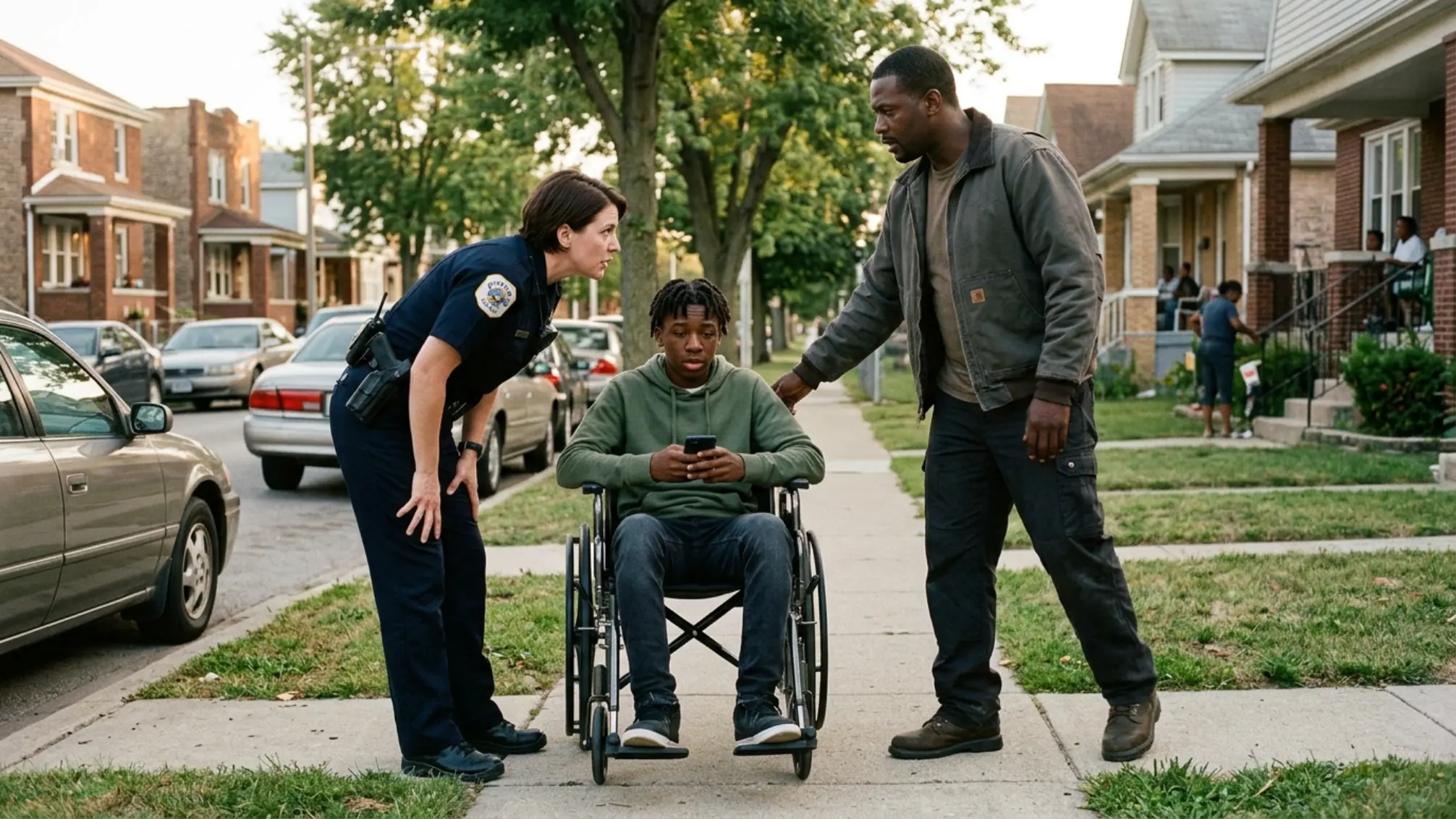
Isaiah had cerebral palsy, which affected his balance and sometimes slowed his speech when he became frightened or overwhelmed. He could move his wheelchair independently, use his hands normally for most tasks, and communicate clearly, but stressful encounters sometimes caused his muscles to tighten and his words to come out slower than he intended. His father had spent years teaching him that taking extra time did not make his thoughts less important. At fifteen, Isaiah understood that lesson until somebody in authority stood over him demanding immediate answers.
Officer Dana Reeves stepped from the cruiser and stared at him for several seconds before approaching. She was forty-two, with short dark hair, a sharp jaw, and a reputation inside her precinct for turning even minor encounters into confrontations whenever someone questioned her instructions. Dispatch had reported a young man possibly checking parked vehicles several blocks away, described only as a tall male in dark clothing walking east toward the commercial district. Isaiah was wearing bright green, seated in a wheelchair, and had been stationary outside his grandmother’s home.
“Put the phone down,” Reeves ordered.
Isaiah looked up. “Why?”
“Because I told you to.”
He slowly placed the phone on his lap.
Reeves stopped directly beside the wheelchair. “What are you doing here?”
“Waiting for my dad.”
“Doing what?”
“He went to get my medicine.”
Her eyes narrowed. “What medicine?”
Isaiah hesitated. “Why do you need to know that?”
That hesitation instantly changed the officer’s tone. Reeves leaned closer and said, “Because I’m asking the questions, kid.” Isaiah looked toward his grandmother’s front porch, wondering whether he should call her, but Reeves noticed the movement and told him to look at her. His anxiety increased enough that the muscles in his hands began tightening around the phone.
“You live here?”
“My grandma does.”
“Which house?”
He pointed three doors down.
Reeves barely looked. “Were you walking around those cars?”
“No.”
“Don’t lie.”
“I’m not.”
“Then why are you acting nervous?”
Isaiah swallowed.
“I have cerebral palsy.”
Reeves stared at him without changing expression. “Sure you do.” Isaiah blinked, thinking perhaps he had misheard her, but the contempt on her face made the meaning clear.
“It’s not something I made up.”
“Everybody suddenly has a medical excuse when police show up.”
Isaiah’s face tightened. “I didn’t do anything.”
Reeves leaned lower, putting herself almost directly into his space. “Stop acting confused. Boys like you always have a story when they get caught.”
Isaiah looked down at his phone.
“I’m just waiting for my dad.”
“Look at me when I’m talking to you.”
He looked up.
Reeves reached toward his arm.
Isaiah recoiled instinctively. “Please don’t touch me.”
That simple movement became the excuse she apparently needed.
Her hand closed around his forearm.
Isaiah stiffened. “Let go.”
“Stop resisting.”
“I’m not resisting.”
“You pulled away.”
“Because you grabbed me.”
Across the street, seventy-two-year-old Mrs. Watkins stopped watering her flowers. She had known Isaiah since he was a baby and immediately understood something was wrong. Without announcing herself, she reached into the pocket of her cardigan and started recording. Two teenagers sitting on a nearby porch noticed her, looked toward Reeves, and raised their phones as well.
Reeves saw them.
“Everybody stay back.”
Nobody had approached.
Isaiah tried pulling his arm closer to his body, but Reeves tightened her grip. His breathing became shallow, and his speech slowed further.
“Please.”
“Stop making this difficult.”
“I’m not.”
“You’re not cooperating.”
“I answered you.”
Reeves laughed without humor. “Not very well.”
A second cruiser turned onto the street.
Officer Brian Hale stepped out and immediately looked from Reeves to the boy in the wheelchair. “What have you got?”
“Possible prowler.”
Hale stared. “Him?”
Isaiah heard the surprise.
Reeves frowned. “He matches enough.”
“Dispatch said dark clothing.”
“Descriptions are wrong all the time.”
Hale looked at Isaiah’s bright green hoodie. “And they said walking between cars.”
Reeves crossed her arms but kept one hand near Isaiah. “He’s being evasive.”
Isaiah whispered, “I’ve been sitting here.”
Reeves snapped toward him. “Nobody asked you.”
“You’re talking about me.”
“I said quiet.”
That was the moment Marcus Carter turned the corner carrying a pharmacy bag.
He noticed the police cars before he saw Isaiah. Then he saw Reeves gripping his son’s arm. The small white pharmacy bag slipped from his hand and landed on the sidewalk.
“Take your hands off my son.”
Everything stopped.
Marcus Carter was forty-three, tall and broad-shouldered, with deep brown skin, closely trimmed black hair, and the disciplined posture of a man who rarely needed to raise his voice to command attention. He wore an ordinary charcoal button-up shirt, dark trousers, and brown work shoes because he had left the office early and deliberately changed before picking Isaiah up from school. Nothing visible suggested that Marcus was the Chief Inspector of the State Police Bureau, responsible for overseeing major internal investigations involving officer misconduct, evidence handling, abuse of authority, and corruption across multiple districts.
Hale raised one hand. “Sir, stay back.”
Marcus stopped immediately.
His eyes remained fixed on Reeves.
“Why are you touching my son?”
“He’s being detained.”
“For what?”
“Suspicious activity.”
Marcus glanced toward Isaiah. “Did she tell you what you supposedly did?”
Isaiah shook his head.
Reeves snapped, “Don’t coach him.”
Marcus slowly turned toward her.
“Excuse me?”
“You heard me.”
His expression changed.
Not anger yet.
Something colder.
“I asked my disabled fifteen-year-old son whether you told him why you put your hands on him.”
Reeves finally released Isaiah.
“Then control your attitude.”
Marcus looked at his son’s arm.
Red fingerprints were already visible.
“Isaiah, are you hurt?”
“My arm.”
Reeves rolled her eyes.
Marcus looked back at her.
“Did he tell you he has cerebral palsy?”
“So he says.”
For the first time, Marcus seemed genuinely stunned.
“So he says?”
Reeves shrugged.
“People lie.”
Hale looked away.
Marcus noticed.
He stepped closer to Isaiah but remained several feet from Reeves. “Officer, I’m going to ask you one very simple question.”
She folded her arms.
“What crime did you personally observe my son commit?”
“He fits the description of somebody checking vehicles.”
Marcus nodded.
“What description?”
“That’s police information.”
Hale’s eyes shifted.
Marcus looked toward him. “Officer Hale, what was the description?”
Reeves immediately snapped, “Don’t answer him.”
Marcus stared at her.
“Why not?”
“Because this is my investigation.”
“Then investigate.”
Her face hardened.
Marcus continued. “Verify the description. Check the cameras. Speak to witnesses. Call dispatch. But if your investigation requires physically grabbing a disabled child before doing any of that, then I want that decision documented very carefully.”
Reeves laughed.
“You sound like a lawyer.”
“No.”
“What, then?”
Marcus looked directly at her.
“A father.”
She pointed toward his chest. “Then act like one and stop interfering.”
Marcus stepped between Reeves and Isaiah’s wheelchair.
“Do not reach for my son again.”
Her hand drifted toward her belt.
Hale moved immediately.
“Dana.”
She ignored him.
“You threatening me?”
“No.”
“You’re standing between me and a detainee.”
“You released his arm.”
“He’s still detained.”
“Based on what?”
“His behavior.”
Marcus glanced around.
“What behavior?”
“He’s evasive.”
“How?”
“He won’t answer questions properly.”
Isaiah spoke quietly behind his father. “I answered everything.”
Reeves pointed past Marcus.
“See? That. He keeps interrupting.”
Marcus’s jaw tightened.
“He is speaking about his own detention.”
Mrs. Watkins called from across the street.
“That boy’s been sitting there since before you arrived.”
Reeves turned.
“Ma’am, go inside.”
“No.”
“You’re interfering.”
“I’m watering flowers.”
The garden hose still sprayed water across her lawn.
Several neighbors laughed quietly.
Reeves became visibly angrier.
Marcus said nothing.
He had spent more than twenty years studying exactly this moment inside complaint files: the point at which an officer realized the original suspicion was weakening and chose escalation rather than correction.
Hale reached for his radio.
Reeves turned sharply. “What are you doing?”
“Confirming the call.”
“I already have it.”
“I want the exact description.”
“You don’t trust me?”
“I want it recorded.”
That sentence mattered.
Dispatch responded seconds later.
“Suspect described as approximately eighteen to twenty, five-ten or taller, black hooded jacket, blue jeans, observed walking between vehicles near Ellison and Grant. Last seen eastbound toward commercial district.”
Everyone looked at Isaiah.
He was fifteen.
Seated.
Wearing green.
Nearly four blocks west of the last known direction.
Marcus waited.
Reeves said nothing.
Finally he asked, “Does that sound like my son?”
“Witness descriptions can be wrong.”
Marcus nodded. “Absolutely.”
Then his voice sharpened.
“But every single detail is wrong.”
Reeves crossed her arms.
“He was still suspicious.”
“How?”
“He got nervous.”
“My son has cerebral palsy.”
“So?”
“So you already know stressful situations affect his speech.”
“I’m not a doctor.”
“You don’t need to be a doctor to listen.”
Her face reddened.
“I know how to do my job.”
Marcus looked toward Isaiah.
Then back toward Reeves.
“Right now, I’m struggling to see evidence of that.”
The street went silent.
Reeves stepped forward.
“You better watch your mouth.”
Marcus did not move.
“No.”
The single word stunned her.
“No?”
“No. You don’t get to physically grab my son, dismiss his disability, ignore a completely different suspect description, and then warn me about my tone.”
Hale stepped between them slightly.
“Let’s keep everybody calm.”
Marcus looked toward him.
“I am calm.”
He was.
That made Reeves look even less controlled.
Hale turned toward her. “Dana, release the kid.”
She stared.
“What?”
“We don’t have reasonable grounds to keep him.”
“You making that call?”
“Yes.”
The answer landed heavily.
Hale approached Isaiah.
“You’re free to go.”
Isaiah nodded.
Hale hesitated.
“I’m sorry this happened.”
Reeves glared at him.
Marcus crouched beside his son and photographed the red marks on his arm.
Reeves scoffed.
“Oh, come on.”
Marcus looked up.
“Something funny?”
“You’re photographing him like I assaulted him.”
Marcus stood.
“No.”
He held up the phone.
“I’m preserving evidence.”
Her expression changed.
Marcus noticed her glance toward the body camera on Hale’s chest.
Then toward her own.
“Your camera running?” Marcus asked.
Reeves did not answer.
Hale did.
“Yes.”
“Good.”
Marcus put his phone away.
Then Reeves made one final attempt.
“I still need identification.”
Marcus shook his head.
“No.”
“He was detained.”
“He was released.”
“I need it for my report.”
“Ask his name.”
“I want physical ID.”
“He’s fifteen.”
Reeves stepped around Marcus.
He moved directly into her path.
“Do not reach past me.”
Her hand dropped toward her belt again.
Hale immediately said, “Dana, enough.”
Marcus held both hands visibly at his sides.
Nobody moved.
Then Reeves stepped back.
The confrontation was over.
At least on the street.
Marcus pushed Isaiah’s wheelchair toward his grandmother’s house. Mrs. Watkins crossed over after they entered and handed Marcus her phone. “I recorded everything.”
Marcus watched less than twenty seconds.
That was enough.
“Send me the original file.”
Mrs. Watkins looked surprised by the specificity.
“You know about this stuff?”
Marcus looked toward Isaiah.
“A little.”
Inside, Isaiah sat on the couch rubbing his arm.
“I didn’t do anything.”
Marcus sat beside him.
“I know.”
“She didn’t believe me.”
“I know.”
“She thought I lied about being disabled.”
Marcus’s expression hardened.
“I heard.”
Isaiah looked toward him.
“Are you going to get her fired?”
Marcus paused.
“No.”
Isaiah frowned.
“You’re not?”
“I’m going to make sure somebody independent examines what happened.”
“But you’re the chief inspector.”
“That’s exactly why I can’t decide her punishment.”
Isaiah understood slowly.
Marcus continued.
“If I use my position to punish somebody who hurt my family, then I become part of the problem.”
That evening Marcus formally disclosed the incident to his deputy inspector and recused himself from direct supervision of any review involving Reeves.
He preserved the photographs.
Saved the neighborhood videos.
Requested gas-station-style nearby camera footage from several residences.
And ensured body-camera data was automatically locked against deletion.
The following morning, Deputy Chief Inspector Evelyn Shaw assumed responsibility.
She watched every recording before interviewing anyone.
The videos told a clearer story than reports ever could.
Isaiah answered questions.
Reeves escalated.
Isaiah disclosed his cerebral palsy.
Reeves mocked the explanation.
The suspect description did not match.
Reeves continued anyway.
Worst of all, her written report described Isaiah as “physically resistant.”
Video showed something different.
He pulled his arm away only after she reached for him without explaining why.
Then he repeatedly asked her to stop touching him.
Shaw interviewed Reeves.
“Why did you believe he was the suspect?”
“Location.”
“The suspect was reported four blocks away.”
“Close enough.”
“Clothing?”
“Witnesses make mistakes.”
“Age?”
“Hard to judge.”
“Mobility?”
Reeves hesitated.
Shaw waited.
“He could have been working with somebody.”
“Was that reported?”
“No.”
“So where did that theory come from?”
Silence.
Shaw leaned back.
“At what point did facts stop supporting the detention?”
Reeves’s expression tightened.
“I had to trust my instincts.”
Shaw looked at the screen.
“Instinct is not evidence.”
The investigation expanded after analysts reviewed Reeves’s history.
Three prior complaints involved people with disabilities.
A deaf man had been described as deliberately ignoring instructions.
An autistic teenager had been accused of suspicious behavior when he became overwhelmed during questioning.
An elderly man with a neurological tremor had been described as possibly intoxicated despite medical identification inside his wallet.
None of the complaints had produced major discipline.
Supervisors had labeled them misunderstandings.
Shaw examined the supervisory files next.
The pattern bothered her more than Reeves herself.
Different incidents.
Same language.
Officer perception reasonable under circumstances.
No malicious intent established.
Additional coaching recommended.
The department had treated every incident as isolated.
Together, they looked systemic.
Marcus received only information appropriate for a complainant.
He refused internal briefings beyond that.
At headquarters, some employees whispered that everyone involved was terrified because the victim’s father happened to be Chief Inspector Marcus Carter.
Marcus hated that.
He addressed his leadership team once.
“If the department only cares because it happened to my son, then we’ve already failed.”
Nobody spoke.
He continued.
“Treat this complaint exactly like the complaint of a father who works nights stocking shelves and knows nobody inside this building.”
That instruction became more important than anything Marcus did personally.
The department’s final findings sustained several allegations against Reeves: improper detention, unnecessary physical contact, inaccurate characterization of resistance, failure to appropriately consider a disclosed disability, and unprofessional conduct.
But the review did not stop there.
Two supervisors were disciplined for repeatedly closing complaints without adequate pattern review.
A new requirement mandated automatic secondary examination whenever officers accumulated multiple complaints involving disability interactions.
Body-camera audits were expanded.
Training changed.
Reeves was removed from street duty during the process and later terminated after a separate review concluded her reporting inconsistencies and repeated conduct made continued field service inappropriate.
Hale received formal counseling.
He had eventually challenged Reeves.
But not immediately.
During his interview, Shaw asked why.
Hale answered honestly.
“She had more seniority.”
Shaw stared at him.
“And?”
“I thought maybe she knew something I didn’t.”
“Did she?”
“No.”
“Then what stopped you?”
Hale lowered his eyes.
“Fear.”
That answer saved neither his pride nor his record.
But it mattered because it was true.
Months later, Hale visited Marcus.
No uniform.
No official appointment.
Just a man standing outside the Carter home.
“I owe Isaiah an apology.”
Marcus let him inside.
Isaiah sat in the living room.
Hale faced him.
“I should’ve stopped her sooner.”
Isaiah looked at him for several seconds.
“Why didn’t you?”
Hale answered without excuses.
“I was scared of challenging someone above me.”
Isaiah nodded slowly.
“I was scared too.”
Hale’s expression changed.
“I know.”
Isaiah continued.
“But nobody expected me to protect you.”
The sentence hit harder than anger.
Hale looked down.
“No.”
Before leaving, he promised one thing.
“Next time I see something wrong, I’ll speak sooner.”
Isaiah shrugged.
“Then do that.”
No handshake.
No dramatic forgiveness.
Just a standard.
A year later, the department introduced a training scenario based loosely on the stop.
Officers watched a fictionalized encounter involving a wheelchair user who did not match the suspect description.
The lesson ended with a question:
What should happen when observable facts contradict your original suspicion?
The answer:
Stop. Reassess. Correct.
Marcus requested one addition.
Do not treat correction as weakness.
That became the line officers remembered.
Isaiah eventually stopped talking about Reeves.
His arm healed quickly.
The emotional part took longer.
For several weeks, seeing police vehicles made his shoulders tighten.
Marcus noticed but never forced him to discuss it.
Then one afternoon Isaiah rolled his wheelchair onto the same sidewalk again.
Green hoodie.
Phone in his hands.
Same spot.
Marcus came outside.
“You okay?”
“Yeah.”
“You sure?”
Isaiah looked toward him.
“Dad.”
“What?”
“You ask that too much.”
Marcus smiled.
“Occupational hazard.”
Isaiah rolled his eyes.
Across the street, Mrs. Watkins waved.
Isaiah waved back.
Life moved forward.
Years later, people who heard the story often focused on the reveal.
The officer grabbed a disabled Black teenager.
Then his father arrived.
Then everyone discovered the father was the State Police Chief Inspector.
Marcus always disliked that version.
It made power sound like the reason Isaiah deserved protection.
It made Reeves’s biggest mistake seem like choosing the wrong family.
That was not the lesson.
Her mistake would have been identical if Isaiah’s father had been a mechanic.
A janitor.
A truck driver.
Unemployed.
Absent.
Unknown.
Marcus’s title changed what happened afterward.
It should never have changed what was right.
A fifteen-year-old boy had been sitting peacefully outside his grandmother’s home.
That should have been enough.
He explained why he was there.
That should have been enough.
He disclosed his disability.
That should have been enough.
The suspect description contradicted nearly every visible fact.
That absolutely should have been enough.
Reeves kept going because admitting she had made a mistake felt harder than finding new reasons to justify it.
Marcus had seen that pattern hundreds of times in investigative files.
He never expected to see it while standing between an officer and his own son.
Months after the case closed, Isaiah asked him a question over breakfast.
“What were you thinking when you saw her holding me?”
Marcus stopped.
He considered lying.
Then decided his son deserved the truth.
“I wanted to pull her hand off you.”
“Why didn’t you?”
“Because I knew exactly what could happen if I did.”
Isaiah looked down.
“So you were scared?”
Marcus nodded.
“Terrified.”
That surprised him.
“You didn’t look scared.”
Marcus smiled faintly.
“Neither did you.”
Isaiah thought about that.
Then Marcus added, “Being calm doesn’t mean you aren’t afraid.”
“What does it mean?”
“It means fear doesn’t get to choose what you do next.”
Isaiah remembered that sentence.
Marcus did too.
Because on that sidewalk, both of them had needed it.
The boy in the wheelchair.
And the Chief Inspector standing between his son and a badge that had forgotten where its authority ended.
“I’m completing documentation.”
“You can document his name.”
“I need ID.”
“He’s fifteen.”
Reeves stepped forward.
Marcus moved between her and Isaiah.
“Do not reach past me.”
Her hand dropped toward her belt.
Hale immediately intervened.
“Dana.”
Marcus did not move.
Neither did Reeves.
For one long moment, the street felt as though a single bad decision could turn everything worse.
Hale spoke again.
“He’s released.”
Reeves finally stepped back.
Marcus nodded once.
“Thank you.”
He pushed Isaiah toward his grandmother’s house.
Neighbors followed at a distance.
Nobody celebrated.
Isaiah was shaking too badly.
Inside the house, Marcus closed the curtains and helped his son onto the couch.
Isaiah stared at his hands.
“I didn’t do anything.”
“I know.”
“She didn’t believe me.”
“I know.”
“She thought I was lying about my disability.”
Marcus sat beside him.
For the first time since arriving on the street, his anger cracked.
“I know.”
Isaiah looked at him.
“Why?”
Marcus did not lie.
“I don’t know.”
That evening Marcus photographed Isaiah’s arm again.
He wrote down every sentence he remembered.
Mrs. Watkins sent her video.
The Johnson family downloaded their doorbell footage.
Two teenagers sent another angle showing Reeves grabbing Isaiah before Marcus arrived.
Hale’s body-camera footage would later become the most important record.
It captured Reeves acknowledging that the description did not match.
It captured Isaiah repeatedly explaining where he was.
It captured Reeves saying, “So he says,” after Marcus explained his son’s disability.
And it captured the moment Hale told her the stop should end.
Marcus filed a formal complaint the following morning.
The department initially described the encounter as a misunderstanding.
Marcus rejected that word.
“A misunderstanding is asking the wrong person a question,” he told investigators. “This became something else when she got answers and kept going.”
The department’s professional standards unit opened a review.
Investigators began with the dispatch call.
The actual suspect had been located twenty-three minutes after Isaiah’s detention.
He was nineteen.
He wore a black hoodie.
He was nearly six feet tall.
And he had been caught checking unlocked vehicle doors three blocks away.
Nothing connected him to Isaiah.
Officer Reeves was interviewed.
She argued that Isaiah’s nervous behavior increased her suspicion.
An investigator asked whether she had received training concerning interactions with people with disabilities.
“Yes.”
“What does the training say about delayed speech?”
Reeves remained silent.
The investigator repeated the question.
“That it can result from neurological conditions.”
“And involuntary movements?”
“Same.”
“Then why did you describe his movements as evasive?”
Reeves shifted.
“I had to make a decision.”
The investigator looked at the body-camera transcript.
“You made several.”
That line stayed with Marcus after his attorney read him the interview summary.
The investigation uncovered three previous complaints against Reeves.
One involved a deaf man whom she accused of ignoring commands before realizing he could not hear her.
Another involved an autistic teenager detained outside a convenience store after becoming overwhelmed during questioning.
Both complaints had been closed with counseling.
The third involved an elderly Black man stopped because he “resembled” a burglary suspect nearly twenty years younger.
None had resulted in formal discipline.
Marcus became angrier at that than at the original encounter.
“The department knew.”
His attorney corrected him carefully.
“They knew pieces.”
“That’s enough.”
“Maybe legally. Maybe not.”
Marcus looked through the window toward Isaiah, who was playing a racing game in the next room.
“It should’ve been enough morally.”
The story reached local television after Mrs. Watkins’s video circulated online.
The most viewed moment was not Reeves threatening Marcus.
It was Isaiah saying quietly, “I’m just waiting for my dad.”
Thousands of people watched.
The department placed Reeves on administrative assignment while the review continued.
Marcus refused invitations to turn Isaiah into a symbol.
“He’s fifteen,” he told reporters. “He’s not your debate segment.”
Isaiah eventually agreed to speak once.
He sat beside Marcus at a community meeting.
Someone asked what scared him most.
Isaiah thought for several seconds.
“That she decided I was lying before I finished talking.”
The room became silent.
Marcus looked at his son.
Isaiah continued.
“When I get nervous, words take longer.”
He looked toward the audience.
“But longer doesn’t mean dishonest.”
That became the sentence people remembered.
The department’s final administrative findings concluded Reeves lacked sufficient justification to prolong Isaiah’s detention after obvious discrepancies emerged between him and the suspect description. Investigators also found her physical handling unnecessary under the circumstances and criticized her failure to appropriately account for Isaiah’s disclosed disability. Her report was found to contain descriptions of “resistance” that were inconsistent with multiple video recordings.
Reeves received a lengthy suspension.
Additional review eventually resulted in her removal from street patrol.
Officer Hale received counseling for failing to intervene sooner, though his eventual decision to challenge Reeves and release Isaiah was formally acknowledged.
Hale visited Marcus several months later.
He did not arrive in uniform.
Marcus met him on the porch.
“I should’ve stopped her sooner,” Hale said.
Marcus nodded.
“Yes.”
Hale looked toward the yard.
“I kept thinking she had more experience.”
“Experience doesn’t make somebody right.”
“I know that now.”
Marcus crossed his arms.
“What are you doing differently?”
Hale answered without hesitation.
“When something doesn’t match, I stop trying to make it match.”
Marcus studied him.
Then he nodded.
“That’s better than an apology.”
The city settled the family’s civil claim the following year.
Marcus placed most of Isaiah’s portion into a protected account for his education and future accessibility needs.
He did not buy a new house.
He did not leave the neighborhood.
He repaired the wheelchair ramp at his mother’s home instead.
Isaiah returned to the same sidewalk.
At first, sitting there made him anxious.
Then one afternoon Marcus found him outside playing a game on his phone again.
“You good?”
Isaiah nodded.
“Yeah.”
Marcus sat beside him.
Across the street, Mrs. Watkins was watering her flowers.
She raised one hand.
Isaiah waved.
Life resumed.
But the neighborhood never forgot what happened.
Neither did the department.
Training materials eventually used an anonymized version of the stop.
Officers were shown the initial description.
Then Isaiah’s image.
Then asked one question:
What should happen when the facts stop matching your suspicion?
The correct answer was simple.
Stop.
Reassess.
Listen.
Marcus liked that.
He wished Officer Reeves had done it before touching his son.
But he also understood why the lesson mattered beyond one street.
Authority could become dangerous when admitting a mistake felt harder than escalating one.
Reeves had seen Isaiah.
Then she built a story around him.
Every fact that contradicted the story became another reason to distrust him.
His wheelchair did not make her reconsider.
His explanation did not.
His father’s arrival did not.
Even dispatch contradicting her did not immediately change the conclusion.
That was what Marcus wanted people to understand.
The traffic stop never should have happened.
But the greatest failure was not stopping the wrong boy.
Mistakes happen.
The failure was refusing to let reality correct the mistake.
Years later, Isaiah remembered the encounter differently than Marcus expected.
He barely remembered Reeves’s insults.
He remembered his father dropping the pharmacy bag.
He remembered Marcus stepping between the wheelchair and the officer.
And he remembered three words.
Look at me.
That was what Marcus said when Isaiah began shaking.
Not fight back.
Not prove yourself.
Not show her who you are.
Just look at me.
Isaiah eventually understood why.
His father had wanted him focused on the one thing the officer could not define.
Who he actually was.
A fifteen-year-old boy.
A son.
A grandson.
A kid waiting outside his grandmother’s home.
No police report could change that.
No suspicion could.
No badge could.
And no one ever again had to convince Isaiah that taking longer to speak meant his voice mattered less.