She told them, “I am a United States Army general.”
They handcuffed her anyway.
What happened next ended two careers and forced an entire police department to confront how its officers exercised authority.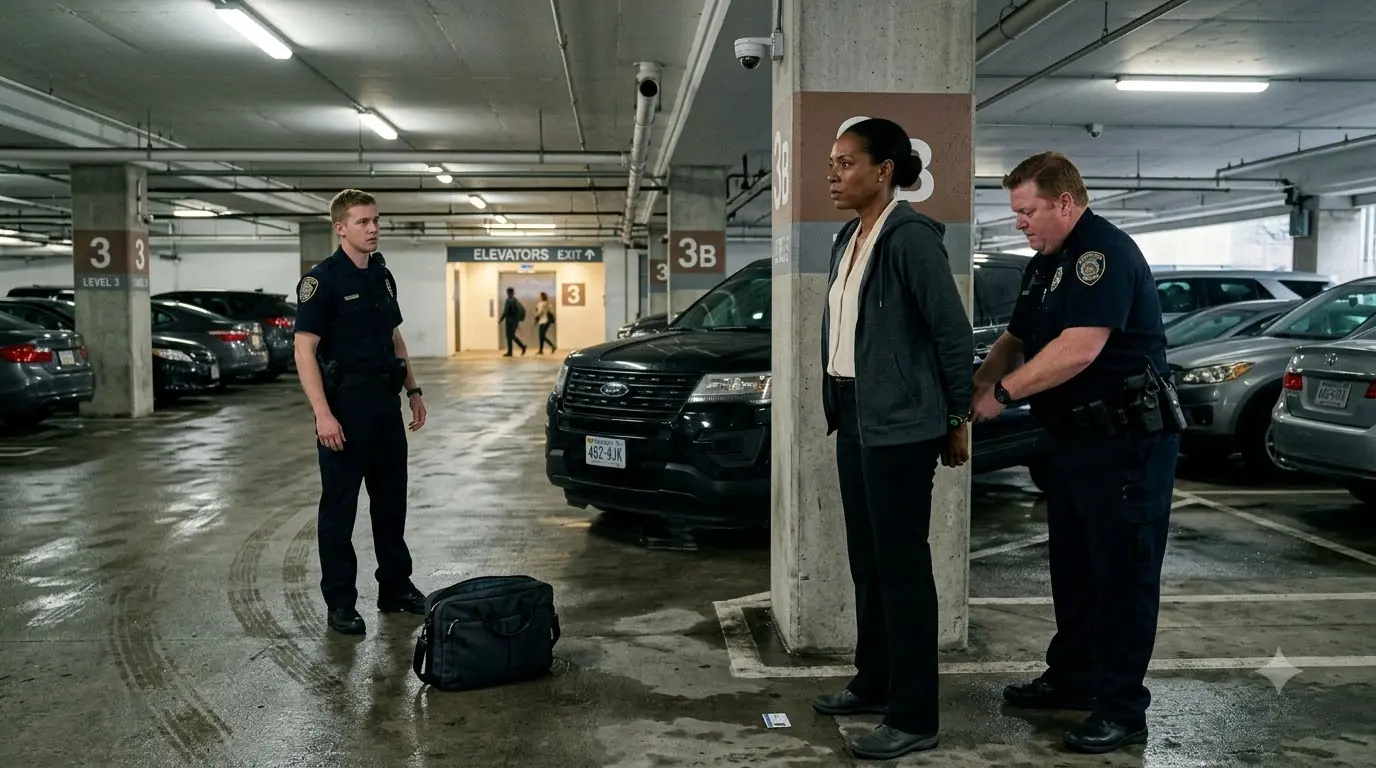
It happened in less than two minutes.
General Angela Witford had parked her vehicle on the third level of the Madison Tower garage, just off Clarendon Boulevard in Arlington, Virginia. She had recently completed a classified briefing at a Department of Defense annex building across the street.
Rainwater still dripped from the hood of her SUV as she reached into her coat pocket for her keys. Angela looked tired but focused, her mind still replaying the final moments of the strategy session.
Then she heard footsteps.
Fast.
Heavy.
Echoing across the concrete level.
“Hands where I can see them!”
The male voice came from behind her.
Angela turned slowly.
Two uniformed police officers were approaching with their weapons drawn and flashlights pointed into her face. One was tall and red-faced. The second was younger, with a nervous movement in his jaw.
“Ma’am, step away from the vehicle!” the younger officer shouted.
Angela raised both hands calmly.
“Officers, I am—”
“Do not move,” the taller officer snapped. “We received a call about a suspicious person tampering with vehicles. You match the description.”
Angela blinked once.
“I am walking to my own car. My name is General Angela Witford. I just came from—”
“Against the wall. Now.”
There was no pause.
Neither officer appeared to register what she said.
They did not request identification or allow her to explain. They simply moved.
The taller officer rushed forward, seized her wrist, and twisted it behind her back. Angela’s laptop bag fell to the concrete with a heavy thud.
Her military service ring scraped against the rough pillar as the officer pulled her other arm back. Angela winced but did not cry out.
“Is this really happening?” she asked quietly.
The question was not directed toward the officers.
She was asking herself.
Angela did not shout or resist. She stood with her cheek near the cold concrete pillar and listened to the metallic rattle of handcuffs closing around her wrists.
Her identification card slipped from her coat pocket and landed beside the taller officer’s boot.
The card clearly displayed her name, military rank, photograph, and a Pentagon security-clearance barcode.
He did not look down.
Angela inhaled slowly.
“Sir, I am a United States Army general. I am unarmed, and I am not resisting. You need to stop and verify my identity.”
“Save it,” the younger officer muttered. “People like you always think they can talk their way out of trouble.”
That sentence made Angela pause.
People like her?
She looked over one shoulder and stared directly into his eyes.
“What exactly do you mean by that?”
The officer did not answer.
The taller man picked up her laptop bag and opened it.
“What is this? Some kind of encrypted device?”
“It is my secured military laptop. It has an inventory serial number. Check the barcode inside the flap.”
They did not check it.
The officers continued opening compartments and moving through the contents. They behaved as though they had already decided who Angela was and why she stood in that garage.
Angela did not panic.
She remained composed.
Not because she was afraid, but because she understood precisely why the situation was unfolding this way.
She remained silent for several seconds.
Then she spoke with careful precision.
“This is not a misunderstanding. This is a mistake with real consequences.”
The younger officer scoffed.
“Lady, you are not in a position to give us warnings.”
Angela did not argue.
She rotated one wrist slightly inside the cuffs and pressed a small button on her smartwatch.
One second passed.
Then two.
A soft vibration confirmed the signal had been transmitted.
It was a secure, real-time emergency alert to the Joint Command liaison office inside the Pentagon’s communications wing.
The alert transmitted her identity, security profile, and exact location.
The call made no sound.
Someone was listening now.
Angela turned her head slightly.
“You have less than ten minutes to determine who I am.”
The taller officer narrowed his eyes.
“Excuse me?”
“I said you have ten minutes before this parking garage becomes very crowded.”
Neither officer stopped.
They continued searching her belongings, still convinced they possessed complete authority over the situation.
To understand how badly they had miscalculated, it was necessary to know who Angela Witford really was.
She was more than a name printed on an identification card.
She was more than the words United States Army General.
Her story began along the dirt roads of Mound Bayou, Mississippi, a small and frequently overlooked town her grandfather proudly described as Wall Street without the press.
Angela grew up inside a house with creaking floorboards and a refrigerator covered in honor-roll ribbons.
Her mother worked as a nurse.
Her father repaired air-conditioning systems and prayed each night that none of his children would ever wear a military uniform unless it was their own choice.
Angela wanted to wear one.
She saw a world filled with rules, authority, and injustice. Rather than turn away, she decided she would understand those rules better than anyone around her.
The Reserve Officers’ Training Corps helped her leave Mississippi.
She attended Jackson State University and later trained at Fort Benning.
From there, her career advanced rapidly.
Angela was intelligent, strategic, and fluent in two languages. She never requested easier treatment because she was a woman serving in a field where women, especially women, rarely advanced beyond middle leadership.
By the age of thirty-eight, she had led operations across four continents.
By forty-five, she was briefing presidents.
She had been deployed, decorated, tested, and trusted with some of the nation’s most sensitive responsibilities.
None of that prevented strangers from seeing only what they expected to see.
Earlier that morning, Angela had led a closed-door briefing concerning cyber-threat deterrence at the Pentagon’s Arlington annex.
Only three generals attended.
Angela was the only person in the room.
She wore her complete uniform during the briefing.
After the session ended, she changed into a hooded coat and slacks before leaving the building.
She did not want attention.
She wanted to reach her vehicle and telephone her driver.
Inside that garage, with two weapons pointed at her and handcuffs pressing into her wrists, none of her achievements seemed to matter.
The officers did not see a general.
They saw a threat.
What disturbed Angela most was that she was not truly surprised.
She had watched similar situations happen to neighbors, strangers, and fellow service members who did not look like others believed they should.
She never expected to become the target herself, especially inside a garage only blocks from a building where she held one of the highest possible security clearances.
Even while restrained, Angela’s mind continued working.
She calculated.
How far were they from the dispatch center?
Were the officers from Arlington Police or a private security contractor?
How quickly would the Pentagon respond to the secure alert?
What angles were covered by the garage cameras?
It was not only survival.
It was strategy.
Angela understood that panic would not protect her.
Protocol might.
She lowered her eyes slightly.
A green light blinked on her watch.
Someone at the other end of the signal was monitoring her location.
Help was coming.
The officers continued behaving as if Angela were an ordinary suspect they had already convicted inside their minds.
“What is a woman like you doing down here anyway?” the taller officer asked with a smug expression. “Were you checking vehicles?”
Angela slowly turned her head.
“You should stop talking.”
“Oh, is that a threat?”
He laughed.
“No,” Angela replied. “It is advice. You will regret every word you are saying.”
The officer tightened the cuffs.
His name was Sergeant Blake Maddox.
Maddox had served on the police force for fifteen years. He disliked being corrected, particularly by women and especially by anyone who challenged his assumptions.
His partner was Officer Trevor Lang.
Lang was newer to the department and constantly attempted to prove himself. He was nervous, uncertain, and frequently looked toward Maddox before acting.
Neither officer possessed a lawful justification for what they did that afternoon.
They responded to a vague report from a woman who claimed someone had been interfering with vehicles inside the garage.
The caller offered no clear description.
There was no confirmed damage.
There was no immediate danger.
It was simply a person with a telephone and an opinion.
When Maddox and Lang entered the garage and saw Angela standing alone in a hooded coat beside a SUV, they did not begin with questions.
They drew their weapons.
They made assumptions.
Then they followed those assumptions as though they were evidence.
Angela did not match their expectation of who belonged inside that part of Arlington.
“Let us check the license plate,” Lang said while reaching toward his radio.
Maddox waved him off.
“No. If she is lying, she will contradict herself. They always do.”
Angela turned her head.
“Do you know what else exposes contradictions?”
Neither answered.
“Body cameras.”
Lang shifted his stance.
“Sergeant, are our cameras operating?”
Maddox gave him an irritated look.
“Of course they are. Standard procedure.”
Angela stared ahead.
“Good. Then the Pentagon will not need to rely only on the garage surveillance system. Your own department’s audio will be included in the investigation.”
Lang paused.
“Did she just say the Pentagon?”
Maddox dismissed him.
“She says many things.”
Even as Maddox laughed, his hands became slower.
Doubt had started entering the space where certainty had been.
Perhaps, for the first time, he considered the possibility that he did not control the outcome.
Angela used the silence.
“I commanded Operation Bronze Drift. I have briefed two presidents.”
She continued without raising her voice.
“Exactly four people in Virginia possess access to the classified information stored on that laptop. Two of them are secretaries of defense.”
Lang blinked.
Maddox laughed again, but it sounded thinner.
“You expect us to believe that?”
“I do not care whether you believe me.”
Angela looked directly at him.
“I care that you seized my property without probable cause, detained me without properly identifying yourselves, and ignored standard procedures for verifying identity.”
Her voice became colder.
“I care that you placed hands on a sitting Army general inside a federal facility.”
Lang moved closer to Maddox.
“Sergeant, perhaps we should examine her identification.”
Maddox’s pride would not allow him to retreat.
“Do not become soft. She is bluffing.”
Angela stopped speaking.
She no longer needed to.
Footsteps sounded from the far side of the garage.
These were different.
Fast.
Precise.
The rhythm of trained personnel moving with purpose.
Three men in dark suits appeared at the end of the level.
Behind them, two uniformed military police officers approached beside a dark vehicle with tinted windows.
Angela shifted slightly.
“That took longer than expected,” she murmured.
Lang’s face became pale.
Maddox straightened, but the moment had already passed.
One of the men in suits raised an identification badge.
“Special Agent Colin Reed, Department of Defense. Step away from the detainee immediately.”
Lang moved backward so quickly that he nearly tripped over Angela’s laptop bag.
Maddox remained in place.
Agent Reed did not blink.
“Now.”
Angela released a slow breath as one of the military police officers unlocked the cuffs.
“Ma’am,” Reed said, lowering his voice, “are you injured?”
Angela looked at her wrists.
“Not physically.”
Maddox remained frozen.
He had not yet understood the full scale of his mistake.
Angela flexed her hands after the cuffs were removed. Her skin was red where the metal had pressed against bone.
She did not complain.
She rubbed her fingers together and kept her attention on Maddox.
Agent Reed faced the officers.
“Did General Witford resist?”
Lang shook his head quickly.
“No, sir. She complied.”
“Did she raise her voice, threaten you, or behave aggressively?”
“No, sir.”
“Did she identify herself?”
Lang hesitated.
“Yes. She said she was a general.”
Reed stepped closer.
“And neither of you considered verifying that statement before restraining her?”
Lang lowered his eyes.
Maddox stared forward as though attempting to disappear into the concrete.
Angela finally spoke.
“This was never about verification. It was about control.”
Reed turned toward her.
“We are reviewing the garage surveillance recordings. The cameras were active, and the Pentagon received your secure alert.”
Angela nodded.
“That is why I transmitted it.”
Two military police officers collected her laptop bag, telephone, and identification card from the floor.
“I want a documented chain of custody for everything they touched,” Angela said.
“Fingerprints, dispatch recordings, vehicle cameras, time stamps, and body-camera audio. Preserve all of it.”
“You will have it,” Reed replied. “A Judge Advocate General officer is already traveling here.”
Maddox finally spoke.
“This is some kind of joke, correct?”
Angela looked directly into his eyes.
“You are right. It is a joke.”
She allowed one second to pass.
“Your career is the punchline.”
Maddox opened his mouth.
Nothing emerged.
Reed gestured toward the command vehicle.
“We will escort General Witford now.”
Then he addressed the officers.
“You will remain here until the Arlington Police Department’s Internal Affairs Division arrives.”
Lang swallowed.
“We are being investigated?”
“You are being documented,” Reed said flatly. “By morning, you will know whether it has become something more.”
Angela walked past the officers with her head high.
She did not look back.
Inside the unmarked vehicle, a young communications officer handed her a secure phone.
“Joint Command is on the line, ma’am.”
Angela accepted it.
Her voice carried the same control she maintained throughout the garage encounter.
“This is General Witford. We have a situation.”
The response came immediately.
“We know. We obtained the body-camera feeds and reviewed the original report. The civilian caller appears to have been mistaken, but the conduct of the officers requires a different conversation.”
Angela remained still.
“I want a complete debrief entered into the official record and routed through legal.”
“Yes, General.”
“I am not requesting apologies. I am requesting protocol and accountability.”
“Understood.”
Angela ended the call.
Not because the matter was finished.
She needed one minute to breathe.
Rain began falling again.
It was not heavy.
Small droplets gathered across the windshield.
Nobody inside the SUV spoke.
Angela looked toward the driver.
“Take me home.”
“Yes, ma’am.”
She leaned against the seat and closed her eyes.
“This country,” she whispered. “I have given it everything, and it still does not recognize me until I display a badge.”
Angela knew the incident was not over.
It had only begun.
By the time she reached her townhouse in McLean, the rain had stopped, though the air remained heavy.
The weight did not come only from the weather.
Her porch light flickered as she climbed the steps.
Angela carried her uniform coat over one arm while her mind continued processing each second of the detention.
She did not sit after entering.
She poured a glass of water, removed her shoes, and opened the message waiting on her secured laptop.
Preliminary Report from the Office of Military Justice.
Angela read it in silence.
Her eyes moved across each line without blinking.
Ten minutes later, her phone rang.
“Angela.”
The caller was Brigadier General Carson Blake.
Blake was direct, a former Marine who did not waste time with unnecessary words.
“We have already received media inquiries. Someone leaked information that local officers detained a high-ranking Army official.”
Angela stood beside the kitchen counter.
“They do not know your name yet,” Blake continued. “They will soon.”
“Let them.”
Blake did not question the answer.
“Are you filing a personal complaint?”
“No. I am allowing the Pentagon and Arlington authorities to handle the investigation.”
Blake waited.
“Are you certain?”
“I am not interested in controlling the public-relations damage. I am interested in consequences and corrected procedure.”
Another pause.
“Understood. For the record, everyone here supports you.”
Angela ended the call without another word.
At the Arlington precinct, Maddox and Lang sat inside a narrow interview room beneath harsh fluorescent lights.
Neither officer was handcuffed.
Neither was comfortable.
A woman wearing a gray suit entered with a thick file.
“I am Captain Yvonne Delgado with Internal Affairs.”
She sat across from them.
“I will make this simple. Would either of you like to explain why you ignored direct identification from a federal official?”
Lang leaned forward.
“She did not look like—I mean, we did not know who she was. She was wearing a hoodie. She did not have identification visible.”
Delgado opened the file.
“She stated her name and rank. Her identification fell beside Sergeant Maddox’s boot. She offered to have her identity verified and remained compliant throughout the encounter.”
Maddox tightened his jaw.
“She was standing beside a SUV. That was all the information we had. You would have done the same thing.”
“No,” Delgado replied without hesitation. “I would not have.”
Maddox stared at her.
“I read reports, verify identities, and do not place civilians in handcuffs because of instinct.”
“You are attempting to make this about race.”
Delgado tilted her head.
“I am not.”
She tapped the file.
“The recordings are.”
Maddox said nothing.
During the following twenty-four hours, the Pentagon’s legal office issued a formal notification to the Arlington chief of police.
The report was precise.
Every movement was documented.
Every second had been recorded.
Angela never raised her voice.
She did not resist.
She repeatedly explained that the officers’ actions lacked justification and asked them to verify her identity.
They refused to listen.
By Wednesday morning, Maddox and Lang were placed on administrative leave.
That afternoon, the police chief held a press conference.
“We take this incident seriously and are cooperating fully with all federal and internal investigations.”
Lang sat alone inside his garage that evening and cried.
The reality had begun reaching him.
His wife was pregnant.
Their child was due in November.
Lang told himself that he had not twisted Angela’s arms or tightened the cuffs.
He had not led the confrontation.
He merely failed to intervene.
He followed Maddox.
That did not make the consequences feel smaller.
Maddox remained defiant.
He told his brother that the incident had been exaggerated.
“People use that kind of accusation when they want attention. She is just another angry government official.”
Nobody inside the department supported that explanation.
Not after watching the video.
Not after hearing the audio.
Certainly not after Angela released a public statement the next day.
It contained only six sentences.
“I did not ask for special treatment. I asked to be seen.
“I did not resist. I complied.
“Still, I was handcuffed, searched, and humiliated while attempting to enter my own vehicle.
“This is not only about me.
“It is about the people who do not have a secure device capable of changing the outcome.
“I had one. They did not.”
The statement spread across the country within four hours.
It did not gain attention because Angela sounded angry.
It gained attention because she was precise.
Calm.
Controlled.
Exactly as she had been inside the garage.
News presenters read her words aloud during morning programs.
People online examined the body-camera timeline.
, Latino, Asian, and white service members began sharing their own quieter versions of similar encounters.
The incident was no longer treated as an isolated scandal.
It became part of a visible pattern.
The country watched.
The Arlington Police Department could not hide the footage.
The body-camera audio was undeniable.
There was no yelling from Angela.
No resistance.
No threatening movement.
Only a calm woman telling two armed officers exactly who she was while they ignored her, restrained her, and treated her as a criminal inside a garage connected to a federal building.
Internal Affairs completed its recommendation.
Sergeant Blake Maddox should be terminated immediately.
Officer Trevor Lang received a choice.
He could resign or face a full disciplinary proceeding.
Lang resigned.
Angela did not celebrate when she learned the result.
She did not smile, open a bottle, or make a public statement.
She sat on her back patio the following morning with a cup of coffee and watched the trees.
The silence expressed more than the headlines.
Later that week, a letter was delivered by hand.
There was no return address.
Inside was one page.
“General Witford,
“I failed to act. I froze and followed when I should have questioned. I did not see you, and for that I am deeply sorry.
“I will carry this for the rest of my life.
“Trevor Lang.”
Angela folded the letter.
She placed it inside a drawer beside old service pins and a photograph of her father wearing a uniform.
That evening, she addressed a class of young cadets through a video call.
Her expression was calm.
Her tone was firm.
“I want each of you to remember something,” she told them. “Your title may carry weight, but your skin enters the room before your résumé.”
The cadets listened.
“People may judge you before you speak. That is not your fault, but it becomes your responsibility to decide how you respond.”
A young female cadet from Tulsa raised her hand.
“Ma’am, were you afraid?”
Angela did not answer immediately.
Then she nodded.
“Yes.”
She looked directly into the camera.
“Not for myself. I was afraid that if I panicked, I would confirm every false assumption they had already made about me.”
That weekend, a national civil-rights organization invited Angela to speak at an event in Dallas.
She declined.
“I do not need a microphone. I need improved policy, training, and accountability. Contact me when those are part of the discussion.”
Instead, Angela wrote a measured opinion article for The Hill.
She also met privately with two state legislators.
There were no press conferences or posed photographs.
Only work.
The Arlington police union released a statement defending Maddox and Lang.
It described the incident as a high-pressure misunderstanding and argued that investigators had not established malicious intent.
Angela read the statement once.
Then she closed the laptop.
She did not respond.
She did not need to.
The truth had already traveled far beyond the parking garage.
For many people, Angela’s silence carried the greatest force.
She did not need to shout.
The officers’ own recordings spoke for her.
Several weeks later, Angela returned to her usual schedule.
Early morning briefings.
Afternoon strategy sessions.
Late-night conversations with overseas counterparts.
A faint outline from the handcuffs remained visible around one wrist.
Angela did not conceal it.
One evening, shortly after nine o’clock, she returned alone to the Madison Tower garage.
She stood at the exact location where the officers detained her.
The same concrete pillar remained there.
The same paint marks.
The same camera watched from the ceiling.
Nobody shouted.
Nobody ordered her to explain why she was present.
Angela stared at the spot for several seconds.
Then she removed her phone and took one photograph.
It was not for social media.
It was not evidence.
It belonged only to her.
The garage was not merely the place where two officers disrespected her.
It was the place where she refused to allow them to define her.
Later that night, Angela opened her journal.
She did not write in it often.
That evening felt different.
“I did everything correctly.
“I followed orders.
“I earned my rank.
“I served.
“Still, they did not see me.
“But I saw them, and I will remember.”
Angela never filed a civil lawsuit.
She never granted an exclusive interview.
The Arlington Police Department changed its procedures anyway.
New identity-verification and de-escalation training was introduced.
A third-party review board was created for uses of force and disputed detentions.
The civilian who originally telephoned the police never came forward publicly.
The recording of the call was later played during training sessions for new recruits.
Sometimes the most important lesson did not appear inside a headline.
It appeared in the silence that followed.
Angela understood what many people believed power looked like.
A sharp suit.
A loud voice.
Someone commanding a room through presence.
She knew another form of power.
The kind that did not need to announce itself.
The kind that moved quietly, spoke carefully, and refused to allow someone else to determine its value.
Her lesson was not limited to race, rank, or professional respect.
It was also about restraint.
Strength was not always loud.
Dignity sometimes remained invisible until someone attempted to take it away.
Angela had carried a title powerful enough to command thousands.
Inside the garage, none of that protected her until a secure signal reached people willing to verify the truth.
The next person might not possess that signal.
They might not carry a clearance card.
They might not have a Pentagon liaison or enough time to wait for help.
That was why the responsibility did not belong only to the person being detained.
It also belonged to every person wearing a badge, carrying a weapon, or exercising authority.
They had to decide whether they were truly listening or merely looking.
Maddox looked and decided.
Lang followed instead of questioning.
Angela listened, calculated, documented, and held the line.
The careers that ended were not destroyed by her rank.
They were destroyed by choices recorded in their own voices.
The dignity Angela carried from the garage never came from the stars on her uniform.
It came from knowing who she was before anyone else was willing to see her.