The gas station on Willow Creek Road was always busy around lunchtime.
Trucks stopped for fuel before heading toward construction sites.
Parents pulled in with children asking for snacks.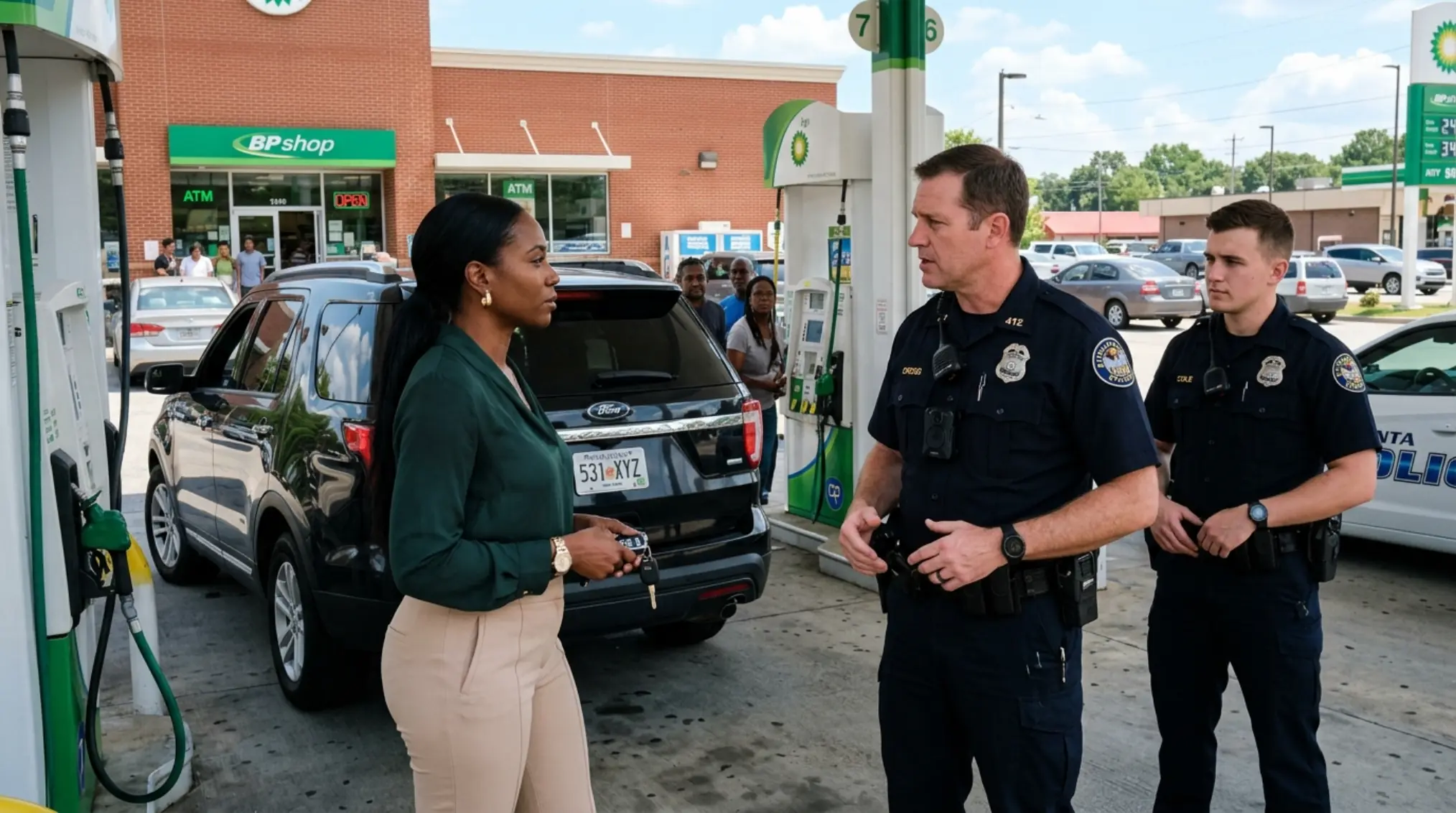
Workers stood outside the convenience store drinking coffee and talking about the heat.
It was the kind of place where everyone noticed everything.
A person arriving late.
A vehicle parked too long.
A conversation that sounded louder than normal.
That afternoon, nobody expected a simple gas stop to become the moment that exposed a much bigger problem.
Ava Bennett had only stopped for ten minutes.
She was traveling back from a meeting in a neighboring county and needed fuel before continuing home.
Her black SUV was parked beside pump number six.
The engine was off.
The receipt was still hanging from the dispenser.
Ava stood beside the vehicle checking an email on her phone while waiting for the gas tank to finish.
She was thirty-five years old, a Black American woman with deep-brown skin, long black hair tied neatly into a low ponytail, and a calm expression that rarely changed even under pressure.
She wore a dark-green blouse, fitted beige pants, small gold earrings, and a simple wristwatch.
To anyone passing by, she looked like an ordinary professional stopping between appointments.
And that was exactly how she wanted it.
Ava had spent years working in compliance investigations.
Her job involved reviewing complicated cases involving organizations, employees, and public accountability.
She knew something important about human behavior.
People often revealed themselves most clearly when they believed nobody important was watching.
That was why she rarely introduced herself by her position.
She believed respect should come before recognition.
Her credentials were inside her handbag.
But she did not expect to need them.
Not that day.
The patrol vehicle arrived while she was putting her phone away.
Officer Daniel Cross noticed the SUV first.
Then Ava.
Cross was forty-five years old, a white American police officer with short brown hair, a serious expression, and fifteen years of patrol experience.
He had built a reputation as someone who trusted instinct.
Sometimes his instincts were correct.
Sometimes they made him move faster than the facts.
His partner, Officer Ryan Cole, was thirty-two years old and newer to the department.
Cole was more cautious.
He listened longer.
He asked more questions.
That difference between them would matter later.
Cross parked behind the SUV.
Ava noticed the cruiser in her mirror.
She watched as the two officers stepped out.
She did not panic.
She simply waited.
Cross approached first.
“Ma’am.”
Ava turned.
“Yes?”
“Can I ask you a few questions?”
Ava looked around.
“About what?”
Cross glanced at the SUV.
“This vehicle yours?”
“Yes.”
“You own it?”
Ava paused.
“Yes.”
Cross looked at the license plate.
Then back at her.
“Registration?”
Ava frowned slightly.
“Why?”
Cross’s expression changed.
“Because I asked.”
Ava remained polite.
“And I’m asking why.”
Cole stood a few steps behind, watching.
He noticed something immediately.
Ava was not refusing to cooperate.
She was asking for context.
Cross did not seem interested in giving any.
“We had a report about suspicious activity in this area.”
Ava looked toward the gas station.
“What kind of activity?”
“Suspicious.”
“That describes a feeling, not an event.”
Cole glanced at Cross.
The younger officer noticed the sentence.
Cross did not like being challenged.
“You always question officers like this?”
Ava looked at him.
“I always ask questions when someone asks me to explain myself.”
Several customers near the convenience store entrance started watching.
A man holding a coffee cup slowed down.
A woman sitting inside her car looked through the windshield.
Cross noticed the attention.
“Ma’am, let’s keep this simple.”
“I agree.”
“Then show me your identification.”
“Why?”
Cross sighed.
“You’re making this harder.”
Ava shook her head.
“No.”
She pointed slightly toward the gas pump.
“I’m standing here fueling my car.”
“I’m asking for identification.”
“And I’m asking for the reason.”
The officer stepped closer.
“You have a problem giving your ID?”
“No.”
Ava looked directly at him.
“I have a problem being treated like I already did something wrong.”
Cole looked away.
That sentence hit closer than he expected.
Cross crossed his arms.
“Nobody said you did something wrong.”
“Then why am I being questioned like I did?”
The silence lasted a few seconds.
Cross looked toward the SUV.
Then toward the convenience store.
“Open the vehicle.”
Ava’s expression changed.
“Excuse me?”
“Open the vehicle.”
“For what?”
“Inspection.”
Ava looked at him.
“Under what authority?”
Cross’s jaw tightened.
“You know, people who have nothing to hide usually cooperate.”
Ava almost smiled.
“That is not how the law works.”
Cole stepped forward.
“Daniel.”
Cross looked at him.
“What?”
“Do we have a reason to search?”
Cross stared.
“We have a concern.”
Cole hesitated.
“That’s not exactly the same.”
Cross’s face hardened.
“Are you questioning me?”
“No.”
Cole lowered his voice.
“I’m asking.”
Ava noticed the difference.
One officer wanted control.
The other wanted clarity.
She reached for her handbag.
Cross immediately reacted.
“Slowly.”
Ava stopped.
She looked at him.
“I’m getting my wallet.”
Cole noticed the unnecessary tension.
“Daniel.”
Cross ignored him.
Ava opened her handbag.
Inside were ordinary items.
A phone charger.
A notebook.
Keys.
A small makeup pouch.
A black leather credential wallet.
Cross saw the wallet.
“What’s that?”
Ava looked at it.
“My identification.”
Cross extended his hand.
“Give it to me.”
Ava did not move immediately.
“You requested identification.”
“Yes.”
She handed him the wallet.
Cross opened it.
At first, he seemed satisfied.
Then he stopped.
The expression on his face changed.
The confidence disappeared.
Inside was an official credential card.
AVA BENNETT.
STATE OFFICE OF PROFESSIONAL STANDARDS.
COMPLIANCE INVESTIGATOR.
Cole stepped closer.
“What is it?”
Cross did not answer.
He kept looking at the card.
Ava calmly took it back.
“Something wrong?”
Cross looked uncomfortable.
“You’re an investigator?”
“Yes.”
Cole looked at her.
“Why didn’t you say that?”
Ava placed the wallet back into her handbag.
“Why would I?”
Cross frowned.
“Because it changes the situation.”
“No.”
Ava looked at him.
“It changes how you see me.”
Neither officer answered.
The people nearby noticed the change.
The woman inside the car.
The man with coffee.
The cashier watching through the window.
Everyone saw it.
A few seconds earlier, Ava was a stranger being questioned.
Now she was someone with a title.
The difference was obvious.
And that was exactly the problem.
Ava looked at Cross.
“If I wasn’t an investigator, would your questions have been different?”
Cross immediately responded.
“No.”
Ava waited.
He did not continue.
She nodded.
“That silence answered for you.”
Cross became defensive.
“I was doing my job.”
“Then explain your job.”
He looked confused.
“What?”
“Explain what crime you were investigating.”
Cross hesitated.
“Suspicious activity.”
“Describe it.”
A pause.
“A report.”
“What report?”
“Someone reported something unusual.”
“What unusual thing?”
Cross looked toward the gas station.
He did not have an answer.
Cole stepped back.
He knew.
The stop had been built on suspicion without facts.
Ava turned toward him.
“Officer Cole.”
“Yes?”
“Did dispatch provide my vehicle description?”
Cole shook his head slightly.
“No.”
“Did dispatch provide my description?”
“No.”
“Did anyone identify me as committing a crime?”
“No.”
Cross interrupted.
“This is unnecessary.”
Ava looked at him.
“No.”
Her voice remained calm.
“This is the necessary part.”
She pointed toward the body camera.
“The part where everyone remembers what actually happened.”
The situation became quieter.
Cross looked around.
More phones were visible now.
The gas station manager had stepped outside.
Ava did not ask anyone to record.
She did not need to.
The truth was already being preserved.
The officers eventually contacted their supervisor.
Sergeant Michael Collins arrived twenty minutes later.
He listened to both sides.
Then watched the body-camera footage.
The video showed everything.
Cross approaching.
The questions.
The lack of explanation.
The request for identification.
The attempt to move toward a search.
The moment Ava opened her bag.
The moment the badge appeared.
Collins watched the footage twice.
Then looked at Cross.
“Why did you stop her?”
Cross repeated the same explanation.
“Suspicious activity.”
“Based on what?”
A silence followed.
Collins looked disappointed.
“Daniel.”
The officer looked away.
“You had no description?”
“No.”
“No vehicle connection?”
“No.”
“No reported crime involving her?”
“No.”
“Then why?”
Cross had no answer.
Collins turned toward Ava.
“Do you want to file a formal complaint?”
Ava thought.
“Yes.”
Cross looked surprised.
She continued.
“Not because I have a badge.”
She looked around the gas station.
“Because nobody should need one.”
The complaint investigation lasted several months.
It did not focus only on Cross.
Investigators reviewed department procedures.
They examined previous encounters.
They interviewed officers.
They reviewed body-camera footage.
They discovered a pattern.
Not necessarily intentional misconduct every time.
But a pattern of assumptions.
People who questioned officers were often described as uncooperative.
People who requested explanations were sometimes labeled difficult.
People who knew their rights were sometimes treated as suspicious.
The problem was not that officers asked questions.
The problem was when questions became conclusions.
Officer Cole was interviewed.
Investigators asked him what he noticed.
He answered honestly.
“She was calm.”
“Was she aggressive?”
“No.”
“Did she refuse to answer?”
“No.”
“Did she threaten anyone?”
“No.”
“Then why did the situation escalate?”
Cole paused.
“Because we expected it to.”
That answer became one of the most important statements in the review.
Expectations shaped behavior.
The department created new training afterward.
Officers were reminded that a person asking for justification was not automatically resisting.
They were trained to separate suspicion from evidence.
They were required to explain the reason for certain investigative actions clearly.
The store manager later thanked Ava.
“I watched the whole thing.”
Ava nodded.
“I know.”
“I thought once they saw your credentials, they would apologize.”
“They did not.”
The manager looked confused.
“They didn’t?”
Ava shook her head.
“That’s not the lesson.”
“What is?”
“The lesson is they should have treated me properly before they knew my job.”
Months later, Ava returned to the same gas station.
The same pumps.
The same convenience store.
The same parking lot.
A young employee recognized her.
“You’re the woman from before.”
Ava smiled.
“I guess I am.”
“Everyone knows that story.”
Ava looked at the fuel pump.
“That’s unfortunate.”
“Why?”
“Because it should not be unusual.”
The employee thought about that.
Then nodded.
Ava started her vehicle.
Before leaving, she looked at the gas station entrance.
That day had never really been about the badge.
The badge only revealed a truth that already existed.
She deserved respect before anyone knew her position.
Before anyone knew her career.
Before anyone knew her name.
And that was the mistake Officer Cross made.
He thought the biggest surprise would be discovering who Ava Bennett really was.
But the real surprise was realizing who she had been the entire time.
Just a person who deserved to be treated fairly.