Power is not always worn like an expensive suit, announced at press conferences, or exercised from a corner office overlooking a city.
Sometimes true power is quiet. Sometimes it is cultivated inside a community garden and carried in the calloused, gentle hands of an eighty-year-old woman.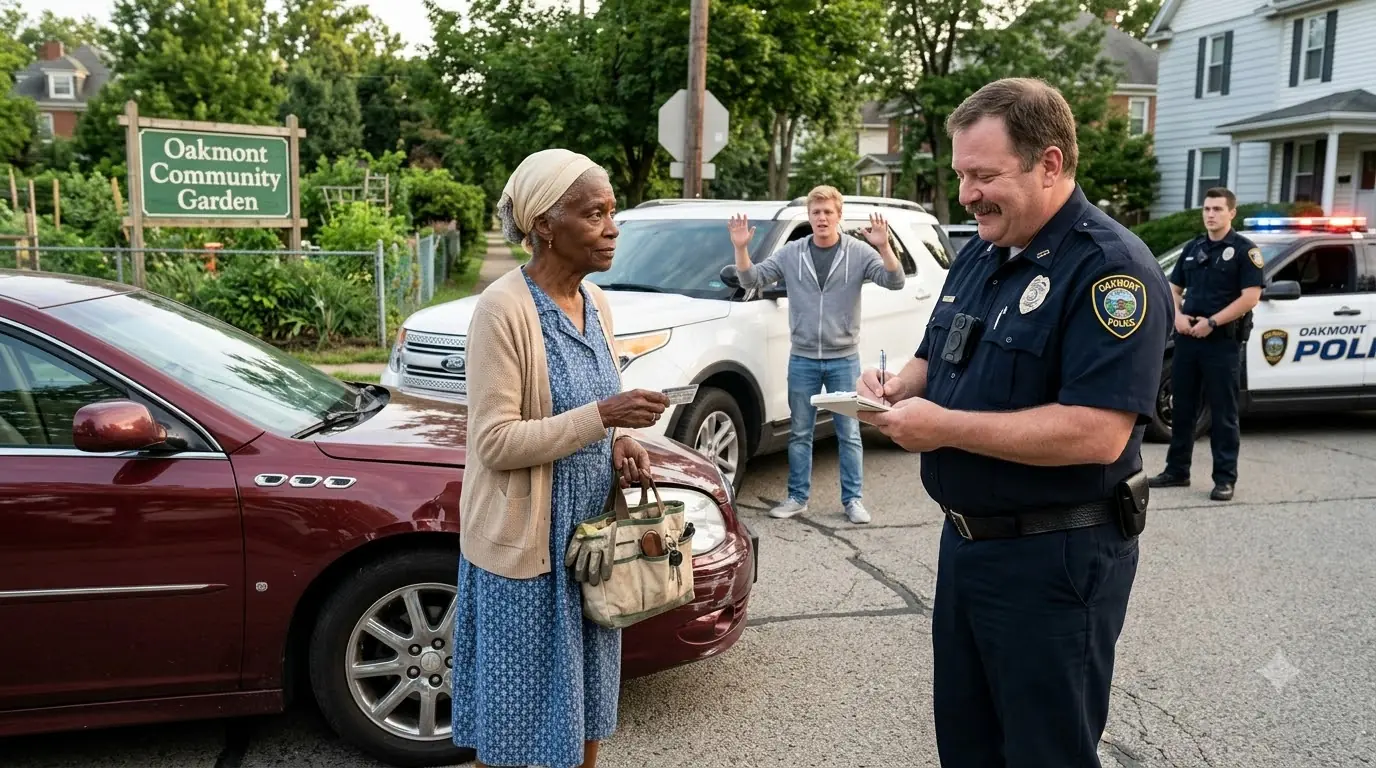
What happens when that quiet strength is mocked by the very people sworn to protect it?
Two police officers believed they were merely amusing themselves at the expense of a frail elderly Black woman after a minor traffic accident. They saw her as invisible, unimportant, and incapable of challenging their version of events.
They did not realize they were writing the final chapter of their careers.
They had no idea who her son was.
The afternoon sun of mid-September rested warmly across Mina Vance’s back. At eighty years old, she moved with a deliberate and graceful slowness that concealed the strength still present inside her hands.
Those hands, wrinkled and mapped with the lines of a long life, were tending the prize-winning roses inside Oakmont Community Garden. The garden was a vibrant patch of green Mina had personally fought to establish more than twenty years earlier.
It had become her sanctuary.
The garden offered quiet communion with the earth, a peaceful contrast to the concrete, traffic, and distant sirens of the city surrounding it. The scent of lavender and damp soil filled the air that afternoon.
Mina finished removing the last weeds and packed her small trowel and gardening gloves into a canvas bag.
Her 2008 Buick Lucerne waited along the curb.
The car was as reliable and unassuming as Mina herself. It was fully paid for, carefully maintained, and capable of taking her to the garden, the grocery store, and the church where she volunteered every Sunday.
It was everything she needed.
Mina lowered herself into the driver’s seat, her joints protesting with a familiar ache. She placed the canvas bag beside her, fastened her seat belt, and started the engine.
As she pulled away from the curb, she signaled, checked both mirrors, and entered the street with the practiced caution of someone who had driven safely for more than sixty years.
She was only three blocks from her small but immaculate house on Sycamore Street when it happened.
A sleek new SUV came speeding down a side road and passed directly through a stop sign.
Mina reacted immediately.
Her foot struck the brake. The Buick’s tires cried against the pavement, but there was not enough distance to prevent the collision.
The SUV clipped the front corner of her car with a harsh crunch of metal and broken plastic.
Mina’s head moved forward, and the seat belt tightened sharply across her shoulder. For several seconds, the world became a confusion of noise, shock, and sudden stillness.
A young man wearing a backward baseball cap jumped out of the SUV.
He could not have been older than twenty-five. Panic covered his face.
“Oh my God, I’m so sorry,” he stammered. “I was looking at my phone. I didn’t see the stop sign.”
Mina remained still for a moment, confirming that she could move her arms and legs. Then she unfastened the seat belt and carefully opened her door.
“It is all right, young man,” she said, though her voice trembled slightly. “The important question is whether you are hurt.”
“No. No, I’m fine.”
The young man gestured helplessly toward Mina’s damaged Buick.
“Your car, though.”
The Buick’s bumper was crumpled, and one headlight had shattered. The expensive SUV had suffered little more than a scrape.
Within minutes, the red and blue lights of a police cruiser washed across the street.
Two officers emerged.
The older officer had a thick mustache and carried himself with the weary slouch of a man who believed he had already seen everything worth seeing. His name was Officer Rick Miller.
His younger partner, Officer Ben Davis, possessed a nervous energy and seemed constantly uncertain whether he should follow Miller or question him.
Miller examined the scene.
His gaze paused on Mina’s old vehicle, her simple cotton dress, and the color of her skin. Then he looked at the young driver standing beside the expensive SUV.
A complete explanation seemed to form inside his mind before he asked a single question.
“All right,” Miller said with bored impatience. “What happened?”
The young driver appeared relieved by the officers’ arrival.
“It was my fault,” he said immediately. “I went through the stop sign because I was looking at my phone. I already told her it was all on me.”
Mina nodded.
“That is exactly what happened. He admitted it as soon as he got out.”
Officer Miller ignored her and kept his attention on the young man.
“You were using your phone?”
“Yes, Officer.”
“License and registration.”
The young man quickly retrieved the documents.
As he handed them over, Miller leaned slightly closer and lowered his voice in a way meant to sound reassuring.
“Don’t worry, son. We’ll get this sorted out.”
He then turned toward Mina.
“Ma’am, I need your license and registration.”
Mina returned to her vehicle, opened the glove compartment, and found the requested documents.
When she handed them to Miller, his fingers touched hers with a faint suggestion of disdain.
He examined her address.
“Sycamore Street,” he murmured. “Figures.”
Miller and Davis returned to their patrol car.
Through the open window, Mina heard fragments of their conversation. Davis spoke quietly, but Miller’s voice carried with condescending confidence.
Mina saw Miller gesture first toward her Buick and then toward the young man’s SUV.
He laughed.
When the officers returned, Miller’s entire demeanor had changed.
He handed the young driver’s documents back.
“All right. We have your statement.”
Then he faced Mina with a faint smirk.
“Ma’am, based on my assessment of the scene, it appears you pulled out in front of him. Failure to yield.”
Mina stared at him.
“What?”
“The damage to your front corner is consistent with you entering his lane.”
“But he went through the stop sign,” Mina replied. “He told you he went through it.”
The young driver looked equally confused.
“Wait. I said it was my fault.”
“Son, you were shaken. People often misremember things after a collision.”
“I’m not misremembering anything. I was looking at my phone.”
“The physical evidence tells a different story.”
Mina pointed toward the stop sign.
“The sign is right there. He drove through it.”
Miller chuckled again, louder and crueler than before.
Davis shifted his weight and looked toward the ground, but he said nothing.
“A stop sign,” Miller repeated, as though Mina had introduced a complicated concept.
He looked at her with patronizing amusement.
“Listen, Grandma. Why don’t you let us handle this? We know what we’re doing.”
Miller removed his citation pad.
“I’m going to issue you a ticket.”
Tears of frustration and humiliation filled Mina’s eyes.
It was not only the citation or the damage to her car. It was the laughter and the ease with which Miller dismissed her account.
She felt herself being reduced from a human being to a stereotype, from a respected citizen to an inconvenience.
“This is not right,” she whispered.
Miller tore the citation from the pad and held it toward her.
“Life isn’t always fair.”
He winked.
“Have a good day.”
Miller and Davis returned to their cruiser.
Their laughter followed them down the quiet street and remained in Mina’s ears long after the patrol car had disappeared around the corner.
She stood beside her damaged Buick with the flimsy citation trembling inside her hand.
The drive home passed in a blur.
Mina’s hands shook so badly that she had to grip the steering wheel until her knuckles became pale. A grinding sound from the damaged wheel well followed every turn.
When she reached her driveway, she pulled into the garage and turned off the engine.
Then she sat there.
The silence magnified the roaring inside her thoughts.
Humiliation left a hot, bitter taste inside her mouth.
Mina had lived through the civil rights movement. She had witnessed open hatred, heard cruel names, and watched doors close because of the color of her skin.
She understood that kind of prejudice.
What Miller had done felt different.
It was the casual poison of being declared irrelevant. His laughter suggested she was not even worth the effort of direct hostility.
She was simply a joke to him.
Her first instinct was to call her son.
Marcus would correct this.
Marcus would demand answers from the police department. One telephone call from him could place Officers Miller and Davis beneath the kind of scrutiny they had never imagined.
After all, Marcus Vance was the mayor.
The thought brought Mina a brief flash of satisfaction.
She reached into her purse and placed her fingers around the worn leather case of her telephone.
Then she stopped.
What would she tell him?
A police officer was unkind to your mother?
Marcus was responsible for a city of nearly two million residents. He was managing union negotiations, a budget crisis, public transportation problems, and infrastructure projects worth billions of dollars.
Compared with all of that, a damaged bumper, a traffic ticket, and her wounded pride seemed small.
For forty years, since Marcus’s father had died, Mina had taken pride in her independence.
She had raised her son to stand on his own feet. She had tried to live by the same rule.
Calling him now felt like weakness. It felt like using his office as a personal shield.
Marcus already had enough battles without worrying about his elderly mother.
“No,” Mina whispered to herself.
She would handle the matter on her own.
She was Mina Vance.
She had challenged hospital administrators during her nursing career and confronted stubborn city council members while fighting to establish the community garden.
She could handle two arrogant patrol officers.
The following morning, Mina called the non-emergency number for the Oakmont Police Department.
After navigating a long automated system, she was finally connected to a desk sergeant who sounded as if he were being paid according to the number of times he yawned.
Mina explained everything calmly.
She described the young driver’s admission, the stop sign, the damaged vehicles, Officer Miller’s false conclusion, and the laughter she heard before the officers left.
“And the officers’ names?” the sergeant asked flatly.
“Miller and Davis. Officer Rick Miller wrote the citation.”
A pause followed.
Mina heard typing.
“I see the report filed by Officer Miller. It states that you entered the roadway without yielding. That matches the citation you received.”
“Yes, but the report is wrong,” Mina said. “The other driver admitted fault in front of both officers.”
“If you wish to contest the citation, you may do so on your court date.”
“He falsified the report. He also mocked me.”
“If you want to file a complaint against an officer, you must come to the Twelfth Precinct and complete a civilian complaint form in person.”
“The Twelfth Precinct is across the city.”
“That is the procedure.”
“It would take me nearly an hour and a half by bus. My car is damaged.”
“That is the procedure,” he repeated.
His tone carried the finality of a door closing.
The sergeant offered no assistance, sympathy, or alternative.
Mina ended the call feeling a fresh wave of despair.
The system was not merely indifferent.
It seemed designed to be difficult enough that people like her would surrender.
At that same time, inside a small apartment overlooking the intersection, a young graphic designer named Maria Sanchez was still thinking about what she had witnessed.
Maria had been watering plants on her balcony when the accident occurred.
She saw the SUV pass through the stop sign.
She heard the young driver admit fault.
She watched the officers ignore him and belittle the elderly woman.
The entire scene had made her furious.
Maria did not know Mina, but she recognized injustice.
She had tried to reach the street before everyone left, but by the time she came downstairs, the officers were gone and Mina was driving away.
Maria did, however, have her phone.
She had recorded a thirty-second video showing the officers walking toward their patrol car, glancing back at Mina, and laughing.
The clip did not show the entire encounter, but it showed enough.
Without Mina’s knowledge, Maria began doing what Mina had refused to do.
She acted.
Maria found the telephone number for the mayor’s Office of Constituent Services.
She did not expect to speak directly to the mayor. She only wanted to leave a detailed witness statement.
The call went to voicemail.
Maria described everything.
She provided the time, location, vehicle descriptions, and officer names. She explained that the elderly woman had remained calm while the officers treated her dismissively.
“I recorded part of what happened,” Maria said. “They laughed at her after issuing the ticket. It was a disgusting abuse of authority.”
Her message became a small electronic seed of rebellion planted inside city hall.
Mayor Marcus Vance sat at the head of a gleaming mahogany table inside a conference room overlooking downtown Oakmont.
The air carried the aroma of expensive coffee and controlled ambition.
Marcus was surrounded by his chief of staff, the city planner, financial advisers, and a group of developers presenting a major waterfront revitalization project.
Detailed images of glass towers, public parks, and modern transportation corridors covered the table.
This was Marcus’s world.
It was a world of billion-dollar budgets, long-term planning, and carefully measured political decisions.
At forty-five years old, Marcus was the youngest mayor in Oakmont’s history. He had built a reputation as a calm, articulate, and intensely intelligent leader.
He had campaigned on police accountability, community investment, and institutional reform.
His assistant, Amelia, entered quietly and placed a tablet in front of him.
Amelia was young, efficient, and familiar enough with Marcus’s priorities to know which messages required immediate attention.
The tablet displayed a transcript from the constituent voicemail system.
A red flag marked the message as urgent.
The subject line read:
Police Misconduct Complaint—Witness Report.
Marcus raised one hand, interrupting the developer who was speaking.
“One moment, gentlemen.”
He read the transcript.
Caller: Maria Sanchez.
Traffic incident at Chestnut and Third.
September, approximately 3:45 p.m.
Older Buick involved.
Young driver admitted passing through a stop sign while distracted.
Officers ignored admission and blamed elderly Black woman.
Report may have been falsified.
Officers condescending and dismissive.
Witness possesses short video of officers laughing.
Marcus felt a familiar frustration tighten inside his chest.
The name Miller appeared in the report.
He knew the name.
Rick Miller already had a thick record of civilian accusations, none of which had resulted in meaningful discipline. The police union had challenged every attempt to investigate him, and previous internal reviews had ended without consequence.
As Marcus continued reading, frustration gave way to something colder.
Elderly Black woman.
Older-model Buick.
Chestnut and Third.
The location was only two blocks from the community garden.
His mother’s garden.
Mina drove a 2008 Buick Lucerne.
Marcus pictured her kneeling beside her roses with soil on her hands.
A wave of nausea moved through him.
It could be a coincidence, he told himself.
Oakmont contained many elderly women and many old cars.
But the details were too precise.
The location.
The vehicle.
The quiet dignity Maria described.
Marcus knew that dignity.
He had been raised by it.
The conference room faded around him.
The city planner, the developers, and the expensive presentation became distant noise.
Marcus saw his mother standing alone beside a damaged car while uniformed officers laughed at her.
He saw the woman who had worked double shifts as a nurse to put him through law school.
He saw the woman who had endured discrimination her entire life without surrendering her faith or dignity.
The thought of two officers employed by his city treating her that way ignited a rage so intense that it nearly stole his breath.
Marcus stood abruptly.
The legs of his chair scraped against the polished floor.
Everyone stopped speaking.
“Amelia,” he said quietly.
The warmth had disappeared from his voice.
“Cancel the rest of my afternoon.”
“Mr. Mayor,” his chief of staff asked, “is something wrong?”
Marcus did not look at him.
His eyes remained fixed upon the tablet, though he was no longer reading the words.
“Get Police Chief Peterson on the telephone immediately.”
Marcus left the conference room.
Amelia was already making the call as he moved through the hallway toward his private office.
The carefully maintained separation between Marcus Vance the mayor and Marcus Vance the son collapsed.
What remained was a man consumed by a single cold purpose.
Someone had harmed his mother.
He intended to discover exactly what had happened.
Police Chief Frank Peterson understood the delicate dance of politics.
A thirty-year veteran, he had served beneath several mayors and learned how to survive their public outrage, private demands, and shifting priorities.
When his private line rang and his secretary announced that Mayor Vance was calling, Peterson leaned back in his leather chair.
He assumed the conversation concerned upcoming union negotiations.
“Frank,” Marcus said without greeting, “there was an incident yesterday at approximately 3:45 p.m. on the corner of Chestnut and Third.”
Peterson sat straighter.
“A traffic accident involving Officers Rick Miller and Ben Davis.”
Miller.
Of course it was Miller.
Peterson had privately described him more than once as a lawsuit waiting for the proper moment to happen.
“I can investigate, Mr. Mayor. Do you have the complaint number?”
“Forget the complaint number.”
Marcus’s voice cracked through the telephone.
“I have a witness report stating that your officers ignored an admission of fault, fabricated an accident report, issued a wrongful citation to an elderly woman, and behaved in a manner that was contemptuous and unprofessional.”
Peterson’s expression tightened.
“I want the incident report, a copy of the citation, and body-camera footage from both officers on my secure server within the hour,” Marcus continued. “I also want their complete personnel files, including every complaint ever filed against them, whether substantiated or not.”
The force and specificity of the demand caught Peterson unprepared.
This was not ordinary political posturing.
Something about this incident was personal.
“Mr. Mayor, I can send the report, but body-camera footage and personnel documents are governed by procedures. There are union considerations and—”
“This is not a request, Frank.”
Marcus’s voice dropped.
“This is an official inquiry into a potential miscarriage of justice by members of the Oakmont Police Department.”
“Mayor Vance—”
“If those files are not on my secure server within sixty minutes, our next conversation will include the city attorney and members of the press.”
Peterson sat fully upright.
“Do you understand me?”
“Yes, Mr. Mayor.”
“Good.”
The call ended.
Peterson remained still for several seconds, an uneasy knot tightening inside his stomach.
Then he called for his aide.
“Get me everything connected to yesterday’s traffic incident at Chestnut and Third. Officers Miller and Davis.”
“Everything?”
“Body cameras, report history, personnel complaints, patrol-car files. Everything.”
He leaned forward.
“The mayor’s office wants it now.”
At the Twelfth Precinct, Officers Miller and Davis were finishing their shift and trading jokes near the coffee machine when their sergeant approached.
His expression was grim.
“Miller. Davis. My office.”
Inside the cramped room, the sergeant threw a memorandum onto the desk.
“The chief’s office just ordered your report and body-camera footage from yesterday’s collision.”
“The one with the old woman?” Miller asked.
“Yes.”
Miller leaned back.
“Seriously? Over that?”
“They also want your full personnel files.”
Davis became pale.
“The mayor’s office wants this?”
“That is what I was told.”
Davis looked toward Miller.
“Why would the mayor care about a traffic citation?”
“I’m sure it’s nothing,” Miller replied with a dismissive wave, though irritation crossed his face. “Some constituent complained. The mayor has to appear concerned, and then it disappears.”
“You had better hope that is what happens,” the sergeant warned. “I have watched small inquiries become full Internal Affairs investigations.”
“Our report is accurate,” Miller said confidently. “She entered the road. End of story.”
As they left the office, Davis could not escape a growing sense of dread.
He remembered Mina’s expression, the quiet manner in which she had absorbed Miller’s ridicule.
He remembered laughing.
At the time, he had been carried along by Miller’s confidence and the unhealthy loyalty of their partnership.
Inside the harsh fluorescent light of the precinct, the memory felt cheap and shameful.
“You don’t think this could become a problem, do you?” Davis asked.
Miller struck him firmly on the shoulder.
“Relax. Who are they going to believe? Two decorated officers or an elderly woman driving an old car?”
He grinned.
“Trust me. We are untouchable.”
As the digital files moved from the precinct server to the chief’s office and then into the encrypted network of city hall, the machinery of accountability began turning against him.
Marcus did not go home that evening.
He went to the place that had anchored him all his life.
The small house on Sycamore Street.
He found Mina in the backyard, sitting inside her favorite wicker chair. A cup of chamomile tea steamed on the small table beside her.
She was looking toward her roses, but her eyes seemed focused somewhere far beyond them.
New lines of exhaustion surrounded her mouth.
“Mama,” Marcus said softly.
Mina turned.
A tired smile appeared but did not reach her eyes.
“Marcus. What a surprise. I wasn’t expecting you.”
He sat in the chair opposite her.
Marcus did not ask about her day or explain why he had come.
He reached across the space between them and took her hand.
“Why didn’t you tell me what happened?”
Mina’s smile disappeared.
For a moment, she seemed ready to deny everything or dismiss it as unimportant.
Something in her son’s expression prevented her.
The wall of composure she had maintained since the accident broke.
Mina told him everything.
She described the collision and the young driver’s admission. She told Marcus how Miller ignored the evidence, issued the citation, called her Grandma, and laughed.
More importantly, she told him how it felt.
“It wasn’t the ticket,” Mina said, tears gathering inside her eyes. “It was the way they looked at me.”
Marcus held her hand more tightly.
“They looked at me as though I were nothing. Like a piece of dust they could brush aside.”
Her voice weakened.
“I felt foolish.”
“You are not foolish,” Marcus said. “You are the strongest person I know.”
He looked toward the roses she had cultivated.
“They are the fools.”
Marcus remained with her for another hour.
He let Mina express the anger, shame, and sadness she had tried to suppress.
When he finally left, the sun was setting and long shadows stretched across the lawn.
The resolve he had felt at city hall had hardened into something unbreakable.
Back inside his office, Marcus opened the secure files sent by Chief Peterson.
He began with Officer Miller’s written report.
It was a carefully constructed fabrication.
Miller described Mina’s Buick as entering the roadway without yielding. He wrote that the other driver had attempted evasive action.
The young man’s repeated admission was entirely omitted.
Marcus opened the first body-camera recording.
It came from Officer Davis’s camera.
The camera angle showed mostly Miller’s back, but the audio was clear.
Marcus heard the young driver say he had been using his phone.
He heard the driver admit running the stop sign.
He heard Mina calmly explain what happened.
Then he heard Miller ignore them.
Marcus opened Miller’s recording.
This camera pointed directly toward Mina.
He saw his mother standing small but upright beside her damaged Buick.
He saw the reflection of Miller’s smirk in the car window.
Then he heard the laughter.
It was not a quiet chuckle.
It was a loud, belittling expression of contempt.
Marcus watched Miller hand Mina the citation and wink.
He saw the hurt inside his mother’s face.
Marcus closed the laptop with enough force to shake the desk.
A strangled sound escaped his throat.
He paced the office.
For several minutes, he wanted to destroy both officers. He wanted to use the full weight of his office to strip away everything they valued.
He wanted them to feel a fraction of the humiliation they had inflicted on his mother.
But Marcus was still the mayor.
His anger had to become something more precise than revenge.
It had to become accountability.
He called Chief Peterson again.
The chief answered immediately.
“Did you receive the files, Mr. Mayor?”
“I did.”
Marcus’s voice was calm.
“I watched both recordings.”
Peterson remained silent.
“I watched Officer Rick Miller ignore a direct admission of fault, falsify an official report, silence a witness, and mock an eighty-year-old citizen.”
Marcus paused.
“I have several questions for you, Frank. Before I ask them, you need to understand the context.”
Peterson waited.
“The elderly woman in that recording has a name.”
Marcus spoke each word slowly.
“Her name is Mina Vance.”
Silence.
Marcus allowed the name to settle.
“She is my mother.”
The silence on the other end became absolute.
Marcus could almost picture Peterson’s face becoming pale as the political implications formed inside his mind.
The department had not simply mistreated a citizen.
Its officers had humiliated the mother of Oakmont’s mayor.
The game had changed.
After nearly ten seconds, Peterson found his voice.
“Mr. Mayor, I had no idea.”
“Why would you?”
Marcus’s voice was cold.
“To your officers, she was simply an anonymous elderly Black woman driving an old car.”
“Mayor Vance, I will open an Internal Affairs investigation immediately. I will assign my best investigators.”
“Your best investigators will be expected to prove they are good enough.”
“Yes, sir.”
“This will not be an ordinary review that disappears after six months. I want a full investigation beginning now.”
Marcus moved toward the office window.
“Miller and Davis are to be placed on administrative leave immediately. Not desk duty. Leave.”
“Understood.”
“They are not to use city vehicles, enter restricted buildings, or exercise police authority until the review concludes.”
“Yes, Mr. Mayor.”
“And Frank?”
“Yes?”
“Do not call me Marcus again.”
Peterson closed his eyes.
“Understood, Mayor Vance.”
Marcus ended the call.
The consequences reached the Twelfth Precinct within the hour.
The captain summoned Miller and Davis into his office.
“I received an order directly from the chief,” he said. “You are both on administrative leave, effective immediately.”
Miller stared.
“For what?”
“Turn over your badges and service equipment.”
“For that traffic stop?”
“I was not provided details.”
The captain was lying, but he had no interest in revealing what he knew.
“All I know is that the order came from the top.”
Davis’s hands trembled as he removed his badge and placed it on the desk.
Miller remained defiant.
“This is nonsense. It’s because of that old woman, isn’t it? She knows someone.”
“You can discuss it with your union representative from home,” the captain said. “Now hand over the badge.”
Miller hesitated before obeying.
The captain pointed toward the door.
“Leave my precinct.”
Stripped of their authority, Miller and Davis walked through the station in stunned silence.
Other officers watched them go.
Some looked curious.
Others made little effort to hide their satisfaction. Miller’s reputation as an abusive officer had earned him few genuine allies.
The following morning, two Internal Affairs detectives arrived.
Detective James Harding was a meticulous veteran known for his patience and refusal to be intimidated.
Detective Lena Chen was younger, highly skilled in digital forensics, and known for finding evidence other investigators overlooked.
They were the investigators Peterson selected when he was genuinely afraid of the outcome.
Harding and Chen sealed Miller and Davis’s lockers and secured the computer systems inside their patrol car.
Their first interview was with the young driver of the SUV.
His name was Kevin Riley.
Without Miller standing nearby, Kevin was eager to tell the truth.
“I told them it was my fault,” he said. “I must have said it three or four times.”
He placed both hands against the table.
“I was looking at my phone. I went through the stop sign. I hit her car.”
“What did Officer Miller do?” Harding asked.
“He ignored me. He acted like he was helping me by telling me to stop talking.”
Kevin shook his head.
“It felt wrong. He had already decided she caused it.”
Harding and Chen then interviewed Miller and Davis separately.
The rooms were sterile, windowless, and intentionally uncomfortable.
Davis collapsed almost immediately.
When confronted with the possibility of losing his career and pension, his loyalty to Miller disappeared.
He admitted that Kevin had confessed at the scene.
He admitted Miller ignored the confession and decided to blame Mina based on what Davis called a feeling.
“Did you laugh at Mrs. Vance?” Detective Chen asked.
Davis looked down.
“Miller made a remark about her driving.”
“That was not my question.”
Davis’s face reddened.
“Yes. I laughed.”
“Why?”
“I don’t know. It was unprofessional.”
“It was more than unprofessional.”
Davis nodded weakly.
“I know.”
Miller’s interview was entirely different.
He entered with anger and confidence.
“This investigation is a joke,” he said. “I made a judgment based on twenty years of experience.”
He leaned back.
“The damage showed she entered his lane.”
“Kevin Riley provided a sworn statement saying he admitted fault repeatedly,” Harding said.
“The kid was confused.”
Chen placed a transcript of the body-camera audio on the table.
“The recording clearly captures him saying, ‘It was my fault, Officer.’ Was the recording confused too?”
Miller’s jaw tightened.
“Things happen quickly during an accident scene. You make decisions.”
“You also made the decision to laugh at the citizen you were citing,” Harding replied.
He slid a photograph of Mina across the table.
“Look at her, Officer Miller. Did she present a threat to you?”
For the first time, genuine fear appeared inside Miller’s eyes.
This was no longer a routine disciplinary review.
The investigators possessed a witness, two recordings, a sworn confession from the driver, and the cooperation of his partner.
Miller’s wall of arrogance was beginning to crack.
Through those cracks, he could see his career falling apart.
Harding and Chen did not stop with the traffic incident.
Chief Peterson’s instructions were clear.
Leave no stone unturned.
The inquiry expanded into an audit of Rick Miller’s entire career.
His personnel file was thick enough to hold open a heavy door.
Over twenty years, Miller had accumulated seventeen civilian complaints.
The accusations included unnecessary force, verbal abuse, improper searches, intimidation during traffic stops, and inaccurate reports.
A disproportionate number of complainants came from minority or low-income neighborhoods.
Every complaint ended the same way.
Not sustained.
Miller had been protected by a powerful union, a culture in which officers rarely challenged one another, and an Internal Affairs process that previously lacked the authority or political support to hold him accountable.
Detective Chen examined Miller’s patrol-car records, official messages, citation history, and body-camera files.
She discovered a disturbing pattern.
Miller issued significantly more citations and conducted more arrests inside minority neighborhoods than officers assigned to comparable patrol areas.
His reports frequently used subjective language such as belligerent, hostile, or argumentative.
In several cases, surviving video footage contradicted his written descriptions.
Citizens described as aggressive appeared calm.
People accused of resisting were simply asking questions.
Several important recordings had been listed as corrupted or unavailable.
Harding conducted traditional field interviews.
He began locating the people who had filed the seventeen complaints.
Many were reluctant to speak.
Their previous encounters with the department had left them with little trust.
Harding remained patient.
For the first time, several complainants felt someone was truly listening.
He met Mr. Henderson, a Black mechanic whom Miller had ticketed for a defective taillight. The light worked perfectly when Henderson visited a repair shop the following morning.
Harding interviewed a young Latina woman whom Miller threatened with arrest for loitering while she waited at a public bus stop.
Another man described being searched without explanation while walking home from his night shift.
The most damaging testimony came from a retired officer named Samuel Ali, who had worked as Miller’s partner before requesting a transfer.
“Rick was a bully with a badge,” Ali told Harding inside his quiet suburban home.
“He divided the world according to who he believed belonged and who did not.”
Ali looked toward the window.
“If you lived in a certain neighborhood or looked a certain way, he treated you as guilty before you spoke.”
“Why didn’t you report him?”
“I tried to raise concerns. Nobody wanted to hear them.”
Ali’s expression hardened with regret.
“Eventually, I transferred. I told myself leaving was the only thing I could do.”
He shook his head.
“It was poison.”
With a sworn statement from Miller’s former partner, the case became far more serious.
This was no longer one falsified traffic report.
It was evidence of a career built on selective enforcement, prejudice, and abuse of authority.
Davis was implicated through his silence and repeated willingness to follow Miller.
The final evidence came from Maria Sanchez.
Harding and Chen visited her apartment.
Maria played the thirty-second video recorded from her balcony.
It showed Miller and Davis returning to their cruiser.
Both officers looked back toward Mina.
Miller laughed openly while Davis smirked beside him.
The visual evidence was simple and devastating.
The detectives assembled their findings into a report exceeding one hundred pages.
It documented the accident, the ignored confession, the falsified report, the ridicule, the history of civilian complaints, the statistical pattern, and the institutional failures that protected Miller.
The report was sent to Chief Peterson and, according to Marcus’s instructions, to District Attorney Sarah Jenkins.
Sarah Jenkins was a direct and highly disciplined prosecutor.
She read the report with increasing outrage.
The incident involving Mina was serious enough by itself. The larger pattern indicated years of unchecked misconduct.
Sarah called the mayor.
“Marcus, I finished the Internal Affairs report.”
“What is your conclusion?”
“This goes beyond termination.”
She turned one page inside the file.
“The report concerning your mother contains evidence of falsifying a government record. The earlier cases suggest a pattern of civil-rights violations and potentially false statements under oath.”
“What happens next?”
“My office is opening a criminal investigation.”
Sarah’s voice remained firm.
“I intend to present the evidence to a grand jury.”
The walls were no longer closing around Rick Miller.
They were collapsing.
He believed his badge had made him untouchable.
He was about to learn that it had only made the breach of public trust more serious.
The laughter from that quiet intersection had echoed into the halls of power.
Now it was returning as a wave he could not escape.
The story became impossible to contain.
One week after the investigation began, someone inside the police department leaked basic details to a reporter at the Oakmont Chronicle.
The newspaper reported that two officers had been suspended during an Internal Affairs inquiry initiated by the mayor’s office after the mistreatment of an elderly woman.
Public attention exploded.
Reporters wanted to know the woman’s identity.
They wanted to understand why Mayor Vance was personally invested in what appeared to be a traffic citation.
The mayor’s office received hundreds of calls.
Marcus understood that he could not continue working through closed channels.
The moment required leadership, not private revenge.
He decided to use the incident as a catalyst for the reforms he had promised when elected.
Marcus scheduled a press conference inside the main media room at city hall.
Every seat was occupied.
Local television crews filled the aisles, joined by national reporters who had learned that a major police scandal was developing in Oakmont.
Chief Peterson and District Attorney Sarah Jenkins stood behind the mayor.
Their expressions were serious.
Marcus approached the podium while cameras flashed.
He surveyed the room and took one measured breath.
“Good morning,” he began. “I have called this conference to address the ongoing investigation into the conduct of two Oakmont police officers, Rick Miller and Ben Davis.”
Marcus outlined the established facts.
He described an accident during which clear evidence was ignored.
He explained that a driver’s admission was omitted and that an elderly citizen received a citation unsupported by the facts.
He did not yet identify Mina.
“The investigation has also uncovered behavior that reflects a complete absence of dignity and professional respect,” Marcus continued.
His voice hardened.
“More importantly, it has revealed a disturbing pattern suggesting systemic failures inside our police department.”
The room grew quiet.
“Those failures allowed prejudice, selective enforcement, and abuse of authority to continue unchecked for far too long.”
A reporter in the front row called out.
“Mayor Vance, sources say you have a personal connection to this case. Can you identify the woman involved?”
Marcus paused.
This was the moment when private pain became public responsibility.
“The citizen involved is an eighty-year-old retired nurse who served this community for forty years,” he said.
“She is a community leader who fought to transform an abandoned lot into a garden. She is a church volunteer, a grandmother, and a taxpayer.”
Marcus leaned slightly toward the microphone.
“Yes, I have a personal connection to her.”
The cameras focused.
“The woman Officers Miller and Davis humiliated is my mother.”
The room erupted.
Reporters whispered, typed, and lifted their hands.
Marcus held up one hand.
“But let me be completely clear.”
The room gradually became silent.
“This cannot become only a story about the mayor’s mother.”
He looked from one camera to the next.
“My mother is a strong and proud woman who has endured far worse than the cruelty of two officers. She will recover.”
His expression sharpened.
“This is about every citizen of Oakmont who has been dismissed, disrespected, or mistreated by someone holding public authority.”
“It is about every complaint that was closed without a serious investigation.”
“It is about every person who lacked a son inside the mayor’s office.”
Marcus then presented a reform plan.
He announced the creation of an independent Civilian Oversight Board with legal authority to examine allegations of police misconduct.
He introduced a policy making the deliberate falsification of official reports grounds for immediate termination.
He announced a joint review with the district attorney’s office of older cases handled by officers who had accumulated repeated complaints.
The city would expand body-camera retention requirements, improve evidence-preservation rules, and establish a complaint process accessible online, by telephone, by mail, and through neighborhood offices.
No citizen would again be required to cross the city merely to submit a misconduct complaint.
“The actions of these officers were not only an insult to my mother,” Marcus concluded.
“They were an insult to the badge worn by every honorable officer in this city.”
“They were an insult to the people of Oakmont.”
His voice carried throughout the room.
“Today, that insult is answered.”
“We will do better.”
“We will become better.”
“The era of impunity is over.”
Marcus stepped away from the podium.
He had taken his personal grief and transformed it into an instrument aimed at the system that allowed the incident to occur.
The story was no longer only about consequences for two officers.
It had become a reckoning for the entire city.
The legal consequences arrived quickly.
A grand jury reviewed the evidence gathered by Internal Affairs and the district attorney.
Rick Miller was dismissed from the Oakmont Police Department.
He was indicted on charges related to falsifying an official document, giving false statements, and violating civil rights under color of authority.
His twenty-year career ended not with a retirement ceremony but with a court appearance.
Ben Davis also lost his position.
Facing potential criminal charges, he accepted an agreement requiring full cooperation and testimony regarding Miller’s conduct.
His law-enforcement career was over.
Davis left Oakmont carrying the knowledge that his refusal to speak when it mattered had cost him everything.
Several weeks later, on a cool autumn afternoon, a car stopped outside Mina Vance’s home.
Ben Davis stepped out.
Mina was watering flowers on the front porch.
Davis approached slowly with his head lowered.
“Mrs. Vance?”
Mina turned off the water.
“Yes?”
“I wanted to apologize.”
His voice was barely audible.
“What we did was wrong. There is no excuse.”
He looked toward the pavement.
“I stood there and allowed it to happen. I laughed. I am deeply sorry.”
Mina studied him.
Her expression contained no rage.
Only weariness.
She did not see a monster standing before her. She saw a weak young man who had chosen the easiest path when courage was required.
“Apologies are words, Mr. Davis,” she said.
He nodded.
“Yes, ma’am.”
“What matters is what you do after speaking them.”
Mina placed the watering can beside the steps.
“You have many years ahead of you. Learn from what happened.”
She looked directly into his eyes.
“Become a better man than the one who stood beside my car that afternoon.”
Mina did not offer forgiveness.
She also did not condemn him.
She gave him the truth and returned inside her home, leaving Davis alone with his conscience.
The reforms Marcus announced became more than promises.
The Civilian Oversight Board was formally established.
Maria Sanchez, whose witness report had begun the process, was appointed as one of its first community members.
The board immediately began examining unresolved complaints.
For the first time, many citizens believed they had access to a process that could not be silenced inside the police department.
The case also forced Chief Peterson to confront his own role.
He had not personally mistreated Mina, but he had presided over a system that repeatedly failed to challenge officers like Miller.
Peterson publicly accepted responsibility for those failures and announced his retirement after helping complete the transition to new accountability procedures.
The city appointed an interim chief with a record of supporting independent review and community policing.
The story of Mina Vance became a local symbol of quiet dignity prevailing over arrogant authority.
Neighborhood organizations rallied around her.
The Oakmont Community Garden was officially renamed the Mina Vance Garden for Peace.
A new plaque was installed near the entrance.
It honored Mina’s two decades of service and the principle that no citizen should ever be treated as invisible.
Months after the press conference, on a bright Saturday morning, Marcus cleared his schedule.
He arrived at his mother’s house in his personal car rather than the official city vehicle.
He found her exactly where he expected.
Mina was kneeling inside the garden, working around a new bed of tulips.
Marcus removed his jacket, rolled up his sleeves, and knelt beside her.
The knees of his expensive trousers sank into the soft soil.
For a long time, mother and son worked without speaking.
They removed weeds and turned the earth.
The air carried the smell of soil, leaves, and new growth.
“Did I do the right thing, Mama?” Marcus finally asked.
Mina paused beside a stubborn root.
She looked at him.
Not at the mayor.
At the boy she had raised.
“You used your power for good,” she said.
Marcus waited.
“You did not do it only for me.”
Mina brushed the soil from her gloves.
“You did it for Mr. Henderson, Maria Sanchez, and every person who did not have a family member inside city hall.”
She placed one hand against his arm.
“You took something ugly and turned it into something that may help people for years.”
Her smile became bright and genuine.
“That is more than doing the right thing, Marcus.”
“That is your legacy.”
For the first time in months, the tension inside Marcus began to loosen.
The anger had served its purpose.
The injustice had been answered.
What remained was the quiet strength of his mother, the rich scent of the earth, and the promise of a fairer city growing from the consequences of one cruel afternoon.
The laughter of two officers faded with time.
In its place remained the hopeful silence of the garden.
Mina Vance’s story became a reminder that dignity and strength are not determined by status, wealth, age, clothing, or professional title.
They are determined by character.
A single act of prejudice, born from the arrogance of authority, became the catalyst for lasting change.
The officers who laughed at an elderly woman never imagined that their behavior would echo through the halls of city government.
They underestimated Mina.
They believed she was invisible.
In doing so, they exposed themselves and the system that had protected them.
True justice was not the destruction of two careers.
It was the creation of a system in which the next Mina Vance would not need a powerful son to be heard.
That was why Marcus’s reforms mattered.
That was why Maria’s witness statement mattered.
That was why Mina’s quiet refusal to surrender mattered.
No one was invisible.
Power could dismiss a person for a time, distort the truth, or place an unfair citation inside a trembling hand.
But power built on arrogance was fragile.
The patient strength of truth could outlast it.
Inside the Mina Vance Garden for Peace, the tulips eventually rose from the soil.
Their roots had grown quietly beneath the surface, unseen but alive.
When spring arrived, they opened toward the light.