James Miller did not think the night would change his life.
At 9:47 p.m., all he wanted was to go home. He had been inside the Atlanta office of Brighton Financial since sunrise, sitting through back-to-back meetings, answering emails that never seemed to end, and wearing the same pale-blue button-down shirt and charcoal slacks corporate life demanded five days a week. His tie hung loose around his neck, his shoulders ached, and his eyes burned from staring at spreadsheets and conference-room screens.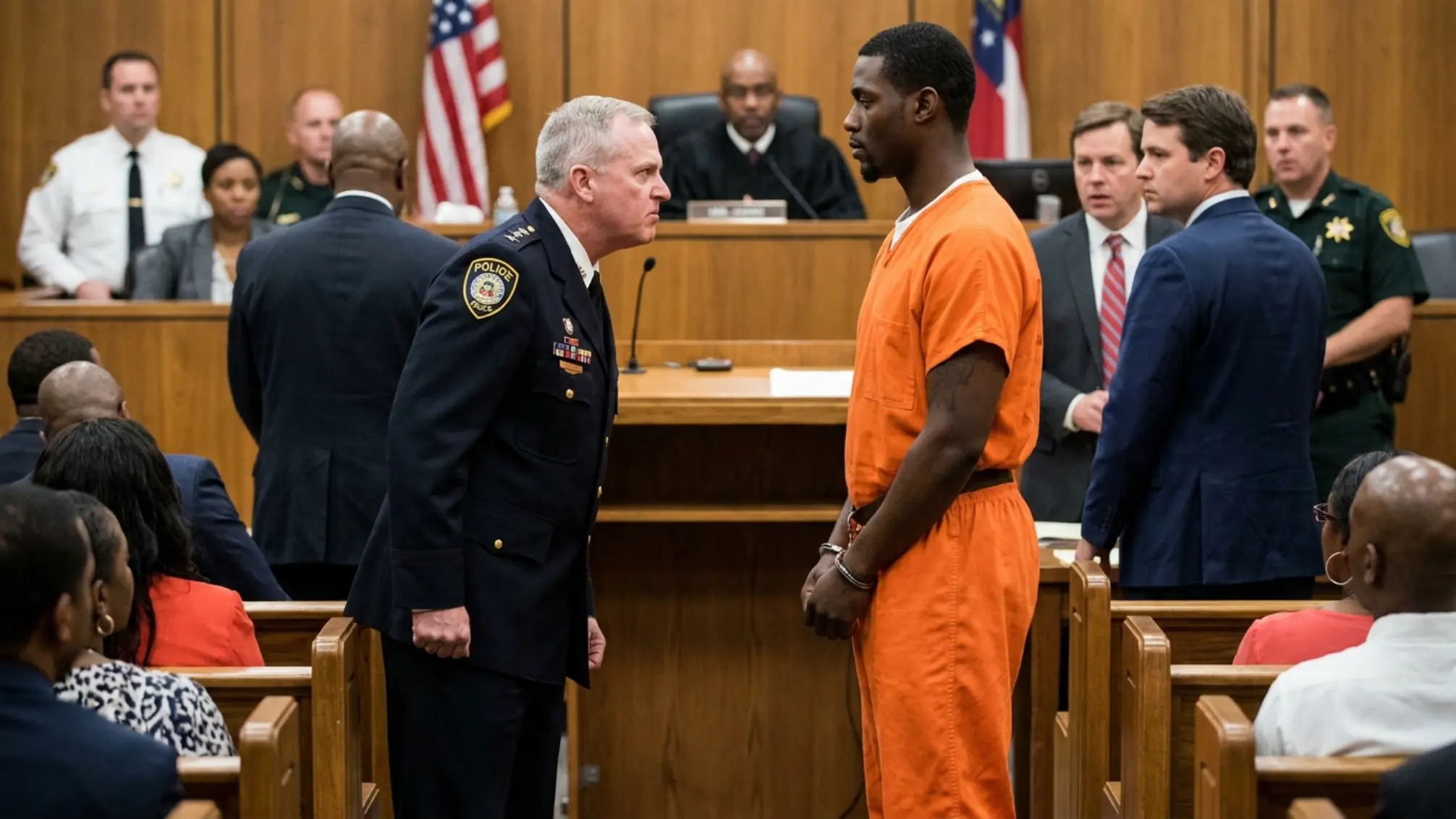
The highway was nearly empty when flashing blue lights appeared behind his black sedan.
James checked his speed. Forty-two in a forty-five-mile zone. His registration was current, every light worked, and he had not changed lanes without signaling.
He pulled into the illuminated parking lot of a closed pharmacy and lowered his window.
Two officers approached.
The first was Officer Travis Dunn, a broad white man in his early thirties with short blond hair and a hand already resting near his holster. The second was Officer Malcolm Reed, a younger Black officer whose body camera showed a red recording light.
“License and registration,” Dunn ordered.
James kept both hands on the steering wheel.
“May I ask why I was stopped?”
“You crossed the center line.”
“I don’t believe I did.”
Dunn leaned toward the window. “Are you refusing to provide identification?”
“No. I’m asking why I was stopped.”
“Then stop asking and give me your license.”
James moved slowly, narrating each action before reaching toward his wallet. He had learned to do that when he was sixteen, after his father sat him down and explained that ordinary movements could be misread by frightened or aggressive officers.
“My wallet is in my right pocket,” James said. “I’m reaching for it now.”
He handed over his license, registration, and proof of insurance.
Dunn examined the address.
“You live in Brookhaven?”
“Yes.”
“What are you doing in this part of town?”
“Driving home from work.”
“At ten at night?”
“My job doesn’t end at five.”
Dunn looked toward the laptop bag on the passenger seat. “What’s inside that?”
“A computer.”
“Step out of the vehicle.”
James felt the first real wave of fear.
“For a traffic violation?”
“Step out.”
“Am I being detained?”
Dunn opened the door himself.
“You are now.”
James exited without resistance. Reed moved behind him and conducted a quick pat-down while Dunn walked around the sedan, shining a flashlight through the windows.
“Any weapons in the vehicle?” Dunn asked.
“No.”
“Drugs?”
“No.”
“Large amounts of cash?”
“No.”
Dunn looked toward the trunk. “Open it.”
“I do not consent to a search.”
The words changed the atmosphere immediately.
Dunn stepped close enough that James could smell coffee on his breath.
“You want to make this difficult?”
“I’m exercising my rights.”
“People with nothing to hide usually cooperate.”
“People with nothing to hide still have rights.”
Reed’s eyes moved toward Dunn. The younger officer looked uncomfortable, but he did not intervene.
Dunn turned toward him. “Run the license.”
Reed returned to the patrol vehicle.
James stood beside his sedan under the pharmacy lights while Dunn circled him slowly.
“You work in finance?” the officer asked.
“Yes.”
“Good salary?”
“I do fine.”
“Car’s nice.”
“It’s six years old.”
“Still nice.”
James understood the questions were not casual. Dunn was measuring him, deciding what kind of man stood in front of him and how much resistance he might offer.
Reed returned.
“License is clean,” he said. “No warrants.”
Dunn looked disappointed.
“Call for a canine.”
James frowned. “For what?”
“Possible narcotics.”
“What gave you probable cause?”
“Your nervous behavior.”
“I’m nervous because you pulled me out of my car without explaining why.”
Dunn moved close again. “Keep talking, and I’ll give you something real to worry about.”
A second patrol car entered the lot ten minutes later.
Captain Robert Hale stepped out.
James recognized immediately that Hale was not there for an ordinary traffic stop. He wore a formal dark uniform despite the late hour, and the officers straightened the moment he approached.
Hale was forty-nine, broad through the chest, with short brown hair and gray eyes that seemed to study people as potential problems.
“What do we have?” he asked.
“Failure to maintain lane,” Dunn said. “Driver refuses consent. Possible narcotics activity.”
James spoke before Hale could respond.
“I was not speeding, I did not cross the line, and there is no basis for a search.”
Hale looked him over.
“Name?”
“James Miller.”
“What do you do?”
“I’m a senior compliance manager at Brighton Financial.”
Hale’s expression shifted slightly.
“Compliance.”
“Yes.”
“That means you investigate people.”
“It means I make sure financial regulations are followed.”
Hale smiled without warmth. “You must enjoy telling people what rules they broke.”
“Only when they actually broke one.”
Reed lowered his eyes.
Hale stepped toward James.
“You think you’re smarter than my officers?”
“I think your officers need a legal basis to search my vehicle.”
Hale glanced at Dunn.
“Search it.”
James immediately objected. “I do not consent.”
Hale did not even look at him.
“Officer safety exception.”
“There is no officer safety threat.”
“You admitted there could be a weapon.”
“I said there was no weapon.”
Hale opened the rear passenger door.
Reed’s body camera captured him leaning inside. Dunn moved between Reed and the vehicle, partially blocking the view.
James watched Hale’s right hand disappear beneath his uniform jacket.
It emerged holding something small and dark.
The captain crouched near the driver’s seat.
James could not see exactly what he did.
But he saw enough.
“What did you just put in my car?” James demanded.
Hale straightened.
Dunn grabbed James’s arm. “Turn around.”
“No. What did he put under my seat?”
“Hands behind your back.”
James pulled his arm free instinctively, not to fight but to remain facing the vehicle.
Dunn shoved him against the hood.
Reed stepped forward. “Sir, he isn’t resisting.”
Hale turned sharply. “Secure him.”
Reed hesitated.
“Now.”
James felt metal cuffs close around his wrists.
Dunn pushed him toward the patrol car while Hale returned to the driver’s side of the sedan. Seconds later, the captain emerged holding a black handgun inside a clear evidence bag.
“Well,” Hale said. “Look what we found.”
James stared at him.
“That is not mine.”
Hale checked the serial number.
“Reported stolen eight months ago.”
“You planted it.”
Dunn laughed.
Hale approached until the evidence bag was inches from James’s face.
“Careful,” the captain said. “False accusations against an officer can make your situation worse.”
James looked toward Reed’s body camera.
“You recorded him.”
Reed touched the device unconsciously.
Hale noticed.
“Turn that off,” he ordered.
“Captain?”
“Battery conservation. We have the suspect secured.”
The red light disappeared.
James was taken to county jail and booked for possession of a stolen firearm, unlawful carrying, obstruction, and resisting arrest. The traffic citation claimed he crossed the center line three times and nearly struck another vehicle.
There had been no other vehicle.
His bond hearing occurred the following afternoon.
Prosecutors described him as a potentially dangerous armed suspect who resisted a lawful search. The stolen handgun had been used during a convenience-store robbery, and although James was not charged with that crime, the connection made the judge cautious.
Bond was set at seventy-five thousand dollars.
James spent four nights in jail before his sister raised the required amount through a bondsman.
By then, Brighton Financial had suspended him.
The company did not accuse him publicly, but employees stopped responding to his messages. A local news website published his booking photograph beside the headline:
FINANCIAL MANAGER ARRESTED WITH STOLEN ROBBERY WEAPON
His mother called crying.
His father said little, which frightened James more.
On the fifth day, attorney Maya Lawson arrived at his apartment carrying a yellow legal pad and an expression that suggested she had already read the police report several times.
Maya was thirty-six, sharp-eyed, and known for attacking weak evidence with the patience of someone pulling threads from a poorly sewn suit.
“Tell me what happened without guessing what the officers intended,” she said.
James described the stop from the beginning.
When he reached the moment Hale leaned into the car, Maya interrupted.
“You saw an object in his hand?”
“Yes.”
“Could you identify it?”
“No.”
“You saw him place it under the seat?”
“His body blocked part of the view.”
“Then we need the body-camera footage.”
“They turned it off.”
“Not immediately.”
Maya requested every recording from the stop.
The police department responded three days later.
Officer Dunn’s camera had malfunctioned before the stop.
Captain Hale was not wearing one.
Officer Reed’s camera recorded the initial detention but suffered a “file corruption error” moments before the search.
The available footage ended just after Hale ordered the officers to search James’s car.
Maya examined the digital file.
“The corruption is too convenient,” she said.
“Can they delete footage?”
“Not without leaving traces.”
The department claimed automatic synchronization failed because of a network interruption. Reed submitted a written statement confirming Hale discovered the gun beneath the driver’s seat.
His statement described James as aggressive, evasive, and physically resistant.
James barely recognized the person in the report.
Maya requested pharmacy security footage.
The owner told her police had already collected it.
The evidence log said officers received the recording two days after the arrest.
When Maya requested a copy, prosecutors said the file contained no usable video because the exterior camera had been facing away from the parking lot.
The pharmacy owner disagreed.
“My camera covered the entire front lot,” he said. “I watched them search your client’s car.”
“Did you keep a backup?”
“No. Police took the hard drive.”
The case appeared designed to eliminate every independent witness.
Then Maya found the first mistake.
The handgun had been listed in department evidence storage six months before James’s arrest.
According to official records, it had been scheduled for destruction after the robbery case ended. The destruction certificate carried the signature of evidence technician Marlene Webb.
Marlene had retired three weeks before the listed date.
Maya located her in Augusta.
“That is not my signature,” Marlene said after seeing the certificate. “And that gun was never supposed to be destroyed.”
“Why?”
“It was connected to an unsolved robbery. Evidence had to be retained.”
“Who had access to the storage room?”
“Captain Hale, the evidence supervisor, and two senior sergeants.”
The defense filed a motion demanding a complete audit of the weapon’s chain of custody.
Prosecutors opposed it, arguing that the handgun’s earlier storage history had no bearing on where it was found later.
Judge Eleanor Price disagreed.
“If the weapon was previously controlled by the same department whose officers claim to have found it,” she said, “the chain of custody is central.”
The court ordered the department to produce all access logs, surveillance footage, and inventory records.
The logs showed Hale entered the evidence room at 7:14 p.m. on the night of James’s arrest.
He remained inside for eleven minutes.
The gun was listed as present during the morning inventory.
It was listed as missing the following afternoon.
Hale claimed he entered to retrieve documents for another case.
No document removal had been recorded.
Maya smiled for the first time.
“We have the door opening,” she told James. “Now we need to see what walked through it.”
The prosecution offered a plea deal.
Five years of probation.
No prison.
James would plead guilty to unlawful possession, while the resisting charge would be dismissed.
His parents urged him to consider it.
“You’d stay out of prison,” his mother said.
“And spend the rest of my life saying the gun was mine.”
“You could rebuild.”
“Not with a felony.”
His father looked at him across the kitchen table.
“What if the jury believes the police?”
James did not answer immediately.
That was the fear underneath every conversation.
The uniform.
The official report.
The evidence bag.
The missing video.
The prosecutor’s confident description of a man who did not exist.
James finally said, “Then I lose telling the truth.”
He rejected the deal.
The trial began four months later.
The courtroom was full on the first morning. Reporters occupied the rear benches, officers filled one side, and James’s family sat behind Maya’s table.
James entered wearing an orange county uniform because his bond had been revoked after prosecutors accused him of contacting a witness. The alleged witness was the pharmacy owner, whom James greeted briefly outside a grocery store.
Judge Price denied a defense request for civilian clothing after jail officials claimed there was insufficient processing time.
Maya understood the purpose.
The state wanted jurors to see a prisoner before hearing a word.
Officer Dunn testified first.
He described James as nervous and argumentative. He claimed James reached repeatedly toward the center console and refused more than ten lawful commands.
Maya approached the witness stand.
“How many vehicles did Mr. Miller nearly strike?”
Dunn hesitated. “One.”
“What color?”
“Dark sedan.”
“Make?”
“I don’t recall.”
“License plate?”
“No.”
“Did that driver stop?”
“No.”
“Did you mention that vehicle in your original report?”
Dunn looked toward the prosecutor.
“I believe so.”
Maya displayed the report.
“There is no mention of another vehicle.”
Dunn shifted in his seat.
She asked why his body camera was not working.
“Equipment failure.”
“When did you discover that?”
“After the stop.”
“Did you report the failure?”
“Yes.”
“Please show the jury the maintenance ticket.”
The prosecution objected.
There was no ticket.
Reed testified next.
He looked exhausted.
He confirmed Hale ordered the search. He claimed the gun appeared beneath the driver’s seat, but his answers grew shorter whenever Maya asked about the missing video.
“Did Captain Hale order you to stop recording?”
“Yes.”
“Before or after the gun was discovered?”
Reed swallowed.
“After.”
“Are you certain?”
“Yes.”
“Did you review the available footage before giving your statement?”
“No.”
“Did anyone tell you what the footage showed?”
“Captain Hale.”
Maya paused.
“Did you see him enter Mr. Miller’s vehicle?”
“Yes.”
“Could you see both his hands?”
Reed’s eyes moved toward Hale, seated behind the prosecution table in formal uniform.
“No.”
“Did you see the gun before Captain Hale entered?”
“No.”
“Did you personally see him remove it from beneath the seat?”
Reed remained silent.
Judge Price instructed him to answer.
“No.”
The courtroom shifted.
Captain Hale testified on the third day.
He entered wearing polished medals and the controlled expression of a man accustomed to being believed. He stated that James’s behavior justified the search and that the weapon was immediately visible beneath the driver’s seat.
Maya handed him the evidence-room access log.
“You entered storage two hours before the stop.”
“Yes.”
“Why?”
“To retrieve a robbery file.”
“Which one?”
“I don’t recall.”
“Did you sign anything out?”
“No.”
“Why not?”
“It was a brief review.”
“Did you touch the gun later found in Mr. Miller’s car?”
“No.”
“Had you ever handled it?”
“Possibly during the original robbery investigation.”
“Your fingerprints were not found on it.”
“That proves I didn’t plant it.”
“No, Captain. It proves whoever handled it may have worn gloves.”
The prosecutor objected.
Sustained.
Maya turned toward the evidence-room photograph.
“Was the gun inside a sealed box?”
“Yes.”
“Was the seal broken after your visit?”
“I don’t know.”
“Do you recognize this signature authorizing destruction?”
“Marlene Webb.”
“Marlene Webb testified it is not hers.”
Hale’s jaw tightened.
“People forget what they sign.”
“She had retired before the date.”
A murmur moved through the courtroom.
Judge Price called for order.
Still, the defense lacked direct proof.
Suspicion was not enough.
The gun had existed inside police storage.
Hale entered the room.
The recording disappeared.
But no witness could say they saw him plant it.
On the fourth morning, courthouse technician Samuel Park contacted Maya.
Samuel managed digital exhibits, archived recordings, and courtroom playback systems. While preparing the body-camera file for trial, he noticed the video’s metadata did not match the department’s explanation.
The file had not been corrupted during upload.
Someone deleted a forty-three-second segment after synchronization.
“Can you recover it?” Maya asked.
“Maybe.”
“How long?”
“I’ve been working on it since midnight.”
The missing segment existed inside the department server’s temporary cache. Automatic redundancy preserved fragments for thirty days, but a court subpoena had frozen the relevant server before routine deletion.
Samuel reconstructed the file frame by frame.
At 8:17 a.m., twenty-three minutes before court began, he called Maya.
“I have it.”
The recovered footage showed Hale standing beside James’s open car.
His left hand blocked part of the camera.
His right hand removed a black handgun from beneath his jacket.
He crouched.
He placed it under the driver’s seat.
Then he stood and said, “Let’s find out what our compliance manager thinks of this.”
Dunn laughed.
Reed whispered, “Captain, don’t.”
Hale answered, “Camera off.”
The truth lasted nineteen seconds.
It was enough.
Maya entered the courtroom carrying a sealed digital drive.
She requested permission to recall Hale.
The prosecutor objected, arguing that the evidence required authentication.
Samuel testified first. He explained the server cache, metadata, deletion command, and reconstruction process. The removal had been performed from a supervisor terminal inside the police department.
The login belonged to Robert Hale.
Judge Price admitted the footage.
Hale stood near the aisle as the screen lowered.
James rose from the defense table.
The captain stepped directly into his path.
“That gun was in your car,” Hale said quietly. “This court will bury you for it.”
James held his stare.
“You should’ve erased more than the first body-camera file.”
Hale’s fists clenched.
“Keep accusing me, and you’ll leave this courtroom in chains.”
James turned toward the judge.
“Then play the recovered video—and let everyone watch who planted the gun.”
Judge Price ordered Hale back to the witness stand.
The courtroom lights dimmed.
The video began.
Everyone watched Hale remove the gun from his jacket.
Everyone watched him place it under the seat.
Everyone heard Dunn laugh.
Everyone heard Reed object.
Nobody moved when the screen went black.
The silence afterward was heavier than any reaction.
Judge Price looked at Hale.
“Captain, remain where you are.”
He stepped backward.
Two courthouse deputies moved toward him.
Hale reached toward his belt instinctively.
The deputies drew their weapons.
“Hands away from your side.”
Hale froze.
His authority disappeared in front of the same jury he expected to persuade.
Maya moved for immediate dismissal.
The prosecutor stood slowly.
“The state joins the motion.”
Judge Price dismissed every charge against James with prejudice. She ordered the record sealed, his bond returned, and an emergency investigation into the officers, evidence unit, and prosecutorial disclosures.
James’s handcuffs were removed.
His mother began crying.
His father placed both hands over his face.
Captain Hale was arrested before leaving the courtroom.
Officer Dunn attempted to resign that afternoon but was taken into custody on charges of conspiracy, perjury, evidence tampering, and deprivation of civil rights.
Reed received immunity in exchange for full cooperation. He admitted Hale had been framing suspects for years, usually people he believed lacked money or influence.
The department audit uncovered fourteen questionable arrests.
Seven involved weapons previously stored as evidence.
Three involved drugs removed from old cases.
Four relied on body-camera files containing unexplained gaps.
Several people had accepted plea deals.
One man had served nearly six years in prison.
James’s case reopened all of them.
Hale’s motive was eventually revealed through financial records. He owned a hidden interest in a private security company seeking city contracts. Rising crime statistics and high-profile weapon arrests helped justify expanded funding, which benefited his company.
He also targeted individuals working in compliance, auditing, and public oversight because he viewed them as potential threats.
James had not been selected randomly.
Hale saw his Brighton Financial identification and recognized the department had recently used the company for pension investments. James had been reviewing irregular transfers connected to a shell corporation owned by Hale’s business partner.
The traffic stop was intended to discredit him before he completed the audit.
The plan nearly worked.
Brighton Financial reinstated James, paid his lost salary, and promoted him to director of internal compliance. He accepted only after the company issued a public statement acknowledging it suspended him too quickly.
“You believed the arrest before you believed me,” James told the board. “That must be part of the record too.”
The company included the sentence.
Hale was convicted after a six-week federal trial.
At sentencing, Judge Price described the damage as broader than one wrongful arrest.
“You did not merely plant a weapon,” she said. “You planted doubt inside every place your authority touched. You taught jurors to distrust evidence, communities to fear officers, and honest police to inherit suspicion created by your conduct.”
Hale received twenty-four years.
Dunn received eleven.
Reed lost his certification despite cooperating. He accepted responsibility during a public hearing.
“I knew the moment Captain Hale entered the car,” he said. “I did not know exactly what he carried, but I knew his actions were wrong. I chose my career over a stranger’s freedom.”
James attended the hearing.
Reed approached him afterward.
“I’m sorry.”
James looked at him for a long moment.
“You were the only person there whose camera could protect me.”
“I know.”
“You turned it off.”
“Yes.”
James did not forgive him immediately.
Some apologies deserved to remain uncomfortable.
“You cannot change what happened to me,” James said. “Tell the truth in every case where you watched it happen to someone else.”
Reed did.
His testimony helped free three men and vacate four convictions.
One year after the trial, James returned to the courtroom for the final hearing connected to the recovered cases. He wore a navy suit, white shirt, and the same loosened tie he had worn on the night of his arrest.
The orange uniform was gone.
The fear remained in smaller ways.
He checked mirrors whenever blue lights appeared behind him. He kept his hands visible when passing patrol cars. Some nights, he woke remembering Hale’s hand disappearing beneath his jacket.
Freedom had returned faster than safety.
Maya joined him near the rear bench.
“You ready?”
“No.”
“Good answer.”
They watched the judge dismiss the final conviction.
A fifty-eight-year-old man named Henry Cole walked out after serving nine years for a gun Hale planted inside his truck. His daughter waited near the courthouse doors.
James saw her run toward him.
That moment mattered more than Hale’s sentence.
The recovered video had not only saved James.
It forced the system to hear people it had already decided not to believe.
Reporters often described the trial as the day truth exploded in court. James thought the phrase sounded dramatic but incomplete.
Truth did not explode suddenly.
It survived quietly.
Inside a deleted cache.
Inside a retired evidence technician’s memory.
Inside a nervous officer’s hesitation.
Inside a pharmacy owner insisting his camera had faced the lot.
Inside James’s refusal to plead guilty merely because surrender offered a shorter path home.
The truth had been present from the beginning.
Power simply kept trying to erase it.
Hale believed the uniform made his story official.
James learned that an official lie remained a lie, even when typed into a report, sealed inside an evidence bag, and repeated beneath oath.
The captain stepped into court expecting the planted gun to send an innocent man to prison.
Nineteen seconds of recovered video sent him there instead.