“Get out of my station.”
A cop in full uniform said it to a woman standing alone in the lobby on her first day.
She stayed calm.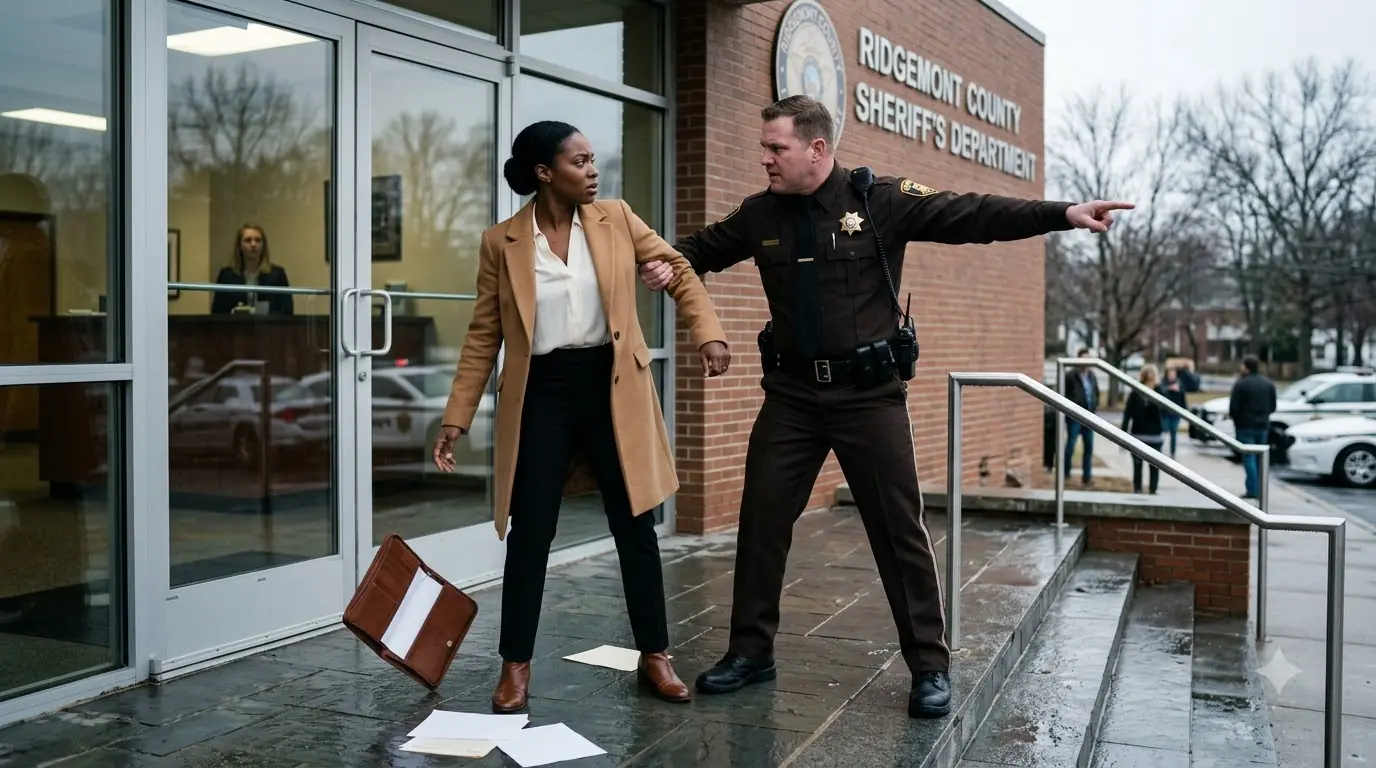
“I have a meeting here.”
“A meeting?” he said, laughing. “The stray dog says it owns the house.”
“I have every right to be here.”
That killed the laugh.
He grabbed her arm and pulled her toward the door.
“That is assault. Take your hands off me.”
Slap.
The sound cut through the lobby like a whip crack.
He leaned down, looked at her holding her burning face, and said, “You’re nothing but a cockroach trying to crawl into my station.”
Four people were right there.
Not one moved.
He thought that was the end of it. Just another nobody he had put in her place. But that woman was hiding a secret, one that was about to destroy everything he had built.
To understand what really happened that day, you need to know who was standing in that lobby.
Her name was Olivia Foster. She was forty-two years old, with eighteen years in law enforcement across two states and a master’s degree in criminal justice from Howard University.
She had worked narcotics. She had worked internal affairs. She had built community policing programs from the ground up.
This was not a woman who wandered into a police station by accident.
This was a woman who had spent her entire career inside them.
But the precinct she had just walked into was a different story.
Ridgemont County Sheriff’s Department.
A midsize department in the South.
And it was rotting from the inside.
Over the past three years, civilian complaints had spiked. Excessive force incidents were up forty percent. A state audit had flagged a pattern of racial profiling so obvious it had made the evening news.
Officers complained.
Citizens protested.
Nothing changed.
The previous captain, Raymond Ellis, saw the writing on the wall and retired early before any of it could land on his desk.
That left a hole at the top, and the pressure to fill it was enormous.
Mayor Patricia Coleman was up for re-election. The community was furious. The department’s reputation was in freefall.
She needed someone who was not part of the old guard.
Someone who would not cover for the people already there.
Someone from the outside with an internal affairs background, someone who knew how to clean house.
She found Olivia Foster.
But Coleman did not just hire her.
She made a decision that would change everything.
She told Olivia, “I don’t want you walking in there with a title on your first day. I want you to walk in like a civilian. See how they treat people when they don’t know who’s watching.”
That was why Olivia showed up in plain clothes.
No badge.
No uniform.
She parked in the public lot, not the staff lot. She walked through the front entrance, not the staff door.
Every detail was deliberate.
She was not visiting the precinct.
She was testing it.
And nobody knew.
The appointment was confidential. The only person inside the department who was told was Raymond Ellis, the outgoing captain.
He was supposed to meet Olivia in the lobby that morning and walk her through.
But Ellis never showed up.
He came in late.
At the time, it seemed like bad luck.
Later, it would look like something much worse.
The cop who slapped her was named Derek Sullivan.
Twelve years on the force.
Four excessive force complaints filed against him.
Zero sustained.
Every single one had been closed as unfounded.
Sullivan was not just aggressive.
He was protected.
And the man protecting him was Sergeant Nathan Moore.
Twenty years on the job.
Moore had supervised Sullivan for most of his career, and every complaint that came in went through Moore’s desk.
Every complaint disappeared.
Sullivan had a partner, too.
Officer Craig Benson.
Younger, less experienced, but he followed Sullivan’s lead on everything.
How to talk.
How to handle calls.
Who to push around.
Benson was not the one giving orders, but he was always standing right there when things went wrong.
Together, the three of them, Sullivan, Benson, and Moore, had built a system.
Sullivan acted.
Benson backed him up.
Moore made it go away.
It had worked for years.
No one had ever challenged it.
Until now.
The night before her first day, Olivia sat in her hotel room. She video-called her teenage daughter, who could tell something was off.
“You nervous, Mom?”
Olivia paused.
“Not nervous,” she said. “Just tired of proving I belong in rooms I helped build.”
After she hung up, she opened her leather portfolio.
Inside was the appointment letter signed by Mayor Coleman. She read it once, closed it, and set it on the nightstand.
She had no idea what was coming the next morning.
But in a way, she had been preparing for it her entire life.
When Olivia walked through that front door, she was not just showing up for work.
She was walking into a test, one she had designed herself.
The only question was what kind of department she would find on the other side.
She got her answer in under sixty seconds.
Now go back to that lobby, because what happened at the beginning was not the full picture.
That was only the highlight reel.
Early, on purpose.
She wanted to see the building before it filled up. She wanted to watch how the front desk operated, how officers moved through the space, and how civilians were treated when they walked in.
She pushed open the glass doors.
The lobby was exactly what she expected.
Scuffed linoleum. Fluorescent lights buzzing overhead. A bulletproof reception window with a clerk sitting behind it, barely looking up.
A row of plastic chairs lined the wall, half of them cracked.
One civilian, a woman named Denise Harper, sat at the far end waiting to file a noise complaint.
That was it.
Quiet.
Unremarkable.
Olivia walked toward the reception window.
She did not get there.
The staff entrance door swung open behind her. Two officers walked through.
The first was Derek Sullivan, full uniform, coffee in hand, badge catching the fluorescent light. Behind him came Craig Benson, same uniform, same walk.
They were coming in from the parking lot, cutting through the lobby to reach the bullpen.
Sullivan noticed Olivia immediately.
A woman in plain clothes, no badge, no lanyard, standing in the middle of his lobby like she had somewhere to be.
He stopped walking.
You need to understand something about Derek Sullivan.
In his mind, that building belonged to him. Not legally. Not officially. But in every way that mattered to a man like him.
He decided who was welcome.
He decided who was not.
And he had already decided about Olivia before she opened her mouth.
“Get out of my station.”
He said it the way someone tells a dog to get off the couch. Casual. Automatic. Like he had said it a hundred times before.
And maybe he had.
Olivia turned to face him.
She did not raise her voice. She did not tense up. She did not do any of the things he expected.
She just said calmly, “I have a meeting here.”
Sullivan looked at Benson.
Benson smirked.
Sullivan looked back at Olivia.
“A meeting?” he said. “The stray dog says it owns the house.”
Behind the reception window, the clerk, a woman named Carol who had worked that desk for nine years, watched the whole thing.
She did not press the panic button.
She did not pick up the phone.
She did not say a word.
Because she had seen Sullivan do this before.
Not this bad, but she had seen it.
And she knew saying something would only make things worse for her.
Denise Harper, the civilian on the bench, shifted in her seat.
She reached into her purse slowly, quietly, and pulled out her phone.
She did not hold it up like a camera. She just set it on her lap, screen facing outward, and pressed record.
She did not know why exactly.
Instinct.
A feeling that someone should be paying attention, even if no one else was.
Olivia held her ground.
“I have every right to be here.”
That was the moment everything shifted.
It was not the words.
It was the refusal.
Sullivan was used to people backing down. He was used to civilians dropping their eyes, mumbling an apology, and shuffling toward the exit.
That was how this was supposed to go.
That was how it always went.
But Olivia did not move.
And she did not look away.
Sullivan’s face changed.
The smirk disappeared.
Something harder took its place.
He stepped toward her, close, too close.
The kind of close that is not about talking, but about making someone feel small.
He grabbed her arm.
Not gently.
Not like a guide.
Like a man moving something he did not want in his space.
He pulled her toward the front door.
She yanked her arm back.
“Take your hands off me.”
Slap.
The sound cut through the lobby like a whip crack.
His open palm struck her face full force, deliberate. The kind of hit that was not about control, but punishment.
He leaned down, looked at her holding her burning face, and said, “You’re nothing but a cockroach trying to crawl into my station.”
Denise Harper’s phone caught everything.
The audio picked up the slap.
It picked up the words.
And it picked up something else, something Sullivan muttered right before he hit her.
Under his breath.
Low enough that the lobby security camera would never catch it.
But Denise’s phone was closer.
What it recorded was a racial slur.
A single word that would later change the entire trajectory of the case.
Olivia staggered one step.
Just one.
Then she straightened up, pressed her hand to her cheek, and looked Sullivan dead in the eyes.
She did not say a word.
She did not need to.
Three seconds.
That was how long she held his gaze.
Three full seconds of silence.
Then she turned, walked across the lobby, pushed through the glass doors, and left.
Sullivan watched her go.
He took a sip of his coffee.
Then he turned to Benson and said, “Let’s go.”
That was it.
That was the entire event from Sullivan’s perspective.
A minor inconvenience.
A nobody who had wandered in and got handled.
He did not file a report. He did not mention it to his sergeant. He just walked into the bullpen like it was any other Tuesday.
And the part that made it worse was what happened next.
When Sullivan got to the bullpen, he told the story loudly to anyone who would listen.
Three officers were at their desks. A detective was grabbing coffee.
Sullivan said, “Some woman wandered in this morning, probably looking for the welfare office. Had to show her the door.”
Benson added, “She had attitude, too. Like she owned the place.”
Laughter followed.
Easy, comfortable laughter.
The kind that comes from a room where everyone agrees and no one questions anything.
One person in that room did not laugh.
Officer Tanya Williams.
A woman.
Six years on the force.
She sat at her desk, eyes down, jaw tight. She had heard stories like this before. She had seen things like this before.
And every single time, she had done the same thing.
Nothing.
Because speaking up in this department did not get you heard.
It got you targeted.
But this time, something was different.
She did not know what yet.
She just felt it.
A shift in the air.
Like something was about to break.
Meanwhile, in the parking lot, Olivia sat in her car alone.
Hands on the steering wheel.
She looked at herself in the rearview mirror. The left side of her face was red, already starting to swell.
She did not cry.
She opened her phone and took a photo of her face.
Then she opened the leather portfolio on the passenger seat, pulled out a pen, and wrote down everything.
The time.
The badge number she had memorized.
The exact words he used.
The names on the uniforms she saw.
Every detail.
Clinical.
Precise.
Like she had done it a hundred times before.
Because she had.
This was internal affairs work.
And Olivia Foster had just become her own first case.
She picked up the phone and dialed one number.
It rang twice.
“Patricia, I’ve seen enough.”
That was all she said.
Six words.
Then she hung up.
The mayor had told her to observe for twenty-four hours.
Olivia did not need twenty-four hours.
She did not even need one.
The announcement had been supposed to stay confidential for twenty-four hours.
So what happens when she moves it up?
What happens when that entire department finds out who she really is?
Olivia did not go home.
She went back to her hotel room and got to work.
First, she locked the door. Then she went to the bathroom mirror and photographed her face from three angles.
The swelling was worse now. The left side of her cheek had gone from red to a deep, angry purple.
She documented everything.
The time each photo was taken.
The lighting.
The distance.
She was not processing trauma.
She was building a case file.
She sat at the desk and opened her portfolio. She pulled out a clean sheet of paper and wrote a formal incident report.
Officer’s badge number.
His name, which she had read off his uniform.
Sullivan.
The time of the encounter.
The exact sequence of events.
Every word she could remember.
Every word he said.
She wrote it all down in the flat, factual language of someone who had written hundreds of reports for other people.
This time, she was writing it for herself.
Then she called Mayor Coleman back.
Coleman picked up on the first ring. She was already angry. Olivia could hear it in her breathing before she even spoke.
“Tell me everything.”
Olivia told her.
No emotion.
No editorializing.
Just the facts.
What was said.
What was done.
Who was present.
How many witnesses.
When she got to the slap, Coleman went quiet for a long time.
“I’ll have him removed by the end of the day.”
“No,” Olivia said fast and firm. “Patricia, don’t react yet. This is exactly what you hired me to find, and I found it in sixty seconds. If you pull him now, it looks political. We do this the right way.”
“Then what do you want?”
“Move up the announcement. Tomorrow morning. Full department assembly. Eight a.m. I want every officer in that building in one room.”
Coleman agreed.
She did not like waiting, but she trusted Olivia.
That was why she hired her.
While Olivia was building her case in a hotel room, nothing happened back at the precinct.
Absolutely nothing.
No incident report was filed.
Sullivan did not write one.
Benson did not write one.
The clerk behind the window, Carol, did not write one either.
In the official record of the Ridgemont County Sheriff’s Department, that morning in the lobby simply did not happen.
And it would have stayed that way.
Because the lobby security camera was on a forty-eight-hour auto-override loop.
In two days, the footage would be gone.
Erased.
Written over by forty-eight hours of empty hallways and officers walking through doors.
Sergeant Nathan Moore knew this.
He had known it for years.
That override policy was not a flaw in the system.
It was a feature.
And Moore had used it before.
That evening, Officer Tanya Williams did something she had never done before.
She logged into the department’s incident database and searched for any report filed that day involving the lobby.
She scrolled through every entry.
Found nothing.
Not a single line.
She took a screenshot of the empty log and saved it to her personal phone.
She did not know what she was going to do with it, but she knew she wanted proof that the silence was deliberate.
Then she sat in her patrol car after shift and called a friend, another officer in a neighboring county.
“It happened again today,” Tanya said. “Right in front of everybody. And I just sat there.”
Her friend asked what she was going to do.
“I don’t know,” Tanya said. “But I can’t keep watching this.”
At the same time, Sullivan was at his kitchen table.
Beer in hand.
TV on.
His wife asked how his day was.
He did not even look up.
“Same old. Had to deal with some woman causing problems in the lobby.”
His wife did not press.
He finished his beer, went to bed early, and slept fine.
That was the part that should have chilled anyone who understood what had happened.
He slapped a woman in a government building and slept fine.
Back at the hotel, Olivia was not sleeping.
She was ironing her dress uniform.
Full captain’s uniform.
Pressed sharp.
She laid it out on the bed.
Captain’s bars.
Polished badge.
Nameplate.
Foster.
The leather portfolio beside it was packed with everything.
Appointment letter.
Incident notes.
Photographs.
She called her daughter one last time.
“Mom, did something happen?”
Olivia paused.
“Something happened,” she said. “But tomorrow something bigger is going to happen.”
At six a.m. the next morning, an email hit every inbox in the department.
From the Office of the Mayor.
Subject line: Mandatory All-Hands Assembly, 0800 Hours, No Exceptions.
Sullivan read it in the locker room and shrugged.
Benson asked what it was about.
Sullivan said, “Probably another diversity seminar.”
He laughed.
Moore read the same email in his office.
He did not laugh.
The mayor’s direct involvement was unusual. He did not know what was coming, but something in his gut told him it was not good.
He was right.
Eight a.m.
The briefing room.
Sixty officers, detectives, and staff packed into rows of metal chairs.
The room smelled like bad coffee and dry erase markers. Conversations bounced off the cinderblock walls.
Low.
Casual.
Bored.
Nobody wanted to be there.
Monday morning mandatory meetings were never good news. Budget cuts. Policy updates. Another lecture from someone downtown who had never worked a patrol shift in their life.
Sullivan sat in the third row, Benson next to him.
Both relaxed.
Legs stretched out.
Sullivan had his arms crossed, leaning back like a man who owned his chair. He looked around the room, nodded at a few guys, and made a joke about overtime.
Benson laughed.
Moore stood near the back wall, arms folded, face flat.
He had not sat down.
He had not talked to anyone.
He just stood there, watching the door.
Tanya Williams sat on the far side alone.
She had her hands in her lap. She did not know what this was about either, but she had not slept much.
The screenshot was still on her phone.
The room buzzed with theories.
Budget cuts.
A new use-of-force policy.
A PR stunt before the next election cycle.
Sullivan leaned over to Benson.
“Ten bucks says it’s some pencil pusher from the state office.”
Benson snickered.
Then the side door opened.
Mayor Patricia Coleman walked in with two aides behind her. She wore a dark suit and no smile.
She walked straight to the podium at the front of the room. She did not greet anyone. She did not shake hands. She just set her folder down and looked out at the room.
The conversations died.
Not all at once, but row by row, like a wave pulling back from shore.
By the time she opened her mouth, the room was silent.
“Thank you all for being here. I’ll keep this brief.”
Her voice was steady and official, the voice of someone who had practiced what she was about to say.
“As you know, Captain Raymond Ellis has retired. This department has been without permanent leadership for the past three months. That ends today.”
A few officers shifted in their chairs. Someone in the back row whispered something.
Moore did not move.
“After a thorough national search, I have selected a new captain for this department. This individual brings eighteen years of distinguished law enforcement experience across two states, including extensive work in internal affairs, narcotics, and community-centered policing.”
Sullivan was already bored.
He was looking at his phone under his armrest.
Benson nudged him. Sullivan glanced up, mildly interested.
Coleman continued.
“This department has lost the trust of the community it serves. The complaints are public. The audit findings are public. The reputation of this office is at a critical low.”
The person I’ve chosen was selected specifically because they have the experience, the independence, and the backbone to lead this department through what comes next.”
That got the room’s attention.
The word backbone hung in the air.
A few officers straightened up.
Moore’s jaw tightened.
Coleman paused, looked down at her notes, then looked back up.
“Please welcome your new captain, Olivia Foster.”
A door at the back of the room opened, and Olivia walked in.
But this was not the woman from the lobby.
Not the woman in the plain coat with no badge.
Not the woman Sullivan had grabbed and slapped and called a cockroach.
This was someone else entirely.
Full dress uniform.
Pressed sharp.
Captain’s bars on her collar, catching the light.
Polished badge on her chest.
Nameplate in clean letters.
Foster.
Her posture was straight. Her shoulders were back. Her face was calm, composed, and completely unreadable.
She carried the leather portfolio in her left hand.
The same one from the hotel room.
The same one she had in the lobby.
But now it did not look like a visitor’s folder.
It looked like what it was.
The paperwork of the woman who was about to run this building.
She walked down the center aisle, steady and unhurried. Her shoes clicked on the floor with every step.
The room was dead silent.
Sixty people watched one woman walk to the front of the room, and not a single one of them made a sound.
She passed the third row.
Sullivan saw her.
At first, it was just a face.
A familiar face.
His brain took a second to place it.
Then another second.
Then it hit him all at once, like a freight train.
His mouth opened, just slightly. His hands gripped the armrests. The color drained from his face.
Not slowly.
Not gradually.
All at once, like someone pulled a plug.
He looked at Benson.
Benson had already gone white.
Their eyes met, and in that single look, they both understood exactly what had just happened.
That was her.
The woman from the lobby.
The woman he had called a stray dog.
The woman he had slapped.
The woman he had called a cockroach.
She was standing ten feet away from him in a captain’s uniform, walking toward a podium where she would be introduced as his new commanding officer.
Sullivan did not breathe.
He could not.
Olivia reached the podium. She thanked the mayor with a single nod.
Then she turned and faced the room.
Sixty faces stared back at her.
Some confused.
Some curious.
Some, in the third row, absolutely terrified.
She did not smile.
She did not need to.
“I’m not here to make friends,” she said. “I’m here because this department has lost the trust of the people it’s supposed to protect. My job is to rebuild that trust from the inside out.”
She paused and let the silence do the work.
“I’ve already seen how some of you operate when you think nobody important is watching.”
She did not look at Sullivan.
She did not glance at the third row.
She did not have to.
Every single person in that room felt the weight of that sentence.
And Sullivan felt it most of all.
“Starting today, every complaint will be reviewed. Every use-of-force incident will be documented and investigated. Every interaction in this building, with civilians, with colleagues, with anyone who walks through that front door, will reflect the standards of this badge.”
She tapped her chest once, right over the badge.
“I expect professionalism. I expect accountability. And I expect it starting now.”
She stepped back from the podium.
The room did not applaud.
Nobody clapped.
The silence was thick enough to choke on.
But not everyone was afraid.
On the far side of the room, Tanya Williams sat up a little straighter. Her hands had stopped shaking.
And for the first time in six years, something that looked a lot like hope crossed her face.
After the assembly, the room emptied in clusters.
Officers filed out in silence, whispering only once they hit the hallway.
Olivia walked to her new office, closed the door, set the portfolio on the desk, and opened it.
Inside were the appointment letter, her handwritten incident notes, and the photographs of her swollen face.
She placed all three side by side on the desk, picked up the office phone, and dialed a number she had saved before she ever arrived in Ridgemont County.
“James, it’s Olivia. I need you to open a formal investigation. I’m sending you everything now.”
Back in the hallway, Sullivan found Benson and grabbed his arm.
His voice was barely a whisper, but it cracked.
“That was her. That was the woman from the lobby.”
Benson did not blink.
“I know.”
“Does she know? Did she—”
“She knows, Derek. She was right there.”
Sullivan’s face went through three expressions in two seconds.
Panic.
Denial.
Then something harder.
Survival.
“We need to talk to Moore,” he said. “Now.”
Olivia’s first official act as captain was not a speech.
It was not a policy memo.
It was not a meet-and-greet with her senior staff.
It was a preservation order.
Within one hour of that assembly, she signed a department-wide hold on all security camera footage from the previous seventy-two hours.
Every camera in the building.
Every angle.
Every second.
Locked down.
No overrides.
No deletions.
No exceptions.
She knew about the forty-eight-hour auto-override policy. She had read it in the department’s technical manual before she ever arrived in Ridgemont County.
That policy meant the lobby footage from the morning of the incident was already on a countdown.
Less than twenty hours left before it was gone forever.
Olivia did not give it twenty minutes.
The order hit Moore’s desk before lunch.
He read it twice.
Then he walked to Olivia’s office, knocked once, and stepped inside.
“Captain, is this really necessary? The server costs alone—we don’t have the storage capacity to hold seventy-two hours across every camera in the building.”
Olivia did not look up from her desk.
“It’s necessary, Sergeant.”
“With respect, ma’am, we’ve never done a blanket hold before. It’s going to raise questions.”
Now she looked up.
“Is there a reason you’d prefer I didn’t preserve it?”
Moore did not answer.
His mouth opened, then closed.
He stood there for three seconds, long enough for the silence to say everything his words did not.
Then he turned and walked out.
He went straight to his office, closed the door, sat at his desk, and for the first time in twenty years, Nathan Moore felt the ground shift under his feet.
The next morning, James Caldwell arrived.
Caldwell was an internal affairs investigator from the state capital.
Twenty-two years of experience.
No connections to Ridgemont County.
No friendships.
No debts.
No reason to protect anyone.
Olivia had worked with him five years ago on a corruption case that ended with three officers indicted and a chief forced into early retirement.
She trusted him completely.
More importantly, she trusted him to be independent.
They met in her office with the door closed.
Olivia handed him the portfolio.
Her incident notes.
The photographs of her face.
The timeline she had written in the hotel room.
Caldwell read through everything without speaking.
When he finished, he looked up.
“You’re the complainant and a witness, which means you can’t be involved in the investigation.”
“I know,” Olivia said. “That’s why you’re here. This is your case, James. I’m stepping back completely. I won’t review your findings until they’re final. I won’t interview anyone. I won’t sit in on any depositions. Whatever you find, you report to me and the mayor at the same time.”
Caldwell nodded.
“I’ll need access to the footage.”
“Already preserved. I’ll have IT give you direct access this afternoon.”
“Witnesses?”
“At least four in the lobby that morning. Start with the security footage to confirm, then track them down.”
Caldwell closed the portfolio and stood up.
“I’ll have preliminary findings within a week.”
He started that afternoon.
First stop, the security footage.
The lobby camera was mounted in the upper corner of the room, wide angle, no audio.
The image quality was not great. Standard government-grade equipment. Grainy at the edges. Slightly overexposed under the fluorescent lights.
But it was enough.
More than enough.
Caldwell watched the footage three times.
The first time, he watched it straight through without stopping.
The second time, he paused at every key moment.
Sullivan’s approach.
The verbal exchange.
The grab.
The slap.
The aftermath.
The third time, he watched it frame by frame.
He timestamped everything.
Exported clips.
Saved them to an encrypted drive.
Then he started building the case file.
The footage showed exactly what Olivia had described.
Sullivan approaching.
The conversation.
The grab.
The physical resistance.
The slap.
Olivia walking out.
Sullivan walking back inside like nothing had happened.
But the footage did not have audio.
That was a problem.
The slap was visible. The physical contact was clear. But the words, the slur, the insults, the cockroach comment, those needed a different source.
Caldwell went looking for one.
And he found her.
Denise Harper.
The civilian who had been sitting on the bench that morning waiting to file a noise complaint.
Caldwell tracked her down through the lobby sign-in sheet. She had written her name, her phone number, and her reason for visiting.
It took him one phone call.
He visited her at her home.
She was nervous. She kept looking at the front door like someone might be listening.
Caldwell showed her his credentials.
He explained the investigation was independent. He explained that her identity would be protected.
She said, “I didn’t know if anyone would care.”
Caldwell said, “I care. That’s why I’m here.”
Then she showed him the video.
Denise’s phone had been sitting on her lap, screen facing outward, recording from less than fifteen feet away.
The angle was not perfect.
Slightly low.
Tilted to the right.
But the audio was crystal clear.
It picked up everything the lobby camera missed.
Sullivan’s opening line.
The stray dog remark.
Olivia’s responses.
The command to leave.
And then the part that changed everything.
The slur.
The word Sullivan muttered under his breath right before he slapped her.
A single word, low and vicious.
The kind of word that does not just insult a person, but reduces them to less than human.
The lobby camera never would have caught it.
But Denise’s phone did.
Caldwell asked for a copy.
Denise handed over the phone without hesitation.
“Take it,” she said. “Whatever you need. Someone needs to see this.”
Caldwell now had two angles, one with audio.
The case was building fast.
But he was not done.
Because a case built on footage and a single witness was strong.
A case built on a pattern was unbreakable.
That was when Tanya Williams came forward.
She did not wait to be called.
She requested a private meeting with Caldwell through the department’s formal channels.
She walked into the interview room, sat down, took a breath, and then she started talking.
“I’ve been here six years. I’ve seen Sullivan do this at least four times. Not always physical. Sometimes it’s words. Sometimes it’s how he handles calls in certain neighborhoods. The way he talks to residents. The way he decides who’s suspicious and who isn’t. But the lobby thing, that was the worst I’ve seen.”
She pulled out her phone and showed him the screenshot of the empty incident database.
The search she had run the evening after the incident.
Zero results.
No report.
No record.
Nothing.
“I took this because I knew it would disappear,” she said. “It always disappears.”
She gave him names, dates, approximate details of prior incidents she had witnessed or heard about.
She told him about the culture.
How complaints were handled.
How Moore’s desk was where accountability went to die.
How officers who spoke up got frozen out of good shifts and good assignments.
When she was done, Caldwell asked her one question.
“Why now?”
Tanya did not hesitate.
“Because someone finally walked into this building who might actually do something about it.”
Caldwell moved to Sullivan next.
The formal interview took place in a closed room. Sullivan arrived with Glenn Dawson, the police union representative.
Dawson was experienced. He had coached Sullivan before the interview.
Deny everything.
Minimize everything.
Redirect everything.
Sullivan started strong.
Calm.
Rehearsed.
“I was following standard protocol for an unidentified individual in a restricted area. She refused to identify herself. She refused to leave. I used the minimum force necessary to escort her to the exit.”
Caldwell let him talk.
Let him build his version.
Then he played the lobby camera footage.
Sullivan watched himself on screen and did not flinch.
“Like I said. Minimum necessary force.”
“Protocol includes striking a civilian?”
“That’s—I was guiding her toward the exit. Any contact was incidental.”
“Incidental.”
Caldwell repeated the word like he was tasting something rotten.
Then he played the phone video with audio.
The room went quiet.
Sullivan heard his own voice.
The insults.
The stray dog line.
The cockroach comment.
Then the slur.
Then the slap.
The sound of it was different on Denise’s recording.
Closer.
Sharper.
You could hear skin hitting skin.
Sullivan’s face did not move, but his hands did.
They gripped the edge of the table.
His knuckles went white.
Dawson leaned over and whispered something in his ear.
Caldwell looked at Sullivan.
“Would you like to revise your statement, Officer Sullivan?”
Sullivan said nothing.
Not a word.
For the rest of the interview, he sat in silence while Dawson did the talking.
And Dawson did not have much to say.
Benson’s interview came next.
Without Sullivan in the room, Benson was a different person.
Smaller.
Quieter.
Less sure of himself.
He started with the same script.
“I was assisting my partner. I followed his lead.”
Caldwell laid out the evidence.
The footage.
The audio.
The witness statements.
Then he said something that cracked Benson open.
“Officer Benson, under state law, failure to intervene during an act of excessive force carries the same disciplinary weight as the act itself. You were standing three feet away. You saw the slap. You heard the slur. And you did nothing. That makes you an accessory.”
Benson asked for a break.
When he came back, his tone was completely different.
He described Sullivan’s pattern.
The way he talked to civilians.
The shortcuts.
The intimidation.
He confirmed the slur.
He confirmed the slap was deliberate.
And he said the words Caldwell had been waiting for.
“I didn’t stop him. I should have stopped him.”
Caldwell noted the statement and moved on.
The last piece was Moore.
Caldwell pulled Moore’s supervisory records going back five years.
What he found was a pattern so clean, it almost looked intentional.
Every single complaint against Sullivan, all four of them, had been routed through Moore’s desk.
Every single one had been closed as unfounded.
Average investigation time?
Four days.
Average documentation?
Less than one page.
No witness interviews.
No follow-up.
Just a signature and a stamp.
Then Caldwell talked to Carol, the reception clerk.
Nine years behind that window.
She confirmed what Tanya had described.
Sullivan had done this before.
Not as bad, but he had done it.
And Moore always made it go away.
Then she said something that made Caldwell stop writing and look up.
“The morning it happened, the morning that woman came in, Captain Ellis was supposed to be there. He’s always in by seven. But that day, he didn’t show up until almost nine. I thought it was strange.”
Caldwell pulled Moore’s department phone records, and there it was.
A text message sent from Moore to Ellis the night before at 11:47 p.m.
The message was short.
Don’t rush in tomorrow. Take your time. I’ll handle the morning.
Ellis had been the only person in the department who knew Olivia was coming, and Moore had made sure he was not there when she arrived.
Caldwell could not prove Moore knew exactly who Olivia was.
But he could prove Moore deliberately kept the one person who could have identified her away from the building during her arrival.
Whether that was sabotage or coincidence, the text message made the answer pretty clear.
The investigation was complete.
Caldwell compiled his findings into a single report.
Sullivan: sustained findings of excessive force, racial discrimination, conduct unworthy of an officer, and failure to report.
Benson: sustained findings of failure to intervene, with mitigating cooperation noted.
Moore: sustained findings of supervisory misconduct, pattern of complaint suppression, and deliberate interference with department operations.
The report was delivered to Olivia and Mayor Coleman at the same time.
Olivia read it in her office.
Alone.
She closed the portfolio one last time.
Then she picked up the phone.
The disciplinary hearing was held on a Thursday morning, nine days after the slap.
No cameras.
No press.
No audience.
Just a closed room on the second floor of the Ridgemont County Sheriff’s Department.
A long table at the front.
Chairs arranged in rows.
The kind of room where careers end quietly.
Olivia sat at the head of the table.
Not as a witness.
Not as a victim.
As the captain.
The ranking officer of the department.
The person with the authority to decide what happened next.
Mayor Coleman sat to her right. Caldwell sat to her left, the investigation file open in front of him.
Glenn Dawson, the union representative, sat in the front row with a legal pad and a tight jaw.
Sullivan was brought in first.
He walked in wearing his uniform for the last time, though he did not know it yet.
He sat down across from Caldwell. His face was blank. Not calm, empty.
The face of a man who had spent nine days watching the walls close in and had finally run out of room.
Caldwell presented the findings, methodical and unhurried.
He played the footage one final time.
Both angles.
The lobby camera.
The phone video.
The audio filled the room.
Sullivan’s voice.
The insults.
The slur.
The slap.
That sharp cracking sound seemed even louder in that small, quiet room than it had in the lobby.
Sullivan’s attorney argued for suspension with mandatory counseling. He used words like isolated incident, years of dedicated service, and opportunity for rehabilitation.
The words landed on the table like dead weight.
Nobody picked them up.
Olivia let the attorney finish.
Then she spoke.
“Officer Sullivan, based on the sustained findings of this investigation, including the use of excessive force against a civilian, a documented racial slur, deliberate failure to report the incident, and conduct unworthy of a sworn officer, you are terminated from the Ridgemont County Sheriff’s Department effective immediately.”
She did not raise her voice.
She did not slow down for emphasis.
She just said it.
The way you read a verdict.
“Your personnel file and the full investigation report will be forwarded to the state licensing board for review of your law enforcement certification. The file will also be referred to the county district attorney’s office for consideration of criminal charges.”
Sullivan sat still for a long time.
Ten seconds.
Maybe more.
Then he reached up, unclipped his badge, and set it on the table.
He did not look at Olivia.
He did not look at anyone.
He stood up and walked out.
The door closed behind him.
The room stayed silent.
Moore came next.
Caldwell laid out the pattern.
Five years of complaints routed through his desk.
Every one closed.
Minimal documentation.
No follow-up.
Then the text message to Ellis.
The deliberate delay.
The systematic protection of an officer who had no business wearing a badge.
Moore did not argue.
He did not explain.
He just sat there like a man watching his house burn down from across the street.
Olivia delivered the ruling.
Moore was stripped of his sergeant rank and suspended without pay effective immediately.
Every complaint he had supervised in the past five years would be reopened and reviewed by an independent panel.
His pension eligibility would be subject to audit.
Twenty years of service.
Twenty years of looking the other way.
And it all came down to a Thursday morning in a room with no windows.
Moore stood up and walked out.
He did not say a word.
Benson was last.
He walked in looking like he had not slept in a week.
Probably because he had not.
His eyes were red. His uniform was wrinkled. He sat down and stared at the table.
Caldwell noted Benson’s cooperation during the investigation, his willingness to break from Sullivan’s account, and his confirmation of the pattern.
It was entered into the record as a mitigating factor.
Olivia looked at him for a long time before she spoke.
“Officer Benson, you are suspended without pay for sixty days. Upon return, you will complete a mandatory retraining program and serve a two-year supervised probation period. Any sustained finding during that probation will result in immediate termination.”
She paused.
Then she said something that was not in the script.
“You had a choice in that lobby. You saw what was happening. You could have stopped it. You didn’t. That failure doesn’t disappear because you cooperated after the fact.”
Benson nodded, still staring at the table.
“But I’m giving you something Sullivan didn’t earn,” Olivia said. “A second chance. Don’t waste it.”
Benson stood up, walked to the door, stopped, and turned around.
“I’m sorry, Captain.”
His voice cracked on the last word.
Olivia nodded once.
That was all.
The hearing was over in less than two hours.
Three careers.
One destroyed.
One dismantled.
One hanging by a thread.
And the woman who made it happen was the same woman who had been slapped in that lobby nine days earlier.
But Olivia was not done.
Because firing bad officers was only half the job.
The other half was making sure this never happened again.
Within two weeks, she rolled out a full reform package.
Mandatory body cameras in all public areas of the precinct.
A new civilian complaint review process with an independent oversight board.
Revised use-of-force protocols requiring documentation within one hour of any physical contact.
Bias training led by external facilitators, not internal staff.
A mentorship program pairing veteran officers with community liaisons.
The state oversight board, which had been monitoring Ridgemont County since the audit, noted the changes in its next quarterly report.
For the first time in three years, the report did not use the word deficient.
Complaints did not stop.
They never stop.
But the nature of them changed.
Fewer about force.
More about process.
That was progress.
Small, slow, unglamorous progress.
But real.
Denise Harper, the woman on the bench with the phone, received a formal letter from the department.
An apology for what she witnessed.
A thank you for her cooperation.
She pinned it to her refrigerator.
She told her neighbor, “I almost didn’t say anything. I’m glad I did.”
Six months later, the Ridgemont County Sheriff’s Department looked like the same building.
Same scuffed linoleum.
Same fluorescent lights.
Same bulletproof reception window.
But it did not feel the same.
There was a civilian liaison desk near the front entrance now. A feedback box on the wall. A posted code of conduct.
Officers greeted people when they walked in.
Not because they were told to.
Because ignoring someone felt wrong now.
It was not perfect.
Some officers resented Olivia.
Some transferred out.
But the ones who stayed were starting to trust her.
She walked through the precinct every morning.
She knew names.
Asked about families.
Reviewed complaints not to bury them, but to follow up.
One afternoon, a young officer knocked on her door and asked for advice on handling a domestic call in a neighborhood he had never worked before.
A year ago, he would have asked Sullivan.
Now, he was asking her.
That was the change.
Not headlines.
Not awards.
Just a young officer in uniform knocking on the right door.
Tanya Williams got promoted to sergeant.
She stood in the same briefing room where Olivia had been introduced. Olivia pinned the insignia on her collar herself.
Tanya said quietly, “I spent six years being afraid to speak. I don’t want anyone else in this department to feel that way.”
Olivia said, “Then make sure they don’t.”
At the end of a long day, Olivia sat in her office and opened the leather portfolio.
The appointment letter was still inside.
Next to it was something new.
A framed photo of her and her daughter at a community barbecue the department had hosted.
Civilians and officers laughing.
Not performing.
Just existing in the same space without fear.
She closed the portfolio, put on her coat, and walked out through the front entrance.
The same door she had been shoved toward six months ago.
She stopped for a second and looked at the lobby.
At the bench where Denise had been sitting.
At the spot where Sullivan had grabbed her arm.
She did not feel anger.
She did not feel triumph.
She felt something quieter.
Something like proof.
Proof that the worst day of her career had become the first day of something better.
She pushed the door open and walked into the evening air.
Sixty seconds.
That was all Olivia needed to see the truth.
She had been slapped, but she did not flinch. She went back to her hotel, picked up a pen, and turned that bruise into a case file.
A woman who had learned to turn pain into power.
But what really changed that department was not only Olivia’s badge.
It was not only her title.
It was Tanya Williams’ six years of silence finally walking into that room and saying enough.
It was Denise Harper, a civilian on a bench, quietly pressing record because she believed someone should be watching.
One person at the top opened the door.
But the people who walked through it were the ones who brought the old system down.
Justice does not come from one hero.
It comes from ordinary people choosing courage over comfort.
Silence is never just silence.
It is always a choice.