The snow had stopped falling an hour earlier, but the truck stop outside Bozeman still looked half frozen beneath a low ceiling of gray Montana clouds. Dirty slush filled the spaces between rows of parked semis, tire spray darkened the concrete, and diesel exhaust hung in the cold air as drivers moved between fuel pumps, restaurants, and sleeping cabs. At the far edge of the lot, a silver eighteen-wheeler sat angled beside a line of trailers, its massive sleeper cab streaked with road salt from nearly eight hundred miles of winter driving. Standing beside it was thirty-five-year-old Nia Carter, one hand tucked into the pocket of her neon-yellow reflective jacket while she stared calmly at the police officer blocking her door.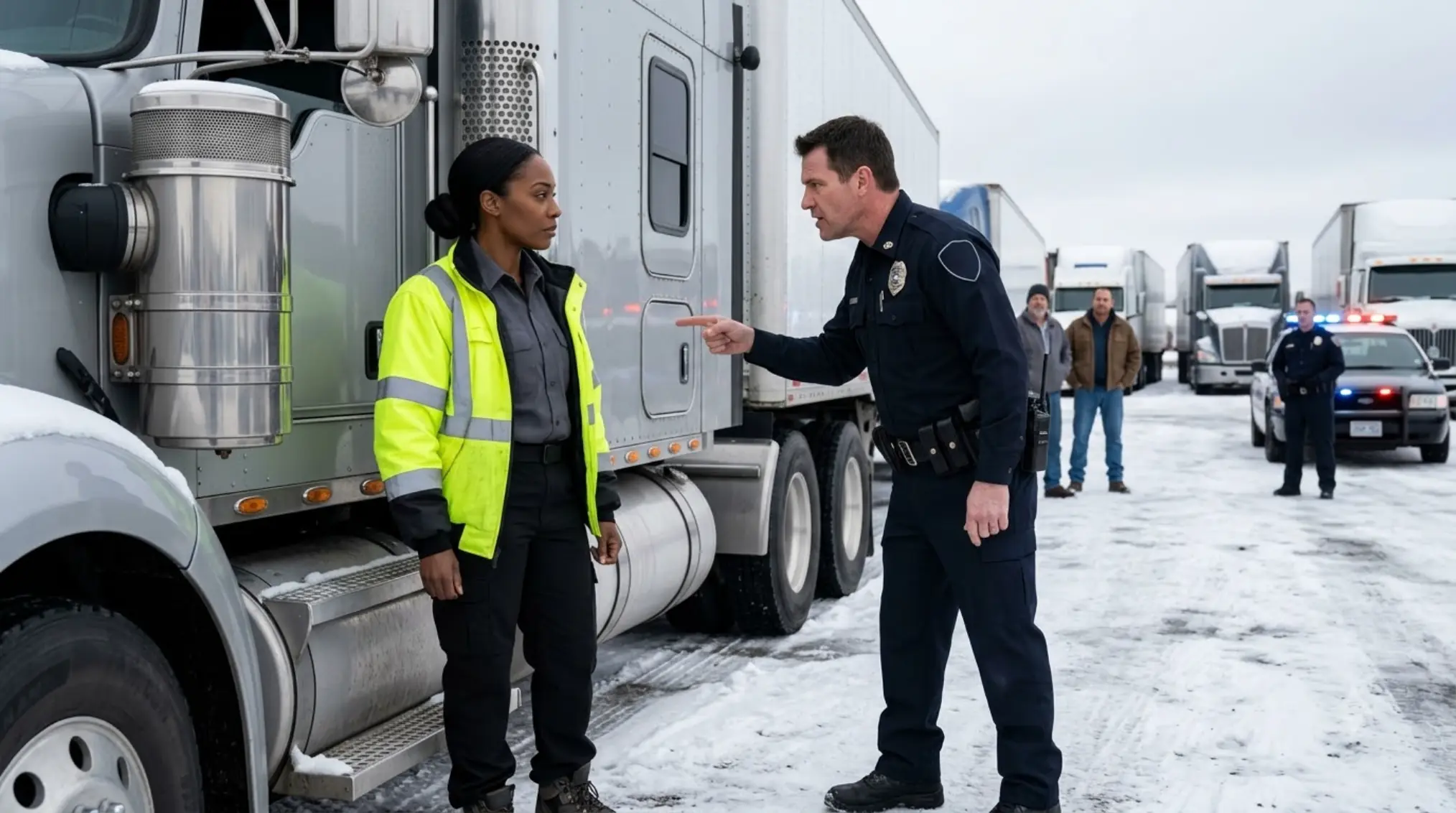
Officer Travis Rourke had decided he did not like her before he asked for her license. He was forty-three, broad through the shoulders, square-jawed, and wearing the permanent hard expression of a man who believed hesitation invited disrespect. His black patrol uniform was zipped high against the cold, his duty belt heavy around his waist, and his boots left dark prints across the wet pavement as he stepped closer. Another officer, Deputy Mason Clark, remained several yards behind near a cruiser with red and blue lights reflecting against the wet side of Nia’s truck.
“Hey, dirt people like you don’t drive a rig without something dirty behind it,” Rourke said.
Nia’s expression did not change.
The sentence had been ugly enough that two truckers standing near a red Peterbilt turned their heads. One lowered the coffee he had been drinking while the other quietly pulled a phone from his pocket. Nia noticed them, but she did not look away from Rourke.
“Are you accusing me of something specific?” she asked.
Rourke slapped one palm against the silver sleeper door.
“I’m asking what you’re hauling.”
“My manifest is in the cab.”
“Then get it.”
Nia reached toward the door handle.
Rourke immediately stepped in front of her.
“Not so fast.”
She stopped.
“You just told me to get the manifest.”
“I told you what I wanted. I didn’t tell you that you could climb into the cab.”
Nia let her hand fall slowly.
That contradiction was exactly the kind of thing she had been trained to notice.
She had been a federal agent for eleven years.
For the previous four months, however, the only people who knew that were members of a tightly controlled investigative team spanning Montana, Idaho, Washington, and North Dakota. To almost everyone else, Nia Carter was a licensed long-haul driver working under the name Nia Brooks, hauling commercial freight through some of the least glamorous stretches of interstate highway in the country.
The truck was real.
Her commercial driver’s license was real.
Her hours behind the wheel were real.
The freight paperwork was partly fabricated.
And the sealed trailer behind her carried exactly the kind of shipment several organized cargo-theft crews had been targeting.
The FBI had spent nearly a year tracking a network stealing high-value electronics, medical equipment, and industrial components from commercial trucks moving through rural freight corridors. The criminals rarely hijacked trucks openly. Instead, someone inside transportation companies leaked routes, rest stops, seal numbers, and driver schedules.
Then corrupt middlemen created excuses to isolate certain vehicles.
A surprise inspection.
A sudden storage issue.
A roadside citation.
A suspicious cargo complaint.
Sometimes thieves arrived twenty minutes later.
Sometimes local officials never realized they had helped.
Sometimes investigators suspected they knew exactly what they were doing.
That was why Nia was in Montana.
Her silver tractor-trailer had been tagged in an intercepted message thirty-six hours earlier.
The message contained her fake name.
Her trailer number.
Her estimated arrival time.
And three words that had changed the operation immediately.
Use local pressure.
Nobody on the federal team knew exactly what that meant.
Nia was beginning to understand.
Rourke extended his hand.
“Keys.”
“No.”
The answer came so quickly that he blinked.
“What did you say?”
“I said no.”
He laughed.
“You think this is optional?”
“You haven’t told me why you want to search the truck.”
“I don’t need to explain myself to you.”
“Then you don’t get my keys.”
Behind him, Deputy Clark looked uncomfortable.
Rourke noticed.
“Problem?”
Clark shook his head.
“No.”
“Then watch the rear of the trailer.”
Clark walked away without arguing.
Nia watched him go.
The second officer was younger, perhaps thirty, and had spoken almost nothing since the stop began. She had already filed him mentally into a category she had learned to watch closely: people who recognized something was wrong but had not yet decided whether protecting themselves mattered more than stopping it.
Rourke stepped closer.
“License.”
Nia pulled out the commercial license attached to her undercover identity.
He examined it.
“Nia Brooks.”
“Yes.”
“Where are you coming from?”
“Spokane.”
“Destination?”
“Fargo.”
“What are you hauling?”
“Commercial refrigeration controls.”
“Value?”
“Not sure.”
Rourke smiled.
“You expect me to believe a driver doesn’t know what’s inside her own trailer?”
“I know what the manifest says.”
“And what does it say?”
“Commercial refrigeration controls.”
The trucker with the phone smiled slightly.
Rourke heard him.
He turned.
“Something funny?”
The man raised his hands.
“No, officer.”
“Then keep walking.”
The trucker stayed where he was.
Rourke returned to Nia.
“I’m searching the sleeper.”
“For what?”
“Contraband.”
“What contraband?”
“We’ll find out.”
Nia folded her arms.
“That’s not probable cause.”
His expression hardened.
“You a lawyer now?”
“No.”
“Then don’t quote law at me.”
“I don’t need to be a lawyer to know you need legal justification for a search.”
Rourke leaned close enough for her to smell coffee on his breath.
“Here’s your justification. You’re nervous.”
Nia nearly laughed.
“I’m standing still.”
“You keep asking questions.”
“That’s nervous?”
“That’s suspicious.”
One of the truckers behind them muttered something.
Rourke turned sharply.
“I said clear the area.”
The man holding the phone shook his head.
“We’re standing beside our trucks.”
Rourke pointed at him.
“Keep recording and you’ll become part of the investigation.”
The trucker raised the phone higher.
“Then make sure you say that again.”
Nia looked down briefly.
That witness might become useful.
Her real concern, however, was not Rourke’s behavior.
It was timing.
The federal team had established strict rules before the operation began.
Nia would maintain her cover unless one of three things happened.
Someone attempted unauthorized access to the trailer.
Someone endangered her physically.
Or someone made a move that could compromise the larger investigation.
Rourke was getting close to all three.
He reached for the sleeper door.
Nia moved sideways and blocked him.
His hand stopped inches from the handle.
“Move.”
“Get a warrant.”
His eyes narrowed.
“You think you’re in control here?”
“No.”
She looked toward his body camera.
“I think the law is.”
Rourke kicked the front tire.
The sound echoed against the metal cab.
“I’ll tear this whole rig apart and stack enough charges to keep you off the highway for years.”
Nia’s voice dropped.
“Do that without legal authority and you’re building evidence for somebody else.”
He stepped closer.
“You threatening me?”