The leather wallet struck the cracked pavement, bounced once, and disappeared beneath the front bumper of Officer Travis Kane’s patrol motorcycle. A retired United States Army identification card, two credit cards, and a faded photograph slid through the desert dust beside it. General Raymond Cole remained on one knee near the fuel pump, his right wrist already locked inside a steel handcuff while the other cuff hung open from Kane’s gloved hand. The afternoon heat pressed down on the isolated gas station outside Yuma, Arizona, but the officer’s expression was colder than anything the desert could produce.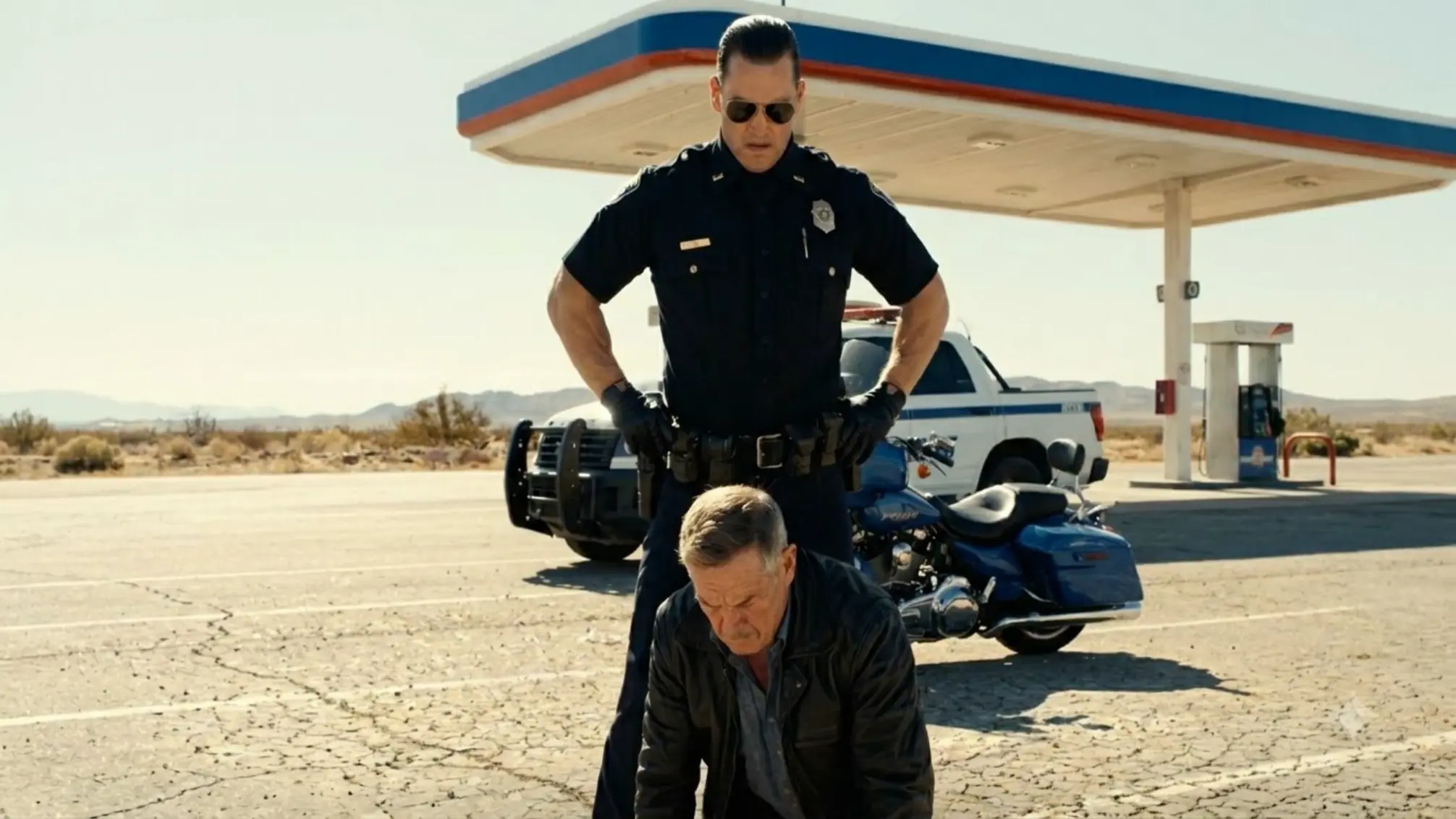
Raymond was sixty-nine years old, lean rather than frail, with short silver hair and a disciplined posture that four decades of military service had made permanent. He wore a worn black leather jacket over a gray button-down shirt, dark trousers, and dusty brown boots. His black SUV stood beside Pump Four with its fuel cap open and a United States Army retirement decal fixed discreetly inside the windshield. Nothing about the vehicle was stolen, illegal, or suspicious.
Kane had decided otherwise before asking a single useful question.
At forty-three, Travis Kane was one of the most feared patrol officers along that stretch of highway. He had a massive build, slicked-back dark hair, and a reputation for turning routine traffic stops into personal contests. Local truckers warned one another about his speed traps, invented equipment violations, and habit of demanding cash payments from motorists who appeared frightened or unfamiliar with the area.
Most victims kept driving after the encounter.
Few returned to complain.
Raymond had stopped for fuel shortly after three in the afternoon while traveling from San Diego to Fort Huachuca. The Army had invited him to attend a private leadership conference honoring commanders who had shaped modern military logistics. He planned to speak the following morning about responsibility under pressure, a subject he believed mattered most when authority could be exercised without immediate challenge.
The irony would become clear before sunset.
Raymond had just replaced the fuel nozzle when Kane’s motorcycle rolled sharply across the station entrance and stopped behind his SUV. The officer remained seated for several seconds, watching him through dark aviator glasses. Then he dismounted, rested one hand near his holster, and demanded identification.
Raymond complied without argument.
Kane examined the driver’s license and vehicle registration. The SUV was registered in Raymond’s name, the address matched, and the documents were current. Still, the officer looked inside the vehicle and noticed a secured black case positioned behind the passenger seat.
“What’s in the case?” Kane asked.
“Personal documents.”
“Open it.”
“Do you have a legal reason to search my vehicle?”
The question changed Kane’s face.
He was accustomed to nervous obedience, not calm precision. “You refusing a lawful order?”
“I’m asking the basis for it.”
“The basis is that I’m telling you.”
“That isn’t a legal basis.”
Kane moved closer. “You lawyers always think you’re smarter than everyone.”
“I’m not a lawyer.”
“Then what are you?”
“Retired.”
The officer glanced at the Army decal. “Retired from what?”
Raymond reached toward the wallet containing his military identification. Kane immediately slapped his hand away.
“Keep your hands where I can see them.”
“My retired military ID is in the wallet.”
“I didn’t ask for a costume card.”
Raymond’s eyes hardened. “You asked what I retired from.”
Kane removed the wallet himself and opened it. Inside was a retired officer credential carrying Raymond’s photograph, service number, and rank at retirement: GENERAL, UNITED STATES ARMY, FOUR-STAR.
The officer stared at it for several seconds.
Then he laughed.
“You expect me to believe this?”
“You can verify it.”
“I’ve met generals. They don’t drive alone through the desert dressed like a mechanic.”
Raymond had commanded soldiers in combat zones, negotiated with foreign defense ministers, and briefed presidents inside rooms where one careless sentence could affect thousands of lives. He had learned that arrogance usually revealed insecurity before it revealed strength.
“Return my wallet,” he said.
Kane looked toward the station windows. The clerk, a young woman named Maya Lopez, watched from behind the counter. A delivery driver filling a vending machine had also stopped working. Kane noticed the witnesses and seemed to make a decision.
Instead of returning the wallet, he told Raymond the SUV matched the description of a stolen government vehicle.
It did not.
The vehicle was black. The stolen SUV listed in the regional alert was white, carried government plates, and belonged to a federal land-management office more than two hundred miles away. Kane knew the difference, but the accusation gave him a reason to escalate.
“Turn around and place your hands on the hood.”
“No.”
The word was quiet.
Kane’s hand moved toward his holster. “What did you say?”
“I said no. You have my license, registration, and military identification. They all confirm who I am and who owns this vehicle.”
“You don’t control this stop.”
“Neither does your temper.”
Kane stepped forward and grabbed Raymond’s left arm. The retired general did not resist, but he shifted his weight to protect an old knee injury. The movement was small, yet Kane used it as an excuse.
“Stop resisting!”
He twisted Raymond’s arm behind his back and forced him against the side of the SUV. Metal scraped leather as one cuff closed around his wrist. Raymond kept his voice steady and asked Kane to activate his body camera.
The officer smiled.
“It malfunctioned.”
Maya could see the red indicator glowing on the camera mounted to his chest.
She reached under the counter and began recording through the gas station’s exterior security system. The cameras normally captured license plates, fuel theft, and overnight vandalism. That afternoon, they recorded Kane bending a retired four-star general over the hood of his own vehicle.
The delivery driver quietly raised his phone.
Raymond looked toward him. “Keep your distance.”
Kane heard the warning and mistook it for an attempt to gather support. He pulled Raymond backward and ordered him onto his knees.
Raymond lowered himself carefully.
His right knee had been reconstructed after a helicopter crash during an overseas deployment. The joint could support his weight, but sudden pressure caused severe pain. Kane saw the hesitation and kicked the side of his boot.
“Down.”
Raymond’s knee struck the pavement.
The open handcuff cut against his free wrist as he caught himself. Kane removed the wallet from his jacket and tossed it toward the patrol motorcycle. When the retired military credential slid into view, the officer deliberately kicked it farther into the dirt.
“Your medals mean nothing on my highway.”
Raymond slowly raised his eyes.
“You’ve made three mistakes,” he said.
Kane leaned down. “Only three?”
“You stopped me without cause. You falsified a vehicle report. And you destroyed evidence while cameras were recording.”
The officer glanced toward the station.
Maya lowered herself behind the counter before he could see her phone.
Kane gripped Raymond’s shoulder. “You think anyone believes an old man pretending to be a general?”
“I don’t need belief.”
“What do you need?”
“Ten minutes.”
Kane laughed. “In ten minutes, you’ll be inside a county holding cell.”
Raymond looked toward the highway.
A distant line of dark vehicles had appeared beyond the heat shimmer. Their headlights moved together with the spacing and discipline of an organized convoy. Two black military SUVs led the formation, followed by an Army staff vehicle and a security truck.
Raymond recognized them immediately.
His conference escort had been scheduled to meet him at a highway checkpoint farther east. When he failed to arrive and stopped answering calls, the tracking beacon in his encrypted travel case transmitted his location to the Army security team.
Kane followed his gaze but did not yet understand what was approaching.
“Friends of yours?”
“Colleagues.”
The first black SUV turned into the station entrance.
A second followed.
Then the Army staff vehicle entered, displaying an official Department of the Army plate beneath the windshield. Kane straightened slowly as uniformed personnel became visible behind the glass.
“Who did you call?”
Raymond remained on one knee. “Nobody.”
The vehicles stopped in a controlled semicircle around the fuel pumps. Doors opened almost simultaneously. Two military police officers stepped out first, followed by three senior Army officers in service uniforms.
Lieutenant General Marcus Reed emerged from the lead SUV.
He was a fifty-eight-year-old Black American officer with a tall frame, close-cropped gray hair, and the unmistakable composure of a commander accustomed to entering unstable situations without adding chaos. Beside him walked Major General Allison Grant and Brigadier General Samuel Price.
Kane stared at the stars on their uniforms.
The retired man kneeling in the dirt suddenly looked different to him.
Marcus Reed saw Raymond’s cuffed wrist, the discarded military credential near the motorcycle, and the officer’s boot positioned inches from the retired general’s injured knee.
His expression became still.
“General Cole?”
Kane stepped between them. “This man is under arrest.”
Marcus did not look away from Raymond. “On what charge?”
“Possession of a stolen government vehicle and resisting lawful detention.”
Major General Grant walked toward the SUV and read the license plate. She then examined the registration papers Kane had placed on the hood.
“This vehicle is privately registered to Raymond Edward Cole,” she said.
Kane raised his chin. “The documents may be fraudulent.”
Brigadier General Price picked up the wallet from the ground. He brushed dust from the retired credential and held it beside Raymond’s face.
“It is authentic.”
“You can’t interfere with a police investigation.”
Marcus Reed finally looked at Kane. “We are not interfering. We are witnessing.”
Kane’s fingers hovered near his belt. “Everyone needs to step back.”
Two military police officers stopped several feet away but did not retreat.
Raymond spoke from the pavement. “Marcus, nobody touches him.”
The lieutenant general’s jaw tightened. “Sir, he has you handcuffed.”
“And he will remove them through his own department’s procedure.”
Even while humiliated and injured, Raymond refused to let the confrontation become physical. His concern was no longer merely his own treatment. One uncontrolled movement between armed officers could turn a corrupt arrest into a tragedy.
Marcus nodded.
Then he removed his phone and contacted the county sheriff directly.
Kane’s confidence began to fracture.
“You don’t have authority over me,” he said.
“No,” Marcus replied. “Your sheriff does.”
The gas station clerk emerged from the store with her phone still recording. “Officer, the security cameras captured everything.”
Kane spun toward her. “Get back inside.”
She stopped but did not lower the device.
The delivery driver stepped forward as well. “My phone recorded him showing you the registration before you cuffed him.”
“You’re obstructing an arrest.”
“I’m standing beside a soda machine.”
Kane reached for his radio and reported an escalating confrontation involving multiple armed military personnel. His words were fast and carefully chosen. He described Raymond as combative, the convoy as threatening, and himself as surrounded.
Major General Grant recorded the transmission.
Raymond remained silent until Kane finished.
“You forgot the stolen vehicle,” he said.
The officer stared at him.
“You said that was the reason for the arrest. Why didn’t you mention it to dispatch?”
Kane realized the mistake too late.
If he repeated the stolen-vehicle claim, the dispatcher could compare the description instantly. If he omitted it, the recording would expose that his justification had changed once witnesses arrived.
Sirens sounded in the distance.
This time, they belonged to Sheriff Elena Vasquez and two county deputies. Vasquez had commanded the department for seven years and had already received complaints about Kane’s conduct, though previous victims lacked video evidence strong enough to sustain disciplinary action.
She stepped from her SUV and surveyed the station.
“Officer Kane, remove the handcuffs.”
He looked at her. “Sheriff, this suspect—”
“Remove them.”
“He resisted.”
“The station owner sent me live footage while I was driving here.”
Kane’s face drained.
Maya had transmitted the security recording directly to the sheriff’s office after recognizing Vasquez’s name on a public contact card taped beside the store telephone. The footage showed the entire encounter, including Kane reading the valid documents before inventing the stolen-vehicle accusation.
Kane unlocked the cuff.
Marcus and Samuel helped Raymond stand. His knee nearly failed when he put weight on it, but he refused the offered chair until the confrontation was formally resolved.
Sheriff Vasquez collected Kane’s duty weapon, badge, and body camera.
“You are suspended pending investigation.”
“This is political.”
“This is recorded.”
“He threatened me.”
“Where?”
Kane looked toward the cameras. “Before they started recording.”
“The exterior system records continuously.”
He had no answer.
Vasquez turned to the military officers. “General Reed, I apologize for what happened here.”
Marcus looked toward Raymond. “He deserves the apology.”
The sheriff faced the retired general. “General Cole, I am sorry. A county officer abused his authority, ignored your identification, and filed a false account of this detention.”
Raymond rubbed his wrist. “How many people has he done this to who had no convoy coming?”
The question silenced everyone.
Vasquez looked at Kane.
He stared at the ground.
Raymond continued, “That is the investigation I care about.”
An Army medic examined his knee and found severe swelling but no fracture. The medic recommended immediate transport, yet Raymond asked for ten more minutes. He wanted every piece of physical evidence photographed before anyone moved it.
His wallet remained on the ground.
The scuffed military credential lay beside the motorcycle tire.
The broken skin around his wrist showed where the cuff had tightened.
The delivery driver provided his video. Maya exported the station footage while a deputy created a digital copy and documented the original recording system. General Grant preserved Kane’s radio call, and military security officers logged the convoy’s arrival times.
Within those ten minutes, the officer’s story collapsed completely.
The alleged stolen vehicle alert concerned a white Chevrolet Suburban with federal plates. Raymond drove a privately owned black Lincoln Navigator. Kane had accessed the alert from his patrol terminal shortly before initiating the confrontation, proving he knew the descriptions did not match.
His body camera had never malfunctioned.
He had manually disabled it thirty seconds before approaching Raymond.
When Sheriff Vasquez restored the device, an internal log displayed the exact time of deactivation. Department policy required continuous recording during enforcement encounters. Kane had switched it off because he expected another unrecorded intimidation.
The gas station cameras defeated that plan.
A search of his patrol motorcycle uncovered twelve envelopes containing cash. Each bore a handwritten date, vehicle description, or first name. Several matched recent complaints from motorists who said a highway officer threatened them with arrest unless they paid immediate “administrative penalties.”
Kane claimed the cash belonged to him.
One envelope contained a handwritten note from a truck driver stating the payment had been made under protest.
Sheriff Vasquez ordered him detained.
The moment changed Kane completely.
His shoulders fell, his voice softened, and the aggressive certainty vanished. He asked to speak privately, then demanded a union representative, then insisted he had been following an unofficial department practice.
No one supported the claim.
A deputy placed the same steel handcuffs around Kane’s wrists that he had used on Raymond.
The corrupt officer looked toward the retired general. “You did this.”
Raymond stood beside the Army vehicles with an ice pack pressed against his knee.
“No. You mistook quiet for weakness.”
Kane was transported to the county detention center.
The investigation widened before nightfall. Sheriff Vasquez reopened twenty-seven complaints connected to his patrol assignments. Gas stations, restaurants, and highway businesses provided security footage. Several recordings showed Kane stopping travelers, threatening vehicle impoundment, and directing them toward cash machines.
Victims came forward after local news reported his suspension.
A retired schoolteacher said Kane had taken four hundred dollars from her after claiming her rental car was stolen. A Mexican American contractor reported being held beside the highway for two hours until he paid an invented permit fee. A young Army specialist described being mocked for carrying a temporary military license plate while driving to his first duty station.
None of them had four-star identification.
None had generals arriving behind them.
That fact became central to Raymond’s response.
He refused to participate in interviews that framed the incident as shocking only because of his former rank. During a press conference at Fort Huachuca, he stood with a cane beside Lieutenant General Reed and Sheriff Vasquez.
“What happened to me was not wrong because I once commanded armies,” Raymond said. “It was wrong because no officer should invent a crime, disable a camera, humiliate a citizen, and expect authority to erase the truth.”
Reporters asked whether Kane had recognized his rank.
“He recognized it,” Raymond replied. “Then he kicked the identification into the dirt because he believed nobody important was watching.”
The phrase spread across the country.
Federal civil-rights investigators joined the case after evidence showed Kane disproportionately targeted elderly motorists, immigrants, veterans, and travelers passing through the county. Financial investigators traced more than eighty thousand dollars in unexplained cash deposits over four years.
Kane had used several accounts belonging to relatives.
He also falsified citations to justify some of the stops after the fact.
His original charges included assault, unlawful detention, evidence tampering, filing a false report, bribery, theft under color of authority, and federal civil-rights violations. Faced with security footage, financial records, body-camera logs, and testimony from dozens of motorists, his attorney negotiated a plea.
Kane lost his badge permanently.
He surrendered his law-enforcement certification, retirement benefits connected to misconduct, motorcycle, and several assets purchased with illegal payments. The court ordered restitution to victims and imposed a prison sentence that ended any possibility of returning to police work.
Sheriff Vasquez did not treat his arrest as the end of the problem.
She required supervisors to audit roadside stops, prohibited officers from accepting cash payments under any circumstances, and installed automatic body-camera activation linked to patrol lights and vehicle doors. Citizens could now receive digital copies of citations immediately, preventing officers from inventing documents later.
Complaints against the department dropped sharply.
Raymond eventually reached Fort Huachuca one day late. His knee was braced, his wrist bandaged, and his black jacket carried a pale streak of desert dust. Organizers offered to reschedule his speech.
He declined.
Hundreds of officers and soldiers filled the auditorium when he walked to the podium. Marcus Reed sat in the front row beside the generals who had stepped from the convoy.
Raymond placed his damaged military credential on the lectern.
The plastic card still carried a scratch from Kane’s boot.
“I planned to speak about leadership under pressure,” he began. “Yesterday gave me a better introduction.”
A few people smiled, but the room remained quiet.
Raymond explained that rank could command obedience but never create integrity. Integrity revealed itself when no senior officer, camera, or convoy appeared likely to intervene.
“Authority does not show us who someone becomes,” he said. “It removes the obstacles hiding who they already are.”
He told the officers that Kane’s greatest mistake was not failing to recognize a retired general. It was believing an elderly traveler without visible power could be treated as disposable.
Then Raymond addressed the convoy.
“Those vehicles did not rescue me,” he said. “The clerk who preserved the footage did. The driver who kept recording did. The sheriff who trusted evidence over loyalty did.”
Maya Lopez and the delivery driver later received civilian commendations from the county. Both tried minimizing what they had done. Maya said she had simply pressed the record button and sent a file.
Raymond disagreed.
“Truth often survives because one ordinary person refuses to look away.”
Months later, he returned to the same gas station. The cracked pavement had been repaired, and new security cameras covered every pump. Maya still worked behind the counter while saving money for nursing school.
Raymond brought her a framed Army commendation and a scholarship letter funded through a veterans’ foundation.
She stared at the documents. “I didn’t do this for a reward.”
“I know.”
“Then why?”
“Because people who act correctly without expecting payment are the ones who deserve support.”
Outside, Raymond walked toward Pump Four.
The desert wind moved dust across the pavement where his wallet had landed. He could still remember Kane’s boot striking the leather and the officer declaring that medals meant nothing on his highway.
Raymond had never disagreed with that part.
Medals did not make him innocent.
Stars did not make him worthy of dignity.
His identity mattered only because it disproved the lie the officer used to control him. The deeper truth was that even without the uniform, rank, convoy, or generals, Kane’s actions would have remained criminal.
Raymond opened the SUV door.
Inside, the repaired military credential rested beside the faded photograph he had carried for decades. The image showed a much younger Raymond surrounded by soldiers before an overseas deployment.
He had spent his career teaching them that leadership began where supervision ended.
At the desert gas station, a corrupt officer had demonstrated the opposite.
Kane believed authority belonged to whoever carried the badge and spoke the loudest. Raymond understood that authority survived only when restrained by evidence, law, and conscience.
The officer had ordered him not to move.
Raymond obeyed.
He stayed still long enough for the cameras to preserve every lie, for the Army convoy to arrive, and for the badge Kane had weaponized against strangers to be removed from his chest forever.