Officer Ryan Mercer leaned through the open window of the black SUV and rested one hand near the holster on his hip.
“Pay me two grand,” he said, “or I’ll find something in this car.”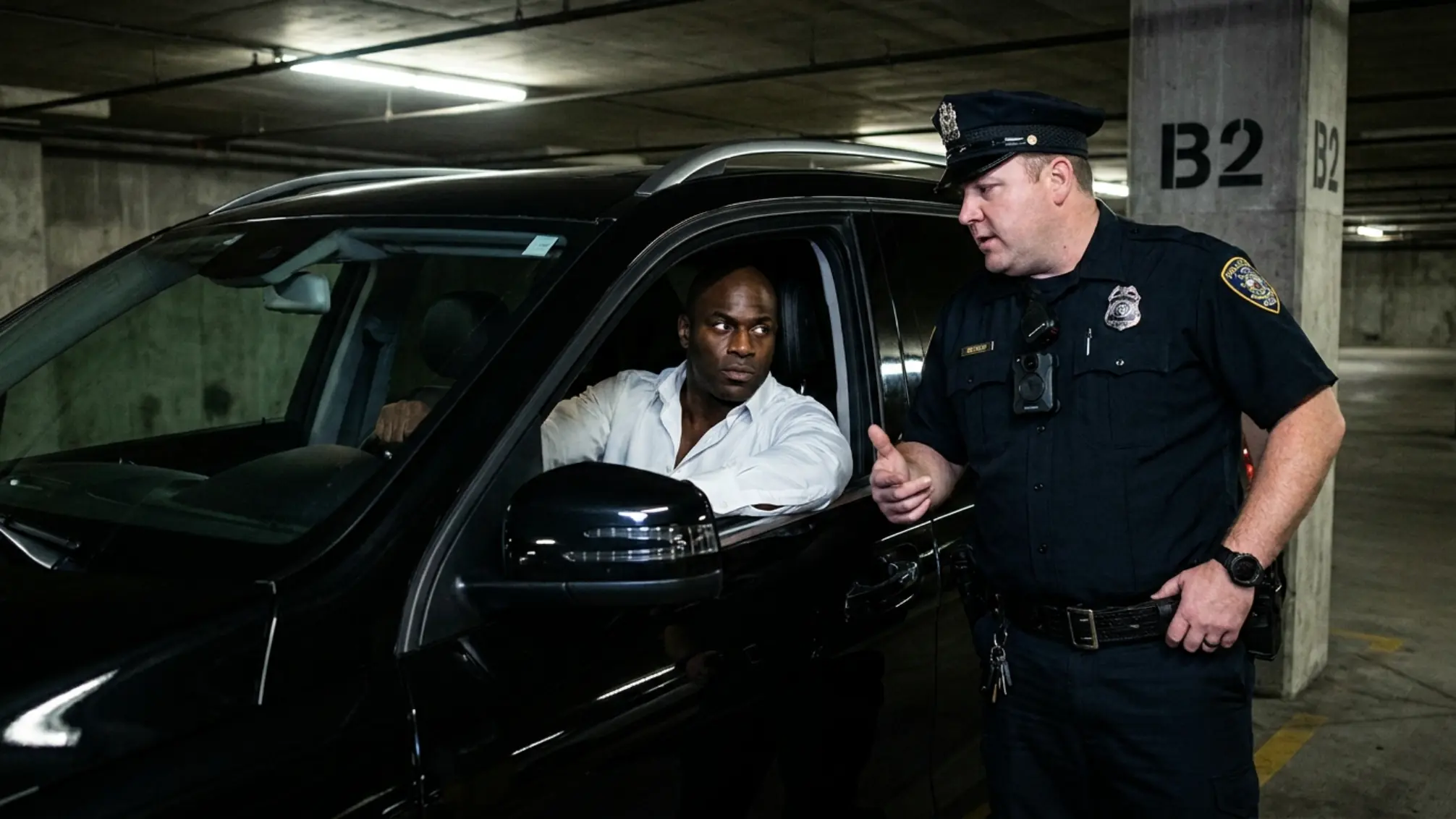
Marcus Kane remained behind the steering wheel, his broad shoulders relaxed beneath a crisp white dress shirt. Fluorescent lights flickered above the empty B2 level of the Atlanta office tower, reflecting in broken lines across the polished hood.
Marcus looked at Mercer’s hand.
“Take it off the holster before this gets worse.”
Mercer stepped closer until his body filled the window.
“You don’t threaten a cop down here. I can bury you before backup arrives.”
Marcus reached slowly inside his shirt and pulled out a leather credential case.
“Then call yours,” he said, opening it. “My federal team just sealed every exit.”
For one second, Mercer did not understand what he was seeing.
The badge was gold, clean, and unmistakable.
FEDERAL BUREAU OF INVESTIGATION
The officer’s expression changed so quickly that Marcus could see each stage separately: confusion, disbelief, calculation, and finally fear.
A heavy metal gate descended across the western exit.
Another slammed into place near the ramp leading to street level.
Red emergency lights began flashing above both lanes.
Mercer stepped away from the SUV.
“What is this?”
Marcus turned off the engine.
“This is the part where you stop pretending.”
Mercer’s eyes moved across the garage. Concrete pillars, parked vehicles, dark corners, and security cameras surrounded him. Until that moment, he had considered the underground level his safest hunting ground.
No pedestrians.
No passing traffic.
No neighborhood witnesses.
No visible patrol cameras beyond the body camera he controlled himself.
Now every shadow looked occupied.
“You set me up,” Mercer said.
Marcus opened the driver’s door and stepped out.
At forty-five, he was six feet three and built like a man who still trained daily despite spending most of his career behind reports, interviews, and surveillance screens. His deep brown skin caught the cold fluorescent light as he straightened beside the SUV.
“No,” he said. “You chose me.”
Mercer’s jaw tightened.
He had selected the vehicle because it looked expensive.
He had selected the driver because Marcus was Black, alone, and dressed well enough to possess money but not visibly powerful enough to make extortion dangerous. Those judgments had been part of Mercer’s method for nearly three years.
The FBI had spent eight months proving it.
The investigation began with a twenty-two-year-old college student named Jamal Bryant.
Jamal worked evenings at an upscale restaurant inside the office tower and parked on level B3. One night, he found Mercer standing beside his car, claiming a security dog had detected narcotics inside the trunk.
There was no dog.
Mercer told Jamal that a full search, arrest, and vehicle impound could be avoided for eight hundred dollars. Jamal had only three hundred in cash. Mercer took it, photographed his driver’s license, and warned him that reporting the incident would turn a “minor misunderstanding” into felony possession.
Jamal remained silent for six weeks.
Then Mercer stopped him again.
This time, the demand was twelve hundred dollars.
Jamal recorded part of the conversation on his phone, but fear caused him to lower it before Mercer stated the amount clearly. The recording contained threats, yet no visible badge number and no proof that money changed hands.
Atlanta police opened an internal inquiry.
Mercer denied everything.
He claimed Jamal had become hostile after receiving a lawful parking citation. His body camera footage began only after the conversation ended and showed Mercer speaking calmly while Jamal looked frightened and angry.
The department classified the complaint as unsubstantiated.
Three months later, a hospital administrator named Dr. Aisha Reynolds reported a nearly identical encounter. Mercer accused her of carrying prescription medication without documentation and demanded fifteen hundred dollars to “resolve the matter privately.”
She refused.
Mercer searched her car and produced a small plastic bag containing white powder.
A laboratory later identified it as crushed aspirin.
The bag carried no usable fingerprints.
Mercer claimed he discovered it beneath the passenger seat.
Aisha spent fourteen hours in custody before prosecutors declined charges.
Her professional reputation survived, but the humiliation did not disappear. Security footage showed Mercer approaching the passenger side of her car before activating his body camera, yet the angle did not reveal what he had done.
Internal Affairs reopened his file.
Five more complaints surfaced.
Every complainant was Black or Latino.
Every encounter occurred late at night inside a parking garage or isolated commercial lot.
Every victim was accused of possessing drugs, stolen property, or invalid identification.
Every incident ended in one of two ways: money disappeared, or suspicious evidence appeared.
Mercer always controlled the beginning of the recording.
The FBI entered the case after one victim was an employee of a federal contractor and reported being threatened with exposure of confidential work information. Investigators suspected Mercer had accessed restricted databases to identify targets unlikely to report him.
Special Agent Marcus Kane led the task force.
At first, the evidence looked frustratingly incomplete.
Victims had inconsistent memories because fear distorted details. Cash transactions left no electronic trail. Mercer’s reports were carefully written and supported by body-camera footage beginning at precisely the moment he wanted official documentation to start.
He had turned procedure into camouflage.
Marcus understood that proving isolated misconduct would not be enough. The task force needed to reveal the entire pattern: selection, pressure, threat, demand, and attempted concealment.
They began watching Mercer.
He worked overnight security details around luxury hotels, medical complexes, and office towers. He volunteered for parking-garage patrols other officers considered boring. He frequently deactivated his body camera, explaining later that battery problems or accidental button presses caused the gaps.
His bank accounts showed no unexplained deposits.
But his younger brother, Kyle, purchased a fishing boat, paid off credit-card debt, and made repeated cash deposits below federal reporting thresholds.
Kyle had no steady employment.
Agents discovered that Mercer met him twice each month behind a storage facility outside Decatur.
The task force still needed direct evidence.
Marcus proposed becoming the target.
His supervisors objected immediately.
“You’re too recognizable,” Assistant Special Agent in Charge Elena Torres told him.
“To Mercer?”
“To local law enforcement. If one officer recognizes you, the operation collapses.”
“Then choose a garage where he works alone.”
“He may search you.”
“He can search the vehicle.”
“He may become violent.”
“That is why the team will be close.”
Elena studied him across the conference table.
“You are personally invested in this.”
Marcus did not deny it.
Twenty-six years earlier, when he was nineteen, a police officer stopped him outside a convenience store in Savannah. The officer accused Marcus of matching the description of a robbery suspect, though the actual suspect was nearly twenty years older and six inches shorter.
Marcus complied.
The officer pushed him against a wall, emptied his pockets, and repeatedly asked where he had hidden the weapon. When Marcus objected, the officer threatened to charge him with resisting arrest.
Nothing was found.
Marcus was released without apology.
The encounter lasted seventeen minutes.
It influenced the rest of his life.
He joined the FBI not because he believed every officer was corrupt, but because he understood how much damage one dishonest person could commit while protected by a legitimate badge.
Elena finally approved the operation.
The task force rented a luxury SUV through a front company. Technicians installed six hidden cameras, three microphones, a remote door-control system, and a concealed transmitter beneath the dashboard.
An evidence technician placed a sealed envelope containing two thousand dollars inside the center console. Every bill was photographed and treated with invisible ultraviolet powder.
Marcus’s background for the operation portrayed him as a private investment consultant visiting the office tower after hours. Parking records, building access logs, and a temporary company profile supported the story.
The team leaked information through a source Mercer trusted.
A wealthy out-of-town businessman.
Alone.
Driving a luxury SUV.
Expected to leave after ten.
Mercer took the bait.
At 10:14 p.m., Marcus entered the garage.
He parked near pillar B2, stepped out briefly, then returned to the driver’s seat and waited. A surveillance van monitored the transmission from across the street. Four agents occupied unmarked vehicles on neighboring levels.
Mercer appeared at 10:27.
He approached without activating emergency lights.
His uniform camera showed no red recording indicator.
Marcus lowered the window.
“Evening, Officer.”
“Registration.”
Marcus handed it over.
Mercer examined the document, then looked toward the rear of the SUV.
“Step out.”
“What is the reason?”
“Vehicle matches one reported in a financial-crimes investigation.”
That statement was invented. No such vehicle had been reported.
Marcus remained seated. “Which agency issued the alert?”
Mercer’s eyes hardened.
“You ask a lot of questions.”
“I’m entitled to know why I’m being detained.”
“You’re entitled to follow instructions.”
Mercer ordered Marcus out, frisked him, and searched the immediate area around the driver’s seat. He deliberately avoided the inside pocket containing the federal credential because the operation required him not to discover it too early.
Marcus had practiced the positioning for two days.
Mercer opened the center console.
He found the envelope.
“What’s this?”
“Cash.”
“I can see that.”
“It’s legal to carry cash.”
“Not when it may be connected to money laundering.”
Marcus leaned against the vehicle.
“You have evidence of that?”
Mercer looked around the empty garage.
That was the moment he believed control had become complete.
He lowered his voice.
“This can become a long night. Vehicle seized, accounts frozen, you sitting in a holding cell while investigators decide whether your business is legitimate.”
“Or?”
Mercer smiled.
“Or I decide the alert was a mismatch.”
Marcus allowed several seconds to pass.
“What would help you decide?”
“Two thousand.”
The surveillance van recorded every syllable.
Elena gave the order to hold positions. A demand alone was strong evidence, but the operation needed Mercer to take possession of the money and ideally explain what would happen if Marcus refused.
Marcus shook his head.
“I’m not paying you.”
Mercer stepped closer.
“Then I search the entire vehicle.”
“Get a warrant.”
“I don’t need one if I smell narcotics.”
“There are no narcotics here.”
Mercer’s smile became colder.
“That can change.”
Marcus looked directly at him.
“Are you threatening to plant drugs?”
“I’m explaining that searches produce surprises.”
He reached inside the center console and lifted the envelope.
Marcus’s voice remained controlled.
“Put that back.”
Mercer tucked the money beneath his vest.
“Too late.”
He then rested his hand near his holster and leaned through the window.
“Pay me two grand, or I’ll find something in this car.”
That was when Marcus delivered the line the task force had been waiting to hear.
“Take your hand off that holster before this gets worse.”
Mercer interpreted calmness as disrespect.
“You don’t threaten a cop down here. I can bury you before backup arrives.”
Marcus revealed the badge.
Now the gates were closed.
Mercer took another step backward.
“You entrapped me.”
Marcus stood beside the open door.
“Entrapment requires us to pressure you into a crime you were not already willing to commit. Nobody ordered you to stop me. Nobody told you to threaten me. Nobody made you take that money.”
Mercer glanced toward the ramp.
The gate remained down.
“Where are they?”
“Close.”
Mercer reached toward his shoulder microphone.
Marcus lifted one hand.
“Think carefully before calling anyone. Your body camera is still off, and six federal cameras have been recording since you approached.”
Mercer looked toward the SUV.
He finally noticed the tiny lens near the rearview mirror.
His face emptied.
“You have no idea what you’re doing,” he said. “There are people above me.”
“We know about Kyle.”
The mention of his brother struck him harder than the badge.
Mercer’s mouth opened, then closed.
“We know about the storage facility,” Marcus continued. “We know about the deposits, the boat, the cash debts, and the victims you selected from restricted databases.”
“You’re lying.”
“We know about Dr. Reynolds.”
Mercer’s breathing changed.
“We recovered the aspirin container from evidence storage. Your partial print was beneath the label.”
That detail had been withheld from every public report.
Mercer now understood the investigation was far larger than tonight’s demand.
A black sedan emerged from behind a concrete pillar.
Then another.
Four agents stepped into view wearing body armor and federal identification. Their weapons remained holstered, but their hands were ready.
Elena approached first.
“Officer Mercer, place both hands where we can see them.”
Mercer did not comply immediately.
His right hand hovered near his belt.
Marcus spoke quietly.
“Don’t turn extortion into something worse.”
The officer looked at the surrounding agents. No escape route remained. No friendly witness could rewrite what happened.
He slowly raised his hands.
An agent removed his firearm.
Another recovered the envelope from beneath his vest. Ultraviolet light revealed powder across Mercer’s fingers, shirt, and body armor.
Elena secured him in handcuffs.
Mercer stared at Marcus.
“You think this changes anything? The department will protect itself.”
Marcus closed the credential case.
“This isn’t about embarrassing a department. It’s about proving what you did.”
“They’ll say the victims were criminals.”
“Several are standing upstairs with attorneys and recorded statements.”
“They’ll attack their credibility.”
“That’s why we built the case around yours.”
Agents transported Mercer through a secured exit.
The operation continued overnight.
Search warrants were executed at his home, Kyle’s apartment, the storage unit, and a private locker inside the police precinct. Investigators found cash envelopes marked with dates and vehicle descriptions, copies of driver’s licenses belonging to victims, unsealed evidence bags, controlled substances removed from old cases, and a handwritten list of parking locations.
The storage unit contained equipment for duplicating identification cards and printing false evidence labels.
Kyle was arrested before sunrise.
He admitted laundering cash in exchange for twenty percent of every payment.
More disturbing evidence emerged from Mercer’s phone.
He had not acted entirely alone.
Sergeant Paul Danner, Mercer’s direct supervisor, accessed complaints before internal investigators reviewed them. Danner warned Mercer when victims provided strong evidence and helped classify body-camera failures as equipment malfunctions.
A civilian database analyst named Rebecca Sloan supplied information about vehicle owners, professions, home addresses, and criminal histories. Mercer paid her to identify targets who appeared wealthy but socially vulnerable.
They called the operation garage tax in text messages.
One exchange read:
Mercer: B2 tonight. Doctor. New Mercedes. Probably good for 1500.
Danner: Keep cam dead until attitude starts.
Another involved Jamal Bryant.
Mercer: Kid has no lawyer money. Easy repeat.
The phrase caused silence inside the task-force office.
He had not merely extorted victims.
He cataloged their fear and returned when he believed it remained useful.
Danner and Sloan were arrested within forty-eight hours.
The police department placed twelve cases under independent review and surrendered all evidence involving Mercer’s patrol activity. Prosecutors dismissed charges against seven people after discovering that the same officer had “found” drugs in each vehicle during unrecorded searches.
Dr. Aisha Reynolds received a formal apology from the city.
She did not accept it immediately.
At a public hearing, she described the night Mercer arrested her.
“He did not only place false evidence in my car,” she said. “He placed doubt around my name. Every colleague who heard I had been arrested wondered whether some part of the allegation might be true. That suspicion remained after the charges disappeared.”
Jamal testified next.
His hands shook while he described giving Mercer the three hundred dollars intended for his mother’s electricity bill. When he finished, Marcus met him outside the hearing room.
“You started this,” Marcus said.
Jamal shook his head. “I stayed quiet the first time.”
“You spoke when speaking was dangerous.”
“I almost didn’t.”
“But you did.”
The federal trial began nine months later.
Mercer’s defense argued that Marcus had offered money, provoked the confrontation, and interpreted ordinary police discretion as corruption. The hidden footage destroyed that claim.
Jurors watched Mercer invent the vehicle alert.
They saw him search the console, take the envelope, threaten to find drugs, and place his hand near his weapon while demanding payment.
They also watched Marcus remain controlled from beginning to end.
The prosecution presented the cash ledgers, database searches, text messages, evidence bags, and testimony from eleven victims.
Mercer took the stand against his attorney’s advice.
He claimed the money was seized evidence.
The prosecutor asked why it was hidden beneath his vest rather than documented.
He claimed he suspected Marcus was dangerous.
The prosecutor asked why he never activated his body camera or requested backup.
Mercer said he feared compromising an investigation.
Then the prosecutor played his words again.
Pay me two grand, or I’ll find something in this car.
No explanation could turn the threat into legitimate policing.
The jury convicted him on extortion, civil-rights violations, evidence tampering, obstruction, and conspiracy.
Danner and Sloan were convicted separately. Kyle received a reduced sentence after cooperating and identifying additional victims.
The judge addressed Mercer before sentencing.
“You used the authority of the law to manufacture fear, then sold relief from the fear you created. Each victim understood that resistance could cost freedom, employment, reputation, or life. That is not corruption at the edge of policing. It is the deliberate inversion of policing.”
Mercer received twenty-two years in federal prison.
After the trial, reporters surrounded Marcus outside the courthouse.
One asked whether he felt satisfaction revealing the badge in the garage.
“No,” Marcus said.
The answer surprised them.
“Why not?”
“Because the badge mattered only after he had already decided I was someone he could threaten. The important moment happened before he knew who I was.”
Another reporter asked whether Mercer’s actions reflected the entire police department.
Marcus rejected the framing.
“Honest officers helped build this case. The point is not that every badge hides corruption. The point is that no badge should prevent scrutiny.”
The department introduced automatic body-camera activation whenever officers entered designated parking facilities during active stops. Camera shutdowns required documented supervisory review, and unexplained recording gaps triggered outside audits.
Cash seizures required immediate electronic reporting and dual-officer verification.
Database access became traceable through real-time alerts.
The reforms could not guarantee integrity.
They made secrecy more difficult.
One year after the operation, Marcus returned to the B2 garage.
The same fluorescent lights buzzed above the black concrete lanes. The pillar remained marked with large white letters. Vehicles entered and left without knowing what had happened there.
Jamal had asked to meet him.
The young man arrived driving a used Honda and parked beside the pillar where Mercer stopped Marcus.
“I got accepted into law school,” Jamal said.
Marcus smiled. “Congratulations.”
“I want to work in civil rights.”
“That is difficult work.”
“I know.”
“Good.”
Jamal looked around the garage.
“Do you ever think about what would have happened if Mercer had realized who you were before asking for money?”
“He would have smiled, apologized, and let me leave.”
“Then you wouldn’t have caught him.”
“Not that night.”
Jamal nodded slowly.
“He respected the badge.”
“No,” Marcus said. “He feared consequences.”
There was a difference.
Mercer had treated powerful people carefully because they could answer his authority. He abused those he believed lacked witnesses, influence, and protection.
The operation succeeded because Marcus appeared to be one of them.
A Black driver alone underground.
An expensive vehicle.
No visible allies.
No obvious power.
Mercer thought the darkness belonged to him.
He never considered that the silence might be listening.
Marcus looked toward the ceiling camera newly installed above the lane. It no longer pointed only at the entrance. It covered the entire parking bay.
He had carried a federal badge throughout the confrontation, but the badge was not what made the extortion wrong. The same threat would have been wrong if Marcus had been an accountant, delivery driver, student, doctor, or unemployed father.
Mercer’s mistake was not selecting an agent.
His mistake was believing any person could safely be treated as prey.
He leaned into a car window, demanded money, and promised to manufacture guilt.
Then the gates closed.
Not because his target happened to possess greater power, but because eleven frightened people had finally combined their voices with evidence strong enough that his badge could no longer protect him.
The power shift lasted seconds.
Building the truth behind it took months.
And once every exit was sealed, Ryan Mercer discovered the one thing corruption always underestimates.
Someone is eventually watching.