Officer Travis Boone froze with the clear plastic bag suspended above the passenger seat. His fingers remained pinched around one sealed corner while white powder settled inside it, and the smug expression on his face disappeared as quickly as it had arrived. In the rearview mirror, Malcolm Reed watched a black delivery van turn onto the palm-lined street and stop half a block behind Boone’s patrol car. The van looked ordinary, but six federal agents inside had just heard every word.
Boone glanced over his shoulder but saw no flashing lights or visible badges. He convinced himself Malcolm was bluffing, because frightened men often invented powerful friends when they realized an arrest was coming. He dropped the bag onto the passenger seat and reached for the driver’s door handle. “Step out of the vehicle.”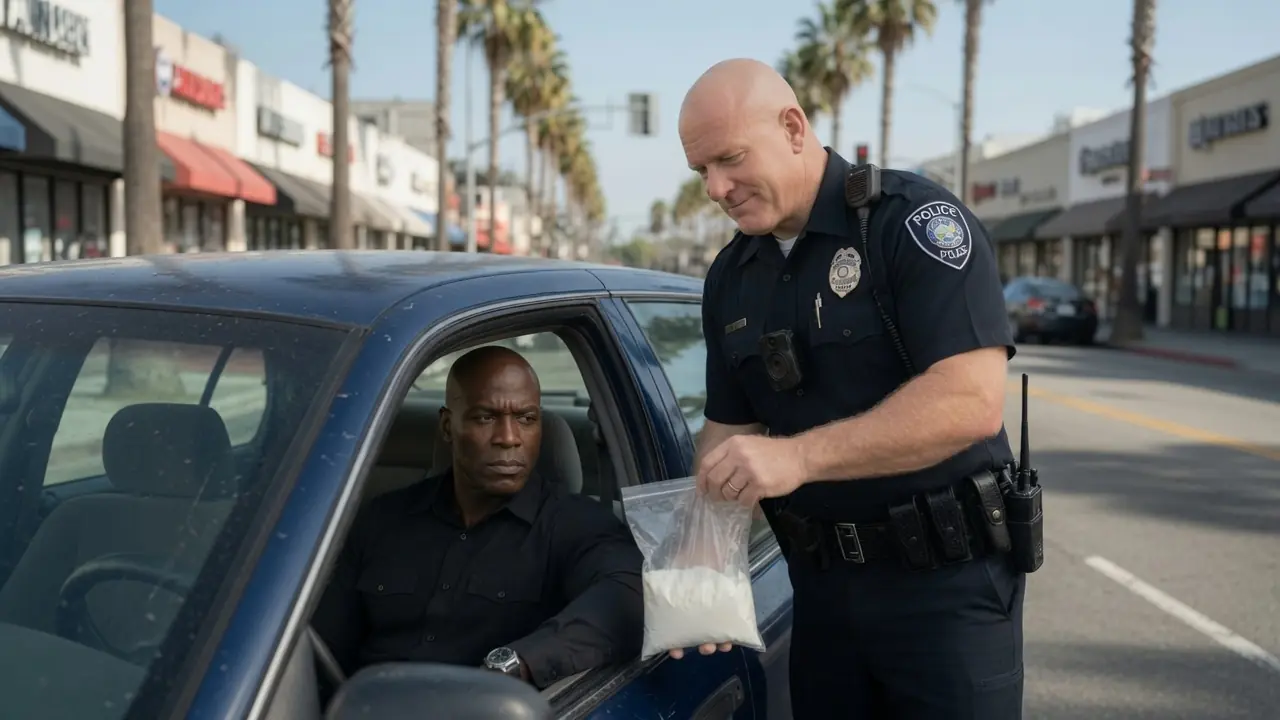
Malcolm remained seated with both hands visible on the steering wheel. At forty-four, he had deep brown skin, a shaved head, steady dark eyes, and the broad build of a man who trained every morning before sunrise. His fitted black shirt concealed a transmitter beneath the second button, while three cameras inside the red sedan recorded the dashboard, passenger seat, and open window. “State the reason for the search.”
Boone leaned closer. “I smelled narcotics.”
“The windows were closed when you approached.”
“They are open now.”
“Because you ordered me to lower them.”
Boone’s jaw tightened. For eleven years, he had controlled traffic stops by speaking faster than drivers could respond and turning questions into accusations. Most people became nervous beneath his voice, and nervous movement gave him language he could reshape inside a report. Malcolm’s calmness felt less like cooperation and more like disrespect.
The stop began four minutes earlier on Harbor Avenue in the fictional Florida city of Gulf Point. Malcolm had driven the red sedan three blocks below the speed limit, stopped fully at two intersections, and used his signal before changing lanes. Boone followed him from the parking lot of a waterfront pharmacy and activated his lights after Malcolm crossed into a quieter commercial district. No traffic violation had occurred.
Malcolm pulled over immediately.
Boone approached with one hand resting near his duty belt. Instead of introducing himself or explaining the stop, he asked where Malcolm obtained the car. Malcolm answered that it belonged to him and offered to provide registration once Boone explained why he had been detained.
Boone looked through the open window and saw an older dashboard, a folded jacket, and a sealed envelope near the center console. He asked whether Malcolm had weapons, drugs, or large amounts of cash inside the vehicle. Malcolm said no.
The officer ordered him to place both hands on the steering wheel.
Malcolm complied.
Boone walked back toward his patrol car, but he did not run the license plate. A hidden rear camera captured him opening the trunk, removing a clear evidence bag from beneath a folded traffic vest, and sliding it into his left hand. He returned to the driver’s window and claimed Malcolm’s refusal to answer unnecessary questions created probable cause.
Malcolm denied consent to search.
Boone smiled.
He opened the passenger door anyway.
The undercover operation had been designed to document suspicionless stops, illegal searches, and coercive seizures linked to Boone’s narcotics unit. Federal investigators expected him to pressure Malcolm into allowing a search. They did not expect him to arrive carrying drugs already sealed inside a police evidence bag.
Now the strongest evidence in the year-long investigation rested between Boone’s fingers.
Malcolm looked toward the rearview mirror again. “Your camera is running, Officer?”
Boone touched the body camera on his chest. “Everything is being recorded.”
Its indicator light was dark.
“You turned it off before returning from your patrol car.”
“It malfunctioned.”
“The dashboard camera malfunctioned too?”
Boone bent closer, lowering his voice so distant pedestrians could not hear. “Technology fails. Reports don’t.”
Malcolm’s expression did not change. “That sentence is going to age badly.”
Boone pulled the passenger door wider and tossed the bag beside the center console. He immediately stepped backward and raised his voice as though the encounter had just become dangerous. “Do not reach for the narcotics!”
Malcolm kept both hands on the wheel.
The officer drew his service weapon and pointed it downward near the door. “Exit the vehicle slowly.”
Malcolm looked at the muzzle, then at Boone’s face. “You planted evidence inside a car with four active cameras.”
Boone laughed. “A man facing twenty years will say anything.”
“I am not talking about your body camera.”
The delivery van’s side door opened.
Special Agent Lena Ortiz stepped onto the road wearing a dark windbreaker bearing large yellow federal letters. Five DEA investigators followed her, spreading across the street in a disciplined formation. Two unmarked SUVs turned in behind Boone’s patrol car, preventing him from driving away without blocking public traffic.
“Officer Boone,” Lena called, “move away from the vehicle and keep your hands visible.”
Boone turned so quickly that his weapon rose several inches.
Every federal agent reacted.
“Lower it!” Lena commanded.
Boone dropped his arm but did not release the gun. “I have an armed trafficking suspect.”
Malcolm spoke from the driver’s seat. “I am unarmed.”
“You found narcotics in his car?” Lena asked.
“Yes.”
“Where?”
“Passenger seat.”
“You watched him place them there?”
“I discovered them during a lawful search.”
Lena’s gaze moved toward the bag. “Did you touch it?”
“I secured the evidence.”
“With bare hands?”
Boone looked down at his uncovered fingers.
He had been so certain Malcolm was powerless that he forgot the simplest part of his own lie. A legitimate narcotics officer would have worn gloves, photographed the evidence in place, called for another officer, and documented the discovery before moving the bag. Boone had done none of those things.
Lena approached slowly. “Place the weapon on the pavement.”
“I am a sworn police officer.”
“And this is a federal operation.”
“You have no authority to interfere with an active arrest.”
Malcolm finally removed one hand from the steering wheel, moving slowly enough that everyone could see his empty palm. He lifted the transmitter from beneath his shirt collar.
“Operation Clean Current,” he said.
Boone’s face went pale.
The operation’s name had never appeared in a public filing. It was known only to the federal task force, the United States Attorney’s Office, and a confidential informant inside Boone’s department. If Boone recognized it, someone had warned him that investigators were examining his unit.
Lena heard the change in his breathing. “Why does that name concern you?”
“It doesn’t.”
“You stopped moving when he said it.”
“I am processing an unusual situation.”
Malcolm stepped from the sedan after Lena gave permission. He kept his hands visible and moved away from the planted bag. When he stood upright, Boone recognized the federal credential clipped behind his belt.
MALCOLM REED
SPECIAL INVESTIGATIONS DIRECTOR
DRUG ENFORCEMENT ADMINISTRATION
Boone stared at it. “You should have identified yourself.”
Malcolm faced him across the open passenger door. “You should not require a federal badge before deciding not to frame a Black driver.”
Several civilians had gathered near the pharmacy entrance. A delivery driver held up his phone, recording everything. An elderly woman who had watched Boone search the sedan placed one hand over her mouth when she realized the bag had come from the officer.
Lena ordered Boone to place his weapon on the ground.
This time, he obeyed.
A federal agent secured the gun while another removed Boone’s radio and department phone. Boone began demanding his supervisor and union representative, but Lena handed him a sealed search warrant covering his patrol car, body camera, locker, office, phone, and home computer.
“This warrant does not authorize my arrest,” Boone said.
“Not yet.”
“You are treating me like a criminal because of his accusation.”
“No,” Malcolm replied. “We are treating you like an officer recorded planting narcotics.”
The agents photographed the bag without moving it. One camera showed Boone holding it outside the car. A second captured his hand crossing the passenger door. The dashboard camera recorded the exact moment he released it onto the seat.
The rear-facing camera provided even more.
It showed Boone taking the bag from his own patrol trunk.
There was no interpretation left to debate.
Boone watched the footage on Lena’s tablet, and his shoulders slowly lost their rigid confidence. “Someone put that in my vehicle.”
“You removed it from a locked compartment using your key,” Lena said.
“I thought it was an evidence sample.”
“Why did you carry an evidence sample to a traffic stop?”
Boone’s mouth opened, but no answer came.
Malcolm looked toward the patrol car. “Search the compartment beneath the emergency blanket.”
Boone turned sharply. “You cannot tell them where to search.”
Lena studied him. “Why not?”
He had reacted before anyone confirmed the compartment existed.
Agents opened the trunk under the authority of the warrant. Beneath an orange emergency blanket, they found six additional plastic bags containing small quantities of illegal powder, two unregistered handguns, and a packet of blank property-seizure forms already bearing Boone’s signature.
Each bag carried a handwritten code.
The numbers matched closed traffic cases from the previous eighteen months.
Boone was detained immediately.
Steel handcuffs closed around his wrists while he demanded to speak with Captain Walter Crane, commander of Gulf Point’s Special Narcotics Interdiction Team. Lena allowed one agent to notify the department through a monitored channel.
Crane arrived twelve minutes later in an unmarked black SUV.
He stepped out furious, accompanied by two officers who placed their hands near their belts when they saw Boone in federal custody. Crane was fifty-eight, silver-haired, and publicly celebrated for building Gulf Point’s most productive narcotics unit.
“What have you done?” he shouted at Malcolm.
“Driven within the speed limit.”
Crane pointed toward the red sedan. “That vehicle was identified in an active trafficking investigation.”
“Show us the bulletin,” Lena said.
“It is confidential.”
“We have a warrant.”
Crane looked toward Boone. “Do not say another word.”
Boone had already said enough.
Lena handed Crane a separate document authorizing the seizure of the narcotics unit’s evidence records. The captain read the first page, then turned toward Malcolm.
“You people manufactured this stop.”
“The drugs came from your officer’s trunk.”
“You put them there.”
Malcolm nodded toward the cameras. “Keep building the defense. The grand jury will appreciate the rehearsal.”
Crane attempted to leave.
Federal agents blocked his SUV.
The investigation that trapped Boone began with a nineteen-year-old warehouse worker named Terrence Hill. Six months earlier, Boone stopped Terrence near the same pharmacy and claimed he discovered a bag of cocaine beneath the passenger seat. Terrence insisted he had never seen it.
His public defender advised him to plead guilty to possession rather than risk a trafficking sentence.
Terrence refused.
His mother sold her car to hire a private attorney, who found surveillance footage showing Boone returning to his patrol trunk during the stop. The angle did not reveal what he removed, but it contradicted his report, which claimed he never left Terrence’s vehicle after beginning the search.
The department called the discrepancy insignificant.
Two weeks later, another Black driver filed nearly the same complaint. Boone stopped restaurant owner Calvin Mercer, searched his SUV without consent, and produced a bag of narcotics from beneath the rear seat. Calvin’s dashboard camera had been disconnected during the search.
Boone’s report called that a coincidence.
Federal analysts reviewed forty-two cases connected to his unit. Thirty-one involved Black or Latino drivers. In twenty-four cases, the same small type of plastic bag appeared in evidence photographs, folded and sealed identically.
More troubling was what happened after each arrest.
Drivers were offered reduced charges if they surrendered cash, vehicles, or valuable property through civil forfeiture. People who challenged the seizures faced enhanced trafficking charges carrying years in prison.
Boone’s unit generated more forfeiture revenue than every other division in Gulf Point combined.
Captain Crane used that money to purchase new vehicles, tactical equipment, surveillance technology, and overtime. City officials praised the program because it increased the police budget without requiring higher taxes.
Nobody asked why so many innocent drivers claimed the drugs were planted.
A confidential source finally came forward.
Officer Danielle Price had joined the unit believing she would investigate serious trafficking networks. Instead, Boone taught her to identify “productive vehicles”—cars likely to contain cash or property worth seizing. When a driver refused consent, officers invented the smell of marijuana or claimed nervous behavior created probable cause.
If a search produced nothing, Boone sometimes supplied what he called “insurance.”
Danielle witnessed him remove drugs from an evidence locker and divide them into small bags. She secretly photographed the process, but fear kept her silent until Boone threatened to frame her younger brother during a personal dispute.
She contacted federal authorities.
Operation Clean Current began.
Malcolm was selected because his job combined narcotics investigations, undercover experience, and vehicle-surveillance technology. The red sedan was deliberately ordinary, registered legally to his consultancy, and equipped with hidden cameras installed by federal technicians.
The team expected an unlawful search.
Boone gave them a complete criminal act.
Federal agents searched Gulf Point headquarters that afternoon. They found major gaps in the evidence inventory. Narcotics recorded as destroyed still appeared in storage logs, while sealed evidence had been opened without court authorization.
Boone’s access code appeared repeatedly.
Crane had approved every discrepancy.
Investigators also recovered a spreadsheet titled Street Returns. It listed drivers, estimated vehicle values, cash amounts, employment information, and whether each person could afford private counsel.
One column carried three classifications:
Contest. Pressure. Fold.
Drivers marked Fold were people the unit believed would accept plea agreements quickly. They included hourly workers, single parents, immigrants, and people with prior minor convictions.
Malcolm’s license plate appeared on the newest row.
Beside it, Boone had written:
Black male. Older sedan. Calm attitude. Possible courier. Test him.
The stop had not been entirely random.
Crane received a warning that a federal investigator might travel through Gulf Point carrying records from the confidential source. He did not know Malcolm’s identity, but he told Boone to stop unfamiliar Black men near the pharmacy because Danielle once used the location to meet an intermediary.
Boone saw Malcolm and decided he fit the profile.
His prejudice and desperation completed the rest.
Boone accepted a plea agreement four months later. In exchange for a reduced sentence, he admitted planting drugs in at least thirteen vehicles and participating in twenty-seven unlawful searches.
He also testified against Crane.
The captain had ordered officers to target drivers carrying cash, particularly small-business owners depositing weekend revenue. He taught his unit to describe calm questions as evasive behavior and nervousness as consciousness of guilt.
No response could protect a driver.
Confidence became arrogance.
Fear became suspicion.
Silence became concealment.
Crane designed reports so every human reaction could justify a search.
The unit’s most profitable victim was a Black contractor named Darius Bell. Officers seized $48,000 he planned to use for payroll after claiming a drug dog alerted to the cash. No narcotics were found, but the city kept the money for nearly two years.
Darius lost three employees and nearly closed his company.
The money was returned only after the federal investigation began.
Hundreds of cases required review. Prosecutors dismissed charges when the only evidence came from Boone’s unit. Judges vacated forty-one convictions, while independent laboratories retested preserved substances and discovered several evidence bags carried identical contamination patterns.
The planted drugs had come from the same seized batch.
Terrence Hill walked out of court with his record cleared.
His mother waited on the courthouse steps holding the paperwork that restored his name. Malcolm stood at the edge of the crowd, avoiding cameras until Terrence approached him.
“You knew they might put drugs in your car?” Terrence asked.
“We knew it was possible.”
“And you still let them stop you?”
“I had protection you didn’t.”
Terrence looked toward the federal agents. “That is the part people will miss.”
Malcolm nodded. “I know.”
News reports called him the fearless agent who allowed a corrupt cop to expose himself. Malcolm rejected the description. He had backup, hidden cameras, federal warrants, and people prepared to believe him.
Terrence had possessed none of those things.
The courage belonged to the civilians who continued denying false charges while police reports, prosecutors, and public assumptions treated them as guilty.
Crane went to trial the following year.
His attorneys described the misconduct as Boone’s private scheme, claiming the captain had signed hundreds of documents without knowing details. Prosecutors displayed messages in which Crane ordered Boone to “prepare insurance” before high-value stops.
Another message read:
No empty cars. Every search must pay.
Danielle Price testified for three days. She described the evidence locker, the planted bags, the intimidation, and the officers who stayed silent because forfeiture money funded their overtime.
Crane called her a disgruntled employee.
The jury saw photographs she had taken months before federal agents arrived.
He was convicted of conspiracy, racketeering, evidence tampering, civil-rights violations, theft, and obstruction.
Boone received a lengthy federal sentence. During his hearing, he apologized to the department and his family but did not mention the drivers he framed until the judge asked directly.
“I made bad decisions under pressure,” he said.
The judge looked toward the victims seated behind prosecutors. “Pressure did not place those bags in your hand thirteen different times.”
The city paid millions in settlements and entered federal oversight. Civil forfeiture proceeds could no longer fund police salaries, bonuses, or equipment purchases.
Every narcotics search required automatic camera activation.
Evidence lockers received independent electronic monitoring.
Officers were prohibited from handling seized substances alone, and any unexplained break in the custody record triggered an outside investigation.
Gulf Point also created a conviction-review unit independent of the police department.
Malcolm returned to Harbor Avenue eighteen months after the stop.
The red sedan remained in federal storage during the trial, so he bought it back when the case ended. A faint powder stain remained on the passenger seat where Boone dropped the bag.
Malcolm could have replaced the upholstery.
He chose not to.
Terrence met him near the pharmacy, now employed by a legal support organization helping people challenge questionable searches. They stood beside the car while traffic moved beneath the palm trees.
“You really kept the seat?” Terrence asked.
“It reminds me how little space a lie needs.”
Terrence touched the roof. “One bag almost gave you twenty years.”
“No. One badge almost gave the bag twenty years of credibility.”
That was the system Boone trusted.
He believed an official report could transform his property into Malcolm’s, his actions into Malcolm’s crime, and Malcolm’s calm denial into resistance. He believed the court would see a Black driver, a bag of drugs, and a uniformed officer—and stop asking questions.
The hidden cameras prevented that ending.
But the cameras did not create Malcolm’s innocence.
They only forced powerful institutions to see what powerless drivers had been saying for years.
Boone thought he was placing drugs inside another man’s car.
What he actually placed there was the final piece of evidence that brought down his badge, his captain, and the profitable machine they had built from stolen futures.