Deputy Roy Mercer had spent nearly ten years learning exactly how frightened people sounded when they realized nobody was coming to help them.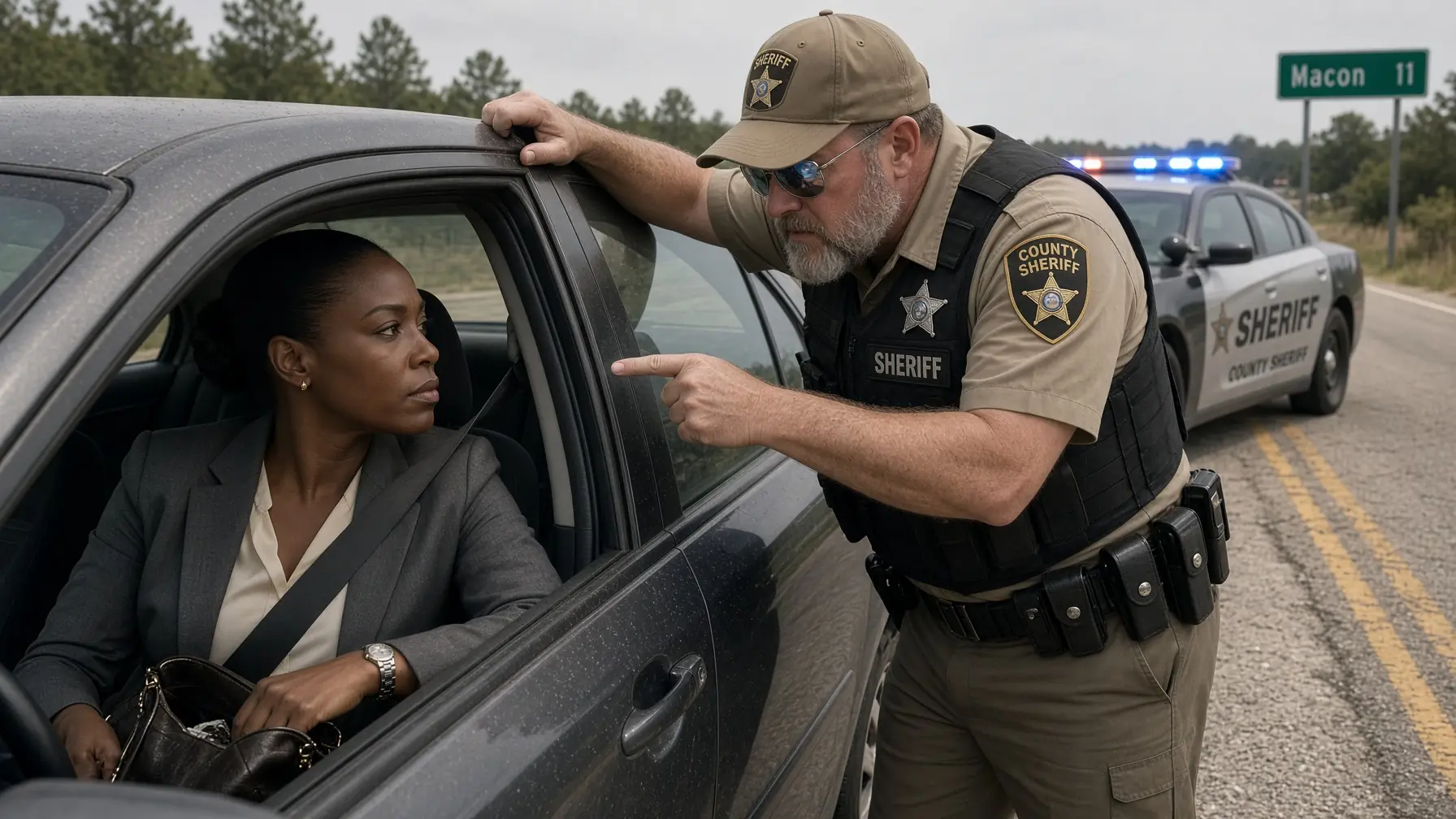
He knew the pauses.
The lowered voices.
The way a driver’s hands trembled when he leaned into an open window and casually mentioned that cash could be “held as evidence.”
He knew which people were most likely to fight back and which ones would simply surrender whatever they had because being robbed by a man wearing a badge felt less dangerous than challenging him on the side of an empty highway.
For years, Mercer had turned that fear into money.
Then, on a dry August morning outside Macon, Georgia, he stopped a charcoal-gray sedan and leaned through the driver’s window toward a woman who did not look frightened at all.
Her name was Vanessa Reed.
She was thirty-nine years old, Black, elegant, controlled, and dressed in a charcoal business blazer over a cream blouse. Her black hair was pulled neatly away from her face, and a thin gold earring caught the sun whenever she moved her head.
Mercer had no idea who she was.
That was the first mistake.
The second was assuming she was alone.
Blue lights flashed behind Vanessa’s sedan on the gravel shoulder of Route 41.
The road stretched through farmland in both directions, bordered by dry grass, telephone poles, and distant rows of pecan trees.
Vanessa kept both hands visible.
Mercer approached slowly, wearing mirrored sunglasses beneath a faded patrol cap.
He was fifty-six, heavy through the shoulders, with a gray beard and the relaxed posture of a man who had controlled roadside encounters for most of his adult life.
He stopped beside the open driver’s window.
“License.”
Vanessa handed it over.
Mercer looked at the photograph.
Then at her.
“Where you headed?”
“Atlanta.”
“From?”
“Macon.”
“What for?”
“Work.”
Mercer glanced through the interior.
There was a black leather briefcase on the passenger seat.
“Step out.”
Vanessa did not move.
“For what reason?”
Mercer lowered his sunglasses slightly.
“You questioning me?”
“I’m asking why you want me outside the vehicle.”
Mercer smiled.
He had heard educated drivers speak like that before.
Careful words.
Controlled breathing.
People who thought knowing procedure would protect them.
It usually made breaking them more enjoyable.
“I smelled something when I walked up.”
Vanessa raised an eyebrow.
“What?”
“Could be marijuana.”
“There is no marijuana in this car.”
“We’ll find out.”
Mercer rested one large hand on the roof and leaned closer.
Vanessa could smell coffee on his breath.
“You carrying cash?”
The question came too early.
That was important.
Vanessa looked directly at him.
“Why would that matter?”
Mercer’s smile disappeared.
“Because I asked.”
Vanessa had been waiting months to hear those exact words.
Not the precise sentence.
The pattern.
The unnecessary question about cash before any legitimate search.
She had read versions of it in twenty-seven complaints.
Drivers stopped without clear explanations.
Questions about where they worked.
Whether they were traveling with cash.
Whether they could prove where the money came from.
Then threats.
Possible arrest.
Possible vehicle impoundment.
Possible drug charges.
Finally, the offer.
Hand over the cash and maybe everything could be handled quietly.
Most victims had never filed formal complaints.
The ones who did had been dismissed.
Mercer looked at her again.
“Purse.”
Vanessa kept her voice level.
“No.”
His jaw tightened.
“What did you say?”
“I said no.”
Mercer reached one hand inside the car.
Vanessa moved backward against the seat.
He stopped inches from the strap of her handbag.
“Don’t make this difficult.”
“You haven’t given me a lawful reason to search my purse.”
Mercer laughed.
“Lawful reason?”
He leaned closer.
“Lady, you’re on my road.”
Vanessa stared at him.
Mercer continued.
“You know how many drivers suddenly start remembering the law when they got something they don’t want me finding?”
“I imagine quite a few.”
“You carrying more than ten thousand dollars?”
Vanessa said nothing.
That silence interested him.
Mercer straightened.
“Ah.”
He looked toward the briefcase.
“That yours?”
“Yes.”
“What’s inside?”
“Documents.”
“Money?”
“Documents.”
Mercer tapped the roof.
“Open it.”
“No.”
His expression hardened.
Behind his sunglasses, Vanessa could not see his eyes.
But she knew the moment the encounter changed.
He stopped testing her.
Now he intended to dominate her.
“Why are you making this hard?” Mercer said. “Hand me the cash before I decide your whole car looks suspicious.”
Vanessa tilted her head slightly.
“You mean the cash you’ve been taking from drivers for ten years without charging them?”
Mercer froze.
Only for a second.
But Vanessa saw it.
His hand came off the roof.
“What did you say?”
“You heard me.”
Mercer leaned down again.
His voice dropped.
“You better watch your mouth.”
Vanessa did not blink.
“Why?”
“Because out here, my report becomes the truth.”
He pointed toward her.
“And your money becomes evidence.”
Vanessa held his stare.
“Perfect.”
Mercer frowned.
“Say it again.”
“What?”
“The part about your report becoming the truth.”
Mercer’s face changed.
Vanessa touched the edge of her blazer.
“The investigators listening to my recorder need your voice nice and clear.”
For the first time in nearly a decade of roadside stops, Roy Mercer took one full step backward.
He looked at Vanessa’s jacket.
Then the windshield.
Then the empty road.
“You recording me?”
Vanessa said nothing.
Mercer reached toward his radio.
Vanessa calmly spoke.
“Before you call anyone, you should probably know your dispatcher isn’t the only person listening.”
His hand stopped.
Vanessa had spent eighteen months preparing for that moment.
She was not a random motorist.
She worked as an investigator assigned to a joint civil-rights and financial misconduct task force examining roadside seizures and unofficial cash confiscations across three counties.
The investigation had begun with a pattern that looked too consistent to ignore.
A college student stopped late at night and pressured into surrendering $1,800 he had saved for tuition.
A construction worker traveling to purchase equipment who lost $6,400.
A grandmother carrying funeral expenses for her sister.
A landscaper paid in cash after finishing a commercial contract.
A Black church deacon driving home from a fundraising event with $3,200 in envelopes.
Different drivers.
Different months.
Different reasons for carrying money.
The same deputy appeared again and again.
Roy Mercer.
Formal reports rarely matched the victims’ stories.
Some reports mentioned suspected narcotics activity.
Others described “voluntary abandonment” of currency.