The Arizona sun burned against the deserted highway as Captain Malcolm Reed sat motionless on his matte-black Harley-Davidson. His deep brown skin glistened beneath the heat, black aviator sunglasses concealed his eyes, and a sleeveless leather vest covered the fitted black shirt stretched across his powerful frame. One hand rested calmly on the motorcycle’s fuel tank while the other remained near the credential wallet hidden inside his vest. Directly in front of him, Officer Grant Mercer leaned over the chrome handlebars as though the motorcycle already belonged to him.
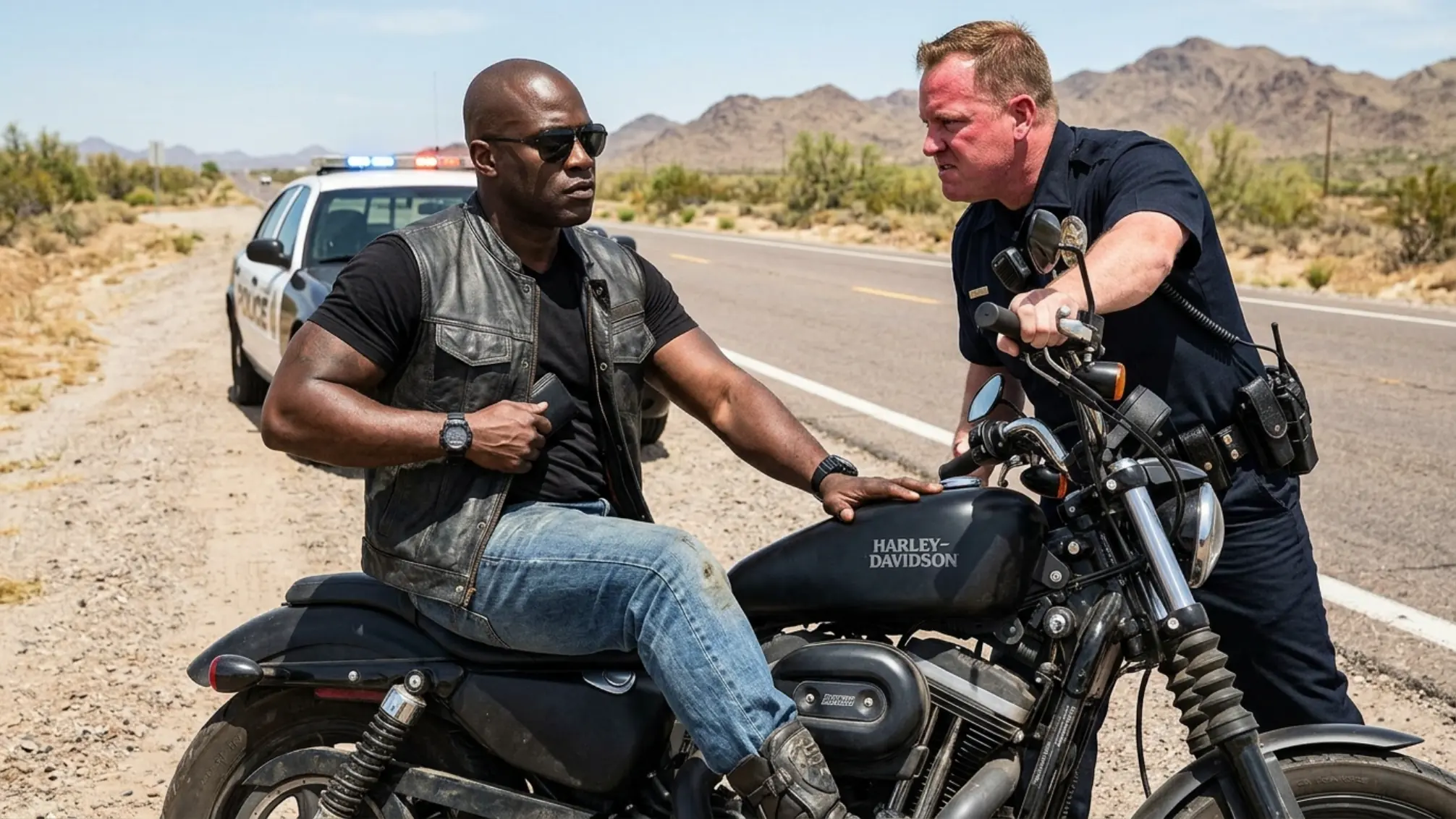
Grant was forty-nine, broad through the waist and shoulders, with flushed fair skin, short light-brown hair, and an aggressive smile that seemed practiced. His marked patrol cruiser stood behind them with red-and-blue lights flashing across the empty road, but his body camera showed no active recording light. He tightened his fingers around the Harley’s handlebar and lowered his voice.
The smile disappeared from Grant’s face.
He stared at the credential wallet Malcolm held between them. The gold badge carried the seal of the Phoenix Metropolitan Police Department, and the identification beside it named Malcolm Reed as captain and commanding officer of the Special Weapons and Tactics Division. Grant read the title once, then again, as though the words might rearrange themselves into something less dangerous.
Malcolm slowly removed his sunglasses.
“Let go of my motorcycle.”
Grant released the handlebar, but only for a moment. His pride recovered faster than his judgment, and he stepped closer until his uniform nearly touched Malcolm’s leather vest.
“I don’t care what unit you command,” Grant said. “Out here, this is my stop.”
“What violation did you observe?”
“Reckless speed.”
“How fast was I traveling?”
“Ninety-two.”
“The speedometer camera on my bike recorded sixty-four.”
Grant’s jaw tightened. “You think your personal equipment overrides my radar?”
“No. Your radar log will.”
The officer glanced toward his cruiser.
Malcolm noticed.
He had spent twenty years learning to read the smallest movements people made when pressure reached them—the delayed answer, the shifting eyes, the hand reaching toward a pocket before the mind had decided what lie should come next. Grant’s glance toward the cruiser told him there was no legitimate radar record. The alleged speed was invented.
“Give me your license and registration,” Grant demanded.
“I already did.”
“Give them to me again.”
“They are in your left hand.”
Grant looked down. He had forgotten he was still holding Malcolm’s documents.
The stop had begun seven minutes earlier when Malcolm left a motorcycle repair shop near Buckeye and turned east toward Phoenix. He was off duty, dressed as an ordinary rider, and returning from a weekend fundraiser organized by a local motorcycle club. His Harley was properly registered, insured, inspected, and mechanically flawless.
Grant followed him for nearly three miles before activating his emergency lights.
Malcolm pulled over immediately.
The officer approached without introducing himself, demanded documents, and spent several minutes walking around the motorcycle while searching for a reason to write a citation. When none appeared, Grant claimed Malcolm had been speeding. He then said the motorcycle’s exhaust was illegal, although the system carried a clearly stamped state-compliance mark.
Finally, Grant lowered his voice and offered an alternative.
Five hundred dollars in cash would make the violations disappear.
When Malcolm refused, Grant threatened to impound the motorcycle, suspend his license, and leave him stranded beneath the desert sun. He believed the leather vest, sunglasses, and powerful motorcycle identified Malcolm as someone he could intimidate or accuse without consequence.
Grant had made that calculation before.
He had simply made it against the wrong man.
Malcolm returned the credential to his vest. “Turn on your body camera.”
“It’s already running.”
“There is no status light.”
“The indicator is broken.”
“Then state the device number.”
Grant’s face hardened. “You don’t give me orders during my traffic stop.”
“I am not asking as your commander. I am instructing you as the citizen you detained to preserve the record of this encounter.”
“I don’t report to SWAT.”
“You report to department policy.”
Grant reached toward his radio. “I’m calling a supervisor.”
“Good.”
The officer expected resistance, but Malcolm stepped away from the motorcycle and placed both hands where they were visible. He knew every movement mattered now. Grant could still transform the incident into an accusation of aggression if Malcolm gave him even a second of unclear footage or an uncertain witness statement.
“Tell dispatch you requested five hundred dollars,” Malcolm said.
“I requested nothing.”
“The microphone inside my helmet recorded you.”
Grant froze.
The black full-face helmet rested on the Harley’s rear seat. A compact camera and communication system were built into its shell, used by Malcolm during tactical motorcycle training and long rides. A small red indicator light blinked beside the visor.
Grant lunged toward it.
Malcolm stepped between him and the motorcycle.
“Touch that helmet,” he said, “and you add evidence tampering to extortion.”
Grant’s right hand moved toward his holster.
Malcolm did not retreat.
“Take your hand away from that weapon.”
“This is my scene.”
“And I am unarmed.”
“You threatened me.”
“I told you to release my property.”
Grant’s fingers remained near the holster.
Malcolm’s voice dropped. “You know exactly what happens if you draw on an unarmed citizen because he refused to pay you.”
The officer stared into Malcolm’s eyes and saw no panic. There was anger, but it was controlled, measured, and supported by the confidence of a man who understood every legal and tactical consequence unfolding between them.
Grant moved his hand away.
He lifted his shoulder radio and called dispatch, but he did not request a supervisor. Instead, he reported an aggressive biker refusing lawful commands and possibly reaching for a weapon.
Malcolm listened without interrupting.
When Grant finished, Malcolm spoke loudly enough for the radio microphone to capture every word.
“For the record, my hands are empty and visible. Officer Mercer demanded five hundred dollars to prevent an unlawful impoundment. His body camera appears disabled, and the complete interaction was recorded by my helmet camera.”
Dispatch went silent.
Then a woman’s voice responded.
“Officer Mercer, maintain position. Do not search, restrain, or move the rider. Supervisors are responding.”
Grant pressed the radio button. “Dispatch, he is interfering with my investigation.”
“Maintain position,” the dispatcher repeated. “Do not take further action.”
Grant lowered the radio slowly.
“You planned this,” he accused.
“I was riding home.”
“You knew I would stop you.”
“I had never seen you before today.”
“You’re setting me up.”
Malcolm looked toward the empty highway. “You chose the road, the fake violation, the amount, and the threat. Which part did I arrange?”
A second patrol cruiser appeared in the distance.
Grant’s breathing changed.
He looked toward the Harley, the helmet camera, and the credential hidden inside Malcolm’s vest. He no longer seemed interested in issuing a citation. He wanted control of the recording.
“You need to surrender that camera as evidence,” he said.
“To whom?”
“To me.”
“You are the subject of the evidence.”
“I am the investigating officer.”
“Not anymore.”
The approaching cruiser pulled onto the shoulder. Sergeant Elena Vasquez stepped out, followed by Officer Ryan Cole. Elena had supervised the western traffic district for four years and knew Malcolm from joint tactical exercises. Her expression changed the moment she recognized him.
“Captain Reed.”
Grant turned sharply toward her. “You know him?”
Elena looked at Malcolm’s motorcycle, Grant’s inactive body camera, and the documents still clutched in his hand.
“I know exactly who he is.”
Grant began speaking before she could ask a question. He claimed Malcolm had been traveling at ninety-two miles per hour, refused instructions, threatened physical violence, and interfered with an equipment inspection. He described the demand for cash as a misunderstanding and said Malcolm had offered money first.
Malcolm listened in silence.
Elena waited until Grant finished.
“Where is the radar reading?”
“In my cruiser.”
“Show me.”
Grant hesitated. “The unit may not have stored it.”
“You said ninety-two.”
“I observed it visually before confirming.”
“Then show me the confirmation.”
Grant glanced toward the cruiser again.
Elena turned to Ryan. “Secure Officer Mercer’s vehicle. Photograph the radar unit before touching anything.”
Grant stepped into Ryan’s path. “Nobody searches my cruiser without authorization.”
Elena’s voice hardened. “Move.”
“This is my equipment.”
“It belongs to the department.”
“I am not under investigation.”
“You are now.”
Ryan walked around him and opened the cruiser’s driver-side door. The dashboard radar system was powered off. Its activity log showed no recorded speed reading during the hour preceding Malcolm’s stop.
Elena looked at Grant.
“You said you confirmed ninety-two.”
“The system must have reset.”
“Radar logs do not erase themselves when power is interrupted.”
Grant folded his arms. “Captain Reed used his rank to intimidate me.”
Malcolm retrieved the helmet while Elena watched. He removed the memory card, sealed it inside a clean plastic evidence sleeve from his motorcycle’s emergency kit, and wrote the date and time across the closure.
“I want this delivered directly to Professional Standards,” he said. “Not through the traffic district.”
Grant laughed nervously. “Because you know they’ll protect you.”
“No. Because your district has already received four complaints involving roadside cash demands.”
Elena’s eyes narrowed. “Four?”
Malcolm looked at her. “That I know about.”
Three weeks earlier, Chief Samuel Hart had asked Malcolm to quietly assist the Professional Standards Bureau with a review of tactical readiness inside several patrol districts. The inquiry had nothing to do with extortion at first. It focused on whether officers assigned to emergency response duties maintained required training and equipment.
During that review, Malcolm saw repeated references to complaints from motorists stopped near the western desert routes.
The details were similar.
The driver was alone.
The alleged violation could not be verified.
The officer threatened towing, arrest, or license suspension.
Cash ended the stop.
All four complaints identified a heavyset white officer with short brown hair, but two victims could not see his badge number, and another was too frightened to make a formal statement. The fourth complainant named Grant Mercer.
His supervisor had closed the complaint for insufficient evidence.
Malcolm had not been conducting an undercover operation that afternoon, but once Grant demanded money, every unrelated concern connected immediately.
Sergeant Vasquez directed Ryan to collect Grant’s body camera. Device records showed that it had been functioning normally at the beginning of the shift. Grant manually deactivated it six minutes before pulling Malcolm over.
“Why did you turn it off?” Elena asked.
“The battery was low.”
“It shows eighty-two percent.”
“The screen was freezing.”
“Did you report the problem?”
“I was going to.”
“When?”
Grant’s face reddened. “You’re treating me like a criminal because he has a higher rank.”
“No,” Malcolm said. “She is treating you like an officer whose story contradicts every available record.”
Another supervisor arrived, followed by two investigators from Professional Standards. The roadside became an evidence scene. They photographed the Harley, both cruisers, the inactive body camera, and Malcolm’s helmet system.
Grant was ordered to surrender his badge, firearm, radio, and department identification pending an emergency administrative suspension.
He refused.
“You cannot strip me on the side of the road.”
The senior investigator, Lieutenant Grace Chen, stepped in front of him. “You can surrender the equipment voluntarily, or we document refusal and remove it under direct order.”
Grant looked around at the five officers surrounding him.
His gaze settled on Malcolm.
“This is what you wanted.”
Malcolm shook his head. “I wanted to ride home.”
Grant finally unfastened his duty belt.
The helmet recording was reviewed that evening inside a secured evidence room. It captured the entire stop clearly, including Grant’s invented violations and the moment he lowered his voice.
“Five hundred cash, and I forget the speed, the exhaust, and the registration issue.”
Malcolm’s response followed.
“There is no registration issue.”
“There will be if I write one.”
The recording left no ambiguity.
Grant’s personnel history revealed seventeen years of service, twelve commendations, and only three formal complaints. At first glance, the record supported his claim that the incident was an isolated lapse.
Then investigators examined the complaints that had never become formal.
Over six years, twenty-seven motorists contacted dispatch, supervisors, or the public-information desk with concerns about roadside stops matching Grant’s assigned routes. Most reports were classified as customer-service disagreements rather than misconduct allegations.
Eleven drivers said the officer mentioned towing their vehicles unless they paid immediate “processing costs.” Seven described cash demands between two hundred and eight hundred dollars. Four claimed he searched their vehicles after they refused.
Nearly every related body-camera file was missing, corrupted, or shorter than the recorded stop duration.
Professional Standards contacted the motorists individually.
One was nineteen-year-old college student Marcus Hill, stopped while driving his mother’s car home from work. Grant claimed the insurance card was invalid and demanded three hundred dollars to avoid impoundment. Marcus had only eighty dollars in cash.
Grant took it and allowed him to leave.
A retired teacher named Gloria Walsh paid five hundred dollars after Grant threatened to tow her car because one rear tire appeared “unsafe.” A mechanic inspected the tire the following morning and found nothing wrong.
A construction worker named Daniel Ruiz refused to pay and spent nine hours in county detention after Grant claimed he smelled alcohol. Daniel’s breath and blood tests were both negative, but the arrest caused him to miss work and lose a major contract.
Each victim believed the incident happened only to them.
Together, the statements formed a pattern.
Investigators reviewed Grant’s personal finances. Cash deposits appeared frequently in amounts too small to trigger automatic banking scrutiny but too large to match his reported income. Over four years, more than eighty thousand dollars entered accounts controlled by Grant and his wife without a documented source.
He claimed the money came from motorcycle sales and private repair work.
There were no sales records, repair invoices, or business registrations.
The investigation then reached Lieutenant Patrick Sloane, Grant’s direct supervisor. Sloane had closed seven complaints and approved sixteen body-camera malfunction reports without sending a single device for inspection. He also signed overtime forms showing Grant working special highway patrol during several questionable stops.
Deleted text messages recovered from Grant’s phone showed their arrangement.
Grant wrote, “Got another loud one threatening complaints.”
Sloane replied, “Lose the camera issue and send me the report first.”
Another exchange discussed money.
“Your envelope is in the usual locker.”
Sloane answered with a thumbs-up symbol.
The extortion was not the work of one officer.
Grant selected isolated motorists, invented violations, and demanded cash. Sloane buried complaints, approved false equipment failures, and warned Grant when investigators requested files. In exchange, he received a percentage.
Professional Standards expanded the inquiry to every traffic stop involving either man.
Malcolm remained outside the investigative chain after providing his statement and recording. As a victim and witness, he could not direct the case without compromising it. He returned to SWAT headquarters and continued his normal duties while independent investigators handled the evidence.
Some officers expected him to use his authority to destroy Grant immediately.
He refused.
“Bad officers survive when discipline looks personal,” Malcolm told his team. “This will stand on evidence, procedure, and testimony—not anger.”
Grant’s attorney attempted to discredit the helmet recording by claiming Arizona’s recording laws prohibited Malcolm from capturing the conversation. Prosecutors rejected the argument because the exchange occurred beside a public highway, during an official stop, with no reasonable expectation of privacy.
The attorney then claimed Grant had been conducting a compliance test and never intended to accept money.
The financial records destroyed that defense.
Search warrants recovered nearly eighteen thousand dollars in cash hidden inside Grant’s garage workshop. Several envelopes carried dates and highway route numbers corresponding to disputed stops.
One envelope contained Daniel Ruiz’s business card.
Lieutenant Sloane resigned before investigators interviewed him, but resignation did not end his exposure. He was arrested three days later after attempting to delete financial records from a personal computer. Digital backups preserved everything.
The department held a public meeting six weeks after the highway confrontation. Residents filled the city council chamber, including victims who had once believed no one would take their stories seriously.
Marcus Hill spoke first.
“He knew I was young,” Marcus said. “He knew I was afraid of losing my mother’s car. He did not need a weapon. The uniform was enough.”
Gloria Walsh described handing over retirement money while Grant smiled.
Daniel Ruiz placed his negative test results on the podium.
“He arrested me because I would not pay,” Daniel said. “Then his supervisor approved the report.”
Malcolm sat in the back row wearing a dark suit rather than his uniform. The meeting was not about his rank or the dramatic moment Grant saw the credential. It was about the people who had no badge to reveal and no command title capable of frightening a corrupt officer.
When the police chief invited Malcolm to speak, he walked to the podium.
“The most dangerous misunderstanding in this case,” he said, “is the belief that Officer Mercer’s conduct became wrong only when he discovered who I was. It was wrong before he saw my credential. It was wrong when he targeted a student, a teacher, a worker, and every person who believed standing alone meant they had no power.”
The room remained silent.
“A badge does not create personal authority,” Malcolm continued. “It creates public responsibility. When an officer turns that responsibility into a private business, every honest officer must help expose him.”
Grant and Sloane were formally terminated. State regulators revoked their law-enforcement certifications, preventing either man from quietly joining another department. Prosecutors charged them with extortion, official misconduct, conspiracy, falsifying public records, evidence tampering, and theft.
Grant eventually accepted a plea agreement after more victims identified him and bank records confirmed the unexplained deposits. The agreement required prison time, restitution, permanent surrender of certification, and cooperation in the case against Sloane.
Sloane chose trial.
The prosecution displayed the complaint files he altered, body-camera reports he approved, text messages he exchanged with Grant, and cash deposits made days after extortionate stops. Officers from his own district testified that he discouraged them from documenting concerns about Grant.
The jury convicted him on every major count.
The department created an independent traffic-stop review unit. Body cameras could no longer be manually disabled without an automatic alert sent to a supervisor and central evidence server. Any stop involving vehicle impoundment required recorded justification and secondary approval unless an immediate safety hazard existed.
Cash payments during roadside stops were expressly prohibited, including alleged administrative or towing fees. Drivers received printed information explaining that all legitimate fines and costs were paid through courts, authorized offices, or secure online systems—never directly to an officer.
Sergeant Elena Vasquez was promoted to lieutenant after investigators determined she preserved the scene without favoritism. Officer Ryan Cole became a field trainer responsible for teaching recruits how to intervene when another officer violated policy.
The department also reopened more than two hundred stops linked to Grant and Sloane.
Seventy-three citations were dismissed.
Four wrongful arrests were removed from public records.
Restitution funds returned money to motorists who could document payments or losses. Daniel Ruiz received compensation for his detention and damaged business contract, while Marcus Hill received the eighty dollars Grant had taken from him.
The amounts mattered, but acknowledgment mattered more.
Three months after the incident, Malcolm returned to the same desert highway. He wore the black leather vest, aviator sunglasses, blue jeans, and heavy riding boots from the original stop. His Harley’s engine rumbled steadily beneath him as he pulled onto the gravel shoulder.
A new patrol cruiser stopped nearby.
Ryan Cole stepped out, now wearing the insignia of a field trainer. A young probationary officer remained in the passenger seat, observing.
“You speeding today, Captain?” Ryan asked.
“Sixty-four.”
Ryan smiled. “That motorcycle probably reaches sixty-four before leaving the driveway.”
“That does not mean it did.”
Ryan looked across the empty landscape. “We use this location during training now.”
“For what?”
“Professional isolation.”
Malcolm removed his sunglasses.
Ryan explained that recruits were brought to remote roads and asked what changed when no witnesses were present. The correct answer was nothing. The law, policy, and dignity owed to a motorist remained the same whether the stop occurred before a crowd or fifty miles from the nearest building.
Malcolm looked toward the place where Grant had once gripped his handlebar and demanded cash.
“That is a useful lesson.”
“The helmet footage became part of the ethics course.”
“Did you include the part where I almost lost my temper?”
“Especially that part.”
Malcolm laughed quietly.
He had been seconds from physically removing Grant’s hand from the Harley. His training and experience kept him still, but he never pretended restraint came easily. Accountability required controlling not only the person abusing authority, but also the anger that could weaken the case against him.
Ryan returned to the cruiser.
Before leaving, he looked back. “Did you ever consider paying the five hundred just to see what he would do?”
“No.”
“Why not?”
“Because men like him do not stop when someone pays. Payment teaches them the method works.”
The patrol cruiser pulled onto the highway and disappeared toward Phoenix.
Malcolm started the Harley. The engine’s deep vibration moved through the frame beneath him, powerful but controlled. He slipped on his sunglasses and looked once more across the empty road.
Grant had believed the desert gave him privacy.
Instead, it gave the truth room to be heard clearly.
Malcolm turned onto the highway and accelerated beneath the bright Arizona sky, leaving behind the shoulder where one corrupt officer had demanded five hundred dollars—and lost the badge he thought made him untouchable.