“Pay two thousand dollars now, or I seize this rig and drag you out myself.”
Sergeant Wade Harlan slammed one thick palm against the black semi-truck’s driver-side door, making the mirror tremble above him. His face was already red beneath the brutal afternoon sun, and his other hand rested near the pistol on his duty belt. Behind him, Officer Eric Nolan held a citation pad against his chest, watching the confrontation with the uneasy expression of a man who had followed bad orders for too long.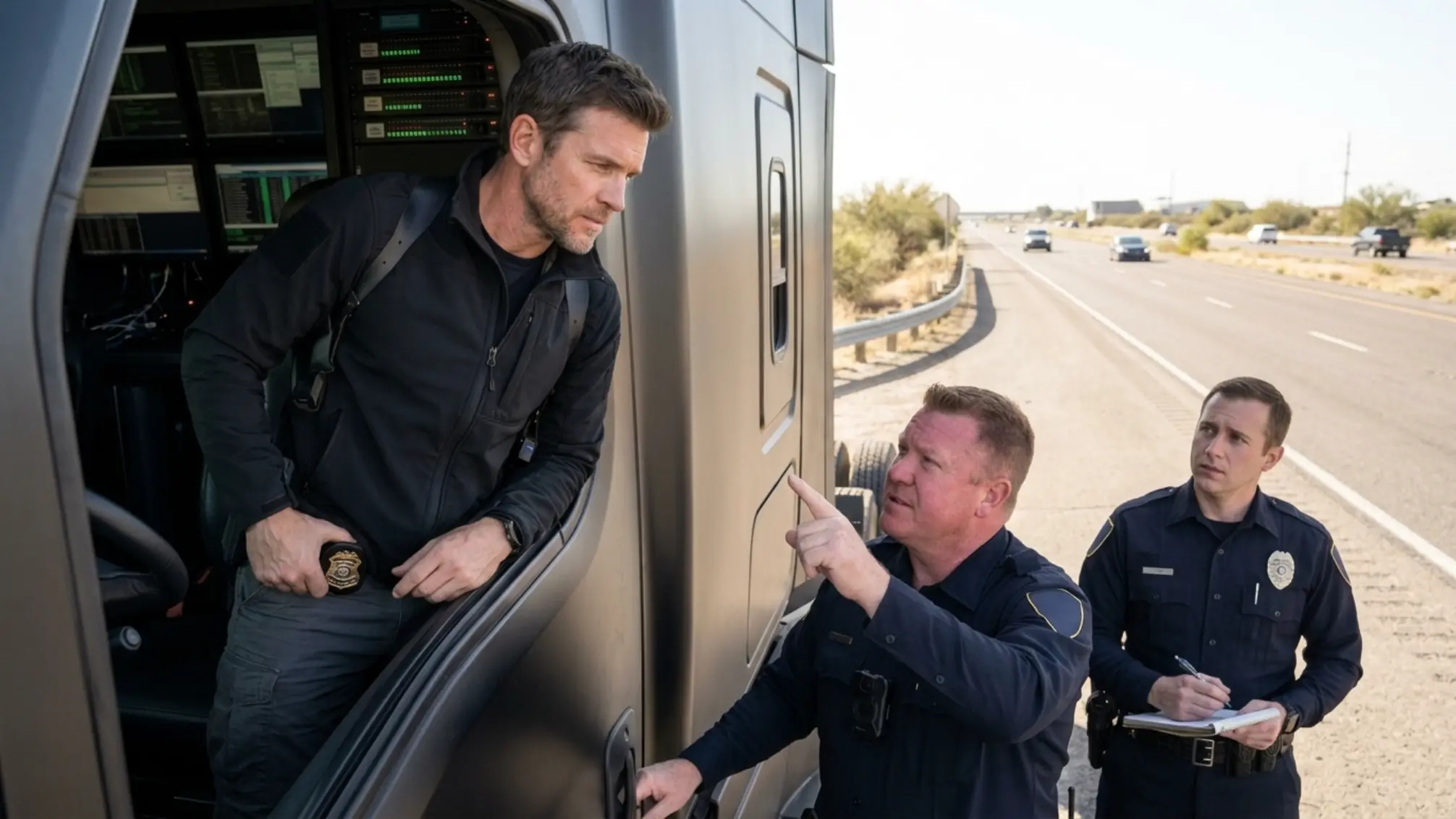
High inside the open cab window, Special Agent Daniel Cross leaned one forearm against the frame and stared down at them. He was forty-two, lean and broad-shouldered, with thick dark-brown hair, gray-blue eyes, and several days of beard shadow across his jaw. Nothing about his black work jacket or unmarked tractor-trailer suggested that twelve federal agents were listening through hidden microphones less than two miles away.
“Touch my door again,” Daniel said, “and this becomes your last day wearing that badge.”
Wade laughed and reached for the handle. “I’ll break your jaw before anyone believes a trucker over me.”
Daniel slowly opened the cab door just far enough for sunlight to strike the federal badge clipped inside his jacket. “Then swing first. The FBI wiretap already has your confession.”
Wade stopped breathing.
The interstate stretched almost empty behind him, bright concrete disappearing toward the horizon beneath a cloudless Oklahoma sky. Heat rose from the shoulder in shimmering waves, and dry grass bent along the guardrail. What Wade could not see was the unmarked van positioned beyond the next overpass, where agents watched three camera angles and listened to every word through Daniel’s concealed audio system.
The semi-truck itself was not hauling freight.
Its refrigerated trailer contained a mobile surveillance center equipped with encrypted recording servers, long-range cameras, evidence storage, and a live communications link to the federal field office. For six weeks, the vehicle had traveled through three counties while investigators built a case against officers accused of extorting truckers, stealing cargo, and protecting a regional smuggling network.
Wade Harlan had just delivered the clearest evidence yet.
The investigation began with a dead truck driver named Samuel Ortiz.
Samuel had been found inside his cab at an abandoned weigh station after midnight, officially classified as the victim of an accidental drug overdose. The county report claimed officers discovered narcotics beside the driver’s seat and no evidence of violence. His widow, Maria, refused to believe it.
Samuel had driven commercial routes for twenty-two years without a single drug arrest, failed test, or disciplinary suspension. He called Maria every night from the road and had spoken with her less than forty minutes before his death. During that call, he sounded frightened.
“Two cops stopped me,” he told her. “They say my paperwork is wrong and want cash.”
“How much?”
“Two thousand.”
“Call your company.”
“They told me not to touch the phone again.”
The call ended abruptly.
Samuel never called back.
Maria contacted the sheriff’s department repeatedly, but every complaint returned to the same office that had investigated the death. Sergeant Wade Harlan signed the original incident report. Officer Eric Nolan appeared as the assisting officer.
The department insisted Samuel had panicked because drugs were hidden inside his cargo. According to Wade, the trucker offered a bribe, fled toward the abandoned weigh station, and consumed narcotics to destroy evidence before officers reached him. No body-camera recording existed because both officers claimed equipment failure.
The story sounded complete.
It was also false.
Maria hired a private forensic pathologist using money borrowed against her house. The second examination found bruising around Samuel’s wrists, a fractured rib, and a small puncture beneath his jaw inconsistent with ordinary drug use. Toxicology showed a powerful opioid in his bloodstream but none of the substances normally associated with long-term consumption.
Someone had injected him.
The FBI became involved after Maria sent the findings to every government office she could locate. Most returned automated responses. One reached Daniel Cross.
Daniel had spent fourteen years investigating public corruption and organized crime. He had learned that corruption rarely began with dramatic conspiracies. It grew through small permissions: a free meal, a dismissed citation, a missing evidence bag, or the decision to protect a colleague because exposing him felt disloyal.
Samuel’s death carried all the signs of something larger.
Daniel obtained records of commercial traffic stops conducted by Wade and Nolan. Over eighteen months, they stopped more than one hundred independent truckers, usually on isolated stretches of interstate and almost always outside the range of fixed traffic cameras. Many received no official citation.
Yet banking records showed unusual cash deposits after those shifts.
Daniel’s team contacted the drivers quietly.
Some refused to speak.
Others described nearly identical encounters.
Wade accused them of weight violations, missing permits, equipment defects, or suspicious cargo. He then offered a private alternative: pay between five hundred and three thousand dollars in cash, and the truck could continue without inspection. Drivers who refused were detained for hours, threatened with impoundment, or forced to unload freight beside the road.
One driver said officers stole six cases of electronics.
Another lost refrigerated meat worth nearly ten thousand dollars after Wade deliberately delayed him until the cargo spoiled. A third reported being punched after attempting to record the stop on his phone.
The complaints disappeared inside the county system.
Every report passed through Captain Raymond Voss, Wade’s commander and longtime friend. Voss classified the allegations as unsubstantiated and threatened several drivers with charges for filing false statements.
Daniel suspected the officers were not only taking cash.
Shipping records revealed certain trucks were stopped, searched, and released without documentation shortly before stolen cargo appeared in warehouses connected to a logistics company called Redline Distribution. The company belonged to Wade’s brother-in-law.
The operation had become a roadside marketplace.
Wade selected vulnerable drivers, especially independent operators without corporate attorneys. He demanded cash when possible, stole valuable cargo when profitable, and flagged certain trucks for smugglers who needed safe passage through the county.
Samuel Ortiz had probably discovered too much.
Federal prosecutors wanted direct evidence before moving against the officers. The drivers’ accounts were powerful, but defense attorneys could portray them as angry people seeking revenge over legitimate enforcement. The missing body-camera footage and manipulated reports made prosecution difficult.
Daniel proposed using himself as bait.
The surveillance semi was registered through a federal shell company and carried ordinary trucking permits. Daniel had driven heavy vehicles during an earlier undercover operation, though he spent two weeks refreshing his commercial skills before entering the route.
Agents designed the truck to appear valuable but vulnerable.
Its exterior was clean enough to suggest expensive cargo, yet the company markings belonged to a small independent carrier unlikely to possess legal power. Daniel’s profile listed him as a recently divorced owner-operator struggling with debt.
Wade would see exactly what investigators wanted him to see.
A man alone.
The first four trips produced nothing.
Daniel passed through Wade’s territory at different times without being stopped. The surveillance team began worrying that leaked information had reached the department. Then Maria remembered something from Samuel’s final call.
“He said there was a white cruiser parked near Exit 117,” she told Daniel. “The officer waited until the road behind him was empty.”
The team adjusted.
Daniel drove the truck through Exit 117 shortly after noon on a Tuesday, timing the route between commercial traffic waves. A marked patrol vehicle sat partially hidden beneath an abandoned billboard.
Its lights activated before Daniel cleared the exit.
He pulled safely onto the shoulder, lowered the window, and kept both hands visible.
Wade approached slowly, chewing gum and scanning the cab. Nolan remained near the cruiser with one hand resting on his belt.
“License, registration, cargo manifest,” Wade ordered.
Daniel passed them through the window.
Wade barely examined the documents. “Step out.”
“For what reason?”
“Inspection.”
“Is there a weigh station nearby?”
“I didn’t ask for a conversation.”
Daniel remained seated. “The shoulder is narrow. I’d rather stay inside unless you have a specific safety concern.”
Wade looked toward the empty road.
Then he smiled.
“You independent?”
“Yes.”
“No company dispatcher?”
“I own the rig.”
“Anyone tracking you?”
“My insurance app, probably.”
Wade’s smile widened. The questions had nothing to do with traffic enforcement. He was identifying how quickly anyone would notice if Daniel disappeared.
Nolan approached carrying a handheld scanner he never activated.
“The plate came back with a customs alert,” he said.
Daniel knew that was impossible. Federal technicians monitored every database search connected to the truck. Neither officer had run the plate.
“What kind of alert?” Daniel asked.
“Contraband association,” Wade answered.
“May I see it?”
“No.”
Wade ordered Daniel to open the trailer. Daniel explained that the cargo compartment required a digital seal and company authorization. This was partly true. The lock protected surveillance equipment worth several million dollars.
The sergeant’s tone became harder.
“You can open it here, or we impound the truck.”
“On what legal basis?”
“Probable cause.”
“What created probable cause?”
“The alert.”
“The one you won’t show me?”
Wade stepped closer. “You trying to be smart?”
“I’m trying to understand the stop.”
Nolan glanced toward Wade. His discomfort was already visible on the hidden camera facing the truck’s side mirror.
Wade lowered his voice. “Here’s what happens next. We tow the rig, open the trailer, and hold everything for thirty days while state investigators decide whether you get it back. The towing and storage could cost you twenty grand.”
Daniel looked toward the trailer as though calculating financial ruin.
“What’s the alternative?”
“Two thousand dollars.”
“Is that an official fine?”
“It’s a roadside compliance settlement.”
“Can I receive a receipt?”
Wade laughed. “You can receive permission to keep driving.”
Inside the surveillance van, Assistant Special Agent Maya Torres marked the exact timestamp. The federal prosecutor listening beside her wrote something across a yellow pad.
Daniel continued carefully. “I don’t carry two thousand in cash.”
“Then use an ATM.”
“The nearest town is twenty miles away.”
Wade tapped the truck door. “You have a phone. Transfer it.”
“To whom?”
Nolan shifted again. “Sergeant, maybe we should—”
Wade turned sharply. “Did I ask you?”
“No.”
“Then inspect the rear tires.”
Nolan walked away, but his body camera transmitted audio to the officers. Federal agents had secretly obtained a court order allowing live access after discovering the equipment had been modified to store footage on a private server controlled by Captain Voss.
Wade leaned closer to Daniel’s window.
“Send the money to Redline Logistics. Mark it as roadside service.”
“That sounds like a private company.”
“They handle county impounds.”
Federal records proved they did not.
Daniel removed his phone and pretended to open a banking application. “What happens if I refuse?”
“Your truck disappears.”
“And me?”
Wade’s eyes narrowed. “That depends on how stupid you become.”
Daniel allowed several seconds of silence.
Then he said, “Was Samuel Ortiz stupid?”
The sergeant went completely still.
Traffic moved far away in the opposite lanes, but the shoulder around them seemed to fall silent. Nolan stopped beside the trailer, his face turning toward the cab.
Wade placed one hand against the door. “What did you say?”
“Samuel Ortiz. Did he refuse to pay?”
“I don’t know that name.”
“You signed his death report.”
“Lots of people die on highways.”
“Not many with injection marks beneath their jaws.”
Wade’s face changed.
The lazy confidence disappeared, replaced by the alert calculation of a man deciding whether violence could still solve the problem. His hand moved toward the door handle.
Daniel watched every movement.
Wade pulled once.
The door remained locked.
“Open it.”
“No.”
“You’re under arrest.”
“For what?”
“Threatening an officer.”
“I asked a question.”
“You accused me of murder.”
“I mentioned a medical finding.”
Wade drew his expandable baton.
Nolan hurried back. “Sergeant, stop.”
“Get away from the truck.”
“We should call this in.”
“I said move.”
Nolan looked at Daniel through the window. Fear had replaced uncertainty. “Sir, keep your hands visible.”
“They are visible.”
Wade struck the truck door with the baton.
The metallic impact echoed across the interstate.
“Pay two thousand dollars now, or I seize this rig and drag you out myself.”
Daniel leaned toward him. “Touch my door again, and this becomes your last day wearing that badge.”
“I’ll break your jaw before anyone believes a trucker over me.”
Wade reached for the handle again.
Daniel opened the door six inches and revealed the badge.
“Then swing first. The FBI wiretap already has your confession.”
Wade stared at the gold shield.
His mind rejected it before his eyes could.
“Fake.”
Daniel opened the door farther. A small camera, microphone array, and federal identification panel became visible behind the driver’s seat.
Wade stepped backward.
Nolan’s face drained of color.
Daniel touched the transmitter inside his sleeve. “Move.”
The command was not directed at them.
Black SUVs entered from both directions. An unmarked van accelerated from beneath the overpass while state police vehicles blocked the nearest exit. Agents in tactical vests poured onto the shoulder with weapons raised.
“Hands!” Maya shouted. “Show me your hands!”
Nolan immediately lifted both arms.
Wade did not.
He looked toward the cruiser, then toward the grass beyond the guardrail. For one desperate second, he considered running.
Daniel climbed from the cab.
“Do not reach for that weapon.”
Wade’s eyes fixed on him. “You set me up.”
“You stopped me.”
“You came here asking for trouble.”
“I drove legally through your county.”
Wade’s hand hovered near his pistol.
Nolan spoke quietly. “Sergeant, don’t.”
Wade turned toward him with hatred. “Shut up.”
Maya stepped closer. “Hands on your head, now.”
Instead, Wade grabbed Nolan by the uniform and pulled him sideways, using the younger officer as a barrier. His other hand reached toward Nolan’s holstered pistol.
Daniel moved before he could draw it.
He caught Wade’s wrist, drove it against the truck door, and forced the sergeant’s arm behind his back. Wade twisted, throwing his shoulder into Daniel’s chest, but three agents reached them within seconds.
They forced him facedown on the gravel shoulder.
Wade continued shouting as handcuffs closed around his wrists.
“This is entrapment!”
Daniel stood above him, breathing hard. “Entrapment requires us to create a crime you weren’t willing to commit.”
“I was testing him!”
“You demanded money, threatened violence, and attempted to seize a federal surveillance vehicle.”
Wade looked toward Nolan. “Tell them.”
Nolan remained beside the cruiser with his hands raised.
His voice broke. “He’s done it before.”
Wade stopped struggling.
Every agent heard the sentence.
Nolan was separated immediately and taken to the surveillance van. He requested an attorney at first, then changed his mind after learning the FBI had recorded the entire stop and possessed previous body-camera files recovered through the federal order.
“I didn’t kill Samuel,” he said.
Maya sat across from him. “Then tell us who did.”
Nolan lowered his head.
According to his statement, Samuel refused the cash demand and attempted to call his wife. Wade dragged him from the cab while Nolan searched the trailer. They discovered sealed electronics belonging to a medical supplier and decided to divert the cargo to Redline.
Samuel recognized Wade’s brother-in-law from paperwork inside the patrol car.
That made him dangerous.
Captain Voss ordered the officers to move him to the abandoned weigh station. Wade restrained Samuel while Voss injected him with fentanyl taken from an evidence locker. They planted narcotics in the cab and disabled the official body-camera uploads.
Nolan helped write the false report.
“Why didn’t you stop them?” Maya asked.
“At first, it was cash,” he whispered. “Then stolen cargo. Every time I told myself I was already too deep to get out.”
“So you kept going.”
“Yes.”
“Samuel had a family.”
“I know.”
“You watched him die.”
Nolan closed his eyes. “Yes.”
His cooperation triggered immediate search warrants.
Agents entered Captain Voss’s home, the sheriff’s department evidence room, Redline Distribution’s warehouse, and properties belonging to Wade’s relatives. They recovered stolen electronics, pharmaceuticals, vehicle parts, and nearly four hundred thousand dollars in cash hidden inside toolboxes and sealed containers.
The evidence locker contained narcotics with broken seals.
Financial records linked Redline payments to Wade, Voss, and three additional officers. More than twenty truckers were identified as victims of extortion or cargo theft.
Samuel’s missing shipment was recovered unopened beneath false warehouse documentation.
Maria Ortiz received the call shortly after midnight.
Daniel met her the following morning inside the FBI field office. She sat across from him holding the same photograph of Samuel she had carried to every meeting.
“Did he suffer?” she asked.
Daniel did not lie.
“He was afraid. But he called you because he wanted someone to know what was happening.”
Maria pressed the photograph against her chest. “They said he was a drug addict.”
“We will correct the record.”
“That won’t bring him back.”
“No.”
“Then make sure they cannot do it to anyone else.”
Daniel promised nothing dramatic.
“We’ll prove what they did.”
The federal indictment was unsealed three months later.
Wade Harlan faced charges including extortion under color of law, conspiracy, cargo theft, evidence tampering, assault, and Samuel Ortiz’s murder. Captain Raymond Voss faced similar charges, along with obstruction and theft from an evidence facility.
Nolan accepted a cooperation agreement.
Many people criticized the decision because he had participated for more than a year. Maria did not forgive him, and prosecutors did not ask her to. His testimony reduced his sentence, but it did not erase his responsibility.
During Wade’s trial, the roadside recording became the central evidence.
The jury watched him demand two thousand dollars, invent a customs alert, threaten impoundment, and promise to break Daniel’s jaw. They saw his reaction when Samuel’s name was mentioned and watched him reach toward a weapon after the FBI badge appeared.
His attorney claimed Daniel provoked the confrontation.
The prosecutor replayed the beginning of the stop.
Daniel remained calm.
Wade introduced every threat.
Truckers testified afterward.
One described borrowing money from his daughter to pay the roadside demand. Another explained losing his business after stolen cargo destroyed his insurance coverage. A third admitted remaining silent because Wade photographed his family’s address from his license and promised to visit them.
Maria testified last.
She played the final voicemail Samuel left before the stop.
His voice filled the courtroom.
“Hey, sweetheart. I’ll be home Friday. Tell Mateo I found that little truck he wanted.”
The recording ended.
Wade did not look toward her.
The jury convicted him on every major count. Voss accepted a plea after learning three additional officers had agreed to testify. Redline Distribution was dissolved, its assets seized and used partly to compensate victims.
The county created independent review procedures for traffic stops involving commercial vehicles. Body-camera footage could no longer be stored solely on department-controlled servers, and cash roadside payments were explicitly prohibited under every circumstance.
Daniel returned to Exit 117 almost a year after the operation.
He parked near the abandoned billboard and stood beside the guardrail while trucks passed in the distance. The shoulder looked ordinary, which was part of what had allowed the crimes to continue.
There had been no secret dungeon or hidden compound.
Only a road, a badge, and officers who believed isolated people were easier to exploit.
Maria joined him carrying a small roadside memorial. Together, they placed Samuel’s photograph beneath a weatherproof plaque near the old weigh station.
The inscription contained no dramatic statement.
SAMUEL ORTIZ
HUSBAND. FATHER. DRIVER.
HE TOLD THE TRUTH.
Daniel looked toward the interstate.
Samuel had not been powerful. He did not own a corporation, carry a federal badge, or command agents waiting beyond an overpass. He was one truck driver refusing to surrender money he did not owe.
That refusal exposed the kind of men Wade and Voss truly were.
The public remembered the dramatic moment: a corrupt sergeant threatened a trucker, opened the wrong cab, and discovered an FBI surveillance operation listening live. Yet Daniel understood that the case had not begun with his badge.
It began with Maria refusing to accept a false report.
It grew because frightened truckers finally spoke.
It succeeded because Nolan, far too late but not entirely too late, admitted what he had helped conceal.
Wade believed nobody would believe a trucker over a police officer.
For years, he had been right.
Then he stopped the black semi, demanded two thousand dollars, struck the door, and threatened the quiet driver sitting above him. He thought he had chosen another isolated victim without power or witnesses.
Instead, every word traveled directly into a federal evidence server.
The rig was never impounded.
The FBI wiretap remained active.
And before the sun set over Exit 117, the corrupt officer who had threatened to drag Daniel from the cab was the one carried away in handcuffs.