Rain struck Route 9 with such force that the narrow highway seemed to disappear beneath moving sheets of water. David Caldwell stood against the hood of his late uncle’s 1994 Ford Crown Victoria, his wrists locked behind his back while Officer Tom Riggins pressed a heavy hand into his shoulder. Red-and-blue lights flashed across the empty fields, illuminating telephone poles, flooded ditches, and the hard expression David had maintained since the moment the officers ordered him from the car. He did not pull away, raise his voice, or give either man the reaction they clearly wanted.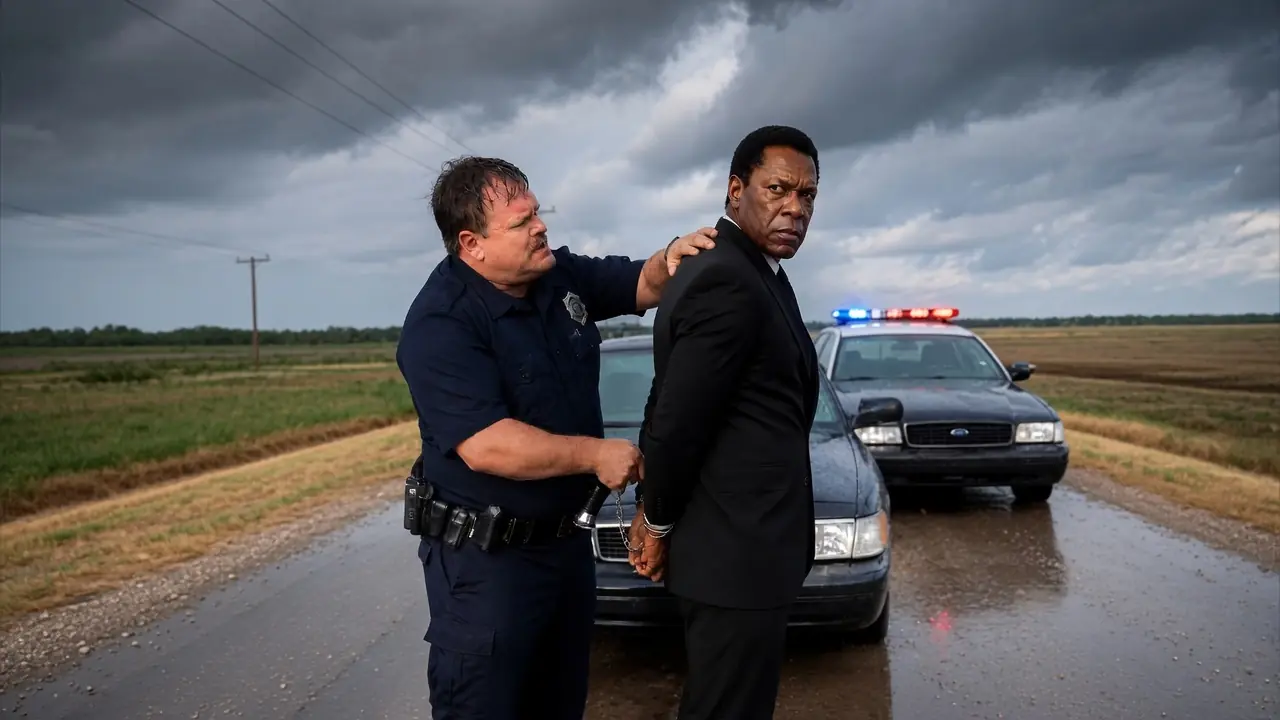
The second officer, Grant Miller, opened the Crown Victoria’s passenger door and began throwing David’s belongings onto the wet shoulder. A canvas travel bag landed in the mud, followed by estate papers, a framed family photograph, and a wooden box containing his uncle’s watch. Miller kicked the box aside and leaned deeper into the car, searching without consent and without stating any legal basis. Riggins watched David’s face closely, almost disappointed by the absence of fear.
David was fifty-two years old, broad-shouldered, and dressed in a black suit that had become soaked during the roadside detention. He had spent the previous three days clearing his uncle Raymond’s farmhouse after the old man died alone in northern Garrison County. The Crown Victoria had been Raymond’s pride, maintained carefully but never polished enough to attract attention. David chose to drive it home because he wanted five quiet hours with the memories of the man who had raised him after his own father disappeared.
He had not expected peace to follow him through Garrison.
For years, complaints had circulated about local officers targeting drivers who appeared unfamiliar, financially vulnerable, or unlikely to challenge authority. The reports described invented traffic violations, aggressive vehicle searches, cash seizures, and towing charges that often exceeded the value of the cars. Most victims paid the fines or surrendered their property because returning to a rural county for court hearings cost more than walking away. The Garrison Police Department dismissed the allegations as resentment from irresponsible motorists.
David had read every complaint.
Three weeks earlier, he had been appointed director of the State Police Bureau, the highest operational position in the statewide force. Before that, he had led the Office of Professional Standards, where his team investigated corruption, evidence manipulation, and unlawful seizures across dozens of departments. One of the first files placed on his new desk contained seventeen separate complaints from Route 9.
All seventeen involved Riggins or Miller.
The complaints shared a pattern but lacked strong physical evidence. Body-camera footage was routinely missing because of alleged battery failures. Dashboard systems suffered unexplained technical errors. Drivers signed statements admitting violations after hours of detention, often without attorneys. Cash seized during searches appeared in departmental reports, but the reported amounts were frequently lower than what the victims claimed had been taken.
David had planned a formal investigation after completing his uncle’s estate. Instead, the investigation found him.
“You have anything illegal in the trunk?” Miller called.
“No.”
“Then you won’t mind if we look.”
“I do not consent to any search.”
Riggins pushed David harder against the wet hood. “You lost the right to make demands when you started acting suspicious.”
David turned his head slightly. “Driving below the speed limit is suspicious?”
“You crossed the center line.”
“Your cruiser’s front camera will show that I did not.”
Riggins’s jaw tightened. “Camera malfunctioned.”
David had expected that answer.
The Crown Victoria contained a small dashboard camera mounted behind the rearview mirror. David had installed it himself before leaving the farmhouse because the car lacked modern safety equipment. The camera recorded the entire mile during which Riggins’s cruiser followed less than a car length behind him, attempting to force him into an error. It also recorded David maintaining his lane until the emergency lights activated.
Neither officer had noticed it.
Miller moved to the trunk and demanded the key. David told him the release was inside the glove compartment. He did not mention the steel lockbox bolted beneath the trunk floor, nor the official credentials, encrypted state phone, and sealed investigative files stored inside it. The box required David’s fingerprint and a rotating access code. Even if the officers found it, they could not open it without leaving clear evidence of forced entry.
Riggins pulled David upright and turned him around. “You think you’re smarter than us?”
“I think you still haven’t told me why I’m detained.”
“I told you. Lane violation, defective taillight, possible impairment, and suspicious conduct.”
“My taillights were inspected yesterday.”
“Maybe your mechanic lied.”
“I was the mechanic.”
Miller laughed from behind the car. “Hear that, Riggins? Man in a suit fixing an old police car in the middle of nowhere.”
The Crown Victoria had once served as a county administrative vehicle before Raymond purchased it at auction. Its reinforced frame, faded spotlight mount, and heavy suspension made it recognizable to anyone familiar with older government fleets. Riggins had noticed those details too, but instead of making him cautious, they seemed to make him more determined to establish control.
He stepped closer to David. “Where did you get the car?”
“My uncle owned it.”
“Name?”
“Raymond Caldwell.”
Riggins exchanged a look with Miller.
The change was small, but David saw it.
Raymond had complained about the Garrison Police Department before his death. Six months earlier, officers stopped him on the same road and seized twenty-eight thousand dollars he had withdrawn to purchase farming equipment. They claimed a trained dog alerted to narcotics, though Raymond had never used drugs and no contraband was found. The department held the money through civil forfeiture procedures and demanded that he prove it was innocent.
Raymond died before the hearing.
David had discovered the forfeiture documents while clearing the farmhouse.
“You knew my uncle,” he said.
Riggins’s hand moved toward his belt. “I know plenty of people.”
“You seized his money.”
“Your uncle was involved in suspicious activity.”
“He was seventy-eight years old and buying a tractor.”
“That’s what he told you.”
Miller slammed the trunk lid. “Nothing back there but junk and a locked compartment.”
Riggins looked at David. “What’s in the compartment?”
“Private documents.”
“Open it.”
“No.”
Riggins leaned close enough that David could smell coffee and tobacco on his breath. “We can do this the easy way, or we can tow the car, obtain a warrant, and keep you in a holding cell until Monday.”
It was early Saturday morning.
David understood the strategy. A weekend detention would pressure most travelers into surrendering keys, money, or property simply to avoid losing two days. Riggins and Miller did not need a legitimate charge. They only needed their victim to believe resistance was more expensive than compliance.
David looked beyond Riggins toward the road.
Two headlights had appeared around the distant curve.
They were low, bright, and evenly spaced. As the vehicle approached, the long shape of a black Mercedes-Benz S600 emerged through the rain. It moved with controlled speed and carried no emergency lights, markings, or visible antennas. Riggins barely glanced at it until the Mercedes slowed and pulled onto the shoulder behind the police cruiser.
Its rear doors opened first.
Deputy Director Evelyn Brooks stepped out beneath a large black umbrella, followed by State Inspector General Martin Cole and two investigators from the Office of Professional Standards. Evelyn was a forty-seven-year-old Black woman known throughout the state for dismantling an evidence-theft network involving three county departments. Martin carried a sealed case containing emergency court authorizations prepared that evening after David failed to check in.
The S600 was David’s official transport vehicle.
He had refused to use it during his private family trip, but Evelyn knew his route and expected him at headquarters before midnight. When his encrypted state phone remained stationary for more than forty minutes and his personal line failed to answer, she requested the location of his vehicle through the emergency executive-tracking protocol. The system led them directly to Route 9.
Riggins stared at the approaching group. “This is an active police stop. Return to your vehicle.”
Evelyn ignored him and looked at David’s wrists. “Director Caldwell, are you injured?”
The rain seemed to become quieter.
Miller stood beside the open trunk, holding a pry bar he had taken from the cruiser. Riggins looked from Evelyn to David and then toward the black Mercedes. The confidence drained from his face so quickly that even the flashing lights could not hide it.
“Director?” he repeated.
David maintained the same calm expression. “Officer Riggins, meet Deputy Director Brooks and Inspector General Cole.”
Riggins released David’s shoulder. “There has been a misunderstanding.”
Evelyn stopped several feet away. “Remove the handcuffs.”
“We had probable cause.”
“Then you can document it after removing the handcuffs.”
Miller quietly lowered the pry bar.
Riggins struggled with the key because his hands had begun to shake. Once the cuffs opened, David brought his arms forward and examined the red marks around his wrists. Evelyn offered him an umbrella, but he declined it and walked directly toward the Crown Victoria.
His uncle’s photograph lay face down in the mud.
David picked it up carefully, wiped the glass with his sleeve, and placed it on the passenger seat. He then retrieved the wooden watch box, the estate documents, and the clothing Miller had thrown outside. No one spoke while he restored each item to the car.
Only after closing the passenger door did he face the officers.
“What was the stated reason for the stop?” Martin asked.
Riggins straightened. “The driver crossed the center line, displayed a defective taillight, and behaved evasively.”
“The driver is standing beside you,” David said. “Refer to me directly.”
Riggins swallowed. “Director Caldwell crossed the center line.”
Evelyn pointed toward the Crown Victoria’s dashboard camera. “Then the recording should confirm it.”
Miller’s face changed when he finally noticed the device.
Martin turned toward the police cruiser. “Where are your body cameras?”
Riggins touched the empty mount on his chest. “Charging problem.”
Miller gave the same answer.
“Both cameras failed simultaneously?” Martin asked.
“We were scheduled to replace the batteries.”
Evelyn walked to the front of the cruiser and examined the dashboard unit. Its power cable had been disconnected manually and tucked beneath the console. She photographed the loose cable before anyone could touch it.
“This did not fail,” she said. “Someone unplugged it.”
Riggins raised his hands. “The connection comes loose on rough roads.”
David looked down the straight stretch of wet pavement. “You followed me for a mile before activating your lights. If the camera had been connected, it would show your cruiser riding less than three feet from my bumper.”
Riggins said nothing.
Martin opened the sealed case he had carried from the Mercedes. Inside were temporary preservation orders covering Garrison Police Department’s traffic-stop records, towing contracts, evidence rooms, and forfeiture accounts. The orders had been requested earlier that week as part of the developing investigation. David had planned to sign them Monday.
The roadside detention changed the schedule.
“You came prepared,” Riggins said bitterly.
“We were already investigating you,” David replied. “You simply gave us a live demonstration.”
Miller stepped away from the Crown Victoria. “I only followed his orders.”
Riggins turned on him. “Shut your mouth.”
“Both of you will remain where you are,” Evelyn said. “Your weapons will be secured pending review.”
Riggins’s eyes widened. “You cannot disarm local officers without the chief.”
“The chief approved emergency state intervention ten minutes ago,” Martin said.
A marked state vehicle arrived shortly afterward, followed by two county deputies from a neighboring jurisdiction. They secured Riggins and Miller’s equipment, photographed David’s handcuff injuries, and preserved both vehicles as evidence. The officers were not immediately arrested, but they were suspended and ordered not to enter the Garrison station or contact anyone connected to the department.
Riggins attempted one final defense.
“We were protecting this county. You don’t understand the people passing through here at night.”
David looked at him for a long moment. “I understand exactly how you decide who deserves protection and who deserves suspicion.”
He opened the Crown Victoria’s trunk and placed his thumb against the biometric lockbox. The steel lid released with a quiet click. Inside lay his gold state credentials, official phone, and a sealed folder carrying the preliminary complaints against Riggins and Miller.
David removed the credentials and held them where both officers could see.
Riggins looked away first.
The investigation began before sunrise.
State teams entered the Garrison station with preservation orders and copied every traffic citation, vehicle-search report, towing invoice, forfeiture record, and evidence-room log from the previous five years. The department’s official database contained hundreds of stops involving out-of-county drivers.
The numbers immediately revealed an impossible pattern.
Riggins and Miller claimed to discover suspicious cash in nearly thirty percent of the vehicles they searched. The statewide average for comparable stops was less than one percent. Their reports frequently described drivers as nervous, evasive, or traveling from known crime areas, regardless of where the drivers actually lived.
The seized amounts were often rounded down.
One woman said officers took nine thousand dollars she had saved for dental surgery. The official report listed four thousand. A restaurant owner claimed twelve thousand dollars disappeared from a locked deposit bag, while the evidence ledger recorded sixty-five hundred.
The missing money had never reached the evidence room.
Investigators found a second handwritten ledger hidden inside Riggins’s desk. It listed dates, vehicles, seized amounts, and initials corresponding to several officers. Beside some entries appeared the word TOW, followed by the name of Garrison Recovery Services.
The towing company belonged to Miller’s father-in-law.
Drivers whose vehicles were seized paid enormous storage fees while waiting for hearings. If they could not pay, Garrison Recovery sold the vehicles at private auctions. Several were purchased by shell companies connected to local officers and later resold for profit.
Raymond Caldwell’s Crown Victoria appeared in the ledger.
So did the twenty-eight thousand dollars.
The official report stated that Raymond carried sixteen thousand. Riggins’s private notes listed twenty-eight and included a division showing how the missing twelve thousand dollars had been distributed.
David read the entry alone in his office.
For the first time since the roadside stop, his composure cracked. He remembered Raymond sitting at the kitchen table months earlier, embarrassed that younger officers had treated him like a criminal. The old man had apologized for “making trouble,” as though losing his life savings had been the result of his own foolishness.
David had promised to recover the money.
Raymond died believing the system had forgotten him.
The investigation proved he was one of eighty-three victims.
Evelyn found David staring at the ledger long after the rest of the team left the room. She placed a cup of coffee beside him and waited.
“I should have moved faster,” he said.
“You moved when the evidence allowed it.”
“My uncle did not have time for the evidence to catch up.”
“No,” she said. “But the people who did this will not use delay as protection again.”
The state froze the department’s forfeiture accounts and suspended six additional officers. Garrison’s police chief initially claimed ignorance, but emails showed that he received repeated warnings about missing money and disabled cameras.
Instead of investigating, he ordered supervisors to stop documenting complaints from travelers unless a court demanded them.
A confidential spreadsheet ranked drivers by “challenge risk.”
People with local attorneys, government connections, or expensive commercial insurance were generally released. Elderly travelers, minorities, immigrants, cash-based business owners, and people driving older vehicles were marked as low risk.
David’s Crown Victoria and appearance had placed him in the easiest category.
The officers never considered that the Black man in the aging car might possess the authority to open every locked room in their department.
Four months later, Riggins and Miller stood trial on charges involving unlawful detention, evidence theft, conspiracy, falsified reports, civil-rights violations, and financial fraud. Their attorneys argued that David’s identity had prejudiced the investigation and transformed an ordinary roadside misunderstanding into a political prosecution.
The jury watched David’s dashboard recording.
It showed him driving steadily below the speed limit. It showed the cruiser tailgating him. It recorded Riggins inventing a center-line violation, Miller threatening him from the passenger side, and both officers searching the vehicle without consent.
The roadside audio captured Riggins saying, “We’ll probably find something once we toss this piece of junk.”
Then the court displayed the handwritten seizure ledger and the missing money connected to dozens of victims.
Raymond’s entry appeared last.
David testified without anger. When Riggins’s attorney asked whether he had concealed his position to trap the officers, David answered simply.
“I provided a valid license, complied with every physical command, and asked why I was detained. A citizen should not need an impressive title to survive that interaction.”
The courtroom remained silent.
Riggins and Miller were convicted. The police chief and three other officers later accepted plea agreements after financial records connected them to the forfeiture and towing scheme. Garrison Recovery Services lost its license, and its assets were sold to compensate victims.
Every disputed seizure from the previous seven years received independent review.
Families recovered money, vehicles, business equipment, and property that had been taken without legitimate evidence. Raymond’s estate received the full twenty-eight thousand dollars plus interest and damages.
David used the money to establish a statewide legal-assistance fund for people challenging unlawful property seizures. He named it the Raymond Caldwell Accountability Project.
The reforms extended far beyond Garrison.
All state-affiliated departments were required to upload body-camera status automatically before traffic patrols began. Disconnecting or disabling recording equipment without documented technical cause triggered immediate review. Cash seizures required dual-officer counting on camera, electronic receipts, and transfer to a centralized evidence system.
Departments could no longer profit directly from forfeited property.
Independent administrators handled the funds, removing the financial reward that had encouraged officers to treat travelers like moving bank accounts.
Six months after the trial, David returned to Route 9 in the restored Crown Victoria. The rain had stopped, and open fields stretched beneath a clear afternoon sky. He pulled onto the same shoulder where Riggins had handcuffed him and switched off the engine.
The dashboard camera remained mounted behind the mirror.
A new sign stood beside the road:
ALL TRAFFIC STOPS ARE RECORDED. RECEIPTS REQUIRED FOR EVERY SEIZURE. REPORT MISCONDUCT DIRECTLY TO STATE OVERSIGHT.
The black Mercedes S600 stopped behind him.
Evelyn stepped out and walked forward without an umbrella this time. She looked at the old car, the quiet road, and the place where the investigation had changed direction.
“You could let the state garage replace this thing,” she said.
David rested one hand on the roof. “My uncle kept it running for twenty-four years.”
“That does not make it comfortable.”
“It makes it honest.”
Evelyn smiled. “The board approved the Raymond Project funding this morning.”
David looked toward the long highway his uncle had traveled so many times. “Good.”
“You think he would be proud?”
David considered the question carefully. Raymond had never cared about titles, ceremonies, or public recognition. He cared about whether a person kept promises after everyone stopped watching.
“I think he would ask whether the money reached the people who needed it.”
“It did.”
“Then yes.”
A state patrol vehicle passed them slowly. The officer behind the wheel recognized David but did not stop or perform any exaggerated salute. He simply checked that the two motorists were safe and continued down the road.
That was exactly what David wanted.
Riggins and Miller had believed the badge gave them ownership of the night. They thought an empty highway, disabled cameras, and a frightened traveler were all the protection they needed.
They were wrong about the traveler.
More importantly, they were wrong about what authority meant.
The Mercedes S600 did not create David Caldwell’s power when it arrived through the rain. It only revealed the truth the officers had failed to understand from the beginning: the man in handcuffs knew the law, knew their scheme, and possessed the patience to let them expose every part of it themselves.