Female Officer (smirking, thrusting the diamond watch toward him): “Oh, look like we caught a high end shoplifter, big guy.” The words cut across Bellmont & Ash, one of Chicago’s most exclusive luxury boutiques, as shoppers turned toward the towering Black man standing beside a glass watch counter. Forty-two-year-old Daniel Cross wore a perfectly tailored charcoal suit over a dark navy shirt, but he showed no fear when Officer Megan Higgins held the $86,000 watch inches from his chest. Behind Daniel, Officer Wade Kane slowly opened a pair of handcuffs and smiled as if the ending had already been decided.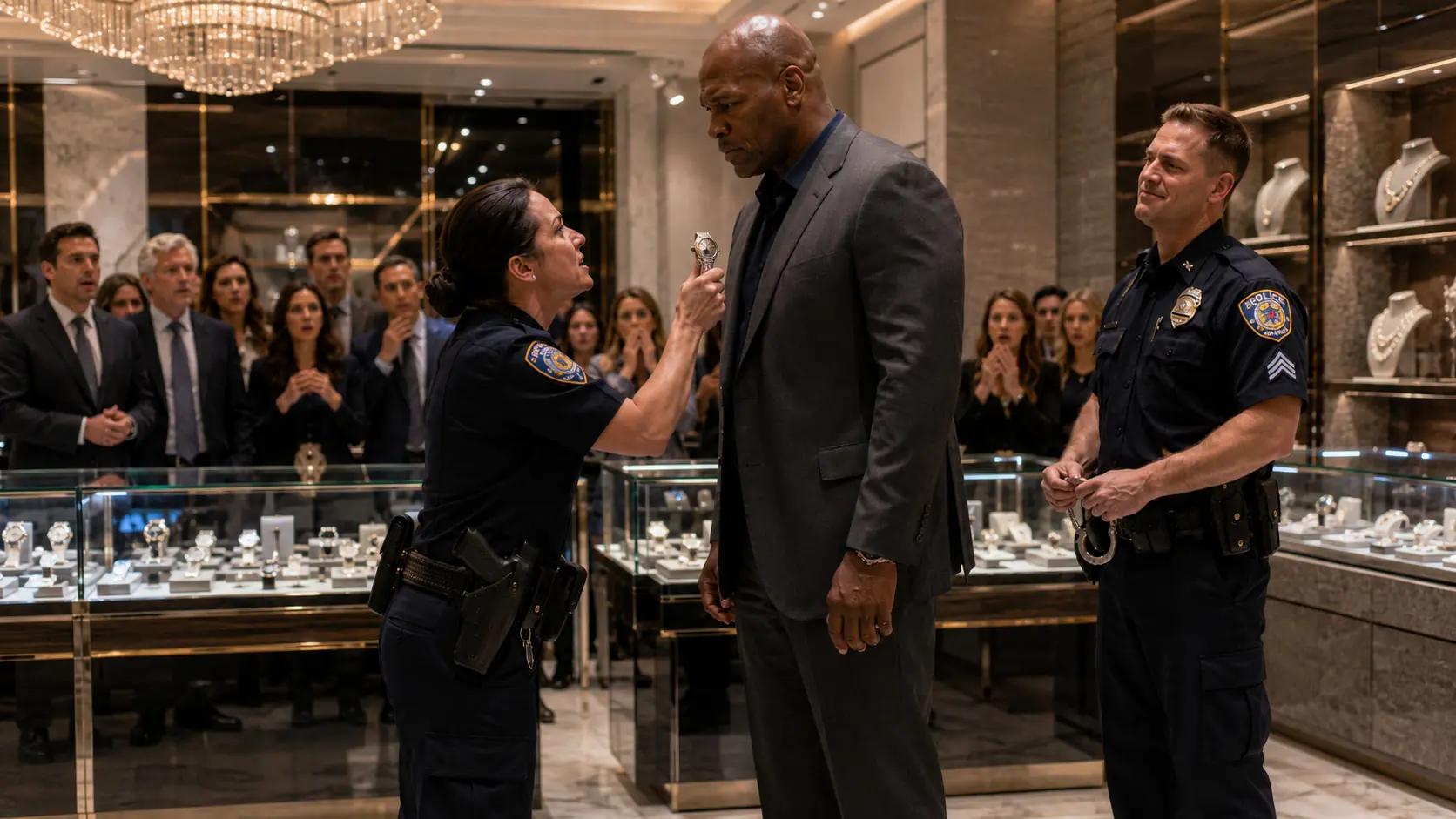
Daniel’s face remained unreadable. He had entered the boutique twenty-three minutes earlier, examined three watches, asked detailed questions about warranty records, and placed nothing inside his pockets. Yet Higgins was now claiming a salesman had watched him conceal the diamond watch beneath his jacket, while Kane positioned himself behind Daniel to prevent him from leaving. Daniel glanced once toward the security camera above the jewelry counter and quietly said, “You planted that watch on me, and you know it.”
Female Officer (angrily, stepping closer): “Careful, big guy. Calling an officer a liar can make your night a whole lot worse.” Male Officer (grinning, raising the handcuffs): “Keep talking and we’ll drag you out in front of everybody.” Daniel looked from Kane to Higgins, then toward assistant store manager Victor Lane, who stood behind the counter wearing a dark designer suit and pretending to look shocked. Undercover FBI Agent (deadly calm, reaching slowly inside his jacket): “Touch me, and your last arrest will be each other when my FBI badge comes out.”
For half a second, nobody moved. Higgins stared at Daniel’s hand as he withdrew a black credential wallet, while Kane’s grin disappeared so quickly it was almost comical. Daniel opened the case just enough for them to see the federal seal, his photograph, and the words SPECIAL AGENT — FEDERAL BUREAU OF INVESTIGATION beneath his name. Victor Lane stumbled backward into the display case.
Higgins recovered first. “That could be fake.” Her voice was quieter now, but Daniel could hear panic beginning beneath the authority. He closed the credential case and returned it to his inside pocket without breaking eye contact. “Then arrest me and explain the probable cause while the federal team across the street watches you finish the operation.”
Kane’s eyes immediately moved toward the boutique’s enormous front windows. Across Michigan Avenue, nothing looked unusual: taxis passed, pedestrians hurried between stores, and tourists gathered beneath umbrellas despite the clear evening sky. What Kane could not see was the surveillance van parked inside a loading garage fifty yards away, where three federal agents were watching four synchronized camera feeds. Daniel had never entered Bellmont & Ash to buy a watch.
For six months, the Chicago Public Corruption Task Force had been examining an unusual series of luxury-store arrests involving Higgins and Kane. The pattern began with a cardiologist accused of stealing a bracelet, followed by a real-estate developer arrested over a designer handbag and a retired teacher accused of slipping a watch into her coat. Each suspect insisted merchandise had been planted, yet every arrest had been supported by an employee statement and a police report claiming the customer acted suspiciously. Most cases disappeared quietly after the accused paid thousands of dollars to lawyers and agreed not to sue the store.
Then one case refused to disappear. Seventy-one-year-old Harold Mercer had been accused of stealing a $34,000 watch while shopping for an anniversary gift for his wife. Harold spent eleven hours in custody before prosecutors declined charges because the boutique could not produce usable security footage. Two weeks later, Harold contacted the FBI with something investigators had never seen before: a ten-second recording accidentally captured by his hearing aid’s companion application.
The audio contained Victor Lane’s voice. “Put the Cartier in the gray coat, then call Higgins.” Another voice answered, “What if he notices?” Victor laughed and replied, “By then the cops will own the story.”
The recording was short, but it was enough to begin digging. Federal investigators compared arrest reports, store schedules, officer assignments, insurance filings, and Bellmont & Ash inventory records. Higgins and Kane appeared repeatedly whenever the boutique reported high-value theft, and Victor Lane was on duty during nearly every incident. Even stranger, merchandise listed as stolen often appeared weeks later in internal inventory transfers instead of remaining permanently missing.
Investigators began to suspect the arrests were camouflage for something larger. Victor was manipulating inventory records and filing inflated insurance loss claims while corrupt officers created believable shoplifting cases around carefully selected customers. The planted merchandise would later return quietly to inventory or disappear through a resale channel, while the customer’s arrest made the initial loss look legitimate. Higgins and Kane received cash payments disguised through a private security consulting company owned by Kane’s brother.
Daniel Cross volunteered to go undercover. He fit the profile investigators had identified from prior incidents: financially comfortable, shopping alone, unlikely to create an immediate public scene, and unfamiliar to employees at Bellmont & Ash. He entered using his real first name but a controlled background attached to the operation, carrying no federal equipment except a concealed transmitter and a credential he hoped never to reveal. His instruction was simple—observe, purchase nothing, and give the suspects an opportunity to act without encouraging them.
Victor noticed him within five minutes. Daniel asked to see a limited-edition Swiss chronograph priced at $42,000, then a diamond-encrusted model worth nearly twice that amount. He handled each watch only while the salesman remained present, returned them carefully, and spent several minutes reading warranty cards. From the surveillance van, Special Agent Lena Ortiz watched Victor disappear into the staff corridor and text someone.
Eight minutes later, Higgins and Kane entered the boutique. Neither officer had been dispatched through the normal emergency system. There was no documented 911 call, no radio request for assistance, and no patrol assignment directing them to Bellmont & Ash. Kane’s private phone had received a message from Victor exactly six minutes before the officers arrived.
Daniel walked toward a display of cuff links while Victor moved behind him. A hidden camera inside Daniel’s jacket button recorded Victor approaching with the diamond watch held low beside his thigh. For less than a second, Victor’s hand disappeared near Daniel’s jacket pocket before Daniel deliberately stepped away. Victor failed to plant it.
That should have ended the attempt. Instead, Victor carried the watch behind the counter, spoke briefly with Higgins, and placed it directly into her hand. Three minutes later, Higgins approached Daniel and announced that an employee had witnessed him stealing it. The accusation happening now was not merely misconduct anymore; it was the moment the federal team needed.
Higgins looked again toward the street after seeing Daniel’s badge. “If you’re really federal, call your supervisor.” Daniel nodded. “That’s exactly what I was waiting for you to ask.”
The boutique doors opened. Lena Ortiz entered first in a dark business suit, followed by two agents and an investigator from the Chicago inspector general’s office. Shoppers moved instinctively away from the entrance as Lena displayed her credentials and walked directly toward Higgins. FBI Supervisory Agent (firmly, holding up her badge): “Officer Higgins, keep your hands where we can see them and do not touch your phone.”
Kane immediately reached toward his pocket. Two agents stepped toward him at once, and he stopped. Male Officer (nervously, raising his hands): “Hold on, nobody needs to make this crazy.” Lena looked at the open handcuffs still dangling from his right hand. FBI Supervisory Agent (coldly): “You were about to handcuff one of my agents using evidence your partner received directly from the store manager.”
Victor began backing toward the employee corridor. Daniel turned his head. Undercover FBI Agent (calmly): “Victor, don’t.”
Victor stopped. “I haven’t done anything.” Daniel nodded toward the watch still in Higgins’s hand. “Then you won’t mind us preserving every camera, inventory record, text message, and employee-access log in this building.”
That was when Victor ran. He made it six steps before another federal agent emerged from the corridor and blocked the doorway. Victor slammed to a stop, turned around, and suddenly found every shopper staring at him instead of Daniel. Less than ten minutes earlier, Victor had been the respected manager accusing a stranger of stealing; now two investigators were placing him in handcuffs.
Higgins still refused to accept what was happening. “You cannot arrest officers because some federal guy says he was framed.” Lena’s expression did not change. “We’re not arresting you because he says it.” She pointed toward the ceiling. “We have video, audio, financial records, location data, preserved messages, and six months of surveillance.”
Kane’s face went white. Unlike Higgins, he understood what those words meant. If investigators had six months, the confrontation inside the store was not the beginning of the case. It was the end of their freedom to control the story.
Daniel walked toward the display counter and looked through the glass. Rows of watches sat beneath perfect lighting, each positioned at an identical angle. He had spent months studying this place through photographs, financial records, floor plans, and witness statements, but standing inside it while officers attempted to manufacture his arrest felt different. For the first time, he understood why several earlier victims had eventually stopped fighting and simply tried to survive the accusation.
Higgins had been good at exploiting that fear. She understood that once a uniformed officer confidently announced a crime in public, most witnesses automatically began interpreting everything afterward through that accusation. A customer demanding proof became aggressive, confusion became evasiveness, fear became suspicious behavior, and attempts to leave became flight. Her reports transformed uncertainty into certainty one sentence at a time.
Federal technicians entered the boutique and began preserving the security system. Victor had claimed cameras malfunctioned during several earlier incidents, but investigators had already discovered that Bellmont & Ash stored redundant video on a remote corporate server. Victor could delete local clips, yet copies remained temporarily available elsewhere. A subpoena issued days earlier had quietly preserved months of footage without notifying store-level management.
The recovered videos were devastating. In Harold Mercer’s case, footage showed Victor slipping behind the older man immediately before claiming a watch disappeared. Another recording showed Higgins arriving before any employee placed an official call for police assistance. A third revealed Kane speaking privately with Victor near a rear entrance, accepting a small envelope hours after a college professor was arrested for allegedly stealing jewelry.
Financial records provided the next layer. Kane’s brother operated a company called North Shore Protection Consulting, which appeared to provide “retail security risk assessments” to several businesses. Bellmont & Ash paid the company more than $190,000 over two years despite having no contracts, reports, employee schedules, or legitimate security work supporting those payments. Portions of that money moved repeatedly into accounts controlled by Kane and Higgins.
Victor’s scheme was even larger. Prosecutors later alleged he manipulated inventory records to create apparent theft losses, submitted insurance documentation, then redirected merchandise into private resale channels. Innocent customers became convenient explanations for missing pieces. Police reports from Higgins and Kane gave those explanations official weight.
One particularly damaging message came from Higgins’s phone after investigators obtained a warrant. Victor had sent a photograph of Daniel walking inside Bellmont & Ash with the message, Big one. Expensive suit. Alone. Pick him if he stays past twenty minutes. Higgins answered, Make sure something is on him before we walk in.
Another message connected the officers directly to Harold Mercer. Kane wrote, Old guy won’t fight hard. Good choice. Victor replied, Camera six goes down at seven. That single exchange destroyed months of arguments that the questionable arrests resulted from misunderstandings or aggressive loss-prevention practices.
The investigation expanded beyond the three people inside Bellmont & Ash. Detectives reviewed dozens of arrests involving Higgins and Kane and identified eight cases with similar problems. Four involved Bellmont & Ash, while others involved two high-end retailers where North Shore Protection Consulting had received unexplained payments. Prosecutors dismissed three pending cases after determining the evidence could no longer be trusted.
Harold Mercer was invited to the federal building when investigators were finally permitted to explain what they had uncovered. He sat across from Daniel holding the same hearing-aid case that had started the investigation. “Did they believe you when you told them you were FBI?” Harold asked. Daniel smiled slightly. “Eventually.”
Harold shook his head. “Must be nice having that badge.” Daniel understood exactly what he meant. “Yes,” he said after a moment. “That’s why this case mattered.”
Harold looked at him. Daniel continued, “When they accused me, I knew another team was listening, I knew cameras were preserved, and I knew I could prove who I was in seconds. You had none of that.” Harold nodded slowly. “No. I just had people looking at me like I was already guilty.”
Daniel never forgot that sentence. The operation made headlines because an undercover FBI agent had nearly been arrested in a luxury boutique, but Daniel believed the more important story involved everyone who had walked into similar situations without a federal team waiting outside. A badge protected him after the trap closed; the investigation existed to protect people who had never had one.
The criminal cases took more than a year to resolve. Victor Lane eventually pleaded guilty to charges connected to fraud, evidence manipulation, and conspiracy, providing records that helped investigators recover jewelry sold through private intermediaries. Wade Kane admitted accepting payments and falsifying reports, while Megan Higgins fought the charges longer before messages and video evidence left almost nothing meaningful to dispute.
Bellmont & Ash terminated several managers and agreed to an independent compliance review. Its insurer reopened multiple theft claims, while customers previously accused at the boutique received formal notice that their cases had been compromised. Some accepted settlements, others pursued civil claims, and Harold insisted on something simpler—a written correction stating clearly that he had never stolen anything.
Daniel returned to the boutique eighteen months later. The polished counters remained, the watches still gleamed beneath white lights, and wealthy shoppers still moved through the store speaking quietly with sales associates. But the security procedures were different, incident reports required independent review, and no employee could request police action over suspected theft without preserving the relevant surveillance footage.
A young salesman approached Daniel near the same counter. “Can I help you with anything, sir?” Daniel looked down and noticed the exact model Higgins had once held against his chest. He smiled faintly.
“Not today.” The salesman nodded politely and walked away without following him, questioning him, or looking toward security. Nothing dramatic happened.
Daniel stood there another moment. That ordinary silence meant more to him than the arrests had.
People often imagined corruption as something loud—a suitcase of cash, a threatening phone call, a secret meeting in a dark parking garage. Daniel had learned that sometimes it looked far more respectable. It looked like a polished boutique, a confident manager, two uniforms, a typed report, and a frightened customer surrounded by people who assumed authority must be telling the truth.
He walked toward the entrance. Through the glass doors, Michigan Avenue was crowded with afternoon traffic, exactly as it had been the night Higgins tried to frame him. Lena Ortiz waited outside holding two coffees.
“Buying yourself a watch?” she asked. Daniel shook his head.
“Too expensive.”
Lena laughed. “You spent six months pretending to be rich.”
“That was government money.”
They started walking down the sidewalk. After several steps, Lena looked toward him.
“You ever think about what would’ve happened if you weren’t undercover that night?”
Daniel’s expression became serious. “Every time I think about the case.”
Behind them, shoppers continued entering Bellmont & Ash, unaware that the store had once been the center of a conspiracy built around people believing the wrong person at the right moment. Daniel did not need them to know his name, his title, or what had happened there.
He only needed the next person accused of something inside that building to be judged by evidence instead of confidence.
And that was the mistake Higgins, Kane, and Victor had made from the beginning. They believed the uniform, the luxury address, and their carefully written reports gave them permanent ownership of the truth.
They chose Daniel Cross because he looked like the perfect person to frame.
They never imagined he had entered the store waiting for them to try.