Isaiah Cole enters the Baltimore federal courthouse in maintenance coveralls after helping an elderly custodian clean a dangerous spill near the entrance.
Assistant administrator Trevor Lang assumes Isaiah is a cleaner, threatens to have him removed, and refuses to listen when the older man warns him to step aside.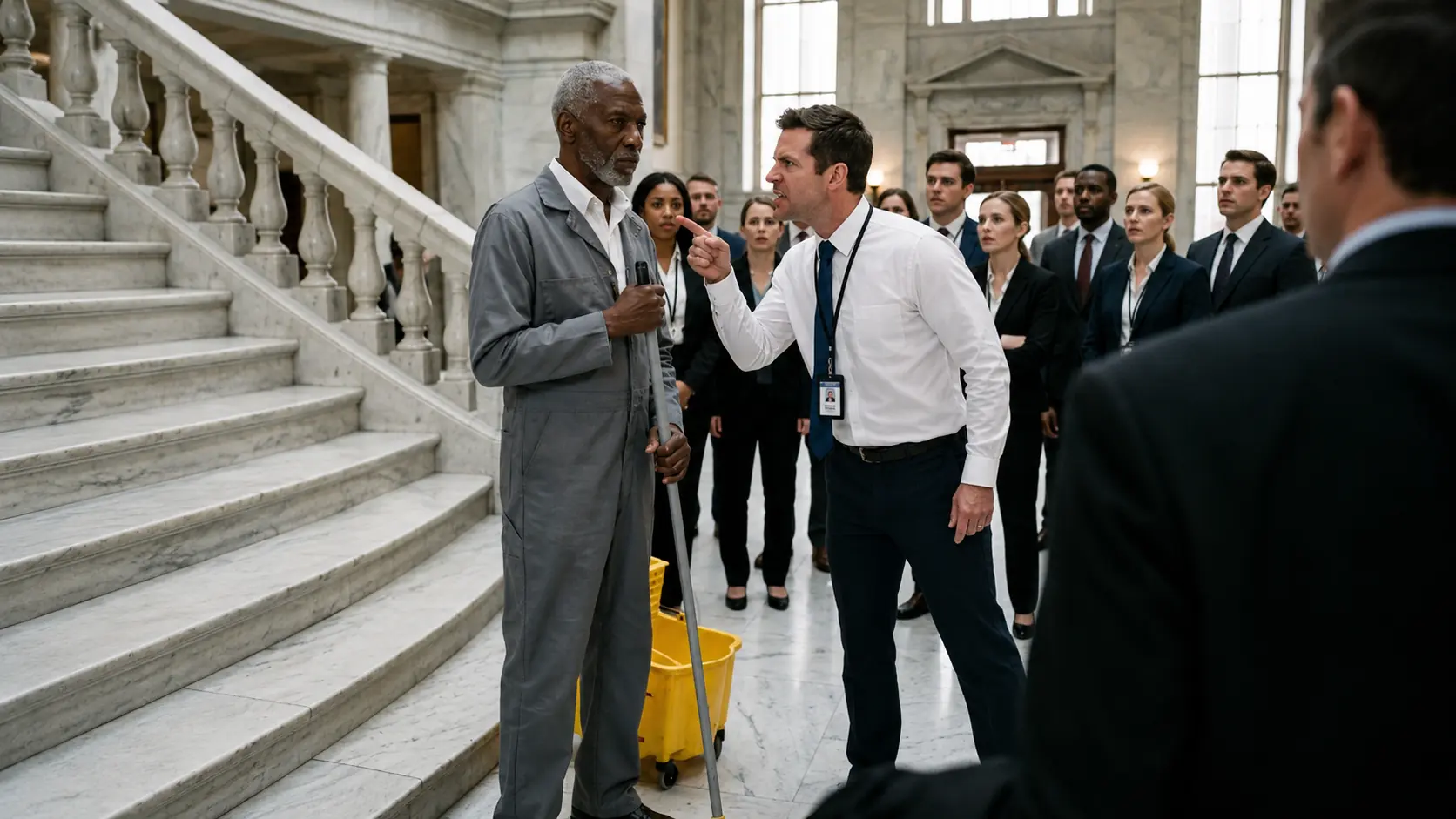
The confrontation changes instantly when Isaiah reveals that he is the courthouse’s newly appointed chief judge, arriving to investigate sealed evidence hidden inside Trevor’s office.
The yellow mop bucket stood beneath the central staircase of the United States Courthouse in downtown Baltimore, surrounded by a spreading crescent of dirty rainwater. Outside, an early-morning storm had driven hundreds of people through the front doors carrying wet umbrellas, dripping coats, and shoes coated with street grime. An elderly custodian named Samuel Brooks had been trying to contain the slippery floor alone when pain suddenly seized his lower back. Isaiah Cole saw him struggling, took the mop from his hands, and told him to sit down before he fell.
Isaiah wore gray maintenance coveralls borrowed from Samuel’s supply cart because his charcoal suit had been splashed when a broken ceiling drain emptied onto the security floor. Beneath the open collar, the white dress shirt and dark tie were still visible, but most people noticed only the plain uniform and the mop in his hands. At seventy-two, Isaiah was tall and lean, with deep-brown skin, short silver hair, calm dark eyes, and a neatly trimmed gray beard. His black shoes were far too polished for custodial work, yet no one passing through the lobby looked long enough to notice.
Samuel sat on a nearby bench, one hand pressed against his back while Isaiah guided the water away from the security lanes. The morning’s first major hearing would begin in less than an hour, and dozens of attorneys, reporters, court employees, and witnesses were already arriving. Isaiah worked without embarrassment because he had never believed dignity came from refusing ordinary labor. He had spent forty-one years in courtrooms, and some of the finest people he knew had cleaned them after everyone important went home.
He was finishing the last section when Trevor Lang stepped out of the executive elevator.
Trevor was thirty-six, sharply dressed, and visibly irritated before he saw Isaiah. His white shirt was crisp, his black tie perfectly centered, and his identification badge hung from a polished leather strap. As assistant court administrator, Trevor controlled employee access, courtroom scheduling, building contracts, and the daily movement of almost every worker who did not wear a robe. He had spent six years turning a middle-management position into a private kingdom.
Trevor stopped beside the bucket.
“What do you think you’re doing?” he demanded. “Cleaners use the back entrance.”
Isaiah rested both hands on the mop handle.
“I came through the entrance assigned to me.”
Trevor looked at the gray coveralls and gave a short laugh.
“No, you didn’t.”
Several employees slowed near the elevators. A group of attorneys standing beneath the marble columns turned toward the argument, while Samuel tried to rise from the bench. Isaiah lifted one hand, quietly signaling him to remain seated.
Trevor stepped closer.
“The public entrance is not for contractors moving equipment.”
“This equipment belongs to your building.”
“That doesn’t give you permission to bring it through here.”
“The water was already here.”
Trevor looked down at the now-clean floor as though the explanation inconvenienced him.
“Take the bucket and leave through the service corridor.”
Isaiah did not move.
“I have business upstairs.”
“Not dressed like that.”
“My clothing does not change my appointment.”
Trevor’s expression sharpened. He had dealt with employees who appealed to supervisors, vendors who complained about invoices, and visitors who believed rules should bend for them. What he had not learned was how to respond when someone simply refused to be intimidated. Isaiah’s calmness felt more threatening to him than shouting would have.
Trevor pointed directly at Isaiah’s face.
“Move.”
Isaiah’s eyes settled on the finger.
“Move your finger.”
The lobby became quieter.
Trevor stepped so close that the front of his tie almost touched Isaiah’s coveralls.
“Leave now, or security drags you out.”
Isaiah slowly unzipped the upper section of the borrowed uniform. Beneath it, clipped inside his suit jacket, was a federal judicial credential bearing the gold seal of the United States Courts. He removed it carefully and held it between them.
“Call them,” Isaiah said. “This is my courthouse.”
Trevor stared at the credential.
The words printed beneath Isaiah’s photograph seemed impossible.
HONORABLE ISAIAH M. COLE
CHIEF JUDGE
UNITED STATES DISTRICT COURT
Someone near the elevator inhaled sharply.
Trevor looked from the badge to Isaiah’s face, as if the man might transform into someone more recognizable if he stared long enough. Photographs announcing Isaiah’s appointment had appeared in courthouse emails, legal publications, and local newspapers for three weeks. Trevor had approved the building notice himself, but he had never bothered to study the face beyond a quick glance.
“Chief Judge Cole,” whispered one of the attorneys.
Samuel finally stood.
“I tried to tell Mr. Lang you were helping me.”
Trevor turned toward him.
“Why didn’t you identify him properly?”
Samuel’s expression changed from pain to disbelief.
“He identified himself.”
Isaiah closed the credential.
“I told you I had business upstairs.”
“You didn’t say you were a judge.”
“You did not ask.”
Trevor lowered his voice.
“This is an unfortunate misunderstanding.”
“No,” Isaiah replied. “A misunderstanding is corrected by information. You rejected every piece of information because you trusted your assumption more.”
The executive elevator opened again.
Court Clerk Denise Avery stepped into the lobby with three senior judges and two federal marshals. Denise was a sixty-year-old Black woman who had worked inside the courthouse for more than three decades. She saw Isaiah in maintenance coveralls, Trevor standing inches away, and the silent crowd surrounding them.
“What happened?” she asked.
Trevor answered immediately.
“Chief Judge Cole entered through the public lobby wearing contractor clothing, and there was confusion about his identity.”
Isaiah looked toward Samuel.
“Mr. Brooks?”
Samuel straightened despite his aching back.
“Judge Cole helped me clean the leak after I hurt myself. Mr. Lang told him cleaners use the back entrance, ordered him out, and threatened to have security drag him away.”
Denise’s eyes moved toward Trevor.
“Did you check his identification?”
“He did not show it until the end.”
“Did you ask for it?”
Trevor remained silent.
Isaiah handed the mop back to Samuel, then picked up the worn brown leather briefcase he had placed beside the bench. The case contained the documents for a closed judicial conference scheduled that morning. Among them were surveillance photographs, access records, intercepted messages, and sealed affidavits connected to suspected evidence tampering inside the courthouse.
Isaiah looked at Trevor.
“My clothing is not the reason I arrived early.”
Trevor’s face tightened.
Isaiah continued.
“I came to review evidence concerning unauthorized access to sealed court files.”
The attorneys nearest the elevator began whispering.
Trevor forced a confused expression.
“I don’t know anything about that.”
Isaiah opened his briefcase and removed a red folder.
“The access occurred through administrative credentials assigned to your office.”
Trevor looked toward the marshals.
“This conversation should not happen in the lobby.”
“For once, we agree.”
Isaiah turned to Denise.
“Please escort Mr. Brooks to the medical office and ensure he receives a full examination. His supervisor assigned him to manage a flooded public entrance alone.”
Denise nodded.
“I’ll handle it.”
Isaiah then addressed the marshals.
“Secure Mr. Lang’s office, computer, courthouse phone, and physical keys. He is not to access any administrative system until the judicial conference concludes.”
Trevor stepped backward.
“You cannot seize my property without cause.”
“The equipment belongs to the courthouse.”
“My personal effects are inside.”
“They will be inventoried.”
Trevor’s voice rose.
“This is retaliation because I failed to recognize you.”
Isaiah held his stare.
“If this were about recognition, we would be discussing training. We are discussing sealed evidence found inside your office.”
The federal marshals moved into position beside Trevor.
He looked at the crowd, searching for someone willing to treat him like the authority he had been ten minutes earlier. The employees who usually stepped aside when he entered now watched in silence. His badge remained visible on his chest, but it no longer seemed powerful.
Isaiah entered the executive elevator with Denise and the senior judges.
The doors closed on Trevor’s expression.
The twenty-fourth floor contained the chief judge’s chambers, a secure conference room, and the court’s restricted records center. Isaiah removed the borrowed coveralls inside a private office, revealing the charcoal suit beneath them. Denise brought him a replacement tie and helped brush dust from one shoulder.
“You could have called me from downstairs,” she said.
“Samuel needed help.”
“You are the chief judge.”
“That did not make the floor less wet.”
Denise allowed herself a small smile.
Then her expression became serious.
“Do you believe Trevor knew who you were?”
“No.”
“Does that concern you?”
“It tells me something about him, but not the thing that brought us here.”
Isaiah opened the red folder.
Three months earlier, a federal corruption case had been assigned to Judge Eleanor Mercer. The defendants included developers, city contractors, and former public officials accused of laundering millions through fraudulent construction agreements. The evidence was protected by a sealing order because several witnesses remained in danger.
Yet confidential details began appearing outside the courthouse.
A witness’s temporary address was leaked.
A contractor learned about a search warrant two days before agents arrived.
A defense consultant referenced testimony that had never been disclosed.
At first, investigators suspected someone inside the prosecution team. Digital audits eventually traced the leaks to the courthouse’s administrative network. Someone used executive-level credentials during early mornings, late evenings, and weekends to open files beyond the limits of ordinary court staff.
The account belonged to Trevor Lang.
Trevor claimed his password had been compromised.
The explanation might have been believable if investigators had not found copies of the sealed files hidden inside a locked cabinet in his office.
Isaiah had been appointed chief judge in the middle of the investigation. His predecessor retired suddenly after surgery, leaving Isaiah responsible for protecting the court while determining whether corruption had reached its administration. Only Denise, two senior judges, the head marshal, and federal investigators knew the full scope of the inquiry.
That morning’s closed conference would determine whether Trevor should be questioned or arrested.
The lobby confrontation accelerated the decision.
Inside the secure conference room, Special Agent Rebecca Sloan connected a laptop to the display. She presented surveillance footage showing Trevor entering the records center at 5:42 on three separate mornings. His access card opened the outer door, while a copied master key allowed him to enter the secured archive.
“He had no approved reason to be there,” Rebecca said.
Judge Mercer studied the timestamps.
“What files did he access?”
“Primarily the Hanover Development case.”
“That is the case scheduled for trial next month.”
“Yes.”
Rebecca displayed financial records.
“Mr. Lang received payments through a consulting company controlled by his brother-in-law. The company was paid by a legal-services vendor connected to one of the defendants.”
Isaiah looked around the table.
“How much?”
“Two hundred forty-eight thousand dollars across eighteen months.”
One judge removed his glasses.
“How did this pass the courthouse financial review?”
“It did not pass,” Rebecca said. “The payments occurred outside his court salary. We found them through banking records obtained last week.”
Denise opened another folder.
“There is more.”
She explained that several custodial and maintenance employees had submitted complaints about Trevor during the previous two years. He had forced them to use separate entrances, restricted their elevator access, and issued disciplinary notices when they appeared in public sections of the courthouse during business hours.
One employee was dismissed after reporting that Trevor entered a sealed courtroom late at night.
Isaiah looked up.
“Who?”
“Maria Torres.”
“Why was she dismissed?”
“Trevor accused her of stealing cleaning supplies.”
“Was anything found?”
“No.”
“Who reviewed the allegation?”
“Trevor.”
The room became silent.
Maria had not simply been treated badly. She had been removed after seeing something dangerous.
Isaiah closed the folder.
“Find her.”
Federal agents located Maria that afternoon at a hotel near the airport, where she worked cleaning guest rooms. She was fifty-three, small, exhausted, and initially terrified when marshals approached her. She believed the courthouse had sent them to recover money from a wrongful unemployment claim.
Isaiah met her in a private interview room.
She recognized him immediately.
“You’re the new chief judge.”
“Yes.”
“Am I in trouble?”
“No.”
Maria kept her coat on.
“I didn’t steal anything.”
“I know.”
Her eyes filled.
“They searched my locker in front of everybody.”
“I am sorry.”
She shook her head.
“Sorry doesn’t give me my job back.”
“No, but the truth may.”
Maria described seeing Trevor leave Courtroom Seven carrying two red folders after midnight. She asked whether he needed assistance, and Trevor told her she had no right to question courthouse business. The next morning, cleaning chemicals were discovered inside her personal locker, and she was accused of theft.
“He put them there,” Maria said.
“Did you see him do it?”
“No.”
“Why do you believe that?”
“Because he told me I should have kept my eyes on the floor.”
Isaiah’s jaw tightened.
“What exactly did he say?”
Maria looked directly at him.
“People who clean this building shouldn’t look at what happens above them.”
The statement stayed with Isaiah.
Trevor had created an entire system around invisibility. He treated custodians, maintenance workers, messengers, and temporary employees as if their presence did not count. That contempt allowed him to move through restricted areas believing no one important would notice.
The same assumption had made him point into Isaiah’s face that morning.
People wearing maintenance clothes did not belong near authority.
People carrying mops did not require explanations.
People using service entrances did not become witnesses.
Trevor had been wrong about all of them.
By late afternoon, investigators discovered deleted messages between Trevor and defense consultant Eric Walton. The messages contained references to sealed witness statements, evidence schedules, and the timing of search warrants. One message instructed Trevor to remove a surveillance file before Judge Mercer’s clerk completed the final evidence index.
The file concerned a warehouse camera.
It showed two defendants meeting a government witness who later disappeared.
Trevor had not deleted the only copy, but he believed he had.
The recovered footage changed the criminal case and the investigation into Trevor.
At 4:20 p.m., federal marshals entered the administrative conference room where Trevor had been waiting with an attorney. Isaiah joined them but remained near the door.
Trevor looked at the restored charcoal suit.
“You dressed for the occasion.”
Isaiah ignored the remark.
Special Agent Sloan read the arrest warrant.
Trevor was charged with obstruction of justice, bribery, unauthorized disclosure of sealed information, evidence tampering, and conspiracy. Additional charges would follow if investigators confirmed his role in Maria’s dismissal and the leaked witness address.
Trevor’s attorney raised one hand.
“My client will surrender peacefully.”
Trevor looked at Isaiah.
“You enjoyed this.”
“No.”
“You made a spectacle downstairs.”
“You created the spectacle.”
“You could have identified yourself immediately.”
Isaiah stepped closer.
“You keep returning to the moment you learned I had power.”
“Because you deliberately concealed it.”
“I concealed nothing. You saw coveralls and decided you knew everything worth knowing.”
Trevor’s expression hardened.
“Do not turn a security mistake into some moral lesson.”
“This is not about morality.”
Isaiah looked toward the arrest warrant.
“It is about evidence.”
The marshals secured Trevor’s hands.
As they led him out, he passed Samuel Brooks near the medical office. Samuel wore a back brace beneath his work shirt and held the same mop Isaiah had used that morning.
Trevor looked away first.
The investigation continued for nearly a year.
Eric Walton pleaded guilty and provided evidence against several defendants. Trevor’s banking records connected him to confidential leaks that had compromised four investigations. The witness whose address had been exposed survived only because federal agents moved her hours before armed men arrived at the location.
Maria Torres was cleared of every accusation.
The courthouse restored her employment record, paid lost wages, and offered her reinstatement. She accepted only after Isaiah guaranteed that she would report to an independent facilities director rather than the administrator’s office.
Samuel received medical leave and returned several weeks later.
The building also changed.
Service entrances remained available for deliveries and equipment, but employees were no longer forced to use them simply because of their job titles. Custodians received full access to the public elevators required for their work. Complaints against administrators were reviewed outside the same chain of authority being accused.
Isaiah required every courthouse manager to spend one full shift alongside facilities employees.
Some called it symbolic.
Isaiah disagreed.
“You should know the people whose work makes your authority possible,” he told them.
Trevor’s trial began ten months after the lobby confrontation.
His attorney argued that the evidence had been distorted by personal conflict with the new chief judge. He repeatedly referenced Isaiah’s clothing, suggesting Trevor had been manipulated into an embarrassing mistake that poisoned the entire investigation.
The prosecutor answered with dates.
Payments began long before Isaiah’s appointment.
Files disappeared before Trevor met him.
Maria was dismissed the previous year.
The corruption existed before the mop bucket stood beneath the staircase.
Isaiah testified on the fourth day.
The defense attorney approached him.
“Judge Cole, is it true you allowed Mr. Lang to believe you were a custodian?”
“I allowed him to observe me helping one.”
“You did not immediately state your title.”
“I said I had business upstairs.”
“Why not simply tell him who you were?”
“Because I expected a courthouse employee to ask questions before issuing threats.”
The attorney folded his hands.
“Were you offended?”
“Yes.”
“So your personal feelings influenced your decision to secure his office.”
“No.”
“What influenced it?”
“The sealed evidence already recovered there.”
The attorney returned to his table.
Trevor was convicted on every major count.
He received fourteen years in federal prison.
Eric Walton received nine.
Two defendants in the Hanover Development case received additional charges connected to witness intimidation and attempted obstruction. The recovered warehouse footage became central to their convictions.
Months later, Isaiah stood in the courthouse lobby before the morning rush.
The ceiling drain had been repaired. The marble floor reflected the chandelier above, and the yellow mop bucket was gone. Employees crossed the space carrying files, coffee, tools, packages, and cleaning supplies.
Maria stepped out of the public elevator beside two attorneys.
No one questioned why she was there.
Samuel approached Isaiah with a fresh cup of coffee.
“You know, Judge, people still talk about the morning you were cleaning the floor.”
“I was not very good at it.”
“You were better than Trevor.”
“That is a low standard.”
Samuel laughed.
Isaiah looked toward the central staircase.
Trevor had believed the courthouse belonged to employees with titles, suits, and offices above the marble lobby. He had treated the people maintaining the building as if they existed somewhere outside its dignity.
But a courthouse did not belong to judges.
It did not belong to administrators.
It did not belong to attorneys, marshals, clerks, or anyone powerful enough to move freely through its doors.
It belonged to the law.
And the law became weakest whenever someone decided another person’s clothing made them unworthy of being heard.
Isaiah had entered wearing gray coveralls and carrying a mop.
Trevor saw a man he could order through the back entrance.
He never imagined he was pointing at the one person with the authority, evidence, and patience to expose everything Trevor had hidden behind the courthouse walls.