“A woman like you does not touch sealed evidence—drop that file before I put you on the floor.”
Captain Daniel Rourke tightened his hand around Simone Carter’s wrist in the center of Federal Courtroom 12, crushing the cuff of her white blouse against her skin. Attorneys, clerks, and federal officials watched from behind polished wooden tables as the heavyset security officer reached for the leather folder beneath her arm. Daniel believed he had caught an unknown woman attempting to enter the restricted prosecution area before the judge arrived.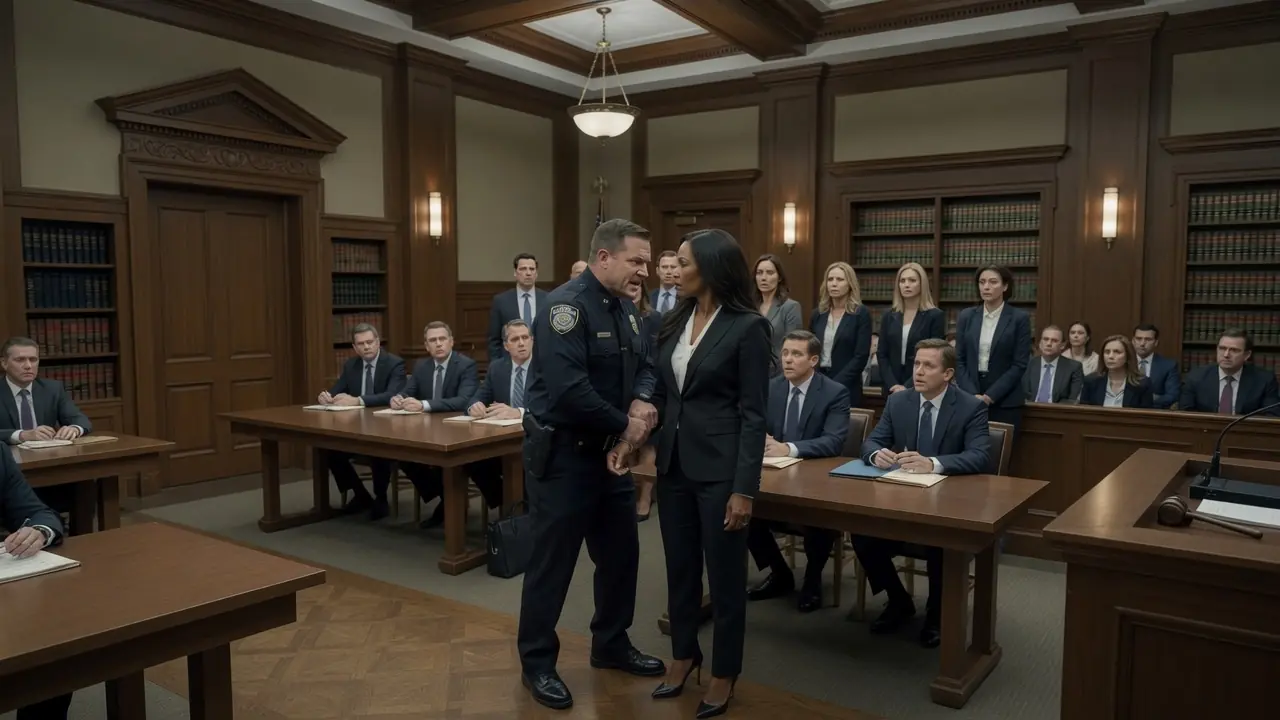
Simone did not pull away. “That file contains six years of your bribes, stolen evidence, and every lie behind that badge.”
Daniel’s face twisted with contempt as his free hand moved toward the handcuffs on his belt. “Keep accusing me, and I’ll bury you in a holding cell before anyone hears your story.”
Simone raised the sealed federal indictment high enough for the courtroom clerk to see the case number. “Go ahead, Daniel—the handcuffs are already here, but the judge ordered them placed on you.”
The rear doors opened immediately.
Four deputy marshals entered in silence, followed by Chief Judge Evelyn Price and Inspector General Marcus Reed. Daniel’s grip loosened as every person in the courtroom stood. He looked toward the judge, waiting for her to accuse Simone of trespassing, but Evelyn’s eyes settled on the red marks forming around the prosecutor’s wrist.
“Captain Rourke,” the judge said, “release Special Prosecutor Carter and place your hands on the counsel table.”
Daniel stared at Simone. “Special prosecutor?”
Simone pulled her wrist free. “The one appointed to investigate evidence disappearing from your courthouse.”
The silence that followed felt heavier than the armed marshals surrounding him.
Daniel had spent eighteen years inside the Franklin Federal Courthouse in Washington, D.C. He began as an entry-level security officer, rose through the supervisory ranks, and eventually became captain of courthouse protection. Judges trusted him with emergency plans, prosecutors requested him during sensitive hearings, and new officers learned quickly that questioning Daniel could damage a career.
He knew which doors remained unlocked after midnight. He knew where confiscated phones, sealed exhibits, and temporary evidence boxes were stored before transport. Most importantly, he knew how to make those items disappear without leaving obvious signs of forced entry.
For six years, Daniel sold information and selected evidence to defense consultants, corporate investigators, and criminal intermediaries. Sometimes he provided photographs of sealed documents. Other times he removed physical evidence long enough for it to be copied, altered, or contaminated before returning it.
The operation made him wealthy without changing his public lifestyle. He kept the same modest townhouse, drove the same government-approved sedan, and deposited nothing suspicious into domestic accounts. The money moved through a security-training company registered in his brother-in-law’s name.
Daniel believed the scheme was invisible.
Then a courthouse custodian named Lorraine Davis found a torn evidence seal beneath a basement storage shelf.
Lorraine was fifty-nine years old and had cleaned federal offices for nearly two decades. People often spoke around her as though the uniform made her deaf, invisible, or incapable of understanding what she heard. One night, she saw Daniel entering the evidence corridor long after his shift had ended.
He carried no inspection order.
The following morning, a sealed accounting ledger connected to a government contracting case was reported missing. It returned forty-eight hours later, but several pages had been replaced with convincing copies. Prosecutors did not discover the substitutions until a handwriting expert noticed differences in the ink.
Lorraine reported what she had seen.
Her supervisor warned her not to accuse a respected security captain without proof.
Three days later, Lorraine was reassigned to another building for “performance concerns.”
She wrote everything down before leaving.
Her notes eventually reached Simone Carter.
At forty, Simone had already built a reputation for prosecuting corruption cases other attorneys considered too politically dangerous. She grew up in Baltimore, where her mother operated a small accounting office and taught her that financial crimes rarely looked violent until families lost homes, employees lost pensions, or witnesses disappeared.
Simone studied law because she wanted to understand how powerful people turned theft into paperwork. She learned early that corruption survived not because criminals were brilliant, but because ordinary employees feared the consequences of noticing.
When the Justice Department assigned her to investigate the courthouse evidence failures, Simone refused an office inside the building. She worked from a secure location across the city and limited information to six trusted investigators.
Daniel was initially considered a witness.
That changed after Simone compared security logs with missing evidence reports.
Every disappearance occurred during Daniel’s shift, within six hours of a schedule change he authorized, or after a camera outage he approved as maintenance. Officers who questioned those outages received poor evaluations or undesirable assignments.
One officer, Miguel Santos, had written a report describing Daniel removing a sealed laptop from storage without signing the chain-of-custody sheet. The report disappeared from the internal system, and Miguel was transferred to overnight parking patrol.
Simone found the original copy inside his personal files.
“Why didn’t you go outside the department?” she asked him.
Miguel looked ashamed. “Daniel said he would destroy my pension and make sure no federal agency hired me again.”
“Did you believe him?”
“I watched him do it to two other officers.”
Miguel became the investigation’s second protected witness.
The third was a junior clerk named Allison Park, who discovered that Daniel’s security-training company received payments from three law firms connected to cases involving missing evidence. The payments were labeled emergency consulting fees, but the company had no employees, no office, and no record of providing training.
Allison copied the financial records before Daniel learned she had accessed them.
Simone spent eight months building the case.
She obtained bank records, security footage, encrypted messages, and testimony from intermediaries who accepted reduced charges in exchange for cooperation. Investigators placed tracking devices inside two decoy evidence boxes and confirmed that Daniel removed both from secure rooms.
Still, Simone needed one final piece.
Daniel rarely touched sensitive material personally when an officer or clerk could be manipulated into moving it for him. The prosecution required proof that he knowingly interfered with a sealed federal case after receiving direct notice that the evidence was protected.
Simone created that opportunity.
The leather folder she carried into Courtroom 12 contained the indictment against Daniel, but it also contained a decoy list identifying witnesses in a fictitious corruption case. The folder was clearly marked, electronically tracked, and protected by a tamper seal.
Judge Evelyn Price authorized Simone to bring it through the courtroom before an unannounced sealing hearing. Only the judge, Marcus Reed, and the marshals waiting outside knew the plan.
Simone expected Daniel to watch the folder.
She did not expect him to grab her.
When she entered through the secured side corridor, Daniel stepped away from the security station and blocked her path. He did not ask for identification. He looked at her face, clothing, and briefcase, then decided she could not belong near the prosecution table.
“Staff entrance is downstairs,” he said.
“I am expected at the bench.”
“Not dressed like that.”
Simone glanced at her tailored gray suit. “What exactly is wrong with how I’m dressed?”
Daniel’s mouth curled. “Don’t play games. Put the folder down and leave.”
“It is sealed federal evidence.”
“That is why someone like you should not be carrying it.”
The court reporter had already activated the audio system for testing.
Every word was recorded.
Simone warned Daniel not to touch her or the folder. He grabbed her wrist anyway, threatened to throw her down, and reached for the handcuffs that would soon be used on him.
Now those handcuffs clicked around Daniel’s wrists.
He looked toward Chief Judge Price. “This was a setup.”
The judge descended from the bench. “The evidence operation was authorized. Assaulting the prosecutor was your choice.”
“She refused to identify herself.”
Simone held up her federal credentials. “They were visible on my belt.”
Daniel looked down and finally saw them.
“You hid them under your jacket.”
“I wore them where regulations require.”
“You wanted me to make a mistake.”
Simone stepped closer. “You made your first mistake six years ago. Today, you simply made it in front of witnesses.”
Marcus Reed removed Daniel’s service weapon and ordered the marshals to search him. Inside his jacket, they found a small camera disguised as a pen and an encrypted flash drive attached to his key ring.
Daniel claimed both were approved equipment.
They were not.
The courtroom was cleared while forensic officers secured every object he carried. Judge Price postponed the scheduled proceedings and assigned another judge to handle Daniel’s arraignment. She also ordered an independent review of every case in which Daniel had access to evidence.
Simone entered a private conference room, where a medic examined her wrist. The skin had already begun swelling, but no bones were broken.
Marcus stood across from her. “You knew he might go for the folder.”
“I knew he might try to inspect it.”
“You didn’t expect him to touch you.”
“No.”
“He saw what he wanted to see.”
Simone looked at the darkening bruise. “That is how men like him make most of their mistakes.”
Within hours, news spread that a courthouse security captain had been arrested inside a federal courtroom. Early reports focused on Daniel grabbing a Black woman he failed to recognize as a special prosecutor.
Simone disliked that version.
It suggested the scandal was surprising because Daniel selected someone powerful. The crime would have been no less serious if he had grabbed Lorraine, Allison, a defendant’s mother, or a frightened witness trying to find the correct room.
At the first press conference, a reporter asked whether Daniel’s arrest proved that the security system worked.
“No,” Simone said. “It proves one investigation worked after years of warnings were ignored.”
Another reporter asked why she had entered without an escort.
“Federal prosecutors should not require armed escorts to walk through a courthouse.”
“Did Captain Rourke target you because of your race?”
“The words he used, the people he targeted previously, and the assumptions he made will be examined as evidence. I will not reduce an organized corruption scheme to a single insult, but I will not pretend the insult was unrelated.”
Daniel’s attorney immediately attacked Simone’s credibility.
He claimed she provoked the incident to create a dramatic arrest and distract from weaknesses in the financial case. He described Daniel as a respected officer who misunderstood an unannounced security exercise.
Then prosecutors released the courtroom audio.
“A woman like you does not touch sealed evidence.”
The sentence played across national news.
So did his threat to put Simone on the floor.
Public attention intensified, but the deeper evidence remained sealed until trial. Investigators searched Daniel’s home, storage unit, and brother-in-law’s company office. They found hidden drives containing photographs of sealed exhibits from twenty-three federal cases.
Some images showed witness lists.
Others contained financial records, informant identities, and unreleased investigative strategies.
The damage extended far beyond stolen documents.
One cooperating witness disappeared after his location appeared in a photographed protection order. A corporate fraud case collapsed when defense attorneys learned which internal emails prosecutors possessed. A criminal organization moved millions of dollars hours before agents executed a seizure warrant.
Daniel had not merely sold information.
He had altered the outcome of justice.
His encrypted messages identified several buyers, including private investigators, attorneys, and intermediaries connected to organized crime. Some paid in cash, others through fake consulting contracts.
One message from Daniel read:
Nothing in that courthouse moves unless I allow it.
Simone printed the sentence and placed it at the center of the prosecution table.
She understood that it revealed Daniel’s true motive more clearly than the money. Wealth attracted him, but control sustained him. He liked deciding who entered, who waited, who was believed, and whose future could be changed by one missing page.
That need for control also explained how he treated employees.
Lorraine Davis returned to Washington to testify before the grand jury. She wore the same maintenance uniform she had worn when she discovered the broken seal.
Daniel’s attorney suggested she held a grudge because of her transfer.
Lorraine answered calmly. “I held a mop, not a grudge. I saw what I saw.”
Miguel Santos testified that Daniel ordered him to disable a camera during a supposed electrical inspection. When Miguel refused, Daniel threatened his pension and reassigned him.
Allison Park provided bank records tying Daniel’s company to the buyers.
The witnesses Daniel considered powerless became the foundation of the case against him.
Simone visited Lorraine after the grand jury returned additional indictments.
“You were the first person who noticed,” Simone said.
Lorraine shook her head. “I was probably the first person who wrote it down.”
“What do you mean?”
“People noticed. They just didn’t think anyone would care.”
That sentence stayed with Simone.
The courthouse launched an emergency review and discovered more than forty complaints involving Daniel. Some described unnecessary searches, verbal humiliation, threats, and selective enforcement.
Black attorneys were stopped more often than white colleagues with identical credentials. Immigrant families were questioned aggressively about identification. Maintenance workers were ordered to use loading entrances even when assigned to public areas.
Supervisors classified each incident as isolated.
Daniel understood the protection that fragmentation created. One complaint looked like miscommunication. Ten complaints looked like a pattern, so he ensured no reviewer saw all ten together.
The financial corruption and discriminatory conduct operated through the same mechanism: he chose people the system was least likely to believe.
Daniel’s trial began fourteen months after his arrest.
He entered the courtroom without a uniform, wearing a gray suit and the restrained expression his attorneys had practiced with him. He looked smaller without the badge and gun belt.
Simone sat at the prosecution table with the leather folder placed beside her.
Daniel stared at it every morning.
The government presented financial records, security footage, encrypted messages, and witness testimony. Forensic experts demonstrated how he copied evidence, manipulated camera outages, and used false maintenance orders to access restricted rooms.
His attorney argued that Daniel was part of a larger security failure and should not bear responsibility for every missing item.
Simone agreed that the failure was larger.
Then she proved Daniel designed it.
She showed jurors schedules he altered, complaints he deleted, and payments he received. She played recordings of him instructing an intermediary to photograph witness information before returning the original seal.
Finally, she called Daniel’s brother-in-law.
He admitted the training company was fake and that Daniel controlled every account.
The defense called Daniel to testify against advice.
He portrayed himself as a dedicated officer pressured by prosecutors who needed a public villain. He claimed the money came from legitimate consulting and insisted employees misunderstood his strict security standards.
During cross-examination, Simone approached slowly.
“You testified that no evidence left secure storage without authorization.”
“Correct.”
She displayed footage of Daniel carrying a sealed laptop into a service elevator at 1:17 a.m.
“That was an emergency inspection.”
“Where is the inspection order?”
“It was verbal.”
“From whom?”
“I don’t recall.”
Simone displayed the next image, showing Daniel placing the laptop inside his personal vehicle.
“Was the courthouse parking lot part of the inspection?”
Daniel’s jaw tightened. “The system was more complicated than your video suggests.”
“The system was simple. You took what did not belong to you and sold access to people willing to pay.”
“That is your interpretation.”
Simone lifted the pen camera taken from his jacket during the arrest. “Why were you carrying an unauthorized recording device when you grabbed me?”
“For security documentation.”
“It contained photographs of the indictment folder.”
“I believed the document was suspicious.”
“You photographed it before speaking to me.”
Daniel hesitated.
Simone continued, “You didn’t grab me because I threatened security. You grabbed me because you wanted the evidence and believed no one in that room would stop you.”
“That is false.”
She played the courtroom audio.
His own voice filled the room.
“A woman like you does not touch sealed evidence.”
Simone allowed the silence to remain before asking her final question.
“What kind of woman did you believe I was?”
Daniel looked toward the jury.
He had no safe answer.
The jury convicted him on charges including bribery, obstruction of justice, evidence tampering, conspiracy, civil-rights violations, assault, and falsifying official records.
Several attorneys and investigators connected to the scheme were convicted separately. Two major cases Daniel corrupted were reopened, while other defendants received new hearings after courts determined evidence chains had been compromised.
At sentencing, Lorraine spoke first.
“You thought people cleaning the courthouse could not understand what happened inside it,” she said. “We understood. You simply counted on us being ignored.”
Miguel described losing years of advancement after refusing Daniel’s orders.
Allison explained how fear followed her home because Daniel knew where every employee lived.
Simone did not deliver a personal victim statement. She spoke on behalf of the government and described how Daniel converted public trust into private inventory.
The judge sentenced him to thirty-one years in federal prison.
Daniel stared at Simone after the sentence was announced. “You destroyed my life.”
She met his eyes. “No. I documented what you did with it.”
The courthouse changed after the trial.
Evidence rooms received independent civilian oversight, automatic access logs, and cameras that no single supervisor could disable. Complaints involving security personnel bypassed local management and went directly to external investigators.
Repeated allegations were reviewed together rather than separately.
Employees received legal protection when reporting misconduct. Transfers could no longer be used to hide unresolved complaints.
Simone demanded one additional reform.
Every sealed item moved through the courthouse would require two-person verification, but the two people could not share the same chain of command. No officer would again control access, documentation, and review simultaneously.
Some administrators complained that the system would slow operations.
Simone answered that corruption had already delayed justice for years.
Lorraine returned to the courthouse as a paid adviser during the reform process. She reviewed maintenance routes, camera blind spots, and after-hours access procedures.
A senior official asked what qualified a custodian to evaluate federal security.
Judge Evelyn Price replied, “She noticed what your experts missed.”
Miguel received his supervisory promotion.
Allison joined the inspector general’s financial crimes team.
Simone continued prosecuting corruption cases, though the scar near her wrist remained faintly visible for months. People occasionally called her brave for standing still while Daniel grabbed her.
She never considered stillness the courageous part.
Courage belonged to Lorraine writing down what powerful people wanted forgotten. It belonged to Miguel preserving a report after his career was threatened. It belonged to Allison copying the records before fear convinced her to look away.
Two years later, Simone entered Courtroom 12 for another corruption hearing.
A new security officer stood near the side corridor. He greeted her professionally, asked to see her credentials, verified them, and stepped aside.
He did not recognize her from the news.
That pleased her.
Respect should not depend on recognition.
As Simone approached the prosecution table, she glanced toward the place where Daniel had seized her wrist. The room looked ordinary again: polished wood, quiet attorneys, sealed folders, and the federal emblem above the bench.
The clerk called everyone to rise.
Simone opened her case file.
Daniel Rourke once believed his badge made the courthouse his private kingdom. He believed he could decide who belonged, who spoke, and which evidence reached the truth.
He was wrong about the Black woman standing before him.
But his greatest mistake was not failing to recognize Special Prosecutor Simone Carter.
It was failing to recognize that every person he dismissed had been watching, remembering, and carrying a piece of the case that would eventually bring him down.