The first thing Ruth Mercer noticed about Crowley Ranch was the silence.
Not the peaceful silence of open country, where wind moves through grass and birds call from fence posts.
This was a harder silence. It sat over the land like a sheet pulled across a body.
No cattle lowed from the pasture. No chickens scratched near the house. No steady sound of water came from the well.
Ruth stood beside the wagon in her travel dress, one gloved hand resting on the handle of her valise, and looked across the Texas land that was supposed to become her home.
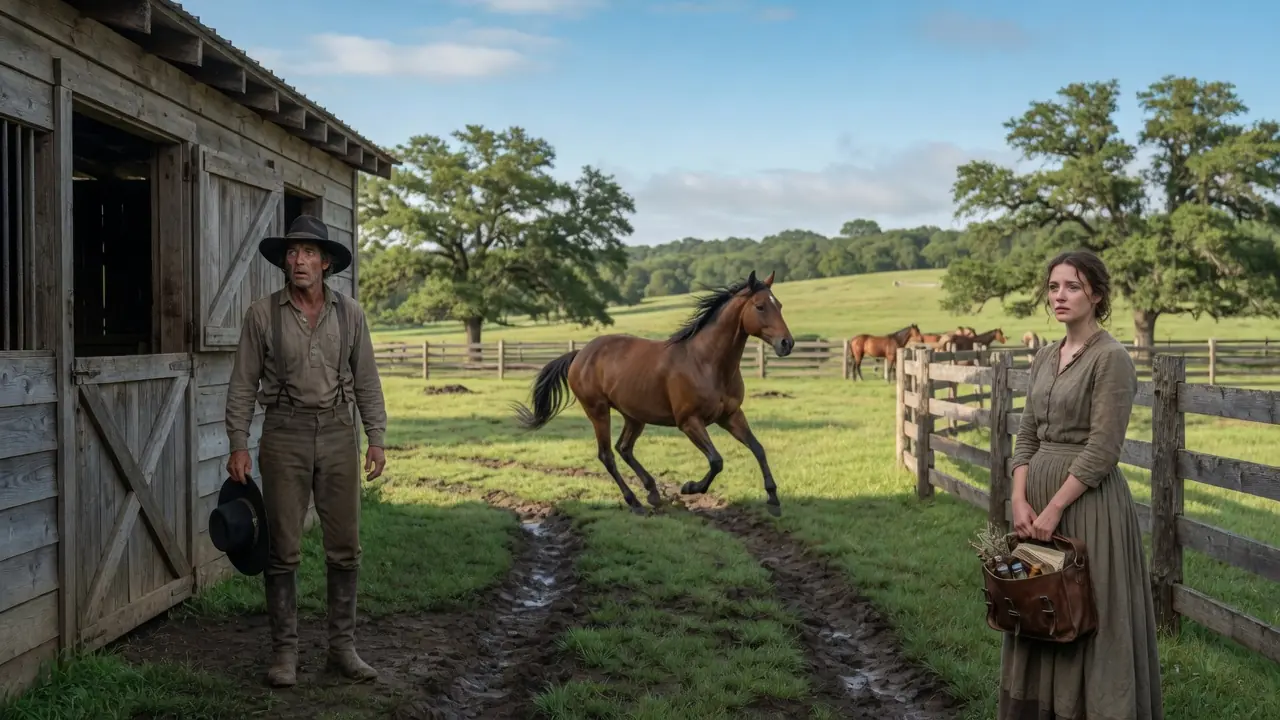
The ranch house stood low and weathered beneath a wide, pale sky. Its porch sagged at one corner. The barn leaned slightly toward the east as if tired from years of holding itself upright. Beyond the corral, the pasture stretched dry and yellow, cracked in places by heat.
Nathan Crowley stood a few feet away, holding the reins of the wagon team. He was taller than Ruth expected, lean from work rather than hunger, with a sun-browned face and gray eyes that did not give much away. His beard was trimmed short, his hat was worn, and his shoulders carried the kind of heaviness a man does not explain to strangers.
He had written her six letters before she came.
None of them had mentioned this silence.
“I should have told you,” Nathan said at last.
Ruth turned to him.
The afternoon sun caught the dust on his coat. He looked older than his thirty-eight years, not in face exactly, but in the way he stood, as if every decision he made had cost him something.
“Told me what?” she asked.
He looked toward the pasture.
“The well went bad three weeks ago. Then the spring slowed. I lost five head of cattle in ten days. Three more are weak. The house cistern is near empty.”
Ruth waited.
Nathan’s jaw tightened.
“I wrote to tell you not to come. The letter must not have reached you before the train left.”
Ruth looked at the ranch again.
Then she looked at him.
“Were you planning to send me back?”
His eyes met hers quickly.
“No.”
The answer came fast enough to be true.
“I was planning to give you the choice.”
Ruth let go of the valise handle. Her fingers were stiff from the long journey. She had left Missouri with two dresses, a Bible, her mother’s sewing scissors, and a small leather notebook filled with the things her father had taught her about wells, springs, soil, and stone.
She had also left behind an aunt who believed no sensible woman married a man she knew only by letters.
Maybe her aunt had been right.
But Ruth had buried both parents before thirty, worked in a boardinghouse kitchen until her hands cracked from lye, and learned that sensible choices did not always save a person from loneliness.
Nathan had sounded honest in his letters.
Lonely, but honest.
Now she stood on his dying ranch with dust gathering at the hem of her dress and a husband she had not yet married watching her like he expected her to turn around.
Ruth lifted her chin.
“Where is the well?”
Nathan blinked.
“The well?”
“If it went bad, I would like to see it.”
For the first time since she arrived, something in his expression shifted.
Not hope.
Not yet.
But attention.
He led her behind the house, past a stack of empty barrels and a garden patch gone brittle under the sun. The well sat beneath a crooked shade roof, its stone lip warm from the heat. The rope hung motionless. A wooden bucket rested nearby, dry and cracked at the rim.
A sour smell rose from the darkness below.
She knew that smell.
Her father had once called it a warning from the earth.
Nathan stood beside her.
“Doc Pritchard said the water turned foul from heat and low flow. Said nothing could be done except wait for rain.”
Ruth frowned.
“Did the cattle drink from here?”
“Before I knew it had spoiled, yes.”
She lowered herself carefully to one knee, pulled a clean handkerchief from her pocket, and dipped one corner into the dampness along the stones. Then she brought it to her nose and sniffed.
Nathan watched her closely.
“What is it?”
Ruth did not answer at once.
She rubbed the damp cloth between her fingers. There was a faint slickness to it. Not natural. Not from mud alone.
“Do you have a lantern?” she asked.
Nathan fetched one without argument.
That told Ruth something about him.
Many men would have laughed, corrected her, or told her a woman had no business looking into a well. Nathan Crowley simply lit the lantern and handed it over.
Ruth held it over the opening and leaned carefully forward.
The light touched wet stone, then vanished into depth. At first, she saw nothing except the dark glimmer of low water. Then the lantern shifted, and something pale flashed against the inside wall.
A scrap of cloth.
Caught on a nail.
Ruth drew in a slow breath.
“Someone has been in this well.”
Nathan’s face hardened.
“What?”
She pointed.
“There. On the west side.”
Nathan took the lantern, leaned farther, and saw it too.
For a moment, he said nothing.
Then he turned away from the well and looked toward the northern ridge. His eyes narrowed at a distant line of fence beyond his property.
“Elias Voss,” he said quietly.
Ruth knew the name.
Nathan had mentioned him in one letter. A neighboring rancher with more land, more cattle, and a habit of buying out smaller men when hardship weakened them.
“What about him?” Ruth asked.
Nathan’s voice was low.
“He offered to buy this place last month. I said no. A week later, the spring slowed. Then the well turned bad.”
Ruth stood.
“If he did this, we need proof.”
Nathan gave a short, bitter laugh.
“In this county, proof against Elias Voss has a way of disappearing.”
“Then we will find something too solid to disappear.”
He looked at her then.
Really looked.
Ruth felt the weight of that gaze, but not in an unkind way. He seemed to be measuring the woman who had stepped off the afternoon train expecting a poor ranch and found a failing one.
“You still want to stay?” he asked.
Ruth glanced at the well, the empty barrels, the dry garden, and the cattle standing weakly in the far shade.
“I did not travel all this way to be frightened by a hole in the ground.”
Nathan almost smiled.
Almost.
The wedding happened that evening in the small parlor of Reverend Bell’s house, with the reverend’s wife as witness and a hot wind rattling the shutters. Ruth wore her travel dress because it was the cleanest thing she owned. Nathan wore a white shirt with the collar buttoned wrong until Ruth reached up and fixed it without thinking.
His eyes softened at the gesture.
The vows were simple.
Neither of them spoke of love. It would have been a lie to claim what had not yet had time to grow.
But when Reverend Bell asked if Nathan would protect, honor, and keep Ruth as his wife, Nathan’s voice steadied.
“I will.”
When he asked Ruth if she would stand beside Nathan through hardship and mercy alike, Ruth looked once toward the window, where the western sky burned red beyond the town.
Then she said, “I will.”
They returned to Crowley Ranch after dark.
There was no celebration. No music. No table full of neighbors. Only a small lamp burning in the kitchen, the sound of dry wind against the walls, and the knowledge that morning would bring the same trouble waiting for them.
Nathan stopped just inside the house.
“The bedroom is yours,” he said. “I can sleep in the front room.”
Ruth looked at him, surprised by the caution.
“You are my husband now.”
His jaw worked.
“That does not mean I have earned the right to make you uncomfortable.”
The words settled gently between them.
Ruth had known men who used marriage like ownership. Nathan spoke of it like responsibility.
She nodded.
“Thank you.”
That night, Ruth slept alone in the bedroom under a faded quilt that smelled faintly of cedar. She heard Nathan moving in the front room long after the lamp went out. Once, near midnight, she heard him step outside. Through the window, she saw him standing near the well, his hat in his hands, staring down into the dark.
The next morning, Ruth began work before breakfast.
She changed into a plain cotton dress, pinned her hair firmly, and opened her father’s notebook on the kitchen table. Nathan came in carrying firewood and stopped when he saw the pages spread before her.
“What is that?”
“My father’s well book.”
“Your father was a well man?”
“He was a farmer first. Then a dowser. Then a man people called when their wells failed and they did not know why.”
Nathan set the wood down.
“And he taught you?”
“He taught whoever listened. I listened more than my brothers did.”
Nathan leaned over the page but did not touch it.
Ruth pointed to a rough sketch.
“If the water turned foul quickly, and the spring slowed the same week, something may be blocking or tainting the flow underground. Not just drought.”
Nathan frowned.
“How would a man do that?”
“Depends on what he knows.”
She turned the page.
“If the spring feeds from the limestone ridge and someone finds the upper seep, they could dam it, divert it, or poison the collection point before it reaches your land.”
Nathan’s eyes went to the window.
“The ridge lies near Voss’s boundary.”
“Then that is where we start.”
They rode out after breakfast.
Ruth rode a small mare named Penny, borrowed from the only healthy horse left fit for light travel. Nathan rode ahead, watching the land with new suspicion. The hills rose gradually north of the ranch, dotted with cedar, scrub oak, and pale limestone outcroppings.
Ruth studied the ground.
Her father had taught her to read land the way some people read scripture. A line of greener weeds where water moved beneath the surface. A hollow that stayed cooler than it should. Soil that cracked differently when moisture lay deep below.
They found the first sign near midday.
A patch of grass, too green for the drought, growing beside a narrow animal trail.
Ruth dismounted.
Nathan did the same.
She knelt and pressed her palm to the ground. Damp.
“Here,” she whispered.
They followed the trail upward through brush until they reached a shallow limestone basin hidden behind cedar limbs. Water should have seeped down from there toward Crowley land.
Instead, stones and packed clay had been forced into the opening.
Nathan crouched beside it.
His hands clenched.
“This was done by a man.”
Ruth nodded.
Then she saw something caught beneath one stone.
A strip of red leather.
She pulled it free.
Nathan’s face darkened.
“Voss uses red leather ties on his saddle gear.”
Ruth looked toward the ridge.
“That is something.”
“Not enough.”
“No,” she agreed. “But enough to know we are right.”
They cleared what they could by hand. Muddy water began to leak slowly from the basin, thin at first, then steadier. Nathan stared at it like he was afraid to believe his own eyes.
Ruth sat back on her heels, breathing hard.
“It may take days to reach the lower spring.”
“Days we may not have.”
“Then we work faster.”
They returned to the ranch at dusk covered in dust and mud. Nathan checked the cattle while Ruth went straight to the kitchen to boil cloths, prepare clean jars, and mix a mild charcoal wash for the animals that had drunk tainted water.
Nathan came in later, exhausted.
“You should rest,” he said.
“So should you.”
“Ruth.”
She looked up.
Something in the way he said her name made her pause.
He stood in the doorway with his hat in one hand. His face was lined with fatigue, but there was something else there too. Shame.
“I was wrong yesterday morning.”
“About what?”
“About you.”
Ruth stilled.
Nathan looked down at his hat.
“I thought you were just a woman with nowhere else to go. I thought you would see this place and regret stepping off that train.”
“And now?”
He lifted his eyes.
“Now I think maybe God sent the only person stubborn enough to argue with a dead well.”
Ruth tried not to smile.
“I have argued with worse.”
His mouth twitched.
“I believe it.”
For three days, they fought for the ranch.
They rose before dawn and rode to the ridge to clear the blocked spring. They hauled clay, stones, and rotting brush away from the basin. Ruth found traces of lamp oil in the runoff and knew then that the poisoning had been deliberate. Someone had poured it near the seep and let it drift through the underground flow.
At night, they tended the cattle.
Two more were too weak to stand. Ruth mixed charcoal, salt, and water in careful portions, coaxing them to swallow while Nathan held their heads. He never questioned her measurements again. He simply watched her hands and did what she asked.
On the fourth morning, water returned to the spring behind the barn.
A thin stream at first.
Then stronger.
Nathan stood beside it, staring as it ran clear over the rocks.
The sound of moving water filled the dry yard.
It was not loud, but to Ruth it felt like a hymn.
Nathan removed his hat.
For a long time, he said nothing.
Then he whispered, “Thank you.”
Ruth stood beside him.
“We still need to prove who did it.”
Nathan nodded.
“And before Voss learns we found the ridge.”
But Voss had already learned.
That afternoon, a black carriage rolled up the road with two riders beside it. Elias Voss stepped down wearing a dark coat too fine for the dust and a smile too smooth for comfort.
He was a broad man with silver hair, pale eyes, and the calm confidence of someone accustomed to other people moving aside.
Nathan came out of the barn.
Ruth stayed on the porch.
Voss looked from Nathan to the flowing spring behind the house. For one brief moment, his smile faltered.
Then it returned.
“Heard you had some trouble, Crowley.”
Nathan said nothing.
Voss tapped dust from his sleeve.
“Land can be cruel. A man gets attached, thinks sentiment will fill a trough. But water decides who stays.”
Ruth stepped down from the porch.
“Water can also tell on a man.”
Voss turned toward her.
His eyes moved over her dress, her pinned hair, the mud still on her boots.
“And this must be the bride from Missouri.”
“Ruth Crowley,” she said.
“Crowley already?” Voss smiled. “Fast work.”
Nathan took one step forward, but Ruth spoke first.
“We found the upper seep.”
Voss’s expression did not change.
“Did you?”
“We found packed clay, cut brush, oil residue, and a red leather saddle tie beneath the stones.”
One of the riders shifted in his saddle.
Voss glanced back once.
A small glance.
But Ruth saw it.
Nathan saw it too.
“That is a serious accusation,” Voss said softly.
“I have not made it yet,” Ruth replied. “I am giving you the chance to explain how your saddle leather ended up blocking my husband’s water.”
The smile left Voss’s face.
The man behind him reached toward his coat.
Nathan’s rifle was in his hands before the movement finished.
“Do not,” Nathan said.
The yard went still.
Voss lifted one hand slightly.
“No need for trouble.”
“Then leave,” Nathan said.
Voss looked at Ruth again.
There was no charm in his face now.
“You are new here, Mrs. Crowley. You do not understand how this county works.”
Ruth met his eyes.
“I understand water. I understand ledgers. I understand tracks. And I understand men who speak softly because they are used to others being afraid.”
Voss’s jaw tightened.
“Enjoy your little victory.”
He climbed into the carriage.
As it rolled away, Ruth felt her knees weaken.
Nathan lowered the rifle and turned to her.
“You all right?”
“No.”
He stepped closer.
She drew a breath.
“But I will be.”
The next move came from town.
Voss filed a complaint claiming Nathan had trespassed on his ridge land and damaged a private water structure. Justice Gannon, who owed Voss more favors than he admitted, ordered a hearing for Monday morning.
Nathan wanted to ride into town with a rifle and a temper.
Ruth stopped him.
“No.”
“He is trying to make us criminals.”
“Then we answer like people with proof.”
“What proof do we have besides a leather tie and our word?”
Ruth opened her father’s notebook.
“Land proof.”
On Sunday afternoon, they rode the ridge again, this time with Reverend Bell, Widow Harris, and Sheriff Cole. Ruth showed them the slope of the land, the old water marks on limestone, the natural channel running toward Crowley Ranch, and the fresh cuts where brush had been placed to hide the blockage.
Sheriff Cole listened quietly.
Widow Harris, who had lived in the county longer than any of them, tapped the limestone with her cane.
“This spring watered Crowley land before Voss ever bought his north pasture,” she said.
Reverend Bell nodded.
“I baptized Nathan’s first boy in that spring.”
The words landed hard.
Ruth looked at Nathan.
His face had gone still.
He had never told her about a child.
Not yet.
That evening, after the witnesses left, Nathan sat on the porch until the stars came out. Ruth sat beside him, leaving a careful distance between them.
“My son’s name was Samuel,” he said after a long while.
Ruth folded her hands.
“He was three months old?”
“Four.”
His voice was rough.
“My wife, Caroline, took fever first. Samuel followed two days later. I buried them both under the live oak beyond the pasture.”
Ruth’s chest ached.
“I am sorry.”
Nathan stared into the dark.
“After that, I kept the ranch alive because I did not know what else to do. But I stopped living in it.”
Ruth looked toward the pasture where the cattle now stood, weak but alive.
“You are living in it now.”
He turned to her.
The starlight softened the grief in his face.
“I think you brought that back.”
Ruth shook her head.
“No. It was still here. Buried, maybe. Blocked like the spring. But here.”
Nathan looked at her for a long moment.
Then he reached across the distance between them and took her hand.
She let him.
Monday’s hearing filled the courthouse.
Elias Voss arrived confident, flanked by his riders and a lawyer from Austin. Nathan arrived in a clean shirt, carrying Ruth’s father’s notebook and the strip of red leather wrapped in cloth. Ruth walked beside him with her head high.
The room listened as Voss’s lawyer spoke first.
He talked of boundaries, property rights, trespass, and damage. He made Nathan sound desperate and unstable, a failing rancher blaming a wealthy neighbor for natural drought.
Then Ruth stood.
The judge frowned.
“This is not a schoolroom, Mrs. Crowley.”
“No, sir,” she said. “It is a room where truth is meant to matter.”
A murmur passed through the crowd.
Justice Gannon’s face reddened, but Sheriff Cole spoke from the back.
“Let her talk.”
Ruth opened the notebook.
She did not speak dramatically. She spoke clearly. She explained how the spring flowed, how the limestone carried water, how the blockage had been placed by hand, how the oil could not have entered the source naturally, and how the leather strip matched Voss’s saddle ties.
Then Widow Harris stood and testified that the spring had always fed Crowley land.
Reverend Bell testified that he had baptized a child there years before Voss bought the ridge.
Finally, Sheriff Cole placed something on the judge’s desk.
A red leather tie taken that morning from the saddle of Voss’s foreman.
The cut matched the strip from the seep.
Voss’s foreman turned pale.
Elias Voss stood suddenly.
“This is nonsense.”
Sheriff Cole looked at him.
“Then your foreman can explain why he was seen riding the ridge the night before the Crowley well turned foul.”
The foreman broke before noon.
Not from fear of jail, though that helped. He broke because Voss looked at him like a tool that had failed, and some men only discover their conscience when they realize loyalty was never returned.
He admitted to blocking the seep.
He admitted to pouring lamp oil into the collection basin.
He admitted Voss had ordered it to force Nathan into selling.
By sundown, Elias Voss was in custody, his complaint dismissed, his reputation cracked wide open in front of the county he had tried to own.
Nathan and Ruth rode home in silence.
But this silence was different.
It did not press against the chest.
It opened space inside it.
That night, they stood beside the restored spring as water ran clear beneath the moon.
Nathan looked at Ruth.
“I should have nothing left,” he said. “The ranch was dying. I was half dead with it. Then you stepped off that train carrying a valise heavier than it looked and started arguing with the earth.”
Ruth smiled faintly.
“My father said the earth usually tells the truth if men will stop shouting long enough to listen.”
Nathan stepped closer.
“And what does it say now?”
Ruth listened to the water.
“It says this place may live.”
“And you?”
She looked at him.
“I think I may live too.”
Nathan’s eyes grew bright, though no tears fell.
“I do not know how to be a husband again,” he said.
“I do not know how to be a wife at all.”
“That makes us even.”
Ruth laughed softly.
Then Nathan took her hands in his.
“I will not ask you to love me before your heart is ready.”
Ruth looked toward the house, the barn, the pasture, the spring, and the man who had given her choice when life had offered her so little of it.
“My heart is not as slow as you think,” she said.
The months that followed did not turn the Crowley Ranch into a paradise.
Life remained hard. Fence posts still rotted. Cattle still wandered where they should not. The roof still leaked in two places. Ruth burned bread twice before admitting the oven pulled too much heat on the left side.
But the ranch was alive.
The cattle recovered. The spring ran strong. The garden returned. Neighbors who had once kept their distance now came to ask Ruth’s advice about wells, sick animals, and stubborn soil. She never claimed to be a doctor. She only said she knew a few things that might help.
Nathan repaired the porch before winter.
Then he built Ruth a workroom off the kitchen with shelves for jars, notebooks, dried herbs, and folded maps of the land. Above the workbench, he hung her father’s old measuring cord in a place of honor.
Ruth stood looking at it for a long time.
“You did not have to do that.”
Nathan leaned against the doorway.
“I know.”
She turned to him.
“You are learning my language.”
“I had a good teacher.”
By spring, flowers grew near the well.
Ruth planted them herself. Not because flowers served a practical purpose, but because her mother had once told her beauty was not a luxury. It was proof that survival had not swallowed everything.
One evening, Nathan came in from the pasture to find Ruth standing by the table with a letter in her hand.
He went still.
“What is it?”
She smiled through tears.
“I wrote to my aunt in Missouri.”
“And?”
“She says she was wrong.”
Nathan removed his hat.
“That is a rare thing for kin to admit.”
“She also says she wants to visit.”
His eyes widened slightly.
Ruth laughed.
“Do not look so frightened. She is only one woman.”
“So was my wife when she arrived. Look what happened to Voss.”
Ruth shook her head, smiling.
Outside, Drummer’s distant nicker carried across the yard. The spring moved steadily beyond the barn. The silence that once sounded like death had been replaced by ordinary noises: cattle, wind, floorboards, boiling coffee, Nathan’s boots on the porch, Ruth’s pages turning late at night.
And sometimes, laughter.
On the first anniversary of Ruth’s arrival, Nathan hitched the wagon and drove her to the train station where he had first met her. The platform looked smaller now. The town looked less frightening. Dust rose under the afternoon sun exactly as it had that day.
Ruth stood where she had stepped down with her valise one year before.
Nathan stood beside her.
“Do you ever wish you had turned around?” he asked.
Ruth looked at the tracks stretching east.
Then she looked west, toward the ranch.
“No.”
“Not even when you saw the well?”
“Especially not then.”
He frowned.
“Why?”
“Because that was when I learned you would let me choose.”
Nathan took her hand.
A train whistle sounded in the distance.
Ruth leaned against him gently.
“A dead well brought me here,” she said.
Nathan looked toward the horizon.
“No,” he answered. “A dead well showed us where to dig.”
They stood together as the train rolled into town, its wheels screaming against the rails, steam rising into the blue Texas sky. Passengers stepped down carrying trunks, letters, hopes, and troubles they had not yet named.
Ruth watched them with quiet understanding.
Some people arrived expecting one life and found another waiting.
Some found hardship first.
Some found silence.
And some, if they were brave enough to stay and stubborn enough to dig, found water beneath the dust.