Nora Vance had worked at Naval Medical Center San Diego for exactly six weeks when the nurses in the break room began falling silent whenever she entered.
It happened too often to be accidental. A conversation would be moving quickly, laughter filling the room, and then Nora would step through the doorway carrying her lunch. Faces would turn away. Someone would clear a throat. Charge nurse Britt Holloway would study her phone with a smile that arrived half a second too late.
Nora told herself she was imagining it.
New employees often felt watched. She had transferred from a small community hospital in Ohio, where everyone knew one another’s birthdays, coffee orders, and family problems. This trauma unit was different. The staff moved rapidly, spoke sharply, and treated every emotion as an obstacle between them and the next patient.
Nora still introduced herself with a smile.
She still sat beside frightened patients instead of talking over them.
She asked people how they were feeling even when the chart already contained an answer.
Britt found that irritating.
“You’re too gentle,” she told Nora during her second week. “People come through these doors bleeding, screaming, and fighting. They don’t need a friend. They need someone fast.”
“Being fast and being kind aren’t opposites.”
Britt laughed. “You’ll learn.”
The charge nurse was forty-two, with twelve years of experience, quick hands, and a reputation for controlling the department through fear. She knew which supervisors ignored complaints, which residents could be pressured, and exactly how much humiliation a new employee would tolerate before breaking.
Nora became her newest target.
Britt assigned her the most demanding patients, gave incomplete handoffs, and corrected her loudly in front of physicians. Two nurses named Kelly Mason and Dana Reid followed Britt’s lead, sharing jokes whenever Nora asked too many questions or spent “too long” explaining a procedure.
Nora endured it because she needed the job.
Her father had suffered a stroke the previous year, and the higher salary allowed her to help cover his rehabilitation. She could not afford to quit because several experienced nurses had decided compassion was weakness.
On a Tuesday afternoon in March, Britt slid a chart across the nurses’ station.
“We’ve got an incoming transfer.”
Nora opened the file.
Information was limited. Male patient. Early fifties. Severe hearing loss. Shoulder injury. Possible blood loss. Estimated arrival in fifteen minutes.
A red flag marked the transfer as high priority.
“He’s completely deaf?” Nora asked.
“Right ear, yes. Almost nothing in the left.”
“Does he use sign language?”
“Late-onset hearing loss. No formal signing.”
“Can he read lips?”
“Not reliably.”
Nora looked up. “Who’s assigned to assist with communication?”
Britt folded her arms. “You are.”
Kelly covered a smile with her hand.
Nora noticed.
“Why me?”
“Because you’re the compassionate one,” Britt said, stretching the final words until they sounded like an insult. “You’re always talking about seeing the person behind the chart. Here’s your opportunity.”
Nora glanced around the station. Nobody offered help.
“What happened to him?”
“Details are still coming.”
“What is his mental status?”
“You can ask him when he arrives.”
A few nurses laughed.
Nora closed the chart.
The assignment was a trap. She understood that now, but identifying the trap did not remove the patient who would soon depend on her.
She spent every remaining minute preparing.
From a supply closet, Nora found a laminated card showing basic medical gestures. She memorized the signs for pain, wait, safe, look, and breathe. She collected a whiteboard, several markers, printed pain scales, and cards displaying common questions in large letters.
She reviewed the available notes twice.
Then the emergency doors burst open.
The transfer was not calm.
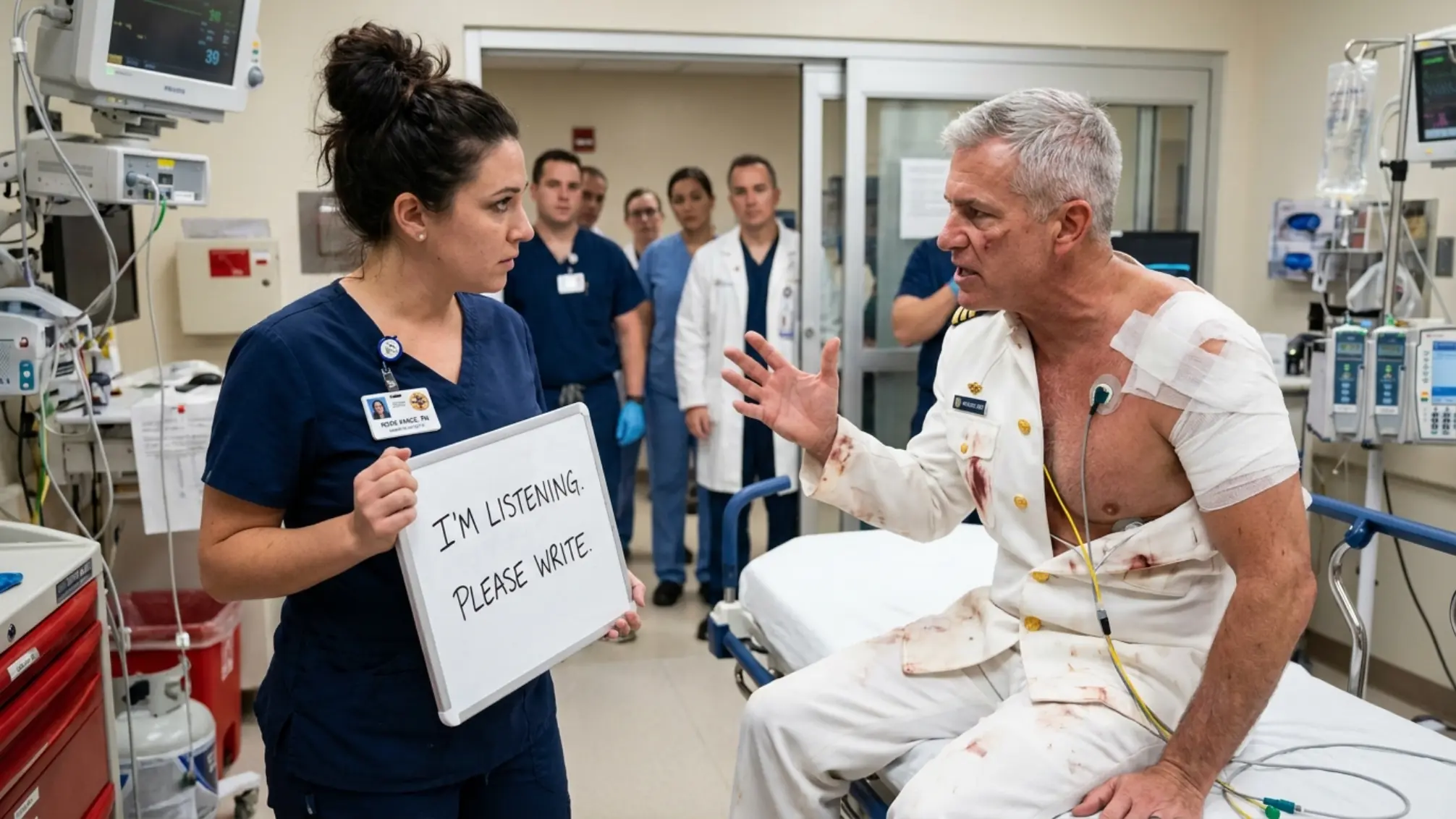
Two corpsmen pushed a gurney into the trauma unit at a run while a physician followed, shouting vital signs. The patient wore a torn white dress uniform stained dark near his left shoulder. Blood had soaked through the bandage and streaked the sheet beneath him.
He was powerfully built despite his age, with weathered fair skin, short silver hair, and sharp blue eyes filled with confusion.
Two stars remained visible on his collar.
Nora recognized the insignia.
Rear Admiral Thomas Bryant.
Nobody had mentioned that.
He tried to sit upright as the gurney crossed the room. A corpsman pressed him back, and Thomas immediately shoved the man’s hand away. Another staff member reached for his injured shoulder, causing him to swing his good arm defensively.
“Sir, stop moving!”
Thomas could not hear him.
“Hold his arm!”
The staff crowded closer.
From Thomas’s perspective, the room was nearly silent. Faces moved rapidly. Mouths opened. Hands reached toward him from every direction. Bright lights passed overhead while pain tore through his shoulder.
He could see panic without understanding its cause.
His breathing accelerated.
He pulled at an intravenous line.
A younger corpsman grabbed his wrist.
Thomas struck the man’s forearm and tried to rise again.
Britt remained near the doorway with her arms folded. Kelly and Dana stood beside her, watching as though the humiliation they planned had finally begun.
Nora moved into the room.
“Everyone step back.”
A physician barely looked at her. “We need to control him.”
“You’re frightening him.”
“He’s interfering with treatment.”
“He cannot hear what you’re telling him.”
The physician reached for Thomas again.
Nora stepped between them.
She did not touch the patient.
She raised both hands slowly, keeping her palms visible. Thomas’s eyes snapped toward her. His body remained tense, ready to fight anyone who approached.
Nora pointed two fingers toward her own eyes.
Then she pointed toward him.
Watch me.
Thomas stopped moving for one second.
That second was enough.
Nora lifted the whiteboard.
YOU ARE SAFE.
She turned it over and wrote again.
HOSPITAL. SHOULDER INJURY. WE ARE HELPING YOU.
Thomas read the message.
His good hand still trembled, but his grip on the intravenous tubing loosened.
Nora pointed to herself, then to her badge.
She wrote:
NORA. YOUR NURSE. I WILL EXPLAIN BEFORE ANYONE TOUCHES YOU.
Thomas looked from the words to her eyes.
Behind Nora, Britt’s smile disappeared.
The patient nodded once.
Nora wrote:
WE NEED TO REMOVE YOUR JACKET AND CHECK THE BLEEDING. MAY WE?
Thomas nodded again.
Only then did Nora gesture for the physician to proceed.
The staff cut through the uniform near his shoulder. Blood flowed from a deep laceration caused by metal debris during a training accident. Initial imaging suggested no major artery had been severed, but the wound required emergency surgery.
Whenever someone approached Thomas, Nora explained first.
THE DOCTOR WILL PRESS HERE.
THIS WILL HURT.
WE ARE GIVING MEDICATION.
STAY WITH ME.
She maintained eye contact while the room moved around them.
The medical team began working instead of fighting.
Within minutes, Thomas’s heart rate fell. His breathing slowed. He stopped resisting treatment.
Britt stood frozen near the wall.
The joke had failed.
Worse, it had exposed a truth none of the senior nurses wanted to admit: they had interpreted fear as aggression because understanding the patient required more effort than restraining him.
The surgeon arrived and requested immediate consent.
Thomas’s hearing loss made the usual rushed explanation impossible, so Nora wrote the essential information in plain language. She paused after every sentence, allowed him to ask questions, and checked his understanding before presenting the consent form.
Thomas wrote beneath her final question:
WILL YOU BE HERE WHEN I WAKE UP?
Nora read it twice.
Then she answered:
YES.
The operation lasted nearly three hours.
Nora’s shift officially ended halfway through it, but she refused to leave. She updated the whiteboard, prepared the recovery area, and reviewed every note associated with Thomas’s hearing loss.
Eleven months earlier, an explosion had damaged both ears, leaving him completely deaf on the right and with minimal hearing on the left. He had not grown up using American Sign Language, and lip-reading became unreliable whenever pain, medication, or exhaustion interfered with concentration.
His deafness was not the only trauma.
Two people had died in the incident that took his hearing.
Thomas had returned to work before fully adjusting to the silence.
When he woke after surgery, confusion struck before memory.
He opened his eyes beneath harsh recovery-room lights. Tubes ran from his arm, his shoulder had been immobilized, and unfamiliar faces moved around him.
His breathing quickened.
Then Nora stepped into view.
She held up the board.
THOMAS, YOU ARE SAFE.
She turned it.
SURGERY IS OVER. IT WENT WELL.
The tension left his face.
He closed his eyes briefly and reached toward the board.
Nora placed it within his good hand.
He wrote slowly:
YOU STAYED.
She answered beneath it:
I SAID I WOULD.
During the next two days, Thomas trusted almost nobody else.
When another nurse entered without explaining what she intended to do, he looked toward Nora. When doctors discussed medication changes behind his bed, Nora turned the information into clear written sentences.
She never infantilized him.
She did not exaggerate her expressions or shout into his damaged ear. She treated him as an intelligent man temporarily trapped inside communication barriers created by the people around him.
Thomas began writing questions unrelated to his treatment.
HOW LONG HAVE YOU WORKED HERE?
SIX WEEKS.
He looked surprised.
YOU SEEM MORE EXPERIENCED.
I WORKED AT A SMALL HOSPITAL FOR FIVE YEARS.
He wrote another question.
WHY DID THEY ASSIGN YOU TO ME?
Nora hesitated.
Across the room, Britt was checking a medication cart.
Nora wrote:
BECAUSE I WAS AVAILABLE.
Thomas studied her expression. He clearly did not believe the answer, but he did not challenge it.
By the third morning, a convoy of black vehicles stopped outside the hospital.
Senior officials entered through the main doors and moved directly toward Thomas’s room. Leading them was Vice Admiral Charles Weston, a three-star officer with a reputation for demanding immediate answers.
Britt intercepted him at the nurses’ station.
“Sir, I’m Charge Nurse Holloway. I supervised Admiral Bryant’s care.”
Weston looked at her. “Who established communication with him during intake?”
Britt hesitated.
“We worked as a team.”
Thomas appeared in the corridor in a wheelchair pushed by a corpsman. His left arm was immobilized, and bruising spread above the edge of his white undershirt.
Weston approached him.
“Tom.”
Thomas could not hear the greeting, but he read his friend’s face. He raised his good hand, then pointed across the nurses’ station.
Directly at Nora.
Every conversation stopped.
Thomas spoke carefully, judging the volume of his own voice through vibration rather than sound.
“Her.”
Weston turned.
Nora stood beside a medication computer, holding a chart against her chest.
Thomas continued.
“Everyone else saw a difficult deaf man fighting treatment. She saw a frightened person who could not understand why strangers were grabbing him.”
Britt’s face went pale.
Thomas looked toward her briefly before returning his attention to Nora.
“She is why nobody got hurt. She is why the doctors could work. She is why I signed the procedure instead of tearing out every line and leaving.”
Weston approached Nora.
“Nurse Vance?”
“Yes, sir.”
“I’m told you calmed him when an entire trauma team could not.”
Nora shook her head. “I used a whiteboard and a laminated communication card.”
Thomas gave a rough laugh.
“Most people in that room saw deafness and decided my ears were the problem,” he said. “She understood the problem was fear.”
Nora looked down.
Thomas continued, “A card can teach a gesture. It cannot teach someone to recognize the human being in front of them.”
Nobody at the station moved.
Weston requested a formal account of the admission. Hospital administrators reviewed the body-camera footage from the transport team and security video inside the trauma bay.
The recording showed staff surrounding Thomas, grabbing him without explanation, and escalating his panic. It also showed Nora ordering them back, raising her hands, and communicating before touching him.
The footage captured Britt watching from the doorway.
It also captured Kelly whispering to Dana:
“Let’s see how long the compassionate one lasts.”
An internal review began that afternoon.
Britt cornered Nora in the supply room before the end of the shift.
“You reported us.”
“No.”
“You told Bryant we set you up.”
“I told him I was available.”
“Then why are administrators asking questions?”
“Because cameras recorded what happened.”
Britt closed the door behind her.
“You think you’re special now because an important patient likes you?”
Nora’s expression changed.
“This is not about whether he likes me.”
“You embarrassed the entire unit.”
“You assigned me to a patient you expected me to fail.”
Britt stepped closer. “You don’t understand how things work here.”
“I understand exactly how they work. You use frightened patients and inexperienced employees as entertainment.”
“You’re still a rookie.”
“And you’re still responsible for what you did.”
For the first time, Britt had no answer.
The investigation confirmed that she had manipulated the assignment after hearing rumors about Thomas’s condition. She wanted Nora to struggle publicly so the staff could laugh about it later.
Kelly and Dana admitted they knew about the plan.
Britt was removed from charge duties pending disciplinary review. Kelly and Dana received formal reprimands and mandatory training. Administrators also changed intake procedures for deaf and hard-of-hearing patients, requiring communication boards, visual consent materials, and immediate interpreter assessment.
Nora never asked for anyone to be fired.
She asked for the system to change.
Before Thomas left the hospital, he requested a private meeting with her.
He was dressed in civilian clothing, his injured arm still supported by a sling. A small tablet rested on his lap, allowing them to type longer messages.
He wrote:
THEY TOLD ME WHAT HAPPENED.
Nora read the words without responding.
He continued:
YOUR ASSIGNMENT WAS A JOKE TO THEM.
She typed:
I KNOW.
ARE YOU ANGRY?
Nora considered her answer.
YES. BUT I AM MORE ANGRY THAT THEY USED YOUR FEAR TO HUMILIATE ME. YOU WERE A PATIENT, NOT A TEST.
Thomas read the sentence several times.
Then he typed:
THAT IS WHY YOU ARE DIFFERENT.
He personally recommended Nora for a commendation in patient communication and crisis de-escalation. The recognition was usually awarded to employees with long records of service, but Thomas insisted that experience should not matter more than impact.
Nora almost declined.
“I only did my job,” she told the hospital director.
The director answered, “Then your work showed us how poorly we had defined the job.”
Months later, Nora attended a ceremony where Thomas described the incident publicly without naming the staff members involved.
He spoke about waking inside a world without sound, surrounded by people whose urgent faces made him believe danger was approaching. He described the moment a young nurse raised her hands instead of grabbing him.
“She did not demand trust,” Thomas said. “She created the conditions in which trust became possible.”
Nora stood near the rear of the room, uncomfortable with the attention.
Afterward, a newly hired nurse approached her.
“Is it true they set you up?”
“Yes.”
“How did you stay calm?”
“I wasn’t calm.”
The young woman looked confused.
Nora smiled gently.
“Being brave does not mean you feel nothing. It means the patient does not have to carry your fear along with their own.”
The sentence spread through the department.
Over time, Nora became the person new employees were told to observe—not because she was the fastest nurse or the loudest voice, but because she could enter a chaotic room and identify the emotion everyone else had mistaken for misbehavior.
Britt eventually returned in a lower-level position after completing disciplinary requirements. She no longer controlled assignments, and most coworkers kept their distance.
One evening, she approached Nora at the nurses’ station.
“I owe you an apology.”
Nora waited.
“I thought kindness made you weak,” Britt said. “I wanted to prove you couldn’t survive here.”
“You nearly harmed a patient to prove it.”
“I know.”
“Do you?”
Britt lowered her eyes. “I do now.”
Nora did not offer immediate forgiveness. Some apologies deserved acknowledgment without pretending trust had already been restored.
“Then show it in how you treat the next person,” she said.
Britt nodded and walked away.
Thomas returned to work and required every medical team under his supervision to study visual communication and de-escalation. He kept a small whiteboard inside every emergency kit.
On the back of each board, he had one sentence printed in permanent letters:
SEE THE PERSON BEFORE YOU SEE THE PROBLEM.
Nora kept the original whiteboard from his admission inside her locker.
The ink had been erased long ago, but faint impressions remained beneath the surface—words written during the moment a frightened man decided one stranger could be trusted.
Her coworkers had handed her Thomas because they wanted to watch a beautiful rookie nurse fail.
They expected panic, confusion, and humiliation.
Instead, the patient they treated like a joke became the witness who revealed exactly who they were.
And the quiet nurse they dismissed became the standard everyone else was required to meet.