“Celeste, put that down!”
My voice struck the kitchen harder than the carry-on bag I had dropped in the hallway. Celeste turned toward me with a feather duster raised by its heavy wooden handle, while my seventy-nine-year-old mother lay trembling beside her overturned wheelchair. For one frozen second, none of us moved.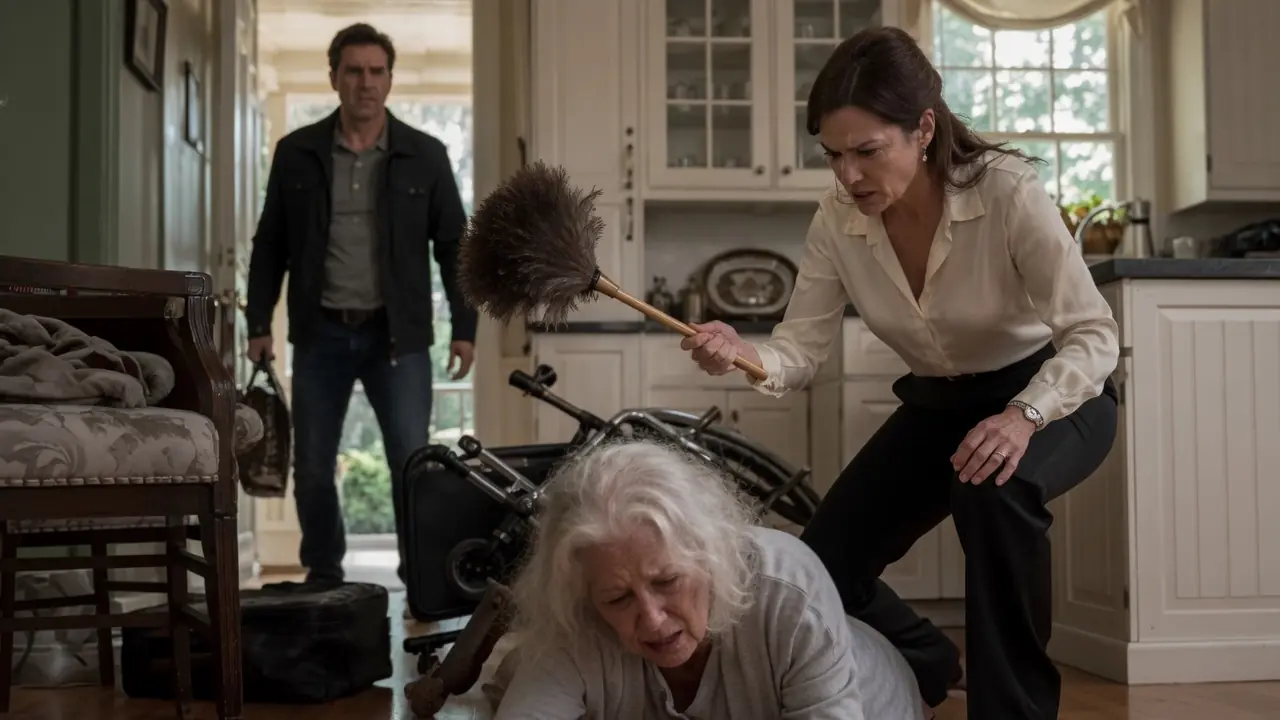
“Daniel, she fell,” Celeste said, lowering the handle slightly. “I was only trying to control her.”
I stepped between them. “Then why is my mother crawling away from you like she’s terrified?”
Celeste’s shock hardened into anger. Her fingers tightened around the handle as she stared at me. “You’ve been gone nine months—ask her what she did before you decide who the monster is.”
My mother reached toward me from the polished floor.
“Daniel,” she whispered. “Don’t let her take the papers.”
I did not understand what she meant, but I understood the fear in her eyes. I crouched beside her, checked her head and shoulders, then carefully lifted her into my arms. She felt frighteningly light, as though nine months had taken years from her body.
Celeste remained near the kitchen island.
“What papers?” I asked.
“She’s confused,” Celeste replied immediately. “She’s been getting worse for months. She hides things, accuses me of stealing, refuses her medication, and deliberately throws herself out of that chair.”
My mother shook her head.
“No,” she whispered.
I carried her into the living room and placed her carefully on the sofa. Her left wrist was bruised, and red marks circled one forearm. When I asked how they appeared, she looked toward the kitchen doorway before answering.
“I fall,” she said.
The words sounded rehearsed.
Celeste followed us, folding her arms across her cream blouse. “See? She admits it.”
My mother lowered her eyes.
I had spent nine months in Western Australia supervising the construction of housing near a remote mining operation. The contract paid enough to clear the remaining debt on our property and build savings for the future, but taking it had meant leaving Celeste responsible for my mother.
At the time, it had seemed safe.
My mother, Margaret Whitmore, had moved into our Georgian-style house after a stroke weakened her right leg. She could still think clearly, manage her finances, and handle most personal tasks, but she needed help with stairs, meals, and transportation.
Celeste had insisted she could manage everything.
“We don’t need strangers in our home,” she had said when I suggested hiring a caregiver. “Margaret is family. I’ll take care of her.”
I had believed my wife.
During the first weeks abroad, Celeste sent photographs of my mother eating breakfast, sitting in the garden, and smiling beside the fireplace. Whenever I called, Celeste remained close enough to answer questions before my mother could.
Margaret is tired.
Margaret is resting.
Margaret is confused today.
After several months, my mother stopped appearing on video entirely.
Celeste said she had become embarrassed about her appearance. She blamed the silence on depression, medication, and the frustration of losing independence. I accepted those explanations because the alternative would have meant admitting I had left the most vulnerable person in my life with someone capable of hurting her.
Now I sat beside my mother and saw how much weight she had lost.
“Did you eat today?” I asked.
She hesitated. “Some toast.”
“Where’s the home health nurse?”
Celeste exhaled loudly. “Your mother fired her.”
“I didn’t,” Margaret said.
“She accused the nurse of spying and threw a glass at her.”
“I never threw anything.”
Celeste looked at me with exhausted patience. “This is what I’ve been living with. Every day, another accusation.”
I studied my wife’s face.
We had been married for eleven years. Celeste had always been composed, elegant, and careful about appearances. She managed charity committees, hosted formal dinners, and remembered the names of people she met only once.
She could also become cold when challenged.
Until that day, I had mistaken that coldness for confidence.
“I’m taking Mom to the hospital,” I said.
Celeste stepped forward. “That isn’t necessary.”
“She was on the floor.”
“She slipped.”
“She has bruises.”
“Because she fights me whenever I try to help.”
Margaret gripped my sleeve.
“Please,” she whispered. “Take me with you.”
That plea ended the discussion.
I called an ambulance.
While we waited, Celeste disappeared upstairs. I heard drawers opening and closing, followed by hurried footsteps. When she returned, she carried a folder against her side.
“What’s in there?” I asked.
“Medical documents.”
“Give them to me.”
“They’re private.”
“They concern my mother.”
“They also contain information about her mental condition that you may not be ready to accept.”
My mother began shaking again.
“Those are the papers,” she said.
Celeste turned on her. “Be quiet.”
The force in her voice silenced the room.
I stood slowly. “Do not speak to my mother like that.”
“She has spent months trying to destroy our marriage.”
“You told me she was confused.”
“She is.”
“Then how could she plan to destroy anything?”
Celeste’s mouth tightened.
The ambulance arrived before she answered.
At the hospital, a physician examined my mother while a social worker asked questions in private. Margaret initially claimed the bruises came from falls, but when I promised she would not return home with Celeste, her resistance collapsed.
She began crying.
“The first time was after I refused to sign,” she said.
“Sign what?”
“Papers giving her control over my accounts.”
My mother had inherited several rental properties from my father. She also owned a significant investment portfolio and held the deed to the house where Celeste and I lived. My parents had allowed us to occupy the property after our wedding, but Margaret had never transferred ownership.
I had never cared.
To me, it was simply our family home.
To Celeste, it was apparently something else.
“She said I was becoming incompetent,” Margaret continued. “She said if I signed willingly, everything would remain in the family. When I refused, she began telling people I had dementia.”
The physician documented dehydration, poor nutrition, bruising, and a healing fracture in one rib. None of the injuries alone proved deliberate harm, but together they told a disturbing story.
The social worker contacted adult protective services.
I called Celeste.
She answered on the first ring. “Is she telling lies?”
“She says you tried to make her sign financial documents.”
“She needs supervision. Someone had to protect the estate.”
“From whom?”
“From herself.”
“Why didn’t you discuss it with me?”
“You were twelve time zones away, Daniel. I handled what you abandoned.”
The accusation struck hard because part of it was true.
I had left.
I had accepted a contract that kept me far from home for nine months. I had trusted photographs and short phone calls instead of insisting on speaking privately with my mother.
But guilt did not make Celeste innocent.
“Where are you?” I asked.
“At the house.”
“Put the folder on my desk and leave.”
Celeste laughed softly. “You’re choosing a confused old woman over your wife.”
“I’m choosing the person I found on the floor beneath someone holding a wooden handle.”
“It wasn’t what it looked like.”
“Then the investigation will prove that.”
Her voice became quiet. “You’ll regret humiliating me like this.”
The call ended.
Margaret was admitted overnight. I stayed beside her until she fell asleep, then returned to the house with two police officers so I could collect clothing and secure her medication.
Celeste was gone.
The folder was gone too.
Several drawers in my study stood open. Documents had been removed from the filing cabinet, and the small safe behind the bookshelf was empty.
Inside that safe had been copies of the property deed, my mother’s trust documents, and financial records belonging to my late father.
I called the police officer back into the room.
“My wife took legal documents.”
“Do you know where she went?”
“No.”
“Does she have access to the accounts?”
“She shouldn’t.”
The word should suddenly sounded dangerously weak.
I contacted our bank and asked them to freeze all unusual transfers until ownership could be verified. Then I called my mother’s attorney, Harold Greene, who had represented my parents for nearly thirty years.
He sounded alarmed the moment I mentioned Celeste.
“I have been trying to reach your mother for six weeks,” he said. “Mrs. Whitmore missed two scheduled meetings, which she has never done.”
“Did Celeste contact you?”
“She claimed your mother was no longer competent and requested documents for a guardianship petition.”
My stomach tightened. “Did you give her anything?”
“No. She had no legal authority.”
“Was there a planned change to the trust?”
Harold hesitated.
“Your mother wanted to discuss removing Celeste as a potential beneficiary.”
I sat down.
“Why?”
“She suspected money had been taken from one of the property accounts.”
“How much?”
“Approximately eighty-seven thousand dollars.”
The room seemed to tilt.
Harold explained that rental income from three properties had been redirected into an account controlled by a newly formed management company. The company belonged to Celeste.
My wife had created it four months after I left the country.
“She told me the money paid for repairs,” Harold said. “Your mother disputed that claim and asked for receipts. Shortly afterward, communication stopped.”
I stared toward the kitchen.
The feather duster lay where Celeste had dropped it.
My mother had not merely been an inconvenience. She had discovered the theft.
That was what Celeste meant when she told me to ask what Margaret had done.
She had resisted.
The next morning, I returned to the hospital and told my mother what Harold had discovered. She closed her eyes as though hearing the number made the betrayal heavier.
“I tried to tell you,” she said.
“When?”
“Every time you called.”
I remembered Celeste answering the phone first, remaining in the room, and ending conversations whenever my mother became emotional.
“I should have noticed.”
“You believed your wife.”
“I ignored the signs.”
Margaret took my hand. “Then notice them now.”
After she was discharged, I moved her temporarily into a private rehabilitation center where she could receive physical therapy and round-the-clock care. She resisted at first, fearing I was placing her in an institution so Celeste could return home.
I promised that would never happen.
The investigation expanded quickly.
Bank records showed Celeste had transferred rental income into her management company, then spent the money on designer clothing, hotel stays, private dining, and payments to a man named Adrian Cole.
I knew Adrian.
He had been Celeste’s partner on several charity committees and a frequent guest at our home before I left Australia. She had described him as a harmless family friend.
The hotel charges suggested otherwise.
Yet infidelity became the smallest part of what she had done.
Adult protective services interviewed the dismissed home health nurse, Nina Alvarez. Nina had not quit voluntarily. Celeste fired her after Nina discovered Margaret without food one afternoon and threatened to contact authorities.
“I knew something was wrong,” Nina told me. “Your mother whispered that Mrs. Whitmore took her phone and locked her bedroom at night.”
“Why didn’t you report it?”
“I did.”
She showed me copies of two online reports filed with the county.
Both had been closed after a welfare check.
Celeste had answered the door, presented herself as Margaret’s devoted caregiver, and claimed the elderly woman was asleep after medication. An officer saw no immediate evidence of danger and left.
Nina then revealed something else.
Before being dismissed, she had placed a small motion-activated camera inside a decorative clock on the kitchen shelf. She intended to capture evidence of neglect and retrieve it during her next visit.
Celeste fired her before she could return.
The clock was still in the kitchen.
I drove home immediately.
Behind the clock face, I found a tiny memory card.
The footage covered eleven days.
Watching it became the most painful experience of my life.
Celeste withheld meals whenever Margaret refused to sign documents. She moved the wheelchair out of reach and left my mother trapped in a kitchen chair for hours. She mocked her, called her useless, and repeatedly told her that I had chosen work because I no longer wanted responsibility for an old woman.
One recording showed Margaret asking to speak with me privately.
Celeste leaned close to her.
“Daniel believes me,” she said. “He always will.”
Another showed Celeste placing guardianship documents on the kitchen table.
“You will sign these,” she told Margaret. “Then the properties, accounts, and this house can be managed properly.”
“They belong to my family,” Margaret replied.
“I am your family.”
“You are stealing from it.”
Celeste swept the papers onto the floor.
On the final recording, captured only minutes before I arrived home, my mother had attempted to reach the kitchen phone. She pulled herself from the wheelchair when Celeste moved it away.
Margaret fell.
Celeste stood over her holding the feather duster.
“You should have signed when I asked,” she said.
Then my voice thundered from the hallway.
“Celeste, put that down!”
The evidence removed every remaining doubt.
I gave the memory card to investigators.
Celeste was arrested two days later at a hotel near the airport while attempting to leave for London with Adrian. Police recovered my mother’s financial documents, forged medical statements, and a nearly completed petition requesting emergency guardianship.
The petition claimed Margaret had become violent, delusional, and incapable of managing her assets.
Celeste intended to have herself appointed guardian.
Once granted control, she could have sold the properties and transferred ownership of the house.
Her attorney initially described the incident as a misunderstanding inside a stressed household. Then the camera footage emerged.
The defense changed immediately.
Celeste called me from jail.
I almost refused the call, but I needed to hear what she would say when excuses could no longer survive.
“You gave them the videos,” she said.
“Yes.”
“I took care of her for nine months while you played hero in Australia.”
“You harmed her.”
“She made my life unbearable.”
“She was dependent on you.”
“She controlled everything. The house, the money, our future. She could have taken it away whenever she wanted.”
“It was hers.”
“It should have been ours.”
There it was.
Not desperation.
Entitlement.
Celeste believed marrying me gave her a claim over everything my mother owned. Margaret’s refusal to surrender her property became, in Celeste’s mind, an attack.
“What would have happened if I came home one minute later?” I asked.
Celeste remained silent.
That silence ended our marriage.
I filed for divorce the following morning.
The legal process lasted ten months.
Celeste pleaded guilty to financial exploitation, theft, unlawful imprisonment, and assault of a vulnerable adult. The court ordered restitution, barred her from contacting Margaret, and sentenced her to several years in prison.
Adrian avoided criminal charges related to the abuse but returned part of the stolen money after investigators proved he had received funds from Celeste’s fraudulent company. He vanished from our lives the moment remaining beside her became inconvenient.
My mother recovered slowly.
Physical therapy strengthened her enough to move around the rehabilitation center with a walker. Her bruises faded, but emotional wounds remained.
She apologized whenever she needed help.
That frightened me more than anything.
Celeste had taught her that dependence was shameful and that every request carried the risk of punishment.
I began visiting every morning before work and every evening afterward. Some days Margaret welcomed me warmly. Other days she barely looked at me.
I did not demand forgiveness.
One afternoon, she finally asked the question I had been dreading.
“Why didn’t you believe something was wrong?”
I sat beside her near the garden window.
“Because believing Celeste was easier than admitting I had failed to protect you.”
My mother looked at the flowers outside.
“I raised you to trust people.”
“You also raised me to notice when someone is frightened.”
“You were far away.”
“I still should have listened.”
She turned toward me. “You came home.”
“Almost too late.”
“But not too late.”
It was not forgiveness, but it was the beginning of a path toward it.
I resigned from the mining project and accepted a lower-paying position in Boston. The decision cost me financially, but money had already taken enough from our family.
Margaret returned home six months later.
Not to the Georgian house.
She never wanted to enter that kitchen again, so we sold the property after the divorce was complete. The money belonged entirely to her, and for the first time in my adult life, I encouraged her to use it for herself.
She purchased a bright single-story home near the coast with wide doorways, accessible bathrooms, and a small garden outside her bedroom. Nina returned as her caregiver three afternoons each week.
I moved into a modest apartment ten minutes away.
My mother initially offered to buy me a house.
I refused.
“Your money is yours,” I told her.
She smiled faintly. “You finally learned.”
The stolen funds were mostly recovered and placed back into her accounts. Harold restructured the trust so no future spouse, relative, or caregiver could gain control without independent legal review.
Margaret donated part of the recovered money to organizations supporting victims of elder abuse.
She also paid for Nina to complete nursing school.
“You tried to protect me when my own family didn’t see what was happening,” my mother told her.
Nina cried.
So did I.
A year after the day I returned from Australia, Margaret and I ate dinner together in her new kitchen. Sunlight entered through wide windows, and the feather duster hanging near the pantry had a soft plastic handle.
My mother noticed me looking at it.
“Daniel,” she said, “it is only a cleaning tool.”
“I know.”
“No one is going to raise it at me again.”
“No.”
She reached across the table and covered my hand with hers.
“You cannot spend the rest of your life standing in that doorway.”
I looked at her.
“You arrived,” she continued. “You stopped it. Then you stayed.”
“I should have protected you sooner.”
“Yes.”
Her honesty surprised me.
“But regret is not protection,” she added. “What you do next is.”
That sentence changed the way I lived.
I stopped imagining that loving someone automatically meant I understood what they were experiencing. I learned to ask questions without accepting the easiest answer. I learned that abuse often survives behind polished doors because the person causing harm appears composed while the victim appears confused.
Most importantly, I learned that silence from someone vulnerable is not always peace.
Sometimes it is fear waiting for a safe witness.
My mother never fully returned to the woman she had been before those nine months. She became more cautious, less trusting, and easily startled by raised voices.
But she also became stronger in new ways.
She spoke publicly about what happened. She helped establish a county program that trained bank employees, caregivers, and first responders to recognize financial exploitation and coercive control.
During one presentation, someone asked how her son had rescued her.
Margaret looked toward me in the audience.
“He did not rescue me alone,” she answered. “A nurse believed me. An attorney asked questions. Investigators followed evidence. My son finally listened.”
Then she smiled.
“But he did come through the door at exactly the moment I needed him.”
I will always remember that doorway.
The dropped suitcase.
The overturned wheelchair.
The wooden handle raised above my mother.
For months, I tortured myself by imagining what might have happened if my flight had been delayed or if I had stopped for coffee before coming home.
Eventually, Margaret asked me to stop living inside possibilities.
“You came home,” she reminded me. “That is the part that happened.”
She was right.
I could not change the nine months I had missed.
I could only make sure she never spent another day questioning whether her voice mattered.
And every time I visited her bright little home near the coast, she greeted me from the doorway with the same words.
“You’re right on time, Daniel.”
I knew she was not talking about the clock.