Adapted from the story you provided.
“Why are you still here? The truck’s going to blow—leave me!” Cole Walker screamed through smoke so thick that his face seemed to disappear every few seconds. Twenty-two-year-old Emma Brooks could not hear a single word, but she could read his lips well enough to understand the fear in them as she braced both sneakers against the scorched highway and pulled on his hands with everything she had. Tears streamed across her soot-streaked face as flames crawled higher behind the overturned tanker. “I can’t hear you,” she gasped, “but I can see you telling me goodbye—and I won’t.”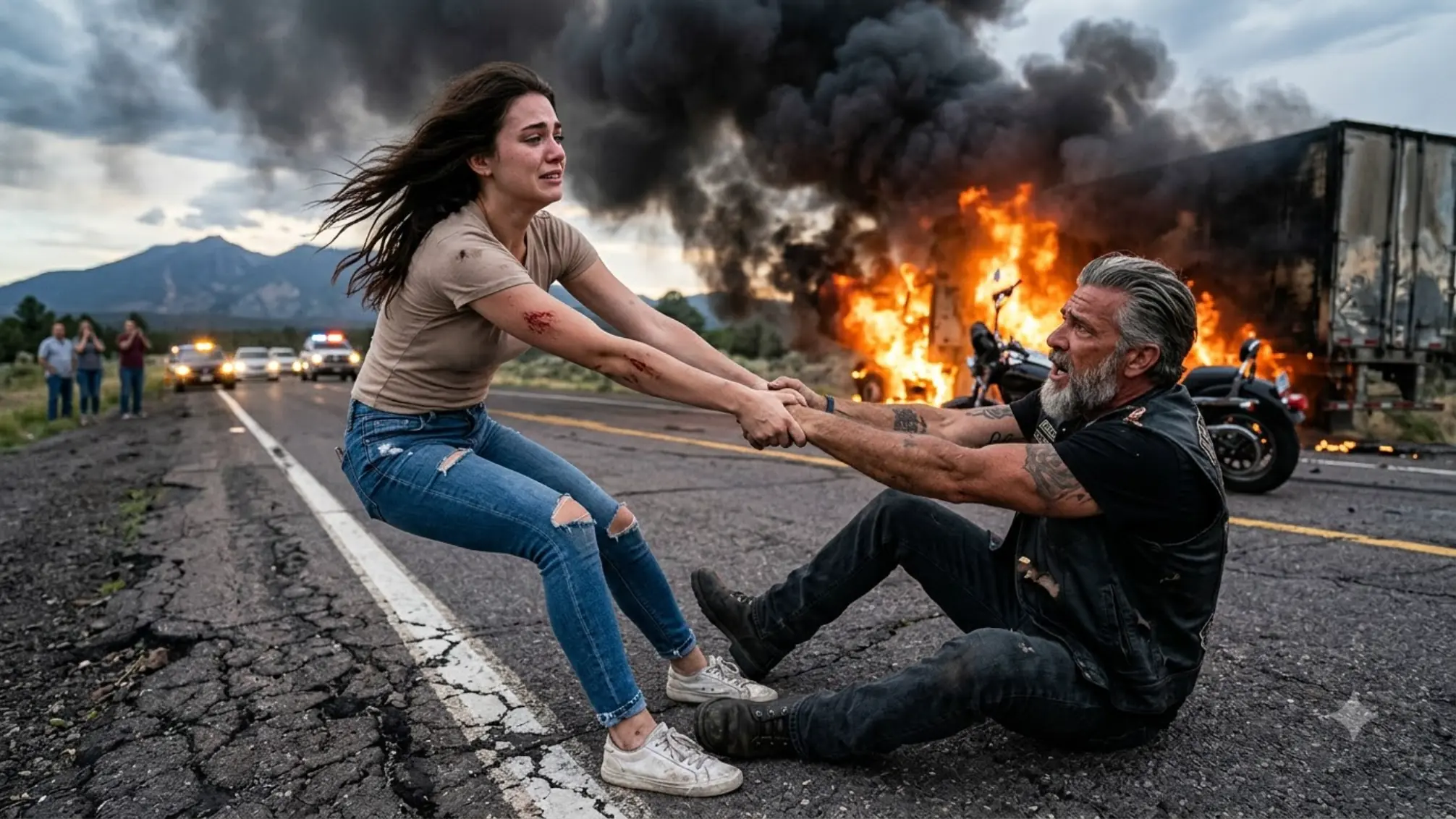
Cole was forty-eight, broad-shouldered and heavily tattooed, with a gray beard, a torn black leather riding vest, and one leg pinned beneath a twisted section of wreckage. He reached toward Emma’s face with his free hand, desperately forming the words slowly enough for her to read them. “Emma, if you stay, we could both die.” Her arms trembled violently, but she tightened her grip and answered, “Then hold my hand tighter, Cole—because I’m not leaving this fire without you.”
Only twenty minutes earlier, Emma had been driving north from Phoenix feeling as if her own future had quietly collapsed. A manila folder sat on the passenger seat containing an estimate of $178,000 for neurological surgery she could not afford, the only procedure doctors believed could stop a degenerative condition from eventually taking away her balance and independence. Emma had been deaf since childhood, and she had spent her entire life adapting to a world designed around information she could not hear. She had learned to read lips, feel vibrations through floors and steering wheels, and notice movements that hearing people often ignored.
That afternoon she had left another failed funding appointment with shaking hands and less hope than she wanted to admit. The state program she had traveled hours to apply for had been delayed indefinitely, while several private grants had already rejected her because her freelance income sat just above one arbitrary threshold. Emma had allowed herself exactly five minutes to cry inside her parked car before starting the engine again. She had no plan except to return to Sedona, keep working, and somehow figure out what came next.
Then she saw the smoke. It rose beyond a bend on Route 89 in a column too black and too violent to be anything ordinary, and Emma’s foot came off the accelerator before she consciously understood why. When she rounded the curve, she saw an overturned fuel truck stretched across the road, fire spreading from its rear, pieces of a destroyed motorcycle scattered across the asphalt. Several motorists stood far back with phones in their hands, staring helplessly toward the wreckage.
Emma stopped on the shoulder and climbed out. A man in a flannel shirt grabbed her arm and shouted something she could barely read because his mouth was moving too quickly. She pulled free, pointed toward a motionless figure near the truck, and asked, “Is somebody alive?” The man pointed toward Cole.
The heat became almost unbearable long before Emma reached him. She felt the violence of the fire differently from everyone else—not through sound, but through pressure vibrating beneath her shoes and through the air pushing against her skin. Cole was face down when she reached him, one arm twisted painfully beneath his chest, but Emma saw his ribs moving. That single movement decided everything.
She grabbed his shoulders and pulled. Nothing happened. Looking lower, she realized a chunk of metal had trapped his leg against the road, and no amount of desperate strength would move two hundred pounds of injured man until that pressure was lifted. Emma searched frantically and spotted a four-foot metal bar lying among the wreckage.
She shoved the bar under the twisted section and used it as a lever. The metal lifted only a few inches, but those inches were enough. Emma dropped the bar, wrapped both hands around Cole’s arms, and dragged backward. Her knees scraped the road while heat burned through the sleeves of her shirt, but slowly his trapped leg came free.
Cole opened his eyes. He saw a young woman pulling him toward safety, her beautiful face twisted with fear and determination while blood ran from one scraped elbow. He tried to tell her to stop, but she only stared at his lips and kept moving. By the time Emma dragged him thirty feet away, her legs were beginning to fail.
The tanker exploded behind them. Emma could not hear the blast, but she felt a violent wall of pressure strike her back and throw her sideways onto the asphalt. For several seconds the entire world became brightness, heat, and vibration. When she forced her eyes open, Cole was still breathing.
“Who?” he mouthed weakly. Emma crawled closer. “Emma,” she answered. “My name is Emma.”
His eyes remained on her as though he were trying to memorize her face. Then Emma’s strength disappeared, and she collapsed beside him. The last thing she saw before darkness came was Cole reaching his uninjured hand toward hers. His fingers closed weakly around hers just before everything faded.
Emma woke inside an ambulance. A young paramedic leaned over her, speaking carefully enough for Emma to read her lips, and explained that she had burns on both arms, a concussion, and a badly bruised knee. Emma immediately grabbed the woman’s wrist and asked about the biker. “Is he alive?”
The paramedic nodded. “He’s alive.” Emma closed her eyes. That was enough.
At Flagstaff Medical Center, doctors treated second-degree burns along Emma’s forearms and kept her overnight for observation. She asked repeatedly about Cole, but nobody could tell her much beyond the fact that he had gone into emergency surgery with broken ribs, a fractured clavicle, burns, and internal injuries. Shortly before midnight, an older nurse entered Emma’s room carrying a notepad. She wrote one sentence and placed it on Emma’s bedside table.
The man you rescued is alive because you got him out when you did.
Emma read it three times. She folded the paper carefully and placed it beside her phone. For the first time since leaving Phoenix that afternoon, something inside her felt useful rather than defeated.
At almost three in the morning, Emma noticed several large men standing outside her hospital room. They wore black leather riding vests and positioned themselves at opposite ends of the hallway with the deliberate stillness of people keeping watch. Emma could not hear what they said to one another, but she understood their body language immediately. They were not there to threaten her.
They were guarding her.
Three days after Emma returned home, a man named Ryan Mercer knocked on her apartment door. He was tall, muscular, and gray at the temples, but before Emma could decide whether to be nervous, he raised both hands and showed her a handwritten note. My name is Ryan. Cole Walker sent me. You saved his life. May we talk?
Emma let him inside. Ryan sat directly across from her at the kitchen table so she could read his lips and explained that Cole was recovering, though the doctors predicted months of rehabilitation. “He remembers you,” Ryan said. “Actually, he won’t stop asking about you.”
Emma lowered her eyes. “He doesn’t owe me anything.”
Ryan looked at her for several seconds. “That isn’t how he sees it.”
He placed a handwritten phone number on the table. “If you ever need something, call this.” Emma did not touch the card. Ryan continued, “Day or night.”
Emma shook her head. “I didn’t pull him out because I expected repayment.” Ryan nodded. “That’s exactly why this number matters.”
Before he left, Emma asked about something she had remembered from the accident. She described a dark blue sedan moving quickly away from the scene moments before the fire became uncontrollable. Ryan’s expression changed immediately, and for several seconds he forgot to keep his mouth clearly visible. Emma pointed at him. “You know something.”
Ryan hesitated. Then he admitted the accident might not have been accidental at all.
Cole had been cooperating quietly with federal investigators investigating a regional criminal logistics network. The tanker collision appeared to have been engineered to kill him and destroy evidence he was carrying. A local detective named Raymond Carver had declared the wreck accidental unusually quickly. Ryan believed Carver was protecting the people responsible.
Emma’s stomach tightened. Detective Carver had already interviewed her at the hospital. He had repeatedly asked whether she remembered other vehicles at the scene, especially anything leaving before emergency services arrived. Emma had honestly told him her memory was incomplete because of the concussion. Now she understood why the question had mattered.
That night, Carver appeared at Emma’s apartment without warning. He smiled politely and said he only needed to clarify a few details, but Emma noticed how often his eyes moved toward her phone and the papers on her kitchen table. When he asked again whether she had seen another vehicle, Emma looked directly into his face. “I told you everything I clearly remember.”
Carver stared at her for a moment longer than politeness required. “Sometimes memories return later.” Emma nodded. “If mine does, I’ll tell the right person.”
The smile disappeared from his eyes. He left without another question.
Emma immediately picked up Ryan’s number. This time she called.
Within forty-eight hours, federal agent Sofia Torres sat across from Emma at a secure location outside Flagstaff. Torres began by asking what communication method worked best rather than assuming, and that simple courtesy earned Emma’s trust almost immediately. Emma spent three hours rebuilding her memory of the accident in precise sequence. She divided everything into two categories: details she knew and details she only thought she remembered.
She was certain the sedan had been dark blue. She was certain it had been traveling east. She was certain its speed made no sense for someone who had just witnessed a catastrophic collision. She believed she had seen two letters on the license plate—A and K—but she refused to say she knew the order.
Torres never pressured her. Instead, the agent compared Emma’s account with traffic-camera footage recovered four miles east of the crash site. A navy four-door sedan appeared within the correct time window. Its license plate contained both letters.
The vehicle belonged to a company connected to Vincent Price, the man investigators believed had ordered the attack on Cole. That registration gave Torres legal leverage she had been missing for months. Within days, investigators connected Carver to Price through bank transfers and encrypted communications. Faced with federal charges, Carver began cooperating.
Vincent Price was arrested before sunrise three days later. Several associates followed. The planned murder disguised as an accident had failed because one witness had noticed four seconds of movement everybody else had forgotten.
When the immediate danger finally passed, Cole asked to see Emma. He was recovering at a private property outside Williams, Arizona, after doctors reluctantly allowed him to leave the hospital under strict conditions he largely ignored. Ryan drove Emma there. She had no idea what she was supposed to say to a man whose life had become tangled with hers through fire, conspiracy, and four seconds of visual memory.
Cole sat upright in a converted bedroom with one arm bandaged and his shoulder immobilized. He looked stronger than the man she had dragged from burning wreckage, but nowhere near healthy. When Emma entered, he stared at her for several seconds. Then he carefully said, “I’ve been trying to figure out what to say to you.”
Emma sat beside the bed. “You could start with listening to your doctors.”
Cole’s mouth almost formed a smile. “Ryan warned me you were difficult.”
“He says that because I don’t automatically agree with him.”
Cole studied her. “You ran into a burning fuel truck.”
“You were inside.”
“You didn’t know me.”
“You were still inside.”
That answer silenced him.
Cole looked toward the bandages along Emma’s forearms. “Those happened because of me.” Emma shook her head. “They happened because there was a fire.”
“You could have died.”
“So could you.”
Cole leaned back slowly, pain tightening his face. “That’s what I can’t get past.”
Emma held his gaze. “You don’t have to get past it. You just have to survive it.”
For the first time, Cole smiled completely.
Then his expression became serious again. He told Emma that Ryan had learned about her neurological condition after trying to understand who she was and whether she needed protection beyond the criminal case. Emma’s face hardened immediately. “He had no right.”
“No,” Cole said. “He didn’t.”
“Then why are we discussing it?”
“Because knowing you saved my life while you were driving home from being told you might lose your independence is something I can’t unknow.”
Emma stood. “I don’t want charity.”
Cole did not flinch. “Neither do I.”
She stared at him.
“You saved a life that matters to hundreds of people,” he said. “You gave those people something back. If those same people decide your future matters to them, that isn’t pity.”
Emma folded her arms. “What are you suggesting?”
“A benefit ride.”
She almost laughed because she believed he was joking.
He was not.
Cole and several affiliated motorcycle organizations wanted to organize a multi-state fundraising ride through legitimate charitable foundations. They planned to raise enough for Emma’s surgery, and anything beyond that would create a permanent fund for deaf children who needed neurological or early-intervention treatment their families could not afford. Cole had already discussed the framework but promised nothing would move forward without Emma’s consent.
Emma stared at him for a long time. “You planned this before asking me.”
“We started planning.”
“That isn’t better.”
“I know.”
She looked toward the window. For three months she had lived between rejection letters, medical estimates, and the quiet terror of eventually losing the ability to drive or walk independently. Accepting help felt dangerously close to admitting she had failed. Yet refusing simply because she hated needing anyone suddenly seemed like another kind of pride.
“If there’s extra money,” Emma said, “it goes to deaf children first.”
Cole nodded.
“I want to know where every dollar goes.”
“Done.”
“I don’t want my face turned into some sad charity poster.”
“Never.”
Emma returned her eyes to him. “And I stand beside you when you announce the fund.”
Cole smiled faintly. “That was going to be my next request.”
“Then stop getting ahead of me.”
“Hard habit to break.”
Six weeks later, 359 motorcycles gathered outside Flagstaff. Riders came from Arizona, Nevada, Colorado, New Mexico, and California, joined by veterans’ groups, local businesses, deaf advocacy organizations, and families who had never met Emma but knew the story. The ground vibrated beneath her shoes long before the ride began.
For Emma, it was extraordinary. She could not hear hundreds of engines roaring together, but she could feel them through the asphalt. The vibrations rose through her legs and into her chest in deep waves.
Ryan stood beside her. “Pretty loud.”
Emma smiled. “You have no idea.”
He laughed before realizing what she meant. Then she laughed too.
Cole approached wearing his black vest again, though he still moved carefully because his ribs had not completely healed. He looked at Emma’s arms; the burns had faded into pink scars. She looked at his shoulder. “Still hurts?”
“Only when I breathe.”
“That seems inconvenient.”
“Very.”
They stood together as motorcycles continued arriving. Several riders recognized Emma and nodded instead of approaching, respecting the distance she had requested. Others signed simple greetings they had clearly learned specifically for the day.
That mattered more to Emma than they understood.
After the five-hour ride, everyone returned to the Flagstaff fairground. A simple stage had been constructed near the center, and representatives from the medical center and Arizona Deaf Children’s Foundation waited nearby. Cole walked onto the platform and faced the crowd.
Emma stood below.
“Six weeks ago,” Cole began, “a young woman saw a burning truck.”
Emma watched his lips.
“Everybody else stopped at a safe distance.”
He looked toward her.
“She went in.”
The crowd became completely still.
“She didn’t know my name. She didn’t know what club I belonged to. She didn’t know there was a criminal investigation behind the crash. She knew one thing—somebody was trapped.”
Cole extended his hand toward Emma.
She walked onto the platform.
“She saved my life,” Cole continued. “Then she remembered four seconds everybody else missed, and those four seconds helped expose the men who tried to take it.”
He handed Emma a ceremonial check.
The amount raised was $341,000.
Emma stared at the number.
More than enough for her surgery.
Enough to launch the Clear Signal Fund for deaf children needing early neurological intervention.
Cole turned toward her. “Say what you want them to remember.”
Emma looked across hundreds of faces.
“I wasn’t fearless.”
Her trained voice remained steady.
“I was terrified.”
The crowd watched.
“I didn’t run into that fire without thinking.”
She paused.
“I thought somebody might still be alive.”
Another pause.
“And I went anyway.”
Emma looked toward a group of deaf children near the front of the crowd.
“That’s what I want them to know.”
She touched the check lightly.
“Courage isn’t not being afraid.”
Her eyes moved back to Cole.
“It’s knowing exactly what scares you—and deciding something else matters more.”
Cole lowered his head for a moment.
The crowd responded.
Emma could not hear it.
But the wooden platform beneath her feet began vibrating.
Then the vibration grew.
Hundreds of hands clapped, boots struck the ground, and engines started beyond the crowd.
Emma stood completely still.
She felt all of it.
Months later, the neurological surgery lasted more than six hours. It succeeded, and Emma began the long physical-therapy process doctors had warned her about. Recovery was painful, frustrating, and slow, but the deterioration that threatened her independence had been stopped.
Cole visited after she was released.
He walked into the therapy center carrying no flowers.
Emma noticed immediately.
“No flowers?”
“You don’t seem like flowers.”
“What do I seem like?”
Cole handed her something wrapped in brown paper.
Inside was a small piece of polished metal.
Emma turned it over.
It was part of the lever she had used to free him from the wreckage.
Investigators had released portions of the damaged motorcycle after the case ended, and Cole had kept the piece.
A small engraving had been added.
YOU CAME BACK FOR ME.
Emma stared at it.
Cole sat beside her.
For several seconds she did not look at him.
Then she signed slowly, knowing he had spent months learning enough sign language to understand.
I would do it again.
Cole signed back awkwardly.
I know.
Emma smiled.
Outside the therapy center, motorcycles moved along the highway, their engines completely silent to her ears but alive through the faint vibration passing into the building’s floor. Her future was not suddenly easy, and neither was Cole’s. Federal trials still waited, physical therapy still hurt, and the scars on both their bodies would remain.
But Emma no longer carried the $178,000 number inside her chest.
Hundreds of children she would never meet now had access to the Clear Signal Fund.
Cole Walker was alive.
And whenever Emma remembered the burning highway, she did not remember herself as a deaf girl running toward something she could not hear.
She remembered Cole’s hand reaching through the smoke.
She remembered grabbing it.
And she remembered refusing to let go.