Black transmission fluid rippled across the steel drain pan when Derek Paulson’s polished boot struck its edge. Several drops splashed onto his spotless dark-green dealership jacket, and his smug expression immediately hardened into anger. Across from him, Warren Dill rose from beside the opened transmission housing of the 1998 John Deere 8410, still holding a ruined speed sensor in one gloved hand and three oil-stained service invoices in the other. The two men stood chest-to-chest beneath the cold lights of Warren’s Nebraska machine shed, surrounded by wrenches, clutch discs, hydraulic lines, and the mechanical evidence of a lie worth twenty-two thousand dollars.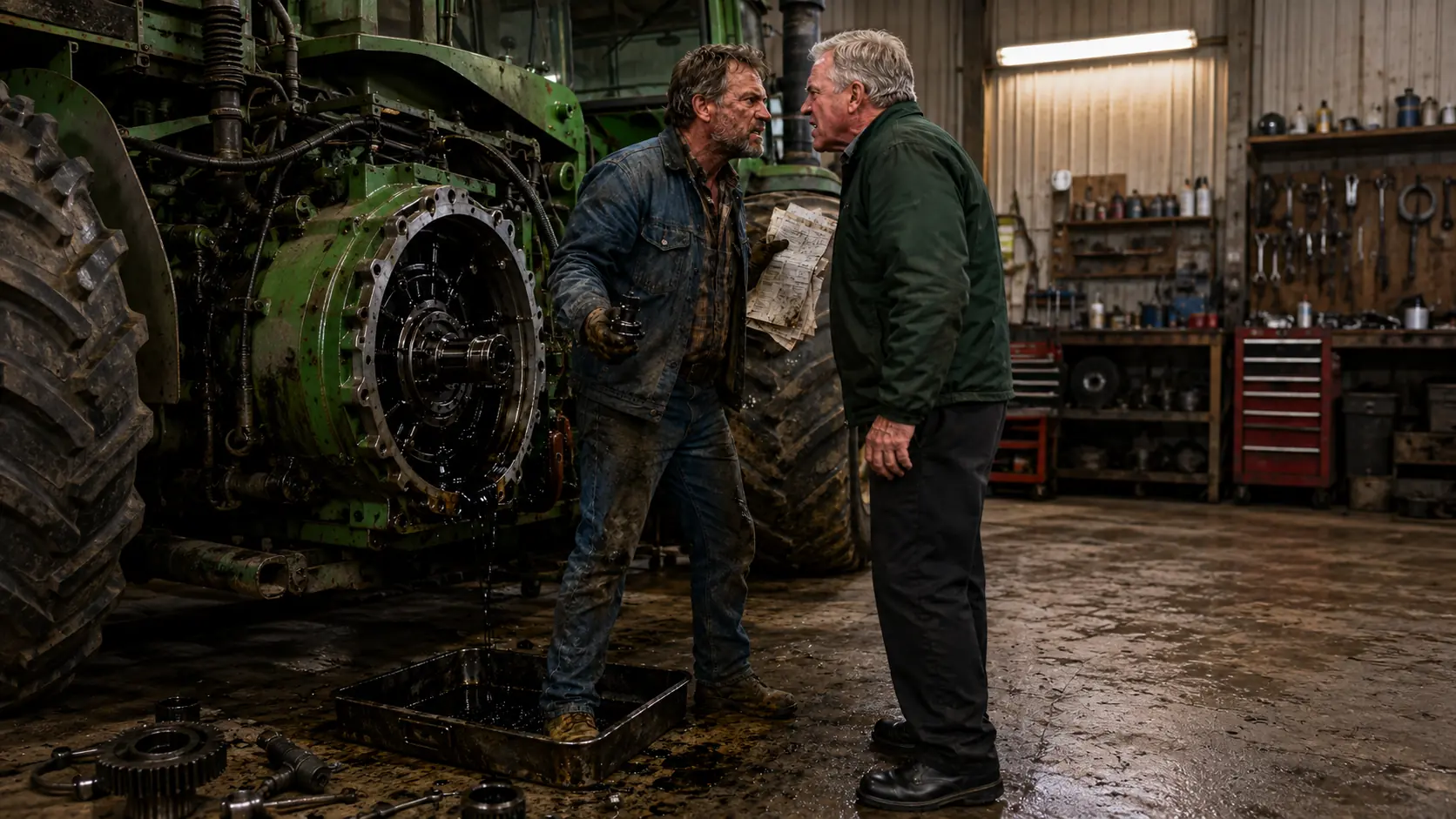
Derek had arrived expecting surrender. Three months earlier, his service department had declared the tractor’s power-shift transmission catastrophically destroyed and told its former owner that only a complete dealer rebuild could save it. Now the supposedly dead machine stood partly reassembled behind Warren, its green body towering above both men while fresh hydraulic oil glistened inside the exposed housing. Derek’s gaze moved from the inexpensive sensor to the invoices, and for the first time, Warren saw fear break through the manager’s arrogance.
“Those documents belong to the dealership,” Derek said.
“They were hidden under my cab mat.”
“They contain confidential service information.”
“They contain proof your shop poisoned this transmission.”
Derek reached again.
Warren knocked his hand aside with enough force to send the manager backward against the tractor’s enormous rear tire. The movement was not wild or emotional. Warren had spent thirty years controlling heavy machinery capable of crushing a careless man, and he knew exactly how much force to use.
“Try that once more,” Warren said, “and you’ll leave without the papers or your dignity.”
Derek straightened slowly. “You think you understand a power-shift system because you changed one sensor?”
“I rebuilt the clutch packs, flushed every passage, replaced the filter, and calibrated the system without your dealer computer.”
“You’ll destroy it the first time you put it under load.”
Warren held up the invoices. “That’s what your oil already tried to do.”
The confrontation had begun on a bitter February afternoon at Kearney Implement’s liquidation auction. The temperature hovered well below freezing, and wind swept across the gravel yard hard enough to cut through denim and insulated canvas. Farmers stood in tight groups with their hands buried in coat pockets, watching machinery pass beneath the auctioneer’s hammer.
At the center of the yard sat a 1998 John Deere 8410.
The tractor looked far too clean to be abandoned. Its green paint remained bright, the cab glass was intact, and the digital hour meter showed only 4,200 hours. The deep tread on its tires suggested years of useful work remained, but nobody approached it because a white card attached to the windshield carried two words every farmer feared:
TRANSMISSION FAILURE.
The auctioneer explained that the power-shift system was completely inoperative. The tractor started, idled, and built hydraulic pressure, but it would not move forward or backward in any gear. Kearney Implement had inspected it and estimated the repair at twenty-two thousand dollars.
The previous owner chose to sell rather than risk the cost.
Bidding opened at eighteen thousand.
Nobody moved.
The auctioneer lowered the number to fifteen, then twelve. A scrap-equipment buyer offered twelve thousand because the engine, tires, and sheet metal could be separated and sold. When the auctioneer asked for thirteen, Warren raised his hand from the rear of the crowd.
The scrap buyer looked back, studied the weathered farmer in the faded denim coat, and declined to continue.
After the buyer’s premium, Warren paid fourteen thousand forty dollars.
He had just placed the receipt inside his shirt pocket when Derek Paulson stepped into his path. Derek managed the dealership’s service department and wore a clean jacket that looked as though it had never touched hydraulic fluid. He asked whether Warren understood what he had purchased.
“A tractor,” Warren said.
“A fourteen-thousand-pound lawn ornament.”
“The engine runs.”
“The transmission is finished.”
“Did you open it?”
“We ran dealer diagnostics.”
“That wasn’t my question.”
Derek’s smile thinned. He explained that the power-shift transmission contained electronic controls, hydraulic clutch packs, speed sensors, proprietary calibration sequences, and internal assemblies beyond the ability of an ordinary farmer. According to him, a man working in a dirt-floor shed could not repair it without dealership software and specialized factory tools.
“Call us when you give up,” Derek said. “We’ll haul it back and rebuild it properly.”
Warren looked toward the tractor. “You already had it.”
“And we know what’s wrong.”
“Then why are you selling it?”
Derek had no answer that did not expose the truth. If the repair were certain and profitable, the dealership could have rebuilt the machine and sold it for many times the auction price. Instead, they had persuaded the previous owner that the risk was his and then abandoned the tractor when he refused the invoice.
Warren drove thirty-seven miles north to his farm near Elm Creek. The John Deere sat chained to his flatbed, its green hood visible in the mirrors as the trailer groaned through the frozen dusk. He had farmed 1,100 acres of corn and soybeans since taking over from his father in 1987, and every acre taught him the same lesson: survival depended less on what a man could buy than on what he could understand.
Dealership technicians had training manuals.
Warren had harvest seasons.
He had rebuilt diesel heads while storms formed on the western horizon. He had machined bushings when replacement parts were delayed for months and repaired wiring harnesses after mice destroyed them during winter storage. His education came from machinery that had to run before the weather changed.
The 8410 entered his machine shed that night.
His wife, Carol, stood near the doorway with her arms folded. “You said you were going to look.”
“I looked.”
“And bought the most expensive broken thing there.”
“The engine is worth half what I paid.”
“What about the transmission?”
“I’ll tell you when I know what’s wrong.”
Carol had been married to him long enough to understand that this was not a promise of success. It was a promise of method. Warren did not say a machine could be repaired until the measurements, parts, and evidence supported it.
The next morning, he climbed into the cab and turned the key.
The 8.1-liter diesel fired immediately. Its idle filled the building with a deep, steady rhythm, and every engine gauge settled exactly where it belonged. Warren let it warm for fifteen minutes before pressing the clutch and moving the power-shift lever into first.
Nothing happened.
He selected reverse.
Nothing.
The engine responded perfectly, but the transmission remained locked in neutral as though the gear lever were disconnected from the tractor beneath it. Warren tried every range once, then shut down the engine before additional testing damaged anything.
He began outside the transmission.
A flashlight in one hand, he rolled beneath the tractor on a mechanic’s creeper and traced each hydraulic line from the pump to the transmission housing. No hose had collapsed, no fitting leaked, and no connection showed signs of pressure failure. He applied direct voltage to the shift solenoids one at a time.
Each produced a clean metallic click.
The electrical coils worked.
The external valves moved.
That meant the problem lay either in the internal hydraulic pressure, the clutch assemblies, or the sensors controlling the computer’s decisions. Warren placed a heavy drain pan beneath the transmission and loosened the main plug.
The fluid that escaped answered the first question.
Healthy hydraulic oil should have been clear and honey-colored. What poured into the pan was thin, black, and carried the bitter smell of burnt friction material. It moved like contaminated water rather than high-viscosity transmission fluid.
Warren removed the filter.
The element was completely choked with sludge and metallic paste. Fine particles covered every pleat, restricting the flow needed to engage the clutch packs. The dealership had described a catastrophic mechanical failure, but the fluid told a different story.
The transmission had not exploded.
It had been starved.
Warren began the teardown. Using a chain hoist, heavy stands, and air tools, he separated the housings and removed the power-shift assemblies. He placed every component on the workbench in the order it came out, labeling bolts and recording clearances in a stained notebook.
The gears were intact.
No shaft had twisted.
No tooth had broken.
The clutch discs showed severe glazing and premature wear, but the hard components remained usable. Contaminated low-viscosity fluid had prevented proper pressure, causing the clutch packs to slip and generate heat.
Buried near the input shaft, Warren found a magnetic speed sensor covered by a thick beard of metal filings. The sensor told the tractor’s computer whether the transmission input shaft was rotating. If it failed, the computer interpreted the missing signal as a dangerous mechanical lock and forced the entire system into neutral.
Warren cleaned the tip and connected a multimeter.
The display showed an open circuit.
The sensor was dead.
He called an independent parts supplier in Omaha and ordered new friction discs, gaskets, seals, a high-flow filter, and the replacement sensor. The entire order cost eight hundred forty dollars.
The speed sensor cost thirty-eight.
When Carol saw the invoice, she stared at the total. “The dealership wanted twenty-two thousand.”
“They wanted to replace more than necessary.”
“Were they wrong?”
Warren looked at the black fluid. “Either wrong or dishonest.”
“Which is worse?”
“Depends on how many people paid them.”
The new parts arrived on Thursday morning. Warren spent two days cleaning every hydraulic passage, washing metal dust from the housings, inspecting bearings, and checking clutch clearances. He installed the new friction discs, seals, and gaskets, then tightened the transmission housing with a calibrated torque wrench.
The final component was the speed sensor.
It disappeared into its bore with one small bolt and a simple electrical connector. Thirty-eight dollars of plastic, copper, and magnetism had silenced a tractor weighing seven tons.
Warren refilled the system with premium high-viscosity oil that met the manufacturer’s exact specifications. Then he climbed into the cab and started the engine.
He waited until the oil warmed.
His left hand rested on the gear lever while his right remained near the key, ready to shut the system down at the first unusual sound. He selected first gear.
The tractor moved.
It did not lurch, grind, or trigger a warning light. The clutch pack engaged with a soft hydraulic sound, and the massive front tires rolled across the concrete.
Warren stopped, selected reverse, and watched the tractor move backward smoothly. He tested each gear in the yard, shifting upward under light throttle and then repeating the sequence under increasing load. The response remained crisp.
Carol watched from the shed doorway.
When he finally parked, she smiled. “Eight hundred forty dollars?”
“That’s the parts.”
“What about your labor?”
“I work cheap for myself.”
Warren could have called Derek immediately. Instead, he cleaned the tractor. Dust beneath the seat, old seed-corn tags in the console, and years of field dirt came out of the cab.
When he lifted the thick rubber floor mat, his fingers touched a rigid envelope wedged against the firewall.
The manila paper was yellowed and stained with oil. Inside were six service invoices from Kearney Implement covering eighteen months before the transmission failed. Three invoices documented full transmission-fluid services.
Every one listed the same product:
Bulk universal tractor hydraulic fluid.
Warren pulled the operator’s manual from his shelf and opened the lubrication section. The warning appeared in bold print. The 8410 required high-viscosity fluid meeting a specific standard. Generic universal oil could cause clutch slippage, pressure loss, filter blockage, and premature component failure.
The dealership had filled the tractor with the wrong oil three times.
Then it had quoted the former owner twenty-two thousand dollars to repair the damage.
Warren locked the invoices inside his filing cabinet. He wanted more than an argument. He wanted to know whether the practice extended beyond one tractor.
Spring arrived, bringing soft fields and a narrow planting window. Warren connected the 8410 to a sixteen-row planter and worked six hundred acres with it. The tractor shifted perfectly while the hydraulics maintained steady pressure through every pass.
It finished two days before the rain.
At the Elm Creek cooperative, Warren’s neighbor Ed Colby noticed the 8410 idling beside the fuel pumps. Ed farmed eighteen hundred acres with late-model equipment maintained almost exclusively by Kearney Implement. He asked whether it was the supposedly unrepairable auction tractor.
Warren nodded.
“What did the transmission cost?”
“Eight hundred forty dollars.”
Ed laughed, assuming it was a joke.
Warren explained the failed sensor, burnt clutch discs, blocked filter, and incorrect fluid. When Ed asked who would put generic hydraulic oil into a high-pressure power-shift transmission, Warren looked south toward the dealership.
“Ask Derek.”
Ed went home and opened twelve years of service records for his own tractors. Every transmission-fluid invoice from Kearney Implement contained the same description: bulk universal hydraulic fluid.
He found no reference to the premium product he believed he had purchased.
Ed confronted Derek at the dealership. Derek first claimed that manufacturer-approved products were always used, then changed his answer when Ed placed the invoices on the counter. He argued that universal oil performed adequately in older tractors and that farmers did not understand the economics of running a dealership service department.
Ed understood enough.
He returned a week later with Carl Bricker and Arlon Miller, two large producers whose combined operations covered more than five thousand acres. They entered owner Gregory Stall’s office carrying copies of their service records.
Derek stood beside the door.
Ed dropped the papers onto Gregory’s desk. “How many tractors did your shop fill with the wrong oil?”
Gregory adjusted his glasses. “There may be a misunderstanding.”
“There are twelve years of misunderstandings in that folder.”
Derek stepped forward. “Universal oil works in most applications.”
Carl turned toward him. “My 8420 lost its transmission eight months after your fluid service. You charged me eighteen thousand dollars and said I abused it.”
“You did not follow our operating recommendations.”
“I followed the manual. Your shop ignored it.”
Gregory offered free flushes and replacement fluid as a gesture of goodwill. The farmers refused. New oil could not reverse wear already ground into clutch packs and bearings.
They removed their business from Kearney Implement that morning.
Carl went further.
He hired an agricultural attorney and filed a civil claim accusing the dealership of gross negligence and deceptive service practices. Kearney Implement argued that contamination could not be proven after Carl’s transmission had been rebuilt.
Then Warren opened his filing cabinet.
The original invoices from beneath the floor mat provided an uninterrupted record showing repeated use of unapproved fluid before the 8410 failed. Warren supplied photographs of the damaged clutch discs, blocked filter, dead sensor, and black oil.
Derek called him the night before the attorney requested the records formally.
“You need to think carefully,” the service manager said. “That dealership supports this entire county.”
“Farmers support it.”
“You’ll put people out of work.”
“Your shortcuts already put farms at risk.”
“You’re enjoying this.”
“No. I’m documenting it.”
The civil case settled before trial. Kearney Implement paid Carl’s repair costs, lost harvest income, and legal expenses. The amount remained confidential, but the existence of the settlement spread quickly through Phelps County.
John Deere corporate auditors arrived soon afterward.
They sealed parts rooms, reviewed bulk-fluid purchases, examined service records, and interviewed technicians. The documents revealed that the dealership had bought cheap universal oil by the tanker load while billing customers for premium maintenance.
The difference became profit.
The mechanical damage became future repair revenue.
One technician, Ron Hendricks, admitted Derek had ordered employees to ignore manufacturer warnings. Ron had questioned the practice early in his career but remained silent because he had a young family and feared losing his job.
Two years later, Ron visited Warren during harvest.
He stood beside the combine wearing faded work clothes without any dealership logo. “My initials are on the invoices you found.”
Warren waited.
“I pumped that oil into the tractor.”
“Under whose order?”
“Derek’s.”
“You knew it was wrong?”
“I knew the manual warned against it.”
“Then why do it?”
Ron looked across the corn stubble. “I needed the paycheck.”
Warren studied him for several seconds. “And now?”
“I quit. I work for an independent shop in Grand Island. We use whatever the machine requires, even when it costs more.”
“Why come here?”
“To say I’m sorry.”
Warren extended his hand. “Make the next invoice honest.”
Ron shook it.
By 2010, Kearney Implement’s gravel lot had begun emptying. Multi-generation farm families took their tractors to independent mechanics or competing dealers. The dealership’s greatest loss was not the lawsuit.
It was trust.
John Deere eventually revoked the franchise after compliance audits found widespread violations. The glass showroom went dark, the service doors closed, and the property was sold to an agricultural supply company.
Derek blamed Warren publicly.
Warren never answered.
He continued using the 8410.
The machine pulled deep rippers through hard autumn soil, powered the sixteen-row planter every spring, and hauled grain carts during harvest. Its transmission remained reliable because Warren filled it with the correct fluid, changed filters on schedule, and watched the sensors.
Years passed.
The hour meter climbed beyond nine thousand.
One afternoon at a regional equipment show, a corporate service trainer approached Warren. He explained that the 8410 repair had become an anonymous case study used to teach technicians about fluid specifications, electronic interlocks, and the danger of diagnosing before verifying.
“They use my tractor in training?”
“Not the name. Just the sequence.”
“What do they tell the students?”
“That one farmer proved a thirty-eight-dollar sensor can imitate a catastrophic failure, and cheap oil can destroy a premium transmission.”
Warren nodded. “Good lesson.”
The trainer looked toward the older man. “You exposed an entire dealership.”
“I wanted the tractor to move.”
Back at Elm Creek, Warren’s son Travis gradually assumed responsibility for the farm. Newer tractors carried GPS steering, larger displays, and more horsepower, but the old 8410 remained in the equipment line.
When rain threatened and planting needed to finish, Travis often chose it first.
The machine started.
The transmission shifted.
The hydraulics held.
One day, Travis found the manila envelope inside the bottom drawer of the filing cabinet. He read the old invoices, then looked toward the tractor parked outside.
“The dealership lied to you.”
Warren shook his head. “A man can lie, or he can be wrong. Either way, you don’t learn the truth until you open the machine.”
He handed his son the thirty-eight-dollar dead sensor he had kept in a small parts box.
“This stopped seven tons of tractor.”
Travis turned it between his fingers. “And ended a dealership.”
“No. Greed ended the dealership. This only revealed it.”
The John Deere continued working long after Kearney Implement disappeared. Its green paint faded, the seat was replaced, and scratches accumulated across the hood, but the power-shift transmission remained untouched after Warren’s rebuild.
The machine the dealer called a total loss became one of the most reliable tractors on the farm.
Derek had entered Warren’s shed expecting to watch an ordinary farmer surrender to an expensive diagnosis. Instead, he found the transmission open, the failed sensor identified, and his dealership’s invoices sitting in the hands of the one customer patient enough to compare them with the manual.
The repair cost eight hundred forty dollars.
The truth cost Kearney Implement everything.