“Poor men don’t buy tractors,” Garrett Caldwell said, laughing loudly enough for half the showroom to hear. “They borrow them.”
Dale Britton stood beside a polished green John Deere with eleven thousand dollars in savings, six hundred acres under lease, and five years of work packed into the calluses across his hands. He had come to Caldwell’s John Deere on Route 9 wearing his cleanest blue work shirt, faded denim overalls, and boots that were old but freshly brushed. He had expected questions about acreage, credit, income, and down payment. He had not expected to become entertainment.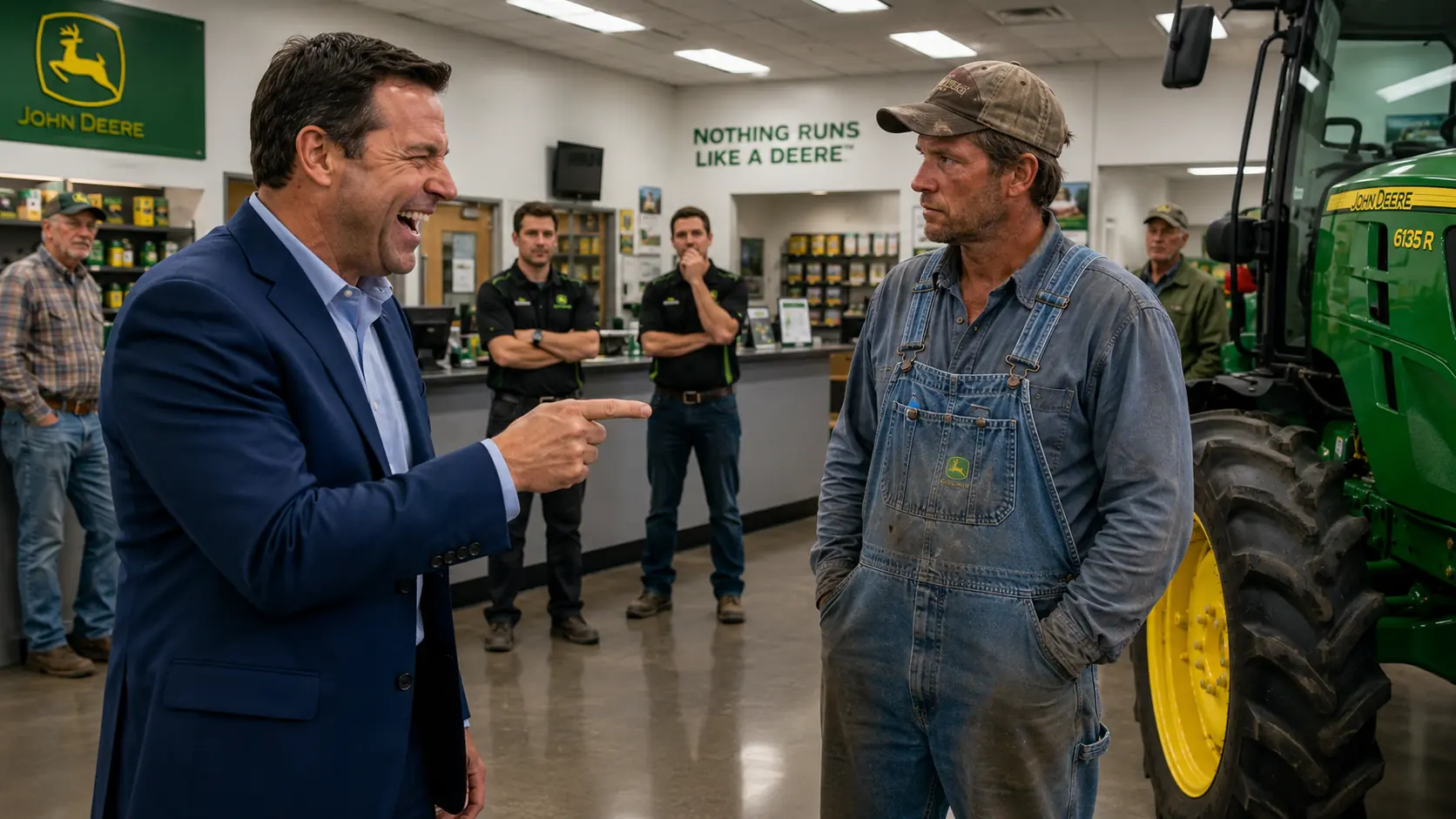
Garrett pointed toward him as two customers near the parts counter awkwardly looked away. “Take that eleven grand and stop wasting my salesmen’s time.”
Dale’s face burned, but his voice remained level.
“You asked what I can afford. You never bothered asking what I’m building.”
Garrett stepped closer, still smiling.
“Build whatever fantasy you want, but you’ll never own enough land to belong in this showroom.”
Dale held his stare for several seconds.
“Remember that sentence, Caldwell. One day you may be standing in here asking me who owns the building.”
A few employees exchanged glances.
Garrett laughed harder.
Dale turned and walked out.
He was thirty-one years old, and at that moment Garrett Caldwell was technically right about several things.
Dale was not wealthy.
He did not own a tractor powerful enough to handle his growing operation.
He did not own hundreds of acres outright.
He drove a 1987 Ford pickup with a cracked windshield, and the eleven thousand dollars he had mentioned represented almost everything he had managed to save after five years of repairing fences, helping neighboring farmers, working winter shifts at the grain elevator, and trying to keep his operation alive.
But Garrett had made one mistake.
He believed Dale’s present condition described Dale’s future.
Dale Britton had been born outside Millhaven, a small Holt County town surrounded by cornfields and soybean ground. His father farmed four hundred rented acres for most of his adult life.
The Brittons never lacked food, but they rarely possessed financial breathing room.
Every season started with calculations.
Seed.
Fertilizer.
Fuel.
Equipment repairs.
Lease payments.
Insurance.
Then came weather, which ignored calculations entirely.
Dale learned early that farming could make a hardworking man look successful from the highway while leaving him frightened of the mailbox.
His father never owned the ground he worked.
When he died, Dale inherited the leases, the cracked Ford, several hand tools, and a feed-store balance that took two harvests to eliminate.
Dale was twenty-six.
For the first year, he survived almost entirely through favors.
Neighbor Hank Kowalski loaned him a tractor during planting in exchange for labor later that summer.
Another farmer allowed Dale to use a cultivator if Dale repaired its hydraulic cylinder first.
When someone needed hay stacked, grain hauled, fencing replaced, or machinery cleaned, Dale volunteered.
He was not ashamed of borrowing equipment.
He was grateful.
But every borrowed hour reminded him that his operation depended upon another man having equipment available.
He wanted independence.
His first real machine was not a tractor.
It was a used cultivator purchased at an estate auction for four hundred dollars.
One arm was bent.
Two bearings were destroyed.
The paint was mostly gone.
Dale dragged it home and spent evenings repairing it using a borrowed welder and whatever manuals he could find.
When it finally worked, he stood in the driveway looking at that ugly piece of steel with more pride than some men felt toward a new pickup.
It was his.
From there he began saving.
Cash from repair jobs went into a coffee can hidden above the kitchen cabinets until the amount became large enough that he moved it into the bank.
A profitable harvest added several thousand.
A bad year added almost nothing.
Still, the number grew.
At thirty-one, Dale was farming his father’s original four hundred leased acres plus another two hundred north of town.
That expansion created his tractor problem.
Borrowing no longer worked.
Planting windows were too narrow.
The distance between fields was too great.
Dale needed a reliable seventy-to-ninety-horsepower machine.
That need brought him to Caldwell’s.
And Garrett’s laughter sent him away.
Dale drove home in complete silence.
At the farmhouse, he sat behind the steering wheel long after shutting off the truck.
He replayed the sentence.
Poor men don’t buy tractors.
For a few minutes, anger controlled him.
Then something quieter replaced it.
Dale did not decide he would destroy Garrett Caldwell.
He did not imagine revenge.
He simply decided that no man behind a polished counter would determine what he was capable of owning.
The next morning, Dale called a retired farmer named Raymond Sloan in the neighboring county.
Raymond had advertised a 1998 tractor.
Two thousand operating hours.
Cosmetically ugly.
Mechanically sound.
Nine thousand dollars.
Dale drove there that afternoon.
Raymond walked him around the machine.
“You know she isn’t pretty.”
“I’m not planting with the paint.”
Raymond smiled.
“You bring a trailer?”
“Yes.”
“You planning to negotiate?”
“No.”
That surprised him.
Dale continued.
“If it runs the way you said, nine thousand is fair.”
Raymond studied him for a moment.
“You farming long?”
“All my life.”
“Own much ground?”
“None yet.”
Yet.
Raymond noticed the word.
The tractor went home with Dale.
For six years, he kept it alive with his own hands.
That first season after the humiliation at Caldwell’s was terrible.
A late frost damaged nearly thirty percent of his corn.
Dale watched plants he had paid to put into the ground turn useless almost overnight.
His savings disappeared into lease payments and operating expenses.
The following year, excessive spring rain delayed planting by three weeks.
He missed a delivery obligation to the local elevator and lost a contract he had spent two years building.
Then his grain bin partially collapsed beneath winter ice.
Almost eight hundred bushels were ruined.
Friends began suggesting that perhaps he was expanding too aggressively.
Dale wondered the same thing.
But every setback taught him something.
He learned machinery repair because repair bills were destroying his margins.
He drove two hours to a technical farm-equipment school and paid for courses in hydraulics and electrical diagnostics.
At night he studied service manuals.
Soon neighboring farmers began calling Dale when equipment failed.
Those repairs created another source of income.
He saved that money too.
At thirty-five, Dale purchased forty acres.
The property was not remarkable.
The soil was decent.
The buildings were nonexistent.
The fence needed work.
But the title carried his name.
After leaving the closing office, Dale pulled the Ford onto the shoulder of a county road.
He sat there with the deed beside him.
Then he cried.
Not dramatically.
No one saw it.
For almost ten years, every acre Dale worked had belonged to someone else.
Forty acres belonged to him.
The experience changed how he approached expansion.
He stopped thinking only about farming more land.
He began thinking about ownership, equity, debt structure, and cash reserves.
A good farmer could still be financially fragile.
Dale had watched that happen to his father.
He did not want more acres merely to impress people.
He wanted an operation capable of surviving bad seasons.
By thirty-eight, Dale controlled more than a thousand acres through a combination of owned and leased ground.
His credit history was excellent.
His machinery was maintained meticulously.
His books were conservative.
That year he finally purchased a new tractor.
He did not visit Caldwell’s.
He drove forty miles to Varga Agricultural Equipment.
Pete Varga met Dale at the door.
Pete did not examine his boots before asking about his farm.
He asked acreage.
Soil type.
Primary crops.
Existing implements.
Expected annual hours.
Then he asked what Dale wanted the tractor to accomplish.
They talked for more than an hour.
When Dale bought the machine, Pete shook his hand.
“Thank you for trusting us.”
Dale remembered that sentence.
Over the following years, Dale bought attachments, service parts, and two additional machines from Pete.
He also told neighbors about the dealership.
That mattered.
Farmers talk.
An arrogant dealership might lose one man in the showroom.
The following month, it could discover it had actually lost ten.
Garrett Caldwell learned that slowly.
Caldwell’s John Deere had once been one of Holt County’s strongest agricultural businesses.
Garrett inherited it from his father.
For years, the dealership benefited from loyal customers, a respected service department, and the strength of the brand displayed across its green-and-yellow showroom.
Garrett interpreted inherited momentum as proof of his own brilliance.
He expanded.
The second location opened in the county seat with borrowed money and expensive inventory.
Garrett expected growth.
Instead, the new store drained cash.
The market did not support two locations.
Labor expenses climbed.
Inventory sat.
Interest accumulated.
After three years, Garrett closed the second dealership.
The debt remained.
Back at Route 9, the original store began showing signs of strain.
Service technicians left.
Customers complained about turnaround times.
Garrett tightened financing standards because he feared defaults.
That drove away smaller farmers.
He raised margins to compensate for falling volume.
That drove away more.
By the time Dale turned forty-two, Caldwell’s still looked impressive from the highway.
The sign remained bright.
Tractors still stood beneath showroom lights.
But people in Holt County knew something was wrong.
The rumor reached Dale at May’s Diner.
He was eating eggs beside two farmers after delivering soybeans when a man at the counter said, “Caldwell’s might be finished.”
Dale kept eating.
Another farmer asked, “Bank taking it?”
“Garrett’s looking for a buyer.”
“Regional group?”
“Probably.”
Dale said nothing.
But the idea followed him home.
For eleven years, the dealership had existed in Dale’s memory as the place where someone had publicly told him what kind of man he was allowed to become.
He did not want to buy it because of that.
Revenge was a bad reason to spend serious money.
But Dale understood farmers.
He understood machinery.
He understood what a dealership should do.
And he understood exactly why Caldwell’s was failing.
Two days later, Dale called his accountant.
“I want you to look at something.”
His accountant laughed when Dale explained.
“You want to buy a dealership?”
“I want to know if I can.”
“That’s different.”
“Yes.”
The numbers took weeks.
Dale had land equity.
Equipment equity.
Strong revenue.
Excellent credit.
Cash reserves.
The dealership owned valuable real estate and a service operation that could still be rebuilt.
The franchise rights also had significant value.
The transaction would be difficult.
Not impossible.
Dale contacted his banker.
Then an attorney.
Then the representatives handling Caldwell’s proposed sale.
Everything remained confidential.
When Dale finally made his offer, it was not insulting.
He refused to lowball Garrett simply because the man was vulnerable.
The offer reflected the actual value of the building, inventory, service business, franchise position, and existing liabilities.
His accountant read the document twice.
“You know what’s funny?”
“What?”
“If Caldwell had treated you properly eleven years ago, you probably would’ve spent hundreds of thousands there by now.”
Dale smiled.
“Probably.”
“And now?”
“Now I might buy the place.”
The offer was accepted.
Garrett Caldwell learned the buyer’s identity from his attorney.
Dale was not present for that conversation.
He never knew Garrett’s first reaction.
He did not need to.
Closing occurred on a Tuesday morning in late October.
No television crews.
No celebration.
No giant ribbon.
Dale signed documents until his wrist hurt.
At 9:00 a.m., Caldwell’s John Deere became his.
The dealership employees knew ownership had changed.
They did not know the buyer.
At 9:20, Dale drove his pickup into the parking lot.
He wore work pants, a clean flannel shirt, and boots carrying dried soil from yesterday’s field inspection.
When he entered, several employees looked past him toward the door.
They were apparently waiting for the new owner.
Dale smiled.
“Morning.”
The sales manager approached.
“Can I help you?”
“I hope so.”
Dale looked around the showroom.
Eleven years disappeared.
He could almost see himself standing beside the tractor while Garrett laughed.
Then he extended his hand.
“Dale Britton.”
Recognition crossed the salesman’s face.
Dale continued.
“I bought the dealership.”
Nobody spoke.
One technician actually laughed because he believed it was a joke.
Dale removed the documents from his folder.
The laughter stopped.
He gathered the employees near the service counter.
“I’m not here to fire everyone.”
Several shoulders relaxed.
“I farm in this county. I understand what your customers need because I am one.”
He pointed toward the service bays.
“The first thing we fix is service.”
Then toward the showroom.
“The second thing we fix is how people are treated when they walk through that door.”
An older salesman looked at him carefully.
Dale continued.
“I don’t care whether somebody operates ten thousand acres or rents eighty.”
He looked around the room.
“I don’t care whether he arrives in a new truck or something held together by rust.”
Nobody missed the weight behind those words.
“If he walks through that door, we treat him like his business matters.”
Dale paused.
“Because it does.”
That afternoon, Garrett Caldwell returned.
He claimed he had forgotten personal belongings in the back office.
Perhaps that was true.
Perhaps he needed to see the building under different ownership.
Dale stood behind the front counter reviewing service records when Garrett entered.
They looked at each other.
Garrett seemed older.
His suit was still expensive.
His hair still carefully arranged.
But something about him had diminished.
“I remember you,” Garrett said.
Dale nodded.
“I know.”
Garrett looked around.
“You bought it.”
“Yes.”
A long silence followed.
Garrett’s eyes moved toward the tractor displayed where another green machine had stood eleven years earlier.
“Guess I was wrong.”
Dale could have delivered the speech.
He could have repeated every word.
Poor men don’t buy tractors.
He could have humiliated Garrett in front of the employees.
He did none of it.
“You were wrong about where I was going,” Dale said.
Garrett looked at him.
Dale continued.
“You weren’t wrong that I was poor.”
The answer surprised him.
“I was.”
Dale leaned against the counter.
“I just wasn’t planning to stay there.”
Garrett nodded once.
He walked toward the office and collected his belongings.
Before leaving, he stopped beside the front door.
“What are you calling the dealership?”
“I haven’t decided.”
Garrett looked back.
“Good luck.”
Dale answered quietly.
“Thank you.”
The door closed.
Then Dale returned to work.
That became the real victory.
Not the purchase.
What he built afterward.
He hired two experienced technicians and reorganized the service department around response time.
Farmers received realistic repair estimates instead of vague promises.
During planting and harvest, emergency field repairs received priority.
Dale purchased additional diagnostic equipment and paid technicians for advanced training.
Within months, repair turnaround dropped.
Customers returned.
Dale also changed financing.
He remembered standing inside the showroom with eleven thousand dollars and six hundred leased acres while nobody bothered understanding his operation.
So applicants were still evaluated financially, but young farmers received something Dale had not.
A conversation.
What did they farm?
Who leased the ground?
What were their expenses?
What machinery did they already have?
What were they trying to accomplish?
Not everyone qualified.
Dale refused irresponsible loans.
But rejection came with explanation instead of humiliation.
Sometimes a young farmer was told, “Not today. Here’s what needs to improve before we try again.”
That difference built loyalty.
One spring morning, a twenty-three-year-old farmer named Cody entered wearing dirty boots and a ripped jacket.
He needed a used tractor.
The salesman began reviewing options.
Dale watched from his office.
For a moment he saw himself.
Cody eventually walked out carrying financing paperwork for a machine his operation could realistically support.
The salesman returned.
“Small deal.”
Dale looked toward the parking lot.
“No.”
The salesman frowned.
“Forty-thousand-dollar used tractor.”
Dale smiled.
“You’re thinking about today.”
Two years later, Cody expanded.
Four years later, he bought another machine.
Then his brother became a customer.
So did two neighbors.
Dale never had to explain the lesson again.
The dealership grew steadily.
He introduced free maintenance clinics twice a year.
Farmers learned how to perform basic inspections, identify hydraulic problems early, maintain batteries, check belts, and avoid expensive breakdowns.
Some business owners warned him that teaching customers repairs would reduce service revenue.
Dale disagreed.
Helping farmers protect equipment built trust.
Trust brought them back when problems became too complicated for a farm shop.
The building changed too.
The polished showroom remained.
So did the tractors.
But the atmosphere shifted.
Work clothes were normal.
Muddy boots did not embarrass anyone.
Coffee remained available near the parts counter.
Technicians sometimes walked directly into the showroom to explain repairs rather than hiding behind service paperwork.
Within three years, people stopped calling it Caldwell’s.
They called it Britton’s.
Dale resisted changing the exterior sign immediately.
Eventually the old Caldwell name came down.
He stood outside watching workers remove the letters.
One employee asked if the moment felt good.
Dale considered the question.
“Mostly feels expensive.”
The employee laughed.
Dale smiled too.
Then he looked at the empty space above the entrance.
Eleven years earlier, he had walked through those doors carrying every dollar he could spare and walked out feeling smaller.
Now his name would hang over them.
But the satisfaction did not come from replacing Garrett’s name.
It came from knowing what the building meant now.
A farmer could enter without being measured by his clothes.
Years later, Dale’s father’s cracked Ford still sat in one of his barns.
It no longer ran.
Dale refused to sell it.
His first tractor remained too.
The old 1998 machine had long since become inefficient for commercial work, but Dale restored it instead of trading it.
One Saturday, a new salesman asked why.
Dale ran a hand across the old hood.
“This tractor taught me something.”
“What?”
“That owning the best machine doesn’t matter nearly as much as having something you can depend on while you build.”
The salesman nodded toward the dealership in the distance.
“That what Caldwell taught you too?”
Dale looked at him.
“No.”
He smiled faintly.
“Caldwell taught me that somebody else’s opinion is a terrible place to build your ceiling.”
The old sentence never completely disappeared.
Poor men don’t buy tractors.
In one sense, Garrett had been describing reality as he saw it.
Dale had arrived poor.
But poverty was a condition, not an identity.
A rented farm was not a permanent limit.
Dirty boots were not evidence of inability.
Eleven thousand dollars was not a measure of everything a man would ever earn.
And a young farmer standing awkwardly inside a showroom was not necessarily asking for more than he deserved.
He might simply be standing at the beginning of a story nobody else had enough imagination to see.
Dale did not become successful because Garrett humiliated him.
He would never give cruelty that much credit.
He became successful because, after the humiliation, he returned to work.
One field.
One repair.
One saved dollar.
One purchased acre.
One careful loan.
One year after another.
By the time the world noticed the result, most of the important work had already happened quietly.
That was the part Garrett Caldwell never understood when he laughed at a thirty-one-year-old farmer in dirty overalls.
He thought he was looking at a poor man who could not afford a tractor.
He was actually looking at the future owner of the entire dealership.