Nine days after his father’s funeral, Luke Harper walked into the John Deere dealership with mud on his boots and a folded order slip in his hand. The boots had belonged to his father, and they were still too big for him, so every step made a soft, awkward thud against the showroom floor. He was fourteen years old, thin from a week of forgetting meals, with dark circles under his eyes and a faded green cap pulled low over his forehead. Behind the parts counter, the manager looked up once, saw a boy instead of a customer, and kept writing.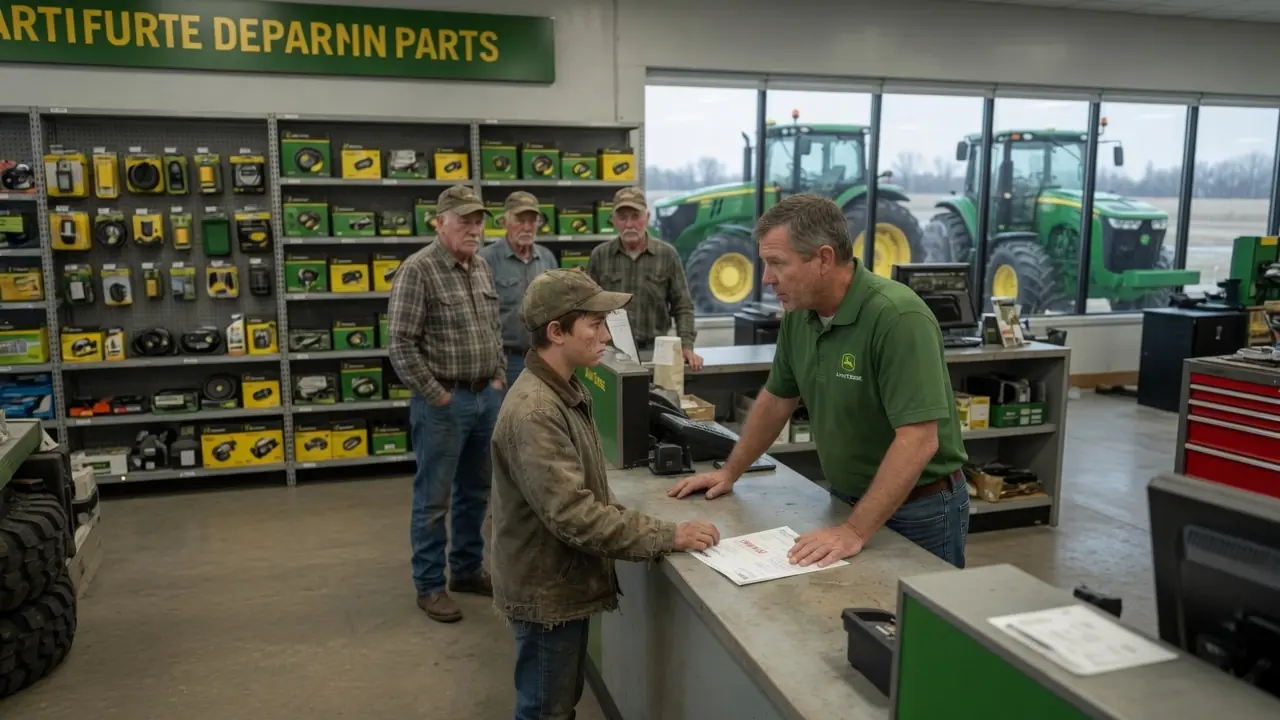
The dealership smelled like rubber tires, oil, new paint, and coffee that had been sitting too long. A row of green tractors lined the showroom wall, their yellow wheels shining under bright lights, polished like machines from another world. Luke stopped at the counter and placed the folded order slip on the metal surface with both hands. His fingers were rough for his age, scratched from fence wire, baler twine, and the cold handles of tools he had been using since he was old enough to follow his father into the barn.
The manager’s name was Harold Briggs, and he had known Luke’s father for twelve years. He had sold Samuel Harper parts, filters, belts, grease, and once, after a good corn year, a used tractor with a cracked seat and a stubborn clutch. Harold was a clean man with a clean shirt, a clean watch, and a voice that always seemed to stand above whoever he was speaking to. When he finally looked at the order slip, his mouth tightened.
“This was for Sam Harper,” Harold said.
Luke swallowed. “Yes, sir.”
Harold looked over the counter at him. “Your father’s gone, Luke.”
“I know.”
The words were small, but they filled the space between them. A few older farmers near the parts shelves went quiet. One man holding a box of filters turned his head slightly, then looked away like grief was something private even when it stood in public. Luke kept his eyes on the part number written in his father’s handwriting, because looking at the letters hurt less than looking at faces.
Harold tapped the order slip. “This is a transmission control module for the 7810.”
Luke nodded. “Dad ordered it before he went to the hospital.”
“It came in yesterday.”
“I came to pick it up.”
Harold leaned back and crossed his arms. “Do you have the money?”
Luke reached into his jacket and pulled out a bank envelope. His mother had cried when she handed it to him that morning, not because the money was gone, but because she knew what it meant. It was part of the emergency cash Samuel had kept in an old coffee can above the workbench, the money he said was only for repairs that could not wait. Luke placed the envelope on the counter.
Harold did not touch it. “You shouldn’t be spending this.”
Luke’s jaw tightened. “It’s already ordered.”
“That’s not what I mean.”
“I know what you mean.”
Harold sighed like the boy was wasting his time. “Listen to me. Your mother is grieving, your land note is coming due, and that old tractor is only one of many problems waiting to break. A farm is not a school project. One part won’t turn a boy into a farmer.”
Luke’s face went pale, but he did not step back. The words hit the exact place everyone had been striking since the funeral. Neighbors had spoken softly about selling. The banker had spoken gently about options. Even his aunt had said his mother needed to think about a house in town before the farm swallowed what was left of them.
Luke looked up at Harold. “I didn’t come here for permission. I came for the part my dad already paid for.”
Harold’s expression hardened. “Your father is dead, Luke. Sell the farm before you bury yourself trying to do a man’s job.”
The showroom went silent.
Luke felt heat climb up his neck. He wanted to shout, but his father had always said anger was like a loose gate in the wind. It made noise, but it did not hold anything. So Luke picked up the envelope, set it directly on top of the order slip, and pushed both toward Harold.
“Then watch this boy harvest every acre,” he said.
Harold stared at him for a long second. Something moved in his face, maybe irritation, maybe pity, maybe the uncomfortable realization that he had spoken too harshly to a child standing in his dead father’s boots. But pride stepped in before apology could. He took the envelope, counted the money, printed the receipt, and brought out the boxed part from the shelf behind him.
Luke lifted the box with both hands. It was heavier than he expected, but he did not let it show. As he turned to leave, one of the older farmers near the filters spoke his name. It was Mason Reed, who farmed eighty acres west of town and had once borrowed Samuel’s grain truck after his own broke down.
“Luke,” Mason said quietly. “You need help loading that?”
Luke looked at him. For one second, the offer almost broke him. But Harold was still watching, and the whole showroom seemed to be waiting to see whether the boy would admit he could not carry the weight.
“I’ve got it,” Luke said.
Outside, the wind cut across the dealership lot and pushed against his jacket. Luke carried the box to his father’s old pickup, set it on the seat beside him, and sat behind the wheel without starting the engine. His hands were shaking now. He pressed them against the steering wheel until the trembling slowed.
His father had died on a Tuesday before sunrise. One week earlier, Samuel Harper had been in the machine shed with a flashlight in his teeth, showing Luke where the wiring harness entered the tractor housing. Two days after that, he was coughing hard enough that Luke’s mother begged him to go to the clinic. Three days later, he was in a hospital bed, holding Luke’s wrist and whispering, “If harvest comes before I do, you know more than you think.”
Luke had said, “Don’t talk like that.”
Samuel had smiled weakly. “Then listen like I’m talking about weather.”
He never came home.
The Harper farm sat six miles outside Mill Creek, Iowa, down a gravel road that turned soft in spring and hard as bone in late summer. It was not a big farm compared to the operations spreading around them, but it was everything Samuel had built and everything Luke had ever known. There were cornfields to the north, soybeans on the lower ground, a red barn with peeling paint, and a white farmhouse where the porch boards creaked in the same three places every time someone crossed them. To Luke, every fence post and ditch line carried his father’s voice.
When he returned from the dealership, his mother, Emily Harper, stood at the kitchen sink staring out at the fields. She was thirty-eight but looked older that month, her hair tied back loosely, her eyes swollen from too many nights without sleep. The house smelled like coffee, laundry soap, and casseroles left by church women who did not know what else to do with grief. Luke came in carrying the box.
Emily turned. “Did they give it to you?”
“Yes.”
“Was Harold kind?”
Luke paused too long.
Emily closed her eyes. “What did he say?”
“He said we should sell.”
Her shoulders dropped.
Luke set the box on the kitchen table. “He said one part won’t turn a boy into a farmer.”
Emily’s face tightened with pain. “Luke…”
“I’m going to fix it.”
“You’re fourteen.”
“I know.”
“You don’t have to become your father overnight.”
“I’m not trying to become him,” Luke said. “I’m trying not to lose what he left.”
Emily looked toward the window again. Beyond the glass, the fields waited under a gray sky. The crops had been planted before Samuel got sick, and all summer he had worried about the old tractor, the combine, the grain truck, the weather, the note at the bank, and whether Luke was growing too serious too young. Now all of those worries had stayed behind like unpaid debts.
Emily sat down slowly. “I don’t know how to run this without him.”
Luke pulled out the chair across from her. “Then don’t run it alone.”
She looked at him, and tears filled her eyes. “You’re my child.”
“I’m also his son.”
That sentence hurt both of them, but it was true. Emily reached across the table and touched his hand. She wanted to protect him from the farm, from grief, from men like Harold Briggs, from the kind of work that made boys grow hard before they were ready. But she also knew Samuel had taught Luke more than anyone realized, because fathers often teach in pieces while sons pretend not to listen.
The repair took three evenings and one full Saturday. Luke worked from his father’s notes, from the service manual stained with coffee and grease, and from memory. He did not understand everything, but he understood enough to be careful. When he was unsure, he stopped, read again, and imagined Samuel’s voice telling him not to force what needed patience.
Mason Reed came by once and stood in the shed doorway. “Your mom called me,” he said.
Luke looked up from the open panel. “I’m fine.”
“She didn’t call because you weren’t fine. She called because she’s scared.”
Luke wiped his hands on a rag. “Are you here to tell me to sell too?”
Mason leaned against the doorframe. “No. I’m here to tell you that when a man is too proud to ask for help, sometimes help has to pretend it was passing by.”
Luke almost smiled.
Mason stepped closer and looked at the tractor. “Your dad showed you this system?”
“Some.”
“Then show me what you’ve done.”
They worked together until dark, not with Mason taking over, but with Mason asking questions and letting Luke answer. By the time the new part was seated and the wiring checked, Luke’s arms ached and his knees were stiff from kneeling on concrete. When he turned the key, the tractor coughed, clicked, and then came alive with a deep rumble that filled the shed like a voice returning.
Emily came running from the house.
Luke stood beside the tractor, oil on his cheek, tears in his eyes, and one hand on the fender. For a moment, no one spoke. The engine idled rough, then steady, and the sound moved through them with a kind of mercy.
Mason nodded once. “Well, Sam. Looks like the boy listened.”
Luke looked away quickly.
Harvest began two weeks later. The first morning, frost silvered the grass along the lane, and the sky burned pale orange over the eastern fields. Luke climbed into the tractor before sunrise, his lunch packed in a cooler, his father’s cap on the seat beside him. Emily stood by the porch in a thick sweater, arms wrapped around herself, watching him like every foot of distance between the house and machine was a risk.
“You call me if anything feels wrong,” she said.
“I will.”
“You stop when you’re tired.”
“I will.”
“You eat.”
Luke looked at her. “Mom.”
She pressed her lips together, then nodded. “Your father would be proud.”
Luke swallowed hard. “I hope so.”
The first day was slow. Painfully slow. Luke checked every sound, every vibration, every gauge, because fear had made him careful and careful made him slower than grown men. He made mistakes. He stalled once near the south field, misjudged a turn, and spilled grain at the edge of the wagon when his attention slipped.
By sunset, he had finished less than he hoped. His back hurt, his shoulders burned, and his hands felt numb from gripping controls too tightly. When he came into the house, he expected disappointment, but Emily only set dinner in front of him and asked how much was done.
“Not enough,” Luke said.
She sat across from him. “Was it more than yesterday?”
He looked at her. “Yesterday was none.”
“Then eat.”
The days became a rhythm of work, school, and exhaustion. Luke woke before dawn to check equipment, went to school with grease still under his nails, came home, changed clothes, and worked until the light failed. Teachers noticed him falling asleep in class. Friends invited him to football games, but he stopped answering messages because the fields did not care about Friday nights.
Some people admired him. Others whispered that Emily was letting grief drive a child too hard. The banker called again and suggested she consider selling part of the acreage before winter. Harold Briggs told a customer at the dealership that the Harper boy would “wear out before the combine did.”
The words got back to Luke, because words always travel faster in small towns than the people who speak them expect. He was in the grain truck when Mason told him, thinking it would prepare him. Instead, Luke stared through the windshield at the field ahead, his jaw tight.
“Let them talk,” Mason said.
Luke nodded but said nothing.
That night, he worked until the tractor lights cut two hard beams through the dust. The rows seemed endless. Corn leaves scraped against metal, the machine groaned under the strain, and Luke kept seeing Harold leaning over the counter, telling him to sell. Every time exhaustion told him to stop, those words pushed him another row.
On the fifth week, the combine broke a belt. Luke stood in the field with the broken piece in his hands and felt something inside him sink. The sky to the west had darkened, and rain was forecast by morning. If the field stayed uncut through heavy rain, the lower acres could become mud, and mud could trap them into losses they could not afford.
Emily arrived in the pickup with a thermos and found him standing beside the machine.
“What happened?”
“Belt snapped.”
“Can we get one?”
“Maybe.”
He hated how small his voice sounded. The part might be at the dealership. It might not. Harold might be behind the counter again. And even if the belt was available, replacing it before rain would take time Luke was not sure he had.
Emily looked at him for a long moment, then took the broken belt from his hand. “Get in the truck.”
“Mom—”
“Get in the truck, Luke.”
They drove to Harland Drove John Deere in silence. Rain clouds pressed low over the highway. Luke kept his hands clenched in his lap, not from fear of Harold, but from fear that one broken belt could prove everyone right. Emily pulled into the dealership lot, parked near the front, and walked in beside her son.
Harold was at the parts counter.
His eyes moved from Luke to Emily, then to the broken belt in her hand. “Mrs. Harper.”
Emily placed the belt on the counter. “We need this.”
Harold looked at Luke. “Combine belt?”
Luke nodded.
Harold typed into the computer. “I have one.”
Luke released a breath he had not realized he was holding.
Harold went to the back and returned with the new belt. For once, he did not make a remark. Maybe Emily’s presence stopped him. Maybe the weeks of Luke still farming had begun to make mockery feel less safe. But as he printed the receipt, he looked at the boy for a long second.
“You still trying to harvest it all?”
Luke met his eyes. “Yes.”
Harold tore the receipt and handed it over. “Rain’s coming.”
“I know.”
“That lower field will be trouble if you don’t finish tonight.”
“I know that too.”
Harold’s mouth moved like he almost said something more. Instead, he nodded toward the door. “Then you better hurry.”
Luke did not know whether that was kindness, warning, or just habit. He took the belt and left.
Mason met them at the field with tools and a work light. Another neighbor, Carla Jensen, arrived with sandwiches and a thermos of coffee for Emily. Nobody made a speech. Nobody called it charity. They simply appeared at the edge of the field, where need was too obvious for pride to argue with.
The belt was replaced before full dark. Luke climbed into the machine and worked under lights while thunder rolled far away. Mason ran the grain truck. Emily parked at the field entrance with the hazard lights flashing, watching the rows fall. Rain began as a mist, then a steady tapping on glass and metal.
“Last pass,” Mason said over the radio near midnight.
Luke’s throat tightened. The machine moved through the final rows of the lower field, slow but steady. When the last strip fell, he stopped and sat there while rain streaked the windshield. His hands rested on the controls. In the reflection of the glass, he looked pale, exhausted, and older than fourteen.
Mason’s voice came again, softer this time. “You did it, Luke.”
Luke closed his eyes.
“No,” he whispered. “We did.”
By late November, every acre Samuel Harper had planted was harvested. The yield was not perfect, and the equipment repairs had eaten more money than Emily wanted to admit, but the farm survived the season. Grain checks came in. The bank agreed to restructure the note. Emily cried in the kitchen after the call, then laughed because crying had become too familiar and laughing felt like rebellion.
Word spread through Mill Creek before Luke even returned the final rented wagon. The boy had done it. Not alone in the literal sense, because no farm survives entirely alone, but alone in the way that mattered to the people who doubted him. He had not sold. He had not quit. He had not handed his father’s fields to strangers because grown men told him grief was the end of responsibility.
Two days after Thanksgiving, Luke walked back into Harland Drove John Deere. This time his boots fit better, not because they had changed, but because he had. His jacket was still worn, his cap still faded, and his face still looked too young for the work behind his eyes. But the boy who entered the dealership was not the same boy who had carried the boxed part out nine days after the funeral.
Harold Briggs stood behind the counter.
The showroom was quieter than before. A few farmers looked up when Luke entered, then nudged each other softly. Harold watched him approach with an expression Luke could not read.
Luke placed a receipt on the counter. “I need to order filters for winter service.”
Harold looked at the receipt, then at Luke. “For the 7810?”
“Yes.”
“And the combine?”
“Yes.”
Harold typed slowly. “I heard you finished.”
Luke kept his face still. “Every acre.”
One of the farmers near the shelves smiled. Another shook his head in quiet disbelief. Harold stopped typing and looked fully at Luke.
“I said something to you that day,” Harold said.
Luke waited.
“I shouldn’t have.”
The apology was plain, almost rough, like Harold had not used one in a while. Luke felt the old anger rise, but it did not burn the same way. Harvest had used up much of it and turned the rest into something heavier.
“You told me to sell my father’s farm,” Luke said.
Harold nodded. “I did.”
“You told me one part wouldn’t turn a boy into a farmer.”
“I did.”
Luke looked toward the tractors in the showroom, then back at Harold. “You were right about one thing.”
Harold frowned slightly.
“One part didn’t turn me into a farmer,” Luke said. “My father already had.”
The counter between them felt different now. The first time, it had been a wall. Now it was just a surface holding receipts and parts books. Harold lowered his eyes.
“I owe you an apology, Luke.”
Luke nodded once. “I’ll take the filters when they come in.”
Harold gave a faint, sad smile. “Fair enough.”
That winter, Luke returned to school more often, though the farm still waited for him every afternoon. Emily hired Mason part-time for the spring, not because Luke had failed, but because surviving one season had taught them that pride could not be the whole plan. The community that had doubted them also began helping in practical ways. Carla Jensen brought seed catalogs. Mason helped inspect equipment. The church organized a Saturday to repair fencing without calling it charity.
Luke still missed his father in sudden, sharp moments. He missed him in the machine shed when a tool was not where Samuel would have kept it. He missed him at the kitchen table when Emily looked toward the empty chair. He missed him most in quiet victories, because those were the moments a boy most wants to hear his father say, “Good work.”
In spring, Luke walked the north field alone before planting. The soil was dark beneath his boots, cold but ready. He crouched, picked up a handful, and let it fall through his fingers the way Samuel had taught him. The land did not speak, but Luke had learned that land answered in other ways.
A truck slowed on the road. Harold Briggs leaned out the window, holding a small cardboard box. “Filters came in early,” he called.
Luke stood.
Harold walked across the ditch and handed him the box. For a moment, neither of them said anything. The wind moved over the bare field.
“Your dad was a good farmer,” Harold said.
Luke looked at the ground. “Yes.”
Harold cleared his throat. “So are you becoming.”
Luke did not answer right away. He looked across the acres his father had left, acres he had nearly been told to surrender before he had even been allowed to try. Then he looked at the box in Harold’s hands, the dealership logo printed on the side, and thought of the day he stood in oversized boots with grief in his throat.
“I’m learning,” Luke said.
Harold nodded. “That’s all any farmer does.”
Years later, people in Mill Creek still told the story of the fourteen-year-old who harvested every acre after his father died. Some told it like a miracle. Some told it like a lesson in grit. Some told it like a warning to never measure a farmer by age, height, or whether his boots fit yet.
Luke never told it that way.
To him, the story was about a father who taught before he left, a mother who stayed when selling would have been easier, neighbors who knew when to step in without stealing his dignity, and a boy who walked into a dealership for one part and came out carrying a promise. Harold’s words had hurt him, but they had also given shape to the thing he had to prove. Not to the manager. Not to the town.
To himself.
One part did not turn Luke Harper into a farmer.
But the day he refused to give up, everyone finally saw that he already was.