This is Richard Cain, age eighty-one. He wears a faded field jacket with an almost unreadable patch, walks with a permanent limp from a hip that never healed correctly, and carries a hearing aid inside his right ear.
This is also the night five young warriors learned that some ghosts are very real.
“You sure you are in the right place, old-timer?”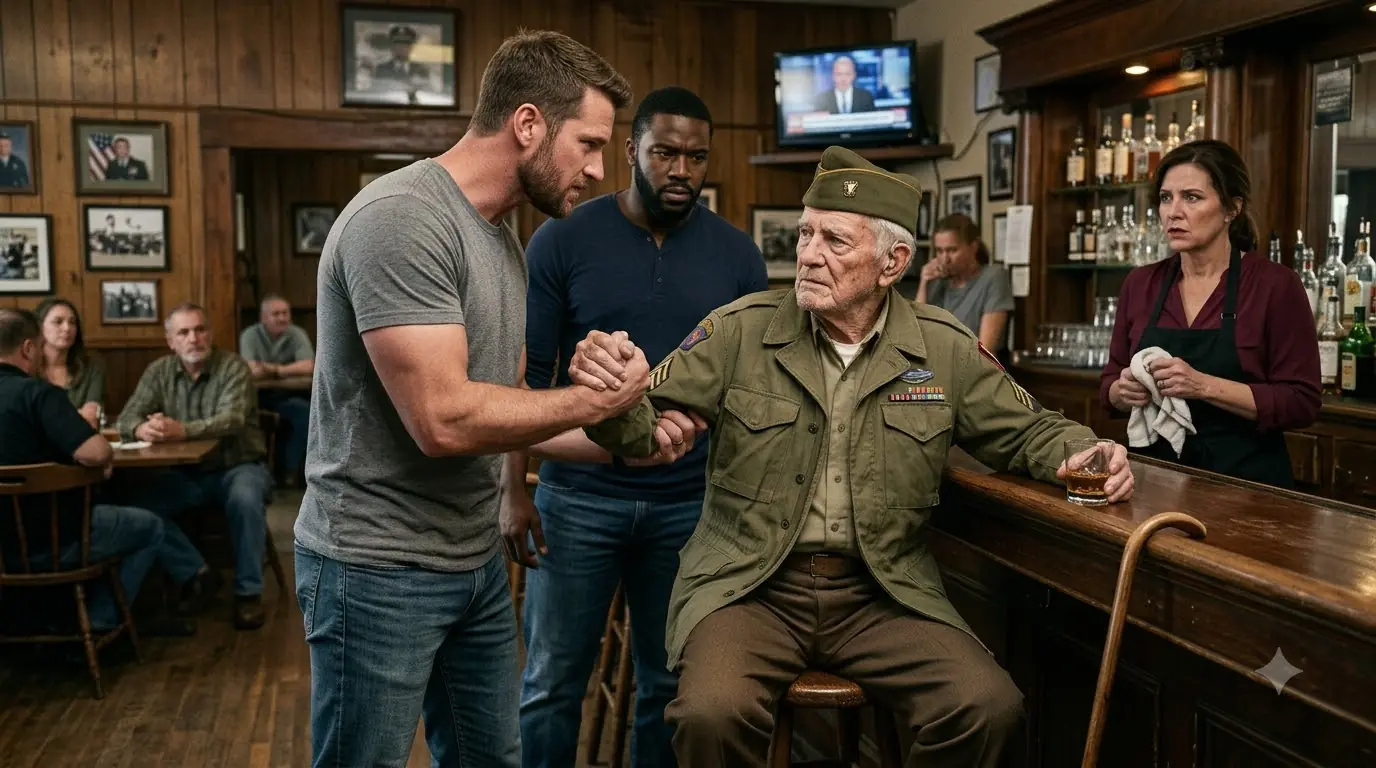
The voice was young and sharp, carrying the casual arrogance that often came from being exceptionally good at something exceptionally dangerous. It cut through the bar’s low murmur, the clinking of glasses, and the distant drone of a sports recap playing on the television in the corner.
Richard Cain did not turn his head. He kept his pale eyes fixed on the dark amber whiskey inside his glass while condensation traced a slow path down the tumbler. His hands, gnarled with age and speckled with liver spots, remained steady around it.
To the rest of the world, Richard appeared to be another old man slowly drinking at the end of a long day inside a quiet neighborhood bar on the outskirts of Fort Bragg. Nothing about him seemed important enough to attract attention.
The young man who spoke was lean and tightly built beneath a plain gray T-shirt. He interpreted Richard’s silence as permission to continue.
He and four friends had occupied a nearby booth, bringing an energy too large and restless for the sleepy establishment. All five were in their late twenties or early thirties, with closely cut hair, neatly trimmed beards, and watchful eyes marking them as something other than civilians.
They were off duty and dressed in jeans and casual shirts, but they carried an invisible uniform of discipline, danger, and confidence. They were Delta Force operators, although nothing on their clothing openly identified them as such.
“I am serious,” the young man said as he moved onto the stool beside Richard. His name was Marcus. “This is not exactly the VFW hall. You look a little lost, Pops.”
Richard finally turned his head. His pale blue eyes examined the younger man with a weariness extending deeper than age or bone. They were eyes that had seen too much sunlight and far too much darkness.
He offered a small, noncommittal shrug.
“I am only having a drink.”
Marcus’s friends laughed from their booth. Their unofficial leader was bored, slightly intoxicated, and had selected a target for his amusement.
Marcus’s attention moved toward the jacket draped across the back of Richard’s stool. It was an old field jacket of the kind commonly found inside military-surplus stores. Its fabric had faded, the seams were worn, and one sleeve carried a patch so frayed that its original design was nearly impossible to distinguish.
The patch appeared to contain a dark circular shape surrounding what might once have been a stylized skull or winged creature. Most of its threads barely remained attached to the fabric.
Marcus pointed toward it with a smirk.
“What is that supposed to be? Did you pick it up at a flea market to impress people?”
Richard’s expression did not change. He reached over and pulled the jacket closer, a simple gesture of quiet possession.
“It is only an old patch.”
That was the wrong answer for men like Marcus.
He and his teammates had sacrificed for the insignia they wore, including symbols that were never officially acknowledged. The possibility that someone might falsely claim such history was deeply offensive to them.
Even the suspicion of stolen valor, initially raised as a joke, acted like a spark dropped onto dry grass. The atmosphere changed from casual mockery into something considerably harder.
“An old patch?” Marcus repeated. The playful edge disappeared from his voice. “What unit?”
“It was a long time ago.”
Richard turned back toward his drink, hoping the conversation would die.
He had not entered the bar looking for recognition or confrontation. He never came there for either. Richard wanted only familiar silence, the scent of stale beer and old wood, and the comfort of being anonymous.
Marcus and his team did not understand anonymity in the same way. They were trained to locate weaknesses, test reactions, and continue applying pressure until something revealed itself. Richard’s unwillingness to answer looked suspicious to them.
One of the other operators left the booth and approached the bar. Derek was broad-shouldered and slightly taller than Marcus.
“He does not want to discuss it,” Derek said, although the grin on his face showed he was enjoying the exchange. “Maybe it is classified.”
“Is that it, old man?” Marcus leaned closer. “Were you a member of some highly classified secret club?”
He lowered his voice.
“Tell us a war story. We are all friends here.”
The bartender, Sarah Bennett, watched from farther down the counter. She had owned the establishment for twenty years and knew Richard as one of her most dependable regulars.
For nearly a decade, he entered three nights each week at almost the same time. He occupied the same stool, ordered the same whiskey, and never caused trouble.
Sarah knew Richard had served in the military, but he never discussed the details. She also recognized the tightly coiled energy surrounding the younger men. She had observed it many times in soldiers visiting from the nearby base.
It was a dangerous mixture of pride, trauma, skill, and restless power. Under the wrong circumstances, it could spill over quickly.
Marcus continued pressing.
He noticed the faded outline of a Combat Infantryman Badge above one pocket of Richard’s jacket. He also noticed the way Richard carried himself, a stillness different from the ordinary slowness of an elderly man.
There was economy in Richard’s movement, a deliberate conservation of energy. Part of Marcus may have been sincerely curious, but whiskey and ego strengthened his desire to expose what he believed was a fraud.
“Look,” Marcus said, his patience disappearing. He jabbed one finger toward the patch again. “I know men who died for the symbols they wore.”
Richard remained silent.
“Better men than you or me,” Marcus continued. “So when I see an old man sitting in a bar with a piece of military decoration he cannot identify, it makes me angry.”
Marcus leaned toward him.
“One final time. What unit?”
The remaining operators rose from the booth. They formed a loose and intimidating semicircle around Richard’s stool.
Other customers began noticing the confrontation. Conversations faltered while people shifted inside their seats and pretended not to watch. Every eye in the room was now directed toward the bar.
Richard looked from Marcus’s hardened expression to those of his teammates.
He saw confidence and judgment. Most of all, he saw their youth.
They were lions, strong and proud, while Richard appeared to be an old man standing in their path.
He released a long, slow breath.
“It does not matter anymore.”
Marcus scoffed.
“That is what they all say.”
He pointed toward the frayed patch.
“This thing is a joke.”
Marcus’s finger touched the worn fabric.
For Richard, the world distorted.
The smell of whiskey, wood, and sawdust vanished. In its place came the metallic scent of blood, smoke, and cordite.
The bar’s cooler transformed into the deafening rhythm of helicopter rotors beating against a dusty, ink-black sky.
Richard was no longer eighty-one years old inside a North Carolina bar.
He was twenty-five and packed into the rear of a military helicopter, the vibrating floor slick beneath his boots. Red cabin lights flickered across tired faces while the aircraft moved through darkness.
A young man beside him, his face streaked with grime and sweat, grinned through the chaos. He slapped the newly issued patch on Richard’s shoulder.
It was identical to the one now attached to the old jacket, but its colors were new and sharp beneath the red cabin light. The skull at its center appeared to stare back at him, a promise of what they were and what they were about to do.
The memory lasted less than a second.
It still left the taste of ash inside Richard’s mouth.
He blinked, and the bar returned.
Marcus remained beside him with one hand near the jacket and smug certainty across his face.
Sarah had seen enough.
She watched the operators close in and saw the profound exhaustion in Richard’s eyes. For all their power and experience, the younger men had no understanding of what they were touching.
They resembled children playing beside an unexploded mine.
Sarah gave them one last pleading look.
None of them noticed.
Their attention remained fixed entirely on Richard.
She set the towel down, tightened her jaw, and walked quietly toward the small office behind the bar. Sarah closed the door and moved toward an old wooden desk.
The patrons may have believed she was calling the police. Several appeared relieved when she disappeared into the office.
Sarah was not dialing 911.
Local officers might separate the men or ask them to leave, but she sensed that this problem belonged to a different world.
She opened a worn drawer and removed a small laminated card. A single telephone number had been written across it in black marker.
Years earlier, a retired two-star general who once drank at Sarah’s bar gave her the card.
“If Richard ever has trouble he cannot handle,” the general had told her, “and it is the kind of trouble a uniform understands, call this number.”
Sarah had asked what the number connected to.
“Do not ask questions,” he said. “Just call.”
She had never used it.
Until that night.
Her fingers trembled as she dialed.
The line rang twice before a clipped, professional voice answered.
“Operations Center.”
“Hello,” Sarah began, forcing her voice to remain steady. “My name is Sarah Bennett. I am calling about a man named Richard Cain.”
The person on the other end did not immediately react.
Sarah quickly explained the situation. She described the group of aggressive younger men who appeared to be soldiers, the way they surrounded Richard, and the growing danger inside the bar.
“I do not want trouble,” she concluded. “But they refuse to leave him alone. They believe he is pretending to be a veteran.”
“Richard Cain,” the duty officer repeated.
His tone remained professional but slightly bored, as though he expected the call to be another misunderstanding or hoax.
“Understood, ma’am. Confirm your location.”
Sarah provided the address.
A pause followed.
She heard the clicking of a keyboard.
Sarah waited inside the quiet office with her heart pounding. Through the wall, she could still hear the younger men’s muffled voices.
They continued pressing Richard.
The silence on the telephone stretched beyond ten seconds.
Then the duty officer returned.
Every trace of boredom had vanished.
His voice carried an immediate and unmistakable urgency.
“Ma’am, keep everyone there.”
Sarah gripped the phone.
“What?”
“Do not allow those men to leave. Assistance is already moving.”
His voice dropped into an intense whisper.
“Now.”
Inside the secure, windowless Joint Special Operations Command Operations Center, Staff Sergeant Rodriguez stared at his computer monitor while cold fear spread through him.
The name Richard Cain had triggered an access warning unlike anything he had previously encountered. The system bypassed multiple levels of ordinary security and revealed one heavily redacted file.
Most of the page consisted of black bars.
Only a handful of words remained visible.
Project Shadow Forge.
Operation Nightshade.
The Reaper of Kandahar.
At the top of the record, crimson letters displayed a direct warning.
INCIDENT OF CONTACT REQUIRES IMMEDIATE NOTIFICATION TO O-6 LEVEL OR HIGHER.
DO NOT ENGAGE.
DO NOT DETAIN.
EXTREME CAUTION ADVISED.
Rodriguez’s hand trembled as he reached for the direct line to his commanding officer’s residence.
It was nearly ten at night.
The hour no longer mattered.
The system was effectively screaming at him.
Richard Cain was a ghost, a name whispered during training but never explained in detail. According to the woman on the phone, several young operators from Rodriguez’s own command were currently harassing that ghost inside a bar only a few miles from the base.
Rodriguez swallowed.
The situation was bad.
Far worse than anyone inside that bar understood.
Marcus remained completely unaware of the response moving toward them.
He had crossed a boundary and felt the surge of authority that came with it. In his mind, Richard’s continued silence amounted to a confession.
The old fraud was trapped.
“All right, that is enough,” Marcus announced loudly enough for the entire bar to hear.
He seized Richard’s arm.
Richard did not resist, but something ancient and dangerous briefly appeared inside his tired eyes.
“You and I are going for a walk,” Marcus said. “We are going to have a conversation with the military police.”
He began pulling Richard from the stool.
“They can determine what kind of stories you have been telling.”
Marcus tightened his grip.
“Maybe spending a night inside a cell will improve your memory. Perhaps they can also arrange an evaluation, because you appear confused.”
It was the ultimate humiliation.
An elderly veteran with a damaged hip was being dragged from his neighborhood bar, publicly accused of lying and instability by a man young enough to be his grandson.
The customers gasped.
Sarah emerged from the office.
“Leave him alone!”
Marcus ignored her.
He pulled Richard upright with a triumphant expression. In his own mind, he was defending the honor of every soldier who had truly earned the right to wear military insignia.
At that exact moment, the front door flew open hard enough to send the small bell above it ringing wildly.
Cool night air entered the room.
Every voice disappeared.
There were no sirens or flashing emergency lights.
Three immaculate black SUVs had arrived at the curb with remarkable speed and almost no warning.
Six men emerged.
They did not wear military uniforms. Their dark civilian clothing was fitted and understated, but they moved with an authority more powerful than visible rank.
The men entered in a controlled formation. Their eyes scanned the room once, evaluating every person before settling on the confrontation at the bar.
Leading them was a tall man with short gray hair and a face seemingly carved from granite. His cold, clear eyes focused immediately on Marcus’s hand around Richard’s arm.
It was Colonel David Anderson.
He commanded the same elite unit to which Marcus and his teammates belonged.
His presence emptied the room of air.
Marcus and the other operators recognized him immediately.
Their bodies became rigid.
Color drained from their faces.
The triumphant expression on Marcus disappeared and was replaced by pure, physical dread.
He released Richard’s arm as though touching heated metal.
Colonel Anderson ignored his own men.
His full attention remained on the elderly man they had surrounded.
He moved forward, polished shoes making almost no sound against the wooden floor, and stopped three feet in front of Richard Cain.
The entire bar held its breath.
Then Colonel Anderson performed an act that made no sense to the civilians watching.
He snapped into the perfect position of attention.
His right hand rose in a salute so precise it seemed capable of cutting glass.
“Mr. Cain.”
The colonel’s low, clear voice resonated with absolute respect.
“Colonel David Anderson. It is an honor, sir.”
Richard slowly rose to his feet.
The movement was painful, and his damaged hip made him unsteady. He looked at the powerful officer saluting him inside an ordinary bar and responded with a slow, tired nod.
Anderson maintained the salute for another moment before lowering his hand.
Then he turned.
His icy gaze settled upon Marcus and the four operators, who now resembled frightened students caught destroying their commander’s office.
“What,” Colonel Anderson asked, his voice falling to a whisper more terrifying than any shout, “do you think you are doing?”
Marcus opened his mouth.
No words emerged.
His mind struggled to reconcile the scene before him. His commanding officer had just saluted a frail old man wearing a worn field jacket.
It seemed impossible.
“We thought, sir,” Derek stammered. “We thought he was pretending.”
“Stolen valor,” another man added weakly.
Colonel Anderson took one slow step toward them.
All five operators flinched.
“You thought.”
Contempt filled the colonel’s voice.
“You are paid to fight, obey lawful orders, and remain among the most disciplined soldiers on this planet.”
He moved closer.
“You are not paid to exercise drunken judgment inside a civilian establishment while harassing an elderly citizen.”
Anderson looked directly at Marcus.
“You are certainly not qualified to pass judgment on this man.”
The colonel turned slightly so everyone inside the bar could hear.
“You look at him and see a quiet old man.”
He gestured toward Richard.
“You see a frayed jacket and a faded patch.”
Anderson drew a breath.
“Let me tell you what I see.”
The operators stood motionless.
“I see the man who held the northern flank at the Battle of Takur for seventeen hours after the rest of his team had been wounded or killed.”
Richard looked down at his glass.
“I see the man who crossed into Cambodia in 1971 during an operation so classified that three administrations officially denied it happened.”
The room was utterly silent except for the low hum of the beer cooler.
“I see the man who helped design the close-quarters techniques that you were taught during selection and training.”
Anderson pointed at Marcus.
“Techniques that have likely saved your life more than once.”
Several patrons stared at Richard with their mouths slightly open.
Sarah stood behind the bar with one hand covering her mouth. Tears had begun gathering in her eyes.
“And this patch,” Colonel Anderson continued.
His voice softened with reverence as he looked at the worn insignia.
“You see a joke.”
He paused.
“I see the mark of MACV-SOG, a unit that officially did not exist, made up of men who accomplished impossible missions in places they were never supposed to enter.”
Anderson allowed the words to settle.
“Within that organization existed an even smaller team.”
The operators listened without moving.
“A hunter-killer element assigned to the most dangerous operations of the war.”
The colonel looked at Richard.
“They were called Shadow Forge.”
He paused.
“There were only four of them.”
Anderson’s eyes remained on the old man.
“Is that correct, Reaper One?”
The call sign hung inside the room.
Reaper One.
It meant little to the civilians.
To Marcus and his teammates, it was as though their commander had invoked the name of a mythical figure.
They had heard fragments during training, ghost stories shared quietly by instructors who never confirmed whether they were true. They had assumed the tales had grown through decades of repetition.
One of those supposed ghosts stood before them.
Shame spread through Marcus with overwhelming force.
His stomach turned.
He could not look at Colonel Anderson or Richard.
Marcus stared at his own boots and felt smaller than he had ever felt in his life.
Anderson turned his back on the operators.
The dismissal carried more weight than any immediate punishment.
He addressed Richard quietly.
“I apologize for the conduct of my men, sir. It is unacceptable.”
Richard finally spoke.
His voice remained steady and carried neither anger nor triumph.
“They are young, Colonel.”
Marcus raised his head slightly.
“They are full of fire. I remember being that way.”
Richard looked toward the five operators.
“That fire is part of what makes them effective.”
He paused.
“You only need to teach them where to direct it.”
Colonel Anderson placed a gentle hand on Richard’s shoulder.
“Allow us to take you home, sir.”
He turned toward one member of his security detail.
“Arrange payment of Mr. Cain’s tab for the next year.”
Then Anderson faced his operators.
His order was short.
“My office. 0500.”
Nobody answered.
“All five of you are on report.”
The consequences for Marcus and his teammates arrived quickly.
They were removed from operational status and assigned to one month of punishing remedial instruction focused on military history, discipline, and humility.
They spent long days inside archives reading histories that were normally inaccessible, including records of units such as MACV-SOG and the men who established the standards they now claimed to represent.
For the first time, they understood that they were only the newest chapter inside a very long book.
They had publicly insulted one of its authors.
Three weeks later, on a Tuesday evening, Marcus returned to Sarah’s bar alone.
His former swagger had disappeared.
In its place was a sober, thoughtful stillness.
Richard sat in his usual place.
Marcus approached slowly and stopped at a respectful distance.
“Good evening, sir.”
Richard turned his head.
His pale blue eyes examined the younger man.
He noticed the change.
The fire remained inside Marcus, but it was now controlled.
“What is your name, son?”
“Marcus, sir.”
Richard motioned toward Sarah.
“Get Marcus a drink.”
Sarah nodded and reached for a glass.
Richard looked back at him.
“Did you learn anything?”
Marcus stared at the surface of the bar before answering.
“I learned that the quietest person in a room is often the one most worth listening to.”
Richard waited.
“I also learned that some medals are carried inside a man’s memory, not displayed on his chest.”
A rare, small smile appeared on Richard’s face.
He raised his glass slightly.
“That is a good beginning.”
Marcus sat beside him.
Neither man needed to speak again immediately.
They remained together in comfortable silence, two soldiers from different eras connected by a lesson learned the difficult way.
Richard Cain returned to the bar three nights each week.
He occupied the same stool, ordered the same whiskey, and rarely spoke about the past. Most strangers continued seeing only an elderly man with a limp, a hearing aid, and an old jacket whose patch had nearly disappeared.
Those who knew the truth understood differently.
They understood that some legends never announce themselves.
Some ghosts prefer quiet corners, familiar drinks, and the freedom to be forgotten.
Their silence is not weakness.
Their humility is not insignificance.
Sometimes the greatest warrior inside a room is the person asking for nothing, explaining nothing, and wearing history so lightly that an arrogant man might mistake it for a lie.