Captain Naomi Bennett stopped at the Pine Ridge Fuel Center outside Savannah, Georgia, at 6:17 on a Friday evening because the fuel gauge on her black SUV had fallen below a quarter tank. She had spent the day attending a professional conference and still wore her clean camouflage uniform, patrol cap, and captain insignia, though she had loosened her posture slightly after hours of meetings. Naomi was thirty-four, strikingly beautiful, with deep brown skin, high cheekbones, dark intelligent eyes, and black hair secured neatly beneath her cap. She expected to buy fuel, grab a bottle of water, and be back on the highway within ten minutes.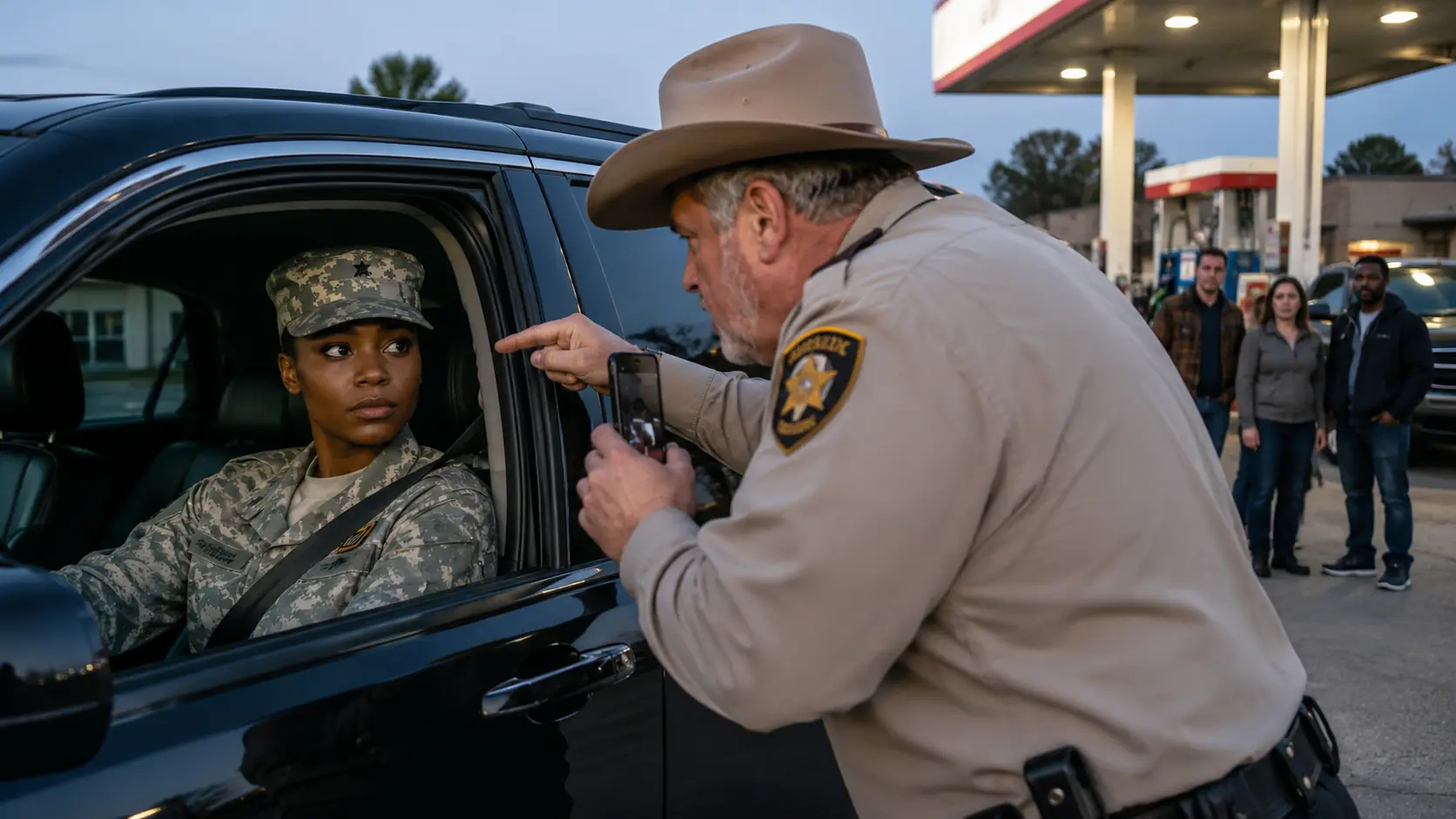
She had barely inserted her card into the pump when a tan sheriff’s cruiser rolled slowly past the station entrance. Deputy Travis Buckner looked toward Naomi once, continued another twenty yards, then abruptly reversed into the parking lot. He was forty-eight, heavyset, gray around the temples, and carried himself with the exaggerated authority of someone who expected strangers to become nervous when he approached. Naomi noticed him but assumed he was stopping for fuel until he parked behind her SUV at an angle that prevented her from leaving.
Buckner climbed out and walked directly toward the driver’s side. “You,” he called. “Hold up.” Naomi had already returned to the SUV to retrieve her wallet, so she turned and asked whether there was a problem. Instead of answering, Buckner stared at her uniform from boots to patrol cap.
“What unit are you supposed to be with?” he asked. Naomi’s expression changed slightly at the word supposed. “I’m Captain Naomi Bennett,” she replied, keeping her voice calm. “Is there a reason you’re questioning me?”
Buckner moved closer. “Identification.” Naomi asked what violation he suspected. He ignored the question and pointed toward the vehicle. “Get inside and put your hands where I can see them.”
Several customers near the pumps turned toward them. Naomi had spent enough years around authority to recognize the moment a routine conversation became something else, and she understood that escalating emotionally would give Buckner exactly the excuse he appeared to want. She returned to the driver’s seat, left the door partly open, and placed both hands visibly on the steering wheel. Buckner leaned through the window far enough that Naomi could smell coffee on his breath.
“Step out of the vehicle,” he said. “Because I don’t believe for one second you’re a real captain.” Naomi slowly turned toward him. “Careful, Deputy. Your mouth is about to become evidence.”
Buckner’s face reddened. He removed his phone, activated the camera, and held it directly toward her. “Keep talking, fake soldier. I’ll put you on the ground before anyone believes you.”
Naomi stared into the phone lens. “Do it,” she answered, opening the door and stepping onto the pavement. “Tomorrow you can repeat that sentence under oath.”
The words stopped him for half a second. Then he laughed. “You think wearing camouflage makes you somebody?” Naomi stood straight in front of him, shoulders squared but hands relaxed at her sides. “No. I think my identification will establish who I am.”
She reached slowly toward the breast pocket containing her credentials. Buckner immediately slapped his palm against the SUV door. “Hands where I can see them.”
“You asked for identification.”
“Not until I tell you.”
Naomi lowered her hand. “Then tell me exactly what you want me to do.” Buckner looked toward the people gathering near the convenience-store windows and seemed increasingly aware that an audience existed. Instead of becoming more careful, he became louder.
“I want you to stop pretending.” He pointed toward the insignia on Naomi’s uniform. “Anybody can buy that stuff online.”
Naomi’s eyes hardened. “You’re accusing me of impersonation?”
“I’m saying you don’t look right.”
“What does a captain look like?”
Buckner opened his mouth, then stopped. Naomi watched him realize too late that the question had forced him toward a statement he could not safely articulate. He changed direction and demanded registration for the SUV.
Naomi told him the registration was inside the glove compartment. Buckner ordered her back into the vehicle and stood inches from the open door while she retrieved it. She moved slowly, announcing each motion before making it, while his phone continued recording.
The registration matched her name. Buckner studied it as though hoping a different answer might appear if he stared long enough. Then he demanded her driver’s license.
Naomi provided it. Captain Naomi Elise Bennett. Georgia address. Valid license.
Buckner compared the photograph repeatedly. “This doesn’t prove the uniform.”
“No,” Naomi replied. “That wasn’t what you asked for.”
He looked at her sharply. “You’ve got a smart mouth.”
“I’m answering your questions.”
“You’re challenging me.”
“I’m documenting you.”
That landed differently.
Buckner lowered his phone slightly. “What does that mean?”
Naomi glanced toward his body camera. “Your body camera is recording. Your personal phone is recording. The gas station has cameras over every pump, and half the people behind you have their phones out.”
She met his eyes. “So keep talking.”
A younger deputy arrived approximately three minutes later. Deputy Miguel Alvarez stepped from his cruiser, evaluated the scene, and immediately seemed confused when he saw Naomi in uniform standing calmly beside the SUV. Buckner intercepted him before he could approach.
“She’s claiming she’s some captain,” Buckner said. “Something’s off.”
Alvarez looked toward Naomi. “Did you run her information?”
“Working on it.”
“What’s the suspected offense?”
Buckner’s expression tightened. “I said I’m working on it.”
Naomi heard every word.
Alvarez approached her carefully. “Ma’am, are you all right?”
“Yes.”
Buckner snapped, “Don’t start interviewing her separately.”
Alvarez looked back. “I’m asking if she’s okay.”
“I’m handling this.”
Naomi noticed the change in Alvarez’s posture. He had just realized this encounter did not have a clear legal foundation, but challenging a senior deputy in public carried consequences of its own. Naomi knew that hesitation well because she had seen junior personnel face the same dilemma inside other institutions.
Buckner radioed dispatch and requested verification of Naomi’s identity. The dispatcher returned her license information quickly, confirming there were no warrants or restrictions. Buckner then asked whether dispatch could verify military status.
There was a pause.
Dispatch said they could not access that information directly through the standard database. Buckner looked satisfied, as if inability to verify immediately proved his suspicion.
“See?” he said.
Naomi almost laughed. “No, Deputy. All you proved is that your dispatcher isn’t the Department of Defense.”
Several bystanders laughed quietly.
Buckner spun toward them. “Everybody back up.”
Nobody moved very far.
He turned again toward Naomi. “Take off the cap.”
“No.”
His eyes widened. “Excuse me?”
“You have no reason to order me to remove part of my uniform.”
Buckner stepped closer until barely a foot separated them. “I don’t need you telling me what I can order.”
Naomi’s voice remained steady. “Then state the lawful basis.”
His jaw tightened.
“Disorderly conduct.”
Naomi looked around the quiet parking lot. “By doing what?”
“Arguing with an officer.”
“That isn’t disorderly conduct.”
Buckner grabbed her wrist.
The entire parking lot reacted.
Alvarez stepped forward immediately. “Buckner.”
Naomi did not pull away.
Instead, she looked down at his hand and then back into his eyes. “Deputy, remove your hand.”
“You’re detained.”
“For what?”
“I just told you.”
“No. You named a crime. You didn’t describe conduct that meets it.”
Buckner twisted her arm behind her.
Naomi inhaled sharply but remained composed.
“Do not resist.”
“I’m not resisting.”
Alvarez moved closer. “She’s complying.”
Buckner glared at him. “Go handle the crowd.”
Alvarez did not move.
Buckner produced handcuffs.
Naomi looked toward his phone, still recording from the hood of the cruiser where he had placed it. “Make sure that keeps rolling.”
He snapped one cuff around her wrist.
“You think this is funny?”
“No.”
Naomi turned her head enough to look at him.
“I think you’re building my case for me.”
The second cuff closed.
Buckner searched her pockets and finally found the credential wallet he had initially refused to let her retrieve. He opened it.
His expression changed.
Alvarez saw it.
Buckner closed the wallet quickly.
“What does it say?” Alvarez asked.
“Nothing.”
Naomi smiled without humor.
“Read it out loud.”
Buckner stared at her.
“Read my credentials, Deputy.”
He refused.
Alvarez reached toward the wallet. Buckner pulled it back.
“I said I’m handling this.”
The younger deputy’s voice became firmer. “If you’re arresting her for impersonating an officer or military member, her credentials are evidence.”
Buckner looked at him.
Naomi remained silent.
Alvarez extended his hand.
After several seconds, Buckner gave him the wallet.
Alvarez opened it.
He read carefully.
Then he looked at Naomi.
“Captain Bennett.”
“Yes.”
Alvarez looked at Buckner.
“These appear legitimate.”
Buckner scoffed. “Appear.”
“There’s contact information.”
“Could be manufactured.”
Alvarez exhaled slowly. “Then call.”
That suggestion sounded obvious because it was.
Buckner did not want obvious anymore.
He wanted vindication.
Instead of calling the listed verification number, he ordered Naomi placed inside his cruiser. Alvarez asked again what charge justified arrest.
“Obstruction.”
“How?”
“She refused commands.”
“Which lawful command?”
Buckner stepped toward him.
“You taking her side?”
“I’m asking what goes in the report.”
That sentence finally stopped Buckner.
Reports had consequences.
Naomi watched both men in silence.
After nearly a minute, Buckner removed the cuffs.
“You’re free to go.”
Naomi rubbed one wrist.
“Am I?”
“Yes.”
“Am I being cited?”
“No.”
“Am I suspected of any crime?”
Buckner looked away.
“No.”
Naomi held out her hand.
“My credentials.”
Alvarez returned them.
She placed them carefully into her pocket.
Then she looked toward Buckner. “I want your name and badge number.”
He laughed. “It’s on the uniform.”
“Say it for the recording.”
“No.”
Naomi nodded toward his phone. “That’s fine. The camera already has it.”
She turned toward Alvarez.
“And yours?”
Alvarez gave both without hesitation.
Naomi thanked him.
Then she walked into the convenience store, purchased the water she had originally stopped for, returned to her SUV, and drove away.
Buckner believed that was the end.
It was not.
Naomi did not call a reporter. She did not post the encounter online or demand immediate public outrage. Instead, she returned home, changed clothes, photographed the marks left around her wrist, wrote a chronological account while every detail remained fresh, and sent formal preservation notices requesting body-camera footage, radio traffic, dispatch records, gas-station surveillance, and any recordings made on Buckner’s personal phone.
Her attorney filed the necessary requests the following morning.
The sheriff’s office initially described the event as a “brief investigatory detention involving identity verification.” Naomi read the statement twice.
Then she watched the gas-station video.
It showed Buckner approaching without first observing any crime.
It showed him saying she did not look like a real captain.
It showed Naomi complying.
It showed him threatening to put her on the ground.
It showed the handcuffs.
And most importantly, Alvarez’s body camera captured the moment Buckner opened Naomi’s credentials, recognized what they said, then told Alvarez they showed “nothing.”
Naomi’s attorney paused the footage there.
“That matters.”
“I know.”
“He understood you were legitimate before continuing.”
“Yes.”
That transformed the case.
The issue was no longer simply whether Buckner had made a mistaken assumption. The evidence suggested he had obtained information contradicting that assumption and continued anyway.
An internal investigation began.
Deputy Alvarez was interviewed first. He answered every question directly, including the one he feared most.
“Did you believe Captain Bennett had committed a crime?”
“No.”
“When did you realize that?”
“Before the handcuffs.”
“Why didn’t you stop Deputy Buckner?”
Alvarez stared at the table.
“He was senior.”
The investigator waited.
“That isn’t a policy justification.”
“I know.”
“Were you afraid of him?”
Alvarez hesitated.
“Yes.”
That answer opened another door.
Investigators began asking why.
Three deputies described Buckner as aggressive toward anyone who questioned his decisions. Two said complaints about him were routinely dismissed because supervisors considered him productive and experienced. A former deputy provided copies of emails showing he had previously raised concerns about unsupported pedestrian stops.
The original gas-station incident began revealing a pattern.
Records showed Buckner had generated unusually high numbers of “suspicious person” contacts, many ending without citation or arrest. Several involved Black motorists or travelers whose presence he described as “out of place.”
Naomi’s attorney requested those reports.
The wording repeated.
Did not appear to belong.
Behavior inconsistent with location.
Clothing raised suspicion.
Subject became argumentative when questioned.
Naomi recognized the structure immediately.
Ordinary questions became “argumentative.”
Requests for legal justification became “uncooperative.”
Confidence became suspicious.
And when no crime emerged, the original assumptions disappeared into paperwork nobody connected.
A federal civil-rights lawsuit followed.
Naomi did not sue because Buckner had insulted her rank. Insults alone were not the center of the case.
Her complaint focused on detention without adequate justification, physical seizure, retaliatory escalation, and the department’s alleged failure to supervise a deputy with previous complaints.
Buckner publicly denied wrongdoing.
Through his attorney, he argued that Naomi had been evasive and that the unusual circumstances justified verifying her identity. His attorney repeatedly emphasized that police sometimes encounter people falsely claiming government credentials.
Naomi agreed with that general principle.
The disagreement centered on what happened after verification.
Months later, the case reached a courtroom.
Buckner walked inside wearing a dark suit rather than his deputy uniform.
Naomi sat across the room wearing a charcoal business suit.
No military uniform.
No medals.
No visible rank.
She deliberately wanted the evidence to stand without symbols.
The defense attorney began by asking whether Naomi understood that law enforcement had responsibilities to investigate suspicious conduct.
“Yes.”
“Would you agree impersonating military personnel can be concerning?”
“Yes.”
“Would you agree a deputy should verify questionable credentials?”
“Yes.”
Buckner looked almost relieved.
Then Naomi’s attorney stood.
“Captain Bennett, when Deputy Buckner asked for identification, did you offer it?”
“Yes.”
“Did he initially allow you to retrieve it?”
“No.”
“Did you physically threaten him?”
“No.”
“Did you attempt to leave?”
“No.”
“Did you refuse to identify yourself?”
“No.”
“Did your vehicle registration match your identity?”
“Yes.”
“Did your driver’s license match?”
“Yes.”
“Did Deputy Buckner later recover your professional credentials?”
“Yes.”
“What happened after he saw them?”
“He told Deputy Alvarez they showed nothing.”
The body-camera footage played.
Buckner’s face appeared on the courtroom screen.
His own voice filled the room.
Keep talking, fake soldier. I’ll put you on the ground before anyone believes you.
Nobody moved.
Then Naomi’s voice.
Do it, and tomorrow you can repeat that sentence under oath.
Her attorney stopped the video.
He turned toward Buckner.
“Deputy, would you mind repeating it now?”
The defense attorney immediately objected.
The judge allowed questioning but instructed counsel to phrase it properly.
Buckner took the stand later that afternoon.
Under oath, he was asked why he believed Naomi’s uniform was false.
He gave several explanations.
Her vehicle was civilian.
She was alone.
Her demeanor seemed unusual.
She had challenged his questions.
Then Naomi’s attorney asked the question Buckner had avoided from the beginning.
“What exactly about Captain Bennett made you believe she did not look like a real Army captain?”
Buckner shifted.
“I can’t describe one thing.”
“Was it her uniform?”
“Partly.”
“Was anything objectively incorrect about it?”
“I didn’t know at the time.”
“Did you later learn it was correct?”
“Yes.”
“Her identification?”
“I verified it.”
“Was it valid?”
“Yes.”
“Her vehicle registration?”
“Yes.”
“Her driver’s license?”
“Yes.”
“Her professional credentials?”
“Yes.”
The attorney paused.
“Then after how many valid documents did suspicion become prejudice?”
The courtroom became completely silent.
The defense objected.
The judge sustained it.
But everyone had heard the question.
The case did not end with Buckner being theatrically dragged from the courtroom. Real accountability moved more slowly.
The parties ultimately reached a settlement requiring compensation to Naomi, policy revisions involving investigative detentions, expanded supervisor review, and mandatory preservation of personal recordings made by officers during official contacts.
The sheriff’s office reopened previous complaints involving Buckner.
Several disciplinary findings followed.
Buckner was eventually terminated after the department concluded that his reporting and conduct during Naomi’s stop violated multiple policies and that previous supervisory responses had been inadequate.
Two supervisors were disciplined.
Alvarez received counseling for failing to intervene sooner.
Naomi publicly supported keeping him employed.
“Deputy Alvarez hesitated,” she said during one interview. “That mattered.”
She paused.
“But he also preserved his recording, told the truth, and stopped protecting rank when asked under oath.”
That mattered too.
Months later, Alvarez encountered Naomi at a courthouse security entrance.
He approached carefully.
“I owe you an apology.”
Naomi looked at him.
“You already testified.”
“That isn’t the same.”
“No.”
Alvarez swallowed.
“I knew he was wrong before I said anything.”
Naomi nodded.
“Yes.”
He looked surprised by the lack of reassurance.
She continued.
“Next time, say it sooner.”
Alvarez nodded.
“I will.”
That was enough.
Naomi returned to her career without turning Buckner into the center of her life. She continued leading teams, mentoring younger officers, and teaching one principle she believed mattered in every institution where authority existed.
Confidence was not evidence.
Uniforms did not create truth.
Rank did not create truth either.
Evidence did.
The gas station eventually replaced its cameras with newer ones. The pump where Naomi had been detained remained exactly where it was, and travelers stopped there every day without knowing what happened beneath those lights.
But inside the sheriff’s training division, one anonymized scenario eventually appeared in new-deputy instruction.
An officer encounters someone whose appearance does not match his expectations.
Credentials are presented.
Documents are valid.
No crime is observed.
The question asks:
What happens next?
The correct answer is only two words.
The stop ends.
Naomi liked that.
No speech.
No heroic revelation.
No requirement that the person detained turn out to be important.
Because that had always been the real point.
Buckner believed the mistake was calling a Black woman a fake soldier when she happened to be a captain.
Naomi knew the deeper mistake came earlier.
He believed she needed to prove she deserved ordinary respect before he gave it.
Her rank eventually exposed him.
But her rank was never supposed to be what protected her.
The law was.